Thursday, December 16, 2010

Greek protests against new round of austerity measures turn violent


Yesterday's general strike meant that much of Greece came to a standstill as public transport, trains, airports closed as did teachers, health sector employees and many in the private sector. According to Greek General Trade Union Council, GSEE turnout was nearly 100% in many areas.

The government's latest round of austerity measures which will see wages and benefits slashed in the near future has outraged many and is especially resented as Greek prime minister Giorgos Papandreou in the run up to November's local elections gave his personal pledge on several occasions that no such measues would be taken. The feeling that the ruling PASOK party have reneged on campaign promises made in last year's national elections as well as the latest local council vote is now deeply rooted and is likely to grow as the economic measures demanded by Greece's creditors take effect in the coming months.

It is a measure of the pent up frustration and rage that ex - minister Kostis Hatzidakis was beaten and narrowly avoid worse as he walked through the centre of Athens during anti-government demonstrations yesterday. While many Greek have nothing but contempt for politicians such an attack was unprecedented and seems to be the work of older protesters rather than more militant anarchist groups that often are in the front line of violent confrontations.

While the TV news bulletins have attempted to play down the extent of the violence in Athens and other Greek cities the reality of the situation is that clashes between the police and protesters are growing steadily more violent and the period of relative calm that followed the tragic death of three bank employees burnt to death during demonstrations in May has come to an end.


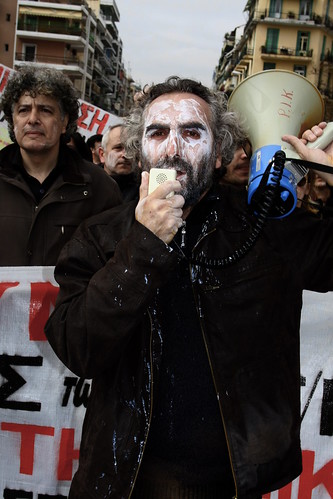
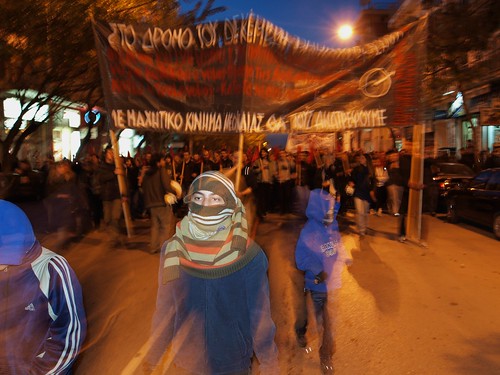
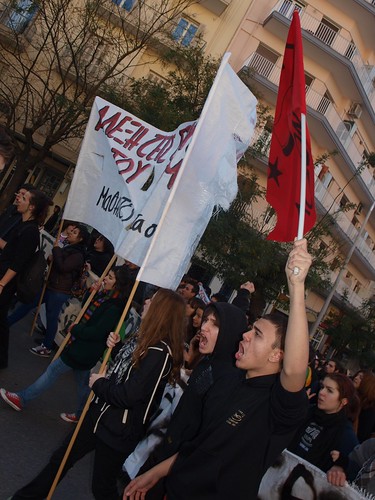
In Greece's second city, Thessaloniki about 15-20,000 marchers braved low temperatures to march in protest through the centre of the city, however, violence erupted when some groups tried to storm government buildings in Agiou Dimitriou St at which point police and marchers fought a series of running battles for over an hour with firebombs, rocks and tear gas being exchanged. The police once again used stun grenades designed for military and anti-terrorism operations to disperse crowds.

Stand off between protesters and police - Thessaloniki, Greece

Later a smaller group with approximately 500 people marched out to the general police headquarters to demand the release of 20 protesters who had been detained by riot police earlier in the morning. Among those releases were several who reported injuries including head wounds.

Wednesday, December 15, 2010

Greece goes on strike

Teachers' union members on strike in Greece

Yesterday the Greek parliament wAS in the process of debating a raft of new labour laws that would radically change the pay and conditions of  most employees and is likely to trigger a fall in wages that will further depress living standards of most Greeks, perhaps pushing them back to levels not seen since the 80's. I do not know the outcome of the vote nor do I particularly care as the result is a forgone conclusion and in the final analysis the decision is not in the hands of elected officials in Athens but rather those of  technocrats in the IMF, European Commission and the European Central Bank. What the ruling PASOK government cares to call the outcome of the vote is merely window dressing and should not be confused with anything resembling democratic process.

However, away from the parliamentary puppet theatre the country today is set to come to a standstill as trade unions in the public and private sector have declared a general strike for today. Trains, buses, planes are  not running and much of Greece's infrastructure has shut down for the durqtion. Across the country people are gathering to take part in protest marches and demonstrations as I write this, angry and disappointed by their rulers.

I will be on the streets trying to take photographs and video of today's events and will be providing updates whenever I have internet access and time. To follow the events on Twitter use the #imfgr hastag. Most of it will be in Greek, of course but Google Translate does a good job of rendering Greek into English and other languages. Alternatively, you could use the following Greek words in your search engines and then translate.

ΑΠΕΡΓΙΑ (STRIKE)

ΕΛΛΑΔΑ (GREECE)

ΑΘΗΝΑ (ATHENS)

ΠΟΡΕΙΑ (MARCH)

Tuesday, December 14, 2010

Jody McIntyre - Cartoon spoofs of media coverage in Daily Mail and BBC


A spoofed version of the cartoon that appeared in Richard Littlejohn's Daily Mail column where he ridiculed disabled activist and journalist Jody McIntyre over his attack by police in London.


In Ben Brown's interview with McIntyre the BBC presenter did his best to insinuate that McIntyre had provoked the police assault on him which saw him dragged not once but twice from his wheelchair during the UK student demonstrations last week.

BBC Vs Jody McIntyre

During the student demonstrations against the UK's tuition fees hike  in London last week news that a disabled participant had been dragged from his wheelchair by the London Metropolitan Police spread across Twitter like wild fire. However, I was initially sceptical that this had actually happened as in such cases rumours, both real and unsubstantiated can be retweeted by many who do not check upon their validity. Even the photograph that was cited as evidence of the attack was less than conclusive as it was open to a number of interpretations. However, in the age of cheap video technology and Youtube it was perhaps inevitable that footage of the incident would come to light.


As it turned the victim of the assault, Jody McIntyre, is an activist and journalist who has previously been interviewed by the Guardian and so there was a face and a history to go with the images of burly police officers wrestling McIntyre who has cerebal palsy to the ground during the protests. As disgraceful as their conduct was it did not the BBC's Ben Brown from accusing McIntyre of possibly provoking it by attacking the officer using his wheelchair? (no, I'm not making this up)

In what was an appalling piece of gutter journalism a disabled person who'd been assualted not once but twice by the police was called upon to defend himself from accusations by a presenter who has obviously confused his role as a journalist with that of London metropolitan Police's defence lawyer. It is a disgraceful piece of biased reporting that was handled skillfully by McIntyre who calmly and rationally argued the obvious that a person in a wheelchair who needs assistance to move around does not constitute a threat to hundreds of  police officers dressed in riot gear.

The BBC  interview is here.


Jody McIntyre's blog is here and you can follow him on Twitter here.

Sunday, December 12, 2010

Friday, December 10, 2010

"Charles, the peasants are revolting. Too right, darling. Have you seen the state of that one?"


Prince Charles and Camilla caught in a candid moment following attack on royal vehicle by students in central London.

Thursday, December 09, 2010

Reporting in Greece getting tougher than ever.

Welcome to the 75th International Trade Fair - Thessaloniki, Greece

As the economic crisis in Greece bites ever harder the number of groups wishing to protest against government policies has also grown and with it the number of situations in which the police have been used . With this has come a worrying trend of police attacks on photographers and others covering the demonstrations and marches. The latest incident happened on Monday when Demotix photographer, Maxime Gyselinck was attacked by riot police during demonstrations in Athens to commemorate the anniversary of the police killing of Greek teenager, Alexandros Grigoropoulos in 2008. Despite telling the officer that he was a photojournlist he had his arm broken in the assault. Fellow photographer Vangelis Patsialos was also assualted when he tried to help Gyselinck.

This is just the latest in a series of incidents of police violence against photographers and camera operators in Greece. Just three weeks ago Aris Messinis was punched repeatedly by a motorcycle officer who he had photographed during a march. (The reporter made a note of the number plate of the motorbike the officer was riding and it also features in a law suits for a violent police raid on a legal aid centre for immigrants in Athens according to independent news service TVXS). In October camermen and photographers were needlessly attacked and tear gassed during a police operation to clear protesting employees from the Acropolis (see video here).

And the list goes on, including many of the photoraphers who are part of the Demotix photography agency who have also been kicked, hit, and abused by police officers during the last year. In addition to running the risk of being hit by flying rocks, bottles or having your equipment smashed by irate rioters photojournalists in Greece also have to calculate the possibilities of being attacked by the police when covering any kind of violent confrontation.

Nor are many of these incidents simply over reaction by riot police units in the thick of the action but often happen after the violence has subsided and there are no possible excuses for mistaking a photographer for a rioting teenager.

I, too was also put in hospital with a dislocated shoulder in 2007 when riot police attacked me for taking pictures of them during a peaceful march and I have lost count of the number of times I have been threatened by individual officers when covering events here in Thessaloniki.

The root of the problem is that the police force (or ELAS as it is known in Greek) operates as if it were above the law and officers know that whatever legal action is taken by the victims of their violence colleagues and superiors will be more than willing to cover for them in the unlikely event of the case reaching court. As the documentary by Reportage Xoris Synora (Reporting Without Borders) on the killing of Grigoropoulos, shot by a police officer in 2008 shows they will even go as far as perjury and alteration of evidence in order to protect their own .

It's little wonder then that Greece dropped 35 places to 70th position (the lowest in the EU) in the Press Freedom Index in 2010. The organisation reported that the precipitous decline in press freedom in Greece was in large part to a series of attacks on reporter which went unpunished.

As times get harder and the government uses the police more and more to contain discontent and frustration felt by Greeks the chances are that such cases on abuse of authority will multiply so making the job of anyone wanting to cover anything other than press conferences and political party photo-ops even more difficult.

UPDATE

Yesterday (Sunday, December 12th) another reporter was attacked while covering a story in Kretea. A presenter for Alter TV news was beaten about the head by a member of the MAT (Greek riot police) while covering protests by inhabitants of the area over the construction of a new rubbish dump.

Wednesday, December 08, 2010

The new Mastercard Freedom Card - Inspired by the US State Department


"The website of MasterCard, the international credit card, has been hacked and partially paralysed by hackers, in apparent revenge for the payment network's decision to cease taking donations to WikiLeaks.

A group of online activists calling themselves Anonymous appear to have orchestrated a DDOS ("distributed denial of service") attack on the site, bringing its service at www.mastercard.com to a halt for many users."

http://www.guardian.co.uk/media/2010/dec/08/mastercard-hackers-wikileaks-revenge

Remembering December 2008


For most people the defining moments of their life usually come during youth when we still have the passion and energy to give a damn about the world around them rather than just sit on the sofa and curse at the TV screen.

For me, however that experience came to me in my forties, hardly an age given over to violent uncontrollable emotion, Yet something in me was woken by the news that police officers had gunned down a 15 year old for no apparent reason in central Athens. I cannot say what I expected when I joined a demonstration on the following morning, an uncharacteristically warm Sunday morning. perhaps a small march with a few hundred (if that) politically active students which would last about an hour before everyone went back home or grabbed a bit to eat.

Instead thousands of people of all ages appeared and then more and still more till the marcher numbered anywhere near 10,000. But as well as the larger than expected turn out I noticed other, more worrisome signs such as the guys rapidly stuffing the necks of beer bottles with cloth.

From the beginning there was a feeling of anger and rage from many in the march, an undefinable sense that some unwritten covenent had been broken and that it wasn't business as usual. That was confirmed when the march verred off its usual route and made its way to the central police station in Aristotelous Square. Moving a little ahead of the front of the crowd I witnessed the first wave of clashes between protesters and riot police, a scene that would be repeated endless times over the following month in Thessaloniki and every other Greek city.

The police responded with endless rounds of tear gas and baton charges yet, almost miraculously people scattered then reformed, determined not to be intimidated by them. The rage and anger towards the police then mutated as the protests went on day after day into a general sense of violent discontent with the authorities in general.

Witnessing these events reminded me of all the account I had read of the student revolts of the late Sixties including Paris in 1968. Yet these protesters were not just teens or college students but rather came from virtually every age group including pensioners who red with anger would hurl the most furious insults at police officers.

The other aspect of the events of December and January was the sense of unreality that came from listening to the mainstream Greek media's account of the events which ranged from clueless to perneciously misleading. At a loss to explain a revolt which owed nothing to traditional party politics they attempted to describe it either in terms of mindless hooliganism or shadowy conspiracy theories.

It was then that I realised the true power of internet tools such as Twitter, Facebook, Youtube and blogs as they quickly proved a far more reliable source of information than TV stations which lumbered through the crisis like a half-blind brontosauras.

Two years on the conditions which fuelled the massive protests of 2008 have worsened still further and the anger feel by many then has grown and intensified as people feel betrayed by their leaders. The ruling political caste seems even more cut off from its popular grassroots support than ever before and seem oblivious that they are standing in the middle of a pool of petrol flicking cigarette butts into the void.

North Korea sends messages of support and congratulations to UK for capturing political hooligan, Julian Assange


If the USA and UK are going to act like totalitarian regimes they could at least learn from governments that do not pretend to protect freedom of speech.

Monday, December 06, 2010

Greek high school student mark second anniversary of death of teen in 2008- Thessaloniki, Greece


Greek high school student mark second anniversary of death of teen in 2008- Thessaloniki, Greece, originally uploaded by Teacher Dude's BBQ.


Berween five and six thousand stuent took part in marches to commemorate the second anniversary of  of Greek teenager, Alexandros Grigoropoulos who was gunned down by a police officer in 2008. The death sparked off a wave of riots and violent demonstrations that lasted for over a month. While the event passed off peacefully in Thessaloniki there were serious clashes between protesters and riot police in central Athens and several other cities.

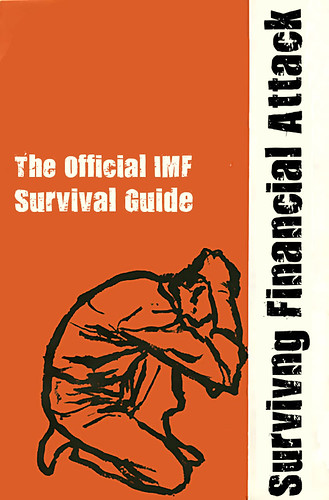
Surviving Financial Attack - The Official IMF User's Guide


Saturday, December 04, 2010

Bedtime For Bezos - Amazon drops Wikileaks from servers.

See that loveable chimp Bezos make a monkey out of freedom of speech in this hilarious new movie by Amazon.

You'll laugh, you'll cry, you'll damn those fuddy, duddy old Founding Fathers for making its so difficult to ban opinions you hate."

Friday, December 03, 2010

Amazon knows best - Let us decide what you need to read.


"By mid-morning, attempts to access the original Wikileaks.org Web site produced only a page saying: “The address is not valid.” The new domain name, Wikileaks.ch, appeared to be providing only sporadic access to the site.

The action by EveryDNS.net, which provides around 500,000 Web sites, followed a decision on Wednesday by Amazon.com Inc. to expel WikiLeaks, the whistle-blowing organization, from its servers, although it remains on the servers of a Swedish host, Bahnhof, as it continues to anger the United States by publicizing a huge array of some 250,000 leaked State Department documents relating to American foreign policy around the globe."


http://www.nytimes.com/2010/12/04/world/europe/04domain.html?_r=1&src=twrhp

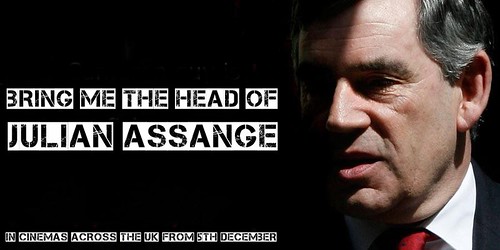
Bring Me The Head of Julian Assange - Gordon Brown's latest blockbuster


"The US embassy in London wrote off Gordon Brown within a year of his arrival in No 10 after concluding that an "abysmal track record" had left him lurching from "political disaster to disaster", according to cables released by WikiLeaks.

In a scathing assessment of the former prime minister, George Bush's last ambassador to London blamed Brown for presiding over a "post-Blair rudderlessness" which prompted senior Labour figures to complain of their despair to the embassy."


http://www.guardian.co.uk/politics/2010/dec/02/wikileaks-gordon-brown-abysmal-prime-minister

Thursday, December 02, 2010

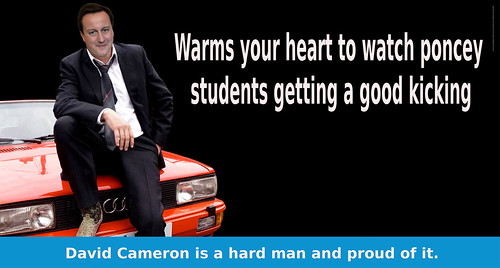
Messages of solidarity from North Korea to David Cameron on the surpression of student dissent

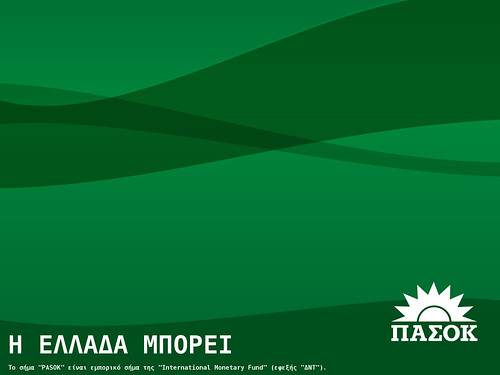
ΠΑΣΟΚ - ΔΝΤ: I love you.


ΠΑΣΟΚ ΔΝΤ, originally uploaded by Teacher Dude's BBQ.

Το σήμα "PASOK" είναι εμπορικό σήμα της "International Monetary Fund" (εφεξής "ΔΝΤ").Μην χρησιμοποιείτε κανένα εμπορικό σήμα του PASOK κατά κανέναν τρόπο που εκφράζει ή υπονοεί σχέση με την εταιρεία Panhellenic Socialist Movement Greece, χορηγία, υποστήριξη, πιστοποίηση ή έγκριση. Μην χρησιμοποιείτε κανένα Panhellenic Socialist Movement Greece εμπορικό σήμα του κατά τρόπον που υποδηλώνει ότι η εταιρεία συνδέεται νομικά με την εταιρεία σας. Πρέπει να προβάλλετε της εταιρική σας επωνυμία πιο έντονα από οποιοδήποτε εμπορικό σήμα του PASOK σε όλα τα υλικά.

Wednesday, December 01, 2010

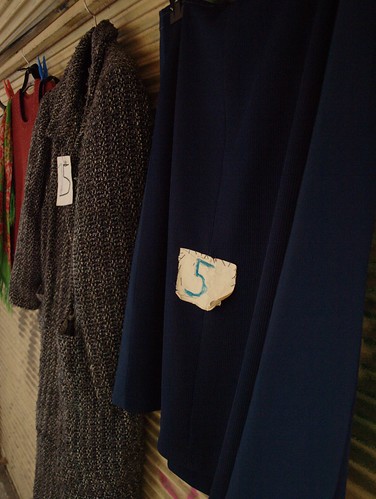
Has it come to this?


Has it come to this?, originally uploaded by Teacher Dude's BBQ.

In the early 90's the USSR collapsed and thousands of ethnic Greeks fled the warring the ex-Soviet Union republics to Greece to escape poverty, war and ethnic conflict. However, at least in the beginning most came with just what they could carry and the maximum $50 allowed in foreign exchange. In the years that followed these refugees were a common site in the street markets of Greece as they sold whatever possessions they had to earn money.

Now such sights are once again becoming more and more common on the streets of Athens, Thessaloniki and other Greek cities as people, especially retirees struggle to get by on tiny pensions. It breaks your heart to see people who have worked hard for decades, struggled to raise families and carve out a life wth dignity reduced to such extremes, forced to sell childens' discarded toys, worn out shoes and their winter clothes just to survive.

Greece and the Neo - Orwellians

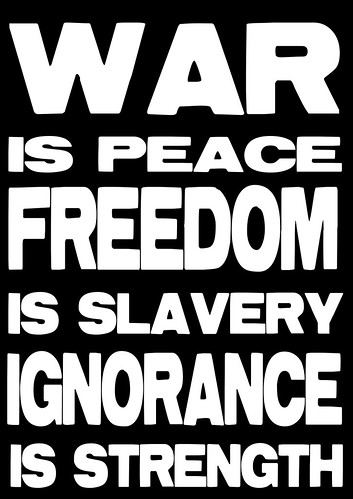
 War is peace - new strategic approach to Afghan conflict

"And if all others accepted the lie which the Party imposed—if all records told the same tale—then the lie passed into history and became truth."

Unlike the pontiffs of old Greek prime minister Giorgos Papandreou seems able to be an unlikely follower of the dogma of papal infallibility in which a move from one theological/ideological position to its exact opposite can be achieved without having erred in either case. On 23rd May Papandreou stated categorically to El Pais that Athens would not ask for its mountain of debt to be restructured, a position he repeated in a BBC interview in September and on 16th November to El Figaro, going so far as to say such a move would be a "disaster for Greeks".

Yet just last week the IMF/EU/ECB decided to extend the payment schedule for Greece's bailout out package from five to 11 years and this is now being hailed by the government and much of the media as a kiss of life for the country. It's interesting to see how the state run channels and pro-government TV stations such as MEGA, Skai and Antenna have promoted this latest change of heart without the slightest reference to previous government statements which held that such policies were not in the nation's interest.

In a repelling way it is fascinating to see how the ideas George Orwell espoused in 1984 are still revelent is a seemingly democratic regime with a free press. The truth, however, is the press in Greece is neither free nor independent but rather beholden to powerful political and economic interests which limit the parameters of what is acceptable in terms of political discussion. One only has to compare the rough ride given Ireland's ruling politicians following their bailout with the servile treatment of their Greek counterparts by local media. In many repects its hard to tell the difference between the official government line and that taken by the reporters who are covering domestic political matters.

The reality of the matter is that the press have sided with those in power in the hope of persuading ordinary Greeks that the massive social and economic dislocation they are suffering is inevitable and that any possible protests against PASOK's austerity measures are futile and anti-productive. This may, indeed by the case, but the stiffling of free and open debate about the options Greece has in the face of the current economic crisis is both dangerous and short sighted as it is steadily undermining respect for the government and democratic institutions in general.

Saturday, November 27, 2010

Wikileaks reveals secret talks between Washington and US embassy in Athens


This is just a piece of satire, not to be taken seriously. Basically, its a parody of ex Greek PM Kostas Karamanlis who was widely ridiculed for his immense appetite and laziness.

Thursday, November 25, 2010

Ντόρα η Μικρή Εξερευνήτρια!!!!!

The Machine is dead. Long live the Machine. Is it the end of business as usual in Greek politics?


For the best part of four decades the two major parties in Greece have relied upon their ability to provide jobs in the public sector as a means of winning public support and elections. For many “a place in the sun” as a civil service job is called in Greece has been a powerful motivator since such positions offer far more security, better pay and conditions than in the private sector where low wages and flagrant abuse of labour legislation are now the norm.

In the past when the economy was growing at rates that made Athens the toast of the European Union Greek governments were happy to ignore such abuses as employees could easily find work elsewhere and the State could easily fund the ever growing number of people on the public payroll. However, with access to cheap credit seemingly at an end and the IMF and EU breathing down its neck for cuts the country is about to undergo radical changes that will not only alter the nature of its economy but also the relationship between rulers and ruled.

Greece's creditors are insisting on a massive reduction in the size of the state and in particular has demanded that for every new hiring, five public sector workers leave. Given the size of the civil service in relation to the rest of the economy this involves a severe jolt to the labour market and is likely to lead to even higher unemployment as the private sector is also shrinking at an unprecedented rate and will not be able to absorb the tens of thousands of new job seekers. This, in turn will push down wages and purchasing power for those employed so further worsening the government's economic position as more businesses close and tax revenues plummet.

In the long term the inability of the ruling party to offer incentives to its supporters in the form of jobs will lead to a breakdown in the network of patron – client relations which is the lifeblood of the modern Greek political system. Whether nominally socialist or conservative the two largest parties, PASOK and New Democracy which have dominated parliament since 1974 have regularly used power to reward followers with state jobs.

While the leader of the right wing New Democracy, Kostas Karamanlis may have promised to reform the state and cut public spending his party followed the internal logic of the system and added employees to the public payroll on an unprecedented scale.

Similarly, while the socialist PASOK vowed to improve public services the reality was that while those working in the education and health rose steadily the quality of services offered dropped to the point that whilst the country had one of the worst school systems in Europe it employs four times the number of educators working in Finland, home to the world's highest ranking schools .

At first glance such moves may seem contradictory but they fit in perfectly with the logic of a political caste that despite marching under different ideological flags differ little in terms of day to day policy. The job of the ruler is to stay in power and once you understand that and leave aside political lablels everything else starts to make sense. If you cannot reward followers then the well oiled party machinery that can deliver votes quickly starts to break down.

The problem is that there are no longer jobs or contracts to hand out. The insistence of the IMF/EU/ECB troika has seen to that by standing tough despite Papandreou's claims that the new austerity measures will not lead to more civil service job losses. However, this hasn't stopped PASOK, state run TV channels and the government's supporters in the media in general from pushing the line that some will still be hired.

In the recent vote the PASOK candidate for the position of Mayor in Thessaloniki, Greece's second largest city committed himself to creating 50,000 new jobs. This at a time when Papandreou has been forced to cut 40,000 places. Even then the government NET news spoke of 8,000 new openings but failed to mention  that any “new” positions created will, in fact be filled by people transferring from other sectors of the civil service.

As the reality of the situation filters down you are likely to see a fragmentation of the party political scene as party members and functionaries jump ship either to join other parties or quit politics all together. The record low turn out in the latest local elections is just a symptom of this sea change in public life and is likely to intensify as the crisis worsens as Athens sits by on the sidelines unable to influence an economic policy decided upon in Brussels, Frankfurt and Washington.

Already Dora Bakoyianni, who was until last year a contender for the leadership of New Democracy has created a new party with the aim of challenging her former colleagues for the centre right vote. Such moves are likely to be replicated in PASOK if MPs and cabinet ministers fall out with the leadership or see that the party is doomed at the polls.

Does this means that the political scene is about to change for good? Probably not in the short term if the tactics and strategies displayed during November's local elections are anything to go by. Too many of the major parties' nomenclature are wedded to the present sysytem which has brought them power and personal wealth for decades to give it up without a fight. Instead they will keep on down the same road but with fewer and fewer resources to back up their promises. In the place of a corrupt, mismanaged political system which costs hundreds of billions you will have a corrupt, mismanged one that runs on far less money.

Wednesday, November 24, 2010

"Our job is to report the news, not fabricate it. That's the government's job."

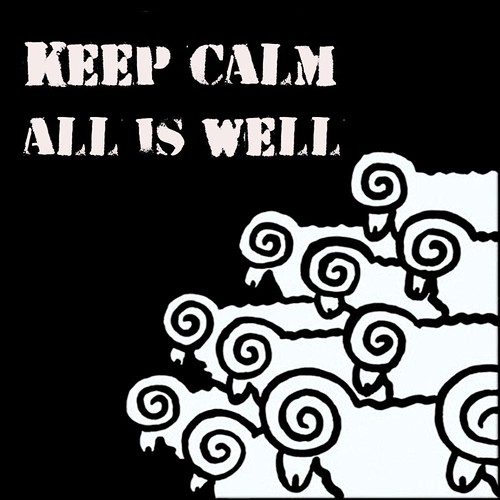
Keep calm, all is well

In my last post I talked about the role of the media and especially TV in presenting the consequences of the current economic crisis in Greece. I was particularly scathing of the role of the state run channels and the pro - government private stations in their efforts to distort the effects of the IMF/EU mandated austerity measures and present whatever PASOK party does in the best possible light.

Yesterday representatives of the IMF, EU commission and the European Central Bank held a press conference setting out the terms of the next installment of bailout money and outlining what the Greek government had and had not achieved in terms of reducing public spending and raising tax revenue. Considering the recommendations presented are set to change the whole of the Greek economy and involves massive upheavals, wage cuts and job losses  you would think that coverage of the event by the Greek press would be intense. Instead not one station broadcast the conference live and limited their reporting to short snippets which included luke warm praise by the troika of Greeec'e efforts so far. This was the line that was presented by most of the TV news bulletins along with prononouncements by experts that Greece had no choice but to accept such changes.

Instead there was extensive live reporting of a routine visit by a the head of the Cypriot republic which was attended by the prime minister, Giorgos Papandreou. Rather than reporting live a story which is set to effect the vast majority of the Greek population the media chose to focus attention on a mundane diplomatic story. As I said before the government and its supporters in the private sector are desperately trying to hide the fact that despite all the rhetoric about protecting jobs and living standards the ruling PASOK party have been forced time and time again to back down and accept everything the country's creditors have put forward.At the same time they have been required to engage in Orwellian feats of linguistic gymnastics in which cuts are called readjustmenst and savage criticsm termed positive feedback. In fact anything that covers the truth that the country is bankrupt and no longer responsible for virtually any aspect of economic policy.

 Indeed the IMF, EU and ECB by timing their report on Greece till after the country's recent elections (out of 27 EU countries, only Greece's report was delayed) you could argue that they have directly involved themselves in national politics. If the current measures which were inspired by the Eurostat's report on the economy had been announced on 27th October as happened with every other EU member) there is a good chance that Giorgos Papandeou's party would have suffered massive defeat and the country would be in the run up to national elections as has happened in Ireland.

Monday, November 22, 2010

Financial crisis and the media: The failure of the Fourth Estate in Greece


As seen on TV., originally uploaded by Teacher Dude's BBQ.

It hardly comes as a surprise that the Greek media is less than impartial and that each part has its own line when it comes to political and financial issues. In the UK the fact that the Telegraph is a strong supporter of the Conservatives or the The Guardian has a left wing bent comes as a surprise to no one. Indeed this is one of the reasons readers choose one rather than the other. Here in Greece the same holds for TV stations as well as newspapers, though sometimes in less obvious ways as the nightly news bulletins aspire to respectability through trying to appear objective in their presentation of the day's events.

However, this veneer of objectivity has started to wear even thinner as the effects of Greece's economic crisis grow ever more apparent and the authorities desperately try to balance the demands of the country's creditors for cuts and reforms with a population deeply unhappy with the current state of affairs. This is most easily seen in the state run channels such as NET, ET1 and ET3 which nightly have a running commentary which is virtually indistinguishable from the official party line and like South Korea's “sunshine policy” attempts to avoid confrontation with government officials and present their policies in the best possible light. In other words spinning the administration's spin still further till the resulting story resembles something drafted by a Soviet era Pravda editorial team.

Case in point has been the visit to Athens by the IMF, EU, ECB trioka in order to negotiate the terms of Greece's next installment of the country's bailout package. The fact that the payment had been delayed was initially attributed by both the ERT news agency and the government to technical difficulties, which clashed with stories running in both Associated Press and Deutsche Welle that reported that the delay had been caused by the Austrian finance minister, Josef Proell threat to withhold his country's contribution to the bailout fund if Greece did not fulfill its obligation to raise more tax revenues. Other Greek media outlets did mention the news once it came out in the international press but even today there is no mention of Austria's role in the current negotiations in the state run ERT online news service .

In addition the recent government split between prime minister Giorgos Papandreou and employment minister Louka Katseli over whether Greece should accept the Trioka's demands for more flexible employment legislation and the abolition of industry wide contracts has been either underplayed or ignored. The disagreement between the minister and creditor's has threatened to derail talks over the terms and conditions of the multi – billion loan, yet today ERT top domestic news story is that foreign minister, Dimitris Droutsas has warned Turkey that failure to remove troops from Northern Cyprus will affect it EU application bid.

Unable to hide the fact that negotiations with the EU and IMF are not going as planned the government and it supporters in the media are attempting to divert attention elsewhere, preferably towards an external “enemy” in order to look tough on national issues. The reality is that such smoke and mirrors cannot hide the fact the Papandreou will almost certainly be forced to backtrack on pre -election promises not to implement further austerity measures further undermining his standing within the ruling PASOK party and the electorate in general.

It's also measure of how much the troika – Katseli affair has spooked the government and their media allies that the pro – government Skai TV channel news commentators were frantically demanding the minister return to the back benches and not disrupt talks that threaten to shipwreck the country. Such partisan statements in news bulletins means that even the pretense of neutrality is being dumped in a last ditch attempt to persuade viewers that Athens is in charge of the situation and not attempting to play a terrible hand of poker with all its cards on show.

Far away from the glare of the TV studio lights the majority of Greeks have written off both the media and the government convinced that neither can be trusted and that vital decisions concerning the future are no longer in the hands of their elected officials. With businesses closing at an ever faster rate and yet more VAT and tax hikes the reality of the situation is that Greece's future is grim and this can no longer be hidden. Despite almost Orwellian attempts by the seven state run outlets to call wage cuts, “readjustments” and the crisis an “opportunity” people are no longer listening to this daily diet of spin, evasion and PR hot air.

There is, however, still much to be learned from ERT (Greece's answer to the BBC) presentation of the news if one looks deep enough. Like sovietologists of old poring over the latest copy of Pravda there is a lot to be gleaned in the choice and order of news items. The first few items often give an insight into what PR line is being promoted which in turn allows the careful observer to understand what the authorities are most worried about. Hence last weeks triumphant headlines that Greece had secured the third tranche of cash from the EU was an indicator that there were doubts that over if the money would indeed be paid.

Similarly today's revanchist statements by the foreign minister is a fairly strong indicator that Papandreou's government is in deep trouble and is looking to create a diversion. Not that we will find out this from NET, ET1 etc but most likely from a TV station or newspaper supported by the opposition or more plausibly foreign media such as the BBC or Reuters. 

To understand why the local media is so bad and getting to the truth you have to understand the close, almost incestuous relationship between journalists and politicians. For the media news IS party politics, sometimes to the exclusion of virtually everything else and that access to sources is worth all kinds of compromises. This is not just a Greek phenomenon but the fact the mainstream political parties are able to reward the "right kind" of coverage with lucrative positions as "consultants" or even candidates in local and national elections means that many reporters do not bite the hand that feeds them.

Nor is the situation in the private sector much better as TV stations and other news outlets are owned by very rich men who use them as a way of gaining leverage with the state by supporting or criticising politicians and parties in order to win lucrative state contracts or to derail legislation not in their interest. In such an environment the Fourth Estate is simply a tool to be used to sway public opinion and so apply pressure when needed. 

On rare occasions where journalists do show integrity the cost is their livelihood as documentary film maker Stelios Koulaglou found out to his cost when he aired a documentary on the state run NET channel on unemployment critical of the then ruling New Democracy government. The result was  his instant dismissal and the end of a well respected TV series Reportage Horis Synora (Reporting Without Borders), which had been running since 1996 and had four times been awarded Best news Programme of the Year.

Wednesday, November 17, 2010

Video from this morning's clashes between PASOK youth wing and other students on campus of Aristotelion University Thessaloniki, Greece


Student supporters of the ruling PASOK party clashed with other factions during a wreath laying ceremony this morining in the Aristotelion university of Thessaloniki. Wearing helmets and armed with clubs, rocks and batteries the PASOK students entered the university campus and fought with other students during a wreath laying ceremony to honour those who lost their lives in 1973 during the Rule of the Colonels.

Today is the 37th anniversary of the Athens Polyechnic uprising which was violently surpressed by the country's military rulers. The event eventaully led to the over throw of the Junta and restoration of democracy.

Greece, Ireland, Portugal, Spain, Italy, France, Uk. There goes the neighbourhood.

Tuesday, November 16, 2010

Greek authorities take no chances on the eve of Polytechniou Day


It seems that the Greek nation has finally accepted the inevitable and got on board with the austerity package demanded by the country's creditors. It must be true since the prime minister, Giorgos Papandreou said so during his speech after the results of Sundays local elections. So did IMF head Dominique Strauss Kahn in an interview on French radio when he said that the victory of the ruling PASOk party showed that Greek had understood the need for change.

What both leaders choose to ignore was the enormous drop in turnout by Greek voters, in some cases 50% less than in previous elections in 2006 and the growing dislocation between the country's ruled and rulers. While both major parties made some gains the overall trend is one of ever intensifying disenchantment with the current political system. Less an endorsment of the country's politicians than an understanding that the country no longer controls its destiny, no matter which party is nominally in charge.

Tomorrow marks the 37th anniversary of the Polytechnic uprising which set in motion a chain of events that led to the overthrow of the military dictatorship that had siezed power in 1967. Every year students and others march in Greece's major cities in commemoration of those who died to restore freedom and democracy. The day is often used as a platform by political groups to demonstrate against unpopular government policies. This year's anniversary is likely to repeat this tradition and the presence of 7000 additional police officers in the centre of the capital is testiment to how worried the government is about the marches turning into something more violent.

Already there have been clashes in Athens between youths and the police around the university of Athens campus the scene of many of the violent confrontations during the 2008 uprising which caused billions of euros worth of damage.

Polytechniou day as it is known in Greece will prove to be an acid test over whether young Greeks in particular have accepted the massive cuts in public spending and job losses proposed by the European Union, European Central Bank and IMF.

Given the anger and frustration felt by much of the population over the continued economic crisis there is a very real possibility that a miscalculation by the authorities could have drastic consequences.

Monday, November 15, 2010

Greeks cast a vote of no confidence in present political system

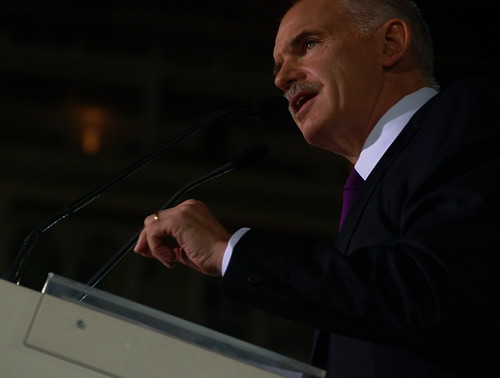
Γιώργος Παπανδρέου - Giorgos Papandreou

At first glance embattled Greek government must have much to celebrate concerning the results of yesterday's second round of local elections. Despite predictions of an electoral meltdown (by me as well as others) the ruling PASOK party mananged to elect mayors in both the Athens and Thessaloniki, the country's second largest city and in both cases decades of rule by conservative candidates has come to an end. Boosted by these victories prime minister, Giorgos Papandreou went on national TV to declare that the results were a vote of confidence in the government's handling of the current financial crisis.

However, Papandreou's address was not aimed at the Greek electorate who decided not to vote in unprecedented numbers but the world's international money markets and in particular the IMF/EU/ECB troika who arrived this morning in Athens to discuss the terms of the nexrt stage of Greece's bailout package and the revised Eurostat figures for government deficits in 2009. Instead of 13.6% the deficit has now been estimated at 15.4% and uch a large readjustment coupled with falling tax revenues means that there is little chance will reach the goals set for the reduction of state debt in 2011.

On the one hand Papandreou has staked what remains of his political capital on promises that there will be no new austerity measures for pensioners and wage earners, yet with the numbers coming up and the prospect of Ireland set to seek EU money the odds are that the the leaders are likely to be in no mood to let Greek leaders off the hook as far as commitments to reduced spending are concerned. If new measures are introduced they will fatally wound Papandreou's standing in PASOK and confirm in the eyes of many Greeks the fact that he has lied to them repeatedly over the causes and consequences of the financial debacle Athens finds itself in.

Behind the initial good news (for PASOK at least) lies another story which threatens to put an end to business as usual for Greek political system as yesterday's vote saw an unprecedented low turnout which when coupled with the number of spoilt votes means that those elected across the country garnered less than a quarter of the popular vote. Whilst such low turnouts are par for the course in many European countries they represent a new phenomenon in Greece where voting figures have been traditionally high. For many media commentators the causes of the lack of voter interest reflect the breakdown of the complex web of patron client relationships which the two main parties, the left of centre, PASOK and the centre right New Democracy have used to retain power both on the national and local level.

With the pork barrels empty mainstream politicians have little to tempt voters apart from extravagant promises which are now being viewed with contempt by the public, convinced that in the current economic crisis the parties can offer nothing in the way of jobs or career advancement for themselves and their families. The claim by PASOK backed candidate for the head of Thessaloniki county council Markos Bolaris that he would create 50,000 new jobs in the city was just one of a plethora of widely optimistic campaign pledges that left the electorate indifferent knowing that instead of creating new positions the state in all likelihood will be forced to fire even more public sector employees.

In some districts such as in the Greater Athens area turnout was a mere 30%, meaning that most voters did not care who won the elections or believed that the winner would make no difference. This means that not just Papandreou but also Antonis Samaras the leader of the main opposition party, are failing to convince the bulk of the Greek population that they can change the country for the better. In the light of such a damning indictment of the current political system talk of victory and popular support of either party is just PR hot air designed to placate the party faithful. The reality is that Greece's semi  - permanent political caste are being faced with an unprecedented vote of confidence which they are rapidly losing. In the absence of  convincing mainstream political answers the road opens for groups and parties offering more extreme solutions to the nation's seemingly intractable problems.

Saturday, November 13, 2010

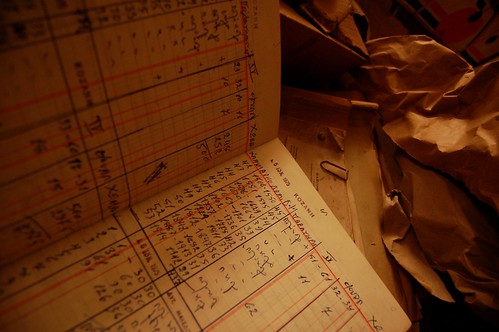
News from the front


Lost archives, originally uploaded by Teacher Dude's BBQ.
This week has proven to be an unending litany of disappointments and bad news as far as the Greek economy is concerned. Wherever you look in the media the news keeps on getting worse and worse. Unemployment figures for August show that the official rate has reached 12.2% and is set to rise still further as thousands of small business close down every month.

Also the long awaited government deficit figures proved to be just as bad as everyone predicted with the official figure set to go from 13 to 15.5% of GNP in 2009. Eurostat will make public the final figures on Monday, just one day after the polls close.

This came at the same time as newspapers reported that Athens attempts to raise tax revenues were in deep trouble, plagued with technical problems and organisational confusion. Instead of the predicted 700 million euro addition to state coffers, just 40 million has so far been found. With the economy shrinking at an unprecedented rate (down 4.5 % in the third quarter) businesses and professionals are refusing or resisting payment of what is widely considered to be an arbitary and unjust attempt by the government to grab whatever revenue it can.

Higher than expected debt levels combined with a falling tax revenues mean that finance minister Giorgos Papakonstantinos will have to cut spending even further if Greece is to meet the goals set down by the IMF, EU and European Central Bank. While prime minister, Giorgos Papandreou has repeatedly said that there will be no new austerity measures, few even in his own party are convinced that he will be able to convince Greece's lenders to renegotiate terms, no matter how unpopular the measures have become.

Beyond the numbers the reality of the situation is that ordinary Greeks are being hammered by the effects of the changes which have hit the vulnerable hardest and left the richest relatively untouched. People are being called upon to make impossible choices; Can we pay the electricity bill AND the motgage this month? What comes first; car insurance or new clothes for the kids?

Fear of what the future is almost palable with worry and anxiety drawn on people's faces as they queue in the supermarket or ride the bus. In cafes the talk is more often than not about money, or rather the lack of it. In Greece with its weak social safety net the family still serves as a buffer against the worst, yet even that institution is struggling to seal with the worst economic figures since the 50's. If the situation does not change in the near future even family may not be enough to get people through.

Perhaps the worst aspect of the pesent situation is the awful feeling that there seems to be no end to present financial woes. There is the fear that the future offers nothing and that all that lies ahead is more poverty and stagnation. This view is particularly stronge amongst the young who are suffereing the worst in terms of unemployment with 1 in 3 of 15-24 year olds unemployed and only a small minority employed in jobs that match their qualifications.

In 2008 the whole country went up in flames following the shooting of a 15 year old by police in central Athens, the violence and duration of the unrest were fuelled in large part by the anger and frustration felt by young Greeks over the nation's dire economic situation and disgust at a political system in which corruption, nepotism and patron client relations stiffle development and lavishly reward mediocrity and incompetence.

Since then the situation has grown so bad that 2008 can almost be considered part of a golden agewhen work, even though badly paid and unrewarding was at least available.

Thursday, November 11, 2010

"Only the dead have seen the end of war."


Today marks the 92nd anniversary of the end of the First World War. The picture shows the graves of Italian war dead who fought alongside , French, Serbian, Russian British and Commonwealth forces in Thessaloniki (Salonika), Greece.

Wednesday, November 10, 2010

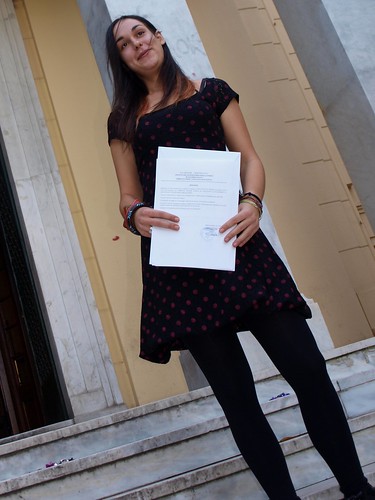
In Greece the future is history


I happened to be walking through the campus of the Aristotelion university of Thessaloniki when a group of well dressed students and parents emerged from a graduation ceremony. Happy faces, proud glances from mum and dad and little to suggest that this generation of Greek students has little to smile about.

In Greece one in three young people are unemployed, a figure which is preversely even higher for those with university qualifications.

Those who do find jobs are badly paid and have little or nothing in the way of career opportunities, especially here in Greece second city, Thessaloniki which has been hit much harder than the South.

After years of toil and sacrifice by students and parents alike the pay off is a degree which is likely to prove useless unless the young person decides to go abroad and try their luck in economies which know what to do with talented, hard working employees who want to get ahead in the world and don't just see them as a source of cheap labour to be hired and fired at will.

I have no idea who this student is but I wish her the best of luck in the future. She is going to need all she can get.

Elections in Thessaloniki, Greece


Election night - Thessaloniki, Greece

Greece gears up for local elections on Sunday

Monday, November 08, 2010

In Greek elections everyone's a winner


After weeks of campaigning, the first round of the Greek local elections is over and it seems the world's money markets are breathing a sigh of relief that the ruling PASOK government has decided not to hold early national elections. Normally, Wall Street, The City and the Frankfurt DAX pay little attention to the small time Hellenic politics but this time prime minister Giorgos Papandreou embarked on a game of high stakes poker and repeatedly declared that a crushing defeat for his party on Sunday would mean a new round of parliamentary elections, perhaps as soon as December. The election campaign quickly transformed from being a debate on mundane local issues such as how often garbage get collected and assumed the dimensions of a referendum on how the Greek government was dealing with its dire financial crisis.

The news, which was quickly labelled political blackmail by his political opponents sent the cost of Greek government borrowing on the world's financial markets through the roof with CDS's topping 900 points. A reaction that reinforced Papandreou's claim that if voters did not support PASOK candidates the alternative would be financial disaster and political chaos.

Whether the high stakes bluff really prevented an all out electoral rout for PASOK is debatable with polls showing that 2/3 of Greeks rejecting the PM's dilemma. However, the use of such dramatic tactics so early on in the current administration's term is indicative of the massive drop in support for the government and growing dissatifaction with the austerity measures which have hit middle and working classes especially hard. Evidence of the effects of the economic crisis can be seen everywhere from a thousands of closed businesses to the growing number of homeless begging in the streets.

Many families are struggling even to pay utility bills as witnessed by recent statistics published in the Greek press which show that 1 in 4 electricity bills have gone unpaid. In addition the country's largest telecom provider OTE reported that half a million bills are overdue.

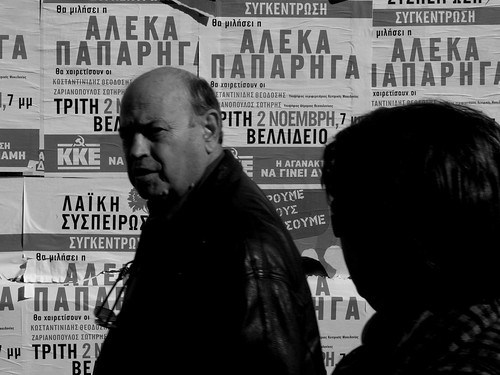
The announcement of yesterday's results was greeted by all parties as a victory with Giorgos Papandreou announcing that it showed that the country was behind his government's attempts to save Greece from bankruptcy and so ruling out new elections. Antonis Samaras, the leader of the largest opposition party New Democracy hailed the vote as an endorsement of his party's anti – Memorandum stance. Aleka Papariga, leader of the Greek Communist Party noted that her party was the only won to increase its share of the vote .

Although the Left benefitted somewhat from the anti – PASOK protest vote it failed to make enough headway to upset the political status quo, similarly, the far Right LAOS party who at one point seemed poised to supplant the more mainstream New Democracy in opposition paid the price for its support of the government's measures.

However, the fact that so many Greeks choose not to vote has worried many political commentators. That voter turn out was at a historical low reflected the disgust and antipathy many feels for the political choices on offer. Amongst ordinary people there is a growing sense of dissafection with the two major political parties and families who have dominated Greek politics since the restoration of democracy in 1974.

In the capital, Athens turn out was especially low with nearly 60% choosing not to vote, a figure that is nearer 70% if spoilt and unmarked ballots are included. After a succession of governments on the right and the left promising and failing to reform Greece's underperforming state, fight corruption and bring development only party die hards remain convinced that those in power can bring about the much needed changes required if the country is to survive in 21st century.

Feeling betrayed and angry with the “politics as usual” attaitude of the larger parties some voters, especially in Athens have turned to more extreme alternatives. The neo – nazi Golden dawn party received over 5% of the vote in the capital as a whole though in some districts the figure was over 20% guaranteeing them a seat on the Athens municipal council

Sunday, November 07, 2010

Election night in Thessaloniki, Greece


The boredom and the glory.

Thursday, November 04, 2010

Show them the money - Business as usual in run up to Greek local elections

With Greece set to go to the polls on Sunday the pressure on prime minister Giorgos Papandeou to avert electoral disaster for the ruling PASOK party grows ever stronger and so the sudden slew of government promises to the unemployed, mothers and pensioners over the last few weeks. Today brought the promise of 1000 euros for every unemployed Greek in the form of coupons which can spent on training and education. In addition the state run ERT news service reported that mothers  with childen under 18 who have the requisite number of national insurance stamps will be still able to retire early and comes hot on the tail of Athens promise to give retirees an extra 300 euros in December.

Of course, none of this is new and very much marks business as usual as far as election campaigning is concerned. Just as PASOK has promised to fund training through coupons Kostas Karamanlis's New Democracy administration also promised to give every school pupil entering junior high school 450 euros which could be used to buy a computer in the run up to 2009 general elections. However, such campaign pledges have been seen by much of the press and public as an attempt to buy votes by promising one -  off payments in return for support on Sunday.

The coupon scheme in particular smacks of last minute panic and provides a classic example of how the Greek economy got into its present mess. Public money is desperately flung around in order to bolster support for the party in power leading to huge costs and minimal benefit for the country as a whole.

The idea of giving those out of work the chance to upgrade their skills is based on sound logic, at least at first glance but is doomed to failure for a number of reasons which the government is probably well aware of.

1 - First and foremost where is the money going to come from? Even if the EU provides 50% of the funding, with the official unemployment rate at 12% and rising fast this means hundreds of millions will be need to be spent to train the unemployed. Currently, the country is having difficulty raising money to pay basics such as medical supplies to hospitals, back wages to government employees and even heating in schools.

2 - Who is going to provide such training and under what oversight? Much of Greece's private education and training  is subject to few checks and inspections (I worked 20 years in various language schools and never witnessed a single inspection). Given such lax rules the possibility of abuse and fraud is ever present. The reality is that many such institutions only survive through connections with corrupt local officials and politicians who mandate who gets sent where. In such an environment the chances of getting the high quality training most modern economies demand is limited.

3 Lack of training and education is not the cause of the present unemployment crisis.Indeed unemployment is highest amongst the young who have far more qualifications than previous generations. The problem is not lack of skills but lack of businesses that can utilise the massive pool of talent already available.Put bluntly, the economy can only absorb a fraction of the educated youth entering the job market every year.

4 The availability of coupons will push up prices for those who do not qualify and wish to do training courses. The example of the one lap top per student scheme introduced last year by the conservatives is a recent example of how the private sector raised prices of computers to make the most of the coupon scheme implemented. While it allowed students and parents to buy PCs it also pushed up prices meaning that everyone else wanting to buy such equipment paid more.

5 As with the measures promised mothers and pensioners it is a one off measure that does not deal with more fundamental issues such as what is going to happen to the present wave of people made redundant when their unemployment benefits run out in six months time.

The economy is in free fall and with two businesses closing for every one that opens the future for Greece's most vulnerable groups looks bleak with a bankrupt, mismanaged state leaving the poorest to fend for themselves. Likewise the electorate is rapidly losing faith in any political party to offer a way out of the impasse Greece finds itself in and promises of yet more money and funding is convincing ever fewer voters.
Monday, November 01, 2010

Come Spring


Come Spring, originally uploaded by Teacher Dude's BBQ.

Will Greece go to the polls in December? The elections no one wants to win.


Greek elections 2007, originally uploaded by Teacher Dude's BBQ.

In contrast to previous years the run up to the local elections in November is a lacklustre affair without the usual frenzy of electioneering that marks Greek politics. In the streets few people are particularly riveted by the choices on offer and despite a concerted effort by the media to inject drama into the event many have turned their back on politicians, and instead are concerned with more immediate worries such as paying the bills and making ends meet.

No one in the present political set up, either on the left or the right set up has been able to turn an intense feeling of voter dissatisfaction into concrete electoral support. Obviously, the great loser in all this is the centre left PASOK party led by prime minister Giorgos Papandreou whose popularity has nose dived in the wake of the austerity measures imposed at the behest of the EU, ECB, IMF troika. However, the main opposition party, the conservative New Democracy has been unable to made much headway in the polls tainted as they are by their role in the country's economic meltdown. Even their newly elected leader Antonis Samaras's populist rhetoric has failed to convince many other than the party faithful.

On the other hand smaller parties of the left and right of the two main parties are also struggling to generate voter interest. On the far right LAOS, led by Giorgos Karatzaferis has failed to poach votes from New Democracy in the numbers it was expecting, the result, in part of its parliamentary support of the PASOK in passing the legislation and measures demanded by Greece's lenders.
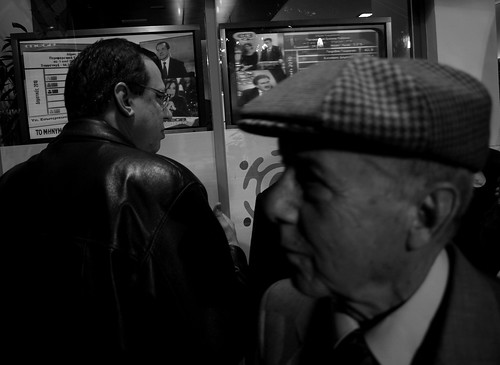
Nor is the picture much better on the left with people wary of the Greek Communist party's old school ideological stance and its unwavering allegiance to the state run socialist economic model favoured by the Soviet Union in its heyday. The other reformist left wing coalitions languish in the polls, internally divided and struggling to get their message across in the media.

Underlying the growing indifference of Greek voters to the choices on offer is the realisations that whoever is in power their ability to change the present economic climate is limited as virtually all major economic decisions taken have to be okayed in Brussels, Strasburg and Washington. In addition an even deeper feeling of distrust of those in power comes from the deeply rooted idea that the country's rules are above the law and so free to abuse their position. This is hardly a new innovation and one that is central to modern Greek mindset but what has changed is the fact that the political caste's greed and incompetence has brought the nation to the edge of the abyss and so is no longer considered the acceptable price of getting things done.

Such extreme notions are reinforced by parliament's handling of recent corruption and bribery scandals involving the cases such asVatopedi Monestary, Siemens and the 2004 Athens Olympic games. These are just a few of the dozens of scandals that have racked Athens over the last few years and yet despite endless investigations not one politician has been convicted of a single misdemeanor, let alone spent time in jail. Many ordinary Greeks have come to the conclusion that whoever is in power, nothing will change and that once in charge the first priority of politicians is to line their own and their family's pockets at the expense of everyone else.
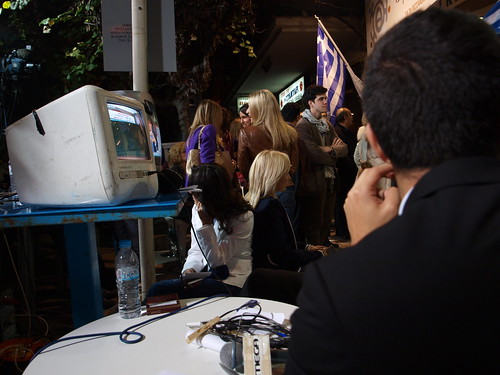
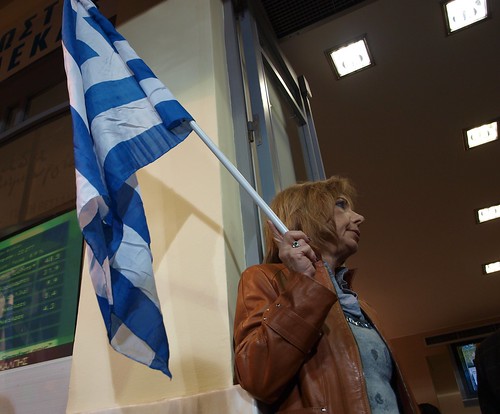
Given such cynicism and anger political analysts and leaders both left and right are worried about how this backlash will effect the vote in November and how the political landscape will be changed. Already the prime minister has warned that a major defeat for his party may result in the country going the polls again in a round new parliamentary elections. The national daily, Nea also published reports that Papandreou is considering a snap election as soon as December 12th in such an eventuality.

For Papandreou and many others the November elections are in reality a referendum on the bailout package and should his party lose badly that would require his government seek a new popular mandate. On the other hand political commentators have interpreted his words as political blackmail, a high stakes bluff aimed at getting reticent PASOK voters to the polls. If so, the costs of such a strategy are high indeed with the world's money markets jittery over the prospect of a change in government in Athens. Over the week Greek CDS's soaring once again above 800 points reflecting the financial world's unease at the prospect of a vote.

If Greece does go to the polls in December, both Papandreou and Samaras face the same dilemma that whoever wins is in no position to change the basic parameters of the current bailout deal and therefore will be associated in the popular imagination with job losses, painful spending cuts and a severe economic downturn.

The trick will be how to run a credible campaign yet not win, a feat the previous New Democracy leader, Kostas Karamanlis pulled off during his lukewarm campaign in 2009. Faced with immediate financial meltdown Karamanlis called early elections is September much to the annoyance of members of the party who wanted to wait till Spring 2010. However, they were unaware of just how dire the country's finances were and that by running early and losing New Democracy would still remain a coherent political force that could present itself as a credible alternative to PASOK once they had dealt with the financial mess at huge political cost.

Like the card game Black Maria in which the aim is to foist the Queen of Spades unto your opponent both main parties are supposedly gearing up to slug it out at the polls whilst secertly hoping that they will not have the misfortune to be in power.