Saturday, December 21, 2013


Friday, October 04, 2013
The Theory Of The Two Extremes - Greek government's attempt to rein in opposition

.jpg)
One of the side effects of austerity measures in Greece has been the spectacular rise of the neo-nazi party, Golden Dawn (Chrysi Aygi, In Greek) and in an attempt to combat its growing influence in the polls the Greek prime minister, Antonis Samaras has been promoting the Theory of the Two Extremes, the idea that the murderous violence on the far right is equivalent to protests on the left over economic reforms. Put crudely, as it often is in the country's highly partisan press, opposition, both on the left and right represent a threat to political and economic stability and so the current coalition government made up of former political foes, New Democracy and PASOK are able to present themselves a solid guarantee against chaos.
This week the prime minister took the opportunity to share the theory with a foreign audience whilst taking part in a Q & A session at the Peterson Institute for International Economics in Washington on Tuesday when he said that while Golden Dawn was at one extreme in Greek politics, those opposed to Athens's membership of NATO and the European Union occupied the other.
The indirect reference to Greece's Communist Party (known as KKE) and the staunchly anti-capitalist ANTARSYA party provoked an immediate and fierce response from commentators on the Left who accused Samaras of fanning the flames of political conflict in order to scare voters back to New Democracy which has seen its importance in Greek public life wane over the last four years as opposition parties have nibbled away at its disgruntled party base.
If this is, indeed the aim of the government then the move has yet to bear fruit according to the latest VPRC opinion polls which show that little of Golden Dawn's drop in popularity has been translated into support for New Democracy who remain in second place, a 1-2 percentage points behind SYRIZA.
Back at home Greek government spokesman, Simos Kedikoglou also tried tying the excesses of Golden Dawn to the the main opposition party, this time for domestics consumption claiming that the SYRIZA leader, Alexis Tsipras was the best advocate Golden Dawn and its leader could ask for after Tsipras questioned the legal basis of the rushed government crackdown on Golden Dawn's political leadership.
In other countries in Europe, those with a less troubled history claims that the government was fighting to save the nation from political extremism would gain little traction, but memories of Greece's brutal civil war in the 40's which pitted Left against Right for four bloody years and the Regime of the Colonels which brought a far right military dictatorship to power from 1967 till 1974 means that fears of extreme political conflict are a living part of the collective political narrative, not to mention the stuff of many a family history.
However, with Golden Dawn facing a raft of serious criminal charges, including several counts of murder and attempted murder the idea that this band of thuggish racists can be compared with Communist Party trade unionists protesting job losses or SYRIZA organised rallies over school closures has become even more absurd.
Sunday, September 15, 2013
Is a Golden Dawn role in government on the cards in Greece?

Last week the leading commentator at one of Greece's largest private TV stations raised the possibility of a political alliance between the ruling conservative New Democracy party and the Neonazis in Golden Dawn.
"Why shouldn't New Democracy co-operate with a serious Golden Dawn?" asked Babis Papadimitriou, the head of the staunchly pro-government Skai TV. The statement was prompted by the latest opinion polls that show the continued rise of Golden Dawn, now at 13-15% and the poor showing of the other partner in the Greek ruling coalition, PASOK, whose fall from electoral Grace has seen support plummet from 42% to 7- 8% within the space of four years.
Papadimitriou's remarks immediately provoked a storm of angry response from Greek Twittersphere and political commentators, many of whom believe that this is the first step in the process of "rehabilitating" Golden Dawn. Such was the reaction that Skai dedicated an entire hour the following day to giving Papadimitriou a chance to clarify his stance. His argument was that Golden Dawn, Greece's third most popular party now represent a large proportion of the electorate and that a similar alliance between centre right and far right parties had already taken place in Norway.
At first glance such an alliance would contradict prime minister, Antonis Samaras's policy of presenting himself and his party as a bulwark against the threat of rising extremism. The Policy of The Two Extremes as it has been termed involves the government and its supporters in the pro-government mass media painting both its opponents on the Left and Right as a dangerous challenge to political stability, harking back to the often chaotic politics that Greece lived through during the 20th century. With junior partner, the nominally left-wing PASOK party hemorrhaging votes, it's leader Evangelos venizelos has been more than willing to go along with this strategy in the hope of scaring back voters from SYRIZA.
The violence used and glorified by Golden Dawn is therefore equated with supposedly similar trends in SYRIZA and the Greek Communist Party (KKE). In such an equation, brutal attacks on immigrants, Nazi salutes and 1930's style Brown Shirt street fighting is considered the same as strike action or sit down protests. In such a world, New Democracy and PASOK can present themselves as a sane alternative to such political madness, a stabilising influence in difficult times.
The problem with this theory is that just does not reflect reality on the ground, no matter how much political and media spin is used. The rise in political influence and extremism on right has not be mirrored by 1930's style street tactics on the left. It is Golden Dawn MP's who have been charged (though not sent to convicted of) with a raft of offences ranging from assault to possession of illegal weapons. It is their supporters who have repeatedly been accused of endless list of attacks against immigrants and increasingly domestic political opponents.
As if to underline this just a day after Babis Papadimitriou talked of the possibility of bringing Golden Dawn in to government, 50 of their supporters took part in a bloody attack on Greek communists who has putting up posters in the city of Perama which left nine of them in hospital.
On other hand the differences between Golden Dawn and New Democracy are fewer than they'd either would like to admit publically. The lurch to the right that PM, Antonis Samaras brought to his party has seen the rise to power of far right supporters, many refugees from the ultra-nationalist LAOS party which was all but wiped out in the last elections. In terms of immigration, for example, New Democracy's policies are little more than a more polished version of unvarnished racism of Golden Dawn.
Despite the political risks that both parties face forming an alliance, New Democracy, at least may not have any other choice. The party cannot rule on its own, having seen its share of the vote drop from 40+ % to 26-29% and it's current coalition partner PASOK is fading away, suffering a wane in political fortunes on par with that which struck the UK Liberal party in the 1920's.
Although die-hard supporters still maintain that PASOK leader, Evangelos Venizelos has a master plan to turn the situation around, the reality is that its decline is irrevocable and that any recovery that may take place is years in the future and almost certainly without the presence of Venizelos who has become personally identified with the decline in Greece's fortunes. The fact that a recent poll found that in one of Greece's largest electoral districts in Athens support for PASOK among younger voters was 0% just underlines the the scale of the problem.
Some commentators have argued that the government's demonisation of Golden Dawn rules out a coalition however, in true Orwellian fashion New Democracy has changed policy stances on a number of occasions. Samaras positioned himself when in opposition as Greece's best hope to fight austerity and then once elected to promote himself as its most loyal defender. Yet one more u-turn in a long history of such moves would surprise few observers and given Samaras's own history as a semi-reconstructed ultra-nationalist an alliance with Golden Dawn would far more sense than one with his arch political rival, PASOK and its leadership.
What is in this for Golden Dawn is less clear since its entire existence is predicated upon its staunch opposition to the political establishment which it has painted as a hotbed of corruption and worse. They have made much of their anger with austerity, promoting themselves as agents of national resistance against a anti-Greek, internationally orientated elite who are betraying the homeland in order to hang onto power. To suddenly join up with New Democracy would risk them being consigned to the dustbin of history, suffering the same fate as far right LAOS party who made the same transition and paid the price for it at the polls.
On the other hand the siren call of access to the State and all the power and privileges that go with it has turned many a head in Greece's turbulent political past. With government position comes the ability to reward followers with public contracts and civil service jobs, a potent recruiting tool in difficult times. More importantly, a role in government brings legitimacy especially in the eyes of Greece's oligarch owned mainstream media who would quickly forget any qualms they once harboured about hosting violent Nazi style idealogues.
None of this is likely to happen soon unless the tensions that underlay the government coalition become untenable and since neither side is looking to go to the polls before it is absolutely necessary that seems unlikely. However, the fact that pro-New Democracy media is mooting the idea of a future alliance between Golden Dawn and New Democracy means that the prospect is being discussed and the waters tested.
Faced with the possibility of a future government lead by SYRIZA Greece's economic and political establishment would be more than willing to hold its nose and embrace a Neonazi party rather than see Greece clash with creditors over the terms of the bailout deal and the attendant risk of exit from the Eurozone.
.
*Note. This post was written just days before a man identified as a Golden Dawn member was accused of stabbing to death singer and left-wing activist Pavlos Fyssas.
Friday, May 17, 2013
Tuesday, May 08, 2012
Squaring the circle - Radical Left's Alexis Tsipras takes turn at forming new Greek government

Monday, May 07, 2012
End of an era in Greek politics

With the dust settling on yesterday's election results only one thing is certain in Greece; the previous political era is now officially over. Both the conservative New Democracy and left wing PASOK parties who've dominated the stage for more than a generation received a drubbing at the polls. Even though New Democracy emerged as the largest party, it garnered just 18.89% (at time of writing), just over half its 2009 election share. PASOK, lead by Evengelos Venizelos suffered an even more crushing reversal, and is left with just 41 seats, down 129 from 2009.
Other losers included the far right LAOS party and conservative Democratic Alliance who both failed to reach the 3% threshold for parliamentary representation. Also the plethora of splinter groups/parties set up by expelled PASOK and New Democracy MPs failed to make any headway, with the sole exception of the hard right Independent Greeks lead by Panos Kammenos which won 33 seats.
On the other the Radical Left Coalition (SYRIZA) came second in the polls, just a few percentage points behind New Democracy and gained 51 seats,and would be just 7 behind the conservative if it were not for the electoral rule that awards an extra 50 seats to the party with the most votes. The newly minted Democratic Left also entered parliament for the first time with 19 seats, having attracted much of its support from dissatisfied PASOK voters.
However, the official communist party KKE proved to have a disappointing night, increasing its share of the vote by less than 1%, a reflection that its old style campaign failed to reach out and convince few new voters.
The more worrying development was the rise of the neo-Nazi Golden Dawn party who are set to have 21 seats in parliament. The extremist group which has been linked numerous acts of violence against immigrants and political opponents are not simply a far right formation but rather a party that believes fervently in many of the core tenants of national socialism and Hitlerite ideology. Their ascent to power allows them a place in the political mainstream and assures them airtime on TV and radio from which they can promote a platform of racial hatred and political intolerance.
With the old political order in tatters and a parliament fractured so deeply along deeply held ideological lines forming a new government will be difficult. In the immediate aftermath of the vote many party leaders rushed to deny that they'd form alliances with others. For example KKE leader Aleka Papariga came out against an alliance with SYRIZA while Kammenos ruled out possible partnership with New Democracy. On the other hand ND leader Samaras and PASOK leader Venizelos are reaching out to other political forces in the hope of creating a viable block.
What is clear is that neither the left nor the right are in a position to form a majority government of their own, and that means either new elections immediately or a fractious coalition unlikely to survive the backlash generated by the latest round of job cuts and tax hikes which are likely to the poorest hardest. In that case new elections during the summer seems unavoidable.
The irony is that the unbending demands of the troika (IMF, EU and ECB) has created exactly the situation they were most anxious to avoid, one in which Greece is unable or unwilling to implement the austerity measures that are part of the next "bailout: plan.
Sunday, May 06, 2012
Peering into the future - Some predictions for the Greek election results
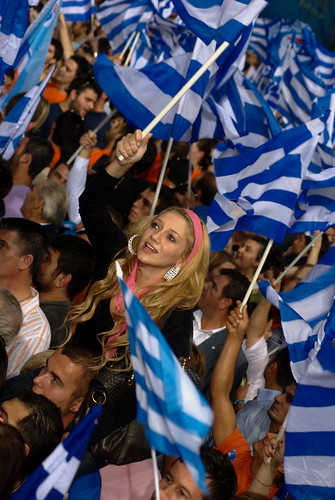
It's now just after 5pm here in Greece and within a couple of hours the voting will have finished and the first exit polls will be published. unlike many other elections the outcome of today's vote is far from clear. The largest party is most likely to be the conservative New Democracy with about 20-25%, followed by PASOK with 10-15% (the numbers are necessarily vague, a product of wildly differing opinion poll results). This is in sharp contrast to the 2009 national elections in which these two parties got the lion share of the vote with 78% combined, reflecting the stranglehold they have had over power since the late 70's.
However, beyond these two predictions not much else can be said for the possible make up of a future Greek government. The ECB, EU and IMF are all banking on these two parties being able to scrape together a majority in parliament in order to continue with the latest round of austerity measures scheduled for June and July. The leaders of PASOK and New Democracy, while swearing blind to the contrary are both hoping their electoral base will have held firm enough to give them a place in a coalition government and so avoid bloody internal conflict involving both backbenchers and rank and file party members. Both Venizelos and Samaras are by no means loved universally loved by their own supporters and a failure to get into power would open up still raw wounds .
On the other hand many other smaller parties are picking up support from disgruntled ND/PASOK voters and that is really the joker in the pack, threatening to overturn the political status quo that was created in the aftermath of the fall of brutal Regime of the Colonels in 1974. Some parties such as the rightist Independent Greeks are new creations whilst others such as the Neo-Nazi Golden Dawn have a longer, if more savage lineage, either way they are attracting votes at a rate that would have been inconceivable even a couple of years ago.
On the left of the spectrum the old school communist party KKE has gained ground as have other leftist parties such as The Radical Left (SYRIZA) and the newly minted Democratic Left with some estimates saying their combined share of the vote may pass 40%.The one thing that unites such disparate groups is their opposition to the austerity package imposed by Greece's creditors, however what else could possibly bring them together remains a mystery.
I'm going to put my money where my mouth is and say that I believe that the polls will produce a three party coalition government including PASOK, New Democracy and possibly Independent Greeks party. I base this prediction on nothing more scientific than a hunch and past experience of Greek politics (though give the sweeping changes going through the system that may not be the best guide). the thing to remember when analysing politics here is that ideological labels often count for little when power is concerned and so a coalition will be based on mutually aligned interests rather than political overlap.
If such an alliance does take power I believe that it is destined to fall apart as the political cost of yet more job cuts and tax hikes takes its toll. So quite possibly Greece will be going to the polls once more before September.
Monday, November 07, 2011
Greece's PM's horse trading reveals political system at odds with public opinion
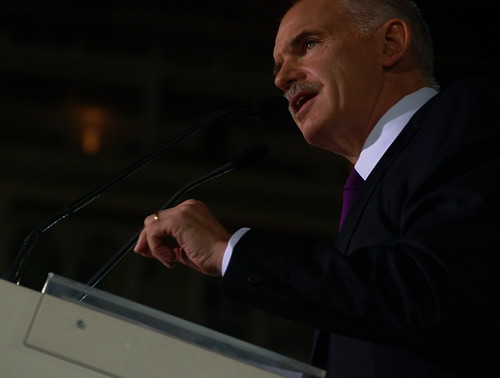
As we speak Greek prime minister and leader of nominally ( labels such as left and right have no firm meaning in a system that is predicted on gaining and keeping power) socialist PASOK party has agreed, at least in theory to come to an agreement with former room mate and leader of the nominally conservative New Democracy party.
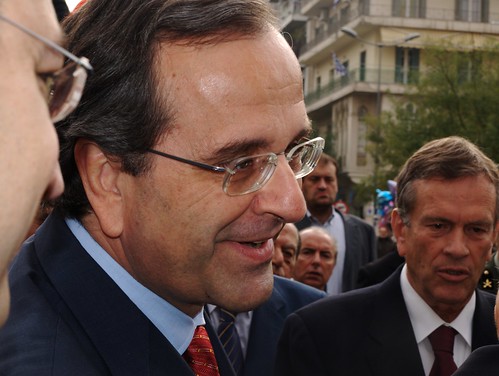
The dilemma Samaras faces is that any co-operation with a figure as despised as Papandreou is disasterous for both New democracy's delicate internal political balance and any future electoral campaigning as his leadership of his party is beset with problems since groups who align themselves with former prime minister Konstandinos Karamanlis are waiting in the wings to mount a leadership challenge.
Also with so little room to manoeuvre New Democracy's claim that they could deal better with the pressure emanating from Berlin and Paris over the nature of austerity measures would be put to the test and most probably be found to be little more than a PR ploy.
On the other hand Giorgos Karatzefris, leader of the far right LAOS party could conceivably be roped into a coalition government,as the party previously voted with PASOK to pass the first round of austerity measures. Although Karatzaferis faces fewer internal challenges (the party, like so many others in Greek political history, is, in essence a vehicle for his personal political ambitions) than Samaras, previous co-operation with PASOK has serious damaged LAOS's claims to be the only true patriotic defenders of the Greek fatherland and cost them poll support.
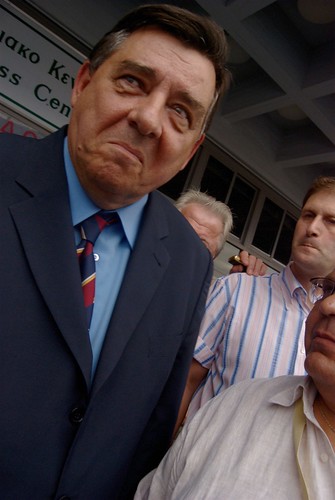
At the other end of the political spectrum Fotis Kouvelis, the leader of the tiny Democratic Left party has been mooted as possible new leader, presumably resurrecting the policy favoured by medieval French baron in elevating the weakest and least able amongst them to kingship. But once again, any party seen siding with the government is likely to severely punished in the next elections.
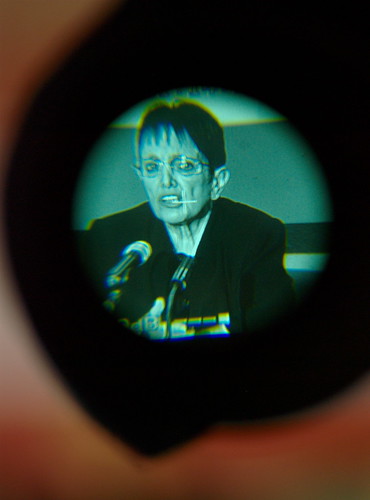
The Greek communist party ( KKE) and the reformist socialist SYRIZA coalition party have made it perfectly clear that will not even contemplate taking party in any unity government believing that such a government simply legitimises the deeply unpopular public spending cuts and tax hikes being imposed by Greece's creditors. Instead communist leader Aleka Papariga has called for open defiance to austerity measures and communist affiliated unions are in the forefront of industrial action designed to fight cuts.
Similiarly, Alexis Tsipras's SYRIZA coalition has also rejected any possibility of working with Papandreou's government, instead promoting a campaign of protest and civil disobedience against the austerity package.

What's left is a hodge podge of independent MPs many of them former PASOK members who've been drummed out of the party for failing to follow the party line so chance are they will be less than willing to trust their former colleagues.
However, what last weeks' dramatic developments have shown is that very little is certain in Greek politics and that MP's statement concerning who and what they support are little more than negotiating ploys and cannot be taken at face value. The endless round of horse trading and ever changing political gamesmanship has left many Greeks even more disgusted than ever with the seemingly amoral behaviour of their representatives who seem to consider party political careers a far more worthy use of their time than trying to repair their credibility with voters.
The reality remains that whatever government is formed they will be faced with the same unpalatable choices that forced the prime minister to offer his resignation and the same angry, resentful citizens who believe that they are paying for greed and incompetence of the country's political and economic elites.
Monday, November 08, 2010
Monday, November 01, 2010
Will Greece go to the polls in December? The elections no one wants to win.
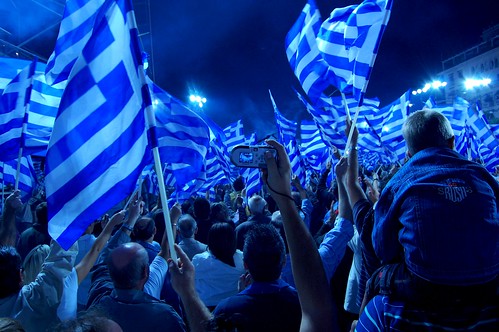
No one in the present political set up, either on the left or the right set up has been able to turn an intense feeling of voter dissatisfaction into concrete electoral support. Obviously, the great loser in all this is the centre left PASOK party led by prime minister Giorgos Papandreou whose popularity has nose dived in the wake of the austerity measures imposed at the behest of the EU, ECB, IMF troika. However, the main opposition party, the conservative New Democracy has been unable to made much headway in the polls tainted as they are by their role in the country's economic meltdown. Even their newly elected leader Antonis Samaras's populist rhetoric has failed to convince many other than the party faithful.
On the other hand smaller parties of the left and right of the two main parties are also struggling to generate voter interest. On the far right LAOS, led by Giorgos Karatzaferis has failed to poach votes from New Democracy in the numbers it was expecting, the result, in part of its parliamentary support of the PASOK in passing the legislation and measures demanded by Greece's lenders.
Nor is the picture much better on the left with people wary of the Greek Communist party's old school ideological stance and its unwavering allegiance to the state run socialist economic model favoured by the Soviet Union in its heyday. The other reformist left wing coalitions languish in the polls, internally divided and struggling to get their message across in the media.
Underlying the growing indifference of Greek voters to the choices on offer is the realisations that whoever is in power their ability to change the present economic climate is limited as virtually all major economic decisions taken have to be okayed in Brussels, Strasburg and Washington. In addition an even deeper feeling of distrust of those in power comes from the deeply rooted idea that the country's rules are above the law and so free to abuse their position. This is hardly a new innovation and one that is central to modern Greek mindset but what has changed is the fact that the political caste's greed and incompetence has brought the nation to the edge of the abyss and so is no longer considered the acceptable price of getting things done.
Such extreme notions are reinforced by parliament's handling of recent corruption and bribery scandals involving the cases such asVatopedi Monestary, Siemens and the 2004 Athens Olympic games. These are just a few of the dozens of scandals that have racked Athens over the last few years and yet despite endless investigations not one politician has been convicted of a single misdemeanor, let alone spent time in jail. Many ordinary Greeks have come to the conclusion that whoever is in power, nothing will change and that once in charge the first priority of politicians is to line their own and their family's pockets at the expense of everyone else.
Given such cynicism and anger political analysts and leaders both left and right are worried about how this backlash will effect the vote in November and how the political landscape will be changed. Already the prime minister has warned that a major defeat for his party may result in the country going the polls again in a round new parliamentary elections. The national daily, Nea also published reports that Papandreou is considering a snap election as soon as December 12th in such an eventuality.
For Papandreou and many others the November elections are in reality a referendum on the bailout package and should his party lose badly that would require his government seek a new popular mandate. On the other hand political commentators have interpreted his words as political blackmail, a high stakes bluff aimed at getting reticent PASOK voters to the polls. If so, the costs of such a strategy are high indeed with the world's money markets jittery over the prospect of a change in government in Athens. Over the week Greek CDS's soaring once again above 800 points reflecting the financial world's unease at the prospect of a vote.
If Greece does go to the polls in December, both Papandreou and Samaras face the same dilemma that whoever wins is in no position to change the basic parameters of the current bailout deal and therefore will be associated in the popular imagination with job losses, painful spending cuts and a severe economic downturn.
The trick will be how to run a credible campaign yet not win, a feat the previous New Democracy leader, Kostas Karamanlis pulled off during his lukewarm campaign in 2009. Faced with immediate financial meltdown Karamanlis called early elections is September much to the annoyance of members of the party who wanted to wait till Spring 2010. However, they were unaware of just how dire the country's finances were and that by running early and losing New Democracy would still remain a coherent political force that could present itself as a credible alternative to PASOK once they had dealt with the financial mess at huge political cost.
Like the card game Black Maria in which the aim is to foist the Queen of Spades unto your opponent both main parties are supposedly gearing up to slug it out at the polls whilst secertly hoping that they will not have the misfortune to be in power.
Tuesday, September 29, 2009
Greek communists (KKE) rally in Thessaloniki
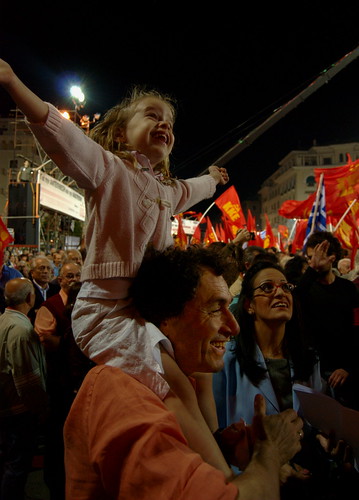
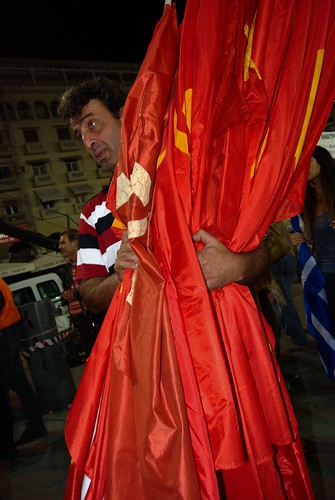
Leader of the Greek communist party (KKE) addressed the party faithful tonight in the centre of Thessaloniki ahead of next month's parliamentary elections.
Thursday, September 10, 2009
Greek communists kick off election campaign
After months of speculation the announcement of snap elections by the Greek prime minister, Kostas Karamanlis last week has seen a flurry of campaigning activity amongst the country's main political parties who are rushing to get their campaign for October 4th parliamentary elections underway.
Last night leader of the Greek communist party (KKE) Aleka Papariga addressed the party faithful at a rally in the northern port city of Thessaloniki. She said that the party, which currently has 22 MPs in the 300 seat Greek parliament offered a chance for voters to reject the failed policies of both the ruling conservative, New Democracy party and their socialist rivals, PASOK.
Monday, July 13, 2009
Greek police raze refugee camp to the ground.
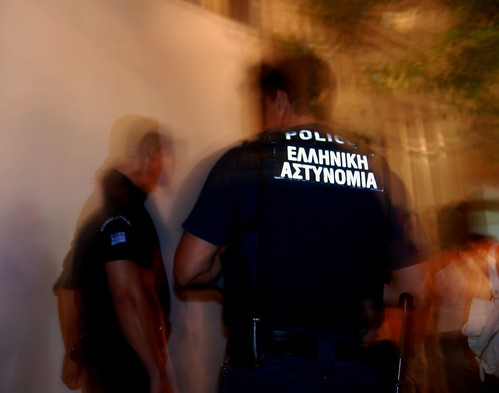
Early on Sunday morning hundreds of members of the Greek police force raided an unofficial refugee camp in the Greek port of Patras as part of an nationwide 'clean sweep" operation. The camp which has been in existence for nearly a decade was home to hundreds of immigrants, mainly from Afghanistan hoping to sneak aboard trucks headed for Italy.
Using bulldozers the local authorities razed to the ground the shacks and huts that until recently housed an estimated 150 people. Several fires were reported as a result of the raid and according to official police sources 44 minors were detained along with 30 adults who will be held in a reception centre until they are deported. The raid has been criticised as "inhuman" and called a "pogrom" by the left wing SYRIZA party and the Greek Communist party.
The ruling New Democracy party has also announced that it will set up internment camps throughout the country to house those who do not have a legal right to stay in the country. It should be noted that at present Greece grants asylum to 0.1% of those who apply for it and has been repeatedly criticised by Amnesty International, other European governments and the UNHCR for its treatment of refugees and immigrants.
On the other hand the latest poll carried out by Public Issue found that 93% of those questioned thought that Greece could not take in any more immigrants and that 62% said that immigration is probably harming Greece.
Stung by his party's poor showing in the recent European elections prime minister Kostas Karamanlis has decided to get tough on the issue of immigration in order to avoid losing more support to the far right LAOS party. With the possibility of general elections in either September or March 2010 at the latest Karamanlis is hoping that a tough stance on crime and immigrants will help bring back voters who have deserted the party in droves after two years of corruption and influence peddling scandals involving several government ministers


Tags: police | Greece | World | immigration | refugees | Patras | New Democracy | fortress europe | karamnalis
Thursday, June 11, 2009
Tuesday, June 02, 2009
ΚΚΕ Θεσσαλονικη - Greek Communist Party rally - Thessaloniki

ΚΚΕ Θεσσαλονικη - Greek Communist Party rally - Thessaloniki, originally uploaded by Teacher Dude's BBQ.
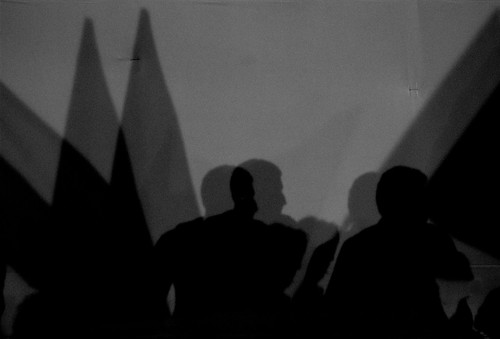
This picture was taken last night during a KKE( Communist Party of Greece) rally in the centre of Thessaloniki. It is party of the final days of the election campaign for the European elections which will take place on Sunday.
Tonight Giorgos Papandreou, leader of the main opposition party, PASOK will also be addressing the party faithful in Aristotelous square.
Tomorrow it is the turn of Kostas Karamanlis, prime minister and head of the conservative New Democracy party. That should be eventful as whenever he appears there are widespread protests. Whatever happens the security measure are sure to be tight so I'll have to have my wits about me.
Actually, all these party rallies are a pale shadow of the events that took place in the 90's and before. Then party leaders could expect to address crowds numbering hundreds of thousands. With the growing importance of TV and the withering of the major parties reliance of local branches ten thousand is considered a big turnout.
Still, none of this matters as the spectacle is designed to look good on TV. For that purpose a crowd of 10,000 is just as useful as 100,000.
Friday, April 10, 2009
Greek communist party (KKE) rally in Thessaloniki
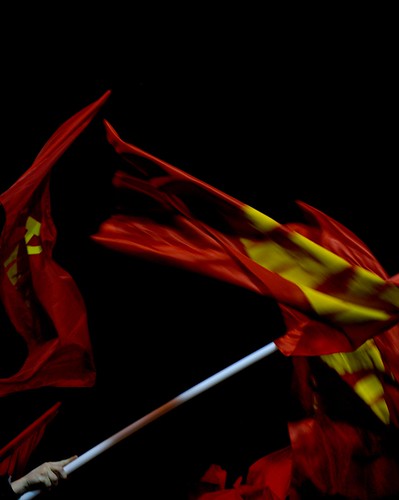
The leader of the Greek communist party (KKE), Aleka Papariga was in town today to rally the faithful. It seems more and more obvious that Greece is about to enter a pre - election period. The present conservative government's slim one seat majority in parliament was reduced still further when one of the ruling New Democracy's MPs, former Aegean Minister Aristotelis Pavlidis became the subject of a parliamentary enquiry over allegations that he demanded kickbacks for handing out subsidies to ferry companies operating to the Greek islands.
It seems more and more likely that as well as Euro - elections the country will go to the polls in the near future to elect a new government.
The news, which was quickly labelled political blackmail by his political opponents sent the cost of Greek government borrowing on the world's financial markets through the roof with CDS's topping 900 points. A reaction that reinforced Papandreou's claim that if voters did not support PASOK candidates the alternative would be financial disaster and political chaos.
Whether the high stakes bluff really prevented an all out electoral rout for PASOK is debatable with polls showing that 2/3 of Greeks rejecting the PM's dilemma. However, the use of such dramatic tactics so early on in the current administration's term is indicative of the massive drop in support for the government and growing dissatifaction with the austerity measures which have hit middle and working classes especially hard. Evidence of the effects of the economic crisis can be seen everywhere from a thousands of closed businesses to the growing number of homeless begging in the streets.
Many families are struggling even to pay utility bills as witnessed by recent statistics published in the Greek press which show that 1 in 4 electricity bills have gone unpaid. In addition the country's largest telecom provider OTE reported that half a million bills are overdue.
The announcement of yesterday's results was greeted by all parties as a victory with Giorgos Papandreou announcing that it showed that the country was behind his government's attempts to save Greece from bankruptcy and so ruling out new elections. Antonis Samaras, the leader of the largest opposition party New Democracy hailed the vote as an endorsement of his party's anti – Memorandum stance. Aleka Papariga, leader of the Greek Communist Party noted that her party was the only won to increase its share of the vote .
Although the Left benefitted somewhat from the anti – PASOK protest vote it failed to make enough headway to upset the political status quo, similarly, the far Right LAOS party who at one point seemed poised to supplant the more mainstream New Democracy in opposition paid the price for its support of the government's measures.
However, the fact that so many Greeks choose not to vote has worried many political commentators. That voter turn out was at a historical low reflected the disgust and antipathy many feels for the political choices on offer. Amongst ordinary people there is a growing sense of dissafection with the two major political parties and families who have dominated Greek politics since the restoration of democracy in 1974.
In the capital, Athens turn out was especially low with nearly 60% choosing not to vote, a figure that is nearer 70% if spoilt and unmarked ballots are included. After a succession of governments on the right and the left promising and failing to reform Greece's underperforming state, fight corruption and bring development only party die hards remain convinced that those in power can bring about the much needed changes required if the country is to survive in 21st century.
Feeling betrayed and angry with the “politics as usual” attaitude of the larger parties some voters, especially in Athens have turned to more extreme alternatives. The neo – nazi Golden dawn party received over 5% of the vote in the capital as a whole though in some districts the figure was over 20% guaranteeing them a seat on the Athens municipal council