Showing posts with label kostas karamanlis. Show all posts

Friday, April 27, 2012

Greece's main parties continue their stealth election campaign

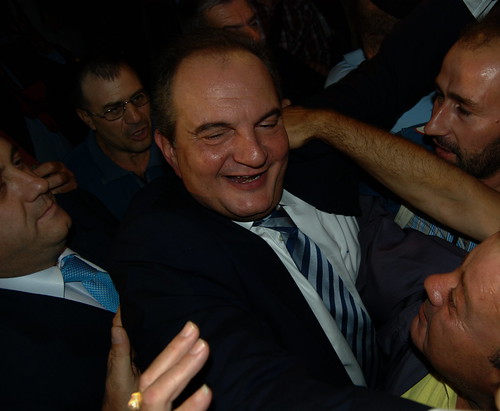
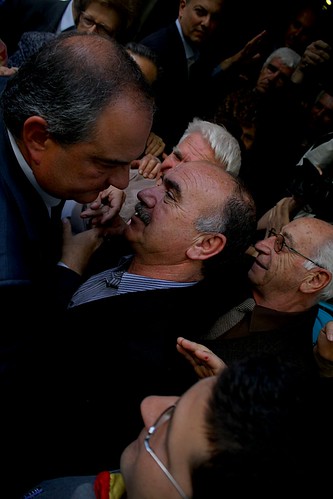
In years gone by the visit by a party heavy weight such as ex-prime minister, Kostas Karamanlis would have involved New Democracy pulling out all the stops. It would have meant saturation media coverage, large public rallies and the kind of reception usually reserved for old school rock stars.Instead Karamanlis was met by just 100-150 of the party faithful outside a non-descript apartment block in the centre of Greece's second largest city, Thessaloniki.

Neither PASOK nor New Democracy candidates can appear at outdoor venues for fear of the whole event turning into a PR debacle as angry voters jeer and pelt them with yoghurt on live TV. It's a measure of how different the political landscape has become that even those figures who were revered and worshipped just a few years ago count for nothing in the run up to the 6th May general election. Five years of recession, a failing economy and plummeting employment prospects have weakened the appeal of both PASOK and New Democracy for voters.

On Sunday, the head of the rival PASOK party, Evenagelos Venizelos will come to Thessaloniki, however, instead of choosing the central Aristotelis Square for his speech he has decided to speak at the harbour, a more defensible position and then only to carefully selected party cadres.

Wednesday, January 19, 2011

Unveiling of a controversial new statue in Thessaloniki, Greece


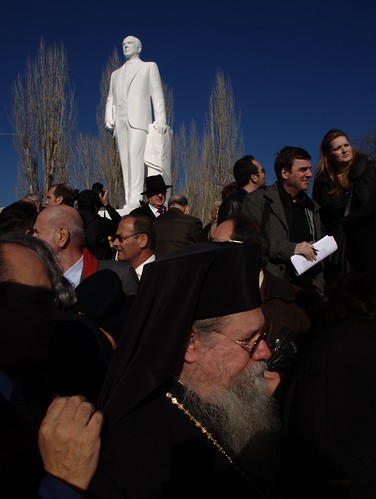
On Monday the mayor of Thessaloniki, along with the leadership of the conservative New Democracy opposition party unveiled a statue of the former prime minister, Kostas Karamanlis (uncle of the previous PM, Kostas Karamanlis) on the seafront.

The statue has been a source of controversy for a number of reasons not leαst being the price tag of 250,000 euros at a time when the local council is 126 million euros in debt and does not have enough money for basics such as fuel and spare parts for the rubbish collection vehicles.

Saturday, November 27, 2010

Wikileaks reveals secret talks between Washington and US embassy in Athens


This is just a piece of satire, not to be taken seriously. Basically, its a parody of ex Greek PM Kostas Karamanlis who was widely ridiculed for his immense appetite and laziness.

Thursday, November 25, 2010

The Machine is dead. Long live the Machine. Is it the end of business as usual in Greek politics?


For the best part of four decades the two major parties in Greece have relied upon their ability to provide jobs in the public sector as a means of winning public support and elections. For many “a place in the sun” as a civil service job is called in Greece has been a powerful motivator since such positions offer far more security, better pay and conditions than in the private sector where low wages and flagrant abuse of labour legislation are now the norm.

In the past when the economy was growing at rates that made Athens the toast of the European Union Greek governments were happy to ignore such abuses as employees could easily find work elsewhere and the State could easily fund the ever growing number of people on the public payroll. However, with access to cheap credit seemingly at an end and the IMF and EU breathing down its neck for cuts the country is about to undergo radical changes that will not only alter the nature of its economy but also the relationship between rulers and ruled.

Greece's creditors are insisting on a massive reduction in the size of the state and in particular has demanded that for every new hiring, five public sector workers leave. Given the size of the civil service in relation to the rest of the economy this involves a severe jolt to the labour market and is likely to lead to even higher unemployment as the private sector is also shrinking at an unprecedented rate and will not be able to absorb the tens of thousands of new job seekers. This, in turn will push down wages and purchasing power for those employed so further worsening the government's economic position as more businesses close and tax revenues plummet.

In the long term the inability of the ruling party to offer incentives to its supporters in the form of jobs will lead to a breakdown in the network of patron – client relations which is the lifeblood of the modern Greek political system. Whether nominally socialist or conservative the two largest parties, PASOK and New Democracy which have dominated parliament since 1974 have regularly used power to reward followers with state jobs.

While the leader of the right wing New Democracy, Kostas Karamanlis may have promised to reform the state and cut public spending his party followed the internal logic of the system and added employees to the public payroll on an unprecedented scale.

Similarly, while the socialist PASOK vowed to improve public services the reality was that while those working in the education and health rose steadily the quality of services offered dropped to the point that whilst the country had one of the worst school systems in Europe it employs four times the number of educators working in Finland, home to the world's highest ranking schools .

At first glance such moves may seem contradictory but they fit in perfectly with the logic of a political caste that despite marching under different ideological flags differ little in terms of day to day policy. The job of the ruler is to stay in power and once you understand that and leave aside political lablels everything else starts to make sense. If you cannot reward followers then the well oiled party machinery that can deliver votes quickly starts to break down.

The problem is that there are no longer jobs or contracts to hand out. The insistence of the IMF/EU/ECB troika has seen to that by standing tough despite Papandreou's claims that the new austerity measures will not lead to more civil service job losses. However, this hasn't stopped PASOK, state run TV channels and the government's supporters in the media in general from pushing the line that some will still be hired.

In the recent vote the PASOK candidate for the position of Mayor in Thessaloniki, Greece's second largest city committed himself to creating 50,000 new jobs. This at a time when Papandreou has been forced to cut 40,000 places. Even then the government NET news spoke of 8,000 new openings but failed to mention  that any “new” positions created will, in fact be filled by people transferring from other sectors of the civil service.

As the reality of the situation filters down you are likely to see a fragmentation of the party political scene as party members and functionaries jump ship either to join other parties or quit politics all together. The record low turn out in the latest local elections is just a symptom of this sea change in public life and is likely to intensify as the crisis worsens as Athens sits by on the sidelines unable to influence an economic policy decided upon in Brussels, Frankfurt and Washington.

Already Dora Bakoyianni, who was until last year a contender for the leadership of New Democracy has created a new party with the aim of challenging her former colleagues for the centre right vote. Such moves are likely to be replicated in PASOK if MPs and cabinet ministers fall out with the leadership or see that the party is doomed at the polls.

Does this means that the political scene is about to change for good? Probably not in the short term if the tactics and strategies displayed during November's local elections are anything to go by. Too many of the major parties' nomenclature are wedded to the present sysytem which has brought them power and personal wealth for decades to give it up without a fight. Instead they will keep on down the same road but with fewer and fewer resources to back up their promises. In the place of a corrupt, mismanaged political system which costs hundreds of billions you will have a corrupt, mismanged one that runs on far less money.

Monday, November 01, 2010

Will Greece go to the polls in December? The elections no one wants to win.


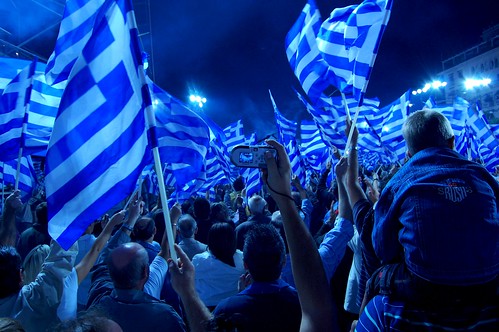
Greek elections 2007, originally uploaded by Teacher Dude's BBQ.

In contrast to previous years the run up to the local elections in November is a lacklustre affair without the usual frenzy of electioneering that marks Greek politics. In the streets few people are particularly riveted by the choices on offer and despite a concerted effort by the media to inject drama into the event many have turned their back on politicians, and instead are concerned with more immediate worries such as paying the bills and making ends meet.

No one in the present political set up, either on the left or the right set up has been able to turn an intense feeling of voter dissatisfaction into concrete electoral support. Obviously, the great loser in all this is the centre left PASOK party led by prime minister Giorgos Papandreou whose popularity has nose dived in the wake of the austerity measures imposed at the behest of the EU, ECB, IMF troika. However, the main opposition party, the conservative New Democracy has been unable to made much headway in the polls tainted as they are by their role in the country's economic meltdown. Even their newly elected leader Antonis Samaras's populist rhetoric has failed to convince many other than the party faithful.

On the other hand smaller parties of the left and right of the two main parties are also struggling to generate voter interest. On the far right LAOS, led by Giorgos Karatzaferis has failed to poach votes from New Democracy in the numbers it was expecting, the result, in part of its parliamentary support of the PASOK in passing the legislation and measures demanded by Greece's lenders.

Nor is the picture much better on the left with people wary of the Greek Communist party's old school ideological stance and its unwavering allegiance to the state run socialist economic model favoured by the Soviet Union in its heyday. The other reformist left wing coalitions languish in the polls, internally divided and struggling to get their message across in the media.

Underlying the growing indifference of Greek voters to the choices on offer is the realisations that whoever is in power their ability to change the present economic climate is limited as virtually all major economic decisions taken have to be okayed in Brussels, Strasburg and Washington. In addition an even deeper feeling of distrust of those in power comes from the deeply rooted idea that the country's rules are above the law and so free to abuse their position. This is hardly a new innovation and one that is central to modern Greek mindset but what has changed is the fact that the political caste's greed and incompetence has brought the nation to the edge of the abyss and so is no longer considered the acceptable price of getting things done.

Such extreme notions are reinforced by parliament's handling of recent corruption and bribery scandals involving the cases such asVatopedi Monestary, Siemens and the 2004 Athens Olympic games. These are just a few of the dozens of scandals that have racked Athens over the last few years and yet despite endless investigations not one politician has been convicted of a single misdemeanor, let alone spent time in jail. Many ordinary Greeks have come to the conclusion that whoever is in power, nothing will change and that once in charge the first priority of politicians is to line their own and their family's pockets at the expense of everyone else.

Given such cynicism and anger political analysts and leaders both left and right are worried about how this backlash will effect the vote in November and how the political landscape will be changed. Already the prime minister has warned that a major defeat for his party may result in the country going the polls again in a round new parliamentary elections. The national daily, Nea also published reports that Papandreou is considering a snap election as soon as December 12th in such an eventuality.

For Papandreou and many others the November elections are in reality a referendum on the bailout package and should his party lose badly that would require his government seek a new popular mandate. On the other hand political commentators have interpreted his words as political blackmail, a high stakes bluff aimed at getting reticent PASOK voters to the polls. If so, the costs of such a strategy are high indeed with the world's money markets jittery over the prospect of a change in government in Athens. Over the week Greek CDS's soaring once again above 800 points reflecting the financial world's unease at the prospect of a vote.

If Greece does go to the polls in December, both Papandreou and Samaras face the same dilemma that whoever wins is in no position to change the basic parameters of the current bailout deal and therefore will be associated in the popular imagination with job losses, painful spending cuts and a severe economic downturn.

The trick will be how to run a credible campaign yet not win, a feat the previous New Democracy leader, Kostas Karamanlis pulled off during his lukewarm campaign in 2009. Faced with immediate financial meltdown Karamanlis called early elections is September much to the annoyance of members of the party who wanted to wait till Spring 2010. However, they were unaware of just how dire the country's finances were and that by running early and losing New Democracy would still remain a coherent political force that could present itself as a credible alternative to PASOK once they had dealt with the financial mess at huge political cost.

Like the card game Black Maria in which the aim is to foist the Queen of Spades unto your opponent both main parties are supposedly gearing up to slug it out at the polls whilst secertly hoping that they will not have the misfortune to be in power.

Tuesday, October 12, 2010

Fiddling while Athens burns - Greek media's love affair with the political establishment shows no sign of ending

The best things in life are free

It's a measure of how far the Greek political system and its supporters in the local media are out of touch with the rest of the country that the recent uproar over the remarks by Jean Claude Juncker,  head of Euro Group that been the subject of some much air time and print columns during the last few days. According to an off the record remark made by Juncker in Washington a Greek prime minister told him that Greece was a country of corruption, a revelation on par with learning that the French eat rather a lot of cheese or that it can get awfully cold in Russia.

The fact that Greece has one of the highest corruption indices in the European Union or that the present PM, Giorgos Papandreou made much the same comment after taking power in 2009 seems to have been ignored by  the Greek political establishment and the country's media who went into a feeding frenzy in their attempts to identify which Greek PM had made such an outrageous statement. Kostas Simitis, head of the 2000-2004 PASOK run administration, Kostas Karamanlis, PM from 2004 till 2009 and finance minister Giorgos Papankonstantionou on behalf of current PM Giorgos Papandreou all rushed to say that they had said no such thing. (Juncker later made a statement saying that it was Giorgos Papandreou)

And so it has gone on, with endless speculation in the press as to exactly let the cat out of the bag. The fact that the Greek state is corrupt, of course comes as absolutely no surprise to anyone living in the country. Indeed Transparency International calculated that Greeks spent an average of 1355 euros in bribes in 2009.
Actually, the problem is not that the Greek political establishment turns a blind eye to corruption (see the Vatopedi land swap scandal) but rather everyone now knows. Worst of all, foreigners know just how venial Greek politicians are. How embarassing when one is putting one's best foot foward in Brussels, Strasburg or Washington that the rest of the world sees you as little more than a robber baron. For people as image conscience and ego driven as Greek politicans in power this comes as a terrible blow.

Perception, rather than reality is everything which is one of the reasons why the country is in such as mess. Why bother attempting to make difficult political decisions when all you need is a handful of IOUs and promises which you may or may not honour. Even now the opposition New Democract leader, Antonis Samaras is touring northern Greece in the run up to November's local elections giving his word to open factories, fund development and the like knowing full well that he would have no more financial freedom than the current PASOK administration to act. (The fact he was a cabinet minister in the previous government which ran up such huge debts seems to have slipped his mind at present).

Such a cavalier attitude to the truth also explains the chronic distrust of the average Greek concerning any promise politicians make. Indicative of this is the refusal of truck drivers to end recent industrial action despite promises by the government to discuss their demands. It wasn't until the proposals were put in writing that truckers agreed to stop strike action. Of course truck drivers know that even written reassurances mean little to politicians but it does give them a little less wiggle room.

But while the country's TV talking heads and their partners in crime and print have talked endlessly about what Juncker's statement means the country slides ever deeper into depression (both financial and psychological) with schools unable to pay fuel bills, hospitals running out of medical supplies and and an angry electorate bracing itself for a winter with 30% hikes in heating costs. For many patience is running out with the endless self - referential charade of the current political setup.

Just one more thing to consder, though when considering the role of corruption in the current financial debacle is that Iceland, whose per capita debt is even greater than Greece's, was ranked the world's 7th least corrupt government (Athens came in at 71) in 2008.

Thursday, October 07, 2010

How did it come to this? The roots of the current Greek economic crisis


This article was originally written last February but I thought that I would post it again since most of the points remain valid and especially in light of the fact that Eurostat has warned that Greek debt numbers are to be revised upwards for the years 2006-2009.

Much of the current media coverage over Greece's debt crisis is focused on how the country is going to raise the funds necessary to cover the $400 plus billion it owes creditors. Scenarios concerning the role of Germany and/or France in bailing out Athens are discussed constantly on national TV and in the newspapers and what will need to be done in order to convince Greece's European partners to cover cost of lending the billions needed just to keep the country afloat.

However, whatever happens in the coming months the question of what Greece does next in a world in which its financial choices are closely scrutinised by whatever monetary institution steps into the breach to save the country from bankcruptcy has not been addressed.

The prospect that an elected socialist government will be obliged to implement a conservative fiscal policy controlled by unelected officials raises all kinds of political dilemmas which Giorgos Papandreou's PASOK administration will have to deal with in the immediate future.


Papandreaou will be forced to challenge directly exactly those public sector trade unions which have put him and PASOK in power. In addition he will be forced to cut areas of spending which have been used by successive government to ensure political support.


The prospect of a place in the Greek civil service has long been the source of political power for parties on the right and left of the political spectrum. This combined by the promise of public sector contracts to economic elites in the private sector form the basis of the country's feudal political structure and in no small measure contributed to its present woeful economic situation.


Instead of land and power being swopped for military service the present Greek version of feudalism sees votes and political support flowing up the system in return for public funds and the influence it garners flowing downwards. It is a structure of patron-client relations which links the heads of the major parties to the humblest villager and is the lifeblood of modern Greek politics.


The ebb and flow of such influence and the complicated web of personal, familial and political relations that it engenders helps explain much of the apparent confusion and chaos of modern life in Athens and other major cities. Much of the country's infrastructure is divided into a patchwork of competing fiefdoms that have formed as a result of the present political setup. Each participant owes their position and continued economic well being to maintaining the right connections with those above and below them in the hierarchy. In such a system qualifications, skill, effectiveness and ability play second fiddle to being able to stay in with those who are in a position to advance your career.


Another by - product is chronic inefficiency and confusion as its duty of every fiefdom to ensure that it gets the maximum amount of resources in order to guarantee its survival. Co-operation and cost cutting mean giving up exactly those resources one needs to make sure that money and influence continues to flow to those whose support you need.


The effects of this system also affect the private sectors as the companies competing for contracts with the public sector, a huge player in the Greek economy, do so on the basis of political, personal and family connections. In some cases this takes the form of outright bribery but many others there is the mutual understanding that favours given must at some point be returned. It is no coincidence that many of the country's richest men have media wings attached to their business conglomerations which can be used to promote or attack parties and politicians .


The upshoot of this unholy alliance is that crony capitalism and "licence Raj's" dominate the economy stifling innovation and competition. There is little incentive to cut the cost of your product or improve the quality of your service in such a system. As a result Greek companies will dominant nationally rarely have the expertise to break into developed markets where transparency means that methods used at home cannot be employed.


Whilst foreign observers often point the finger of blame at Greece's powerful public sector unions for lack of competiveness and low productivity the reality is that pay in the private sector has remained stagnant for years and that much critised worker protection laws are rarely applied to non - public sector businesses. Despite a pool of cheap, educated labour which can be hired and fired at will the private sector has done little to prepare the demands of a modern globalised economy and instead reaped the benefits of European Union's lowest wage while raising prices far beyond the rate of inflation safe in the knowledge that an invisible web of cartels and unofficial "gentlemen's agreements" mean that they will not be faced with any real competition.


It is difficult to see how an economic and political system run on such principles can reform itself in the kind of time scale being proposed by Europe and controlled by exactly those people who helped run the country into the ground in the first place. The obvious answer is that Greece will not be able to implement the kinds of reforms being demanded and that in trying to square the circle the country will tear itself apart as different social and economic groups turn on each other to preserve a semblance of their priviledges and power.


Already there has been a growing wave of political violence with terrorist attacks now forming a staple of the daily news. That combined with a burgeoning crime rate form the background to a society that appears to be gradually coming apart at the seams.

Tuesday, October 05, 2010

Despite crisis business as usual for Greece's politicians


Towards the end of the ex - Greek prime minister, Konstantinos Karamanlis's second term yet another corruption scandal erupted which would ultmately be the death knell for the ruling conservative New Democracy party in the 2009 general elections. After less than two years in power the party founded by his uncle, also called Konstantinos Karamanlis in 1974 lost power to the left of centre PASOK party lead by Giorgos Papandreou, son and grandson of previous Greek PMs Andreas and Giorgos Papandreou.

The revelations that senior New Democracy officials had collaborated in a highly dubious land swap in which a remote lake in the north of Greece was exchanged for a large piece of prime Athens real estate outraged public opinion and ultimately ended in Karamnlis calling for early elections.

The details of the deal which featured the Greek Orthodox monastery of Vatopedi are as convoluted as they are legally dubious. However, an insightful article in Vanity Fair by Michael Lewis paints a lucid, if dark picture of corruption and lawlessness at the heart of the Greek political establishment. According to Lewis it was exactly the ability of polticians to operate without oversight or restraint that helped create the present financial crisis and massive debt load.

Yet even as the country set to enter its third year of recession with the prospect of still more cuts and the economy set to shrink even further the the political establisment in Athens are still playing the same constitutional games, seemingly untouched by the financial maelstrom embracing Greece. Evasions, denials and endless parliamentary manouevering still rule the day and even after the appearance plethora of evidence indicating wrong doing the former prime minister of Greece can say that neither he, nor his administration have any repsonsibility for either the Vatopedi scandal of the dire state of Athens's coffers.

It would be nice to think that by ousting a corrupt government Democracy has once more won out. The reality of the situation is that one corrupt poltical oligarchy has been replaced by another. The current rulers of Greece, PASOK have a rich history of scandal and corruption which has been not resulted in a single conviction, The Sieman's bribery case and a list of pay offs by other German firms to PASOK officials in the run up to the 2004 Olympic Games has also been put on the parliamentary back burner, to be quietly dropped at a future date.

Given that the current political scene is full of exactly those officials who presided over the creation of Greece's present woes its is very hard to have faith in their ability to not repeat the mistakes of the past. In all probability the future holds more of the same just on a smaller scale reflecting the country's dire fiancial state.

It's a bitter irony that Kostas Karamanlis was elected on a reform ticket by an electorate fed up with the corruption of the previous PASOK government lead by Kostas Simitis. His promise to clean up politics and reform the dysfunctional Greek state stroke a chord with voters who hoped that the right of centre New Democracy party would change the status quo. As history has shown the differences in ideology between Greece's two largest parties are nothing compared with their inability to resist the financial temptations offered by power.

Faced with the failure of both PASOK and New Democracy to control the greed of their own officials the local elections in November may prove to be the beginning of the end of the current Greek party political scene.

Saturday, March 20, 2010

A plague on both your houses

Just a quick post then it's off to pick up Lydia. There's plenty happening on the political front here in Thessaloniki with both New Democracy and PASOK holding party conferences here. Actually, despite what the Greek media is saying the PASOK conference is being held 100km outside the city in Halkidiki. Party officials know full well that any appearance by Giorgos Papandreou in the city would provoke massive street protests. On the other hand the ND conference featuring Kostas Karamanlis is taking place in the centre but you can be sure that there will be enough officers there to police a small nation.

I was thinking of going there, despite the security there are ways of taking pictures but I decided not to. I haven't had the chance to see my daughter in some time and that is far more important than any photo and secondly, I'm sick of those in power, sick of their lies, arrogance and sense of entitlement. The same people who got the country into this mess are now exhorting people to make sacrifices. A bitter irony from those who earn more in a month than many pensioners get in a year.


Monday, March 08, 2010

Greece set to explode over austerity package


On Wednesday the Greek government announced its long awaited package of economic measures to deal with the financial crisis the country has been facing since the discovery that the previous conservative government under prime minister Kostas Karamanlis had systematically lied about the country's debt load,. At the beginning of 2009 the Greek minister for finance, Yiannis Papathanasiou confidently predicted that Athens public lending requirements would not go above 3% of GNP, a figure that gradually creeped up over the following months.

However, no one, including Greece's EU partners nor the international money markets were quite ready for the real figure of 12.3% which only came to light following the crushing defeat of New Democracy in the October general elections.

On taking power Giorgos Papandreou, like president Barack Obama immediately found himself in the middle of an economic maelstrom unprecedented in recent history. Unlike America, Greece's chronically weak economy combined with a history of fiscal deception and misinformation meant that newly elected socialist PASOK party had very little room for manouevre with state coffers empty and debt repayments looming. A situation not aided by the role of speculators who saw in Greece a way of exploiting fears about the Euro and so bet on the currency losing value.

The upshot of the crisis is that a socialist government elected on a platform of social reform and aid to the poorest is currently attempting to implement a conservative fiscal reforms which are straight out the Thatcher - Friedman play book and so achieve in five weeks that which the previous right wing administration failed to do in five years in power.

Already swingeing price hikes in the cost of petrol, VAT and and the promise of wage cuts across the board have produced a wave of strike actions and protests. And this is just the beginning. Last weeks marches were marked by violent confrontations between marchers and the riots police who, despite orders by the Minister of the Protection of the Citizen, Mihalis Chrysohoidis used tear gas to disperse those present.

In scene reminiscent of December 2008 the heart of Athens once more resembled a war zone. In addition trade unionists and left wing protesters attempted to storm the ex-ministry of Macedonia and Thrace in Thessaloniki, Greece's second largest city. Like the 2008's outbreak of violence the confrontation are being fueled by a deep sense of outrage and injustice and are drawing support from a wider cross section of society. Enraged pensioners are just as likely to take part in these protests as disenfrancised youths.

As the austerity package starts to bite and the knock on effect of such a drastic change in the economy is reflected in skyrocketing unemployment then these clashes are set to increase in both size and intensity as more and more people take to the streets to voice their disagreement.Next week the country's trade unions have declared another general strike and with the work stoppages are planning public demonstrations which are likely to see a repeat of last Friday's violence.

At the heart of the protests lies the belief that while the country is indeed corrupt and that the public service is bloated and inefficient billions of euros has been siphoned off illegally and that the man in the street is being asked to pay for the folly of the local economic and political elites who have used their power to get rich at the cost of the rest of the country.

The fact that the PASOK politicians asking Greeks to make sacrifices have been repeatedly embroiled in corruption and bribery scandals has done little to convince voters to accept such painful cuts. Over the last decades members of both main parties, New Democracy and PASOK have been accused of a seemingly endless list of scandals involving corruption and influence peddling yet not one MP has ever been convicted or gone to jail. In such a climate of lawlessness where those in power seem able to float the law with impunity few have the moral stature to ask ordinary Greeks to give up so much in such a short time frame.

Although untouched by scandal personally, Prime minister Giorgos Papandreou's party is currently facing allegations that the German Siemens electronics corporation paid bribes to high ranking PASOK officials in order to win contracts for the 2004 Olympic Games held in Athens.

The Games which cost three times the previous ones in Sydney provide an insight into how the present economic crisis came about. Massive cost over runs, lack of transparency over contracts and a legacy of expensive facilities which lie rotting and unused across Athens are testiment to Greece's system of crony capitalism where efficiency, cost, competion, and innovation count for very little in an economy where political favours, kick backs and bribery are the rule rather than the exception.
Thursday, September 03, 2009

Greek prime minster announces national elections for October


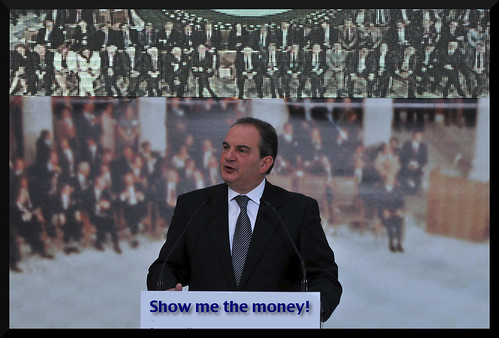
Show me the money, originally uploaded by Teacher Dude's BBQ.

After weeks of speculation over when the next general elections will take place, Kostas Karamanlis finally announced that the country will go to the polls in October.

This means that they economy really is in dire straits as no sane person would call for elections just weeks after devastating fires and with the ruling New Democracy party mired in a series of corruption scandals, Obviously, the PM thought that it is better to bite the bullet now rather than wait till next year when who knows what terrible economic news is going to come to light.

Tuesday, August 25, 2009

Greek forest fires - update

Yesterday at this time virtually every channel in Greece was broadcasting live coverage and commentary on the country's forest fire disaster. The screen was full of dramatic scenes of people fleeing the flames, begging the authorities for help or desperately trying to protect their homes using whatever came to hand. Today: nothing. I have been trying to find out what has happened over night and I can't find a single channel that covering the event anymore. Not one. Instead the TV stations seem more interested in discussing the results of the country's university entrance requirements which were announced this morning.

Although the worst of the fires seems to be over the strong winds blowing in the area still means that there is a chance that the fires could burst back into life. In addition only now can the true extent of the destruction wrought can be assessed. According to the European Forest Fire Information Service 31,000 hectares of forests have been lost in the Attiki region around Athens, more than the last 28 years put together. Click here for pictures of the day after taken in the Dionysos area near Athens,

Prime minister Kostas Karamnlis showed his support for firefighters by visiting them at their airbase in Eleusina. This was very nice of him and it's good to see they hold no hard feeling over the beating and tear gassing their colleagues received in March this year when they demanded the government honour its promise to give them permanent contracts. Also the 1000 other fire fighters who got roughed up by the riot police for asking to be paid for last summer's work will cherish the PM's words of encouragement.

A protest rally is being organised for this Friday at 7pm in Syntagma Square in central Athens.

Monday, July 13, 2009

Greek police raze refugee camp to the ground.

Greek police raze refugee camp to the ground.

Early on Sunday morning hundreds of members of the Greek police force raided an unofficial refugee camp in the Greek port of Patras as part of an nationwide 'clean sweep" operation. The camp which has been in existence for nearly a decade was home to hundreds of immigrants, mainly from Afghanistan hoping to sneak aboard trucks headed for Italy.


Using bulldozers the local authorities razed to the ground the shacks and huts that until recently housed an estimated 150 people. Several fires were reported as a result of the raid and according to official police sources 44 minors were detained along with 30 adults who will be held in a reception centre until they are deported. The raid has been criticised as "inhuman" and called a "pogrom" by the left wing SYRIZA party and the Greek Communist party.


The ruling New Democracy party has also announced that it will set up internment camps throughout the country to house those who do not have a legal right to stay in the country. It should be noted that at present Greece grants asylum to 0.1% of those who apply for it and has been repeatedly criticised by Amnesty International, other European governments and the UNHCR for its treatment of refugees and immigrants.


On the other hand the latest poll carried out by Public Issue found that 93% of those questioned thought that Greece could not take in any more immigrants and that 62% said that immigration is probably harming Greece.


Stung by his party's poor showing in the recent European elections prime minister Kostas Karamanlis has decided to get tough on the issue of immigration in order to avoid losing more support to the far right LAOS party. With the possibility of general elections in either September or March 2010 at the latest Karamanlis is hoping that a tough stance on crime and immigrants will help bring back voters who have deserted the party in droves after two years of corruption and influence peddling scandals involving several government ministers


Tags: | | | | | | | |

Thursday, June 04, 2009

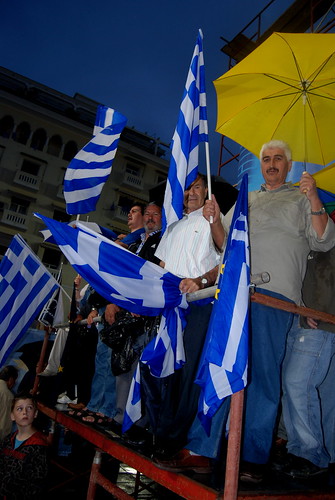
New Democracy rally in Thessaloniki for the European elections


New Democracy rally in Thessaloniki for the European elections, originally uploaded by Teacher Dude's BBQ.

Amidst torrential rain and lightning, Greek prime minister Kostas Karamanlis spoke to New Democracy supporters in the northern port city of Thessaloniki last night as part of the country's European election campaign .

Stressing foreign policy issues such as relations with Turkey and Greece's northern neighbour, Macedonia, Karamanlis sought to deflect criticism of the government's domestic record and play down the effects of a series of damaging corruption scandals which have rocked Greece over the last year.

Despite massive publicity bad weather and a general sense of disappointment with the performance of both major parties in the Greek parliament meant that turnout for yesterday's rally was lower than expected.


Greek prime minister addresses crowds in run up to Euro poll | Demotix.com

Shared via AddThis

Sunday, May 31, 2009

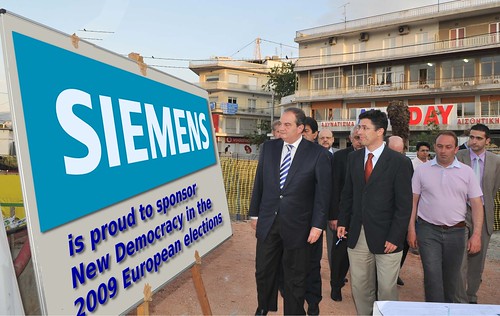
Siemens is proud to sponsor New Democracy

Σhow me the money

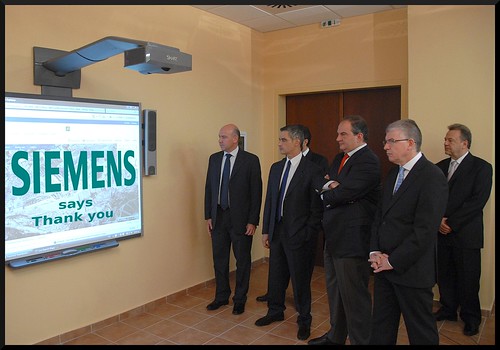
Siemens says thank you

"The warrant for Christos Karavellas, Siemens' former financial manager in Greece, was issued after he failed to appear in court as scheduled on Friday. Karavellas' lawyer claimed his client was abroad and sought to postpone the testimony, the source added.

German industrial giant Siemens is accused of bribing local politicians and officials from Greek telephone operator OTE to bag a multi-million-dollar contract before the
Athens Olympic Games in 2004.

An arrest warrant was also issued on May 20 for the group's former Greek operations director Michalis Christoforakos, who is believed to be in Munich. Greek officials are labouring to have Christoforakos extradited.

Two more suspects, former Siemens executive Ilias Georgiou and OTE's former telecommunications general manager George Skarpelis, who are scheduled to testify in mid-June, have been barred from leaving the country.

The paybacks scandal rocked Greece for months and both the ruling party of Prime Minister Costas Karamanlis and the main opposition PASOK socialists are accused of taking bribes.

A former PASOK official admitted in June to having accepted 1 million German marks (around €510,000 $720,000) from Siemens in 2000, on behalf of the party when it was in power.

The Siemens scandal erupted in late 2006 and shook the group to its core. The sprawling conglomerate has acknowledged that millions of euros were funnelled into various funds used to obtain foreign contracts, and that the practice was widespread across its numerous divisions."

Sunday, February 15, 2009

Greek government fights for its political life


Latest opinion poll results show that nearly half of Greek voters believe that neither of the country’s two major political parties is capable of governing. The ruling right - wing New Democracy was given an approval rating of just 16% whilst the opposition centre left PASOK party polled just 17%.

The results underline the massive lack of trust in the present political system which has been exacerbated by the recent economic downturn, a series of high profile corruption scandals and the wave of violent confontations which swept Greece In December and January.

This week doctors and other health care officials took industrial action for 48 hours in order to protest the chronic staff and equipment shortages that have plagued the public health care system for years.

A senior doctor at a hospital in Thessaloniki, Greece’s second city, speaking on condition of anonymity said that his department had just a third of the nurses required. In addition lack of staff means that Greek hospitals are regularly demanding doctors work more than the European Union mandated limit of 48 hours a week.

There have also been complaints over shortages of basic supplies such as bandages and medicine in many hospitals caused by cuts in funding by the Ministry of Health and massive delays in paying medical suppliers for previous orders.

The death of a 58 year old man this week in a ambulance taking him to hospital in Thessaloniki sparked off a political row when it came out that the man died as paramedics were unable to revive him following a heart attack as their resuscitator was missing parts. Although a coroner's report said that the death was unrelated to the heart attack, doctors who treated the man are adamant he could have been saved if the ambulance's equipment had been in working order.

The strike action is just one of a series of protests which has seen the government pitched against students, farmers, cleaners and even police officers.


Whilst the riots and street clashes that were sparked off by the killing of a teenager in December have faded from the world’s TV screens violent confrontations have continued albeit on a smaller scale.

Last week Thessaloniki saw riots in which 500 - 1000 demonstrators attacked the city’s central police station and take part in running street battles for hours. In addition there were 17 arson attacks on Friday by a revolutionary organisation calling itself the Conspiracy of the Cores of Fire.

Even more violent have been the armed attacks on police stations in Athens which left one police officer seriously injured after being shot while standing guard outside the Ministry of Culture signalling a rekindling of terrorism in the country.

Political and economic woes have added to calls for national elections by many unhappy with the government’s handling of a wide range of everyday issues such as employment, education and law enforcement.

Currently, Prime minister Kostas Karamanlis has just a slim one seat majority in parliament and is facing a series of clashes within his own cabinet as ministers manouever to position themselves for the possibility of national elections and a subsequent leadership battle.

Saturday, January 31, 2009

New cabinet reshuffle in Greece?


Faced by growing popular dissatifaction and falling opinion poll results, leader of the ruling New Democracy party, Kostas Karamanlis is said to be contemplating his second major cabinet reshuffle in a matter of months. Sources close to the prime minister say that Karamanlis is considering a radical restructuring of the government to bring in new talent to deal with the country’s worsening econmic position and get to grips with the challenges thrown up by the continuing worldwide financial crisis.

Although yet to be confirmed, Athens mayor, Nikitas Kaklamnis is said to be a sure bet as the next Minister of the Environment. Given his experience with handling ecological matters and sensitivies over green issues, Kakalmanis is thought to be the perfect replacement for Giorgos Sofoulias. However, the global nature of the problems facing Greece potential candidates from outside the country’s borders mean that others from wider afield are being considered.

Moves have been made via diplomatic connections in Tehran to invite, Iranian president, Mahmoud Ahmadinejad to take over at the Ministry for National Education and Religious Affairs. News of the talks came to light in the national press after video surfaced on Youtube and quickly spread throughout the Greek language blogosphere.

Even more dramatic are the negotiations being quietly held in New York between the Greek government and Bernard Madoff, ex - Wall Street financier to take over the reins at the Ministry of Economics and Finance. High ranking officials in Athens say that Madoff’s particular skill set would be a perfect addition to the cabinet and that he would be the ideal man for the government’s attempts at reforming the economy.

Rumours that the charasmatic North Korean leader, Kim Il-sung., is to replace present foreign minister, Dora Bakoyainni have not yet been officially denied according to local media sources.

http://edition.cnn.com/2009/WORLD/europe/01/07/greece.government.reshuffle/index.html?iref=newssearch


Warning: This report has a high satire content and is not recommended to people with a low tolerence to humour. Side effects include spontaneous laughter, smirking and wry smiles. Please consult your doctor if symptoms persist.

Friday, October 24, 2008

Greek government walks out of parliament

Karamanlis - Greek PM under siege

With a parliamentary majority of just one the ruling New Democracy party of Kostas Karamanlis is fighting for its political life amidst scandal, economic downturn and growing popular dissatisfaction with the Greek government’s track record on a range of issues.

Today at 6pm (local time) the government faces a vote on whether to allow to a parliamentary investigation into the most recent in a string of scandals to hit the country. Despite vigourous denials of any wrong the entire ruling New Democracy parliamentary body has decided to abstain from this evening’s vote.

The latest scandal to rock the present administration claimed its most recent victim yesterday when Minister of State and the government public spokesman, Theodoros Rousopoulos resigned over alleged involvement in the Vatopedi land swap case. Bowing to intense political pressure from opposition parties Rousopoulos stood down from his post. However, he denied any wrongdoing and attributed his fall to baseless and unfair accusations by the left - wing PASOK party.

The Vatopedi case came to lighty earlier this year when the 1000 year old Greek Orthodox monastery attempted to exchange Lake Vastonidi, which was originally designated a wildlife reserve for a 40 million dollar conference facility in Athens, built with tax payer’s money for the 2004 Olympic games.

The high profile deal triggered a series of investigations in the Greek press over the terms of the purchase and the highly irregular way in which the lake had been obtained from the Greek state.

Since then there have been a series of embarrasing revelations in the media over connections between high ranking members of the current conservative government and the Vatopedi monastery bringing to light the shadowy, often tangled web of financial and political interests that link the Greek state and Greek Orthodox church.

The vote and resignation of one of the prime minister’s closest political associates weakens still further the government’s chances of seeing out the rest of its second term in power. Repeated clashes with trade unions over pension reforms, hundreds of high school sit-ins nationwide and plummeting opinion poll results point to the mounting unhappiness many ordinary Greeks feel at the inability of the New Democracy government to fulfil its electoral pledges to improve basic services and deal with the with endemic corruption marks much of public life.


Greek government walks out of parliament

Tags: | | | | | |

Sunday, September 07, 2008

Karamanlis - Greek PM under siege

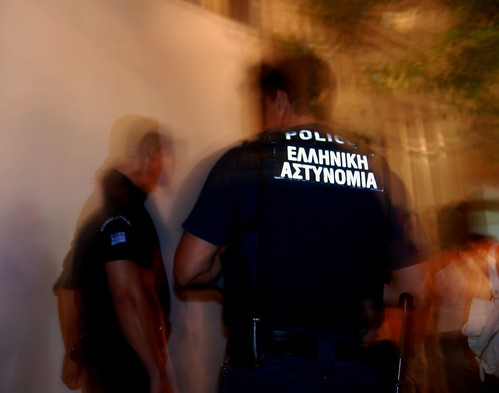
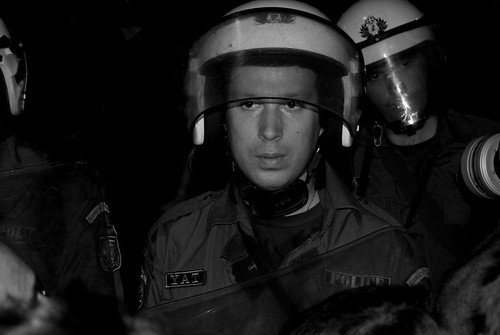
With the presence of 2000 extra police officers on the streets, snipers stationed on rooftops and helicopters circling overhead, downtown Thessaloniki resembles less a city celebrating the opening of a major trade fair than a town under siege.

The arrival of the Greek prime minister Kostas Karamalis in Greece’s second city has triggered massive street protests by those unhappy with his government’s handling of the economy and upset at a seemingly endless stream of financial scandals involving senior ministers.

In a keynote speech at the opening of the trade fair the prime minster tried to put a brave face on what has been a disasterous summer for the New Democracy administration by emphasising the need for reform of Greece’s ailing economy and by promoting public works such as the Thessaloniki underground which he says are proof that the present government has been able to improve the lives of ordinary Greeks.

However, critics have pointed out that despite five years of conservative rule the country, unlike neighbouring Turkey and Bulgaria has failed to attract increased foreign investment and that direct investment is now lower than in countries such as Uzbekistan.

Similarly, all except one of the major public works in Greece’s second city have ground to a halt due to lack of funding from Athens and that the much hyped underground is behind schedule and over budget.

Karamanlis and party officials have been keen to point out that Greece is suffering from the effects of worldwide problems caused by rising oil prices and a global credit crunch. However, many of the ruling New Democracy party’s problems appear to be strictly home made.

Their standing in the opinion polls has fallen dramatically over the 12 months since re-election as scandal after scandal has come to public light, many connected with dubious land deals involving ruling party MPs and ministers. As if to add to the government’s woes last week the party even faced accusations of tampering in a parliamentary vote.

In addition the rises in the cost of basic goods and services, which have long outstripped those in other European countries, stagnant wages and most recently swingeing tax increases for lower income groups have combined to undermine public confidence in the Greek government.

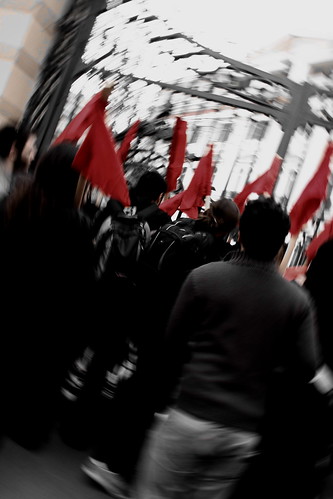
Opposition to government attempts to push through an unpopular political agenda has seen groups as disparate as cleaners and anarchists, police officers and communist trade unionists joined forces on the streets of Thessaloniki. Yesterday. Between ten and twenty thousand protesters marched to express their unhappiness with government policies and the state of the country’s political scene in general.

Whilst the march passed off peacefully, local media sources reported that small anarchist groups attacked shops and a bank afterwards and the police had made 15 arrests.

http://www.nowpublic.com/world/greek-pm-under-siege

Anti-government demo - Thessaloniki

Facing your demons

Smoking can seriously damage your health

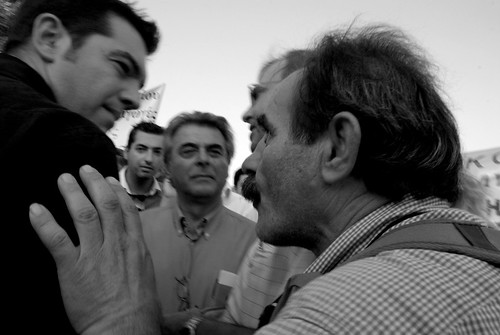
Alexis Tsipras  Αλεξης Τσιπρας

Anti-government demo - Thessaloniki


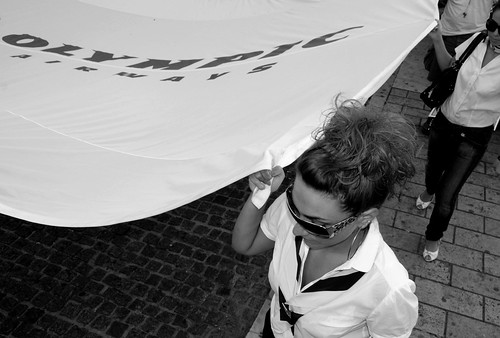
It takes a particular kind of political genius to build a coalition that includes groups as disparate as air stewardesses and anarcho-syndicalists, firemen and ecologists, cops and communists. However, Greek prime minister, Kostas Karamanlis has indeed united all these people, however, all in opposition to his scandal - ridden government which seems incapable of getting through a week without one embarrassing revelation or another.

Dodgy land deals, suspicious financial transactions in business, even vote rigging in parliament are just some of the charges the conservative New Democracy party has faced in the 12 months since it was re-elected.

http://www.nowpublic.com/world/greek-pm-under-siege