Showing posts with label thessaloniki. Show all posts

Monday, March 23, 2020

Greece imposes curfew

Yesterday the Greek government tightened up its rules concerning travel and movement. For now on people have to justify why they have left their home via some kind of official statement and carry with them either their passport or police ID.  Otherwise there is a 150 euro fine.

There are three ways to declare reason for travelling;

1 Send a free text message to 13033 along with name, address and reason for travel (see below for details).

2 Download, print out  and fill in a form from this Greek government site.

3 Write by hand the same information - For people who are travellling to work this includes, name, home address, employer, times of travel. Full details (but only in Greek) are here

Here are details for the SMS/text message option in Greek English and Arabic.

Το SMS στο 13033 θα είναι της μορφής:

X κενό ονοματεπώνυμο και διεύθυνση κατοικίας
όπου Χ ο λόγος εξόδου με αριθμους:

1. Φαρμακείο - γιατρός
2. Super market κτλ
3. Τράπεζα
4. Παροχή βοήθειας
5. Μετάβαση σε τελετή
6. Σωματική άσκηση - κίνηση με κατοικίδιο - σίτιση αδέσποτων

You can send a free SMS to 13033 in this way

X (number listed below-space-name&address

eg 3 Giannis Papadopoulos 4 Dimitriou

1 Pharmacy/doctor
2 Supermarket etc
3 Banks
4 Giving help
5 Traveling to a ceremony
6 Physical exercise or exercising/feeding pet

بالنسبة للأشخاص الذين لا
يتحدثون اليونانية
إذا كنت بحاجة إلى التنقل داخل اليونان ، يمكنك إرسال رسالة قصيرة مجانية إلى 13033 بهذه الطريقة
X (عدد الأسباب المذكورة أدناه) - مسافة - الاسم والعنوان
على سبيل المثال 3 Giannis Papadopoulos 3 Agiou Dimitriou Thessaloniki
1 صيدلية / طبيب
2 سوبر ماركت الخ
3 بنوك
4 إعطاء المساعدة
5 السفر لحفل
6 ممارسة الرياضة البدنية أو ممارسة / تغذية الحيوانات الأليفة

Friday, March 20, 2020

The Corona Blog

I'm not sleeping. Or rather I'm not sleeping enough. Every night this week I've woken up around 4 or 5 o'clock and been unable to get back to sleep. However, unlike this is no '4 AM of the soul' kind of insomnia, driven by existential questions about what will happen to me in the future. No, this is far more concrete and far scarier. The Corona virus outbreak has been in Greece for weeks now and the news just keeps on getting grimmer and grimmer with restrictions on movement becoming ever tighter. There's even talk of a possible curfew over the weekend, though what this depends on seems unclear.

Officially the number of COVID-19 cases in Greece seems to be rising slowly, with just 30 or 40 new ones per day. The number of deaths is currently six, in both cases the figures are far lower than in many other places, yet it is very hard to get accurate, independent information. The current Greek government, like so many before it, always attempts to bury or ignore bad news. The fact that so much of the local mainstream media is willing to support the ruling conservatives New Democracy party, just adds to their ability to present whatever message they see fit.

During the recent tensions on the Greek-Turkish border, example of extreme abuse of migrants and refugees by Greek security forces only came to light due to the work of foreign news crews. Even then, the government and their many supporters in domestic media were happy to decry all such incidents as 'fake news' without feeling the need to provide any kind of evidence to support their claims. I'm worried that  this same pattern will be repeated, either in the name of national security or for less honourable reasons of party self-interest.

Whatever the true picture is, the good news is that ordinary Greeks are taking the official instructions about self-isolation, social distancing and other preventive measures in deadly earnest. The streets are not empty yet, but the number of those out and about is far, far lower than before. The thing is we are having a gloriously mild spring and the weather seems perfect for going out and relaxing at a cafe or in park. Not that this is possible as all the cafes, bars, restaurants have been closed down for anything other than take away.


This morning, once again unable to sleep beyond 5 AM, I decided to stock up once again just in case the talks of a weekend curfew proves to true. The local supermarket security guard was carefully controlling the flow of people entering and there were gloves for customers who wanted them. The shelves are still full and there are few shortages, with the one exception of yeast. It turns out Greece is once again turning into a nation of home bakers, a folk reaction, perhaps, to previous crises and disaster the nation has been through in living memory.


I remember when I first came to Greece, my then girlfriend, Athena had invited me to her place and I still remember vividly standing in her kitchen as she explained in an somewhat embarrassed way why all the cupboard space was full of bags of sugar, sacks of flour and large 5 litre metal containers with olive oil called 'teneke'. This was something her mother always insisted on having in the home, a relic of the difficult times she had lived as a young child during the German occupation of Greece in WWII. Then, a collapse in food production and distribution to the cities caused widespread famine which killed tens of thousands. Even so many years later, after most Greeks had achieved the kind of material comfort and prosperity undreamt  of by previous generations, the memories of those difficult times still haunted Athena's mother and many other members of her generation.

And not just her. The sudden spike in prices for things like surgical masks and hand gel was termed 'black marketing' by many and the urge by some, especially those who have the wealth and power to exploit a crisis reappeared. TV stations, owned by some of the richest
men in Greece were full of their own ads for 25 euro packs of masks. A week ago those same six masks would have cost just a few euros from any pharmacy. The fact that these very same TV stations are the ones who are so happy to support the government and act as PR agents just add to my anxiety.

The funny thing is that I stopped blogging regularly here just as another crisis was starting in 2015. Then I ended up heading a refugee solidarity group that worked in the camps on Greece's northern border for six months and I saw just how bad things can get when things fall apart. 

Thursday, May 17, 2018

Call for help and solidarity in support of refugees in northern Greece


Dear friends,

 we would like to inform you about the refugee situation in Greece and specifically in the city of Thessaloniki and the surrounding Macedonia region in the hope you can help us con tend with the growing crisis.

As more and more conflict arises in Syria and the surrounding areas, more people are fleeing, leaving their homes behind to seek refuge in Europe.

There has been a considerably large incoming wave of refugees during the past four months, as a result of the recent strikes. The vast majority of the refugees arriving are families with underaged children and elders, as well as individuals.

In Thessaloniki, there are a few tens to a few hundreds of arrivals per day. Only very few of the hospitality centers set up by the government in the past two years are still working and they are certainly not enough to host all the arriving refugees. The three centers around Thessaloniki are about 50 to 70 km away from the city and can only offer housing to the newly arrived.

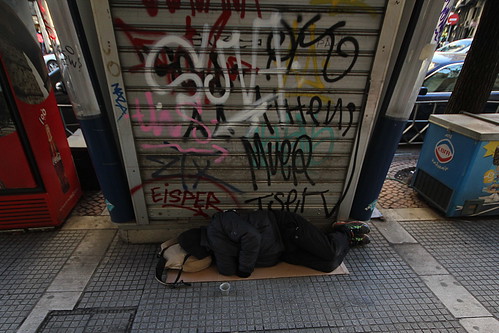
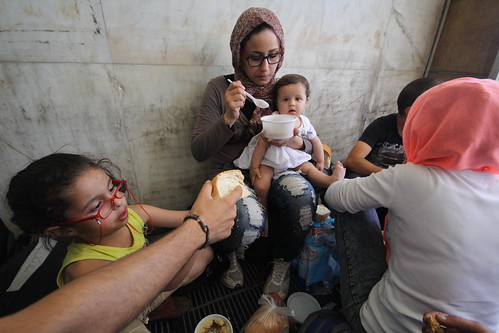
But since these facilities are already overcrowded, a lot of people have to stay in the streets. In many places in Thessaloniki, families are forced to sleep on the sidewalks, without any support from the state.

We, the people of the Ecological Movement of Thessaloniki and Oikopolis, consider it our duty to support these people during their rough journey towards safety and we collaborate closely with all the organizations and volunteer groups that are engaged in our city.

In order to help these people we constantly try to:
  • Cook and distribute hot meals and fruits - vegetables for people that don’t have any access to cooked food.
  • Provide them with raw materials for cooking in their houses or in the camps.
  • Supply them with personal hygiene products for adults and children as well
  • Offer baby milk as well as the possibility to prepare it in our place
  • Support them with their medical expenses
  • Collect and distribute clothes , shoes, sleeping bags, tents and anything else that will help them if they are homeless.
  • Have free English and Greek language lessons

We are gathering all available supplies and we would be grateful if anyone would like to contribute any of the following:

Baby formula and baby food
Baby diapers and wet wipes
Strollers and baby carriers
Personal hygiene and care goods, soaps etc.
Rice and pasta
Legumes (beans, chickpeas, lentils etc.)
Flour, Oil (sunflower oil, olive oil)
Fruit and vegetables
Men’s clothes and shoes
Children’s clothes and shoes
Socks and underwear
Backpacks
Sleeping bags

Any financial contribution will also be highly appreciated!

You can contact us at:
Tel: 0030 2310222503 - email: oikopolis.social.center@gmail.com

Visit us at:
ΟΙΚΟΠΟΛΙΣ/ΕCOPOLIS, Ptolemeon 29a, 5th floor, Thessaloniki

Visit our pages:

Make a donation at the following account:
ΕΘΝΙΚΗ ΤΡΑΠΕΖΑ / NATIONAL BANK OF GREECE
IBAN GR2301102170000021729602652
Swift code: ETHNGRAAXXX
ΟΙΚΟΛΟΓΙΚΗ ΚΙΝΗΣΗ Ν. ΘΕΣ/ΝΙΚΗΣ
ECOLOGICAL MOVEMENT OF THESSALONIKI


Back in the saddle again

It's been a  long time since I last wrote a post here but I decided I would revive this platform as I have started to work with refugees once again here in Thessaloniki, northern Greece. Despite what much of the media say, the crisis has not gone away and indeed over the last few months has grown more intense in the parts of Greece such such as the islands of Lesbos, Chios and Samos, whilst here in the north the number of people fleeing war, persecution and poverty has doubled and doubled again.

If you're curious about what I have been doing over the last year, check out my Flickr page here.


Sunday, April 23, 2017

Passing through - memories from the Western Balkan Route

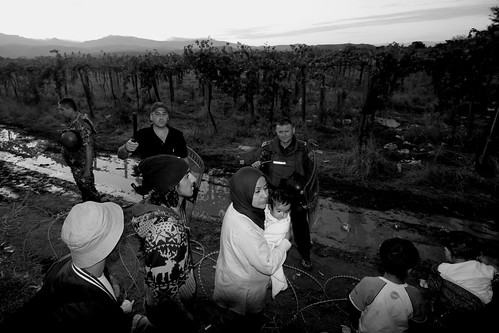
Batons Vs babies - Idomeni, On the Greek-Macedonian border in August 2015

I took this photograph in August, 2015 in the neutral zone that separates Greece from it's northern neighbour, Macedonia. Then, the village of Idomeni was unknown, even to the vast majority of Greeks. A tiny railway crossing that for some reason was fast becoming the focal point for refugees taking the Western Balkan Route from  Turkey to the countries of northern Europe.

However, this day was different, instead of tens or hundreds making their surreptitiously across the border to catch the north bound train in the town of Gevgeliji, thousands had been left stranded by the decision by the Macedonian government to close down the unofficial crossing point and deploy both riot police and border troops to enforce this decision.

With summer temperatures reaching 35C+  these people were left to fend for themselves in the fields around the tiny railways station on the Greek side of the border, Drinking water was virtually non-existent and refugees were reduced to drinking water from the irrigation systems in nearby fields, and sanitary facilities were just a handful of portoloos that quickly became unusable due to the demands of so many people.

The fact that the border had been closed came as no surprise as this had been a fairly regular occurrence all through the summer of 2015 as EU and Balkan governments vacillated over what to do with the ever increasing number of refugees and migrants fleeing the fighting in Syria and Afghanistan and poverty in other regions of the world.

This confusion manifested itself as an endlessly changing policy on the part of the Greek authorities and in particular, the police who would turn a blind eye to refugees making their way from the Greek islands to Idomeni and then suddenly introduce bans of movement in the north. Not, that such moves made much of difference to the numbers of refugees moving north, if the trains were denied them, refugees took the local buses or taxis. In the worst cases when all other options were denied them , they simply walked, guided the 70 km from the nearest large city, Thessaloniki by Google maps.

However, not only the Greek authorities but also their Macedonia counterparts had started to clamp down on refugee movement and not only were the borders more tightly guarded, the train that connected Gevgeliji with Belgrade had been suspended, the daily service completely overwhelmed by the scale of the passenger flow.

Yet, the border was still relatively porous and the nothing to mark it out but a dusty series of paths and raggedy hedges that separated Macedonian and Greek fields. With nothing in the way of natural or man made barriers to deter them , many made the dash to the nearby town , chased down by Macedonia police or border units in the wheat fields.

On the other hand while this was an option for healthy young people with a sense of adventure, it was really possible for the bulk of refugees who were travelling in family groups, often with older relatives or young children, Instead, they sweltered in the summer heat, waiting for the travel rules to change once again as they has so many times before.

The local solidarity groups that had been helping those making the journey north since 2014 were overwhelmed by the sudden increase in the scale of the numbers of refugees suddenly amassed in Idomeni and so appeals groups across northern Greece to come and help out. I managed to wing a place on a convoy of cars and vans that had set out from Thessaloniki, carrying drinking water, cooked food, clothing and sanitary items. I had been doing this with my group since May and I thought my experience would help in this situation and in that I was completely and utterly wrong.

Not only was the scale of the crisis much greater than I had previously experienced, the state of those in need was far more precarious. Instead of providing food and clothing to those who were tired and weary from their journey from Athens to Thessaloniki, these people were in need of far more and as a result more desperate. It was a combination that required all those providing help and required a degree of discipline and organisation that we had till then not obtained.It quickly became clear that if we were not to create more problems then we were solving then we would have to up our game.

The experience and failures I witnessed that day would prove invaluable when our group started going up to Idomeni on a regular basis later on in September and till the route was finally shut down for good in March 2017.

Friday, March 03, 2017

Friday, January 20, 2017

Energy poverty and pollution in Greece

A symptom of Greek economic crisis is air pollution as people switch to burning wood instead of more heavily taxed heating oil/electricity

Greece's economic crisis grinds on for yet another year

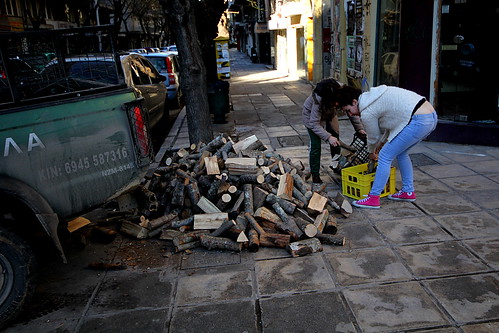
One of the symptom or perhaps better put, a victim of the economic crisis in Greece is air quality, especially in large cities such as Athens  and Thessaloniki as people switch from using heating oil and electricity to burning wood in order to heat their homes.

The government's attempt to claw in revenue by massively increasing taxation on the heating oil that used to be the staple of central heating boilers in many urban apartment blocks has seen many residents abandon them, unable to pay for the oil that fuelled them. In addition, in Greece people are wary of running up massive electricity bills and so are loathed to rely just on it for heating.

In their place many people have returned to traditional wood burning stoves which produce far more air pollution than other forms of heating and in built up urban areas have led to a serious decline in air quality, especially when combined with other sources of smog such as car exhaust fumes.

The recent bitterly cold spell in Greece dramatically brought to the fore energy poverty, yet another entry in a long list of woes that Greeks have had to face since the start of the economic crisis in 2009. Even after years of supposed bail outs and mandated economic "adjustments" (Read cuts in health, educational spending, pensions etc) the economy continues to wither and die on the vine, starved on capital and the prospect of improvement any time soon.

Snow bound Thessaloniki

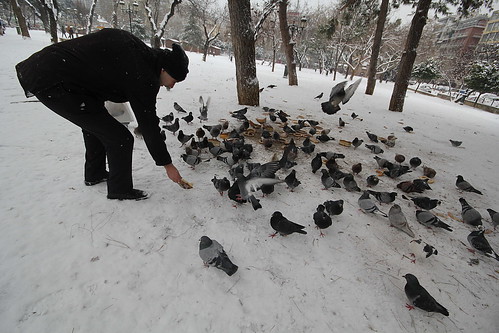
Feeding pigeons in the park

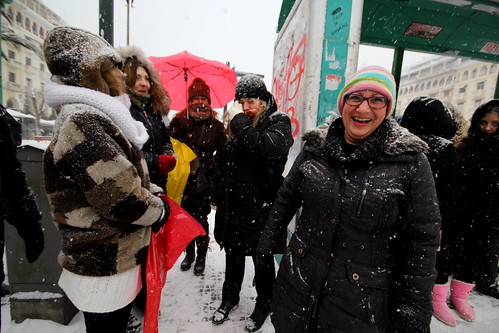
Passengers waiting for buses in snow storm

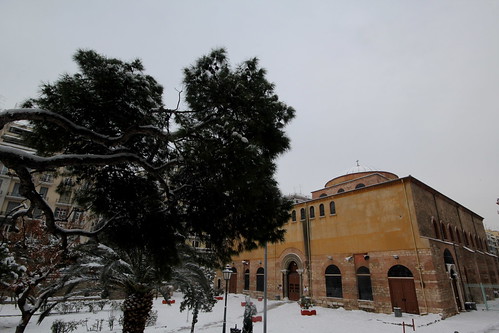
The church of Holy Wisdom - Thessaloniki, Greece

Thankfully, the worst of the recent cold snap is over here in Thessaloniki. Last week temperatures nose dived far below zero and the city was blanketed with snow for the first time in years, According to some accounts it was coldest spell Thessaloniki has experienced since the 1930s. As result many were left without heating and water as gas and water pipes froze then cracked open. To add to people's woes electricity supplies were affected in many areas, making for a particularly miserable week for some.


Monday, December 19, 2016

English for refugees - Recipe dictation and cooking together

This lesson plan is based on a idea from Teaching Adults Second Language Learners by McKay and Tom

Aim - To help refugees use cooking vocabulary, write recipes

Materials - Cooking equipment and ingredients, access to a kitchen, photocopies (see below)

Level - Elementary/intermediate.

1 - Ask students what verbs/words we use to talk about cooking. write some on the board and mime them to ensure understanding. Otherwise ask students to use smart phones for translation.

2 - Elicit words and write them on the board, use mime to ensure understanding.


3 - Hand out this photocopy from Englishwsheets.com


4 - Students copy down any words they didn't know, check comprehension.

5 - In pairs, student mime words from the photocopy and the other s have to guess them.

6 - Now explain that you are going to give them a recipe (or write it on the board) and that they have to copy them into their notebooks but some words and/or numbers will be missing. (Just choose numbers for beginner students).


7 - Read the recipe aloud and have students fill in the missing gaps.

8 - When you have finished reading have students take turns in completing the dictation on the board or in groups of 3-4

9 - Now get students to use this as a template for their own recipes, encourage them to use their smart phones to find ingredients and names of cooking equipment

10 Tell students that next lesson we will be cooking together in Oikopolis's kitchen, ask students to say who would like to cook something simple for the class, e;g salads, dips etc that take less than an hour to make. Take students on a tour of the kitchen to check that it has all the equipment they need.,

Thursday, December 15, 2016

VIDEO: Clashes between riot police and anarchists in Greek port city of Thessaloniki.


December 6 marks the 8th anniversary of the killing of a 15 year old Greek teenager, Alexis Grigoropoulos in central Athens district of Exarchia. Within hours violent protests swept the country and for weeks afterwards Greece saw clashes between demonstrators and riot police.

Every year the events is commemorated, often violently.

Video taken in Thessaloniki on 6 December 2016.

Tuesday, February 16, 2016

Refugee crisis brings racist rhetoric back into the European mainstream

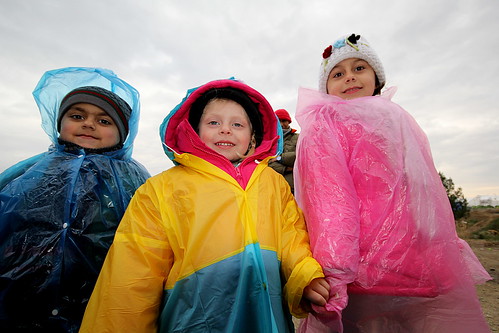
Refugee children - Idomeni transit camp, northern Greece


''The waves of immigrants threaten to turn Europe into an endless hell of Islamic terrorism"

Greek Orthodox bishop Anthimos - Thessaloniki 14th February 2016

The current refugee crisis  has awakened the very worst in Europe's collective psyche, with racist rhetoric that would have been considered unacceptable in "respectable" discourse a few years ago becoming part of mainstream political discussions. Ideas and attitudes that were once the preserve of far right extremists are gradually worming their way into media and political debate as the arrival of refugees prompts responses that often verges on the hysterical.

Bishop Anthimos, who has long been a fixed feature of the Greek Orthodox ultra-nationalist far right addressed a conference on Sunday in the northern Greek city of Thessaloniki in order to draw attention to the supposed threat of the "Islamisation" of Europe. In this he is hardly along as similar ideas are quickly gaining ground in other nations (just see Hungary's PM, Viktor Orban and the rise of the Pegida movement in Germany and elsewhere. With austerity policies making the traditional parties of power ever increasingly unpopular, many politicians have been happy to scapegoat refugees directly or ride the wave of fear whipped up by mainstream media outlets looking to boost flagging ratings and declining political influence.

With many European states willing to use heavily armed NATO warships to stem the flow of refugees in the Aegean and fund Macedonia to fence in EU member, Greece the fear of the Other so shamelessly cultivated by much the continent's mainstream media is bearing poisonous fruit, Once more Europe has shown that Fear sells, both at the polling both and the news stand.

Sunday, July 19, 2015

The story so far - Feeding refugees in Thessaloniki, Greece

Syrian refugees stranded at Thessaloniki, northern Greece

Today, I'm taking a day off, this will the second day off I've had in the last five weeks. What was once a small, part-time effort to feed refugees here in Thessaloniki has mushroomed into a seven days a week effort (see our Facebook page) that hands out cooked meals and other much needed items to anywhere between 30 and 100 refugees a day passing through the city on their way north. Even now I'm amazed by how quickly and how successfully this has taken off.

Five weeks ago it became clear that the number of refugees in need of help was far beyond the means of me and my friends and so I sent out a call for help via Twitter. the idea was that like-minded people would get together and see if we could organise ourselves and expand the help we could provide. That has succeeded beyond my wildest dreams and instead of just a couple of people handing of cooked beans in a park I'm proud to be part of a group that is able to help and information to hundreds every week.

After the first meet up, a number of volunteers are came forwards and quickly we formed ourselves into a much more effective group. I'm not sure if it was luck or good timing but along with the first wave of people to join us were those who possessed an immense range of vital skills as well as a genuine appetite for hard work. Amir, has proven to be a huge asset as he himself is from Afghanistan and not only helps with translation and cultural advice, but also other insights into what it means to be a refugee. That combined with the fact that he is an able manager meant that he kept us going off the rails, especially, in the beginning when we had the tendency to run around like headless chickens.

The same goes for Maria, a German exchange student who as well as bringing much needed structure to our group, has also been its calm centre when things threatened to grow too chaotic. That combined with her gift for languages, social media skills and ability to forge links with other, similar groups has been invaluable.

Giannis is a 70 year old Greek pensioner who catches two buses just to get to the centre of the city to help us. His passion and knowledge of the local political landscape proved vital in establishing links with and getting help from Thessaloniki city council. Thanks to his and other people's intervention the city has provided toilet facilities to refugees and 50 portions of cooked food a day along with a van and driver to assist us.

Another source of assistance has been our collaboration with the Oikopolis social centre who on hearing of our work opened their kitchen facilities to us. This along with the network of connections that have at their disposal has transformed our efforts. In addition to material help they have been able to put us in contact with other groups doing similar work in the city.

After the initial wave of people joining us with have also been lucky enough to attract other volunteers who make all this possible and often are lugging things in 35C summer heat. Literally, without them none of this would be possible. They are an international bunch and on any given day there may be anywhere between four and eight different nationalities taking part.

The ever tireless Gorka, a Spanish exchange student, Marina , from the Ukraine, also on an Erasmus program, Nikoleta, a first year psychology student who is a also a dab hand at DIY and organising people, Safar, our second Farsi speaker who is always willing to do whatever is needed, also willing to make sure the job gets done., Jason and Marcus, our Irish friends who have really been great in providing help, the wonderful people from Anatolia College who have regularly brought much needed sanitary items and clothing,... This list goes on and I know I have left out people who should be mentioned, but don't worry, over the next few days I'll be filling in the missing names.

To say the last few weeks have been transformative is an understatement, the fact that we not only got this feeding program up and running but in the midst of a crisis here in Greece is a testament to the strength of people's willingness to help.

Thursday, June 11, 2015

Take the Starbucks challenge! Can you feed 30 refugees for less than price of a coffee?

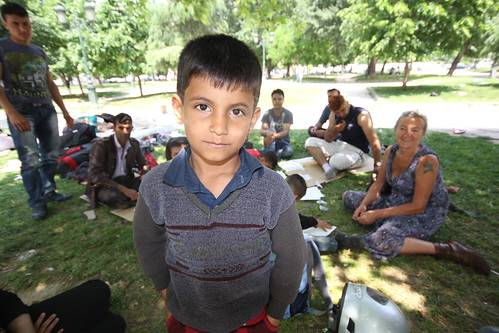
Refugee kid in the park. Taking a break before moving north.

Modern life is tougher than ever and full of a seemingly endless list of First World Dilemmas; domestic or imported beer, Chinese or Italian, Starbucks mocha double latte with added cream or feeding 30 hungry refugees. So here is the smart guide to having it all, a clear conscience and a decent meal for hungry kids camped out in your local park and all for less than cost of a coffee that has more calories than visible stars in the sky.

For this you will need a few things organised in advanced, other than the ability to give a damn about fellow human beings not mentioned in the gossip columns.

1kg of dried white beans (approximately 1.19e from Lidl)
1kg rice (1.20e) from Lidl)
3 cans of tomatoes (3x0.37e) from... guess where)
1 cartoon of concentrated tomato juice or small tin of tomato paste (0.40e)
4 large onions (0.60e)
8 cloves of garlic 0.20e
1 chilli pepper or a few pinches of chilli powder (0.10e)
1 large zucchini/courgette (0.25e)
loads of green peppers (optional)
1 cup of olive oil (0.40e)
1/2 cup of cooking oil (0.15e)
salt/pepper/oregano/bay leaves/sugar.

Total cost is less than 6 euros. That's not a bad deal on 25-30 portions.

Alas, nothing is ever as simple as it appears in the ads on TV so will need to prepare a few things in advance, so in keeping with that thought you will need to soak the beans overnight (add a tablespoon of baking soda to the water). You could just buy beans in a can but then cost increases even more exponentially than Greece's debt repayments.

Basically, you are making two one pot dishes so will need...... wait for it..... two pots. The one dish is the traditional Greek bean soup known as fasolada, the source material nationwide for endless fart jokes since the time of Plato. The other is a fusion/hybrid/bastardised rice dish designed to provide carbs as cheaply whilst still being edible.

Fasolada recipe

1 Wash the beans well and then add enough water and level tablespoon of salt to cover them, just
    like you would cook rice.

2 Boil till they're kind of soft, which may be between 1-2 hours depending on whether the 
   beans are big or small. (you may need to add more water)

3 In your other pot add 1/2 cup of olive oil (doesn't need to be fancy extra-virgin stuff).

4 Gently fry 3 thickly sliced onions till they are translucent.

5 Add half the chilli pepper/powder and 6 cloves of garlic chopped/crushed/grated/ atomised

6 Cook for few minutes more then add 3 cans of tomato and 1/4 of the tomato paste/concentrated 
   juice, along with a tablespoon of sugar, teaspoon of salt, handful of oregano and 4-6 bay leaves

7 Cook gently for another 10-15 mins.

8 Put aside till beans are cooked or at least not rock hard.

9 If you can put the tomato mix in the blender and give it a whizz, Makes for better presentation and 
   easier to serve.

10 Add the tomato mix to the beans and cook on a medium/low heat for another 20-30 minutes.

11 Add the remaining 1/2 cup of olive oil along with more salt/pepper to taste.

How do I know it's ready? Well, the beans shouldn't break a tooth and the sauce should be fairly thick, but that's a matter of personal preference.

Refugee rice 

I call it that as I had to think of something quickly this morning when I went to the park and saw that my fasolada dish was nowhere near enough to go around.

1 Slice thickly 1/2 onion and whatever softish vegetable (eg. courgette/zucchini, peppers) are 
   cheapest or in your fridge and gently fry them in 1/2 cup of cooking oil.

2 After onions have gone translucent, add the remaining chilli pepper/powder and  2-3 cloves of 
   garlic chopped/crushed/vapourised. Cook for a few minutes.

3 Add 1kg of rice (your choice) and gently fry for a few minutes.

4 Add tablespoon of salt and sugar along with 2 two and a half times much water as rice.

5 Bring to the boil and after turning it down to a milder setting add the remainder of the tomato 
   concentrate/paste.

6 Cover and leave for 10-15 minutes.

Now you have a recipe that can feed approximately 25-30 people and all for less than the cost of a coffee that frankly, tastes crap.