Showing posts with label PASOK. Show all posts

Wednesday, January 28, 2015

Greece wakes up to a different world.


By all rights the world, at least that corner of the world that is forever Greece should be in tatters, the the entire nation in ruins, or at last teetering on the edge of the abyss. Sorry for the hyperbole but that's what happens when you follow too much of the media coverage of Syriza's unprecedented election victory on Sunday. For those unfamiliar with modern Greek politics for the first time since the mid 70's neither the conservative New Democracy or the nominally centre-left Pasok party will be in government. It is as if USA had just elected a president who was neither Republican or Democrat or that the UK was now governed by the Green Party.

The electoral self-immolation of Pasok along with growing disenchantment with its right wing coalition government partner New Democracy drove away voters who in other eras would never have countenanced voting for a party as avowedly left-wing as Syriza. In doing so they have changed the political landscape more radically than at an other time since the fall of the military junta what ruled Greece till it was toppled in 1974.

Voters, sick of austerity and the endless succession of promises of recovery being just around the corner made by a political elite widely seen as out of touch abandoned the dominant parties to vote for Alexis Tsipras's Radical Left Alliance. Even the weeks of scare mongering by the government and its allies in the media proved insufficient to convince voters to give prime minister Antonis Samaras the mandate he needed to stay in power.The daily predictions by Greek and EU officials of a Grexit, bank runs and even the possibility of a collapse in the economy so dire that ordinary people would not be able to buy even basics such as toilet paper failed to win back lost ground.


However, this  switch in allegiances had less to do with a general surge in sympathy for radical leftist ideas than with a groundswell of disgust with the politics of business as usual which have left many Greeks jobless, poorer and without hope for the future. The siren call of stability which the PM promoted so hard during the short but divisive campaign cut little ice with those who desperately need to see real change and not just endless talk of improvement in the the nation's 10 year bond yield or its standing with credit rating agencies such as Standard and Poors.

Since the the announcement of Syriza's victory on Sunday evening, the political developments have been coming thick and fast. Lacking the 151 seats needed to form a government on its own Greece's new prime minister, Alexis Tsipras brokered a deal with the right-wing Independent Greeks party to form a coalition. The announcement, which was made at midday Monday suggests that neither side was surprised by the offer and that the groundwork had been laid in advance, so catching off guard the other opposition parties who had assumed that the search for a partner would be a long and convoluted process, or even the prelude to another round of elections.

The choice of Independent Greeks has surprised many observers, especially those abroad who find it hard to comprehend a partnership between a radical socialist party and a conservative nationalist one, Yet for Syriza this constitutes the least worst choice given the options available. The most obvious candidate for coalition partner would have been the Greek Communist Party (KKE) but anyone even vaguely aware of Greek politics would have known that such an alliance would have been impossible as KKE would never compromise on its own leftist principles which include leaving the European Union, the Eurozone and NATO.


Others may have considered a partnership with PASOK (well, the S does stand for Socialist) would have been a better fit, but once again the party's role in imposing austerity plus its identification with the country's corrupt political elite would have proven unacceptable to Syriza rank and file, not to mention the fact that it would have instantly damned Tsipras in the eyes of voters seeking change.

The other likely partner for many analysts would have been the recently formed Potami (River) party headed by ex -TV presenter Stavros Theodorakis who's attempt to carve  out a centre - left niche for themselves in the Greek political landscape made them a good match for Syriza, at least on paper. However, this was never really on the cards for a number of reasons. Theodorakis, whose party's funding and basic policies still remain a mystery is widely seen by the Left as a stalking horse for Greece's oligarchs, a front for the vested interests that have been forced to abandon the traditional parties of power. To give Theodorakis the political equivalent of a "kill switch" would have not been acceptable.

So, in the end Independent Greeks who are often painted as a collection of right wing conspiracy theorists and borderline racists (imagine UKIP a la Grecque) made the cut, a decision that has already been condemned by many on the Left, both inside and outside Greece (for an account of why this is so, I recommend this blog post). However, the party led by Panos Kammenos repeatedly made clear its opposition to Troika imposed austerity measures and its participation will perhaps assuage more conservative Greeks that issues such as defence and policing will not be solely decided by a bunch of "wild radicals". It's also an admission that much of Syriza's support is not from those who traditionally identify themselves as left wing, let alone radical socialists.

Above all, such an alliance allows Syriza to implement policies which will be popular with voters and build up a more solid base ahead of any confrontation with Greece's creditors who seem unwilling to back down on the issue of debt renegotiation.

Tuesday, January 20, 2015

PASOK leader on the campaign trail


Evangelos Venizelos, leader of the Greek PASOK party about to address supporters ahead of next weeks elections. The audience was dominated by the party's ageing party base, with those under 40 being a distinct minority.

Thursday, January 08, 2015

Greek elections - state of play so far


The Greek national election campaign is now well under way and all parties involved have started their campaigns, both on the road an in the media. The Greek prime prime minister, Antonis Samaras kicked off New Democracy's efforts with a televised rally in a hotel in city of Larissa, almost immediately followed by SYRIZA leader's rally in a stadium in Athens. The contrast could not have been greater, while the prime minister gave a lacklustre performance which meet with lukewarm response, even among party faithful, Alexis Tsipras on the other hand showed just how far he's come as a public speaker, both energising the party base with his speech and showing that he was clearly setting himself out as a national leader.

In the meantime, coalition party leader Evangelos Venizelos addressed PASOK party members in a cafe, reminding viewers that the glory days of the party when they could attract crowds numbering hundreds of thousands were well and truly over.

To add to the uncertainty surrounding the most unpredictable Greek election in years, ex-prime minister and once leader of PASOK Giorgos Papandreou announced his formation of a new party, The Movement of Democratic Socialists in the same period, a move that was quickly condemned by the current PASOK leader as "irrational and unethical". Some media outlets were even predicting, rather generously as it would later turn out, that the new party would garner anything up to 6% of the poll, so allowing it representation in parliament.

New Democracy's campaign which as being spraying the internet with banner ads and pop up non-stop since the day of the vote for president has been focused on playing on fears of ordinary Greeks that a SYRIZA victory would be tantamount to an exit for the Eurozone, even the the European union itself. 

The talk of Grexit cultivated by the Samaras and echoed by pro-government TV stations and newspapers has spooked markets and led to a number of European officials to back track and say that such a contingency is out of the question. However, such denials did not stop prime minister repeating such threats in his speech on Tuesday in the northern city of Komotini, though latest news reports seem to indicate that the party's campaign will change direction and now focus on the government's track record in power.

As part of this change in tack it seems Samaras is willing to use the even more incendiary topic of immigration, even the tragic deaths of the 12 people killed in the Charlie Hebdo shooting in Paris on Wednesday were used by him in order to attack SYRIZA's immigration policies. In his speech in Halkidi he said, 

"There was a massacre today in Paris yet some people want to invite more illegal immigrants and hand out citizenship"

This campaign promises to be the dirtiest in years, and as if to underline the point the prime minister and other senior New Democracy figures were eagerly using the deaths of the victims in Paris to drum up votes for their party which has consistently been behind the polls over the last few weeks. Whilst some surveys have put SYRIZA anything up to 7.5% ahead, most seem to agree on a 3-4% lead for Alexis Tsipras's Radical Left party, despite the fact that they are facing an almost uniformly hostile mainstream media inside Greece and to a large degree abroad.

If such figures prove accurate this mean that SYRIZA will be unlikely to elect the 151 MPs required to have a majority government in Greece's 300 seat parliament and so will probably need to form a coalition with one or more of the smaller parties vying for power. This is where the waters muddy and accurate predictions of what will happen on election day and afterwards become less certain. All the other parties who could be in parliament are polling between 6 and 2% which given the margin of error present in such cases means any meaningful estimation of how seats will be distributed is difficult.

However, some guesses can be made. It would seem sure that KKE (Greek Communist Party) will once again get 4-6% and so about 12 seats as it did in 2012. Whilst KKE has not been able to exploit the economic crisis in order to widen its base, it's party organisation and strong campaigning abilities mean that the party faithful will turn out and support them. Likewise Golden Dawn's support in the polls has remain steady at 5-6% despite the jailing of most of it leadership on criminal charges pending trial. Despite almost singularly negative press coverage there remains a hardcore of voters who are willing to vote for them, no mater what.

On the other the once might PASOK party was in the throes of a major meltdown, even before the announcement of Papandreou's new party which is likely to drain what is left of its popular support among older voters. Latest polls show PASOK at between 3 and 5% and the Movement of Democratic Socialists at 2-3%, though there is a possibility that neither will break the 3% barrier needed to gain a seat in parliament. The situation is not helped by high level defections from PASOK to other parties. Today, PASOK cabinet minister Angela Gerekou announced she would be standing on a New Democracy ticket in the next elections.

The other major unknown is the amount of success the Potami (River) party will enjoy,set up last year by a former TV presenter with the oligarch owned MEGA TV station, Potami has been built up as a centre - left alternative to SYRIZA for those unhappy with PASOK's record in power. Currently, it is polling 5-7% and seems on track to be the third largest party.

Other parties such as the far light LAOS and the centre left Democratic Left party who once were government coalition partners have paid the price for pushing through deeply unpopular austerity measures and seem unlikely to win even one seat in parliament. Even the Independent Greeks party once seen as a viable centre right alternative to New Democracy is struggling to reach 3%

(It should be noted though that Greece's pollsters have proven notorious political in the results over the last few elections and so any results should be taken with a pinch of salt, and the political affiliations of the news outlets that commission them should be taken into account).

Whatever the final outcome, it seems SYRIZA may need allies, but this is where things get complicated. A first glance the most obvious coalition partner would seem to be KKE but this is extremely unlikely given the deep ideological gulf that divides them. The insistence of KKE's party leadership on maintaining ideological purity in the face of siren calls of power is unlikely to disappear soon.

A partnership with either a rump PASOK or Potami also is not without risks and threatens to split SYRIZA which till very recently was a loose coalition of leftist parties, many of who are far to the left of the Tsipras leadership and would view such allies with the deep suspicion, seeing them as the agents of the establishment seeking to worm their way back into positions of power and responsibility. 

Finally, there is a possibility that no government may be formed and so Greece may have to go to the polls again. Such a move would definitely make the nation's creditors deeply uneasy as it would raise the spectre of default over debt repayments due in 2015. 

Thursday, May 29, 2014

Greek 2014 election results - a post mortem


First of all, let's get the apologies out of the way. In the run up to the Greek EU and local elections I predicted that the results might bring about major changes in the Greek political scene, even perhaps national elections. Nothing of the sort happened, the coalition remains in power as do the leaders of both New Democracy and PASOK. So how did I get it so wrong?

I had assumed that the weakest link in this particular chain would be the PASOK vote and that a dire poll result for them would signal the end of deputy PM and party leader Evangelos Venizelos. Venizelos, himself had publicly announced in the weeks leading up to the elections that anything less than a 10% share of the vote for his party would destabilise the coalition, hinting that the party might withdraw form power. The fact that PASOK hasn't polled as high as 10% for years seemed to reinforce the impression that changes were on their way.

Throughout the months prior to last Sunday's vote Greek opinion polls consistently underestimated the PASOK vote, most putting it between 5-7% (they received 8% in the EU vote) and since pollsters have historically always been more lenient towards parties in power I, and many others assumed that the final tally could even be lower. It was a sentiment further strengthened by PASOK's dire showing in the first round of the Athens and Thessaloniki municipal and city elections.

Also the fact that PASOK made almost no effort to advertise or campaign during the elections and even went as far as changing their name to Olive Tree (Elia) just added to the impression of a political organisation on the verge of collapse. Unlike 2009, there were none of the mass public rallies that used to, until recently, be the hallmark of Greek campaigning.

With New Democracy the issue was never one of collapse but rather how wide the gap would be between them and SYRIZA, by May even the most pro-govt pollsters could no longer hide the fact SYRIZA was pulling ahead, the question was by how much. Poll figures which were notoriously inaccurate  in 2012 had to be taken with a pinch of salt. The dream result for SYRIZA would have been one in which their share equalled or exceeded the combined vote of the coalition parties. Then, opposition leader Alexis Tsipras could claim that the government no longer had a popular mandate and therefore demand national elections. In the end neither happened.


New democracy lost by less than 4% and so prime minister Antonis Samaras could sell the defeat as the inevitable price of imposing difficult, but necessary reforms mid-term. Venizelos could argue that the results showed that the fall in popularity PASOK has suffered since the start of the crisis has been halted, and even reversed. In both cases the party base could be mollified with the idea that while not great the outcome could have been far worse.

So business as usual? No, I said that these elections marked the end of an era and that still remains true as the political landscape today is radically different form the one in place during the last European parliamentary elections in 2009. Then both PASOK and New Democracy were unassailable electorally, able to attract tens of thousands to their public rallies. Giorgos Papandreou and then prime minister Kostas Karamanlis could speak in public and mingle with party supporters would give them the kind of reception usually reserved for teen idols such as Justin Bieber. Between them the two parties garnered 70% of the vote and sent 16 out Greece's 22 MEPs to Strasburg. In 2014 most public rallies were marked by small turnouts and extremely tight security measures, the coalition's share of the vote had dropped to 31% and just 8 MEPs.

PASOK has lost much of its clout in the cities, where previously it had been entrenched, replaced by SYRIZA mayors and councilors. On the other hand the Golden Dawn vote  remained high and has weakened New Democracy, despite almost entirely negative press and a legal crackdown on its leadership. Even with no positive TV exposure, the antipathy many conservative voters feel towards the present government outweighed misgivings over Golden Dawn's true identity. Nor was this move right limited to those neighbourhoods hit hardest by job cuts, even in the upscale central district of Kolonaki, Athens, home to many foreign embassies Golden Dawn polled 13.7%.

With popular support at an all time low and a yet more austerity measures set to be imposed the Greek government's slim majority is coming under ever greater pressure, especially as despite all claims to the contrary the real economy is not improving, unemployment refuses to drop from record highs , trade deficit is climbing and the debt continues to balloon in size. While the national leadership may be congratulating themselves on retaining power, the wild last-minute assurances of vast numbers of new jobs and more foreign investments will come to haunt them in future clashes with the opposition who will seize upon such broken promises that the current political elite cannot be trusted.

Nor can such anger be put down as simply a local protest, the elections results across the EU have shown that problems austerity is creating has created a groundswell of resentment against not only national elites but also those operating in Brussels.


Monday, May 19, 2014

Greek Elections: Round One


With the first round of Greece's city and municipal elections over the government coalition parties and the opposition have being trying to persuade the public that they were the winners in yesterday's vote. However, unlike parliamentary or EU elections the conclusions that can be drawn are not so clear cut for a number of reasons.

First and foremost, local election results in Greece, as in the rest of the world are just as likely to be influenced by local issues such as rubbish collection, state of the roads etc. as they are by the party affiliations of the candidate. This mean clear comparisons between these results and national ones cannot be made so easily, for example in Greece's two largest cities, Athens and Thessaloniki independent candidates came first, but in Crete PASOK retained its lead in the municipal elections and conservatives aligned with New Democracy did very well in Macedonia.

Also the fact that many candidates stood as independents or as members of parties that have no clear affiliation with the national ones also makes more general conclusions difficult to make. While in the big urban areas the candidates favoured by the parties are easy to pick out, in other regions the connection, if any between local political groups and candidates and the national parties is less clear to many voters.

Finally, only one fifth of the contested positions have been decided, the rest will have to wait for the second round next Sunday.

The Guardian talked about an anti-austerity backlash and In Athens and Thessaloniki mayoral elections the candidates supported by New Democracy and PASOK fared badly, though how much of that was due to anti-government sentiment and how much was due to less than stellar contenders is hard to say.

However, all these caveats aside a picture does seem to be emerging that confirms recent opinion polls that SYRIZA is gaining strength and that candidates identified with parties that make up the coalition government. are losing support. The fact that the party has made gains in the urban areas is more proof that its is no longer just a raggedy band of protesters and stands poised to replace PASOK as the main opposition party on a permanent basis. Once PASOK loses its stronghold in local government then its ability to keep intact a party machine that depends more on patron client relations than it does on ideology is severely compromised.

New Democracy's position also seems to be under threat, not only from SYRIZA on the Left but Golden Dawn on the right. Despite the fact that much of leadership is behind bars facing criminal investigation, the neo -Nazi party's level of support was back to 2012 levels. Even in chic upmarket neighbourhoods such as Kolonaki in central Athens, they won 13.7% of the vote, in other poorer districts it topped 20%.

The prime minister's campaign strategy of pulling to the Right and co-opting the rhetoric and policies of Golden Dawn seems not to be paying off. Nor has the anti-Golden Dawn media coverage in the pro-government press seemed to have driven away voters.

The May 25th EU parliamentary vote will give a clearer picture of where Greece's parties stand in the eyes of the electorate when the contenders will be standing on party tickets for the 22 MEP seats. In 2009 PASOK and New Democracy won 15 of those, but this time around they'll be lucky to get half that number and there is a good chance that PASOK will get just one seat.

Already SYRIZA is promoting the idea that the EU vote is a referendum on austerity itself and that a poor showing by the government will mark the end of its popular mandate and so be the reason to hold new national parliamentary elections. On the other hand both prime minister Antonis Samaras and deputy prime minister, Evangelos Venizelos are calling upon supporters to vote for the coalition in the name of stability and so as to save a fledgling economic recovery.

My prediction for next week's EU vote is;

1 SYRIZA 20-25%
2 New Democracy 18-23%
3 Golden Dawn 8-10%
4 Potami (River)  6-8%
5 KKE (Greek Communist Party) 4-5% and Olive Tree (PASOK) 4-6%

Wednesday, May 14, 2014

Fear and Loathing on the Greek Campaign Trail


If you took away the cordon of riot police surrounding the building, you could be mistaken for thinking you'd stumbled upon the annual conference of South Jersey importer and exporter association sponsored by a fraternal organisation with its roots in Southern Italy. Made men with large cigars and even larger bellies flowed out of the hall and in between them mingled guys who looked like they made their living doing door duty in third rate provincial "nightclubs. All wearing shades, all unshaven, all willing to take offence at anyone whose gaze lingered upon them any longer than was absolutely necessary.

The latest stop of the PASOK party's 2014 EU election campaign had rolled into town, not that anyone apart from the party nomenclature and a few dozen protesters had noticed. Instead of the mass public rallies that in the past attracted hundreds of thousands of the party faithful, Sunday's event was a part of the new trend towards stealth electioneering, attended by a few hundred local functionaries behind closed doors and lines of riot police.

This is in sharp contrast to the campaigns I witnessed in the late 80's and 90's in which leaders of both the socialist PASOK and the conservative New Democracy parties could count on huge turnouts that would flood the centre of Greece's cities, literally a sea of people as the Greek saying goes. People were gripped by an almost religious fervour and you would have thought rock stars had come to town rather than elderly politicians. However those days have gone and in all likelihood will never return, the victim of changing times and most lately, the six year long economic crisis which is proving as severe as that suffered by the US in the Great Depression. 


The ongoing commitment of successive governments to spending cuts, public sector job losses and tax hikes have all but destroyed PASOK and severely wounded its traditional rival, New Democracy. (PASOK, which is now calling itself Olive Tree is now polling between 10 - 15% of its 2009 strength and new Democracy share of the vote has been cut by half). The leaders of both coalition parties dare not risk public appearances unless they are held incognito or under the tightest security, outdoor events having been replaced with tightly choreographed televised shows as is the case with prime minister Antonis Samaras's rare public outings.

The latest revelations in the Financial Times about how EU leaders egged on the then finance minister (and PASOK leadership rival) Evangelos Venizelos to depose Greece's prime minister, Giorgos Papandreou in 2011 after he proposed a referendum on the terms of the bailout deal has just added to public mistrust of the country's political leadership, widely perceived to be more interested in preserving their own hold on power than defending national interests.

Such a feeling is likely to drain still further support for both government parties and make the chances of the coalition staying intact still less likely. With goes the two party system which has dominated Greek politics since the 1980's and a network of corruption, pork barrel politics and crony capitalism which led the country into its present dire state.

Monday, May 12, 2014

Where Have All The Flags Gone? The End of Days For Greece's Post - Junta Political Order.


At least till recently Greek election campaigns have been vibrant. rambunctious affairs, marked by mass public rallies, a barrage of ads on TV and the kind of political theatre long since extinguished in Northern Europe. Yet this year shows that whilst Greece may be steeped in tradition, it has also a long history of radical change and re-adjustment, a legacy of its traumatic modern history which has seen the small Balkan nation undergo invasion, civil war, famine and spectacular economic growth and decline.

In contrast to 2009's hard fought EU election campaign, the current run up to the dual local and EU parliamentary votes on 18th and 25th May have been so low key as to be practically invisible. Gone are the constant TV ads and posters on every major thoroughfare. gone are the large scale public rallies that used to be the trade mark of both New Democracy and PASOK parties.

So why the reticence on the part of a political caste whose one guiding principle is to stay both in power and the public eye? Partly, it is financial, New Democracy and PASOK are bankrupt in all but name, owing between them 250 millions euros to the banks and as their State funding is linked to electoral prowess their steep decline in support means they have little chance of returning to solvency. State allocation for campaign spending (of which PASOK and New Democracy got the lion's share) which reached 65 million Euros in 2010 has now been reduced to 7 million and with so little cash the lavish outlays that allowed Greece's two largest parties to outspend on a massive scale their political rivals has disappeared.

Partly, the anemic campaign is for reasons of self - defence. Ruling politicians are so detested by many of their voters that any kind of large public gathering is next to impossible unless  the image politicians want to project  is one of anger and discontent. Brave is the government minister who'd appear in public unless in front of a crowd of heavily vetted party loyalists. Whilst opposition parties such as SYRIZA and KKE (Greek Communist Party) will be holding outdoor rallies neither the prime minister nor deputy PM dare risk such a move, fearful that they'd be faced with a sea of hostile faces live on TV.


Case in point has been the election campaign of PASOK leader and deputy prime minister, Evangelos Venizelos. Appearances so far have so been held behind closed doors in meetings held for hard core party cadres rather than rank and file supporters. In each case demonstrations by sacked public sector employees and other disgruntled groups means that such events are marked by high levels of security, further heightening the image of a political elite cut off from the rest of the nation.

For the prime minister's New Democracy's conservative party the picture, whilst not pretty, is nowhere near as dire as that of PASOK but they too are saddled with massive debt load which has severely curtailed their spending. Though much of the mainstream media continues to support them,  a serious decline in TV ratings for the most partisan pro-austerity channels and the collapse in newspaper readership has lessened their ability to set the political agenda.

While the polls show wildly divergent predictions for the results, two things can be widely agreed upon; firstly, that even the support of the country's oligarchs may not be enough to avert SYRIZA becoming the largest party in EU elections (local election results are less easy to use as an indicator for national party support as candidates are forbidden by the constitution to run under national party tickets,). And secondly PASOK will be wiped out, lucky if it elects even one euro MP. A long, inglorious fall from the time it dominated post Junta politics in the 1980's and 90's.

If the results prove particularly disappointing for government coalition partners then there is most likely to be quick and fundamental changes in the party leaderships as different groups vie for power and seek to avoid loss in support.


Venizelos has already warned that anything less than 10%  share of the vote for PASOK Now renamed Olive Tree) will threaten government stability. A strange statement given that the party has not polled as high as 10 percent in years. Nearly all polls show that likely their share will be  be between 3 and 7 percent and that even their recent name change will do little to avert the inevitable

The prime minister is faced with a similar dilemma as a severe defeat at the polls will weaken his position and give ammunition to internal opponents already unhappy with his promotion of far right elements to top party and government posts. Many are suspicious that once again Samaras will lead New Democracy to electoral defeat as he did in the mid 90's when he left the party to set up Political Spring, an act many Karamanlis loyalists still see as an act of betrayal.

The fact that the Greek supreme court has ruled that Golden Dawn can run for elections despite the fact that many of its MPs are facing criminal charges. Must give New Democracy even more reason to fear defeat as both parties have been actively cultivating far right polices in the hope of winning ultra-conservative voters. Problem is that unlike Golden Dawn, the prime minister's long series of u-turns and policy flip flops have disillusioned many on the Right.


Golden Dawn may have been vilified by both local and foreign press for its racist activities,  but there are still many Greeks who will use the party as a vehicle for their anger at the existing political set-up, which is widely perceived as both corrupt and out of touch. Even the media campaign that followed the fatal stabbing of activist rapper Pavloss Fyssas by Golden Dawn members has ended up backfiring as the pro-government stations fall victim to their desire to  please political goals of their owners at the expense of credibility.

The arrival of the Potami - River party formed by former journalist Stavros Theodorakis promises to make firm predictions over the exact result even more difficult. Theodorakis recently set up the party as  non-political alternative to the traditional ones of Left and Right. Initially polls showed support as high as 15% but since then these numbers have dropped significantly especially as questions of how the party has been financed remain unclear and the fact that he was till recently a senior reporter in the pro-government MEGA channel.

However, whatever happens the political landscape forged in the aftermath of the Regime of the Colonels in the 70's is now almost at an end; PASOK, the child of left wing firebrand Andreas Papandreou is all but spent as a major political force, a victim of its adherence to hated austerity policies.


Their eternal rival, New Democracy, also created in the ashes of the Junta is riddled with dissent and after six years of grinding economic decline caused by austerity. Even among the party's core demographics the cuts in pensions, endless list of taxes on property and spending cuts have taken their toll with levels of support now at less than half those of pre-crisis elections.

Finally, next Sunday's vote also marks the death knell for the family dynasties that dominated so much of public life in modern Greece, the latest generation of Karamanlises Mitsotakises and Papandreous both took the reins of power riding to victory on name recognition and achievements of their father's and grandfathers, only to be found wanting as the crisis upturned so many of Greece's political shibboleths.

Konstantinos Karamanlis (nephew of New Democracy founder Kostas Mitsotakis and nephew of previous prime minister Konstantinos Karamanlis) won two terms in office but left behind a heavily indebted economy and a party image battered by string of corruption and influence peddling  scandals.

Similarly, Giorgos Papandreou's (son and grandson of previous Greek prime ministers) time at the helm was no less disastrous than his equally privileged predecessor, faced with an unprecedented economic downturn his vacillation turned a major setback into a full-blown meltdown, eventually leading to him being deposed in a "palace" coup by Evangelos Venizelos when Papandreou threatened the EU and IMF with a referendum over austerity.

Though neither will be missed by most voters, like so many failed leaders of the past they hang on like Banquo's ghost ever ready for a call from the Greece's voters to come back and save the nation. It's a call they are unlikely to receive.


Sunday, May 11, 2014


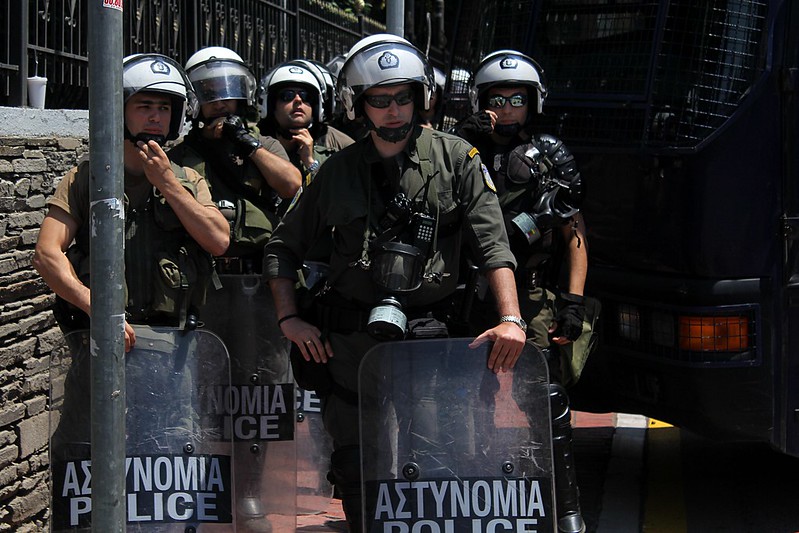
Riot police units in the northern Greek city of Thessaloniki deal with protester outside election meeting for the government coalition party ,PASOK.

Sunday, April 13, 2014

Angie Through The Looking Glass - Merkel visits Athens

Greek recovery is back. The news story that refuses to die no matter how many times the predictions are debunked.


Photo I took during Merkel's 2012 visit to Athens.

Once again the world's press and a large chunk of the nation's police force descended upon Athens in anticipation of the visit by German chancellor, Angela Merkel to beleaguered Greek prime minister, Antonis Samaras.

Bathing in glow of German praise for his government's austerity policies and the a successful five - year bond auction the fragile coalition government and its supporters in the the media were certain that this marked the end of a six-year economic downturn that has not been seen in a developed European country at peace since the Great Depression. Nor was such optimism limited to local reporters and analysts, foreign outlets such as the BBC also waxed lyrically that Greece had finally turned a corner.


Alas, as with so many similar predictions made in 2009, 2010, 2011, 2012 and 2013, the facts, on closer examination do not bear out the basic assumption that a successful bond sale signals growing confidence in Greek economic performance and hence represents the end of the downturn in the real economy. Unemployment still remains high at 26.7% and 20% of those in employment remain unpaid for at least three months, often for much longer. Exports have dropped and GDP is still more than 25% less than it was in 2008. The government is mired in scandal over its connection with Golden Dawn and during the last austerity vote saw it's parliamentary majority drop to just one MP in the 300 seat house.

As if to underline the growing sense of unease, a massive car bomb went off outside the Bank of Greece building in central Athens a day ahead of Merkel's visit. Although police were quick to claim it was probably the work of anarchists, the sophistication and scale of the attack is completely unlike the kinds of attack such groups usually carry out. As yet no individual or group has claimed responsibility.

Yet none of this could puncture the joint Hellenic-German display of  mutual appreciation on display, and to make sure that that would remain so 5000 police officers were on duty to enforce a ban on any form of demonstration in the centre of the Greek capital. Strange that a leader who compared the NSA with the East German secret service (Stasi) for tapping her phone had nothing to say with a display of state strength that Erich Honenker would have gladly approved of.

In keeping with the authoritarian spirit of the day, the Greek state run press Agency APA doctored the chancellor's speech, deleting all reference to austerity in their translation which was released to the local press. Unnecessary given that both state and private broadcasters (which are owned by country's oligarchs with close ties with the ruling parties) went to extraordinary lengths to make sure the prime minister's version of events got as wide and uncritical a hearing as possible.

On  the other hand reactions to Merkel's appearance in Athens on Twitter were almost universally negative, with many comparing it to the visit of a monarch to a newly acquired colony and seething at the revoking of basic civil rights for the duration. Abroad, financial analysts were less giddy with excitement over possibilities of a Greek recovery given that fact that none of the economic fundamentals which are crushing development have changed.

So what was the point? Economically almost none, but politically the return of Greece to the money markets is being sold as a indication that the austerity policies which have brought many European economies to their knees is finally paying off. This is a message we are going to be hearing repeatedly over the next few weeks as EU countries go the poll to vote in European parliamentary elections in May and while this media narrative may play well in Germany throughout the rest of Europe the response could be more muted.

Usually, EU elections are marked by indifference both among the public and the media, but given the growing unpopularity of parties implementing austerity and the rise of the far Right this year's vote is the nearest thing the continent will have to a referendum on the dominant austerity narrative. In the UK, the Conservative/Liberal coalition government is nervously facing the prospect of a spike in UKIP support at their expense. Hollande's position in France would also be seriously weakened if he has a repeat of the debacle his party suffered in the recent local elections.

As well as EU vote Greece will also have local elections in May and the reality is that it will mark the end of a political era with PASOK being ousted from power in many districts, a fall from political grace that has seen its share of the vote drop from 43% in 2009 to around 4%, if recent polls are to be believed. That will probably signal the downfall of deputy PM and PASOK  leader Evangelos Venizelos's time as party leader, even his blustering, bullishness will not be able to keep in check anger at how the party has been destroyed by its leadership's commitment to austerity policies.

Similarly, the prime minister's New Democracy party is also growing restless, unhappy with the coterie of far right advisors and politicians that surround the leader, also worried that they too, may eventually suffer the same fate as PASOK as their power is challenged by SYRIZA on the left and Golden Dawn of the right. A poor showing in May elections may also trigger a challenged to Samaras's leadership.

This is why the visit of Angela Merkel and the bond auction was so vital to a political leadership, desperate to convince the public that despite all the evidence to the contrary the Greek economy is on the right track. Whether this will be transformed in votes in the polls is another matter.Putting aside the growing anti-German sentiment in Greece, the statistics and indicators being used by politicians and media to make the case for recovery are, at best tangential to the everyday struggle for survival many Greeks face. Spreads, yields, and bonds will not make finding a job any easier, reduce skyrocketing tax bills or stop the flood of young people leaving the country.

Friday, April 04, 2014

All The Prime Minister's Men - Top aide to Antonis Samaras reveals his close ties with Golden Dawn


Perhaps one of the worst kept secrets in Greek political life came to light when Golden Dawn MP Ilias Kasadiaris released a video (transcript in English here) which revealed just how close the party was to Takis Baltakos, cabinet secretary to both the prime minister, Antonis Samaras and Deputy PM, Evangelos Venizelos. The tone and content of the conversation underlined what many had suspected that instead of being stalwart foes, the ruling New Democracy party and the avowed political outsiders Golden Dawn party were in fact working closely together.


This is doubly embarrassing for the prime minister as it not only undermines New Democracy's policy of presenting itself as a moderate bulwark against extremism on both the Left and the Right (the so-called Theory of the Two Extremes) but also shows just how little independence the Greek judiciary has in the country's political system. According to Samaras's right hand man, the prosecutions of senior Golden Dawn figures and the imprisonment of its MPs was based on the threat they posed to New Democracy's poll share and not because of their string of violent attacks on immigrants and political opponents.

Despite the fact that the neo-Nazi party had racked up an impressive record of violent racist assaults for years prior to 2013's clamp down the real trigger was, according to the secretly recorded video, their rise to 14% in the polls. Taking advantage of the murder of rapper, Pavlos Fyssas by Golden Dawn members in the port city of Piraeus, Greek police arrested top members of the party and charged them with being part of a criminal conspiracy.According to the transcript, this decision was not based on evidence linking local party supporters involved with the national leadership but rather political pressure brought to bear on judges involved..


Before that, however the Greek prime minister was quite happy to play a double game, on the one hand condemning Golden Dawn as a threat to democracy (especially when abroad) but on the other using their language and ideas to win back conservative voters with anti-immigrant policies taken straight from the pages of the Golden Dawn playbook. Also, when necessary using the threat of an alliance with the party to rein in Democratic Left, the junior party in Greece's (then) three-party coalition government when it threatened to vote against the government over the closure of the state broadcaster, ERT,.

Given Samaras's past as a ultra-nationalist in the in 1990's and the fact that he has surrounded himself with a coterie of far right politicians that this group has close ties with Golden Dawn should come as no real surprise. The ideological overlap between the clique that forms the heart of New Democracy's leadership and the Europe's most far right parliamentary party is much greater than either would like to admit (as least in public).

So, it seems the love that dare not speak its name has become a matter of public record as Greece's creaking coalition govt hangs on by a thread with a majority of one following the expulsion from PASOK of a senior MP who voted again the latest round of austerity laws imposed by Athens's creditors.

In May Greece goes to the polls to vote in European parliamentary, local and if one cabinet minister is to be believed national elections that promise to recast a political landscape that was formed in the 70's. The once powerful PASOK party is likely to be trounced, lucky to elect even one Euro MP whilst its last remaining stronghold in local government will be severely weakened by a drop of 90% in popularity since 2009.


For New Democracy the other traditional party of power the fall has been less crushing but still severe enough to possibly warrant a challenge to the leadership by a party base unwilling to follow PASOK's example and march themselves off into political oblivion.

Now the prime minister's problem is how to manage the decline and turn defeat at the hands of the main opposition party, SYRIZA into a minor victory. If the gap between the two in polls is a matter of a few points Samaras may be able to convince the party base that it was the necessary price to push through unpopular, but much needed policies. If, however, the gap is larger and conservative voters pick Golden Dawn in sufficiently large numbers then Samaras's position will be untenable, leading to a fierce scramble for the leadership within the party and the almost certain end of the unholy alliance between PASOK and New Democracy so putting an end to the coalition government that has governed Greece since 2012. That in turns means new round of national elections in which none of the old political paradigms will apply anymore.

Whilst this is bound to create uncertainty, not least within financial markets, it will signal the end of a era of graft, clientalism and pork barrel politics in which both PASOK and New Democracy officials from the top to the very bottom treated the State as their own private fiefdom and turned a blind eye to the actions of  handful of extremely rich men who used their political connections to wield enormous, and often unseen influence over the economy and lives of millions of Greek citizens.


Thursday, February 13, 2014

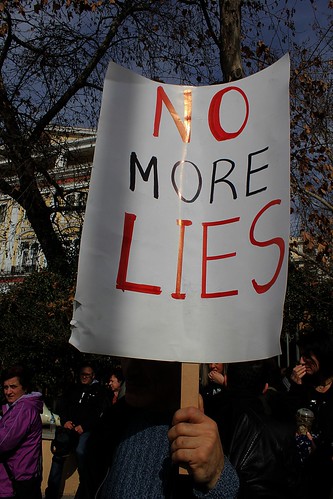
No More lies - Greece

With the crisis dragging on in Greece, voters are growing ever more angry at the lies and spin the government coalition parties employ to distract from their corruption, incompetence and lack of vision for the future.

In May the country will vote in both local authority and European parliamentary elections and if current opinion polls prove correct, then this mark that end of the monopoly on power the nominally socialist PASOK and far right New Democracy parties have held since the late 70's.

PASOK in particular, is likely to hardest hit with possibility that its share of the vote will be as low as 4%, a startling decline from the 44% it won in the 2009 general elections. New Democracy's base is also shrinking as people,sick of austerity and endless finance scandals turn their back on them, many changing allegiance to the neo-Nazi Golden Dawn party .

The position of the two main parties is not helped by the fact that between them they have 270 million euros in non-performing loans, which have been serviced since January 2013, making them technically bankrupt.

With the prime minister announcing new taxes on food, property and cigarettes, the chances that his New democracy party will fall from second place to third place behind SYRIZA and Golden Dawn should not be ruled out.

Whatever the final tally is poor results in May's elections will further increase pressure by party supporters and backbench MPs on PM Antonis Samaras and deputy PM Evangelos Venizelos to step down, so opening the way to more instability and the possibility of new national elections in the summer.

Sunday, September 29, 2013

Golden Dawn arrests mark sea change in Greek politics.

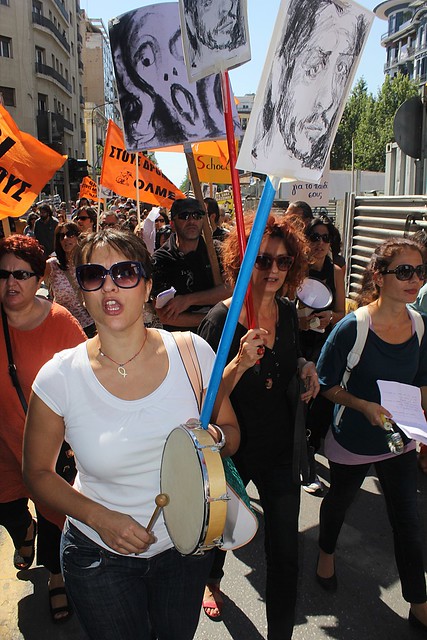
Striking Greek teachers on the streets of Thessaloniki - Greece
Striking teachers carry picture of murdered singer, Pavlos Fyssas.

September is usually the time of year when Greek politics shrug off its summer stupor and the country's parties vie with each other to set the political agenda for the coming winter. Yet this year the speed at which developments have unfolded is unprecedented and the arrest yesterday of the leader of the neo-nazi (let's not be coy about using the term) Golden Dawn party leader along with many of their MPs and supporters is just part of a string of developments which are sending shockwaves through Greek political life.

Suddenly, Greece's mainstream media which has often been indifferent to Golden Dawn violence over the past few years is full of stories concerning murders, money laundering etc allegedly carried out in the name of the movement. In fact all those widely documented stories they were so unwilling to report till the Greek government decided to clamp down on the far right this weekend.

The same TV stations and newspapers that till recently were happy to host Golden Dawn politicians have, as if by magic, turned into die-hard defenders of democracy and the sworn enemy of those who threaten its sacred institutions. In a similar vein, these media organisations have run stories concerning secret armies of Golden Dawn cadres trained by Greek special forces, calls for a coup by army reservists and dark tales of infiltration in the military and the police force.

Such stories have been seized upon by foreign correspondents eager for a juicy headline and not too worried by the fact that many of these plots have little in the way of hard evidence to back them up other than anonymous sources quoted in Greece's less than reliable newspapers. At times the furour concerning the influence of Golden Dawn in Greek public life reads like an extract from Evelyn Waugh's satirical novel about journalism, Scoop in which wild rumour is magically transformed into informed analysis by the press.

However, the killing of hip-hop singer and left-wing activist, Pavlos Fyssas (known as Killah P) set off a chain of events that has seen a sea change in Greek public life. Before it, Golden Dawn was cresting a political wave of discontent over austerity and exploiting for all its worth the public's disgust with the existing political establishment. Polls showed its share of  the vote rising and some even predicted that it would go from being the third to the second party in next year's local elections. The lead analyst at the pro-government Skai TV even raised the possibility of a New Democracy - Golden Dawn alliance, saying a similar partnership had been cemented in Norway.

Now all of that is changing, instead of Golden Dawn being invited into government they're now behind bars, facing a raft of serious criminal charges, including that of being a criminal organisation. Opinion polls show a significant drop in support though it should be noted that they still remain the third most popular party a sign that while down Golden Dawn cannot be dismissed just yet.

It seems that the country's political leadership has decided to take the political gamble of clipping Golden Dawn's wings and even hope to secure their right flank by neutralising them politically. They are hoping that such a move will woo disgruntled voters back to the New Democracy/PASOK party fold and allow the coalition to portray itself as the saviour of Greek democracy both at home and abroad.

For domestic audiences the arrests are being used as evidence that traditional parties of government are combatting political extremism and so are a force for stability in difficult times. For those abroad the rise and fall of Golden Dawn can be used to force concessions in Europe in the next round of talks over the latest austerity measures. "Look," they say "if you insist on yet more cuts and firings you'll enable those extremists who wish to destabilise Greece".

Yet this is still a major political risk for prime minister Antonis Samaras. Golden Dawn MPs have threatened to resign en masse which would lead to 18 by-elections and so threaten the government's slim two seat majority. Other commentators are proposing that in such a situation Samaras would have no other choice but to call for general elections. Given the fact that Samaras was happy to bring down the PASOK led government last year just months after it was elected shows that such a possibility does not daunt the man. Indeed, given Samaras's role in bringing down the New Democracy administration in the 1990's, it would par for the course.

While Greek political establishment and its supporters in the mainstream media congratulate themselves on dealing with the threat to public order posed by Golden Dawn others wonder why an organisation facing multiple charges of murder and a much longer  list of attempted murders and other acts of violence was allowed to get away with it for so long. Where have the police and judiciary been while for years gangs of thugs terrorised people on the streets of Greek cities? 

If nothing else the clamp down reveals clearly the lack of distance between Greece's justice system and political parties in power. Only when the political leadership decided that Golden Dawn had gone too far did the police intervene decisively, despite a mountain of evidence collected by Greek and foreign activists over the last four years. 

However, the willingness to overlook racism and violence is not limited to Greece's police officers. On the contrary, both PASOK and New Democracy have been more than willing to adopt Golden Dawn style positions on immigration in order to win back votes by proving that they are cracking down. It is this, along with the crushing effects of austerity that have provided Golden Dawn with so much impetus. The ruling parties have been happy to legitimise racism by making it government policy and so helped turn Golden Dawn from a bunch of nazi-junta nostalgists out on the wilder fringes of Greek political discourse into a part of mainstream public debate.

If the politicians had thought more about ethics rather than polls, if the police had just done their job rather than serve an ever changing political agenda and if both had treated violence against dark skinned people with the same seriousness as those with lighter complexions there would be several people alive today including Pavlos Fyssas, RIP.


Sunday, September 15, 2013

Is a Golden Dawn role in government on the cards in Greece?

Members of the neo-Nazi Golden Dawn party take party in anti-government march by emergency services employees - Thessaloniki

Last week the leading commentator at one of Greece's largest private TV stations raised the possibility of a political alliance between the ruling conservative New Democracy party and the Neonazis in Golden Dawn.

"Why shouldn't New Democracy co-operate with a serious Golden Dawn?" asked Babis Papadimitriou, the head of the staunchly pro-government Skai TV. The statement was prompted by the latest opinion polls that show the continued rise of Golden Dawn, now at 13-15% and the poor showing of the other partner in the Greek ruling coalition, PASOK, whose fall from electoral Grace has seen support plummet from 42% to 7- 8% within the space of four years.

Papadimitriou's remarks immediately provoked a storm of angry response from Greek Twittersphere and political commentators, many of whom believe that this is the first step in the process of "rehabilitating" Golden Dawn. Such was the reaction that Skai dedicated an entire hour the following day to giving Papadimitriou a chance to clarify his stance. His argument was that Golden Dawn, Greece's third most popular party now represent a large proportion of  the electorate and that a similar alliance between centre right and far right parties had already taken place in Norway.

At first glance such an alliance would contradict prime minister, Antonis Samaras's  policy of presenting himself and his party as a bulwark against the threat of rising extremism. The Policy of The Two Extremes as it has been termed involves the government and its supporters in the pro-government mass media painting both its opponents on the Left and Right as a dangerous challenge to political stability, harking back to the often chaotic politics that Greece lived through during the 20th century. With junior partner, the nominally left-wing PASOK party hemorrhaging votes, it's leader Evangelos venizelos has been more than willing to go along with this strategy in the hope of scaring back voters from SYRIZA.

The violence used and glorified by Golden Dawn is therefore equated with supposedly similar trends in SYRIZA and the Greek Communist Party (KKE). In such an equation, brutal attacks on immigrants, Nazi salutes and 1930's style Brown Shirt street fighting is considered the same as strike action or sit down protests. In such a world, New Democracy and PASOK can present themselves as a sane alternative to such political madness, a stabilising influence in difficult times.


The problem with this theory is that just does not reflect reality on the ground, no matter how much political and media spin is used. The rise in political influence and extremism on right has not be mirrored by 1930's style street tactics on the left. It is Golden Dawn MP's who have been charged (though not sent to convicted of) with a raft of offences ranging from assault to possession of illegal weapons. It is their supporters who have repeatedly been accused of endless list of attacks against immigrants and increasingly domestic political opponents.

As if to underline this just a day after Babis Papadimitriou talked of the possibility of  bringing Golden Dawn in to government, 50 of their supporters took part in a bloody attack on Greek communists who has putting up posters in the city of Perama which left nine of them in hospital.

On other hand the differences between Golden Dawn and New Democracy are fewer than they'd either would like to admit publically. The lurch to the right that PM, Antonis Samaras brought to his party has seen the rise to power of far right supporters, many refugees from the ultra-nationalist LAOS party which was all but wiped out in the last elections. In terms of immigration, for example, New Democracy's policies are little more than a more polished version of unvarnished racism of Golden Dawn.

Despite the political risks that both parties face forming an alliance, New Democracy, at least may not have any other choice. The party cannot rule on its own, having seen its share of the vote drop from 40+ % to 26-29% and it's current coalition partner PASOK is fading away, suffering a wane in political fortunes on par with that which struck the UK Liberal party in the 1920's.

Although die-hard supporters still maintain that PASOK leader, Evangelos Venizelos has a master plan to turn the situation around, the reality is that its decline is irrevocable and that any recovery that may take place is years in the future and almost certainly without the presence of Venizelos who has become personally identified with the decline in Greece's fortunes. The fact that a recent poll found that in one of Greece's largest electoral districts in Athens support for PASOK among younger voters was 0% just underlines the the scale of the problem.

Some commentators have argued that the government's demonisation of Golden Dawn rules out a coalition however, in true Orwellian fashion  New Democracy has changed policy stances on a number of occasions. Samaras positioned himself when in opposition as Greece's best hope to fight austerity and then once elected to promote himself as its most loyal defender. Yet one more u-turn in a long history of such moves would surprise few observers and given Samaras's own history as a semi-reconstructed ultra-nationalist an alliance with Golden Dawn would far more sense than one with his arch political rival, PASOK and its leadership.

What is in this for Golden Dawn is less clear since its entire existence is predicated upon its staunch opposition to the political establishment which it has painted as a hotbed of corruption and worse. They have made much of their anger with austerity, promoting themselves as agents of national resistance against a anti-Greek, internationally orientated elite who are betraying the homeland in order to hang onto power. To suddenly join up with New Democracy would risk them being consigned to the dustbin of history, suffering the same fate as far right LAOS party who made the same transition and paid the price for it at the polls.

On the other hand the siren call of access to the State and all the power and privileges that go with it has turned many a head in Greece's turbulent political past. With government position comes the ability to reward followers with public contracts and civil service jobs, a potent recruiting tool in difficult times. More importantly, a role in government brings legitimacy especially in the eyes of Greece's oligarch owned mainstream media who would quickly forget any qualms they once harboured about hosting violent Nazi style idealogues.

None of this is likely to happen soon unless the tensions that underlay the government coalition become untenable and since neither side is looking to go to the polls before it is absolutely necessary that seems unlikely. However, the fact that pro-New Democracy media is mooting the idea of a future alliance between Golden Dawn and New Democracy means that the prospect is being discussed and the waters tested.

Faced with the possibility of a future government lead by SYRIZA Greece's economic and political establishment would be more than willing to hold its nose and embrace a Neonazi party rather than see Greece clash with creditors over the terms of the bailout deal and the attendant risk of exit from the Eurozone.
.
*Note. This post was written just days before a man identified as a Golden Dawn member was accused of stabbing to death singer and left-wing activist Pavlos Fyssas.


Saturday, August 03, 2013

Greek TV going down the tubes

As seen on TV


Perhaps the easiest way to understand just exactly where the Greek economy is heading is to switch on the TV whilst here. Don't worry no knowledge of the language is required (many of the most popular series are in Turkish anyway), just the ability to cast a discerning eye over what is being shown and sold.  The first impression is that Greeks fashion tastes ossified sometime in the late 90's. Do they really think that is still cool? No, seriously? This misunderstanding stems from the fact that there are no new TV productions being made in Greece and so the stations are filling airtime with popular hits from the last couple of decades. This is also true for foreign imports such as Friends which is repeated so often you might be forgiven for believing Ross, Monica et al have created their own cult of personality.

The same goes for the adverts, gone are many of the slick Hollywood - style productions used by multi-nationals to push their wares, instead we have street barkers hawking carpets, dodgy diet products and perhaps the ugliest shoes on the planet, and all of this on prime time TV, even on the largest private stations.

In short, Greek TV like so much of the economy is in crisis and has sought to combat declining revenues by cutting back on spending and firing staff. And, as with the rest of the economy the results have been a miserable failure. Falling quality has driven away much of the TV's audience especially among the younger and well-educated who have migrated to the internet in search of something a little less trashy. Those left are happy enough with their daily diet of Turkish drama, gossip and b/w Greek movies from the 60's but they are a sign that TV in Greece is fading away as it's core audience gradually shuffles off this mortal coil, both just a shadow of their former selves.

To understand the reasons behind this decline is to understand the reasons why the Greek economy in general has suffered so badly over the last six years since in many respects they are are closely connected in ways it is often difficult  for outsiders to understand . The first thing to realise is that Greek TV was never really about making money, at least not in the way broadcasters usually do so. In most parts of the world a successful TV station makes it cash through bringing in as many viewers as possible and then using that to sell advertising. More viewers means more ad money which allows you to buy/create better programming which brings in more eyeballs etc, etc, etc.

However, in Greek economic universe there is often a kink. Whilst having as many viewers as possible is a given and ad revenue important too, neither has been the primary goal of the larger commercial stations. Instead these broadcasters are embedded in wider business empires and acted as the PR wings of the handful of very rich families that dominate much of the Greek economy. 

With these tools the owners of financial corporations, shipping lines, construction conglomerates etc. use the power of the media and especially that of the television to influence political policy. Parties and political careers can be nurtured, opponents embarrassed or vilified by suitably briefed reporters on the nightly newscast and in return all the owners required is a friendly ear in government. No wonder every self-respecting oligarch in Greece has, since private TV stations were permitted in 1989, sought to buy a TV channel, to go along with their newspapers and the inevitable football team.

However, as they ownership of the media has always been divided between a number of players the impression given to the outside world is that of plurality in which a variety of views and political opinions are expressed when in reality what is on offer are different interest groups vying for power and influence. The rewards for such influence are great; government contracts for major structural works, benign tax regimes, laws that effectively crush competitors are regularly doled out to those willing to support in power. In other words crony capitalism masquerading as a free economy in which those with the best connections to the State rather than the most efficient or innovative thrive.

However, the media sector was hit by a triple whammy after 2008 and the start of the current round of austerity measures. The crisis of confidence over that state of Greek banks mean that loss making media outlets could no longer rely on friendly banks to give no-strings attached loans, advertising revenue went into steep decline as multi-nationals cut back on their TV presence and the steady stream of State "support" dried up. Finally with public finances suddenly under close scrutiny many of the traditional means used to reward media supporters such as public works contracts, used by both PASOK and New Democracy parties became unavailable .

With Greece wavering on the edge of default and/or exit from the Eurozone, the stance of the owners of the country's media changed dramatically, instead of squabbling among themselves the TV stations and their sister newspapers suddenly came down hard of the side of any party or politicians most willing to implement the austerity measures being demanded by the Troika. The few outlets such as Alter TV or Eleutherotypia that refused to tow the line quickly found themselves in financial difficulties when banks refused to extend further lines of credit and so closed down.

On the other hand if it seemed that the government was dragging its feet then politicians would face the wrath of a vengeful journalists and commentators warning darkly that the nation risked wasting the hard won sacrifices made by ordinary Greek people for short term political gain.A warning that the oligarchs would not countenance any threat to their privileged place in the country's economy or open confrontation with the country's creditors and its attendant risk of default.

Such influence reached its peak (or nadir) in the 2012 elections when the Greek media along with much of foreign coverage painted SYRIZA as a threat to Greece's recovery and kept up an unrelenting campaign of of vilification against anyone advocating an end to austerity. Day after day, week after week, month after month the airwaves and front pages were filled with the doomsday scenarios that would accompany any attempt by Greek political forces to question the logic of austerity.

Likewise the supposedly independent public broadcaster ERT gradually lost more and more editorial control post 2008 as government sought to impose their own line and clamped down on even the faintest signs of resistance to the pro-austerity narrative playing upon the nation's screens nightly. The final act in that drama came in June when just two days after a strike that kept the prime minister off the air the government sent riot police to shut down transmission and fired all its employees leading to a three month war of nerves which continues to this day.

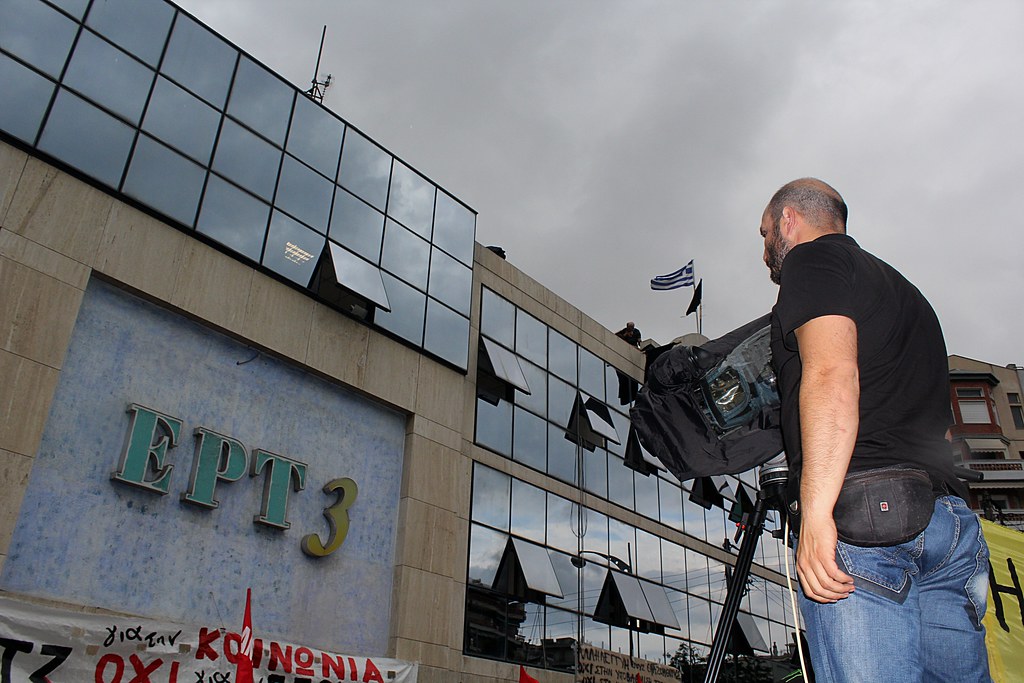
Cameraman outside ET3 studio - Thessaloniki, Greece


While the political situation may have stabilised Greek TV is still in crisis, the private TV stations so long, the playthings of rich oligarchs wishing to play political games are deeply in debt and stuck in a downward economic spiral in which every cut ensures fewer viewers and less revenue. And those who've gone are not coming back, once given a taster of the choice and variety the internet offers it is going to be next to impossible to lure people back to the TV screen with pitifully poor fare on offer at present. 

Deprived of access to government funds and cheap loans that have kept stations afloat till now they have become a mill stone around their owners' necks. Their primary purpose; their ability to set the political agenda  is now in severe decline, a victim of the public's distrust in news reporting whittled away away by endless stream of propaganda posing as news.

Even the parties the media relied upon to exercise power are waning, the government coalition partners, PASOK and New Democracy are seen by many voters as corrupt and beholden to the same wealthy individuals and family dynasties that own so much of the media. On the other hand Golden Dawn which has been largely excluded from the media has continued to grow in popularity at the expense of the two main parties in the coalition government, proof that TV's ability to make and break parties is fading.

So what happens next? The closure of ERT and the re-division of ad money to other stations will give the industry a slight boost for a while but in the middle to long term the situation look bleak. The lords of the small screen have been used to having enormous power for so long they disdained the internet as just a childish fad and did little to prepare for the new media landscape coming into being. They're have been half-hearted attempts to put their stations on mobile platforms such as Android but the reality is that the content is so poor that those most likely to use the service, namely the young are those least likely to be interested in what they have to offer. 

Most likely, media owners will do with their TV station what they did with their newspapers and run them into the ground, hoping that before they fail completely some second tier magnate will be persuaded by the fading glamour to take it off their hands.


Sunday, June 16, 2013

ERT - Greek government embroiled in very public showdown with state run broadcaster.

ERT reporter talking to people gathered outside studio in Thessaloniki, Greece

Sitting in the foyer of the ET3 studios, now being occupied by its own journalists and technicians the strangest thought crossed my mind; those who were part of the groups protecting the building included some of the station's most bitter opponents. The same people that have been so critical of the willingness of public broadcasters to toe the government line and allow politicians such a free hand in domestic affair were now willing to stay there day and night and risk injury in the event of a riot police raid. The irony of the situation was not lost on them.

The sudden decision by the Samaras government to shut down ERT on Tuesday took even insiders by surprise, no one I talked to, be they journalists or political activists had expected that such a move would happen so quickly. That the government was looking to subject ERT to the same kinds of cuts as suffered by other areas of the public sector was obvious but the swiftness of the closure left everyone wondering what was really behind the action.

Heavy riot police presence around  ERT studio in Thessaloniki, Greece

However, no one in the government, I suspect realised the the scale and determination of the reaction both from within Greece and abroad. Within hours technicians and journalists had stopped normal programming and were providing news and updates of the situation within the studios and suddenly, most miraculously of all, reporting on what was happening and not what they been told  by the government party leadership to cover.

It was this change in reporting which most probably prompted the Greek prime minister, Antonis Samaras's decision to send in the riot police to shut down transmission facilities across the country and the privately run DIGEA service to threaten other TV channels when they attempted to re-broadcast ERT's signal. The idea of journalists who has been privy to so many of the back room deals, dirty political tricks and acts of censorship going public with their knowledge must have terrified politicians used to always getting their way whenever they appeared on the state run channels.

Protesters come out on the streets in support of public broadcaster ERT - Thessaloniki, Greece

For many older Greeks the announcement by NET TV presenter that the riot police were on the move followed by a black screen brought back memories of the Regime of the Colonels that ruled the country with iron fist from 1967 to 1974. Like Spain, and Portugal the experience of living under a dictatorship is still a vivid part of Greek popular memory and not simply a footnote is a school history book.

Unlike the 1970's the shutting down of the ERT signal has proved more problematic and technician have defied the crackdown using internet broadcasting, satellite signals (provided by the European Broadcasting Union) and resurrected analogue frequencies to ensure that NET in Athens and ET3 in Thessaloniki are still on the air. In its turn the authorities have tried to thwart these moves, shutting off telephone and internet connections to ERT facilities and in many parts of Athens and Thessaloniki, platoons of riot police have been stationed just a few hundred metres from ERT facilities.

As many Greek Twitter users repeatedly wrote; support of ERT was about defending democracy and not the status quo, so even groups opposed to the idea of a state run broadcaster were willing to stand shoulder to shoulder with sacked journalists in the demonstrations, marches and concerts that have been taken place in Athens, Thessaloniki and other Greek cities over the last five days.

IMG_4kk739

The reason and timing behind the ERT closure has been a source of speculation for many political analysts in the media and beyond. For some the closure was a diversionary tactic designed to draw attention from the failure of the Greek - Russia GAZPROM deal that the prime minister had hailed as a "success story".. For others the move is the opening shot in a new round of elections that will allow New Democracy to dump both PASOK and Democratic Left coalition partners who are both doing badly in the polls in order to form a new government that will allow them top act more freely.

For what It's worth I believe that the closure of ERT is a political gamble by Samaras, who sees it as a way to kill several bird with one stone. In firing 2,600 public employees in such a swift and dramatic manner he thinks that he'll win point abroad with the Troika (ECB, EU and IMF) who have repeatedly criticised Greece for dragging its feet over public sector reforms.

Domestically, Samaras feels he can still sell the idea that he is a bold reformer taking on a corrupt, wasteful public organisation that is a burden to the tax payer. And finally, the the loss of so many media outlets will play well with the local oligarchs, upon whose support he relies upon more and more. Their own media wings are hemorrhaging cash as the economy continues to shrink and ad money dries up.

However, the gamble may not have paid off, international reactions from have been far greater and far more critical than Athens had probably expected and even local popular support for ERT is much higher than Samaras had anticipated, with 65% of those questioned in recent VPRC poll saying they disagreed with the decision to shut down the broadcaster.

So what happens next? Hard to say, on the one hand the PM has acknowledged that the loss of the so many stations was hasty and has offered to re-instate a limited number of ERT employees to run a skeleton service yet in this mornings speech he vowed to shut down the public broadcaster.

As with so many aspectsof current Greek political policy decisions change from day to day, with political opportunism being more of a guide than any grand plan or ideology.

More on this story via Asteris Masouras at Global Voices.