Showing posts with label Alexis Tsipras. Show all posts

Monday, January 25, 2016

Can you Help? Demand the Greek government treats refugees more humanely


 Over 1,000,000 million refugees entered Europe in 2015, more than 800,000 chose the Western Balkan route which took them to an obscure railway crossing near the tiny village of Eidomeni on  Greece's northern border with FYR Macedonia.

After a journey from the port of Pireaus that can last up to 20 hours refugees are rushed by the Greek police to the border. Volunteer groups and NGOs at the camp are often given as little as 10 minutes to hand out food, clothing, medical aid and information before crossing over.

There is the constant fear that the government of FYR Macedonia will permanently close down the border with Greece and so leave people stranded. When the border is open or closed seems to be completely at the whim of the FYR Macedonia government  and there is little or no co-operation between the authorities on both sides of the frontier and so little idea when and for how long the crossing remain shut.

For their part the Greek police who control acccess to Eidomeni also refuse to share information with NGOs and volunteer groups over when and how many refugees will be arriving at the camp on any given day, despite the fact that they control the flow from start to finish on the Greek mainland. Indeed since December the attitude of the police has perceptibly hardened, ranging from sullen indifference to active hostility, sometimes kicking out organisations such Médecins Sans Frontières all together, with little or no notice.

To make an already difficult situation worst, the police forbid access to the hot food, doctors, heated tents and other faciities that have been built recently at Eidomeni. Instead refugees are forced to wait endless hours at a road side petrol station/cafe 20km from the site whilst temperatures at night often drop to -15c. Here refugees are obliged to buy food and water whilst just a ten minute ride away volunteers wait to hand out such items at no cost.

Last week over 3,000 people, including many families with very young children were forced to endure extreme cold overnight while the camp remained half empty.

We are calling upon media outlets to highlight this scandalous abuse of refugees by the Greek authorities. The more international pressure is brought upon the SYRIZA government and prime minister, Alexis Tsipras the more likely refugees will receive more humane treatment on the Greek leg of their trek to safety.

Refugee Solidarity Movement Thessaloniki-Eidomeni

Wednesday, January 28, 2015

Greece wakes up to a different world.


By all rights the world, at least that corner of the world that is forever Greece should be in tatters, the the entire nation in ruins, or at last teetering on the edge of the abyss. Sorry for the hyperbole but that's what happens when you follow too much of the media coverage of Syriza's unprecedented election victory on Sunday. For those unfamiliar with modern Greek politics for the first time since the mid 70's neither the conservative New Democracy or the nominally centre-left Pasok party will be in government. It is as if USA had just elected a president who was neither Republican or Democrat or that the UK was now governed by the Green Party.

The electoral self-immolation of Pasok along with growing disenchantment with its right wing coalition government partner New Democracy drove away voters who in other eras would never have countenanced voting for a party as avowedly left-wing as Syriza. In doing so they have changed the political landscape more radically than at an other time since the fall of the military junta what ruled Greece till it was toppled in 1974.

Voters, sick of austerity and the endless succession of promises of recovery being just around the corner made by a political elite widely seen as out of touch abandoned the dominant parties to vote for Alexis Tsipras's Radical Left Alliance. Even the weeks of scare mongering by the government and its allies in the media proved insufficient to convince voters to give prime minister Antonis Samaras the mandate he needed to stay in power.The daily predictions by Greek and EU officials of a Grexit, bank runs and even the possibility of a collapse in the economy so dire that ordinary people would not be able to buy even basics such as toilet paper failed to win back lost ground.


However, this  switch in allegiances had less to do with a general surge in sympathy for radical leftist ideas than with a groundswell of disgust with the politics of business as usual which have left many Greeks jobless, poorer and without hope for the future. The siren call of stability which the PM promoted so hard during the short but divisive campaign cut little ice with those who desperately need to see real change and not just endless talk of improvement in the the nation's 10 year bond yield or its standing with credit rating agencies such as Standard and Poors.

Since the the announcement of Syriza's victory on Sunday evening, the political developments have been coming thick and fast. Lacking the 151 seats needed to form a government on its own Greece's new prime minister, Alexis Tsipras brokered a deal with the right-wing Independent Greeks party to form a coalition. The announcement, which was made at midday Monday suggests that neither side was surprised by the offer and that the groundwork had been laid in advance, so catching off guard the other opposition parties who had assumed that the search for a partner would be a long and convoluted process, or even the prelude to another round of elections.

The choice of Independent Greeks has surprised many observers, especially those abroad who find it hard to comprehend a partnership between a radical socialist party and a conservative nationalist one, Yet for Syriza this constitutes the least worst choice given the options available. The most obvious candidate for coalition partner would have been the Greek Communist Party (KKE) but anyone even vaguely aware of Greek politics would have known that such an alliance would have been impossible as KKE would never compromise on its own leftist principles which include leaving the European Union, the Eurozone and NATO.


Others may have considered a partnership with PASOK (well, the S does stand for Socialist) would have been a better fit, but once again the party's role in imposing austerity plus its identification with the country's corrupt political elite would have proven unacceptable to Syriza rank and file, not to mention the fact that it would have instantly damned Tsipras in the eyes of voters seeking change.

The other likely partner for many analysts would have been the recently formed Potami (River) party headed by ex -TV presenter Stavros Theodorakis who's attempt to carve  out a centre - left niche for themselves in the Greek political landscape made them a good match for Syriza, at least on paper. However, this was never really on the cards for a number of reasons. Theodorakis, whose party's funding and basic policies still remain a mystery is widely seen by the Left as a stalking horse for Greece's oligarchs, a front for the vested interests that have been forced to abandon the traditional parties of power. To give Theodorakis the political equivalent of a "kill switch" would have not been acceptable.

So, in the end Independent Greeks who are often painted as a collection of right wing conspiracy theorists and borderline racists (imagine UKIP a la Grecque) made the cut, a decision that has already been condemned by many on the Left, both inside and outside Greece (for an account of why this is so, I recommend this blog post). However, the party led by Panos Kammenos repeatedly made clear its opposition to Troika imposed austerity measures and its participation will perhaps assuage more conservative Greeks that issues such as defence and policing will not be solely decided by a bunch of "wild radicals". It's also an admission that much of Syriza's support is not from those who traditionally identify themselves as left wing, let alone radical socialists.

Above all, such an alliance allows Syriza to implement policies which will be popular with voters and build up a more solid base ahead of any confrontation with Greece's creditors who seem unwilling to back down on the issue of debt renegotiation.

Wednesday, January 21, 2015

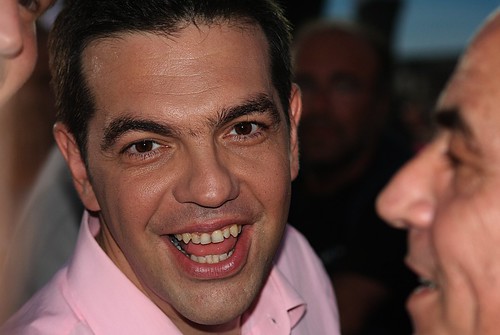
Alexis Tsipras, leader of Syriza greets supporters at campaign rally in Thessaloniki, Greece


Greek opposition leader, Alexis Tsipras greets supporters at campaign rally last night in the northern port city of Thessaloniki. Come Sunday there is a good chance the party he leads, SYRIZA will win the elections and form Europe's most radical government in decades.

Thursday, January 08, 2015

Greek elections - state of play so far


The Greek national election campaign is now well under way and all parties involved have started their campaigns, both on the road an in the media. The Greek prime prime minister, Antonis Samaras kicked off New Democracy's efforts with a televised rally in a hotel in city of Larissa, almost immediately followed by SYRIZA leader's rally in a stadium in Athens. The contrast could not have been greater, while the prime minister gave a lacklustre performance which meet with lukewarm response, even among party faithful, Alexis Tsipras on the other hand showed just how far he's come as a public speaker, both energising the party base with his speech and showing that he was clearly setting himself out as a national leader.

In the meantime, coalition party leader Evangelos Venizelos addressed PASOK party members in a cafe, reminding viewers that the glory days of the party when they could attract crowds numbering hundreds of thousands were well and truly over.

To add to the uncertainty surrounding the most unpredictable Greek election in years, ex-prime minister and once leader of PASOK Giorgos Papandreou announced his formation of a new party, The Movement of Democratic Socialists in the same period, a move that was quickly condemned by the current PASOK leader as "irrational and unethical". Some media outlets were even predicting, rather generously as it would later turn out, that the new party would garner anything up to 6% of the poll, so allowing it representation in parliament.

New Democracy's campaign which as being spraying the internet with banner ads and pop up non-stop since the day of the vote for president has been focused on playing on fears of ordinary Greeks that a SYRIZA victory would be tantamount to an exit for the Eurozone, even the the European union itself. 

The talk of Grexit cultivated by the Samaras and echoed by pro-government TV stations and newspapers has spooked markets and led to a number of European officials to back track and say that such a contingency is out of the question. However, such denials did not stop prime minister repeating such threats in his speech on Tuesday in the northern city of Komotini, though latest news reports seem to indicate that the party's campaign will change direction and now focus on the government's track record in power.

As part of this change in tack it seems Samaras is willing to use the even more incendiary topic of immigration, even the tragic deaths of the 12 people killed in the Charlie Hebdo shooting in Paris on Wednesday were used by him in order to attack SYRIZA's immigration policies. In his speech in Halkidi he said, 

"There was a massacre today in Paris yet some people want to invite more illegal immigrants and hand out citizenship"

This campaign promises to be the dirtiest in years, and as if to underline the point the prime minister and other senior New Democracy figures were eagerly using the deaths of the victims in Paris to drum up votes for their party which has consistently been behind the polls over the last few weeks. Whilst some surveys have put SYRIZA anything up to 7.5% ahead, most seem to agree on a 3-4% lead for Alexis Tsipras's Radical Left party, despite the fact that they are facing an almost uniformly hostile mainstream media inside Greece and to a large degree abroad.

If such figures prove accurate this mean that SYRIZA will be unlikely to elect the 151 MPs required to have a majority government in Greece's 300 seat parliament and so will probably need to form a coalition with one or more of the smaller parties vying for power. This is where the waters muddy and accurate predictions of what will happen on election day and afterwards become less certain. All the other parties who could be in parliament are polling between 6 and 2% which given the margin of error present in such cases means any meaningful estimation of how seats will be distributed is difficult.

However, some guesses can be made. It would seem sure that KKE (Greek Communist Party) will once again get 4-6% and so about 12 seats as it did in 2012. Whilst KKE has not been able to exploit the economic crisis in order to widen its base, it's party organisation and strong campaigning abilities mean that the party faithful will turn out and support them. Likewise Golden Dawn's support in the polls has remain steady at 5-6% despite the jailing of most of it leadership on criminal charges pending trial. Despite almost singularly negative press coverage there remains a hardcore of voters who are willing to vote for them, no mater what.

On the other the once might PASOK party was in the throes of a major meltdown, even before the announcement of Papandreou's new party which is likely to drain what is left of its popular support among older voters. Latest polls show PASOK at between 3 and 5% and the Movement of Democratic Socialists at 2-3%, though there is a possibility that neither will break the 3% barrier needed to gain a seat in parliament. The situation is not helped by high level defections from PASOK to other parties. Today, PASOK cabinet minister Angela Gerekou announced she would be standing on a New Democracy ticket in the next elections.

The other major unknown is the amount of success the Potami (River) party will enjoy,set up last year by a former TV presenter with the oligarch owned MEGA TV station, Potami has been built up as a centre - left alternative to SYRIZA for those unhappy with PASOK's record in power. Currently, it is polling 5-7% and seems on track to be the third largest party.

Other parties such as the far light LAOS and the centre left Democratic Left party who once were government coalition partners have paid the price for pushing through deeply unpopular austerity measures and seem unlikely to win even one seat in parliament. Even the Independent Greeks party once seen as a viable centre right alternative to New Democracy is struggling to reach 3%

(It should be noted though that Greece's pollsters have proven notorious political in the results over the last few elections and so any results should be taken with a pinch of salt, and the political affiliations of the news outlets that commission them should be taken into account).

Whatever the final outcome, it seems SYRIZA may need allies, but this is where things get complicated. A first glance the most obvious coalition partner would seem to be KKE but this is extremely unlikely given the deep ideological gulf that divides them. The insistence of KKE's party leadership on maintaining ideological purity in the face of siren calls of power is unlikely to disappear soon.

A partnership with either a rump PASOK or Potami also is not without risks and threatens to split SYRIZA which till very recently was a loose coalition of leftist parties, many of who are far to the left of the Tsipras leadership and would view such allies with the deep suspicion, seeing them as the agents of the establishment seeking to worm their way back into positions of power and responsibility. 

Finally, there is a possibility that no government may be formed and so Greece may have to go to the polls again. Such a move would definitely make the nation's creditors deeply uneasy as it would raise the spectre of default over debt repayments due in 2015. 

Thursday, June 21, 2012

Monday, June 18, 2012

Greece election post mortem

Antonis Samaras, head of Greece's main opposition party, New Democracy

First things first. An apology to anyone who  bet (and lost their shirt) on my prediction that SYRIZA would be the largest party in parliament today, if I see you, let me buy you a drink, it's the least I can do. As it turned out my analysis was off the mark. I overestimated SYRIZA's final vote and more crucially underestimated the final New Democracy tally. Also I didn't see the collapse in Greek Communist party support which halved, unlike PASOK and Golden Dawn who only saw a small drop in votes received. All in all, my days as a poll pundit are numbered. (Vote statistics can be found here).

Why was I so wrong? First of all, I failed to grasp just how successful the fear campaign over possible Greek exit would be. I had assumed that the constant barrage of warnings over the consequences of Greece having to leave the Eurozone had done its work and wouldn't push Samaras's vote over 25%. On the other hand the record low turnout (down 8% from 2009) seemed to have had an effect, I suspect on younger voters who would have supported anti-bailout parties. Finally, the scenes of violence perpetrated by Golden Dawn spokesman on live TV did nothing to diminish their popularity, which is both surprising and deeply worrying.

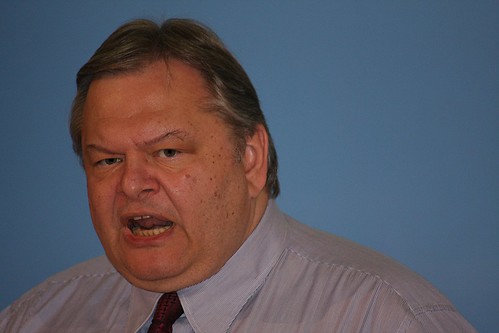
PASOK leader, Evangelos Venizelos

Mea culpa aside, today the New Democracy leader, Antonis Samaras will be asked by the president of the Greek republic to form a government. At first glance this seems just a formality as New Democracy with 129 seats and the other pro-bailout party, PASOK with 33 seats will comfortably exceed the 151 MPs needed to form a majority. Indeed both leaders in the last week of campaigning repeatedly stated the need for the country to immediately have a working administration in order to deal with its current economic meltdown.

However, beyond the campaign promises, Samaras and PASOK leader, Evangelos Venizelos have to take into account other factors concerning their own and their parties' political future. If they do assume power, then they will be seen as the parties that are responsible for the country's economic woes, leaving SYRIZA and others to claim that have are the only real anti-austerity choice in any future elections. Given the drubbing PASOK got and the marginal victory achieved by new Democracy that more or less guarantees their defeat in the next elections (barring an economic miracle and the Germans have outlawed miracles).

Alexis Tsipras, head of the The Radical Left Coalition, SYRIZA

The answer to this dilemma is to try and persuade SYRIZA leader, Alexis Tsipras to join the government with promises, appeals to patriotism and threats of possible dire economic consequences if he does not.This card was played after the May elections and judging by official SYRIZA statements coming out in the Greek media such overtures are almost certainly likely to be rejected. On the other hand the Democratic Left have made it quite clear that they will be willing to take part in such a government. But this does not solve Samaras and Venizelos's long term problem about how deal with Tsipras in coming elections.

The other factor which plays a crucial role in any negotiations is ego. Even with Greece mired in the worst economic downturn, the monsterously overblown egotism of both Samaras and Venizelos may prove an obstacle in forming a stable government. Both have spent decades slowly working their way up the greasy pole of political power and just as they seemed to be destined to become prime minister, the game changed. To have to share power after so many years playing second fiddle is almost more than either can bear.

Whatever form the next Greek government takes, its fate will not be decided in Athens but in Berlin and Brussels. If the troika (EU/ECB/IMF) are serious about supporting Samaras then serious concessions in the terms of the current austerity measures will have to be made, otherwise with unemployment rising 1% every two months and the economy contracting the fragile New Democracy - PASOK (and possibly Democratic Left) coalition will fracture under the weight of more job cuts and tax hikes. At which point Greece holds yet more elections and most likely brings to power SYRIZA.

There seem to be mixed signals coming out of Europe over whether there will indeed be a change in approach which will allow New Democracy to stay in office, on the one hand deputy German finance minister, Steffan Kampeter said that Greece shouldn't be overstrained during a talk on German TV, on the other the Eurogroup of EU finance minsters sent a polite but clearly worded statement last night warning Athens that it could not deviate from the term of the bailout agreement.

With cost of lending in Spain continuing to rise and with Italy on the verge of asking for its own bailout deal none of this may matter as the systemic problems of the Eurozone continue to rage unchecked, leading to possibly disastrous results for European debtors and creditors alike


Saturday, June 16, 2012

SYRIZA leader, Alexis Tsipras sets his eyes on the prize

Last night I attended SYRIZA's last campaign rally here in Thessaloniki and for the second time in a month I saw their leader, Alexis Tsipras address the party faithful in the central Aristotelous Square. However, the difference between Tsipras last appearance here and this one shows just how much Greece's political scene has changed in the previous four weeks. Then, SYRIZA was seen at best, the third largest party with opinion polls putting their vote as low as 7 or 8% (In the May election their share of the vote reached nearly 17%), but now it seems the they are poised to become the largest party with anything up to 31.5% of the vote if some polls are to believed.


In the meantime the party and its leader has become the centre of unprecedented media attention, both at home and abroad, and most of it has been highly critical,as SYRIZA threatens to upset the austerity program crafted in Brussels, Washington and Berlin by the EU,ECB and IMF. The possibility of a radical leftist party taking power in an EU nation has driven some sections of the media into a veritable frenzy of hyperbole and fear mongering, culminating in the German edition of the Financial Times calling upon Greeks to resist demagogues (With the title written in Greek as well just to make sure the message would not go amiss).

The result has been a field day for anti-austerity parties who used the article to rally support for their policies. Even New Democracy leader, Antonis Samaras was forced to take issue with the article as a gross intervention in Greek internal affairs. Another factor which has benefited SYRIZA is the continued disintegration of the centre left PASOK party who were, until recently their main political rival. Under the inept leadership of Evangelos Venizelos, they look set to lose even more votes than their disastrous 13% showing in May (down from 43% in 2009). Video of Venizelos having a very public meltdown on live TV after being asked by a member of the audience about corruption just added to the impression that PASOK has lost touch with its traditional base.

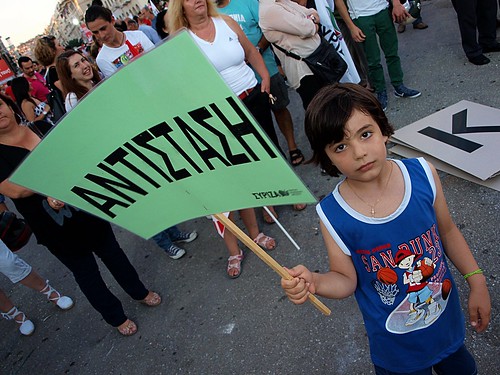
Antistasi - Resistance. SYRIZA campaign rally in Thessaloniki, Greece

The change in fortunes for SYRIZA was reflected in Tsipras's speech which was bold and clearly aimed at reaching out to those who until recently would never have even considered voting for them. Instead of shying away from media attacks, Tsipras tackled them head on, accusing both PASOK and New Democracy of offering Greek people nothing but fear.

Not usually an electrifying public speaker, this time the leader of SYRIZA upped his game and gave a performance reminiscent of the kind of firebrand speeches that used to be part and parcel of Greek electioneering. A far remove from the bloodless style of public delivery preferred by previous prime minister, Giorgos Papandreou who was widely derided for his wooden public addresses.

At time of writing "secret polls" which I cannot blog about (due to a law that forbids their publication for two weeks prior to elections) favour New Democracy, as do Greek and UK bookies. However, if their accuracy is anything like the previous examples such predictions mean little.

By the end of Sunday, whoever wins one thing will be sure, that the trials that Greece has faced over the last three years will not have disappeared. Should SYRIZA come first they will have to form a government and then deal with a Europe determined not to budge over the terms of further cash injections.

On the other hand if New Democracy comes first they will have to cobble together a coalition from disparate parties all of whom will have to foist upon their voters yet more public spending cuts and tax hikes. How long such a fragile alliance will last in such hostile economic conditions is open to debate and probably mean elections once again before the year is up.


Thursday, June 14, 2012

What's next for Greece?

Anti-government protests during Thessaloniki Trade Fair, Greece

Greece's latest round of elections has been, paradoxically, its most important in decades and its most low key. In contrast to previous votes, there has been a a conspicuous lack of campaigning on the part of most parties. Few public rallies, little canvassing and even less leafleting. This is, in part due to lack of funds and partly due to the fact that PASOK and New Democracy, the two parties that dominated Greece's political scene for four decades are just a shadow of their former selves, victims of their support for pro-austerity measures over the last three years.

Instead the most likely winner of Sunday's elections will be SYRIZA (Radical Left Coalition) who will most likely see their share of the vote exceed 30%. This is nothing short of a revolution in Greek politics as until recently the party (or rather a coalition of a diverse band of smaller leftist groupings) was seen as a marginal player, rarely polling more than 5%. Similarly, on the right, Independent Greeks, a newly minted right of centre party created by New Democracy defector Panos Kammenos has also risen from nowhere to become a major factor in the domestic political scene. Despite their ideological differences, both have benefited from their unwavering opposition to the austerity packages foisted upon Greece by its EU, ECB and IMF creditors.

However, with the chance of SYRIZA coming first in the polls and therefore winning the extra 50 seats guaranteed by the constitution, the media war against the party both at home and abroad has ratcheted up, with daily stories attacking its leader Alexis Tsipras for putting Greece in mortal danger. For most of last week the mainstream media in Greece, which is with few exception extremely hostile in its reporting of SYRIZA, accused Tsipras of having links with terrorists, using as evidence a Youtube video by former SYRIZA candidate, Ifikratis Amiras calling upon Greeks to take part in an armed struggle. The fact that Amiras no longer has any formal links with the party did not stop the media taking the story through several news cycles. Even eccentric Slovenian philosopher, Slajov Zizek who shared a panel with Tsipras recently in Athens was accused of promoting extremism amongst SYRIZA ranks during a news report by the state run NET TV channel who stopped just short of accusing him outright of being him a terrorist.

On the other hand the fact that leading New Democracy supporter, Panagiotis Psomiadis called the neo-nazi Golden Dawn, " a brother party" and suggested that parties develop closer ties in a radio broadcast in Thrace this week  went unremarked in the media. Nor did the fact that party leader, Antonis Samaras was promoting a deeply divisive anti-immigrant program designed to wean voters from the far right by taking on board many of their policies

Of course, dirty tricks, spin and flagrant misrepresentations of the truth are part and parcel of Greek electioneering which may be one of the reasons that despite this barrage voters remain unconvinced that the world will end on Sunday if SYRIZA comes first. After two years of the media telling them that the sky is about to fall down ,many have either stopped paying attention or welcome an alternative to the slow, painfully drawn out process of social collapse that has gripped the nation.

So what happens next?


Although Greek law forbids the publication of polls in the two weeks leading up to elections the last ones published showed that new Democracy and SYRIZA were neck and necks, with one exception. a GPO poll commissioned by the conservative daily, Kathimerini  which put SYRIZA well ahead at 31.5% and this is what I believe the will get (For an excellent blog post on how many Greek polling companies played fast and loose with last elections predictions see here). My hunch is based on the consistent under - reporting of SYRIZA support (about 6-7%) and the conviction that the currently media onslaught shows that the Greek establishment is fighting to limit damage caused by a SYRIZA victory.

So let's put my money where my mouth is.

Syriza willl get about 30%, New Democracy, 25% and PASOK 10%. I think that the recent attack by Golden Dawn MP on fellow politicians during a live TV show will affect their share but they will still get enough votes to pass the 3% threshold which guarantees them seats in parliament. As for the other parties I believe that their share will stay more of less the same as the previous elections.

However, being the largest party will not automatically mean that SYRIZA will be in a position to form a government, since the Greek Communist party have ruled out any form of coalition that means Tsipras will have to approach either The Democratic Left party who are lukewarm about co-operation or perhaps disgruntled PASOK MPs, which will not play well internally as many are already portraying SYRIZA as a new PASOK in sheep's clothing.

On the other hand, political gossip has it that the remains of the old regime have already accepted that SYRIZA will come first but believe the PASOK, New Democracy and a third party will be able to keep them out of power by forming their own administration in the name of national salvation. How much legitimacy such a move would have and how long such fragile alliance will last is anyone's guess.


Supposing Tsipras does form a government then the real battle will begin and all the ugly scenarios that the international press has so gleefully propagated may turn out to be true. The EU has absolutely no interest in allowing a successful rejection of its economic program and will do everything in its power to force Athens into a compromise. Most likely this will take the form of shutting off all further financial aid which will quickly cause chaos in Greece's weakened economy as wages, pensions and benefits will not be paid. In addition the health system will grind to a halt as hospitals run out of supplies (though that particular problem has been around for over six months).

Without money Greece will also no longer be able to import staples such as oil and that will lead to panic buying, queues and the kind of scenes usually associated with times of war. Faced with this, Athens will either have to knuckle under or, as it seems the Germans are hoping, exit the Euro and re-adopt the drachma.

On the other hand the sight of Berlin and Brussels wrecking havoc with a fellow EU member will have immense ramifications for the image of European Union across the continent and will lead to searching questions about what exactly European unity means. The political costs for Brussels may be far greater than they could possibly imagine in the long run. In the short run the markets may also respond to Greece's economic demise, not as a one-off acts but the taste of things to come as other southern EU countries such as Spain slip deeper and deeper into recession and stop reaching their austerity imposed targets. In such a case the outflow of capital from the Eurozone may prove unstoppable.


Saturday, May 19, 2012

With new elections approaching EU's war of words with Greece gets down and dirty


Alexis Tsipras  Αλεξης Τσιπρας

The announcement last week that none of the parties in the Greek government were able to form a government has brought with it a dose of madness that dwarfs even the fervid election campaign rhetoric that proceeded it. If you were to take the statements of much of theforeign and local mainstream media at face value Greece is about to collapse andthat it will take with it much of the Eurozone.. Once again Athens is at the centre of a maelstrom of media speculation that can be seen as a retread of 2011 when the Greek prime minister, GiorgiosPapandreou raised the possibility of Greece holding a referendum on whether it should implement yet more austerity measures . Then the suggestion was met by a vociferous campaign from within Greece, not to mention the pressure exerted by Paris,Brussels and Berlin.

With Papandreou now gone from the political scene, his role as the Eurozone's enemy number one has been taken over by Alexis, Tsipras, the leader of the Radical Left Coalition (SYRIZA), which if the name didn't give you a clue is a group of socialist and communist parties who shot into second place in the May elections campaigning on the promise to defy European Union's demands for yet more austerity measures.

The results has been a surge of interest in Greece and a concerted attempt to paint anti-austerity politicians and parties as extremist and dangerous. The new media narrative being created goes like this; Tsipras and, by extension any political group opposed to the terms set down by Athens's creditors are putting in danger Greece's place in the Eurozone and so inviting economic collapse by forcing it to re-adopt the drachma. Some variations on this theme even go as far as to say that Greece may even by kicked out of the EU, and so face decades of North Korean style isolation.

Greek exit from the Euro?

It is a story that has been carefully cultivated in the local press as well, with daily horror stories coming out in the state run TV stations and their allies in the privately controlled media sector. Pro-austerity parties such as PASOK and New Democracy appear regularly to crank up the fear factor by painting the Radical Left as a bunch of crazed fanatics hell bent on destroying what's left of the economy.

If that wasn't enough this week's non-story about a run on Greek banks was gleefully jumped upon and news organisations were desperately trying to recruit local bloggers/twitter users to feed them stories of people besieging banks to take out their money. Rumours of banks limiting withdraws to just 50 E swirled around the internet. That neither was happening proved to be no impediment to reporters eager to get another scoop.

The fact that this week the EU decided to cut off funding to Greek banks it deemed non-viable did nothing to help the situation , leading some commentators to say that maybe that was their intention after all. An example of yet more attempts to nudge the Greek electorate in the “right”direction.

Burning bank - Thessaloniki, Greece

This week also saw the arrival of EU president, Martin Schulz in Athens, obstensibly to persuade the new Greek government to adhere to its earlier fiscal commitments, however, his public appearances with both the leaders of PASOK and New Democracy made it quite clear that the EU wanted it's say in Greece's next round of elections. A message with he then went to repeat on state run and pro-austerity channels yesterday and today.

If that wasn't enough the suggestion by German chancellor Angela Merkel toGreek president KarolosPpapoulias that Greece hold a referendum on membership of the euro was meets by angry accusations of interference in Greek internal affairs. Raising ugly memories of the two countries troubled past relationship.

Ironically, the suggestion, which the German chancellor's office denied (the office of the Greek president then went on to deny the denial) has helped undermine the position of those parties who are hoping to persuade Greek voters to swallow more job cuts and tax increases scheduled for June.

ΠΑΣΟΚ / PASOK rally

Whether the fear of expulsion from the Eurozone is working is hard to tell. Some local opinion polls have put New democracy ahead of SYRIZA but then there are otherσ which show wildly differing results. The problem is that no one knows what will happen in June. Gauging public opinion has become much harder when the two main political parties are constantly changing their make up and positions. PASOK has decided, under it determinedly uncharismatical leader, Evangelos Venizelos to distance itself from both scandal ridden past by abolishing much of its present hierarchy.

On the other hand Greece's right has seen a flurry of deals and team changes. With members of the smaller unsuccessful parties jumping ship to sign up with Samaras's right rainbow alliance. Howe much of this will change the results of the elections is hard to say. Many of those retuning to New Democracy such as ex party super star, Dora Bakoyianni, northern populist, Panayiotis Psomiadis (once again the subject of  legal proceedings) and former MPs with the far right LAOS party are hardly the stuff that electoral landslides are made of.

With a party made up of those willing to change political allegiances at the drop of a hat, it is going to difficult to persuade sceptical voters that the right won't result to yet more u-turns and back flips if elected.

Greek pensioner looking through rubbish for leftover food

Far away from the endless media attention to those in mainstream politics, ordinary Greeks continue to face the everyday grind of surviving in a shrinking economy in which 30-40% are living in poverty, more than half the country's youth (some of the most educated in Europe) are without work and no one knows when things will get better.

Beyond vague promises to renegotiate the terms of Greece's bailout, only SYRIZA has offered something positive to those who have already lost so much. Even if it's the empty gesture of defiance it gives something concrete to those left bitter and disillusioned by the country's more moderate political choices.

Monday, May 14, 2012

Greece's political elite gears up for new elections

"Apocalypse, bane, coup de grace, death knell, end of the world, The End of days "

Judging by the reports circulating in both the Greek and foreign media The End of Days is indeed almost upon us if Athens cannot form a government within the next 24 hours. You would think that such an awful prospect would focus minds of those in power and yet it is just business as usual for Greece's political elite who, even now are more interested in playing political musical chairs than in dealing with deep rooted problems.


According to much of the local media Greece is facing catastrophe as the Radical Left Coalition party (SYRIZA) is refusing to take part in a government of national salvation along with PASOK, New Democracy and the Democratic Left. As a result journalists and senior officials say that new elections will have to be held which could irreparably damage the country and lead to Athens exit for the Eurozone and possibly EU.


However, the maths do not add up. PASOK, New Democracy and Democratic Left have between them 168 seats in the country's 300 seat parliament, more than enough to form a majority government. Indeed, if the Independent Greek party could be persuaded to come on board then the coalition would boast an impressive 201 majority. However the fly in the ointment is the Democratic Left's insistence that they will only help form a government if SYRIZA is also part of it. On the right Panos Kammenos's conservative Independent Greeks have repeatedly refused to co-operate with New Democracy.

Party faithful listen to speech by Conservative leader, Antonis Samaras at election rally - Thessaloniki, Greece


However, that is not the media narrative being promoted. Instead Antonis Samaras, leader of New Democracy, Evangelos Venizelos, leader of PASOK and Fotis Kouvellis, leader of Democratic Left have all put the blame firmly on SYRIZA's Alexis Tsipras. But if the situation is so dire then some kind of compromise can be reached, surely?


And the answer is no as this is all part of the tawdry political game that has been played since Greece sought  help with its debts in 2009. Once again the heads of the two major parties are hoping to shore up their dwindling electoral base by scaring the living daylights out of voters with talk of unpaid pensions and imminent economic collapse. PASOK, led first by Giorgos Papandreou and then by Venizelos used the same language to push through austerity legislation despite the presence of hundreds of thousands of disgruntled Greeks protesters outside parliament.


Instead of cobbling together a government both Samaras and Venizelos are already campaigning for the next round of elections, most probably set for 17th June by attacking SYRIZA who are according to latest polls on track to be the largest party. The message is clear, if you vote SYRIZA Greece will go bankrupt, be kicked out of the Eurozone and all your savings will be lost. The EU has helpfully made such scenarios more realistic by refusing to release money promised for the payment of Greece's day to day running costs (money destined for debt repayments was paid on time).


It is a message that is likely to weigh on people's minds as they vote and may be enough to put off those considering voting left. On the other hand, unemployment, especially among the young is climbing rapidly, prices of basic goods are spiralling upwards and many have lost any hope of a decent future. Will they be swayed by talk of the End of Days? For them they are already here. Will talk of lost savings affect those under 30 who have none to speak of?


There are two contradictory forces at work as far as the next elections are concerned. On the one hand the fear of possible national bankruptcy may well drive those who still have something to lose back into the arms of New Democracy and PASOK and so give them a boost, perhaps enough to form a government of their own.


On the other hand disgust with the ineptitude and corruption of the current political set up has not disappeared and the inability of the main leaders to recognise that is costing them dearly. People know full well, that despite promises to renegotiate terms of the bailout agreement if Germany refuses (and there seems every indication that they will) then Greek politicians will have little choice but to accept the decision. Another round of public spending cuts and tax hikes would follow just adding to the economic woes that Greece has been facing for the last five years.


Greek communist party election rally - Thessaloniki, Greece


SYRIZA benefited from the disgust that ordinary Greeks feel about their government in May and that is likely to be repeated in June. However, there are several factors that may up their share of the vote still further. Both PASOK and New Democracy have shown that even after the drubbing they received they have not changed attitudes in the slightest and still continue to act as if the elections never happened. This will provide SYRIZA with extra votes, especially from younger voters who are not benefiting from the status quo.


Also the endless back room political games played by newly formed Democratic Left in the last few weeks have alienated even its own MPs and will cost them in June, the most likely recipient of their votes will be SYRIZA. The fact that the Greek Communist party has decided not to work with any other left parties has irked many of its electoral base, especially the young who do not want to sit of the political sidelines. Though the number of voters will be quite small as the party's supporters are among the most loyal in Greek politics


Lastly, as SYRIZA has emerged as a viable political force more and more voters will no longer see a vote cast for them as wasted, so attracting people who see them as something more than a party of protest. Voters, like everyone else love winners.

Thursday, May 10, 2012

EU and Greece's high stakes poker game.

Evangelos Venizelos by Teacher Dude's BBQ
Evangelos Venizelos, a photo by Teacher Dude's BBQ on Flickr.


This time my prediction proved right and Alexis Tsipras this morning told the Greek president that his SYRIZA (Radical Left Coalition) party is unable to form a new government. This means that the task now falls to the head of the centre left PASOK party, Evangelos Venizelos, however, the chances of Venizelos, whose party lost 70% of its parliamentary seats in Sunday's elections, faring any better than Tsipras or the conservative leader, Antonis Samaras are slim.

It is becoming quite obvious that under the present economic conditions any party working with PASOK or New Democracy in order to form a pro-austerity government is signing their own political death warrant and with elections likely in June that mitigates against any agreement.

So what happens next?

Tsipras used his time in the political spotlight to further underline his party's opposition to the terms of the Greek bailout deal and made it quite clear that if the Radical Left took power they would play a very different game from their immediate predecessors. Also in a parliamentary address broadcast live on TV last night at 9pm he reached out to other groups on the left, both trade unions and political parties in what could be called the creation of a united front in any new national elections. If SYRIZA can attract some of the smaller left wing parties and get the Ecologists to sign up there is a good chance that they may overtake the conservatives in the polls. In addition the language Tsipras used was also aimed at the supporters of the Greek Communist party (KKE) who may be persuaded to switch allegiances. There are rumblings of discontent amongst KKE rank and file members who are unhappy with Aleka Papariga's unwillingness to form wider political alliances.

Samaras supporters light up flares during New democracy rally - Thessaloniki, Greece

The prospect of a radical left wing, anti-austerity government in Athens has, predictably enough provoked a strong reaction by both local and European elites. Already the local media are running scare stories blaming political instability for falling tourism bookings and saying that ΣΥΡΙΖΑ would use power to grab people's savings. In a similar vein, both Samaras and Venizelos claimed that such a government would get the country kicked out of the Eurozone and the EU and would lead to economic collapse.

On the European level last night the EU said that it was delaying payment of part of the latest bailout tranche, of the 5.2 billion euros promised, only 4.2 billion will be released today, the remaining 1 billion destined to fill holes in the Greek government's day to day running costs will be paid at the some unspecified time in June. Such crude blackmail attempts underline the sense of unease being felt in Brussels and Berlin at the prospect of Greece defying creditors and possibly derailing the entire EU austerity program.

There is an other possibility as the BBC's Paul Mason pointed out that in light of the elected parties being unable to form a government and unelected technocratic caretaker government would be charged with passing the latest cuts and tax hikes scheduled for June and July. Such a move would plunge the country into even more political turmoil as people would see it as a clear defiance of the anti-austerity message the national elections sent. In such a climate the legitimacy of the parties participating in such a government would be shredded, opening up opportunities to other less mainstream parties, including the neo-Nazi Golden Dawn who already have 21 MPs in parliament.

Thank God for the IMF and ECB

Once again the Greece and the EU are playing a game of high stakes poker, upping the ante and hoping that the other will fold first. However, unlike previous round the mood in Greece has changed dramatically with the worsening economic crisis and threats of dire social consequences of failure to comply no longer hold such sway. With youth unemployment at 50% and the thousands of businesses closing every week, for many the worst has already arrived.


Tuesday, May 08, 2012

Squaring the circle - Radical Left's Alexis Tsipras takes turn at forming new Greek government

Αλεξης Τσιπρας/ Alexis Tsipras by Teacher Dude's BBQ


Well, one of my predictions bit the dust. The possibility that New Democracy would work with Independent Greeks was nixed yesterday when Panos Kammenos refused even to meet with New Democracy leader, Antonis Samaras. Now it's the turn of the leader of the Radical Left coalition party (SYRIZA), Alexis Tsipras to try and form a government. After today's meeting with the president of Greece at 2pm he will have 72 hours to forge a coalition. 

At first glance this seems an uphill task given the fact that the Greek Communist party (KKE) has ruled out any possible deal and without their 26 seats getting a 151 seat majority just from the left went from being difficult to being  impossible.Even if KKE's leader Aleka Papariga had agreed, the presence of members of PASOK once again in government would have caused enormous problems both within parliament and with the electorate at large who sent a very clear message that they do not want more of the same.

Aleka Papariga, leader of KKE - The Cummunist Party of Greece

So what's left? One rumour doing the rounds of the Greek language twittersphere is that a quick and dirty coalition of PASOK, Independent Greeks, SYRIZA and Democratic Alliance would form a short term government to repeal the election law that gives leading party an extra 50 seats in parliament and then announce new national elections with a more level playing field.

However, this is just a rumour and I believe the most likely outcome will be Tspiras announcing that a new government cannot be formed in which case the task falls to PASOK leader Evengelos Venizlos who is likely to have even less luck.

Evangelos Venizelos addressing rally. Thessaloniki, Greece

So its seems that new elections will be held once more with the 10th or 17th June being mentioned as the most likely dates. It will be interesting to see if they produce radically different results to the previous ones. Equally interesting will be how this affects the next round of measures required by Greece's creditors in return for the latest bailout installment. If Athens is not in a position to implement the tax hikes and job cuts being demanded will the money be withheld? With government revenues falling all the time what happens to the real economy and the stability of the Eurozone as markets get ready for a possible knock on effect in Spain, Italy and Portugal. 

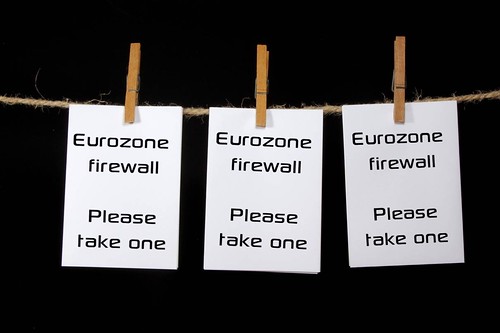
In such a case will the EZ's firewall be enough?

EZ firewall - Please take one.

Thursday, September 10, 2009

Alexis Tsipras in Thessaloniki today

With parliamentary elections just weeks away Greece's radical left alliance, SYRIZA (Coalition of the Radical Left) has launched its elections campaign with a withering attack on both the ruling conservative New Democracy government and it's main socialist rival, PASOK. Speaking today at a press conference in Greece's second largest city, Thessaloniki, leader of SYRIZA's parliamentary group. Alexis Tsipras attacked the government's bank bail out policy for supporting the country's financial institutions with public money at a time when they have reported massive profits.

In addition Tsipras poured cold water on the idea of any possible post election coalition with the PASOK party of Giorgos Papandreou. However, SYRIZA, which is made up of several smaller left wing parties has itself found difficulties with leadership battles and an electorate that failed to respond to the party's platform in the recent European parliamentary elections.

Friday, September 19, 2008

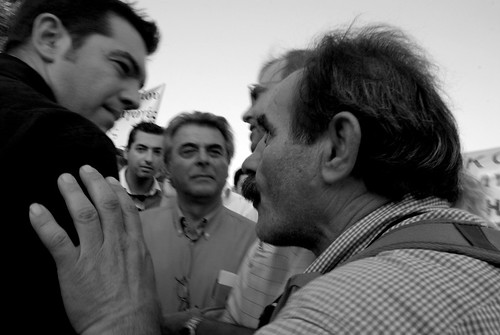
Alexis Tsipras at the Helexpo demonstration

With the presence of 2000 extra police officers on the streets, snipers stationed on rooftops and helicopters circling overhead, downtown Thessaloniki resembles less a city celebrating the opening of a major trade fair than a town under siege.

The arrival of the Greek prime minister Kostas Karamalis in Greece’s second city has triggered massive street protests by those unhappy with his government’s handling of the economy and upset at a seemingly endless stream of financial scandals involving senior ministers.

In a keynote speech at the opening of the trade fair the prime minster tried to put a brave face on what has been a disasterous summer for the New Democracy administration by emphasising the need for reform of Greece’s ailing economy and by promoting public works such as the Thessaloniki underground which he says are proof that the present government has been able to improve the lives of ordinary Greeks.

However, critics have pointed out that despite five years of conservative rule the country, unlike neighbouring Turkey and Bulgaria has failed to attract increased foreign investment and that direct investment is now lower than in countries such as Uzbekistan.

Similarly, all except one of the major public works in Greece’s second city have ground to a halt due to lack of funding from Athens and that the much hyped underground is behind schedule and over budget.

Karamanlis and party officials have been keen to point out that Greece is suffering from the effects of worldwide problems caused by rising oil prices and a global credit crunch. However, many of the ruling New Democracy party’s problems appear to be strictly home made.

Their standing in the opinion polls has fallen dramatically over the 12 months since re-election as scandal after scandal has come to public light, many connected with dubious land deals involving ruling party MPs and ministers. As if to add to the government’s woes last week the party even faced accusations of tampering in a parliamentary vote.

In addition the rises in the cost of basic goods and services, which have long outstripped those in other European countries, stagnant wages and most recently swingeing tax increases for lower income groups have combined to undermine public confidence in the Greek government.

Opposition to government attempts to push through an unpopular political agenda has seen groups as disparate as cleaners and anarchists, police officers and communist trade unionists joined forces on the streets of Thessaloniki. Yesterday. Between ten and twenty thousand protesters marched to express their unhappiness with government policies and the state of the country’s political scene in general.

Whilst the march passed off peacefully, local media sources reported that small anarchist groups attacked shops and a bank afterwards and the police had made 15 arrests.

http://www.nowpublic.com/world/greek-pm-under-siege

Monday, September 08, 2008

Saturday's demo in colour

I thought I'd post some more photos from Saturday's anti-government rally that marked the Greek prime minister's visit to the 73rd International Trade Fair here in Thessaloniki. For more details on that check out the story I wrote for NowPublic.com.

Actually, these events are full of striking images and often remind me of Kurosawa's Ran in that each group is colour coded. The trade unionists wear something orange or yellow, the anarchists with their red and black, the anarcho-ecologist, green and black, the communists decked out with their traditional red flags.

In addition to the more traditional groups the Greens were there to raise public awareness about the problems of carbon footprint created by the use of lignite by the Greece's publicly owned power company, DEH.

Employees from Olympic Airways were protesting against government attempts to sell off Greece's national airline.

The riot police were employed not just to keep protester from approaching the Trade Fair, but also to separate various groups within the march who spent as much time battling each other as they did the authorities.

"Dear Mom,

Just arrived in the city and it's very hot, Still, the people are very friendly and the police have been very helpful. I think they are all here to watch a soccer match. Hope everyone back there in Arkansas is doing well.

Yours

Bob
Alexis Tsipras, the chairman of the Synaspismos party.

Friday, April 11, 2008

Greek politician faces one million euro law suit for criticising


In a move that sent shock waves through the Greek political world, Alexis Tsipras, the leader of the left-wing Synaspismos party has been sued for over 1 million euros for defamation by the Marfin Investment Group (MIG) over his criticism of the company's role in the sale of its 2.5 billion euro stake in the Greek state run telecommunication OTE to Deutsche Telekom. In addition the Greek TV channel, Star is being sued for 150 million euros over claims that MIG's funds had come via the Albanian mafia.

Tsipras, who was recently elected the president of Synapismos, has repeatedly called the controversial OTE deal a "fraud" and along with other opposition leaders has tried to block the sell of OTE to the German telecoms giant. In statement posted on the party's website Tsipras called the suit an "unprecedented attempt at penalising political life."


The other major Greek parties have been swift to condemn the action by Marfin. Government spokesman, Evangelos Antonaros, stated that the government disagreed with any attempt to sue any political leader for exercising their right to criticise. In addition PASOK party secretary, Giannis Ragousis, speaking to Alpha Radio said that the legal action was "unthinkable and unprecedented", adding that is was the duty and not just the right of political partys and leaders to engage in criticism and debate on public matters.


Andreas Vgenopoulos, vice-president of the Marfin Investment Group, claimed in a press conference that that the company had been the victim of a slur campaign organised by politicians, trade unionists and elements of the media. The lawsuit, he added, was needed to restore the honour and dignity of the MIG Group's 52,000 employees.


Greek politician faces one million euro law suit for criticising privatisation deal

Tags: | | | | | | | |