Showing posts with label spain. Show all posts

Monday, June 01, 2015

EU believes puts its faith in guns not aid


According to a secret document released on 25 May 2015 by Wikileaks the EU is in the process of implementing a plan for the use of military force in order to deal with the growing refugee influx from Libya to Europe via the Mediterranean. The plan devised by the EU Politico-Military Group aims to "disrupt human smuggling networks" and  "to contribute to systematic efforts to identify, capture and destroy vessels before they are used by traffickers".

Given the turbulent nature of Libya in the aftermath of the NATO - sponsored overthrow of the Gaddafi regime, how yet more European military intervention is going to affect the situation on the ground is unclear. This, in turn leads to the problems of identifying "traffickers" (as the document calls those taking migrants to Europe) in a fluid, often violent civil conflict in which different factions are vying for advantage. It is all too easy in these cases to be misled by groups hoping to use European military force to even the odds by way of air strikes. As the West's debacle in Iraq and Afghanistan, shows ignorance of local history, customs and political realities is often fatal for civilians. 

Yet even if EU manages to avoid the mistakes of the past it is hard to imagine how such actions will do anything more than temporarily limit numbers from Libya. The operations are being marketed as a way of saving refugees from the dangers of a taking a route which has cost the lives of thousands, but refugees are perfectly aware of the risks they take when crossing the Mediterranean. With the expansion in ownership of smart phones worldwide, modern refugees can often contact home via services such as Viber and Facebook, so ensuring valuable, potentially life saving information can be shared. Faced with the choice of drowning on a leaky vessel and going back to the war torn homes they fled, they are opting for the former, given the fact the EU immigration rules have given very little chance of choosing a safer alternative.

Even if, by some miracle European war planes/ships do manage to target just smuggler ships what exactly happens to those intercepted in international waters? Will they be forced back to Libya, fired upon if the crew refuses to heed warnings, foisted off on some third nation's territory following Australia's example?

Should this measure work then the next step would be the switch to smaller, less easily detected vessels even less suitable for making a long sea crossing and hence we have the possibility that a successful interdiction policy will lead to even more drownings of men, women and children in the Mediterranean, now the most dangerous stretch of water for refugees in the world. Alternatively, the flow of those willing to risk all for a better life will be channelled elsewhere to places such as Spain and Greece whose close proximity by sea to other non-EU nations make them impossible to seal off unless the most draconian of war time precautions are employed.

Already, Greece has become a transit spot and many unable to fly or use other forms of transport are walking across the Balkans in order to reach places such as Germany and Holland. In cities in the north the parks are now temporary home to groups, often composed of families with young children taking a short break before continuing their arduous trek north (see previous post). In an era when air travel has become more affordable than ever before we are faced with the sight of groups of people attempting to cross a continent on foot.

On a deeper, more moral level the idea of using military action in a humanitarian crisis is a symptom of a malaise in Europe, instead of providing aid and relief to those fleeing war, poverty and other disasters in places such as Syria and Yemen The EU, which won the Nobel Peace Prize in 2012, is authorising the use of force against some of the poorest and most desperate people on the planet. 

The deliberate conflation of the terms "smuggling" and "trafficking" by European politicians and mainstream media outlets is part of the current media strategy aimed at legitimising military action to deal with, what in essence is a refugee crisis. The idea is that people who smuggle others (angels by no means|) over a border are the same as those who are little more than modern day slavers.This, itself the product of the hardening of attitudes to newly arrived migrants, minorities and other groups of the poor who have suffered the brunt of austerity measures implemented since the 2008 financial crisis. Often the poorest are pitted against each other in a bitter fight for basic resources such as employment, health care and housing


Attitudes to immigration, once the preserve of far right fringe groups such as the ultra-right British National Party are now to be considered respectable enough to be part of mainstream political discourse and even worse are becoming the basis for initiatives that remind us of the darker days of Europe's recent past. 


Sunday, February 01, 2015

2015 - The Year We Fight Back


We're barely into February and already Syriza, a  radical left government has been elected in Greece in the face of fierce media resistance, their victory challenging the prevailing pro-austerity narrative that has wrought such destruction in southern Europe. Soon it seems the same feat is going to be repeated elsewhere as Podemos gains popularity and takes on Spain's corrupt political elite.

Sunday, October 21, 2012

Is the European experiment grinding to halt?

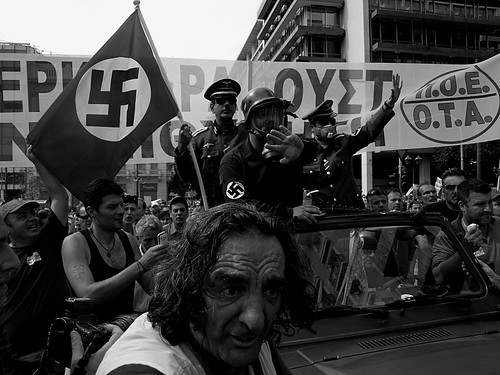
Greek protesters greet Merkel with Swastikas and Nazi salutes - Athens

Earlier this morning I got a call from a friend, saying that she'd found a job but I was at a loss whether to congratulate her or not, as she will not only leave her country but also her two young children as well. For the next nine months my friend will be teaching English at a private school in the Gulf States. In doing so she'll be following a path trailed by many other friends and acquaintances over the last few years.

Her children will remain here to be looked after by grandparents for the duration, a story reminiscent of the sacrifices that many Greeks were obliged to make in the 60's and 70's as guest workers who went north to find jobs in the booming economies of Europe and especially in German factories then powering the country's export led economic miracle.

As with so many other Greeks six years of recession has forced my friend to consider working abroad as the only alternative to a slow slide into poverty at home so repeating a story that has been told and re-told so often here over the last 100 years. However, this latest generation is both luckier and unluckier than their parents and forebears.

On the one hand many emigrating Greeks are highly educated and have university level qualifications and language skills that set them apart from previous generations. No longer are they the monolingual, sometimes barely literate villagers who went abroad, able only to obtain dead end jobs that post war northern Europeans were all to happy to spurn in favour of better paid, higher status ones in the service sector.

Austerity is working - Ask the experts

Yet young educated Greeks are sallying forth into a very different world, one in which jobs, even badly paid, low status ones are becoming more and more difficult to find. While some will find work that fully utilises their knowledge and skills many will find that a foreigner in a declining economy, not matter how well educated will always be at a disadvantage.

In addition the gap between earnings in the North and South of Europe has shrunk to a remarkable degree since the 1960's, with those in countries such as Germany often remaining static whilst those in the South have risen along with rising living standards.Gone are the days when an unskilled factory hand could earn a wage that would have been the envy of those back at home. So, the question that goes through many people's minds is why go through all the social and psychological upheaval of leaving home? Why uproot yourself when factories in east Germany pays just 6E an hour, just a few Euros more than can be earned at home, unless your only criteria is survival?

However, with unemployment at 25% (30% plus, if Greek trade union research is to be believed) and family and social security networks buckling under the strain, then survival rather than having a better standard of living may push Greeks as well as Spaniards, Portuguese and Italians north once again.

But with recession gradually mutating into Depression what reception will this new generation of gasterbiters receive? Even when cheap labour was in demand in the heavy industries of the Ruhr and the Rhine southern European workers were often grudgingly accepted, now that they are coming into competition for jobs in a shrinking economy the potential for ugly confrontation becomes a real possibility .

Given the campaign of virulent anti-Greek feeling that has marked German politics and media coverage of the current debt crisis, the groundwork for growing racist sentiment has been assiduously cultivated. Should the situation in other PIIGS start to resemble that of Greece how long is it before the myths of the lazy Spaniard and work shy Italian once more become part of the cultural and political landscape north of the Alps?

Then, the German far right, like Greece's neo-Nazi Golden Dawn,will happily exploit the opportunities given them by more “respectable” conservative forces. As the economic decline of the European South takes its toll on German export markets and the government will inevitably struggle to balance a commitment to the EU ideal of open borders with growing demands that German jobs and businesses be protected.

Welcome to the fight. Here is where we draw the line. Here is where we defeat austerity

Switzerland's military is already drawing up contingency plans in case of a deepening of the social crisis in the Southern EU, UK's prime minister, David Cameron talked of the possibility of closing the country's borders in case of a flood of Greek economic refugees is being considered and France's demand for the re-introduction of internal EU border controls set the tone  showing that the EU's policy of open borders could be reversed in a heartbeat, should national moods change.

How much of this is just right wing political opportunism, designed to win votes with a frightened electorate and how much of it points the way to a more disunited future depends on the depth and duration of the crisis. If the North follows the same pattern as indebted nations such as Greece and Spain then all bets are off as growing divisions may threaten to derail the decades of unification and reconciliation that the EU has wrought.

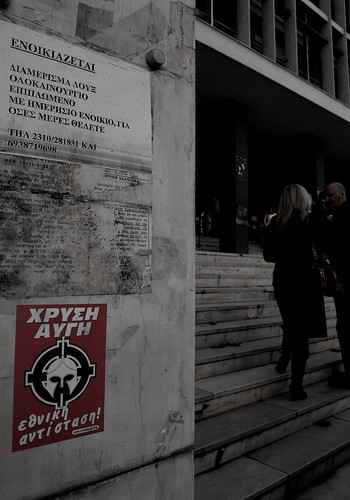
Racist poster outside the central courts, Thessaloniki

It's a sad irony of modern history that the years of hard work put in by successive German leaders since end of World War II to prove that Berlin can be trusted to rejoin the European family of nations is being thrown away by a new generation of fiscal hard liners who are willing to put their allegiance to dubious economic dogma ahead of the unity of the continent.

One of the lessons of the 1930's that German chancellor, Angela Merkel and many other EU leaders seem willing to ignore is just how quickly economic disaster changes the political outlook of people who've enjoyed years of financial growth and security. The frenzied growth of the 20's and the sudden loss of prosperity that hit the middle class especially in the Great Depression helped bring the extreme right to power in a remarkably short period of time. 

In just a five years, the percentage of the popular vote captured by the Nazi party grew from 2.6% to 43.9%, a political rise that is being eerily echoed by their modern day counterparts in Greece, who have increased their popular support at an even more spectacular rate, going from just 0.29% to 14% in three years.

In 30's the insistence of the political mainstream to cling to ineffective economic theories even in the face of dismal failure drove disenchanted voters into the arms of fascist parties across Europe and beyond. The, then widespread political belief that ordinary people would endure years of extreme poverty and suffering in the name of an empty promise that it would eventually bring about future growth helped bring down democracies across the world.

Does Europe need to lose tens of millions of lives once more to relearn lessons that ended up being so brutally paid for in the streets of Stalingrad and fields of Normandy?

Thursday, June 14, 2012

What's next for Greece?

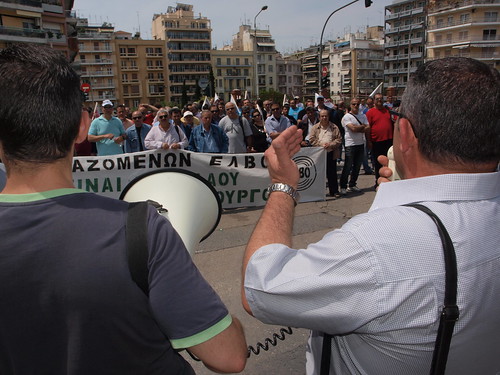
Anti-government protests during Thessaloniki Trade Fair, Greece

Greece's latest round of elections has been, paradoxically, its most important in decades and its most low key. In contrast to previous votes, there has been a a conspicuous lack of campaigning on the part of most parties. Few public rallies, little canvassing and even less leafleting. This is, in part due to lack of funds and partly due to the fact that PASOK and New Democracy, the two parties that dominated Greece's political scene for four decades are just a shadow of their former selves, victims of their support for pro-austerity measures over the last three years.

Instead the most likely winner of Sunday's elections will be SYRIZA (Radical Left Coalition) who will most likely see their share of the vote exceed 30%. This is nothing short of a revolution in Greek politics as until recently the party (or rather a coalition of a diverse band of smaller leftist groupings) was seen as a marginal player, rarely polling more than 5%. Similarly, on the right, Independent Greeks, a newly minted right of centre party created by New Democracy defector Panos Kammenos has also risen from nowhere to become a major factor in the domestic political scene. Despite their ideological differences, both have benefited from their unwavering opposition to the austerity packages foisted upon Greece by its EU, ECB and IMF creditors.

However, with the chance of SYRIZA coming first in the polls and therefore winning the extra 50 seats guaranteed by the constitution, the media war against the party both at home and abroad has ratcheted up, with daily stories attacking its leader Alexis Tsipras for putting Greece in mortal danger. For most of last week the mainstream media in Greece, which is with few exception extremely hostile in its reporting of SYRIZA, accused Tsipras of having links with terrorists, using as evidence a Youtube video by former SYRIZA candidate, Ifikratis Amiras calling upon Greeks to take part in an armed struggle. The fact that Amiras no longer has any formal links with the party did not stop the media taking the story through several news cycles. Even eccentric Slovenian philosopher, Slajov Zizek who shared a panel with Tsipras recently in Athens was accused of promoting extremism amongst SYRIZA ranks during a news report by the state run NET TV channel who stopped just short of accusing him outright of being him a terrorist.

On the other hand the fact that leading New Democracy supporter, Panagiotis Psomiadis called the neo-nazi Golden Dawn, " a brother party" and suggested that parties develop closer ties in a radio broadcast in Thrace this week  went unremarked in the media. Nor did the fact that party leader, Antonis Samaras was promoting a deeply divisive anti-immigrant program designed to wean voters from the far right by taking on board many of their policies

Of course, dirty tricks, spin and flagrant misrepresentations of the truth are part and parcel of Greek electioneering which may be one of the reasons that despite this barrage voters remain unconvinced that the world will end on Sunday if SYRIZA comes first. After two years of the media telling them that the sky is about to fall down ,many have either stopped paying attention or welcome an alternative to the slow, painfully drawn out process of social collapse that has gripped the nation.

So what happens next?


Although Greek law forbids the publication of polls in the two weeks leading up to elections the last ones published showed that new Democracy and SYRIZA were neck and necks, with one exception. a GPO poll commissioned by the conservative daily, Kathimerini  which put SYRIZA well ahead at 31.5% and this is what I believe the will get (For an excellent blog post on how many Greek polling companies played fast and loose with last elections predictions see here). My hunch is based on the consistent under - reporting of SYRIZA support (about 6-7%) and the conviction that the currently media onslaught shows that the Greek establishment is fighting to limit damage caused by a SYRIZA victory.

So let's put my money where my mouth is.

Syriza willl get about 30%, New Democracy, 25% and PASOK 10%. I think that the recent attack by Golden Dawn MP on fellow politicians during a live TV show will affect their share but they will still get enough votes to pass the 3% threshold which guarantees them seats in parliament. As for the other parties I believe that their share will stay more of less the same as the previous elections.

However, being the largest party will not automatically mean that SYRIZA will be in a position to form a government, since the Greek Communist party have ruled out any form of coalition that means Tsipras will have to approach either The Democratic Left party who are lukewarm about co-operation or perhaps disgruntled PASOK MPs, which will not play well internally as many are already portraying SYRIZA as a new PASOK in sheep's clothing.

On the other hand, political gossip has it that the remains of the old regime have already accepted that SYRIZA will come first but believe the PASOK, New Democracy and a third party will be able to keep them out of power by forming their own administration in the name of national salvation. How much legitimacy such a move would have and how long such fragile alliance will last is anyone's guess.


Supposing Tsipras does form a government then the real battle will begin and all the ugly scenarios that the international press has so gleefully propagated may turn out to be true. The EU has absolutely no interest in allowing a successful rejection of its economic program and will do everything in its power to force Athens into a compromise. Most likely this will take the form of shutting off all further financial aid which will quickly cause chaos in Greece's weakened economy as wages, pensions and benefits will not be paid. In addition the health system will grind to a halt as hospitals run out of supplies (though that particular problem has been around for over six months).

Without money Greece will also no longer be able to import staples such as oil and that will lead to panic buying, queues and the kind of scenes usually associated with times of war. Faced with this, Athens will either have to knuckle under or, as it seems the Germans are hoping, exit the Euro and re-adopt the drachma.

On the other hand the sight of Berlin and Brussels wrecking havoc with a fellow EU member will have immense ramifications for the image of European Union across the continent and will lead to searching questions about what exactly European unity means. The political costs for Brussels may be far greater than they could possibly imagine in the long run. In the short run the markets may also respond to Greece's economic demise, not as a one-off acts but the taste of things to come as other southern EU countries such as Spain slip deeper and deeper into recession and stop reaching their austerity imposed targets. In such a case the outflow of capital from the Eurozone may prove unstoppable.


Friday, March 30, 2012

Debt crisis puts European project in jeopardy

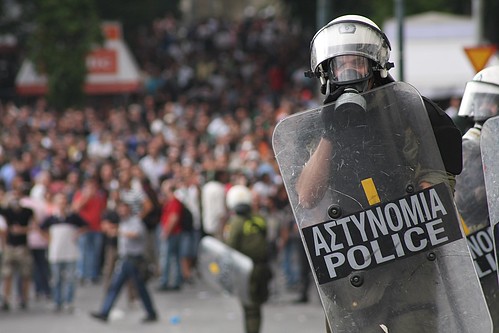
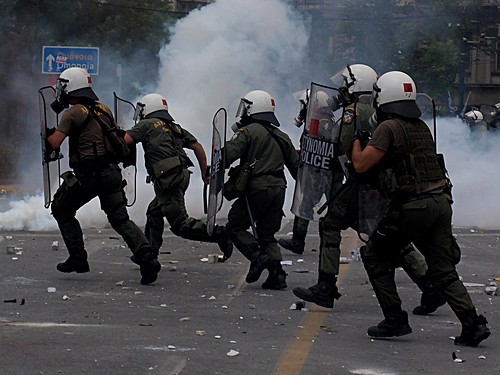
Is this the future of Europe? When rioting broke out in Athens in previous years it was seen as a purely local phenomenon, taken as yet more evidence by foreign press that the Greeks were an unruly and undisciplined bunch who refused to see sense.

The idea propagated in much of the international press was that the the austerity measures imposed by the country's creditors were the only sensible solution for the nation and that refusal to knuckle down was was a refusal to accept reality. I remember being interviewed by the BBC and the first question was why the Greeks were so upset about being "saved". The reporter seemingly unaware of the harsh conditions of the bailout deal.

Two years on the Greek economy is in free fall beset with a disintegrating private and public sector which is shedding jobs at an unprecedented rate. If that wasn't enough, the government's attempt to balance the books by rising taxes on everything from bread to boats has just sped up the decline. At every single juncture an increase in taxation has been matched with a fall in consumption leading to even less money flowing into the coffers.

Despite two years of patent failure IMF and EU officials continue to claim that their policy recommendations have been ignored and that the Greek government has brought this disaster upon itself. Yet, in nations which have adopted troika policies more comprehensively the results are the same. In Spain and Portugal (always seen by foreign financial press as the model student) the same cycle of decline and debt is also playing out and with it a growing level of violent dissent.

Yesterday's images from Madrid and Barcelona echo those seen recently in Athens and other Greek cities as young people facing a future without hope or work work out their resentments in the streets.With youth unemployment in both country's reaching 50% a potential generation gap is opening up as young Europeans start to associate the EU with poverty and joblessness.

Even if the European ideal survives the current Eurozone crisis the damage done to its image in the eyes of the continent's youth may mean that it's future will be in doubt as young Europeans enter political life and see the union, not as a guarantor of unity and prosperity but an force for disruption and inequality.

Tuesday, May 24, 2011

Greeks react angrily to latest austerity measures


Today the ruling PASOK party announced the latest round of austerity measures meant to put Greece financial house in order. Yet more increases in VAT (this time on basic food items such as bread and milk), a road tax hike, lower tax bands as well as a new privatisation plan.

In other words more of the same kind of policies that have brought about an economic decline unprecedented in post war years and created an army of desperate unemployed who are being left to the mercy of the marketplace. Despite German media reports to the contrary Greece's not a paradise for the jobless with fewer than half those without work entitled to unemployment benefit. While other help is available, at least on paper, bureaucracy and lack of funds means that many who require help do not receive it.

Despite the continued fall in the economy and a spiralling debt load Athens continues to follow the recipe led down by its IMF. EU and ECB creditors which has brought little but disaster and suffering to millions of Greeks on lower incomes.

Tomorrow there has been a call for a Spanish style street protests here in Thessaloniki (6pm Wednesday outside the White Tower) so it shall be interesting to see if people respond. On the one hand there is certainly enough anger and indignation in Greek society but the experience of 18 months of severe economic downturn has sapped people's will to protest.