Showing posts with label troika. Show all posts
Showing posts with label troika. Show all posts
Thursday, November 28, 2013


Friday, March 30, 2012
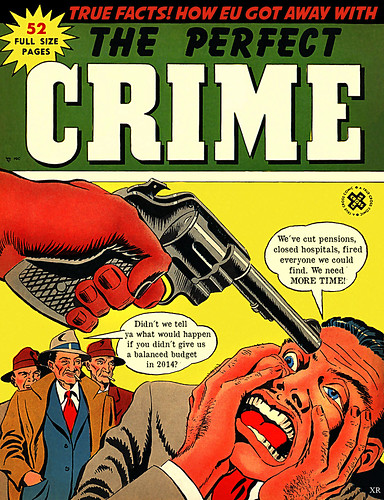
Debt crisis puts European project in jeopardy
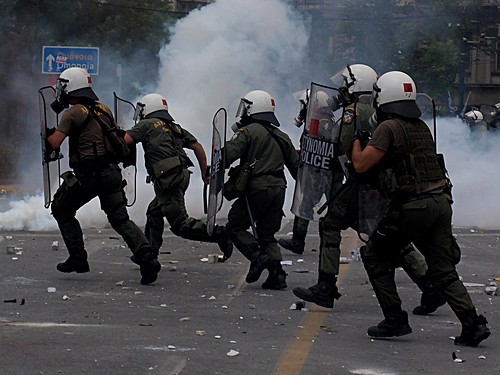
Is this the future of Europe? When rioting broke out in Athens in previous years it was seen as a purely local phenomenon, taken as yet more evidence by foreign press that the Greeks were an unruly and undisciplined bunch who refused to see sense.
The idea propagated in much of the international press was that the the austerity measures imposed by the country's creditors were the only sensible solution for the nation and that refusal to knuckle down was was a refusal to accept reality. I remember being interviewed by the BBC and the first question was why the Greeks were so upset about being "saved". The reporter seemingly unaware of the harsh conditions of the bailout deal.
Two years on the Greek economy is in free fall beset with a disintegrating private and public sector which is shedding jobs at an unprecedented rate. If that wasn't enough, the government's attempt to balance the books by rising taxes on everything from bread to boats has just sped up the decline. At every single juncture an increase in taxation has been matched with a fall in consumption leading to even less money flowing into the coffers.
Despite two years of patent failure IMF and EU officials continue to claim that their policy recommendations have been ignored and that the Greek government has brought this disaster upon itself. Yet, in nations which have adopted troika policies more comprehensively the results are the same. In Spain and Portugal (always seen by foreign financial press as the model student) the same cycle of decline and debt is also playing out and with it a growing level of violent dissent.
Yesterday's images from Madrid and Barcelona echo those seen recently in Athens and other Greek cities as young people facing a future without hope or work work out their resentments in the streets.With youth unemployment in both country's reaching 50% a potential generation gap is opening up as young Europeans start to associate the EU with poverty and joblessness.
Even if the European ideal survives the current Eurozone crisis the damage done to its image in the eyes of the continent's youth may mean that it's future will be in doubt as young Europeans enter political life and see the union, not as a guarantor of unity and prosperity but an force for disruption and inequality.
The idea propagated in much of the international press was that the the austerity measures imposed by the country's creditors were the only sensible solution for the nation and that refusal to knuckle down was was a refusal to accept reality. I remember being interviewed by the BBC and the first question was why the Greeks were so upset about being "saved". The reporter seemingly unaware of the harsh conditions of the bailout deal.
Two years on the Greek economy is in free fall beset with a disintegrating private and public sector which is shedding jobs at an unprecedented rate. If that wasn't enough, the government's attempt to balance the books by rising taxes on everything from bread to boats has just sped up the decline. At every single juncture an increase in taxation has been matched with a fall in consumption leading to even less money flowing into the coffers.
Despite two years of patent failure IMF and EU officials continue to claim that their policy recommendations have been ignored and that the Greek government has brought this disaster upon itself. Yet, in nations which have adopted troika policies more comprehensively the results are the same. In Spain and Portugal (always seen by foreign financial press as the model student) the same cycle of decline and debt is also playing out and with it a growing level of violent dissent.
Yesterday's images from Madrid and Barcelona echo those seen recently in Athens and other Greek cities as young people facing a future without hope or work work out their resentments in the streets.With youth unemployment in both country's reaching 50% a potential generation gap is opening up as young Europeans start to associate the EU with poverty and joblessness.
Even if the European ideal survives the current Eurozone crisis the damage done to its image in the eyes of the continent's youth may mean that it's future will be in doubt as young Europeans enter political life and see the union, not as a guarantor of unity and prosperity but an force for disruption and inequality.
Monday, February 14, 2011
Greek PM feigns shock over EU-IMF reform plans
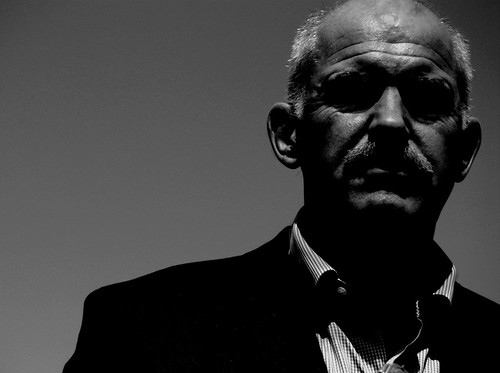
On Friday the IMF, EU and ECB (known locally as the Troika) announced their joint proposals concerning the future of the Greek economy and actions needed to reduce the country's massive debt load which is set to exceed 150% of GDP this year. The most controversial element of the plan is the privatisation of 50 billion euros of public assets over the next three years and was protrayed in much of the media as a sell off of the family silver at bargain basement prices. Only the rabidly pro-PASOK Ethnos newspaper dared to present the news that troika representatives had issued an apology as a victory for the government.
In the face of such stiff opposition Greek Prime minister Giorgos Papandreou claimed to have blind sided by the EU-IMF saying that the press conference had given the impression that the Greek government was simply following the orders given it by the country's creditors.The reality of the situation is that the so-called argument is a rather crude PR trick designed to spin the fact that the ruling PASOK party have already agreed to carry out the measures demanded and is attempting to sell the public the idea that they are still in charge and not just acting as locally recruited management representatives.
The ploy has failed to convince even ardent government media supporters in the privately run SKAI channel who condemned it as a cheap theatrics. Indeed it is hard to believe that after months of negotiations the head of the Greek government was unaware of all the details of the EU-IMF strategy and was taken by surprise.
Actually, if you read Papandreou's actual complaint he was apparently not criticising the content of the Troika's press conference but the manner in which it was presented. Government minister for education Anna Diamantopoulou even went as far as to suggest that Troika representatives be banned from making public statements during a radio interview this morning.
Many Greek journalists and commentators have derided the plan to raise the 50 billion as impractical given the depressed state of the economy and the Greek state's abysmal record in selling off public assets. For example more than seven years after hosting the Olympic games in 2004 much of the expensive facilities built are falling apart, forgotten and neglected despite the billion dollar price tag.
Another fear is that given the deeply corrupt nature of Greek politics much of the assets will be sold off in sweet heart deals to friends and supporters of the government and so the sacrifices made by the Greek people will be wasted as little of the money will actually make it into public offers. These concerns are no just limited to a few crackpots but are daily reinforced as scandal after scandal involving officials from both of the largest political parties are swept under the carpet. Only last week charges against those involved in the massive Vatopedi monastery land swap scandal were dropped despite the fact that the case resulted in the Greek state losing hundreds of millions in lost revenue.Likewise revelations in Der Spiegel last year that members of the ruling PASOK party including an ex - minister of defence took bribes in return for buying German submarines have resulted in no official reaction of behalf of the country's justice system.
Given the inability of the political system to police itself the idea of politicians handling billions of dollars in real estate and public property is an invitation to corruption on a scale not seen since the debacle that followed the fall of the Soviet Union when massive fortunes were made by ruthless “businessmen” who used bribes and threats to amass fortunes by taking control of state owned industries.
Subscribe to:
Posts (Atom)