
Greece's latest round of elections has been, paradoxically, its most important in decades and its most low key. In contrast to previous votes, there has been a a conspicuous lack of campaigning on the part of most parties. Few public rallies, little canvassing and even less leafleting. This is, in part due to lack of funds and partly due to the fact that PASOK and New Democracy, the two parties that dominated Greece's political scene for four decades are just a shadow of their former selves, victims of their support for pro-austerity measures over the last three years.
Instead the most likely winner of Sunday's elections will be SYRIZA (Radical Left Coalition) who will most likely see their share of the vote exceed 30%. This is nothing short of a revolution in Greek politics as until recently the party (or rather a coalition of a diverse band of smaller leftist groupings) was seen as a marginal player, rarely polling more than 5%. Similarly, on the right, Independent Greeks, a newly minted right of centre party created by New Democracy defector Panos Kammenos has also risen from nowhere to become a major factor in the domestic political scene. Despite their ideological differences, both have benefited from their unwavering opposition to the austerity packages foisted upon Greece by its EU, ECB and IMF creditors.
However, with the chance of SYRIZA coming first in the polls and therefore winning the extra 50 seats guaranteed by the constitution, the media war against the party both at home and abroad has ratcheted up, with daily stories attacking its leader Alexis Tsipras for putting Greece in mortal danger. For most of last week the mainstream media in Greece, which is with few exception extremely hostile in its reporting of SYRIZA, accused
Tsipras of having links with terrorists, using as evidence a Youtube video by former SYRIZA candidate, Ifikratis Amiras calling upon Greeks to take part in an armed struggle. The fact that Amiras no longer has any formal links with the party did not stop the media taking the story through several news cycles. Even eccentric Slovenian philosopher
, Slajov Zizek who shared a panel with Tsipras recently in Athens was accused of promoting extremism amongst SYRIZA ranks during a news report by the state run NET TV channel who stopped just short of accusing him outright of being him a terrorist.
On the other hand the fact that leading New Democracy supporter,
Panagiotis Psomiadis called the neo-nazi Golden Dawn, " a brother party" and suggested that parties develop closer ties in a radio broadcast in Thrace this week went unremarked in the media. Nor did the fact that party leader, Antonis Samaras was
promoting a deeply divisive anti-immigrant program designed to wean voters from the far right by taking on board many of their policies
Of course, dirty tricks, spin and flagrant misrepresentations of the truth are part and parcel of Greek electioneering which may be one of the reasons that despite this barrage voters remain unconvinced that the world will end on Sunday if SYRIZA comes first. After two years of the media telling them that the sky is about to fall down ,many have either stopped paying attention or welcome an alternative to the slow, painfully drawn out process of social collapse that has gripped the nation.
So what happens next?
Although Greek law forbids the publication of polls in the two weeks leading up to elections the last ones published showed that new Democracy and SYRIZA were neck and necks, with one exception.
a GPO poll commissioned by the conservative daily, Kathimerini which put SYRIZA well ahead at 31.5% and this is what I believe the will get (For an excellent blog post on how many Greek polling companies played fast and loose with last elections predictions
see here). My hunch is based on the consistent under - reporting of SYRIZA support (about 6-7%) and the conviction that the currently media onslaught shows that the Greek establishment is fighting to limit damage caused by a SYRIZA victory.
So let's put my money where my mouth is.
Syriza willl get about 30%, New Democracy, 25% and PASOK 10%. I think that the recent attack by
Golden Dawn MP on fellow politicians during a live TV show will affect their share but they will still get enough votes to pass the 3% threshold which guarantees them seats in parliament. As for the other parties I believe that their share will stay more of less the same as the previous elections.
However, being the largest party will not automatically mean that SYRIZA will be in a position to form a government, since the Greek Communist party have ruled out any form of coalition that means Tsipras will have to approach either The Democratic Left party who are lukewarm about co-operation or perhaps disgruntled PASOK MPs, which will not play well internally as many are already portraying SYRIZA as a new PASOK in sheep's clothing.
On the other hand, political gossip has it that the remains of the old regime have already accepted that SYRIZA will come first but believe the
PASOK, New Democracy and a third party will be able to keep them out of power by forming their own administration in the name of national salvation. How much legitimacy such a move would have and how long such fragile alliance will last is anyone's guess.
Supposing Tsipras does form a government then the real battle will begin and all the ugly scenarios that the
international press has so gleefully propagated may turn out to be true. The EU has absolutely no interest in allowing a successful rejection of its economic program and will do everything in its power to force Athens into a compromise. Most likely this will take the form of shutting off all further financial aid which will quickly cause chaos in Greece's weakened economy as wages, pensions and benefits will not be paid. In addition the health system will grind to a halt as hospitals run out of supplies (though that particular problem has been around for over six months).
Without money Greece will also no longer be able to import staples such as oil and that will lead to panic buying, queues and the kind of scenes usually associated with times of war. Faced with this, Athens will either have to knuckle under or,
as it seems the Germans are hoping, exit the Euro and re-adopt the drachma.
On the other hand the sight of Berlin and Brussels wrecking havoc with a fellow EU member will have immense ramifications for the image of European Union across the continent and will lead to searching questions about what exactly European unity means. The political costs for Brussels may be far greater than they could possibly imagine in the long run. In the short run the markets may also respond to Greece's economic demise, not as a one-off acts but the taste of things to come as other southern EU countries such as
Spain slip deeper and deeper into recession and stop reaching their austerity imposed targets. In such a case the outflow of capital from the Eurozone may prove unstoppable.
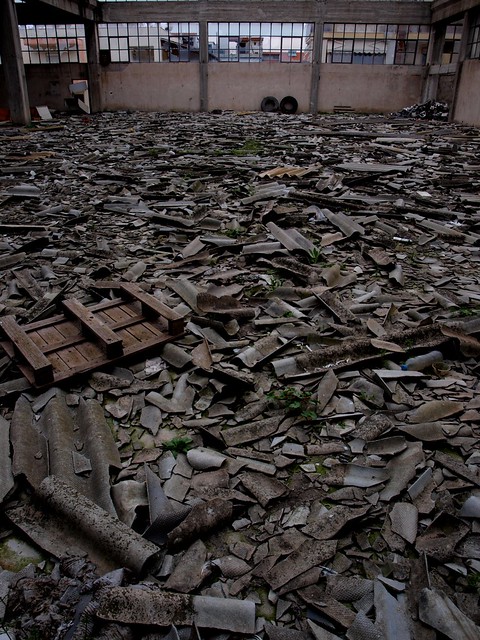


The harsh new economic reality facing Greeks can be seen in a slew of reports that show that many household are now struggling to pay basics such as power and phone bills. The state run electricity board says that 1 in 4 bills are overdue whilst the OTE telecommunications corporation has 500,000 unpaid accounts to deal with. Even in Greater Athens area, which one of richer parts of the nation 1 in 11 are receiving food handouts via breadlines according to research carried out by the Athens University of Economics recently. In Greece's second city, Thessaloniki, home to over a million nearly half the population is living on either savings or loans whilst another 40% say that they can barely make ends meet.
Even consumption of basics such as bread has dropped by 30% whilst other areas of the economy such as real estate and car sales have ground to a virtual halt. The Greek chamber of commerce says that 4,000 small businesses are closing every month with thousands more being added to unemployment figures.
With such a bleak outlook Giorgos Papandreou decided to hold a press conference to set out his party's policies and to explain to the nation what he believes has to be done to save Greece from bankruptcy.
The interview which was carried out by seven journalists lasted two hours and was followed by millions of viewers nationwide. In the first round journalists were allowed to ask one question and one follow up. A recipe which allowed the PM plenty of wiggle room and produced a predictably sonorific result as Papandreou was free to simply set out party positions that have long been made clear in previous briefings. While the questions were hard hitting, the lack of follow up meant they were easily sidestepped with waffle and set speeches.
The second half of the interview proved more interesting with reporters able to pursue points made and get the prime minister to do more than simple PR.
However,the basic tenet of Papandreou's message remained the same that the current crisis was the results of years of fiscal mismanagement that the previous New Democracy administration had failed to take seriously and that if Greece did not have any other choice but to implement the painful measures set down by the EU and IMF. He also made it clear that his government sees the forthcoming elections as a referendum on the measures intimating that if PASOK suffered a serious defeat then this would be seen as a loss of the popular mandate necessitating national elections in the near future.
For Papandreou the choice is clear; either accept the cuts in public services and wages set out or vote for the opposition New Democracy party led by Antonis Samaras whose brand of populist rhetoric is full of heat and passion but light on concrete proposals on exactly how different his right of centre party would deal with a 400 billion debt load without severe cuts in public spending or higher taxation.
Yet despite growing dissatisfaction with both major parties it seems business as usual with both sides making lavish promises to voter in order to persuade people to support them. The ruling PASOK party has vowed to help local income families and farmer with extra funds before the end of the year, though where exactly the money is coming from is unclear especially with so many employees of the state run organisations and pensioners who have been waiting months to be paid. Next week heating oil distributors have threatened to suspend deliveries from 1st November in protest over delays over the return of tax payments promised earlier. Likewise hospital report running low on basic supplies after pharmacutical companies stopped taking new order until the government pays outstanding debts, some going back years.
However, the 600lb gorilla in the room is the possibility of still harsher cuts when Eurostat revises Greek debt figures for 2009. The organisation delayed publishing figures citing the need for more time to untangle Greece's often tangled web of public spending statistics until 15th November just after the second round of local elections. This has been seen in many quarters are an attempt not to upset PASOK's election chances still further with more bad news. On the one hand Papandreou has stated on a number of occasions that there will be no further measures for wage earners and pensioners whilst European Commissioner Olli Rehn has made it clear that higher than expected debt load will mean more sacrifices on the part of Greece in 2011.
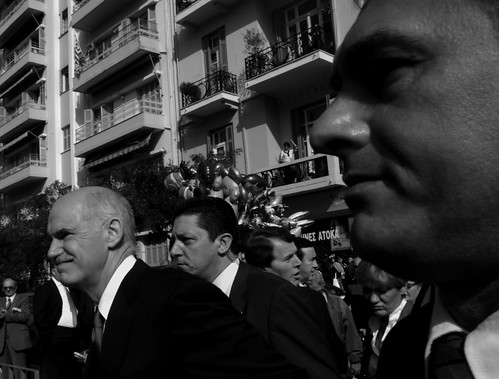
Attending celebrations in Thessaloniki today Giorgos Papandreou was met with boos and jeers by some worshippers outside the Saint Demetrios cathedral and was quickly whisked inside the building with church bells ringing in order cover the sounds of protests from TV crews covering the event. Hundreds of riot police were also on duty in the surrounding area ready to keep disgruntled state employees at a safe distance while people shouting anti-government slogans were swiftly confronted by uniformed and plain clothes officers in the crowd.