Showing posts with label greek politicians. Show all posts
Showing posts with label greek politicians. Show all posts
Friday, January 21, 2011



Friday, January 14, 2011
Greek politician, Theodoros Pangalos makes a new statement concerning civil servants - Νέα δήλωση του Πάγκαλου για τους δημοσίους υπαλλήλους
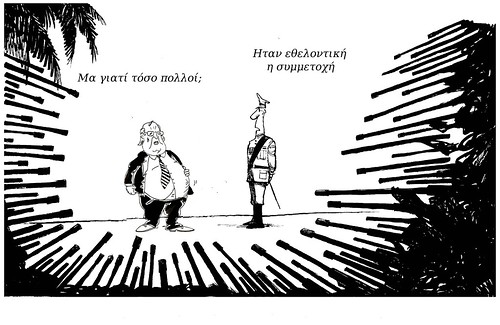
New statement by Theodoros Pangalos (the Greek PM's right hand man and party enforcer) concerning civil servants. Pangalos has managed to infuriate many Greeks with his explosive statements which have included announcements that public sector workers are a bunch of mongrels, voters corrupted politicians and that everyone is responsible for the current economic crisis since all Greeks had a hand in racking up the country's record debt load.
Translation of the cartoon caption
"But why so many?"
"Participation was on a voluntary basis."
"But why so many?"
"Participation was on a voluntary basis."
Wednesday, October 27, 2010
Greek PM's press conference fails to convince voters
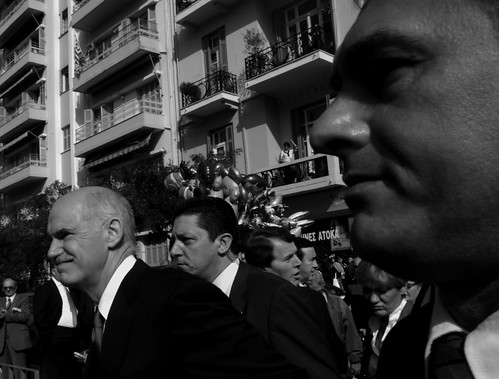
Greek prime minister, Giorgos Papandeou (left) leaving the St Demetrios cathedral - Thessaloniki, originally uploaded by Teacher Dude's BBQ.
Last night Greek prime minister took part in a Q & A session with journalists from the country's largest TV stations. The decision to organise such an event in the run up to the local elections in November was criticised by opposition parties who consider that the Papandreou is campaigning on behalf of his beleaguered PASOK party who have been trailing in the polls, affected by the harsh austerity measures that have seen living standards plummet as job losses, higher taxes and galloping inflation have combined to make for a perfect storm for those on lower incomes such as the unemployed and pensioners.
The harsh new economic reality facing Greeks can be seen in a slew of reports that show that many household are now struggling to pay basics such as power and phone bills. The state run electricity board says that 1 in 4 bills are overdue whilst the OTE telecommunications corporation has 500,000 unpaid accounts to deal with. Even in Greater Athens area, which one of richer parts of the nation 1 in 11 are receiving food handouts via breadlines according to research carried out by the Athens University of Economics recently. In Greece's second city, Thessaloniki, home to over a million nearly half the population is living on either savings or loans whilst another 40% say that they can barely make ends meet.
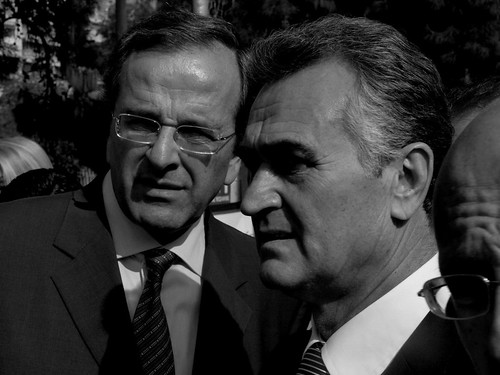
Even consumption of basics such as bread has dropped by 30% whilst other areas of the economy such as real estate and car sales have ground to a virtual halt. The Greek chamber of commerce says that 4,000 small businesses are closing every month with thousands more being added to unemployment figures.
With such a bleak outlook Giorgos Papandreou decided to hold a press conference to set out his party's policies and to explain to the nation what he believes has to be done to save Greece from bankruptcy.
The interview which was carried out by seven journalists lasted two hours and was followed by millions of viewers nationwide. In the first round journalists were allowed to ask one question and one follow up. A recipe which allowed the PM plenty of wiggle room and produced a predictably sonorific result as Papandreou was free to simply set out party positions that have long been made clear in previous briefings. While the questions were hard hitting, the lack of follow up meant they were easily sidestepped with waffle and set speeches.
The second half of the interview proved more interesting with reporters able to pursue points made and get the prime minister to do more than simple PR.
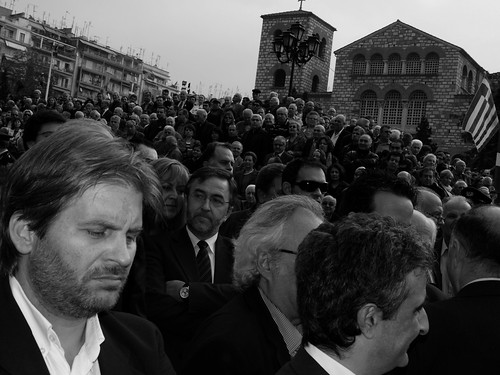
However,the basic tenet of Papandreou's message remained the same that the current crisis was the results of years of fiscal mismanagement that the previous New Democracy administration had failed to take seriously and that if Greece did not have any other choice but to implement the painful measures set down by the EU and IMF. He also made it clear that his government sees the forthcoming elections as a referendum on the measures intimating that if PASOK suffered a serious defeat then this would be seen as a loss of the popular mandate necessitating national elections in the near future.
For Papandreou the choice is clear; either accept the cuts in public services and wages set out or vote for the opposition New Democracy party led by Antonis Samaras whose brand of populist rhetoric is full of heat and passion but light on concrete proposals on exactly how different his right of centre party would deal with a 400 billion debt load without severe cuts in public spending or higher taxation.
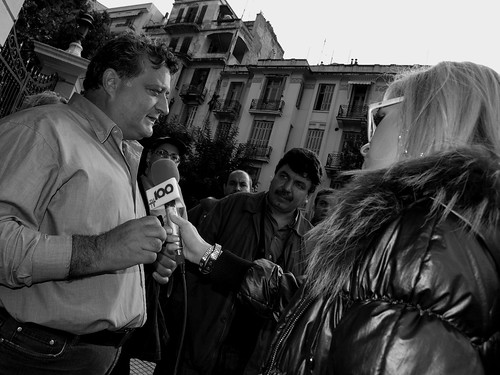
Yet despite growing dissatisfaction with both major parties it seems business as usual with both sides making lavish promises to voter in order to persuade people to support them. The ruling PASOK party has vowed to help local income families and farmer with extra funds before the end of the year, though where exactly the money is coming from is unclear especially with so many employees of the state run organisations and pensioners who have been waiting months to be paid. Next week heating oil distributors have threatened to suspend deliveries from 1st November in protest over delays over the return of tax payments promised earlier. Likewise hospital report running low on basic supplies after pharmacutical companies stopped taking new order until the government pays outstanding debts, some going back years.
However, the 600lb gorilla in the room is the possibility of still harsher cuts when Eurostat revises Greek debt figures for 2009. The organisation delayed publishing figures citing the need for more time to untangle Greece's often tangled web of public spending statistics until 15th November just after the second round of local elections. This has been seen in many quarters are an attempt not to upset PASOK's election chances still further with more bad news. On the one hand Papandreou has stated on a number of occasions that there will be no further measures for wage earners and pensioners whilst European Commissioner Olli Rehn has made it clear that higher than expected debt load will mean more sacrifices on the part of Greece in 2011.
Attending celebrations in Thessaloniki today Giorgos Papandreou was met with boos and jeers by some worshippers outside the Saint Demetrios cathedral and was quickly whisked inside the building with church bells ringing in order cover the sounds of protests from TV crews covering the event. Hundreds of riot police were also on duty in the surrounding area ready to keep disgruntled state employees at a safe distance while people shouting anti-government slogans were swiftly confronted by uniformed and plain clothes officers in the crowd.
The harsh new economic reality facing Greeks can be seen in a slew of reports that show that many household are now struggling to pay basics such as power and phone bills. The state run electricity board says that 1 in 4 bills are overdue whilst the OTE telecommunications corporation has 500,000 unpaid accounts to deal with. Even in Greater Athens area, which one of richer parts of the nation 1 in 11 are receiving food handouts via breadlines according to research carried out by the Athens University of Economics recently. In Greece's second city, Thessaloniki, home to over a million nearly half the population is living on either savings or loans whilst another 40% say that they can barely make ends meet.
Even consumption of basics such as bread has dropped by 30% whilst other areas of the economy such as real estate and car sales have ground to a virtual halt. The Greek chamber of commerce says that 4,000 small businesses are closing every month with thousands more being added to unemployment figures.
With such a bleak outlook Giorgos Papandreou decided to hold a press conference to set out his party's policies and to explain to the nation what he believes has to be done to save Greece from bankruptcy.
The interview which was carried out by seven journalists lasted two hours and was followed by millions of viewers nationwide. In the first round journalists were allowed to ask one question and one follow up. A recipe which allowed the PM plenty of wiggle room and produced a predictably sonorific result as Papandreou was free to simply set out party positions that have long been made clear in previous briefings. While the questions were hard hitting, the lack of follow up meant they were easily sidestepped with waffle and set speeches.
The second half of the interview proved more interesting with reporters able to pursue points made and get the prime minister to do more than simple PR.
However,the basic tenet of Papandreou's message remained the same that the current crisis was the results of years of fiscal mismanagement that the previous New Democracy administration had failed to take seriously and that if Greece did not have any other choice but to implement the painful measures set down by the EU and IMF. He also made it clear that his government sees the forthcoming elections as a referendum on the measures intimating that if PASOK suffered a serious defeat then this would be seen as a loss of the popular mandate necessitating national elections in the near future.
For Papandreou the choice is clear; either accept the cuts in public services and wages set out or vote for the opposition New Democracy party led by Antonis Samaras whose brand of populist rhetoric is full of heat and passion but light on concrete proposals on exactly how different his right of centre party would deal with a 400 billion debt load without severe cuts in public spending or higher taxation.
Yet despite growing dissatisfaction with both major parties it seems business as usual with both sides making lavish promises to voter in order to persuade people to support them. The ruling PASOK party has vowed to help local income families and farmer with extra funds before the end of the year, though where exactly the money is coming from is unclear especially with so many employees of the state run organisations and pensioners who have been waiting months to be paid. Next week heating oil distributors have threatened to suspend deliveries from 1st November in protest over delays over the return of tax payments promised earlier. Likewise hospital report running low on basic supplies after pharmacutical companies stopped taking new order until the government pays outstanding debts, some going back years.
However, the 600lb gorilla in the room is the possibility of still harsher cuts when Eurostat revises Greek debt figures for 2009. The organisation delayed publishing figures citing the need for more time to untangle Greece's often tangled web of public spending statistics until 15th November just after the second round of local elections. This has been seen in many quarters are an attempt not to upset PASOK's election chances still further with more bad news. On the one hand Papandreou has stated on a number of occasions that there will be no further measures for wage earners and pensioners whilst European Commissioner Olli Rehn has made it clear that higher than expected debt load will mean more sacrifices on the part of Greece in 2011.
Attending celebrations in Thessaloniki today Giorgos Papandreou was met with boos and jeers by some worshippers outside the Saint Demetrios cathedral and was quickly whisked inside the building with church bells ringing in order cover the sounds of protests from TV crews covering the event. Hundreds of riot police were also on duty in the surrounding area ready to keep disgruntled state employees at a safe distance while people shouting anti-government slogans were swiftly confronted by uniformed and plain clothes officers in the crowd.
Tuesday, October 12, 2010
Fiddling while Athens burns - Greek media's love affair with the political establishment shows no sign of ending
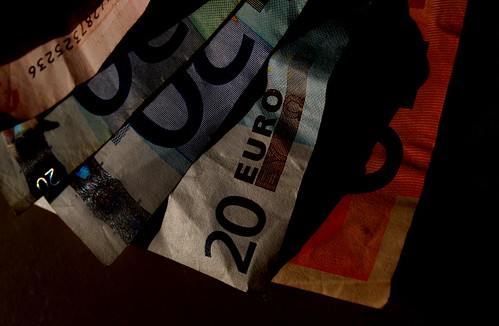
It's a measure of how far the Greek political system and its supporters in the local media are out of touch with the rest of the country that the recent uproar over the remarks by Jean Claude Juncker, head of Euro Group that been the subject of some much air time and print columns during the last few days. According to an off the record remark made by Juncker in Washington a Greek prime minister told him that Greece was a country of corruption, a revelation on par with learning that the French eat rather a lot of cheese or that it can get awfully cold in Russia.
The fact that Greece has one of the highest corruption indices in the European Union or that the present PM, Giorgos Papandreou made much the same comment after taking power in 2009 seems to have been ignored by the Greek political establishment and the country's media who went into a feeding frenzy in their attempts to identify which Greek PM had made such an outrageous statement. Kostas Simitis, head of the 2000-2004 PASOK run administration, Kostas Karamanlis, PM from 2004 till 2009 and finance minister Giorgos Papankonstantionou on behalf of current PM Giorgos Papandreou all rushed to say that they had said no such thing. (Juncker later made a statement saying that it was Giorgos Papandreou)
And so it has gone on, with endless speculation in the press as to exactly let the cat out of the bag. The fact that the Greek state is corrupt, of course comes as absolutely no surprise to anyone living in the country. Indeed Transparency International calculated that Greeks spent an average of 1355 euros in bribes in 2009.
Actually, the problem is not that the Greek political establishment turns a blind eye to corruption (see the Vatopedi land swap scandal) but rather everyone now knows. Worst of all, foreigners know just how venial Greek politicians are. How embarassing when one is putting one's best foot foward in Brussels, Strasburg or Washington that the rest of the world sees you as little more than a robber baron. For people as image conscience and ego driven as Greek politicans in power this comes as a terrible blow.
Perception, rather than reality is everything which is one of the reasons why the country is in such as mess. Why bother attempting to make difficult political decisions when all you need is a handful of IOUs and promises which you may or may not honour. Even now the opposition New Democract leader, Antonis Samaras is touring northern Greece in the run up to November's local elections giving his word to open factories, fund development and the like knowing full well that he would have no more financial freedom than the current PASOK administration to act. (The fact he was a cabinet minister in the previous government which ran up such huge debts seems to have slipped his mind at present).
Such a cavalier attitude to the truth also explains the chronic distrust of the average Greek concerning any promise politicians make. Indicative of this is the refusal of truck drivers to end recent industrial action despite promises by the government to discuss their demands. It wasn't until the proposals were put in writing that truckers agreed to stop strike action. Of course truck drivers know that even written reassurances mean little to politicians but it does give them a little less wiggle room.
But while the country's TV talking heads and their partners in crime and print have talked endlessly about what Juncker's statement means the country slides ever deeper into depression (both financial and psychological) with schools unable to pay fuel bills, hospitals running out of medical supplies and and an angry electorate bracing itself for a winter with 30% hikes in heating costs. For many patience is running out with the endless self - referential charade of the current political setup.
Just one more thing to consder, though when considering the role of corruption in the current financial debacle is that Iceland, whose per capita debt is even greater than Greece's, was ranked the world's 7th least corrupt government (Athens came in at 71) in 2008.
Friday, November 27, 2009
Tony Samaras - The Prince of Spam
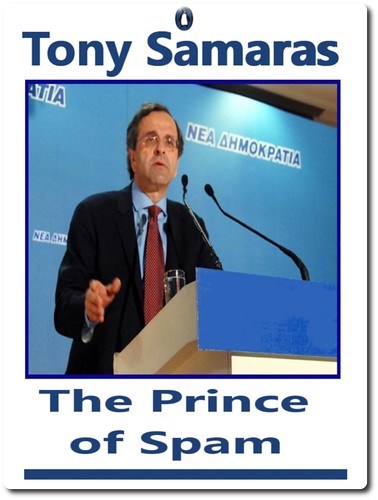
Antonis Samaras, contender for the leadership of Greece's main opposition party, New Democracy, has been sending out unsolicited SMS text messages to all and sundry in his effort to become the next head of Greece's conservatives.
Since their crushing defeat in October's national election New Democracy has been engaging in a fratricidal campaign to replace Kostas Karamanlis who resigned just hours after the country's polls closed.
Despite nearly two months of electioneering none of the three candidates have really answered how their party got the country into its current financial quagmire or how the last government's lending went from 2.5% of GNP in January 2009 to 14+% in October.
Saturday, May 30, 2009
When regular journalism is for the birds, Twitter

A few days ago Greek TV ( and I mean with 12 channels showing the same footage, nearly all of it) a "debate" with the leaders of the major parties in the run up to the European elections. I use the "debate" in inverted commas as the format of the event involved questions from a panel of journalist and the politicians' answers. At no point were the reporters or other leaders allowed to query responses. As a result what you had was a dull, lacklustre affair in which those questioned were allowed to simply trot out the party line. There were no opportunities to further probe the answers or engage in anything that resembles the word "debate", at least in English.
I think that the format of the discussion neatly reflects the relationship between the mainstream media and those in power. Yes, you are allowed to ask difficult questions, on occasion, but in the final analysis the politicians have the final word. There is no follow up, and at least for those at the top of this particular greasy pole, no exposure to the harsh wind of critical questioning. The politicians were free to ignore any difficult question and so got out the line set down by the party hacks, PR experts and God knows who else in the wings.
The whole programme was less an exercise in democracy than a beauty pageant, except I think that nowadays most contestants in, say Miss World would give more convincing answers. I shudder to think what the bikini round would look like, though.
On the other hand I followed the event live on Twitter (use #deb8) and that was a much more interesting experience as the idiocies and inanities of our political betters were ruthlessly exposed and dissected. Not least of which was the almost total absence of European issues in a debate over the European elections.
Waffle, evasion and laughable attempts at manipulation marked the answers by most of those involved. The only funny thing about the debate was the clumsy way in which Georgios Karatzaferis, leader of the far right, LAOS party flirted with the possibility of some kind of political alliance with ruling conservatives, New Democracy. Kiss, but no tongue it seems so far. Still with prime minister Kostas Karamanlis up to his neck in scandals and dire poll results looming who knows if this isn't the start of another beautiful friendship.
Monday, October 27, 2008

Subscribe to:
Posts (Atom)
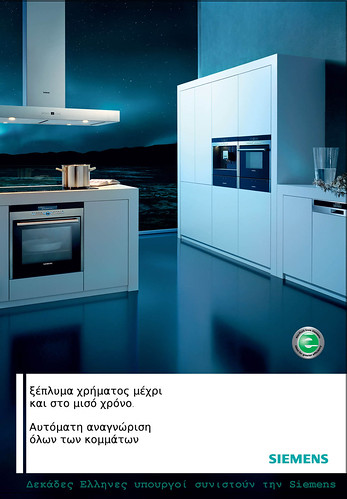
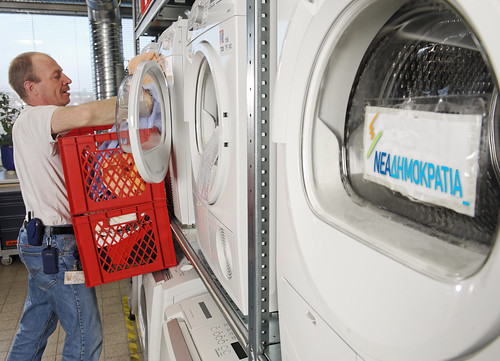
Αυτόματη αναγνώριση όλων των κομμάτων
Launder your money in half the time or less!
Automatic recognition of all parties.
Yet another political scandal gets swept under the carpet by the Greek parliament. Today it was the Siemens corruption case involving accusations that the company spent millions in bribes to PASOK and New Democracy party officials in return for contracts for the 2004 Athens Olympics.