
Showing posts with label recession. Show all posts

Sunday, October 21, 2012

Is the European experiment grinding to halt?

Greek protesters greet Merkel with Swastikas and Nazi salutes - Athens

Earlier this morning I got a call from a friend, saying that she'd found a job but I was at a loss whether to congratulate her or not, as she will not only leave her country but also her two young children as well. For the next nine months my friend will be teaching English at a private school in the Gulf States. In doing so she'll be following a path trailed by many other friends and acquaintances over the last few years.

Her children will remain here to be looked after by grandparents for the duration, a story reminiscent of the sacrifices that many Greeks were obliged to make in the 60's and 70's as guest workers who went north to find jobs in the booming economies of Europe and especially in German factories then powering the country's export led economic miracle.

As with so many other Greeks six years of recession has forced my friend to consider working abroad as the only alternative to a slow slide into poverty at home so repeating a story that has been told and re-told so often here over the last 100 years. However, this latest generation is both luckier and unluckier than their parents and forebears.

On the one hand many emigrating Greeks are highly educated and have university level qualifications and language skills that set them apart from previous generations. No longer are they the monolingual, sometimes barely literate villagers who went abroad, able only to obtain dead end jobs that post war northern Europeans were all to happy to spurn in favour of better paid, higher status ones in the service sector.
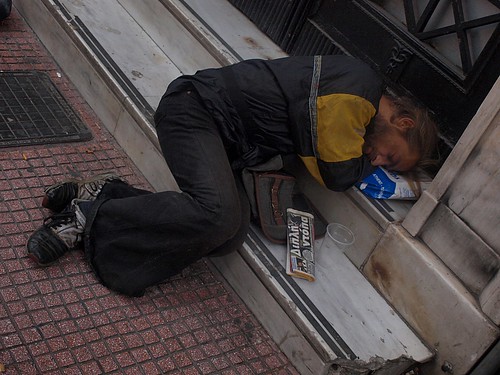
Austerity is working - Ask the experts

Yet young educated Greeks are sallying forth into a very different world, one in which jobs, even badly paid, low status ones are becoming more and more difficult to find. While some will find work that fully utilises their knowledge and skills many will find that a foreigner in a declining economy, not matter how well educated will always be at a disadvantage.

In addition the gap between earnings in the North and South of Europe has shrunk to a remarkable degree since the 1960's, with those in countries such as Germany often remaining static whilst those in the South have risen along with rising living standards.Gone are the days when an unskilled factory hand could earn a wage that would have been the envy of those back at home. So, the question that goes through many people's minds is why go through all the social and psychological upheaval of leaving home? Why uproot yourself when factories in east Germany pays just 6E an hour, just a few Euros more than can be earned at home, unless your only criteria is survival?

However, with unemployment at 25% (30% plus, if Greek trade union research is to be believed) and family and social security networks buckling under the strain, then survival rather than having a better standard of living may push Greeks as well as Spaniards, Portuguese and Italians north once again.

But with recession gradually mutating into Depression what reception will this new generation of gasterbiters receive? Even when cheap labour was in demand in the heavy industries of the Ruhr and the Rhine southern European workers were often grudgingly accepted, now that they are coming into competition for jobs in a shrinking economy the potential for ugly confrontation becomes a real possibility .

Given the campaign of virulent anti-Greek feeling that has marked German politics and media coverage of the current debt crisis, the groundwork for growing racist sentiment has been assiduously cultivated. Should the situation in other PIIGS start to resemble that of Greece how long is it before the myths of the lazy Spaniard and work shy Italian once more become part of the cultural and political landscape north of the Alps?

Then, the German far right, like Greece's neo-Nazi Golden Dawn,will happily exploit the opportunities given them by more “respectable” conservative forces. As the economic decline of the European South takes its toll on German export markets and the government will inevitably struggle to balance a commitment to the EU ideal of open borders with growing demands that German jobs and businesses be protected.
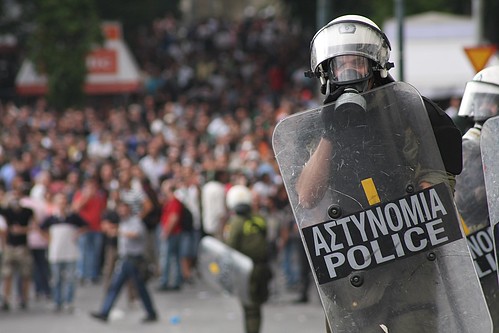
Welcome to the fight. Here is where we draw the line. Here is where we defeat austerity

Switzerland's military is already drawing up contingency plans in case of a deepening of the social crisis in the Southern EU, UK's prime minister, David Cameron talked of the possibility of closing the country's borders in case of a flood of Greek economic refugees is being considered and France's demand for the re-introduction of internal EU border controls set the tone  showing that the EU's policy of open borders could be reversed in a heartbeat, should national moods change.

How much of this is just right wing political opportunism, designed to win votes with a frightened electorate and how much of it points the way to a more disunited future depends on the depth and duration of the crisis. If the North follows the same pattern as indebted nations such as Greece and Spain then all bets are off as growing divisions may threaten to derail the decades of unification and reconciliation that the EU has wrought.
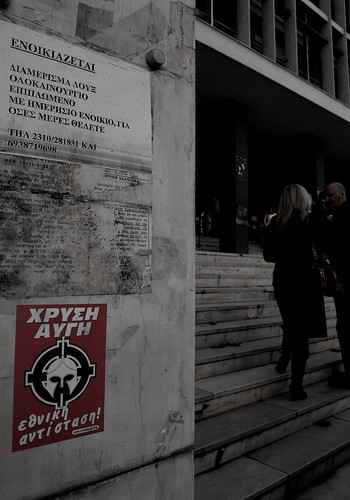
Racist poster outside the central courts, Thessaloniki

It's a sad irony of modern history that the years of hard work put in by successive German leaders since end of World War II to prove that Berlin can be trusted to rejoin the European family of nations is being thrown away by a new generation of fiscal hard liners who are willing to put their allegiance to dubious economic dogma ahead of the unity of the continent.

One of the lessons of the 1930's that German chancellor, Angela Merkel and many other EU leaders seem willing to ignore is just how quickly economic disaster changes the political outlook of people who've enjoyed years of financial growth and security. The frenzied growth of the 20's and the sudden loss of prosperity that hit the middle class especially in the Great Depression helped bring the extreme right to power in a remarkably short period of time. 

In just a five years, the percentage of the popular vote captured by the Nazi party grew from 2.6% to 43.9%, a political rise that is being eerily echoed by their modern day counterparts in Greece, who have increased their popular support at an even more spectacular rate, going from just 0.29% to 14% in three years.

In 30's the insistence of the political mainstream to cling to ineffective economic theories even in the face of dismal failure drove disenchanted voters into the arms of fascist parties across Europe and beyond. The, then widespread political belief that ordinary people would endure years of extreme poverty and suffering in the name of an empty promise that it would eventually bring about future growth helped bring down democracies across the world.

Does Europe need to lose tens of millions of lives once more to relearn lessons that ended up being so brutally paid for in the streets of Stalingrad and fields of Normandy?

Monday, January 16, 2012

What we've lost - A personal account of the crisis in Greece

Lydia


I could give you a list of statistics and figures that show just how grim the situation has become in Thessaloniki, such as the rise in unemployment or I could tell you how many businesses have closed down in the city over the last 12 months. Then, there are the number of suicide attempts "successful" and "unsuccessful" that have taken place in Greece recently. But I doubt that they would mean much to you. Numbers have a strange way of draining the life out of any disaster, reducing it to simply an accountant's end of year report.

Instead I would like to talk about what I have lost and through that give you an idea of the what people are going through. For me, the most poignant memory of late has not been people sleeping out in freezing temperatures or pensioners scavenging for for food in rubbish bins, nor has it been the sight of kids as young as eight years old collecting scrap metal from bins and off the street to sell. No, for me the worst image has been that of a cardboard box, inside it the things my daughter will be taking with her to her new home 200km from here.

Unable to survive economically in the city Lydia's mother has decided to move away to be closer to her side of the family. The small flower business Maria has struggled to keep afloat for the least two years is now completely unviable and so is being closed down. With people now waiting to see what happens before getting married and fewer and fewer buying flowers to take as presents to friends and family the shop has become a liability and will shut in the next few days.

For my daughter it means leaving her friends, school and home to start out afresh in a new community, a tough challenge for anyone but especially so for a twelve year old on the brink of teenage.

As for me, that means the amount of time I get to spend with her will be drastically reduced, no longer will she be just a bus ride away but every visit will need to be co-ordinated and so will lose the spontaneity I so cherish. Of course, 200km away is not another world but it is far enough to make visiting much more difficult.

So far I have hidden all these thoughts from my daughter, she has enough on her mind without an adult's compliment of concerns, so instead I've kept on emphasising the benefits of moving to a smaller community where she's have more freedom to roam and even have her own cat.

I cannot fault her mother for her decision as things have got so bad in Thessaloniki that any alternative form of decent employment is just a pipe dream. Even when work is available friends have been telling me that wages as low as 300 euros a month are bring offered. And if you don't like it there are plenty more desperate people who do. Just to give you a sense of perspective 300 euros is barely enough for rent let along food and bills. And of course such wages come without health benefits or unemployment insurance.

Lydia's mother is making a rational choice and abandoning a sinking ship and in that she is not alone, so many friends have left the city either to return to the small towns or villages they came from or alternatively gone abroad to places as diverse as Germany and China. Indeed, anywhere where they can have something resembling a living wage and a future.

On the other hand I've been lucky in being to keep my head above water financially, but that is just for the time being, my lessons are growing fewer and no new ones are coming along. Occasionally, I am asked if I want to take on new students but almost invariably it doesn't work out as people struggle to pay yet more taxes and rising prices for basics such as power, food and transport.

Like so many others I have had to give up so much over the last 12 months, eating out is just a memory as is going to the cinema or buying new clothes. instead you feel happy if you can earn enough to pay your rent this month and still have enough left over to go food shopping. And I'm one of the lucky ones. Today 20,000 households and businesses will have their power cut off as they did not pay the latest property tax hike included in their electricity bills. The total number of accounts under threat is estimated to be a quarter of a million.

In the meantime Greece's political leaders bicker and pose for the cameras daily issuing statements that show that they have lost touch with the mounting crisis outside parliament. locked away in their offices, surrounded by police guards they indulge in power struggles over who will take over once the present party leaders are toppled. However, given the plummeting poll figures for all three parties involved in the present coalition government whoever the the next leader is, they are about to be charge of not much at all as much of the Greek electorate has written them off as corrupt, venial and inept.

But little of that matters, the packing cases containing my daughter's possessions are still in her bedroom, awaiting a removal van to take her off to a new life and I'm still here trying desperately not to get sucked down into the kind of despair that has debilitated so many people I know.

Monday, March 02, 2009

The economic downturn bites even deeper


"As many as 51 million jobs worldwide could be lost this year because of the global economic crisis, says the International Labour Organization(ILO).

The UN agency says that would push up the world's unemployment rate to 7.1% by the end of 2009, compared with 6.0% in 2008 and 5.7% in 2007.

The ILO's most optimistic forecast is for 18 million more unemployed, giving a global jobless rate of 6.1%"


Wednesday, October 08, 2008

Recession, credit crunch, financial collapse - Not a moment too soon for some

With financial institutions collapsing, developed countries slipping into recession and whole nations facing the possibility of bankruptcy there are few reasons to celebrate. However, for the world's poorest, living on a dollar a day or less the current credit meltdown may have come just in time.

It is not just Lehrman Brother CEOs gently floating back to earth with their golden parachutes that are looking with relief at the present economic crisis. The sudden end to cheap loans and lax lending policies have put a break on spiralling food prices and the given a respite to those struggling to pay for basics such as corn, rice and bread.

Over the last two years countries such as Bangladesh, Cameroon, Egypt and Yemen have seen riots and other forms of serious social unrest triggered by the massive increase in the cost of basic food stuffs. Rising oil prices, the growth in consumption by China and India and the impact of growing biofuel demand have all been cited as the villain of the piece. While these factors have been implicated in the sudden rise in the cost of food worldwide the upsurge in prices is, in the opinion of some analysts the result of the rapid rise in speculation in the commodities market. According to the New Statesman the massive influx of investment capital fleeing unstable mortgage market has set off speculation in commodities such as wheat, rice and the like by investment houses, pension funds, private equity groups and banks.

The Toronto Global and Mail reported in May 2008 that investments in commodity indexes rose from $13 billion dollars (U.S.) in 2003 to $260 billion in March 2008 and that according to U.S. hedge fund manager, Michael Masters, speaking at a Senate hearing in May that that figure could rise to $1 trillion. Under the weight of such numbers the demand for increased returns has proved stronger than the reality that such increases have to come from the pockets of the planet's poorest and most vulnerable.

Rising prices have impacted on the lives of billions worldwide but none more so than those who live on $2 a day or less as Josette Sheeran, the executive director of the World Food Program, speaking to Time in July says;

"What we're seeing is that people living under $2 a day are giving up health care and education," says Sheeran. "Those living on under $1 a day are giving up protein once a week or vegetables." And those on 50¢ a day or less, like the people of Karamoja (Uganda), are simply cutting out meals".

Similarly, the World Bank predicted that 100 million people run the risk of starvation in its 13 April forecast.

However, with the sudden halt in the supply of cheap credit, the driving force behind the commodities bubble the price of basic food stuffs has dropped, perhaps restoring a note of sanity in what has been one of the most heinous robbery attempts in recorded history.

Despite the fall in prices many in the poorer parts of the world worry that once the markets recover their nerve the commodity markets will once again be flooded with capital wary of riskier choices. Dr Dunstan Campbell, FAO representative in Jamaica, The Bahamas and Belize speaking to the Sunday Gleaning that the food markets will be once again considered a secure market in a world economy heading to recession thus pushing up prices once more.


Recession, credit crunch, financial collapse - Not a moment too soon for some
Tags: | | | | | | | |