Showing posts with label pasok evangelos venizelos. Show all posts
Showing posts with label pasok evangelos venizelos. Show all posts
Sunday, June 10, 2012


Saturday, May 19, 2012
With new elections approaching EU's war of words with Greece gets down and dirty
The
announcement last week that none of the parties in the Greek
government were able to form a government has brought with it a dose
of madness that dwarfs even the fervid election campaign rhetoric
that proceeded it. If you were to take the statements of much of theforeign and local mainstream media at face value Greece is about to collapse andthat it will take with it much of the Eurozone.. Once again
Athens is at the centre of a maelstrom of media speculation that can
be seen as a retread of 2011 when the Greek prime minister, GiorgiosPapandreou raised the possibility of Greece holding a referendum on
whether it should implement yet more austerity measures . Then the suggestion was met by a
vociferous campaign from within Greece, not to mention the pressure exerted by Paris,Brussels and Berlin.
With
Papandreou now gone from the political scene, his role as the
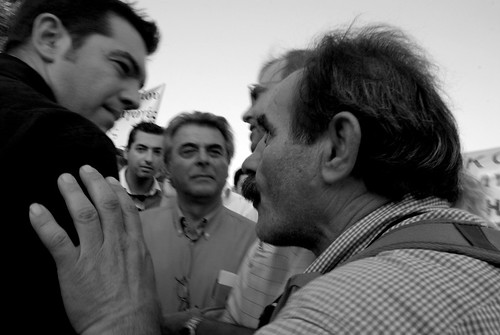
Eurozone's enemy number one has been taken over by Alexis, Tsipras,
the leader of the Radical Left Coalition (SYRIZA), which if the name didn't
give you a clue is a group of socialist and communist parties who
shot into second place in the May elections campaigning on the
promise to defy European Union's demands for yet more austerity
measures.
The
results has been a surge of interest in Greece and a concerted
attempt to paint anti-austerity politicians and parties as extremist and dangerous. The new media narrative being created goes like this; Tsipras and, by extension any political group opposed to the terms set
down by Athens's creditors are putting in danger Greece's place in
the Eurozone and so inviting economic collapse by forcing it to
re-adopt the drachma. Some variations on this theme even go as far as
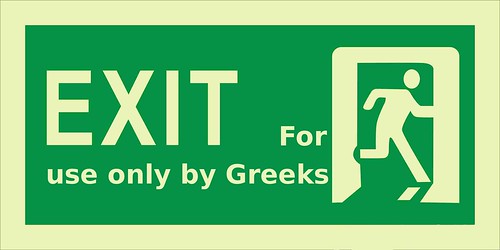
to say that Greece may even by kicked out of the EU, and so face
decades of North Korean style isolation.
It is a
story that has been carefully cultivated in the local press as well,
with daily horror stories coming out in the state run TV stations and
their allies in the privately controlled media sector. Pro-austerity
parties such as PASOK and New Democracy appear regularly to crank up
the fear factor by painting the Radical Left as a bunch of crazed
fanatics hell bent on destroying what's left of the economy.
If that
wasn't enough this week's non-story about a run on Greek banks was
gleefully jumped upon and news organisations were desperately trying
to recruit local bloggers/twitter users to feed them stories of
people besieging banks to take out their money. Rumours of banks
limiting withdraws to just 50 E swirled around the internet. That
neither was happening proved to be no impediment to reporters eager
to get another scoop.
The fact
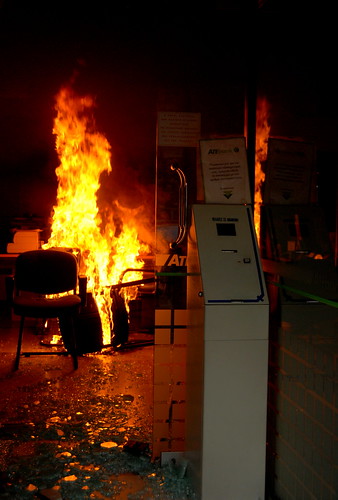
that this week the EU decided to cut off funding to Greek banks it
deemed non-viable did nothing to help the situation , leading some
commentators to say that maybe that was their intention after all. An
example of yet more attempts to nudge the Greek electorate in the
“right”direction.
This week
also saw the arrival of EU president, Martin Schulz in Athens,
obstensibly to persuade the new Greek government to adhere to its
earlier fiscal commitments, however, his public appearances with both
the leaders of PASOK and New Democracy made it quite clear that the
EU wanted it's say in Greece's next round of elections. A message
with he then went to repeat on state run and pro-austerity channels
yesterday and today.
If that
wasn't enough the suggestion by German chancellor Angela Merkel toGreek president KarolosPpapoulias that Greece hold a referendum on
membership of the euro was meets by angry accusations of interference
in Greek internal affairs. Raising ugly memories of the two countries
troubled past relationship.
Ironically,
the suggestion, which the German chancellor's office denied (the
office of the Greek president then went on to deny the denial) has
helped undermine the position of those parties who are hoping to
persuade Greek voters to swallow more job cuts and tax increases
scheduled for June.
Whether
the fear of expulsion from the Eurozone is working is hard to tell.
Some local opinion polls have put New democracy ahead of SYRIZA but
then there are otherσ which show wildly differing results. The problem
is that no one knows what will happen in June. Gauging public opinion
has become much harder when the two main political parties are
constantly changing their make up and positions. PASOK has decided,
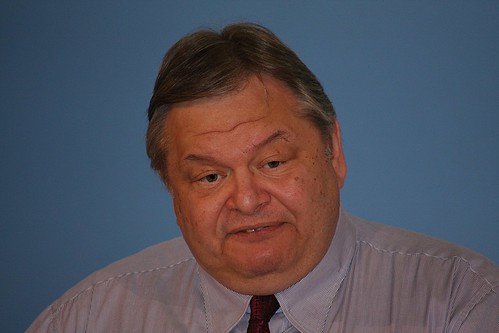
under it determinedly uncharismatical leader, Evangelos Venizelos to
distance itself from both scandal ridden past by abolishing much of
its present hierarchy.
On the
other hand Greece's right has seen a flurry of deals and team
changes. With members of the smaller unsuccessful parties jumping
ship to sign up with Samaras's right rainbow alliance. Howe much of
this will change the results of the elections is hard to say. Many of
those retuning to New Democracy such as ex party super star, Dora
Bakoyianni, northern populist, Panayiotis Psomiadis (once again the subject of legal proceedings) and
former MPs with the far right LAOS party are hardly the stuff that
electoral landslides are made of.
With a
party made up of those willing to change political allegiances at the
drop of a hat, it is going to difficult to persuade sceptical voters
that the right won't result to yet more u-turns and back flips if
elected.

Far away
from the endless media attention to those in mainstream politics,
ordinary Greeks continue to face the everyday grind of surviving in a
shrinking economy in which 30-40% are living in poverty, more than
half the country's youth (some of the most educated in Europe) are
without work and no one knows when things will get better.
Beyond
vague promises to renegotiate the terms of Greece's bailout, only
SYRIZA has offered something positive to those who have already lost
so much. Even if it's the empty gesture of defiance it gives
something concrete to those left bitter and disillusioned by the
country's more moderate political choices.
Monday, May 14, 2012
Greece's political elite gears up for new elections
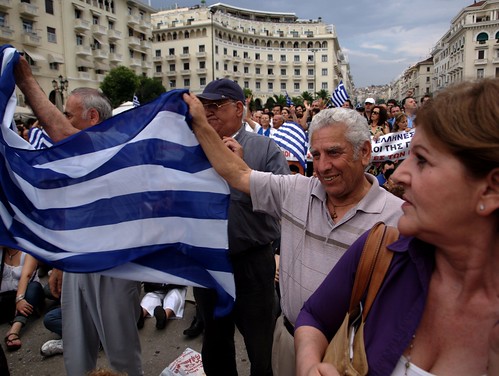
Greek composer, Mikis Theodorakis defies speaking ban to address anti-government rally, a photo by Teacher Dude's BBQ on Flickr.
Judging by the reports circulating in both the Greek and foreign media The End of Days is indeed almost upon us if Athens cannot form a government within the next 24 hours. You would think that such an awful prospect would focus minds of those in power and yet it is just business as usual for Greece's political elite who, even now are more interested in playing political musical chairs than in dealing with deep rooted problems.
According to much of the local media Greece is facing catastrophe as the Radical Left Coalition party (SYRIZA) is refusing to take part in a government of national salvation along with PASOK, New Democracy and the Democratic Left. As a result journalists and senior officials say that new elections will have to be held which could irreparably damage the country and lead to Athens exit for the Eurozone and possibly EU.
However, the maths do not add up. PASOK, New Democracy and Democratic Left have between them 168 seats in the country's 300 seat parliament, more than enough to form a majority government. Indeed, if the Independent Greek party could be persuaded to come on board then the coalition would boast an impressive 201 majority. However the fly in the ointment is the Democratic Left's insistence that they will only help form a government if SYRIZA is also part of it. On the right Panos Kammenos's conservative Independent Greeks have repeatedly refused to co-operate with New Democracy.
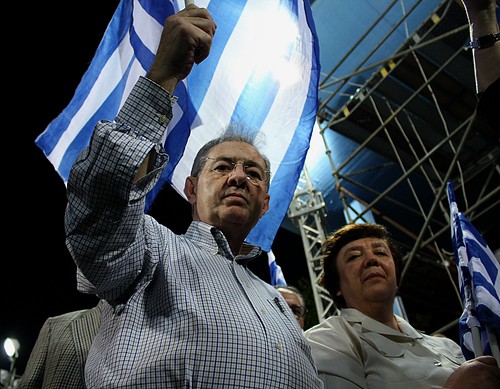
However, that is not the media narrative being promoted. Instead Antonis Samaras, leader of New Democracy, Evangelos Venizelos, leader of PASOK and Fotis Kouvellis, leader of Democratic Left have all put the blame firmly on SYRIZA's Alexis Tsipras. But if the situation is so dire then some kind of compromise can be reached, surely?
And the answer is no as this is all part of the tawdry political game that has been played since Greece sought help with its debts in 2009. Once again the heads of the two major parties are hoping to shore up their dwindling electoral base by scaring the living daylights out of voters with talk of unpaid pensions and imminent economic collapse. PASOK, led first by Giorgos Papandreou and then by Venizelos used the same language to push through austerity legislation despite the presence of hundreds of thousands of disgruntled Greeks protesters outside parliament.
Instead of cobbling together a government both Samaras and Venizelos are already campaigning for the next round of elections, most probably set for 17th June by attacking SYRIZA who are according to latest polls on track to be the largest party. The message is clear, if you vote SYRIZA Greece will go bankrupt, be kicked out of the Eurozone and all your savings will be lost. The EU has helpfully made such scenarios more realistic by refusing to release money promised for the payment of Greece's day to day running costs (money destined for debt repayments was paid on time).
It is a message that is likely to weigh on people's minds as they vote and may be enough to put off those considering voting left. On the other hand, unemployment, especially among the young is climbing rapidly, prices of basic goods are spiralling upwards and many have lost any hope of a decent future. Will they be swayed by talk of the End of Days? For them they are already here. Will talk of lost savings affect those under 30 who have none to speak of?
There are two contradictory forces at work as far as the next elections are concerned. On the one hand the fear of possible national bankruptcy may well drive those who still have something to lose back into the arms of New Democracy and PASOK and so give them a boost, perhaps enough to form a government of their own.
On the other hand disgust with the ineptitude and corruption of the current political set up has not disappeared and the inability of the main leaders to recognise that is costing them dearly. People know full well, that despite promises to renegotiate terms of the bailout agreement if Germany refuses (and there seems every indication that they will) then Greek politicians will have little choice but to accept the decision. Another round of public spending cuts and tax hikes would follow just adding to the economic woes that Greece has been facing for the last five years.
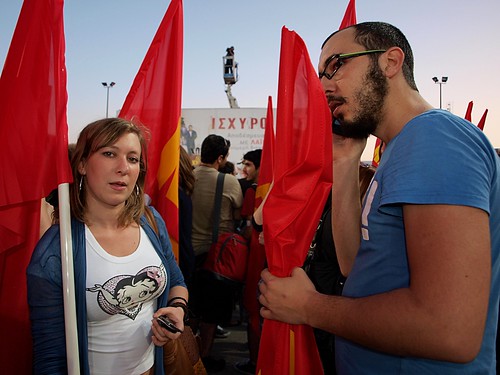
SYRIZA benefited from the disgust that ordinary Greeks feel about their government in May and that is likely to be repeated in June. However, there are several factors that may up their share of the vote still further. Both PASOK and New Democracy have shown that even after the drubbing they received they have not changed attitudes in the slightest and still continue to act as if the elections never happened. This will provide SYRIZA with extra votes, especially from younger voters who are not benefiting from the status quo.
Also the endless back room political games played by newly formed Democratic Left in the last few weeks have alienated even its own MPs and will cost them in June, the most likely recipient of their votes will be SYRIZA. The fact that the Greek Communist party has decided not to work with any other left parties has irked many of its electoral base, especially the young who do not want to sit of the political sidelines. Though the number of voters will be quite small as the party's supporters are among the most loyal in Greek politics
Lastly, as SYRIZA has emerged as a viable political force more and more voters will no longer see a vote cast for them as wasted, so attracting people who see them as something more than a party of protest. Voters, like everyone else love winners.
Monday, May 07, 2012
End of an era in Greek politics

With the dust settling on yesterday's election results only one thing is certain in Greece; the previous political era is now officially over. Both the conservative New Democracy and left wing PASOK parties who've dominated the stage for more than a generation received a drubbing at the polls. Even though New Democracy emerged as the largest party, it garnered just 18.89% (at time of writing), just over half its 2009 election share. PASOK, lead by Evengelos Venizelos suffered an even more crushing reversal, and is left with just 41 seats, down 129 from 2009.
Other losers included the far right LAOS party and conservative Democratic Alliance who both failed to reach the 3% threshold for parliamentary representation. Also the plethora of splinter groups/parties set up by expelled PASOK and New Democracy MPs failed to make any headway, with the sole exception of the hard right Independent Greeks lead by Panos Kammenos which won 33 seats.
On the other the Radical Left Coalition (SYRIZA) came second in the polls, just a few percentage points behind New Democracy and gained 51 seats,and would be just 7 behind the conservative if it were not for the electoral rule that awards an extra 50 seats to the party with the most votes. The newly minted Democratic Left also entered parliament for the first time with 19 seats, having attracted much of its support from dissatisfied PASOK voters.
However, the official communist party KKE proved to have a disappointing night, increasing its share of the vote by less than 1%, a reflection that its old style campaign failed to reach out and convince few new voters.
The more worrying development was the rise of the neo-Nazi Golden Dawn party who are set to have 21 seats in parliament. The extremist group which has been linked numerous acts of violence against immigrants and political opponents are not simply a far right formation but rather a party that believes fervently in many of the core tenants of national socialism and Hitlerite ideology. Their ascent to power allows them a place in the political mainstream and assures them airtime on TV and radio from which they can promote a platform of racial hatred and political intolerance.
With the old political order in tatters and a parliament fractured so deeply along deeply held ideological lines forming a new government will be difficult. In the immediate aftermath of the vote many party leaders rushed to deny that they'd form alliances with others. For example KKE leader Aleka Papariga came out against an alliance with SYRIZA while Kammenos ruled out possible partnership with New Democracy. On the other hand ND leader Samaras and PASOK leader Venizelos are reaching out to other political forces in the hope of creating a viable block.
What is clear is that neither the left nor the right are in a position to form a majority government of their own, and that means either new elections immediately or a fractious coalition unlikely to survive the backlash generated by the latest round of job cuts and tax hikes which are likely to the poorest hardest. In that case new elections during the summer seems unavoidable.
The irony is that the unbending demands of the troika (IMF, EU and ECB) has created exactly the situation they were most anxious to avoid, one in which Greece is unable or unwilling to implement the austerity measures that are part of the next "bailout: plan.
Friday, May 04, 2012
Government versus people - Greek elections 2012
In the picture you can see so much of how the current Greek political scene has changed since the last national elections in 2009. Then, a rally by a major political figure would have taken place in Thessaloniki's central Aristotelous Square with the space dutifully filled with party supporters bussed in from all over northern Greece.
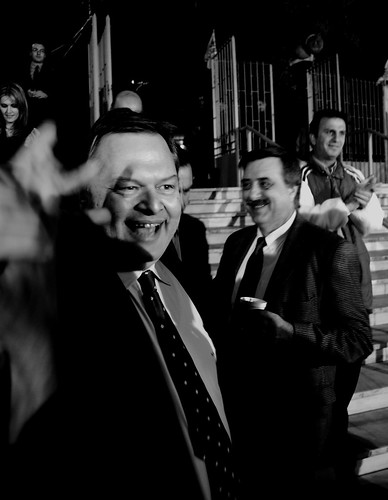
The security needed would have been more low key and the adoring public would have been allowed to approach and even talk to their leaders. This is no longer possible for most of the country's most political elite and instead of adoration party stalwarts like PASOK's Evangelos Venizelos are reduced to ever more convoluted ways of appearing popular whilst hiding behind layer upon layer of security.
Instead of wide open squares the dwindling number of party faithful are corralled into narrow strips in order to bulk out numbers for the TV cameras which work hard to create a sense of mass and enthusiasm.
In this particular case PASOK packed out the front rows with a hundred or so members of its youth wing, disguising the fact that behind them was just 1000 or so supporters, whose average age seemed to be in the 50's.
For both PASOK and New Democracy participation in a pro-austerity coalition government has whittled away at their electoral base and for the first time in a generation they are faced with the real prospect of not being able to form a government, either on their own or together.
Instead of adoration and cheers party officials are often meet with jeers and something yoghurt thrown by disgruntled voters, disgusted with austerity policies.Hence the heightened security measures that underline the gulf that has grown up in the last few years between a discredited political elite and an electorate at the end of its tether.
For many 6th May national elections will mark the end of an era begun in the 70's in which PASOK and New Democracy dominated national politics and promises to usher in a newer, more volatile chapter in public life in Greece.
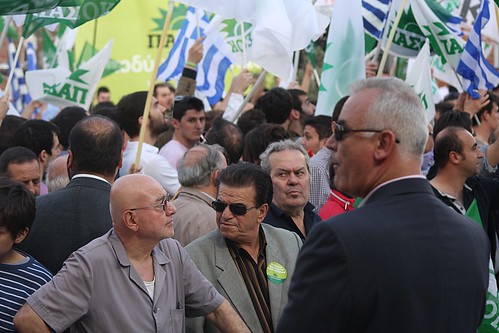
The security needed would have been more low key and the adoring public would have been allowed to approach and even talk to their leaders. This is no longer possible for most of the country's most political elite and instead of adoration party stalwarts like PASOK's Evangelos Venizelos are reduced to ever more convoluted ways of appearing popular whilst hiding behind layer upon layer of security.
Instead of wide open squares the dwindling number of party faithful are corralled into narrow strips in order to bulk out numbers for the TV cameras which work hard to create a sense of mass and enthusiasm.
In this particular case PASOK packed out the front rows with a hundred or so members of its youth wing, disguising the fact that behind them was just 1000 or so supporters, whose average age seemed to be in the 50's.
For both PASOK and New Democracy participation in a pro-austerity coalition government has whittled away at their electoral base and for the first time in a generation they are faced with the real prospect of not being able to form a government, either on their own or together.
Instead of adoration and cheers party officials are often meet with jeers and something yoghurt thrown by disgruntled voters, disgusted with austerity policies.Hence the heightened security measures that underline the gulf that has grown up in the last few years between a discredited political elite and an electorate at the end of its tether.
For many 6th May national elections will mark the end of an era begun in the 70's in which PASOK and New Democracy dominated national politics and promises to usher in a newer, more volatile chapter in public life in Greece.
Subscribe to:
Posts (Atom)