Wednesday, December 03, 2014


Tuesday, November 06, 2012
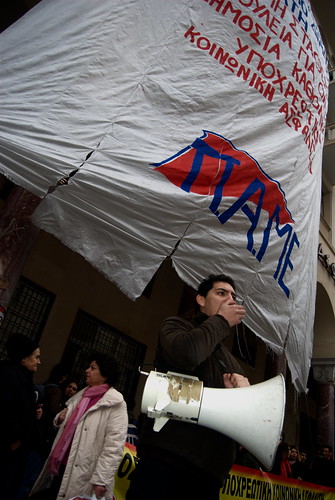
Fight like a Greek - Crush austerity before it crushes you.

Fight like a Greek - Crush austerity before it crushes you., a photo by Teacher Dude's BBQ on Flickr.
Wednesday, February 08, 2012
As Greece drifts towards disaster, what happens next?
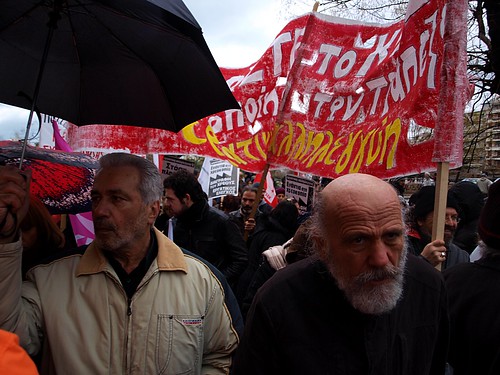
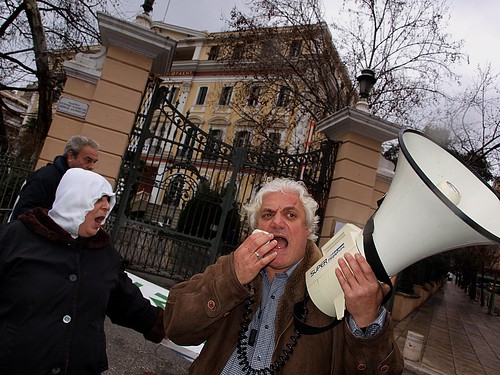
In response to the latest cuts trade unions called a general strike for Tuesday with limited results, many public sector employees carried on working while the turnout for marches was low, with just a few thousand participating in Athens and Thessaloniki. Some argued that the last minute nature of the call combined with unusually low temperatures were to blame. However, I believe there is a growing despondency which has taken hold of people, the conviction that whatever they do nothing will change, feed by the fact that after two years of austerity and four years of economic decline marches, strikes and other protests have not succeeded in halting the malaise.
This, however, should not be mistaken for acceptance, no matter how grudging, of the new economic measures, anger over those and disgust with the current political system is greater than ever. It's is now an article of faith that no member of government can appear in public without presence of riot police units to protect them from their own voters, sometimes even members of their own party. What people lack is a focus for their frustration and the possibility that they can change the present situation.
With the dissolution of established forms of protests and dissent there is a growing danger that popular anger will explode in ways that cannot be directed or contained in the traditional way and with unpredictable consequences. With money drying up and families resources dwindling more and more people will be open to any suggestion, no matter how radical or extreme that offers them even a glimmer of hope for the future.
Friday, December 02, 2011

Friday, October 21, 2011
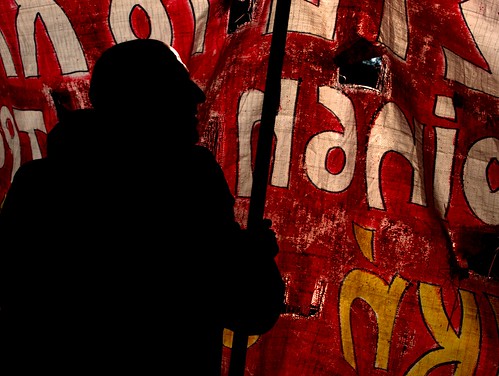
Greek general strike 19/20 October 2011
In Athens , Thessaloniki and many other towns and cities acros Greece hundreds of thouands took part in anti - government demonstrations aimed at over turning the latest round of austerity measures which promise to finish off what is left of the economy.
Sunday, May 15, 2011
Greek police force's reputation drops still further
Over the last three days two stories have dominated much of Greece's domestic news coverage and especially the TV news. The first concerns the tragic death of a 44 year old Athens resident who was murdered as he was getting ready to take his wife to hospital to give birth to their second child. According to newspaper reports the man was accosted by three assailents in the parking area of his apartment and when he refused to hand over a video camera he was carrying stabbed fatally.
The second story concerns savage attacks by riot police in Athens on participants in yesterday's protest marchers held in support of the country's general strike. As the video above shows the police beat and kicked repeatedly marchers leading to the hospitalisation of over 20 including two who are still in intensive care.
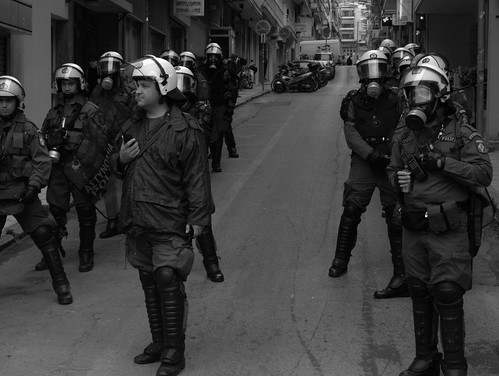
In both cases we are witnessing the failure of Greece's police force to deal with the challenges being wrought by wrenching economic changes and a rising crime wave. For too long the police have operated with impunity able to ignore short comings in both its ability to deal with day to day crime and an evermore restive population that is angry with the role of the government in the current financial crisis. On the other hand the lessons learnt following the month long wave of unrest that accompanied the death of a 15 year old at the hands of police officers in the Exarchia district of central Athens in 2008 have already appear to have been forgotten.
In the wake the December shooting of Alexandros Grigoropoulos riots and street fighting broke across Greece and lead to billions of euros worth of damage. Yet, less than three years later the lack of control both by the police authorities and the legal system over the conduct of officers has once more come to the fore.
It is the same lack of accountability that has seen the police fail to deal with a growing crime wave which has turned some areas of Athens in no-go zones and allowed local far right to gain ground politically by setting itself up as the saviours of the locally born Greek population against a supposedly criminal immigrant element. Aided by media eager to scape goat foreigners for Greece's present economic woes extremists are filling the vacuum created by lack of effective, professional policing.
However, the police authorities, despite the suspension of some officers following the Athens incident ares no mood to change their ways. Indeed with the ruling PASOK party's popularity at an all-time low the government needs the police more than ever as it battles to impose deeply unpopular austerity measures on a angry electorate. In a country where no member of the government can appear in public without causing a near riot PM, Giorgos Papandreou's cabinet knows that it dare not push the police too far since it is next to helpless without them.
Monday, December 20, 2010
Wednesday, December 15, 2010
Greece goes on strike
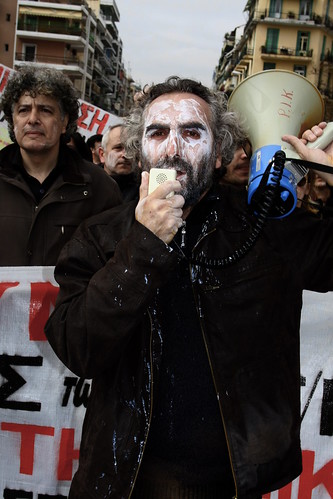
Yesterday the Greek parliament wAS in the process of debating a raft of new labour laws that would radically change the pay and conditions of most employees and is likely to trigger a fall in wages that will further depress living standards of most Greeks, perhaps pushing them back to levels not seen since the 80's. I do not know the outcome of the vote nor do I particularly care as the result is a forgone conclusion and in the final analysis the decision is not in the hands of elected officials in Athens but rather those of technocrats in the IMF, European Commission and the European Central Bank. What the ruling PASOK government cares to call the outcome of the vote is merely window dressing and should not be confused with anything resembling democratic process.
However, away from the parliamentary puppet theatre the country today is set to come to a standstill as trade unions in the public and private sector have declared a general strike for today. Trains, buses, planes are not running and much of Greece's infrastructure has shut down for the durqtion. Across the country people are gathering to take part in protest marches and demonstrations as I write this, angry and disappointed by their rulers.
I will be on the streets trying to take photographs and video of today's events and will be providing updates whenever I have internet access and time. To follow the events on Twitter use the #imfgr hastag. Most of it will be in Greek, of course but Google Translate does a good job of rendering Greek into English and other languages. Alternatively, you could use the following Greek words in your search engines and then translate.
Friday, July 09, 2010
Greek general strike - Thessaloniki 8th July 2010
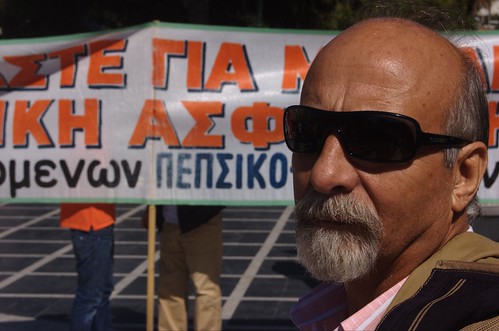
About 3-4000 protesters marched through the centre of Thessaloniki , Greece today to demonstrate against government plans to radically reduce pensions and social benefits.
Wednesday, June 30, 2010
Greek general strike 29/06/2010 - Thessaloniki
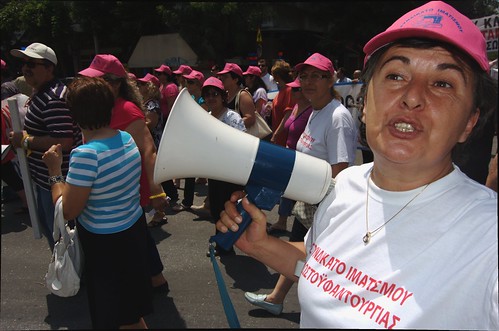
Between 8,000 and 10,000 striking trade unionists took to the streets in the northern port city of Thessaloniki in order to show their opposition to the recent austerity package which they claim will plunge millions of Greeks into poverty by allowing mass redundancies and by cutting pensions.
Sunday, May 09, 2010
Will Greek government be able to implement austerity package?
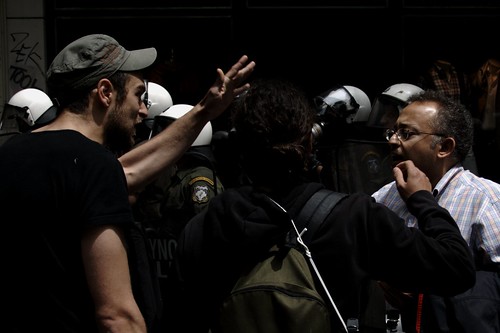
The streets of Thessaloniki are full of kids carrying bunches of flowers to take home since today is Mother's day here in Greece. It's strange to be strolling with my daughter along streets that just a few days ago looked like scenes out of a war movie with phalanxes of riot police charging protesters and the air heavy with the stench of tear gas and burning plastic.
Yet the calmness is deceptive and belays the fact that people here are extremely angry over the latest developments concerning the IMF-EU brokered bailout deal, and despite the concerted efforts of the country's media and especially the main TV stations not convinced that the massive cuts in incomes and public spending are the inevitable price Greece will have to pay to stop the slide into bankcruptcy. In a poll carried out by VPRC 55% of those asked said that they supported the idea of renegotiating the terms of the debt repayment whilst nearly a third wanted a stop on payments altogether. Similarly, the May 4th poll carried out by Public Issue on behalf of the Greek newspaper, Kathimerini on Sunday found that 66% of Greeks were against the measures. (it should be noted that opinion polls carried out for the Vima and Naytemporiki papers found exactly the opposite figures).
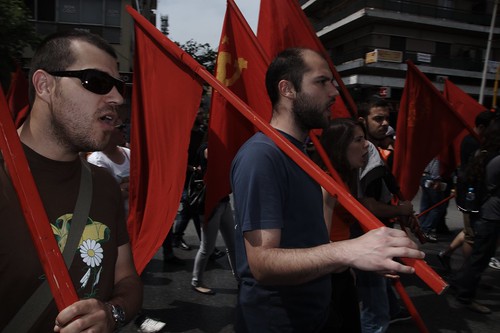
Once again despite what Prime minister Giorgos Papadreou may declare to fellow EU leaders at meetings in Brussels there is absoluely no popular support for the current measues and that the tactic of bypassing constititional and legal objections as part of their imposition is simply fanning the flames of disdent. Reform by diktat is not going to win over many hearts or minds here in Greece and is rapidly dismantling what little consensus exists within the country.
There is also the growing fear that even if the measures announced are enforced there is no guarantee that the sacrifices will bear any kind of fruit. If the rest of the world thinks that the Greek people are simply going to may down and play dead in order that Wall Street/The City/ Franfkfurt can sleep easier at night is in for a terrible shock. The month long wave of riots and revolt that struck Greece in December 2008 following the death of 15 year old Alexander Grigoropoulos was the work of Greece's youth to alarge extent. Current dissatisfaction with the political and economic system covers a much wider segment of the population and is likely to be even more bitter as millions slide into poverty and despair.
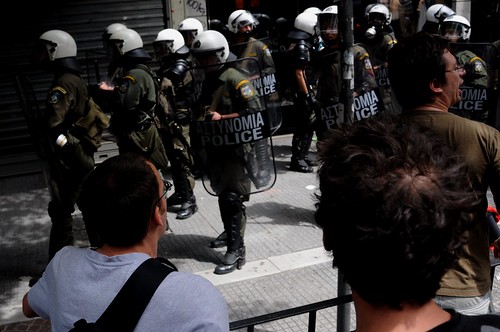
One only has to see the example of IMF intervention in Argentina to see the likely social effects of an austerity package which may last for a decade and may nothing but the chance of better macroeconomic statistics at the cost of untold human misery.
Friday, March 12, 2010
Greek general strike - riot police attempt to split protest march in two
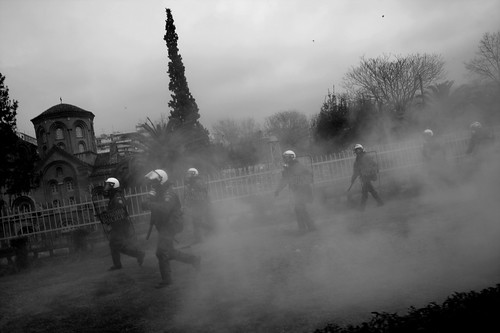
Greek general strike - riot police attempt to split protest march in two, originally uploaded by Teacher Dude's BBQ.
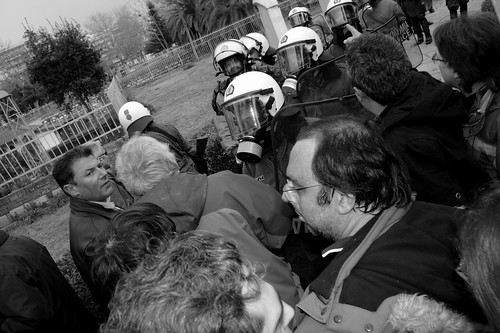
"Greece's largest trade unions managed to bring much of the country to a halt with strikes in both the private and public sector. In the northern port city of Thessaloniki approximately 10,000 people took to the streets in protest against the government's recently announced austerity package. Thessaloniki, Greece. 07/03/2010.
Although mainly peaceful there were some clashes when riot police units attempted to split the march in two, provoking a reaction by members of the teachers' union who attempted to block the move. The police answered with tear gas but quickly withdrew after coming under a hail of rocks thrown by other demonstrators."
Thursday, March 11, 2010
Greek general strike - rolling coverage
Thursday, March 04, 2010
Greek trade unions fire opening salvo over austerity measures
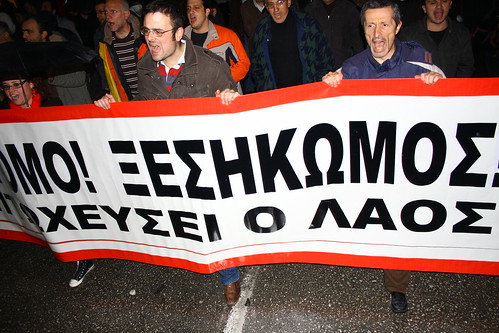
Greek trade unions fire opening salvo over austerity measures, originally uploaded by Teacher Dude's BBQ.
In what promises to be the opening shots in a war of attrition Greek public and private sector trade unions have taken to the streets in the country's major cities angry with the drastic cuts in pay announced by prime minister, Giorgos Papandreou yesterday. Thessaloniki, Greece 03/03/2010
The cuts in salaries combined with a rises in VAT of between 1 and 2% have angered many Greeks who believe the $420 billion debt has gone to line the pockets of the rich and that it is they who should shoulder the burden of reducing the deficit. Marching under the banner, “The plutocracy should pay” the communist controlled PAMe trade union confederation marched this today in Athens and Thessaloniki. Other actions also included an occupation of the economics ministry and the state run ET3 TV station.
On the internet Greek Twitter users could barely contain their outrage over the new economic measures which aim to fill government coffers and cut down on the bloated government budget. However there was anger over the fact that areas such as defence spending which soaks up 4.3% of GNP, a figure twice that of the UK was untouched wheras the education budget was cut by 600 million euros.
Tomorrow sees the first in a series of widespread strike actions across Greece which threaten to bring the country to a standstill.
Friday, February 26, 2010
Thursday, February 25, 2010
Greek general strike 2010 - Thessaloniki
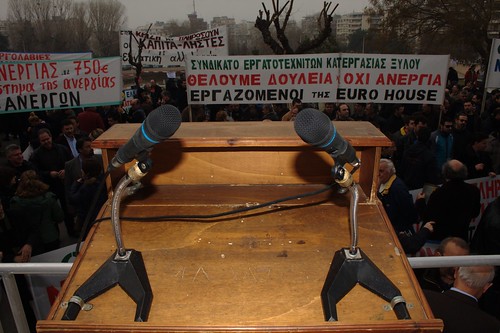
Thousands of Greeks have taken to the streets to show their rejection of the government's proposed austerity measures, which are supposed to right the country's flailing economy. Our Observer in Thessaloniki was in the middle of the protest there, along with his camera.
Craig Wherlock is a British expat based in Thessaloniki. He's a teacher at a private school.
I think there were between eight and nine thousand people in the streets [7,000 according to the police]. Unlike in Athens however, there were no clashes here.
The marchers were mainly public sector workers as their unions, like the PAME [communist], are the most active. But there were also employees from the private sector amongst them. Everybody's worried about the wage freeze, cuts to social benefits, an increase in VAT (from 19% to 21%) and the changing of the legal retirement age (currently 60 for women, 65 for men, but could be set at 67 for all).
People are really angry and feeling desperate. Most shop workers and even small factory employees aren't registered and therefore have no social security. They work up to 50 or 60 hours per week for only 600 euros a month [Read Craig's previous post on the high costs and low wages in Greece].
So they're wondering how the country managed to amount 300 billion euros of debt - what was that money spent on? Certainly not, they say, on public services or roads. The protestors have the impression that politicians robbed the country blind. With the former government, there was a corruption scandal every two months. So talk of wasted money is still rife. The former health minister ordered 16 million doses of the H1N1 flu vaccine, but only 400,000 were needed in the end.
I saw the slogan ‘plutocracy should pay for the crisis' - which pretty much sums up the feelings of the protestors."
http://observers.france24.com/en/content/20100224-greek-demonstrators-say-plutocracy-should-pay-crisis-austerity-plan
Tuesday, February 23, 2010
Down on the street
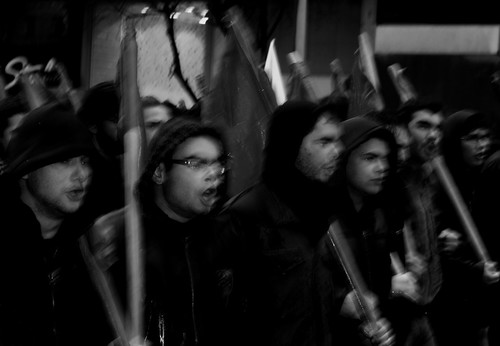
Huh!
Down on the street
Where the faces shine.
Floatin' around i'm
A real low mind.
See a pretty thing - ain't no wall.
See a pretty thing - ain't no wall.
No wall,
No wall,
No wall.
Uuh!
Yeah deep in the night
I'm lost in love.
Yeah deep in the night
I'm lost in love.
A thousand lights
Look at you.
A thousand lights
Look at you.
I'm lost, i'm lost, i'm lost - yeah.
Huh
Faces shine - real low mind.
Real low mind.
I'm a real low mind.
Real low mind
The Stooges/Rage Against the Machine
Wednesday, February 10, 2010
Greek civil servants strike
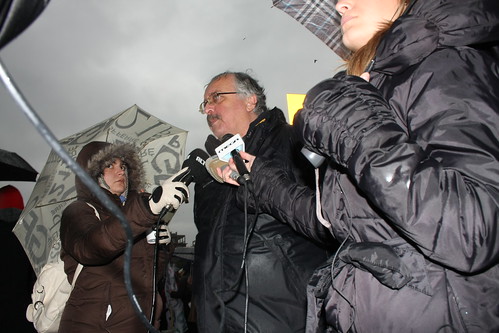
According to the leading Greek newspaper Kathimerini, the next 72 hours are going to prove crucial if the government is to convince European and International money markets that Greece can be trusted to implement its Stabilisation program and reduce its massive $400 billion debt load. Athens, Greece. 10/02/2010.
The program announced this week by recently elected socialist prime minister Giorgos Papandreou has angered civil service trade unions unhappy with goods in bonuses and the promise of a two year wage freeze. In response the civil service trade union confederation ADEDY called a series of stoppages and strikes for the next three days. The action has grounded all flights in and out of the country and severely disrupted train timetables.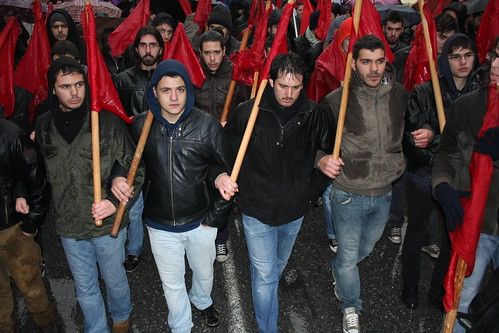
In addition trade unions and left wing political parties organised marches in Athens, Thessaloniki and over 60 other Greek towns. Braving torrential rains thousands took to the srtreets to protest the government's austerity measures.
Despite promising wage increases and a rise in unemployment benefits the left wing PASOK government is unlikely to concede to worker's demands as such a move would weaken attempts by Athens to secure a European backed bailout package. Despite initial talk of Greece putting its own economic house in order intense pressure by speculators has raised fears that if Greece defaults on its financial commitments failure would have a knock on effect on Portugal and Spain and so threaten the Euro itself.