Showing posts with label Greek police violence. Show all posts

Friday, November 21, 2014

Tuesday, February 05, 2013

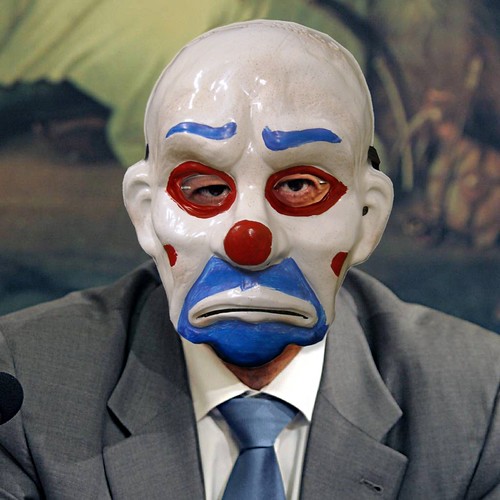
Greek law and order minister denies police mugshots were Photoshopped.

Greek police ‘Photoshop away’ signs of brutality from mugshots.

"Greek authorities must investigate accusations of torture after mugshots of four bank-robbery suspects were doctored to remove signs of injury, Amnesty International said today."

Amnesty International

www.amnesty.org/en/news/greek-police-photoshop-away-signs...

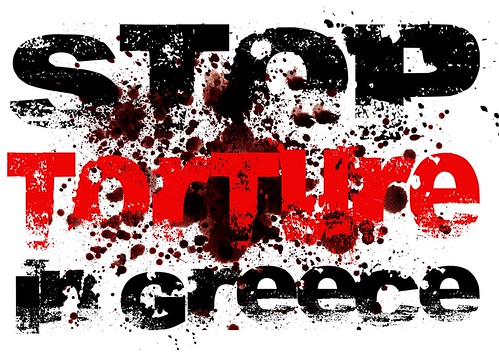
Stop torture in Greece

Friday, April 06, 2012

Yet another Greek photojournalist hospitalised by riot police in Athens

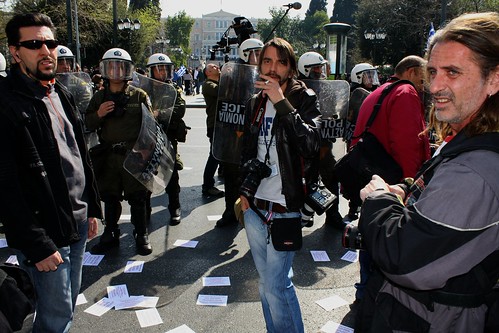
Marios Lolos (far right in the photograph taken on 25th March), president of the union of Greek photojournalists is currently being treated for serious head injuries in the Central clinic in Athens after being attacked by riot police units in Syntagma Square, Athens during protests following the suicide of a 77 year old man yesterday outside the Greek parliament.

Lolos will undergo surgery for his injuries tomorrow.

Κρίσιμη χαρακτηρίζεται η κατάσταση του προέδρου της Ένωση Φωτορεπόρτερ Ελλάδος, Μάριου Λώλου, που νοσηλεύεται με βαριά κρανιοεγκεφαλική κάκωση στην Κεντρική Κλινική Αθηνών, μετά από χτύπημα που δέχτηκε στο κεφάλι από αστυνομικό, κατά την διάρκεια επέμβασης της αστυνομίας στο Σύνταγμα.

Ο τραυματισμένος άνδρας μεταφέρθηκε στην Κεντρική Κλινική Αθηνών, και αφού του παρασχέθηκαν οι πρώτες βοήθειες, κρίθηκε αναγκαία η παραμονή του στο νοσοκομείο.

Αύριο θα υποβληθεί σε χειρουργική επέμβασης

www.enikos.gr/society/31051,Twra-_Se_sovarh_katastash_o_F...

Monday, February 13, 2012

Tear gas and violence put an end to Greek austerity demonstrations

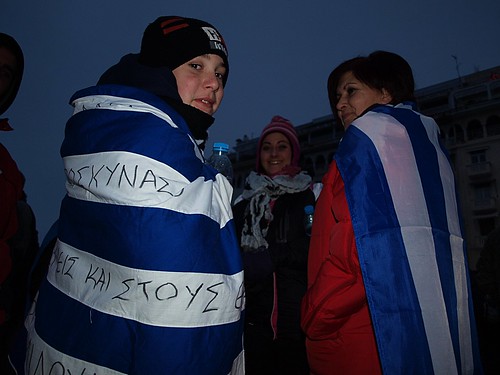
Greeks take part in anti-austerity protest march - Thessaloniki, Greece

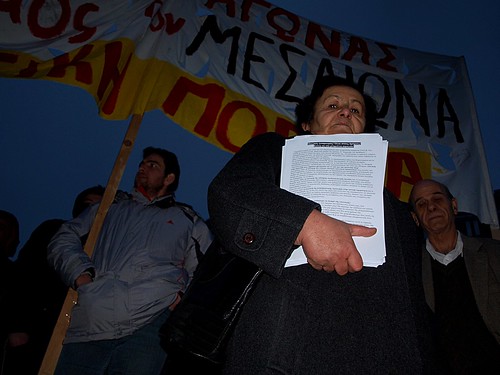
Last night's protest rally saw a large turnout as about 20,000 people gathered in the central Aristotelous Square and then marched through down town Thessaloniki.

However, once the march returned to the Square violence broke out and police repeatedly attacked the rally, using tear gas and truncheons, often against people who had no involvement with any act of violence. (see video below).


Riot squad units also lashed out indiscriminately at marchers outside the Olympion cinema which had been occupied yesterday by groups opposed to the latest round of austerity measures.


At least two people were injured in the attack including one man who was taken to hospital with head wounds received during the police charge.

Saturday, February 11, 2012

Wednesday, December 07, 2011

Latest austerity measures in Greece adding to the flames

"Why are you taking photographs?" The riot cop kept on screaming at me, his face screwed up into a red ball, his club raised, waving back and forth.

What I wanted to say was "So you don't beat the kid you just caught to a bloody pulp. So you don't plant evidence on him"

But I didn't say anything of the sort, I just said that I was doing my job, whatever that may mean. I suppose I could have got into a discussion about the role of citizen journalists in the newly emerging media landscape but then again, never argue with a man with a baton and a badge.

Yesterday I marched with students in Thessaloniki who were marking the third anniversary of the murder of 15 year old Alex Grigoropoulos, who was shot by a police officer in cold blood on December 6th, 2008 in Athens. His crime was talking back to an officer with an attitude and a gun.

The death sparked off a maelstrom of violent protest that lasted for nearly a month and saw clashes between protesters and Greek police across the country, affecting both large cities and smaller communities.

The crime acted as a catalyst for anger over much of the discontent many young Greeks felt about their future and the way the country was being run, as it came in the wake of a series of corruption and influence peddling scandals involving top government officials.

It also was fuelled by the widely held belief that the police, and by extension much of the state is above the law, able to flaunt legislation and human rights at will.

Three years on and the economic situation has deteriorated so rapidly that 2008 seems like a lost paradise, where there were still a future for some and some way of making do for most.

With youth unemployment at 40% nationally and over 50% in Thessaloniki little now remains for Greece's 15-30 year olds in terms of jobs and career choices.

To make matters worse the problem has spread to their parent's and grandparent's generations as the relentless list of austerity measures and tax hikes have hit both the public sector and small businesses, both bastions of Greece's new enfranchised middle class.

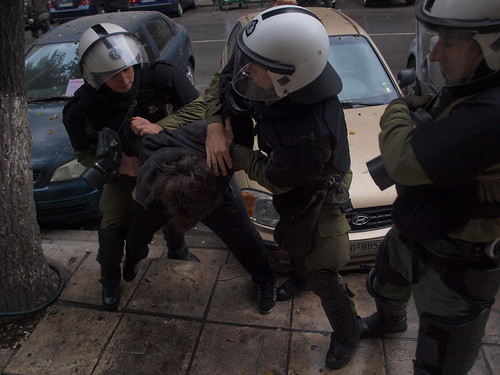
Footnote. The teenager you see being arrested in the photograph was simply guilty of not running fast enough, like most of those who took part in yesterday's demonstrations, he did so peacefully. However, in the heat of the moment trifling matters such as innocence and guilt matter little to ill-disciplined riot police units looking to settle scores.

Thursday, October 06, 2011

Reporters Without Borders issue alarm over police violence against media professionals in Greece

Reporters Without Borders issue alarm over police violence against reporters in Greece by Teacher Dude's BBQ
Reporters Without Borders issue alarm over police violence against reporters in Greece, a photo by Teacher Dude's BBQ on Flickr.

Following a series of attacks on photographers and other journalists covering anti-government protests in Athens, Reporters without Borders has issued an alarm over the Greek police's treatment of reporters. Below is an extract from their damning report on lack of press freedom in the country.

"Working conditions during demonstrations are nowadays rather like in a war-zone, which is both surprising and deplorable in an EU member-state. press photographers and camera-operators are by far the worst affected. Few protesters make a distinction any longer between media owners and journalists just trying to do a job.


Photojournalists and camera-operators are scapegoats for all the bitterness and violence. to the police, they are undesirable witnesses of often harsh and illegal repression. “Our images show that the police don’t know how to do their job,” says Aristotelis Messinis, a photographer in Athens for the french agence France-Presse news agency. “We show up their poor training and their abuses and excesses.


The police also consider the pictures taken of them as an invasion of their privacy. It’s weird but true. For activists and extremists, we’re a similar problem, as undesirable witnesses of their activities that don’t belong in such demonstrations. To them, the media is an arm of the government, so they attack us."

en.rsf.org/IMG/pdf/greece_2011_eng.pdf

Sunday, July 24, 2011

Shot by shot capture of Greek riot police attacking a demonstrator - Athens 3.50pm 29 June 2011


This was just one of the hundreds of acts of police violence commited by Greek riot squads during the 29th June, the vast majority of attacks were directed at peaceful protesters who'd gathered in Syntagma Square, central Athens to show their disagreement with the latest round of Government austerity measures which has brought the country to its knees economically.

Thursday, July 07, 2011

When those who think words can change the world meet those who know that weapon will.

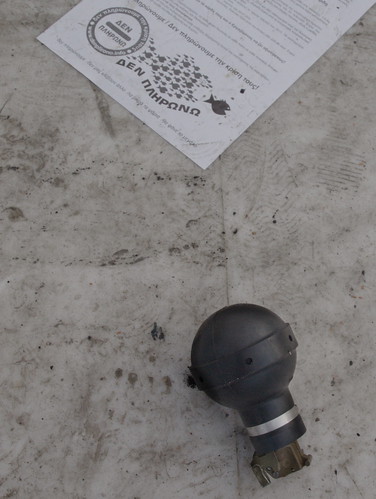
A leaflet for the "I won't pay" campaign lies on the pavement outside parlaiment in Athens, next to a used tear gas grenade, a particularly vile weapon that once lit fliesoff in all directions leaving a trail of disabling gas.

I saw several of these used by riot police last Wednesday by riot police and was always relieved when this hunk of metal which travels in the air at 50-60 kph managed not to hit anyone.

I thought the juxtaposition of the leaflet and the grenade encapsulates so much of what happened later that day. In essence a peaceful protest movement was drowned in a wave of violence and tear gas by a government terrified that it would develop even further and threaten their pwer.

Using a violent actions of a few demonstrators the police launched a sustained and savage attack on all sections of the rally leaving in its wake over 500 injured and the centre of Athens looking like a war zone, an especially damaging image for a country as dependent on tourism as Greece is. In contrast to most riot situations when the police use about 100 tear gas cannisters police sources admitted that 2860 cannisters were used on Wednesday alone.

The sense of outraged felt by those witnessing the casual brutality of the Greek police was paliable and goaded many , normally law abiding citizens to pick up whatever came to hand and fight back.

With the Indignant movement shattered, or at least geatly weakened, a false feeling of calm has decended upon Greece as people no longer take part in mass demonstrations. This is partly due to the time of year (Summer is traditionally a slow period politically) and partly a sence of futility as people have been unable to stop the austerity measures. But do not count on such emotions lasting indefinitely, with the coming Autumn the Greek government is likely to be faced by a large number of political challenges both from within and without parliament.

Already rage against the ruling PASOK party and politicians in general has lead to a series of over 90 attacks on MPs, a number which is set to rise as they return to disgruntled constituencies for the summer recess.

Friday, July 01, 2011

The Battle for Athens. The day after.


When I got back from Athens the first thing I did was take a shower to wash away the stench of tear gas, Maalox and fear that had hung around me since the morning. Although I have seen my fair share of violent clashes here in Greece, including the uprising in December 2008, nothing had prepared me for the sheer level of savagery shown by the Athens riot police. More than once I saw them act like wild animals, pouncing upon anyone foolish enough to stop to plead or remonstrate with them

Time and time again the police sent vollies of tear gas into packed crowds and it's only by a miracle that no one got crushed under foot as thousands of people ran panic striken from the gas and flash grenades. Nor did this stop throughout the day, from the moment the trouble started at 1pm till after midnight Syntagma Square smelt and sounded like a war zone with an almost continous series of loud explosions and renewed tear gas attacks on the Los Indignados encampment.

Even as far away away as Monesteriki (a neighbourhood about 1km from parliament) rampaging motocycle officers created havoc as they attacked peaceful protesters in cafes and tavernas and gunned their bikes along narrow streets packed with tourists drinking coffee outside.

At no point did the level of police response correspond with the threat they were facing, instead of calmly dealing with a small group of stone throwing trouble makers they launched an all out attack on five fronts against demonstrators which succeeded in provoking a furious reaction from a much larger section of the rally who had outraged by the scenes of uncontrolled police violence they were witnessing.

If such violence had been restricted to an handful of officer or units then perhaps you could talk about rogue officers acting unlawfully, but the scale and the duration of the operation left no doubt that police were under direct ordrs to do everything in their power to break up the demonstration and make sure those taking part would not regroup. In that way the country's political leadership and ultimately, prime minister Giorgos Papandreou took the decision to surpress the anti-government protests in manner more befitting the brutal regimes of Egypt and Tunisia than any EU member.

This is a decision that may buy the ruling PASOK administration some time as people reel in shock from the violence but in the long term has severely damaged, perhaps irreparably the credibility of Greek parliamentary democracy and probably will be the final nail in the coffin of PASOK as a viable political force in future elections.

In a country where folk memories of previous state violence run deep, sometimes going back generations the events of the 28th and 29th June are not likely to remain fade any time soon..

Thursday, June 30, 2011

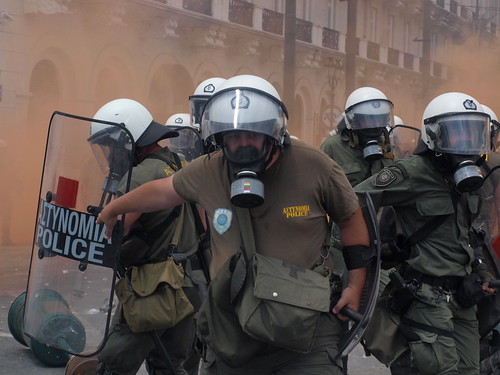
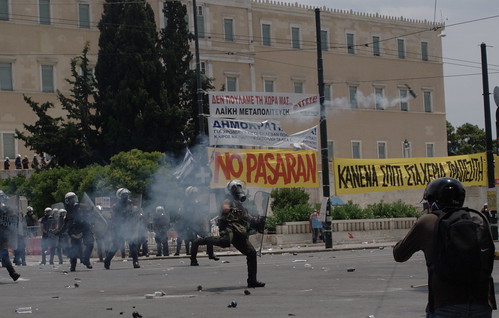
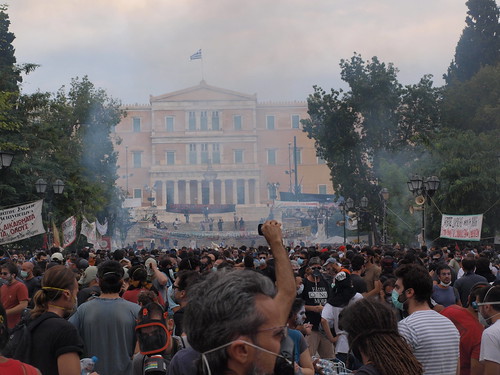
Greek parliament swathed in tear gas. Athens

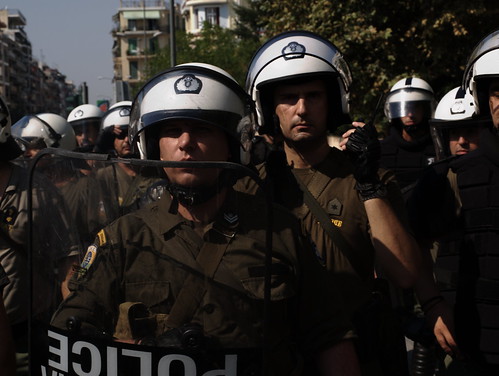
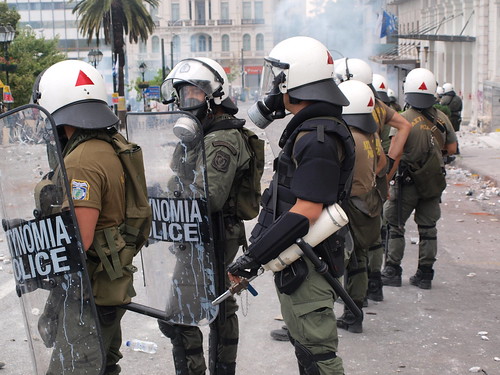
Greek riot police getting ready to attack Los Indignados encampment, Syntagma Square, Athens

I was in Syntagma Square yesterday and it was like being in hell. I have never witnessed so much violence from the police in all the demos and protests I've covered in Greece. I saw riot police officers beat a man who'd fallen to the ground, acting for all the world like a wolf pack falling upon its prey. Pure, unadulterated savagery.

What I saw yesterday in Athens was a corrupt regime drown legitimate dissent in a sea of tear gas and violence.

The only bright spot was the extreme bravery of ordinary Greeks who defied the brutality of the police to protest and were capable of the most amazing acts of kindness to strangers even in the worst situations.

For more pictures on Flickr click here. For Demotix story and photos click here and here,

Sunday, May 15, 2011

Greek police force's reputation drops still further


Over the last three days two stories have dominated much of Greece's domestic news coverage and especially the TV news. The first concerns the tragic death of a 44 year old Athens resident who was murdered as he was getting ready to take his wife to hospital to give birth to their second child. According to newspaper reports the man was accosted by three assailents in the parking area of his apartment and when he refused to hand over a video camera he was carrying stabbed fatally.

The second story concerns savage attacks by riot police in Athens on participants in yesterday's protest marchers held in support of the country's general strike. As the video above shows the police beat and kicked repeatedly marchers leading to the hospitalisation of over 20 including two who are still in intensive care.

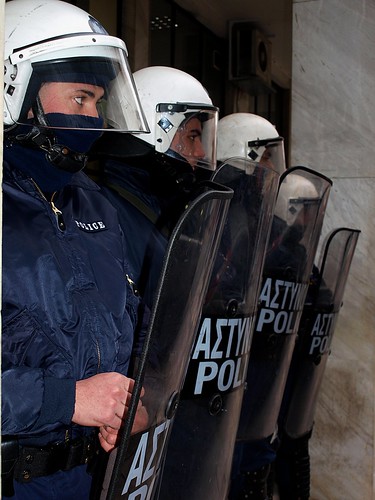
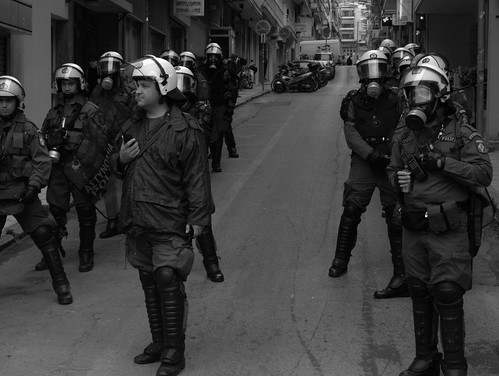
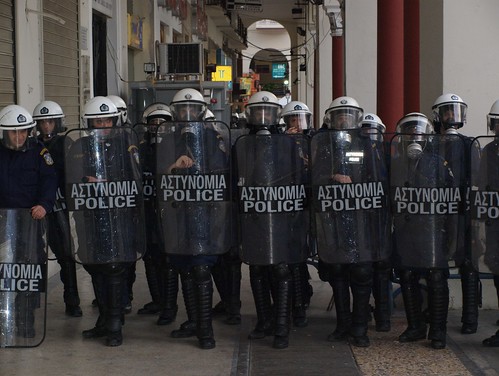
Greek riot police on standby during protest march - Thessaloniki, Greece.

In both cases we are witnessing the failure of Greece's police force to deal with the challenges being wrought by wrenching economic changes and a rising crime wave. For too long the police have operated with impunity able to ignore short comings in both its ability to deal with day to day crime and an evermore restive population that is angry with the role of the government in the current financial crisis. On the other hand the lessons learnt following the month long wave of unrest that accompanied the death of a 15 year old at the hands of police officers in the Exarchia district of central Athens in 2008 have already appear to have been forgotten.

In the wake the December shooting of Alexandros Grigoropoulos riots and street fighting broke across Greece and lead to billions of euros worth of damage. Yet, less than three years later the lack of control both  by the police authorities and the legal system over the conduct of officers has once more come to the fore.

It is the same lack of accountability that has seen the police fail to deal with a growing crime wave which has turned some areas of Athens in no-go zones and allowed local far right to gain ground politically by setting itself up as the saviours of the locally born Greek population against a supposedly criminal immigrant element. Aided by media eager to scape goat foreigners for Greece's present economic woes extremists are filling the vacuum created by lack of effective, professional policing.

However, the police authorities, despite the suspension of some officers following the Athens incident ares no mood to change their ways. Indeed with the ruling PASOK party's popularity at an all-time low the government needs the police more than ever as it battles to impose deeply unpopular austerity measures on a angry electorate. In a country where no member of the government can appear in public without causing a near riot PM, Giorgos Papandreou's cabinet knows that it dare not push the police too far since it is next to helpless without them.

Police violence sparks off new round of protests across Greece


Protests against police violence - Thessaloniki Greece

Thursday night's demonstration against the savage attacks by riot police on marchers taking part in the protests in support of the Greek general strike on Wednesday. After a result 67 people needed medical treatment including a 30 year old who is in critical condition in a central Athens hospital. See here for photographs of the victims.

www.demotix.com/news/687230/20000-greeks-protest-over-new...

Saturday, February 26, 2011

Photographs and video from Greek anti-government march on 23rd February 2011 - Thessaloniki.

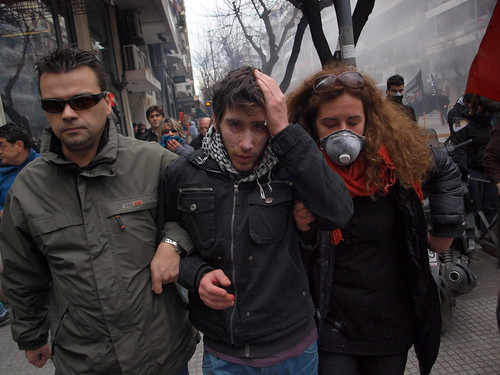
Injured Greek marcher helped by protesters after police attack.

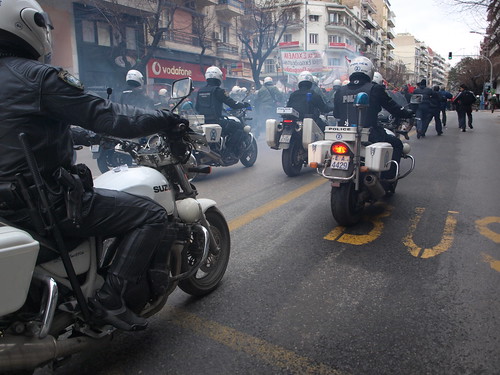
Greek police motorcycle units used to chase and intimidate marchers in anti-government demonstration - Thessaloniki, Greece

More pictures and video from the marches that accompanied the general strike last week. The person taking the video was also attacked by police officers who often employed batons and tear gas indiscriminately to break up the march. In addition to this the riot police also made extensive use of military grade ordinance which is intended for special forces anti-terrorist operations in the form of the N591 stun grenade. This is the third occasion (I've witnessed this in the last year alone. See here and here for the previous two instances).


At 8 mins 20 sec you can see footage of the police attacking the camera operator as they tried to film the arrest of a demonstrator. I also saw uniformed officers clubbing marchers on Tsimiski Street who had not been involved in any acts of violence and clearly posed them no threat.

The video was originally posted on the We Are Change Greece website which has a description of the events shown in Greek and English.

Another video from the Antipliroforisi (Anti-misinformation) site from the same demo showing police using tear gas, flash greandes and motorcycles to stampede demonstrators along the main street in Thessaloniki.

Thursday, December 09, 2010

Reporting in Greece getting tougher than ever.

Welcome to the 75th International Trade Fair - Thessaloniki, Greece

As the economic crisis in Greece bites ever harder the number of groups wishing to protest against government policies has also grown and with it the number of situations in which the police have been used . With this has come a worrying trend of police attacks on photographers and others covering the demonstrations and marches. The latest incident happened on Monday when Demotix photographer, Maxime Gyselinck was attacked by riot police during demonstrations in Athens to commemorate the anniversary of the police killing of Greek teenager, Alexandros Grigoropoulos in 2008. Despite telling the officer that he was a photojournlist he had his arm broken in the assault. Fellow photographer Vangelis Patsialos was also assualted when he tried to help Gyselinck.

This is just the latest in a series of incidents of police violence against photographers and camera operators in Greece. Just three weeks ago Aris Messinis was punched repeatedly by a motorcycle officer who he had photographed during a march. (The reporter made a note of the number plate of the motorbike the officer was riding and it also features in a law suits for a violent police raid on a legal aid centre for immigrants in Athens according to independent news service TVXS). In October camermen and photographers were needlessly attacked and tear gassed during a police operation to clear protesting employees from the Acropolis (see video here).

And the list goes on, including many of the photoraphers who are part of the Demotix photography agency who have also been kicked, hit, and abused by police officers during the last year. In addition to running the risk of being hit by flying rocks, bottles or having your equipment smashed by irate rioters photojournalists in Greece also have to calculate the possibilities of being attacked by the police when covering any kind of violent confrontation.

Nor are many of these incidents simply over reaction by riot police units in the thick of the action but often happen after the violence has subsided and there are no possible excuses for mistaking a photographer for a rioting teenager.

I, too was also put in hospital with a dislocated shoulder in 2007 when riot police attacked me for taking pictures of them during a peaceful march and I have lost count of the number of times I have been threatened by individual officers when covering events here in Thessaloniki.

The root of the problem is that the police force (or ELAS as it is known in Greek) operates as if it were above the law and officers know that whatever legal action is taken by the victims of their violence colleagues and superiors will be more than willing to cover for them in the unlikely event of the case reaching court. As the documentary by Reportage Xoris Synora (Reporting Without Borders) on the killing of Grigoropoulos, shot by a police officer in 2008 shows they will even go as far as perjury and alteration of evidence in order to protect their own .

It's little wonder then that Greece dropped 35 places to 70th position (the lowest in the EU) in the Press Freedom Index in 2010. The organisation reported that the precipitous decline in press freedom in Greece was in large part to a series of attacks on reporter which went unpunished.

As times get harder and the government uses the police more and more to contain discontent and frustration felt by Greeks the chances are that such cases on abuse of authority will multiply so making the job of anyone wanting to cover anything other than press conferences and political party photo-ops even more difficult.

UPDATE

Yesterday (Sunday, December 12th) another reporter was attacked while covering a story in Kretea. A presenter for Alter TV news was beaten about the head by a member of the MAT (Greek riot police) while covering protests by inhabitants of the area over the construction of a new rubbish dump.
Monday, December 07, 2009

This is what happens when you fire tear gas canisters at range of 10m or less.


This is what happens when you fire tear gas canisters at range of 10m or less., originally uploaded by Teacher Dude's BBQ.

Whilst the mainstream media here in Greece has been having a feeding frenzy with the violent scenes in central Athens and talk of murder attempts on the dean of the university of Athens many other similarly deplorable acts of violence have not garnered such coverage. Three trade unionists are currently in hospital one with serious head injuries after being rammed by motorcycle units as part of the police new crowd control tactics first used in the Tehran protests (see video). Also pictures have emerged of the same officers wildly waving their service pistol in the air in an attempt to intimidate protesters (see picture).


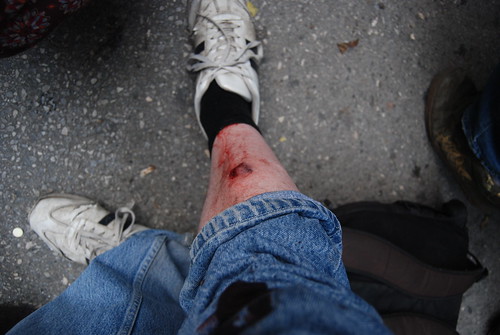
I myself was also hit by a fragment of tear gas canister fired at point blank range into a crowd of 200 hundred or so marchers who had been "kettled" by the riot police here in Thessaloniki. I got off lightly with just a wound to the leg which just needed a few stitches, others, however, suffered more serious injuries caused in exactly the same way. Not that this stopped officer punching and kicking those on the ground once they'd gained the upper hand.

The 100 or so young people taken in for questioning were simply picked at random, unlucky enough to be in the middle of the march.

Minister of the protection of the citizen(The new Orwellian term for law and order) said on his Twitter page that he had zero tolerance for anyone breaking the law, whoever they are. Still, he'll be gone in a couple of years whereas those policemen who broke the law today will probably retire with a pension.


Monday, November 23, 2009

Greek police accused of beating 35 year old mother in front of her two year old child

Greek police raze refugee camp to the ground.

I just came across a story that once gain confirms my belief that the police here in Greece are out of control subject to little or no oversight. In an appalling case reported in the Eleutherotypia newspaper's site (see here in Greek) a 35 year old Armenian woman was beaten, handcuffed and detained in front of her two year old child home on the home from a supermarket in Athens last Thursday.

According to the interview she gave to the newspaper the incident was triggered when the woman, who is married to a well - known Greek musician, was accused by plain clothes police in an unmarked car of insulting them. They then asked if she was from Romania and when she said that she was, in fact from Armenia demanded to know why she was in Greece. They then produced police ID and demanded she come with them to the local police station.

When she went to get the pushchair carrying her child they grabbed her, pushed her to the ground, kicking and punching her in the belief she was resisting arrest. The hapless mother was handcuffed and taken with her child to the Aghios Pantelimenos police department where she was kept for four hours.

The Aghios Pantelimenos district of Athens has been in the news on several occasions over the last year following clashes with the far right group, Chrysi Aygi and immigrants living in the area. Many foreign born shop owners have also accused the police of turning a blind eye to racist intimidation in the area.

Thursday, October 22, 2009

Greek law and order minister says police out of control


Greek police have been accused of heavy handedness and over - reaction after a raid on a bookshop in central Athens following a book reading by the author Dimitris Papachristos. Shortly after the reading approximately 50 masked riot police surrounded the Floral bookshop in the Exarchia district and arrested two teenagers inside prompting protests by members of the audience, including the author and journalists, Sotiris Damatapoulos, reporter with the Greek state broadcaster ERT and Stelios Elliniadis, radio presenter who demanded to know why the officers were masked and had covered their ID numbers. As a result all three were also arrested.

On hearing of the event head of the newly formed Ministry for the Protection of the Citizen, Michalis Chrysohoidis demanded that the release of those being held in the central Athens police station and according to the TVXS independent news service said that the officers were out of control.

Last night's raid followed clashes between police and local youths in the area in which stones and bottles were thrown. However, many left wing groups have accused the police of acting as an army of occupation with mass sweeps and arrests of local residents and visitors to the area.

Questions still remain over how much oversight the newly elected PASOK government can exercise upon the nation's police force which has repeatedly been condemned by the UNHCR, Amnesty International and many other European humans rights groups over its violent treatment of immigrants and supporters of opposition groups. Universities in Athens and Thessaloniki, Greece's second city were occupied this week by students protesting the death of Pakistani national, Mohammed, Kameran Atif following his detention by police in the Nikia district of Attiki.

Despite sparking off nationwide riots which cost the country billions of euros in damage and brought Athens and many other Greek cities to a halt for days on end the Greek police force seems to have learnt little from the violent December protests which followed the death of a 15 year old shot by an officer in the Exarchia.

UPDATE

Minister for the Protection of the Citizen, Michalis Chrysohoidis sought and received the resignation of the head of Greek police force EL. AS, Vasilis Tsiatouras this evening.

Monday, September 07, 2009

Greek police fail to learn lessons of December

Greek police raze refugee camp to the ground.

Just hours after the shooting of 15 year old Alexandros Grigoropoulos by a police officer in the Exarchia district of central Athens, hundreds started violent protests that would last for weeks and cost the country billions of euros in damages. Despite the ferocity of the response to the killing it seems that the Greek authorities have yet to appreciate the potential for backlash created by accusations of police violence. One of the major driving forces behind the December riots, the worst in modern Greek history was the conviction that the officer involved would not be punished.

In the latest case the recently formed Delta motorcycle unit stand accused of using excessive force in the arrest of a 27 year old man last week in Exarchia. According to report in today's national daily, Eleutherotypia the unnamed man was detained and beaten by several police officer who left him with broken ribs and a punctured lung. Afterwards he and four others who had also been detained were tied to a tree.

The official police report states that the detainee had been stopped during a routine check and arrested for carrying explosive materials, GBH and resisting arrest. Throughout most of last Thursday night police and youth clashed in a series of running skirmishes in the area.

As the article in Eleutherotypia points out it is a standard police tactic in such cases to charge victims of police violence with serious crime in order to justify their treatment. In a similar case in November 2007, Cypriot student, Augustinos Dimitrios whose brutal beating was captured on live TV was charged with resisting arrest.

Similarly, the police officers charged with the killing of Alexandros Grigoropoulos in December first stated that they had acted in self defence after allegedly being attacked by a group of stone throwing youths, including Alexandros. Despite the appearance of amateur video footage the following day which contradicted the official version of events the authorities insisted on sticking with the officer's discredited account for weeks.

The Greek police force has routinely been the object of critical attention by organisations such as UNHCR, the European Union, Amnesty International and other human rights groups. In both 2005 and 2008 the Council of Europe’s Committee for the Prevention of Torture (CPT) roundly condemned the Greek authorities for turning a blind eye to the violent treatment of prisoners and suspects by prison and police officers (click here to see report).