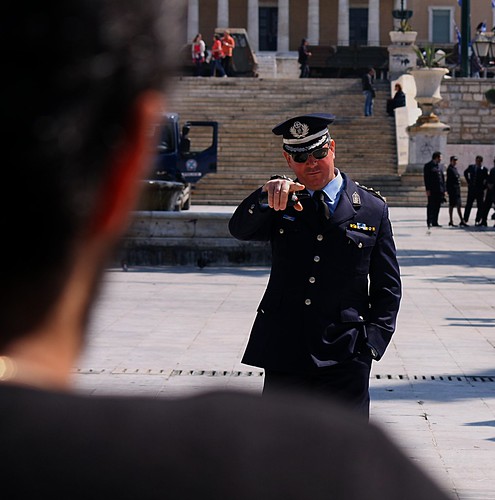
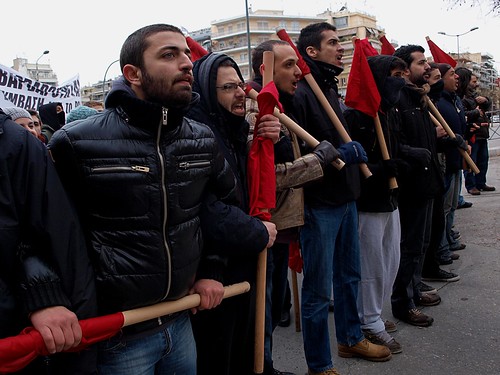
With Greek Independence day almost upon them the country's political elite has decided to put on its bravest face and take part in the military parade that marks the event. However, the rare public appearance by so many government officials is a security nightmare as the authorities are faced with the possibility that enraged voters will take the opportunity to once more attack politicians as happened a few weeks back on the Greek island of Rhodes.
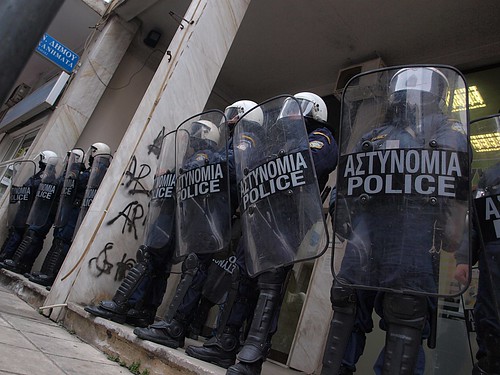
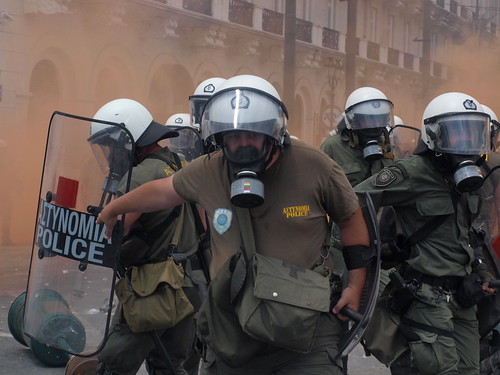
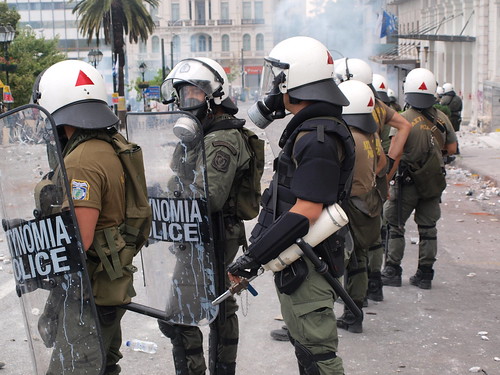
As a result nothing is being taken to chance in the run up to this weekend's parades in Athens. Local media reports on the number of police and secret service personnel on duty vary from 4,500 to 13,000, with anything up to 3000 riot police on standby ready to intervene with tear gas in case of trouble.
Evacuation plans for government officials have been drafted and the orange trees that line boulevards of central Athens are being stripped of their fruit lest they be used to pelt cabinet members. The police have warned that they will be carrying out random bag checks and anyone found in possession of eggs, tomatoes or yogurt could face arrest.
Even the media have come under closer scrutiny as the Greek government has demanded that only those accredited by Athens city council be allowed access to the parades, an unprecedented move.
The draconian security measures are designed to avoid a repetition of the PR debacle suffered by the previous Papandreou government during 28th October military parade in the northern port city of Thessaloniki when the president was forced to flee the VIP stand after angry protesters temporarily shut down the parade.
While no one knows how Sunday will play out the potential for conflict is extremely high as an angry electorate, feeling betrayed by its political rulers comes face to face with those they feel responsible for their present plight. darker voices even talk of deliberate provocation, with the idea that scenes of violent clashes will allow the present government to put off elections and so avoid a humiliating defeat at the polls.
I will be present in Syntagma Square on Sunday and whatever happens I will try my best to record it both on video and in photographs.
Prime minister Lukas Papademos last night warned his fellow Greeks that failure to reach agreement on the latest austerity measures in parliament today would bring disaster to the indebted nation. Such dramatic talk in perhaps hardly surprising in the country that gave the world the word, apocalypse and reflects the fear those in power feel about the possibility that the legislation will not pass, or even worse will produce a wave of protest so intense that it will stall its implementation.
For the last three days there have been a series of strikes and marches against the latest cuts and job losses, but they are just a warm up for the big event which will take place later today at 5pm Athens times when people will start to gather for a series of nationwide rallies.
For over two years Greek voters have been told that austerity will save the country and yet all people have seen is a huge drop in living standards as the economy has collapsed and prices have soared. Caught between these two pincers many have despaired that will be able to survive financially as bills pill up and incomes from pensions and wages keep on falling.
The situation has not been helped by a political system that is widely despised as being both inept and deeply corrupt. This has been reflected not only in the falling poll figures for those parties in power but also the seemingly endless clashes between riot police and protesters that occur whenever government members are spotted in public.
Those who call upon Greeks to make more sacrifices are exactly those most unwilling to give up the priviledges they have accrued whilst in power, a fact that few outside parliament have failed to notice.
The reality is that Greece has ceased to be a sovereign nation in anything but name, it's economic policy, spending decision and hence the vast majority of decision usually made in the name of the nation state are being dictated by the country's creditors who have demanded a heavy tribute in return for their intervention.
The fiscal policies being imposed have slashed GDP, pushed up unemployment and all but destroyed any real chance of the economy recovering for the forseeable future. In such a situation using talk of bankruptcy to scare people into supporting yet more of the same is simply not going to succeed as so many have, to all intents and purposes already been bankrupted.
What is left for the government and its supporters in the the media, (which to a large extent is controlled by domestic oligarchs heavily invested in the banking sector) are a series of crude threats warning of massive shortages in food and other basic goods should the country renege on its debt agreements.
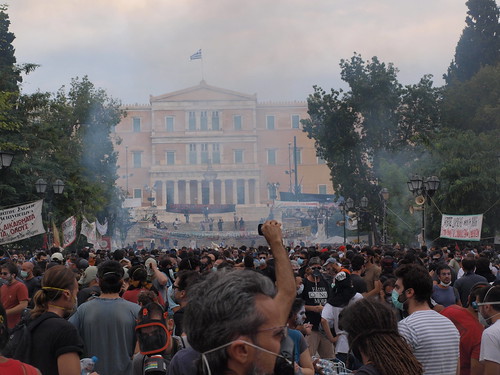
Tonight in Athens's Syntagma Square we will see if the riot police can contain the groundswell of popular anger now building up. It will be a scene repeated in towns and cities across the country as people gather once more to say no to a future which holds nothing but poverty and decline for the next decade.
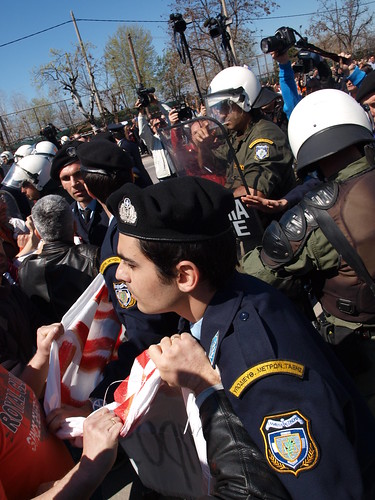
This was just one of the hundreds of acts of police violence commited by Greek riot squads during the 29th June, the vast majority of attacks were directed at peaceful protesters who'd gathered in Syntagma Square, central Athens to show their disagreement with the latest round of Government austerity measures which has brought the country to its knees economically.
Occasionally, things happen that takes time to process or require distance to filter them through memory till they start to take on the contours of anything that can be explained in a meaningful way.
It has been over two weeks since I went to Athens to take part in the anti-government rally on the 29th June. Tagging along with a group of 400 "indignant" as the Greek protesters call themselves I found myself waiting at midnight outside the White Tower in the centre of Greece's second largest city, Thessaloniki with a bunch of people who resembled less a group of serious demonstrators than over aged participants in a school trip. The joking and jostling for position, who sits next to whom, brought back memories of similiar journeys as a kid.
Arriving in Athens the next morning we wasted no time and no sooner had we clambered off the coaches than a banner was unfurled and people took to the road to march and shout out chants, announcing to all who cared to listen that the northern contingent was in town and looking to join their big city counterparts in Syntagma Square. The Square which faces the houses of parliament has, for much of modern Greek history been the focal point of clashes between disgruntled citizens and their rulers.
As soon as we entered the square than many of us were overwhelmed with tears, though this was less to do with any emotion than the residue of tear gas that had been used the previous day and which still coated much of the area. Luckily for us, one of the leaders knew exactly where we could equip ourselves with gas masks and goggles that later would prove so vital for anyone who wanted to stay in Syntagma.
In the crowd that was massed in front of the parliament the atmosphere was a strange mix of carnival and demo, on the one hand people were in a upbeat mood with some present dancing to music played by drummers yet the underlying feeling of tension and anger was apparent to anyone familiar with Greeks and Greek culture.
Another interesting point was the "ideological" composition of the rally, which seemed to embrace a wide, if not contradictory range of political opinions. In the centre where trouble would later start were the "patriots" as I termed them, who were convinced that the entire Greek debt crisis was the result of American born prime minister, Giorgos Papandreou's collusion with the Jewish banking nexus, with a measure of masonic conspiracy theory thrown in for good measure.
On the other hand every shade of left wing opinion including the anarchists also had their own blocks. In the middle, a mass of others who identified with none of the available political choices but were convinced that the austerity law being debated was a disaster for the country and wanted send a message to those inside parliament.
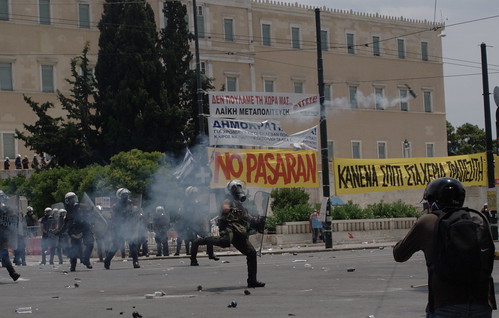
The real panic began at 1.30pm when news that the austerity vote had passed became known, leading to a group of about 100-200 next to the barriers outside parliament to rush the police. The charge was quickly stopped when riot police units started firing tear gas and the demonstrators quickly retreated. Taking this as a cue a group of about 50-100 youths started pelting police lines from nearby the Grand Bretagne hotel and and the police intervened effectively the violence would have probably been over within a few minutes.
However, riot police units then took the attack as an excuse to lauch a concerted assault on the rally from five different directions, using thousands of tear gas cannisters, flash grenades and other weapons. The result was a generalised onslaught on anyone still remaining in Syntagma who were all perceived by the police as rioters, even though the vast majority were protesting peacefully and had nowhere to flee to.
Assualts by the police continued inside Syntagma and throughout much of the centre of Athens for the rest of the day, with hundreds being hospitalised with breathing problems or the result of beatings by the police who in many situations acted more like football hooligans than the agents of law and order.
How to describe the horror of seeing a pack of 10 officers kick and beat a man in front of my eyes, or the anger generated when a protesters who talked back to a policeman was repeatedly punched in the face by a another cop. It was scenes like these that infuriated many present and created a much wider circle of people, many older men and women willing to throw stones and other objects at the police.
I repeatedly saw demonstators plead with riot squad units to stop attacks and who intervened to calm down fellow protesters but often their attempts to play peacemaker were thwarted by the police themselves who lashed out at anyone who approached them or grabbed people, seemingly at random.Each time this happend yet another wave of anger rippled through those nearby.
This pattern of violence and over reaction repeated itself through the day and lead me to the conclusion that the violence of the police was not simply a lack of self control but part of a plan by the authorities to empty the square and put down the Indignant movement at all costs. I doubt if anyone in government uttered those words but I'm pretty sure that the police leadership was left with no illusion about what their political masters wanted done about the situation.
Another infuriating aspect of the day's events was the foreign coverage of the rally which seemed to misunderstand the gravity of the situation, For most of the foreign press crews the story as yet another clash between Greek "anarchists" and the police so ignoring the wider implications of a massive police surpression of a mainly peaceful protest movement.
I'm not sure if this was simply journalistic laziness or the result an agenda that much of the mainstream media often bring to news stories.I remember arguing with some smug US TV anchorman next to me who was waffling on about how futile the protests were as if it was a tired theatrical show that has outstayed its welcome rather than the desperate fight by ordinary Greeks for a viable future. This unwillingness or inability to look beyond the dramatic images to get to a deeper truth has marked much ofthe reporting from Syntagma and the Greek crisis in general.
Later as the day wore on my nerves and stamina dwindled the constant threat of attack by the police or injury by flying objects from both sides plus the experience of being tear gassed took its toll and even the adenaline jolt of being in a highly charged conflict wasn't enough to keep me going . So I went to a cafe to send off pictures and comment to Demotix. yet even there the atmosphere was heavy with tear gas and I ended up sitting at a table in a mall wearing a mask while tapping out my story.
Towards midnight I carefully made my way back to Syntagma Square which now resembled a war zone with fires burning and the much of the surrounding area looking as if it had been used for target practice to get to the subway station to meet up with the other protesters from Thessaloniki who were going back by coach from Monestiraki.Even inside the station the regular thud of flash grenades going off near the entrance gave the impression that we were in an air raid.
Even though I have seen lots of upheaval in Greeece, including the violent uprising in December 2008 the level of violence I witnessed in Syntagma was of a new order of magnitude and it seemed that it was ushering in a violently different relationship between the Greek government and the people they are supposed to represent.
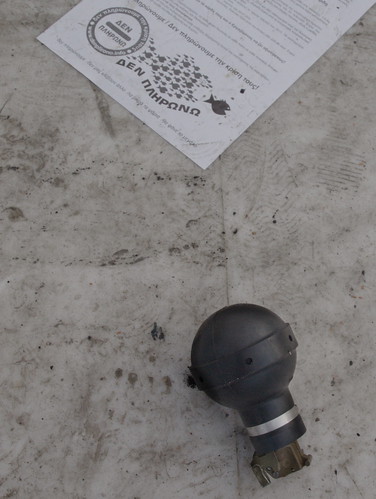
A leaflet for the "I won't pay" campaign lies on the pavement outside parlaiment in Athens, next to a used tear gas grenade, a particularly vile weapon that once lit fliesoff in all directions leaving a trail of disabling gas.
I saw several of these used by riot police last Wednesday by riot police and was always relieved when this hunk of metal which travels in the air at 50-60 kph managed not to hit anyone.
I thought the juxtaposition of the leaflet and the grenade encapsulates so much of what happened later that day. In essence a peaceful protest movement was drowned in a wave of violence and tear gas by a government terrified that it would develop even further and threaten their pwer.
Using a violent actions of a few demonstrators the police launched a sustained and savage attack on all sections of the rally leaving in its wake over 500 injured and the centre of Athens looking like a war zone, an especially damaging image for a country as dependent on tourism as Greece is. In contrast to most riot situations when the police use about 100 tear gas cannisters police sources admitted that 2860 cannisters were used on Wednesday alone.
The sense of outraged felt by those witnessing the casual brutality of the Greek police was paliable and goaded many , normally law abiding citizens to pick up whatever came to hand and fight back.
With the Indignant movement shattered, or at least geatly weakened, a false feeling of calm has decended upon Greece as people no longer take part in mass demonstrations. This is partly due to the time of year (Summer is traditionally a slow period politically) and partly a sence of futility as people have been unable to stop the austerity measures. But do not count on such emotions lasting indefinitely, with the coming Autumn the Greek government is likely to be faced by a large number of political challenges both from within and without parliament.
Already rage against the ruling PASOK party and politicians in general has lead to a series of over 90 attacks on MPs, a number which is set to rise as they return to disgruntled constituencies for the summer recess.
When I got back from Athens the first thing I did was take a shower to wash away the stench of tear gas, Maalox and fear that had hung around me since the morning. Although I have seen my fair share of violent clashes here in Greece, including the uprising in December 2008, nothing had prepared me for the sheer level of savagery shown by the Athens riot police. More than once I saw them act like wild animals, pouncing upon anyone foolish enough to stop to plead or remonstrate with them
Time and time again the police sent vollies of tear gas into packed crowds and it's only by a miracle that no one got crushed under foot as thousands of people ran panic striken from the gas and flash grenades. Nor did this stop throughout the day, from the moment the trouble started at 1pm till after midnight Syntagma Square smelt and sounded like a war zone with an almost continous series of loud explosions and renewed tear gas attacks on the Los Indignados encampment.
Even as far away away as Monesteriki (a neighbourhood about 1km from parliament) rampaging motocycle officers created havoc as they attacked peaceful protesters in cafes and tavernas and gunned their bikes along narrow streets packed with tourists drinking coffee outside.
At no point did the level of police response correspond with the threat they were facing, instead of calmly dealing with a small group of stone throwing trouble makers they launched an all out attack on five fronts against demonstrators which succeeded in provoking a furious reaction from a much larger section of the rally who had outraged by the scenes of uncontrolled police violence they were witnessing.
If such violence had been restricted to an handful of officer or units then perhaps you could talk about rogue officers acting unlawfully, but the scale and the duration of the operation left no doubt that police were under direct ordrs to do everything in their power to break up the demonstration and make sure those taking part would not regroup. In that way the country's political leadership and ultimately, prime minister Giorgos Papandreou took the decision to surpress the anti-government protests in manner more befitting the brutal regimes of Egypt and Tunisia than any EU member.
This is a decision that may buy the ruling PASOK administration some time as people reel in shock from the violence but in the long term has severely damaged, perhaps irreparably the credibility of Greek parliamentary democracy and probably will be the final nail in the coffin of PASOK as a viable political force in future elections.
In a country where folk memories of previous state violence run deep, sometimes going back generations the events of the 28th and 29th June are not likely to remain fade any time soon..
I was in Syntagma Square yesterday and it was like being in hell. I have never witnessed so much violence from the police in all the demos and protests I've covered in Greece. I saw riot police officers beat a man who'd fallen to the ground, acting for all the world like a wolf pack falling upon its prey. Pure, unadulterated savagery.
What I saw yesterday in Athens was a corrupt regime drown legitimate dissent in a sea of tear gas and violence.
The only bright spot was the extreme bravery of ordinary Greeks who defied the brutality of the police to protest and were capable of the most amazing acts of kindness to strangers even in the worst situations.
Just arrived in Athens and now along with 400 other protesters from Thessaloniki we're in Syntagma Square which looks a lot like a warzone, with used ordinance on the ground and broken windows throughout the area. There is a very strong police presence with who knows how many riot police platoons in the vacinity. Also the place absolutely stinks of tear gas, enough to bring tears to almost all those who marched into the square, hate to think what those who got te full dose of chemical warfare yesterday went through. One reliable soiurce on Twitter spoke of 270 people badly affectd by gas. The first thing I'm going to do when the stores open is buy a gas mask, no way Maalox on its own can deal with so much tear gas.
I'll also try to keep updates coming either here or via Twitter.
I've taken the plunge and signed up to join a group of Aganaktismenoi (Indiganant) who are off to take part in the anti-government rallies outside parliament in Syntagma Square, Athens.
I thought long and hard about the decision for a number of reasons, not least being could I afford to go. Also another thought weighing heavily on my mind was the possibility that the protests turning violent if the latest auterity law passes and becomes law.
Despite all those reservations I decided that I had to go for a number of reasons. First of all, I want to stand shoulder to shoulder with those who oppose these outrageous measures which threaten my and family's future for the forseeable future.
Another, equally compelling reason is the chance to see history being written, to take part and record events that I believe will be considered pivotal in the future. Since if thse kind of measues can be foisted on the Greeks you can be sure that the next targets will be Portugal, Ireland and later other EU states rolling back decades of hard won social progress.
The coach leaves at 10pm tomorrow from the White Tower and if I don't see you there hope we get the chance to meet up and chat in Athens.
One of the few good things to have come out of the events that Greece has witnessed over the last week is the growing awareness amongst ordinary people that they can get out their message without having to rely on the traditional media.
I have decided to share this video posted 13th December which shows the effects of the police using tear gas on a peaceful protest in Syntagma Square, central Athens. For those who haven't experienced this, imagine someone throwing vinegar in your eyes while you are in the middle of a severe asthma attack.
I include the text which accompanies the video on Youtube.
"Κάθε βράδυ στο Σύνταγμα, από την δευτέρα 8/12/08, μαζευόμαστε και κάνουμε μια ειρηνική διαδήλωση. Στις 13/12/2008 έγινε μία ειρηνική διαδήλωση. Φωνάζαμε συνθήματα, τραγουδούσαμε, μέχρι που, γύρω στις 12 το βράδυ, μας περικύκλωσαν τα ΜΑΤ. Τους είδαμε ότι είχαν προετοιμαστεί, φορόντας μάσκες και μετά, χωρίς να έχει προηγηθεί κάτι, προσπαθούσαν να διαλύσουν την ειρηνική διαδήλωση με χημικά (παρεπιπτώντος, επειδή έφαγα το χημικό στην μούρη, δεν μπορείτε να φανταστείτε πως πονάει) και ξύλο με τα γκλοπ. Δύο κοπέλες και ένα παλληκάρι πήγαν στο νοσοκομείο, η μία κοπέλα και το παιδί λόγω άσθματος, και η άλλη λιποθύμησε από το χημικό και την έδειραν. Ένα παιδί το βάρεσαν στο κεφάλι, και ένα άλλο το χτύπησαν στα πόδια.
Translation
"Every evening since Monday 8/12/08 we have been gathering in Syntagma Square to protest peacefully. On 13/12/08 there was also a peaceful demo. We shouted slogans, we sang and it was around about 12 midnight when the MAT (Greek riot police) surrounded us. We saw that they had prepared for this as they were wearing gas masks and then, without anything having happened they tried to break up the peaceful demo using tear gas. (BTW as I got some tear gas in the face you can't imagine how much it hurts) and truncheons. Two girls and a lad went to hospital . One of the girls and a kid because of asthma and the other who had fainted due to gas who was beaten. One guy was beaten in the head, the other on the legs."