Showing posts with label press freedom in Greece. Show all posts

Saturday, June 22, 2013

ERT - Greek prime minister's plan for a surgical strike turns into war of attrition

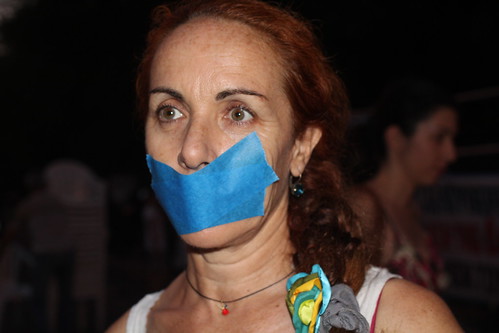
Protests against government's closure of public broadcaster, ERT continue in Thessaloniki, Greece. by Teacher Dude's BBQ

Like so many plans that go badly array, it must have seemed a great idea, at least in the beginning. With a bold move, the Greek prime minister, Antonis Samaras would at once show the country's lenders that his flagging reform program was back on tracks and appeal to his conservative base by getting rid of a symbol of public sector extravagance. What could go wrong?

Unfortunately for the Greek government just about everything. The decision 11 days ago by the ministry of finance to announce the immediate closure of Greece's public broadcaster, ERT set in motion a series of events that is now threatening to bring down the uneasy coalition that has been in power since last summer's elections. The departure of the Democratic Left from the three party coalition yesterday in protest over the handling of the ERT affair has seriously weakened the PM's hand  and revealed  that just how unstable the partnership with PASOK has become.

This is just one in a series of political miscalculations that has turned a political gamble into a political nightmare for Samaras, both at home and abroad, garnering yet more criticism and negative publicity for the country at exactly the time the leadership has been boasting to any media outlet who would listen of its success in turning the economy around.
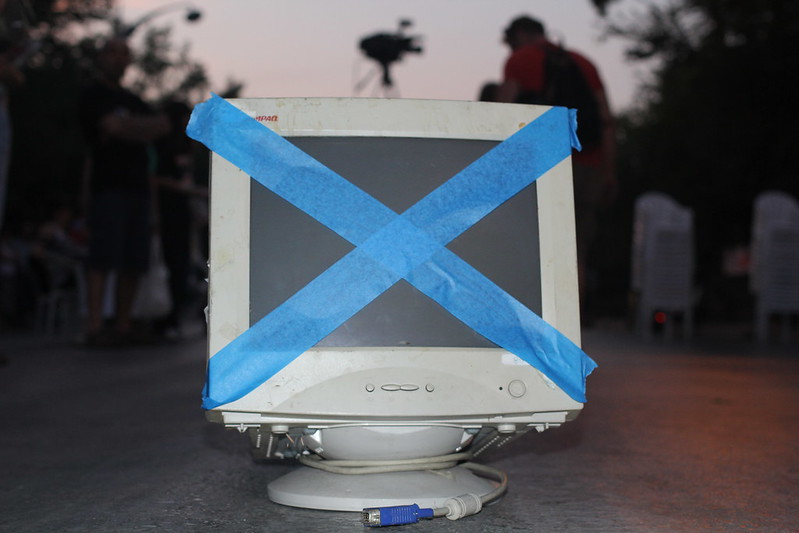
Protests against government's closure of public broadcaster, ERT continue in Thessaloniki, Greece.

The live TV images of ERT reporters warning of impending police action only to be replaced by a black screen shocked many Greeks, especially among the older generation who had witnessed similar media black outs during the Regime of the Colonels (1967-1974). For foreign observers such as The European Broadcast Union and the Head of the BBC the sudden cutting off of a public broadcaster whilst on air was unprecedented in post war Europe and a direct attack on democratic values and freedom of the press.

Instead of a few days of protests by the employees of ERT which could easily be ignored by pro-government private media the government was faced with a media insurrection as journalists and technicians defied threats by the authorities to continue broadcasting, using internet live streaming, unused analogue signals, satellite etc. This, along with the social media storm created meant that thousands turned up outside state run studios in Athens, Thessaloniki and other cities to protect   those inside from the riot police units that quickly deployed around such facilities.

Instead of stifling the voice of those working in ERT these actions encouraged people to find their signal in any way they could and demand via the live streaming channel provided by the EBU grew so rapidly it overwhelmed the site's capacity.
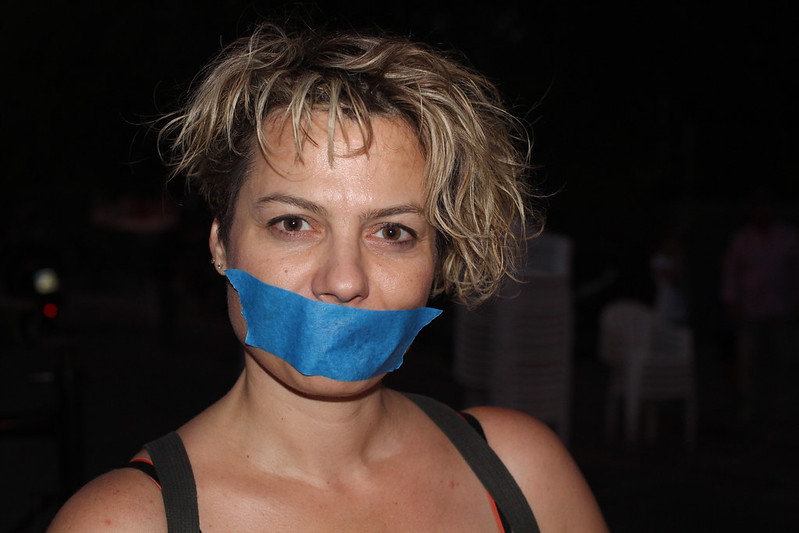
Protests against government's closure of public broadcaster, ERT continue in Thessaloniki, Greece.

The quick surgical strike that New Democracy advisers had promised was now turning into a long drawn out and very public shouting match in which the government was being viewed as bullying autocrats rather than bold reformers taking on an arrogant publically funded elite. The decision by the Council of State that ERT be allowed to go back on air via its normal broadcast facilities was ignored so adding to the sense that Samaras was acting as if he and his ministers were above the law, a point the opposition SYRIZA party seized upon in order to appeal to disillusioned PASOK supporters, increasingly frustrated with their own party leadership.

Now the authorities are on the horns of a dilemma, if they back down over the ERT closure, then this will likely re-ignite anti-austerity opposition and provide a template for future battles over the sale off of publically owned power and water utilities. On the other hand a swift, police raid to empty the occupied broadcasting facilities would be a PR disaster, both at home and abroad as well as possibly shattering the fragile alliance with  the PASOK party.

So, probably the government will be forced to play the long game, hoping that as time goes by ERT employees can be bribed or coerced into agreeing to a watered down version of the original closure plan

Protests against government's closure of public broadcaster, ERTcontinue in Thessaloniki, Greece.

Tuesday, October 30, 2012

Greece's beleaguered government cracks down on dissent

Perhaps it is appropriate that Thessaloniki, which this weekend celebrated the 100th anniversary of its liberation from the Ottoman Empire looked like a city under siege. For three days the centre of Greece's second largest city was the objects of draconian security measures designed to avoid a repetition of last year's peaceful protests which closed down the annual military parade and forced the president of the republic to flee.

Mindful of the fact that the event lead to the resignation of the then prime minister, Giorgos Papandreou just weeks later the current political leadership decided to make sure last year's events were not repeated.

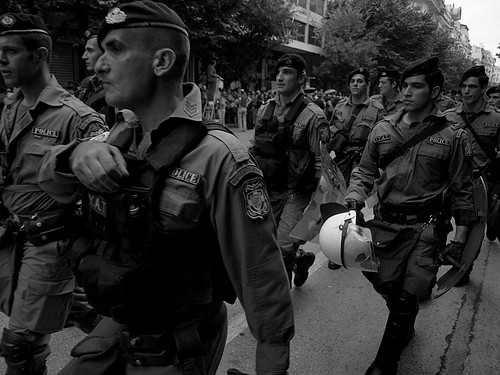
As a result 2,000 extra police were drafted to protect prime minister Antonis Samaras and president Karolos Papoulias as they visited Thessaloniki over the weekend. The security measures for the Oxi Day parade were so tight that no even the parents of high school pupils taking part were allowed within the 1 km “dead zone” that surrounded the VIP stand and effectively isolated the parade from the vast majority of citizens who'd turned out to follow it.

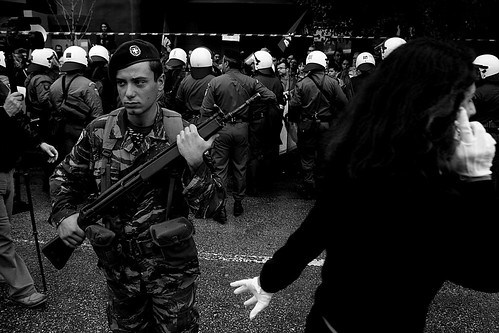
Greek riot police protect politicians and VIPs during high school student parade

This was the equivalent of banning the public from 4 July/ Bastille Day/Remembrance Day. Only those with an invitation from the government were permitted to attend the event which is held annually to mark the entry of Greece into the Second World War.

Even journalists were turned away as the invitation only rule caught many by surprise. As a result the event was covered nearly exclusively by pro-government media who did an excellent job on ignoring the fact that no one was watching, apart from armed soldiers, riot police units and party cadres from the political parties that form Greece's coalition government.

Instead of commenting on the strange absence of ordinary people on a day many Greeks consider sacred, the state run media was generous in its praise for the organisers as nothing untoward had happened.

Greek PM arrives in Thessaloniki amid draconian security measures

As Greece's economic slide continues the country's political leadership has become more isolated from voters and as a result has grown ever more paranoid. The few public appearances by government officials are invariably marked by the presence of thousands of uniformed and plain clothes police officers. Even the most traditional and innocuous gatherings are eyed with suspicion and policed as if they were a football derby between deadly rivals.

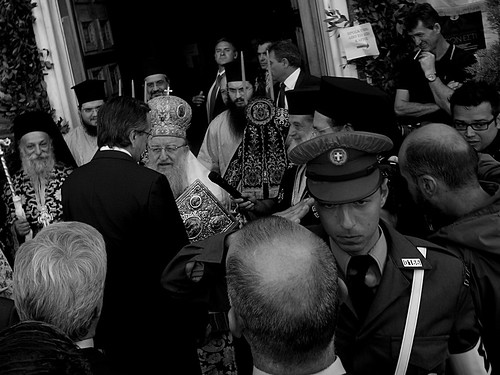
When on Friday Antonis Samaras visited the Agios Demitrios Cathedral in Thessaloniki to attend a religious service to celebrate the city's patron saint, heavily armed riot police units carrying shields and tear gas kept back curious worshippers from the leader. Inside the perimeter between hundreds of police officers made sure that the 100m journey from the prime minister's limo to the church entrance went off without incident. Inside, dozens of plain clothes officer kept a watchful eye of the congregation to make sure no embarrassing images of pensioners booing were seen on TV screens.

(UPDATE - The one hapless reporter from the local state run ET3 channel who happened to mention heavy police presence during the visit of the prime minister was quickly taken off air and later fired).

Karolos Papoulias - One of Greece's hidden leaders.

Such scenes are just part of growing intolerance towards dissent and protest, both in the streets and in the press. Whilst pro – austerity sentiment dominates both state run and private mass media, even the slightest show of anti – government defiance is now being punished. In the last 48 hours alone, Greek journalist Kostas Vaxevanis was arrested for publishing a list of possible tax dodgers given to then finance minister, Papakonstantinos by IMF head, Christine Lagarde.

Unlike his French and German counterparts Giorgos Papakonstantinos did not act upon the information (reasons why seem to vary from week to week), instead handing the information to his successor PASOK leader, Evangelos Venizelos, who kept it in desk drawer for two years.

Such heavy handedness was also repeated when two presenters on a popular morning TV show were fired suddenly by the state run NET TV channel after they mentioned reports in the Guardian that linked law and order minister Nikos Dendias in connection with an alleged police torture scandal.

It's hard to see how long any democratically elected government, especially a coalition one made up of such disparate elements can survive just using just the power of a supine media and the blunt instrument of massive police force.

Thursday, December 09, 2010

Reporting in Greece getting tougher than ever.

Welcome to the 75th International Trade Fair - Thessaloniki, Greece

As the economic crisis in Greece bites ever harder the number of groups wishing to protest against government policies has also grown and with it the number of situations in which the police have been used . With this has come a worrying trend of police attacks on photographers and others covering the demonstrations and marches. The latest incident happened on Monday when Demotix photographer, Maxime Gyselinck was attacked by riot police during demonstrations in Athens to commemorate the anniversary of the police killing of Greek teenager, Alexandros Grigoropoulos in 2008. Despite telling the officer that he was a photojournlist he had his arm broken in the assault. Fellow photographer Vangelis Patsialos was also assualted when he tried to help Gyselinck.

This is just the latest in a series of incidents of police violence against photographers and camera operators in Greece. Just three weeks ago Aris Messinis was punched repeatedly by a motorcycle officer who he had photographed during a march. (The reporter made a note of the number plate of the motorbike the officer was riding and it also features in a law suits for a violent police raid on a legal aid centre for immigrants in Athens according to independent news service TVXS). In October camermen and photographers were needlessly attacked and tear gassed during a police operation to clear protesting employees from the Acropolis (see video here).

And the list goes on, including many of the photoraphers who are part of the Demotix photography agency who have also been kicked, hit, and abused by police officers during the last year. In addition to running the risk of being hit by flying rocks, bottles or having your equipment smashed by irate rioters photojournalists in Greece also have to calculate the possibilities of being attacked by the police when covering any kind of violent confrontation.

Nor are many of these incidents simply over reaction by riot police units in the thick of the action but often happen after the violence has subsided and there are no possible excuses for mistaking a photographer for a rioting teenager.

I, too was also put in hospital with a dislocated shoulder in 2007 when riot police attacked me for taking pictures of them during a peaceful march and I have lost count of the number of times I have been threatened by individual officers when covering events here in Thessaloniki.

The root of the problem is that the police force (or ELAS as it is known in Greek) operates as if it were above the law and officers know that whatever legal action is taken by the victims of their violence colleagues and superiors will be more than willing to cover for them in the unlikely event of the case reaching court. As the documentary by Reportage Xoris Synora (Reporting Without Borders) on the killing of Grigoropoulos, shot by a police officer in 2008 shows they will even go as far as perjury and alteration of evidence in order to protect their own .

It's little wonder then that Greece dropped 35 places to 70th position (the lowest in the EU) in the Press Freedom Index in 2010. The organisation reported that the precipitous decline in press freedom in Greece was in large part to a series of attacks on reporter which went unpunished.

As times get harder and the government uses the police more and more to contain discontent and frustration felt by Greeks the chances are that such cases on abuse of authority will multiply so making the job of anyone wanting to cover anything other than press conferences and political party photo-ops even more difficult.

UPDATE

Yesterday (Sunday, December 12th) another reporter was attacked while covering a story in Kretea. A presenter for Alter TV news was beaten about the head by a member of the MAT (Greek riot police) while covering protests by inhabitants of the area over the construction of a new rubbish dump.