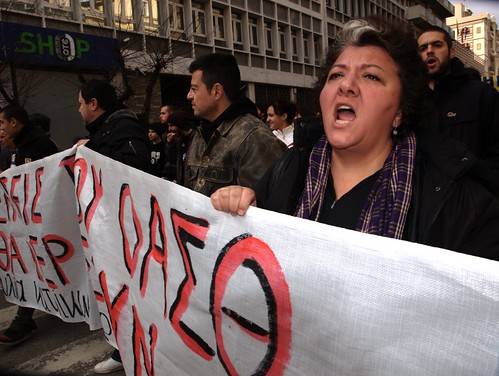
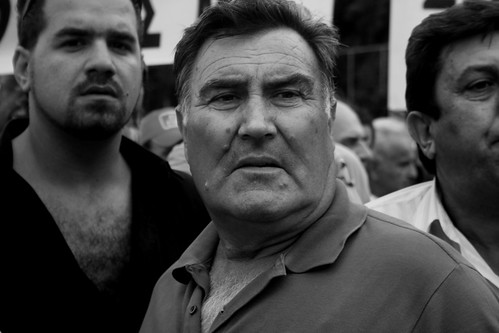
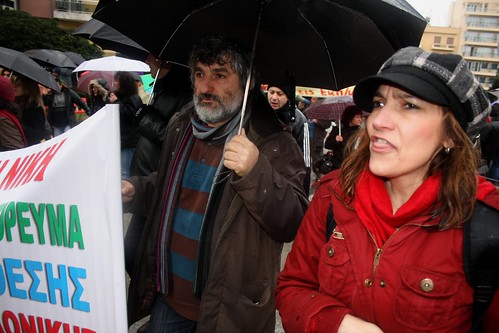
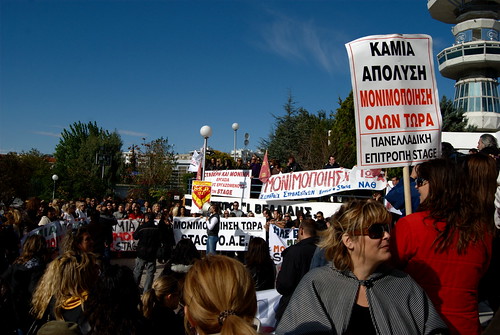
Angry consumers in protests against rising prices - Thessaloniki, Greece, originally uploaded by Teacher Dude's BBQ.
Greek haulage associations have decided to continue strike action and blockades despite government moves to pass laws that would allow protesters to be jailed for up to five years and have their licence revoked.
With supermarket shelves emptying and shortages in basic goods appearing across the country Greek truckers this week voted to continue their industrial dispute with Athens over radical changes in transport policy which are aimed at liberalising road haulage regulations along with other sections of the economy.
However, continued resistance to the changes which were voted into law earlier this month has continued unabated across Greece with truckers refusing to haul goods to and from warehouses and ports. In addition there have been violent clashes between drivers and riot police units in Athens and other cities as the ruling PASOK government decided on a tougher line against strikers leading to arrests.
Shots were fired at truck operating in the Malakasas region in Attiki and according to Greek media there have been a number of attacks on Bulgarian vehicles in northern Greece.
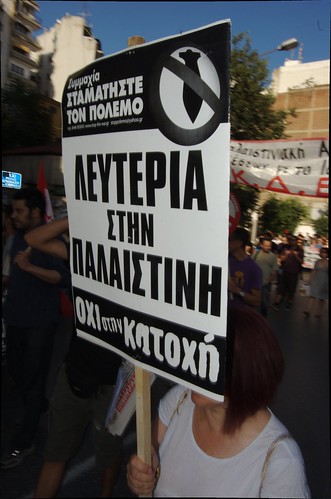
As I write this another ship, the MV Rachel Corrie carrying aid to Gaza is making its way towards Israeli waters in defiance of prime minister Benjamin Netanyahu who has vowed to stop the Irish vessel from making landfall.
Last night about 500 people took part in a march in the centre of Thessaloniki in support of the Palestinian people and the lifting of Israel's blockade of the Gaza Strip.


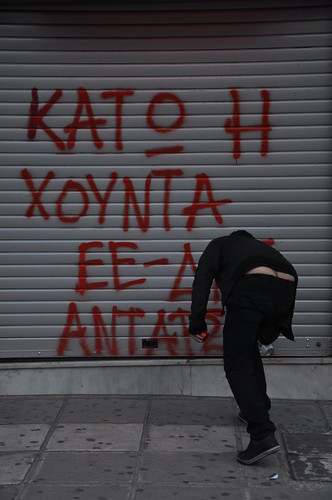
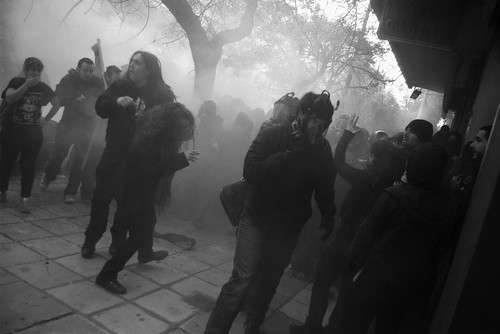
In Greece's second largest city, Thessaloniki about 1000 demonstrators marched through the street with some groups calling for the country's withdraw from the Eurozone. In tense scenes outside a government compound riot police used batons, tear gas and flash grenades to break up crowds who gathered to protests the attempted detention of two youth spraying graffiti on the walls of the building.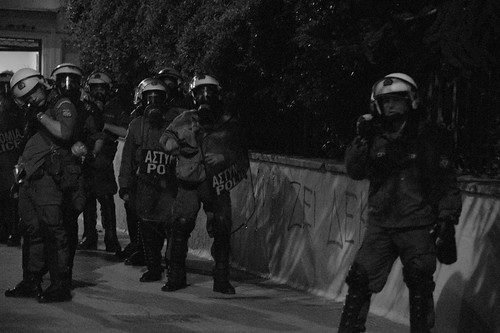
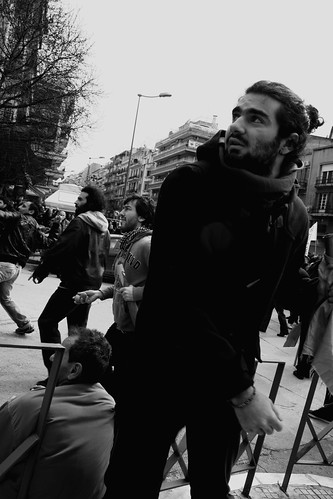
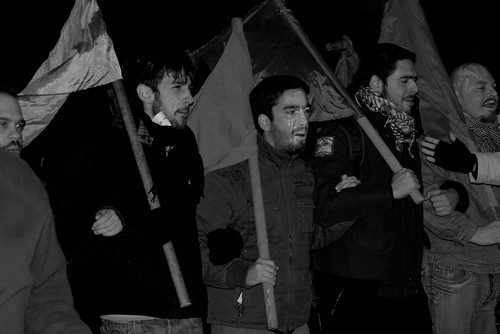
Taken during an anti-government protests tonight in Thessaloniki, Greece. 600-800 people marched to demonstrate against the imposition of austerity measures .
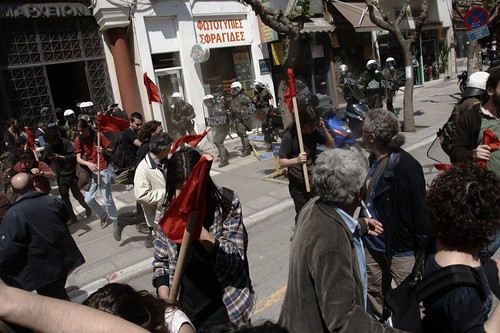
 us Square, near the police station then pop by and check it out. If you can't make it then follow their live stream broadcast here.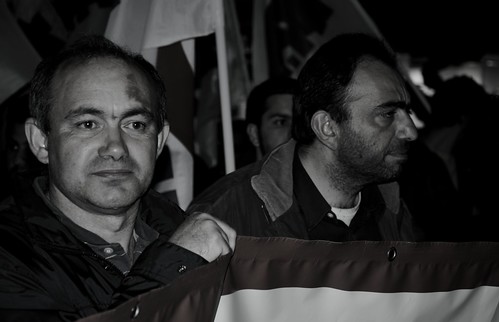
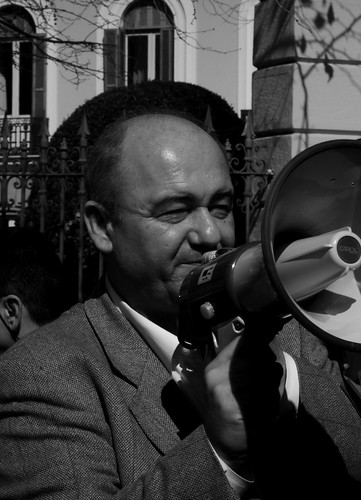
About 1000 members of the PAME trade union demonstrated in the northern port city of Thessaloniki, part of a nationwide wave of protests in Greece against the government's austerity measures.
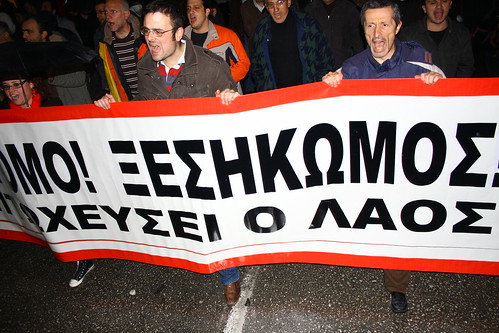
In what promises to be the opening shots in a war of attrition Greek public and private sector trade unions have taken to the streets in the country's major cities angry with the drastic cuts in pay announced by prime minister, Giorgos Papandreou yesterday. Thessaloniki, Greece 03/03/2010
The cuts in salaries combined with a rises in VAT of between 1 and 2% have angered many Greeks who believe the $420 billion debt has gone to line the pockets of the rich and that it is they who should shoulder the burden of reducing the deficit. Marching under the banner, “The plutocracy should pay” the communist controlled PAMe trade union confederation marched this today in Athens and Thessaloniki. Other actions also included an occupation of the economics ministry and the state run ET3 TV station.
On the internet Greek Twitter users could barely contain their outrage over the new economic measures which aim to fill government coffers and cut down on the bloated government budget. However there was anger over the fact that areas such as defence spending which soaks up 4.3% of GNP, a figure twice that of the UK was untouched wheras the education budget was cut by 600 million euros.
Tomorrow sees the first in a series of widespread strike actions across Greece which threaten to bring the country to a standstill.
Today the Greek prime minister Giorgos Papndreou announced a series of emergency measures aimed at raisng government revenues and cutting costs. These have included hikes in VAT across the board extra tax on petrol, alcohol and tobacco, cuts in civil servent's pay and a freeze on pension rises.
In his address to the Greek parliament Papandreou said that the country is "at war" and that these measures are necessary to avoid the country going bankrupt.
The reaction on the internet and on the street has ranged from desperation to outrage at the seeming injustice of members of the country's pampered political elite demanding sacrifices after making such a huge mess of running the country. On hearing the measures I found myself reminded of a quote from The Crow in which Eric Draven says to a drug lord,
According to Greek prime minister Giorgos Papandreou yesterday's decision by the country's European partners to bail out Athens was a “breath of life”. However, the decision by the EU to rescue their southern partner from the mercy of international finance markets may not be enough to put Greece back on a sound monetary footing.
For the past month the European Union has seen the integrity of the Euro threatened by the prospect of Greece defaulting on its massive $419 billion debt load. Whilst Germany has made it clear that Greece should put it's own house in order rather than let relay on its European partners the prospect of a domino effect involving Portugal, Spain and perhaps Italy has raised the prospect of a direct threat to the viability of the Euro itself.
However, even if Greece does manage to find the funding to service its debt in the immediate future the country faces the reality that any such bailout will come with strings attached and that in essence the country will have to cede control over its financial policies to Brussels.
Already the recently elected left wing PASOK government has announced increases in tax on petrol, alcohol and tobacco as well as saying that it will freeze public sector pay for two years. In addition sweeping changes in taxation, social security and public spending aresaid to be in the pipeline.
Doubts remain though over Athens ability to implement such radical changes given the massive public resentment they have created with the country's civil service trade unions. Already proposed changes to police and armed services pension contribution schemes have been postponed in the face of opposition.
Also the ability of Greece notoriously corrupt tax authorities to get tough on tax evasion has been questioned by Greeks long accustomed to such calls by political parties on both the left and right. As one Thessaloniki taxi driver drily put it, getting Greece out its present fix by raising taxes is like bailing out the Titanic with a sieve.
As well as strikes and public demonstrations there is also the fear that growing social unrest will spark off a repeat of the month long revolt which swept the country in December 2008 following the death of a teenager, allegedly shot by the police in central Athens. Although the violent street confrontations have died down the clashes have given rise to a resurgence in terrorist violence which has seen police stations machine gunned and almost daily firebomb attacks on banks and government targets.
Beyond the immediate problem of excessive public spending Greece faces enormous macro – economic challenges which have been growing since it joined the Euro-zone. By adopting the Euro the country has gained financial stability at the cost of raising prices and shrinking competitiveness in international markets.
With the old Drachma Greek products and services could exported at more competitive prices and the government could, if necessay devalue the currency so cutting prices in international markets. The rise in cost brought on by the Euro combined with cheap Chinese textiles an manufactured goods have decimated Greece's industrial base, especially in the north of the country where unemployment was rising steadily even before the present crisis. As with East Germany's adoption of the Deutschmark the use of the new currency has made Greek goods too expensive for their traditional markets.
In addition the country's endemic corruption has meant that many Greek companies have long relied on personal and political connections to win contracts with the state and so have had little incentive to increase productivity or lower costs. The result of decades of such crony capitalism is that such countries are ill – equipped to operate in international markets.
The existence of shadowy price cartels has also helped blunt Greek competitiveness as many parts of the economy and especially the retail sector is able to avoid damaging price wars and so has done little to improve service or reduce costs. The irony is, as the Greek media has been quick to point out that feta cheese is now cheaper in Berlin or Amsterdam than it is in Athens.
Although Greece's leader has pointed the finger of blame at the previous New Democracy government for hiding the scale of the country's financial woes the truth is that ex - PM Kostas Karamanlis was simply following the strategies inherited from the previous PASOK government's who systematically hid debts in order to meet the entrance requirements for the Euro-zone.
It should be noted that Papandreou held several high level posts in the PASOK government from 2000 – 2004 including responsibility for the 2004 Olympic Games which ended up costing 10 billion Euros, nearly three times that of the Sydney games in 2000.
The Greek parliament is still investigating charges that the German based Siemens corporation spent millions bribing Greek politicians in both major parties in order to win security contracts.
According to the leading Greek newspaper Kathimerini, the next 72 hours are going to prove crucial if the government is to convince European and International money markets that Greece can be trusted to implement its Stabilisation program and reduce its massive $400 billion debt load. Athens, Greece. 10/02/2010.
The program announced this week by recently elected socialist prime minister Giorgos Papandreou has angered civil service trade unions unhappy with goods in bonuses and the promise of a two year wage freeze. In response the civil service trade union confederation ADEDY called a series of stoppages and strikes for the next three days. The action has grounded all flights in and out of the country and severely disrupted train timetables.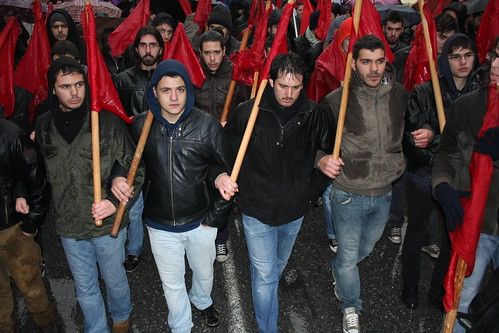
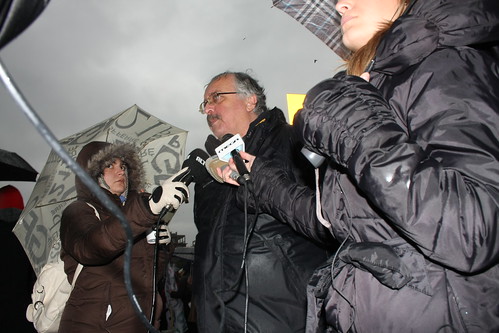
In addition trade unions and left wing political parties organised marches in Athens, Thessaloniki and over 60 other Greek towns. Braving torrential rains thousands took to the srtreets to protest the government's austerity measures.
Despite promising wage increases and a rise in unemployment benefits the left wing PASOK government is unlikely to concede to worker's demands as such a move would weaken attempts by Athens to secure a European backed bailout package. Despite initial talk of Greece putting its own economic house in order intense pressure by speculators has raised fears that if Greece defaults on its financial commitments failure would have a knock on effect on Portugal and Spain and so threaten the Euro itself.
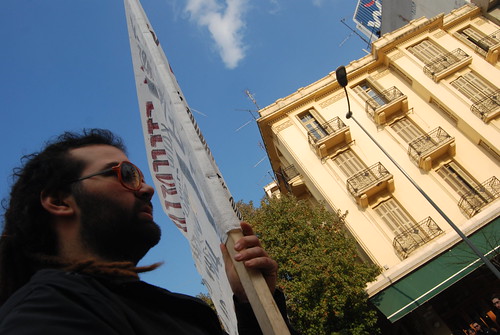
Today thousands of students and pupils marched in cities across Greece to mark the first anniversary of the killing of Alexandros Grigoropoulos which sparked off the worst civil unrest for a generation.
With the first anniversary of the killing of Alexandros Grigoropoulos by a police officer last year in Athens the scene looks set for a repeat of last year's violent protests which engulfed most of Greece.
In the run up to 6th December there have been a number of bombings and attacks on both the offices of the ruling PASOK party and and anti - authoritarian communes in Thessaloniki and Athens.
Nor do the police seems to have learnt the lessons of December 2008. Only last week a 35 year old Armenian woman was beaten in front of her two year old child by two plain clothes officers who accused her of insulting them. The fact that she was pushing a pram laden with shopping was not enough to deter them from handcuffing her, kicking her whilst she lay on the ground then taking her to a police station where she was held for six hours.



For more information (in Greek)
epibates-thess.blogspot.com