Showing posts with label european commission. Show all posts

Wednesday, December 15, 2010

Greece goes on strike

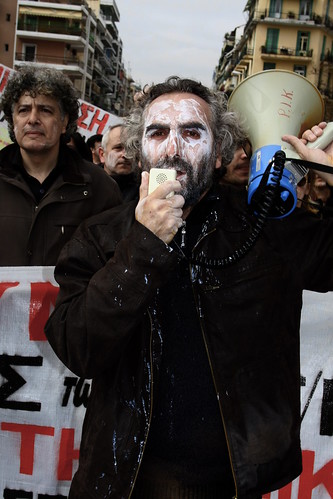
Teachers' union members on strike in Greece

Yesterday the Greek parliament wAS in the process of debating a raft of new labour laws that would radically change the pay and conditions of  most employees and is likely to trigger a fall in wages that will further depress living standards of most Greeks, perhaps pushing them back to levels not seen since the 80's. I do not know the outcome of the vote nor do I particularly care as the result is a forgone conclusion and in the final analysis the decision is not in the hands of elected officials in Athens but rather those of  technocrats in the IMF, European Commission and the European Central Bank. What the ruling PASOK government cares to call the outcome of the vote is merely window dressing and should not be confused with anything resembling democratic process.

However, away from the parliamentary puppet theatre the country today is set to come to a standstill as trade unions in the public and private sector have declared a general strike for today. Trains, buses, planes are  not running and much of Greece's infrastructure has shut down for the durqtion. Across the country people are gathering to take part in protest marches and demonstrations as I write this, angry and disappointed by their rulers.

I will be on the streets trying to take photographs and video of today's events and will be providing updates whenever I have internet access and time. To follow the events on Twitter use the #imfgr hastag. Most of it will be in Greek, of course but Google Translate does a good job of rendering Greek into English and other languages. Alternatively, you could use the following Greek words in your search engines and then translate.

ΑΠΕΡΓΙΑ (STRIKE)

ΕΛΛΑΔΑ (GREECE)

ΑΘΗΝΑ (ATHENS)

ΠΟΡΕΙΑ (MARCH)

Friday, August 20, 2010

The Memorandum of Economic and Financial Policies - Greece

"Dear Messrs. Juncker, Rehn and Trichet,

In the attached update to the Memorandum of Economic and Financial Policies (MEFP) and the Memorandum of Understanding on Specific Economic Policy Conditionality of 3 May 2010, we describe the progress and further policy steps towards meeting the objectives of the economic program that is being supported by financial assistance provided by the euro-area Member States in the context of the loan facility agreement.

The policies of the government of Greece remain fully oriented toward securing fiscal sustainability, safeguarding the stability of the financial system, and boosting potential growth and competitiveness.

We have made a vigorous start with our economic program. The fiscal program is progressing well, financial policies are being strengthened, and structural policies are ahead of schedule in key aspects:

The end-June quantitative performance criteria have all been met, led by a strong implementation of the fiscal program. Not unexpectedly, it has proven difficult to fully control expenditures at some entities, and in anticipation of such problems we significantly under-executed budget implementation at the state level, thereby ensuring that targets for the general government were met. Going forward, we are redoubling our efforts to strengthen controls at all levels of government and are determined to continue to over-perform at the state level until such controls become fully effective.

Reflecting the weaknesses in expenditure controls at some entities, the indicative target on the non-accrual of domestic arrears has not been observed as the monitoring system for general government commitments, accounts payable, and arrears is still being developed and implemented. We commit to bringing these arrears down to zero by year-end, so that only a normal level of accounts payable is carried over into 2011.

While the financial system continues to feel the effects of tight liquidity, sentiment indicators are gradually beginning to improve, and policy progress has been made by establishing the Financial Stability Fund to backstop any capital needs that banks might have in the future owing to an expected increase in impaired loans as the

The government has made significant progress in structural reforms with far-reaching pension and labor market reforms being approved ahead of schedule. Parliament has also already adopted important budgetary reform and reforms of local government. Other major reforms that are at an advanced stage aim at liberalizing the trucking industry and restructuring the railroad system, while reforms of the energy sector, protected professions, the licensing and business regulatory framework and preparations for implementation of the services directive are gaining momentum, as foreseen in our program.

On this basis and the completion of the prior action, we request the disbursement of the second instalment of financial assistance by the euro-area Member States in the amount of EUR 6 500 million, in line with the loan facility agreement.

We believe that the policies set forth in the 3 May 2010 Letter of Intent, MEFP and MoU, and the attached updates, are adequate to achieve the objectives under the program. We stand ready to take any corrective actions that may become appropriate for this purpose as circumstances change. We will consult with the European Commission and the ECB, as well as with the IMF, on the adoption of any such actions and in advance of revisions to the policies contained in this letter.

We are copying this letter to Mr. Strauss-Kahn, Managing Director of the IMF."


For the full text of the memorandum click here

Friday, August 06, 2010

The Greek economic crisis's 600lb gorilla in the room

I'm sure than you have that old medical joke, "the operation was a success but the the patient died" a thousand times but I can't help but recall it when I see on the state - run ET1 and NET news bulletins reports of how quietly optimistic the IMF/EU/ECB are about the progress Athens has been making in implementing the economic reforms needed before they approve the latest installment of the bailout package.


However, nowhere in the constant round of self - congratulation and back slapping are you going to hear anything about the issue that is most worrying to Greeks, namely unemployment. Currently, the official figure is 570,000 or 11.7% however, behind these numbers hide some truely horrifying facts. In some areas such as the Attiki region and Ionian islands the number of those looking for work has risen by up 50% in just one year. According to the latest OECD predictions unemployment is set to reach nearly 15% in 2014 whilst the Greek Trade Union Conference or GSEE (ΓΣΕΕ) is talking about a million jobless by next year out of a total labour force of 5 million.

Even this figure may be an underestimate since unemployment figures only include those signing on, which does not include many of those who have been unemployed more than one year who are considered to be "economically inactive" rather than unemployed or simply do not bother signing on as their benefits have run out. Nor are those working in the black economy (tourism and construction and even education are rife with employers who refuse to pay contributions) without national insurance who cannot claim unemployment benefit.


No provision has been made by the government for the tremendous social disruption likely to be caused by having one in five or even one in four of the work force unemployed, a number which is going to be higher if you happen to be a woman, disabled, under 25 or over 50. No mention was made of unemployment in the joint European Commission, European Central Bank and IMF upbeat press announcement concerning Greece's latest installment of the bailout package.

It's hard to consider any economic plan which produces joblessness on a scale not seen since the Great Depression as a success, yet that is exactly what the Greek government representatives and their supporters in much of the media are trying to do. There seems little awareness of the degree of social dislocation unemployment of such a scale is bound to produce. instead we are feed a steady diet of statistics and projections which are based on economic modela which do not take into account the conditions on the ground nor the fact that many official economic indicators are little more than educated guesses, the product of a state apparatus that does not even know how many people it employs.

On the other hand whilst hundreds of thousands of pensioners face cuts in their incomes to get permssion to borrow 9 billion euros the Greek government has found 25 billion to give to banks in order to improve their credit worthiness, which in addition to the 26 billion given in 2008 amounts to 15% of GDP or nearly four times the amount Greece spends on education per annum


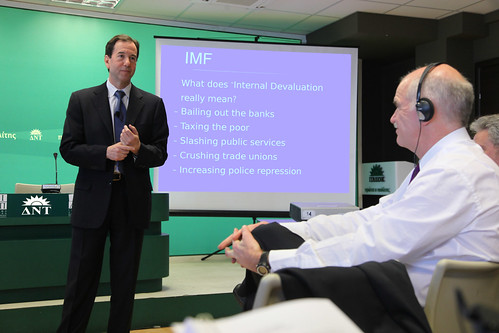
NB the picture is NOT real but a piece of photoshopped fun. Just a reminder for those who had their sense of humour removed instead of tonsils when young.