Sunday, July 27, 2014

What if other nations acted in the same manner as Israel in Gaza?

One of the central themes of Israel's defence of its intervention in Gaza is that if other countries, especially those in Europe or North America, were in its position then, they too would be forced to take similar measures to ensure their security.

Let's take their argument and test its logic. Imagine that during The Troubles the UK government had responded to the the bombing campaign carried out by the Provisional IRA in both Northern Ireland and the British mainland in a manner akin to than being employed by the Israeli Defense Force now in Gaza. (See full size image here).
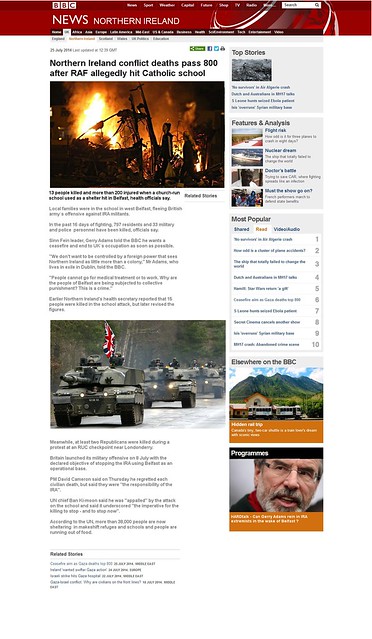
What if other nations acted in the same manner as Israel in Gaza?

Just to remember that the often brutal conflict in Northern Ireland cost the lives of 3,530 and left more than 47,500 injured in a campaign that lasted from the late 60's to the Clinton brokered Good Friday peace deal in 1998. The current death toll for The Gaza Strip is 1032 dead after just 19 days of IDF operations.

Monday, July 21, 2014

Killing Kids Is Not Cool - Israel invades Gaza

In Kosovo again


I spent part of last week in Pristina, Kosovo. Despite the fact that the country was involved in a brutal war in  the late 90's the capital shows little evidence of the fighting, and instead is now a bustling, friendly Balkan city.


Saturday, July 05, 2014

The Girl In The Yellow Dress

On the war path, protesters against plans to privatise historical market place - Thessaloniki, Greece


The authorities in Thessaloniki want to sell off the historical Modiano market place in the heart of the city.

Greek high school students protest changes in the exam system


Already the changes have resulted in a six-fold increase in those failing certain lessons in northern Greece. As with so many educational systems, the Greek one is used as a political football as new ministers introduce their latest pet projects, often ignoring the disastrous effects of constant change on those trying to complete their studies.


Monday, June 23, 2014

Hearts of Darkness - Thessaloniki's Gay Pride Parade stirs angry response from Church.


 On Friday those opposed to the Thessaloniki Gay Pride Parade gathered in the shadow of the city's Saint Demetrios cathedral to hear speeches by priests and lay people who seem to believe that the parade is part of a wider plot to destroy not just the moral fibre of the nation but also Greece itself. But this is not hate speech, every single participant went to great lengths to say that they did not hate gay people, then went onto equally great lengths to accuse them of being degenerate perverts who were waiting to molest children and destroy everything clean and decent. (Greek speakers can see a video here for a taste of their bigotry).

 Where to begin? One earnest young man blamed Elvis for the rot, or rather the TV stations that broadcast him below the waist in the 1950's For the monk(?) who was the headline speaker, the promotion of LGBT rights was just another example of those who wish to impose a New World Order by smashing the moral foundations of nation states. Of course, the plot, according to the monk didn't stop there (it rarely does when it comes to conspiracy loons) as he listed the other elements of the diabolical plan which included, TV, Conchita, black magic,the Dutch, Jews,fanatical Muslims, ex-PM Giorgos Papandreou, George Soros and immigrants.


 The speech liberally touched many of the Greek far right's favourite topics such as Kosovo, Ukraine, Kissinger, Germany, the Pope and the ever present threat by One Worlders. All of which would not have been out of place in a Golden Dawn rally, indeed, I'm sure that a fair few of those present in the audience has cast their votes for them. For the attendees the world is a dark, sin ridden place in which Satan and the White House/Vatican/EU and UN work day and night to undermine the Church and the Righteous, using issues such as gay rights as their stalking horse.


 It was a vile example of hate speech made all the more extreme by the fact that that the third Gay Pride in Thessaloniki was just a warm, loving affair with a beautiful atmosphere that was a credit to the the city. As the party wound its way through the centre the thousands taking party brought a feeling of hope and optimism sorely missing from the town which has been struggling to survive being in the eye of a six year economic storm. Instead of the stony faced zealots who attended Friday's anti-rally, three - four thousand revellers turned the city streets in to travelling carnival, dancing, singing and helping us forget our woes, if just for one evening.

Rain, rain go away!

Summer storm

This year's June has been full of storms and rain, which is very unusual.

Thursday, May 29, 2014

Greek 2014 election results - a post mortem


First of all, let's get the apologies out of the way. In the run up to the Greek EU and local elections I predicted that the results might bring about major changes in the Greek political scene, even perhaps national elections. Nothing of the sort happened, the coalition remains in power as do the leaders of both New Democracy and PASOK. So how did I get it so wrong?

I had assumed that the weakest link in this particular chain would be the PASOK vote and that a dire poll result for them would signal the end of deputy PM and party leader Evangelos Venizelos. Venizelos, himself had publicly announced in the weeks leading up to the elections that anything less than a 10% share of the vote for his party would destabilise the coalition, hinting that the party might withdraw form power. The fact that PASOK hasn't polled as high as 10% for years seemed to reinforce the impression that changes were on their way.

Throughout the months prior to last Sunday's vote Greek opinion polls consistently underestimated the PASOK vote, most putting it between 5-7% (they received 8% in the EU vote) and since pollsters have historically always been more lenient towards parties in power I, and many others assumed that the final tally could even be lower. It was a sentiment further strengthened by PASOK's dire showing in the first round of the Athens and Thessaloniki municipal and city elections.

Also the fact that PASOK made almost no effort to advertise or campaign during the elections and even went as far as changing their name to Olive Tree (Elia) just added to the impression of a political organisation on the verge of collapse. Unlike 2009, there were none of the mass public rallies that used to, until recently, be the hallmark of Greek campaigning.

With New Democracy the issue was never one of collapse but rather how wide the gap would be between them and SYRIZA, by May even the most pro-govt pollsters could no longer hide the fact SYRIZA was pulling ahead, the question was by how much. Poll figures which were notoriously inaccurate  in 2012 had to be taken with a pinch of salt. The dream result for SYRIZA would have been one in which their share equalled or exceeded the combined vote of the coalition parties. Then, opposition leader Alexis Tsipras could claim that the government no longer had a popular mandate and therefore demand national elections. In the end neither happened.


New democracy lost by less than 4% and so prime minister Antonis Samaras could sell the defeat as the inevitable price of imposing difficult, but necessary reforms mid-term. Venizelos could argue that the results showed that the fall in popularity PASOK has suffered since the start of the crisis has been halted, and even reversed. In both cases the party base could be mollified with the idea that while not great the outcome could have been far worse.

So business as usual? No, I said that these elections marked the end of an era and that still remains true as the political landscape today is radically different form the one in place during the last European parliamentary elections in 2009. Then both PASOK and New Democracy were unassailable electorally, able to attract tens of thousands to their public rallies. Giorgos Papandreou and then prime minister Kostas Karamanlis could speak in public and mingle with party supporters would give them the kind of reception usually reserved for teen idols such as Justin Bieber. Between them the two parties garnered 70% of the vote and sent 16 out Greece's 22 MEPs to Strasburg. In 2014 most public rallies were marked by small turnouts and extremely tight security measures, the coalition's share of the vote had dropped to 31% and just 8 MEPs.

PASOK has lost much of its clout in the cities, where previously it had been entrenched, replaced by SYRIZA mayors and councilors. On the other hand the Golden Dawn vote  remained high and has weakened New Democracy, despite almost entirely negative press and a legal crackdown on its leadership. Even with no positive TV exposure, the antipathy many conservative voters feel towards the present government outweighed misgivings over Golden Dawn's true identity. Nor was this move right limited to those neighbourhoods hit hardest by job cuts, even in the upscale central district of Kolonaki, Athens, home to many foreign embassies Golden Dawn polled 13.7%.

With popular support at an all time low and a yet more austerity measures set to be imposed the Greek government's slim majority is coming under ever greater pressure, especially as despite all claims to the contrary the real economy is not improving, unemployment refuses to drop from record highs , trade deficit is climbing and the debt continues to balloon in size. While the national leadership may be congratulating themselves on retaining power, the wild last-minute assurances of vast numbers of new jobs and more foreign investments will come to haunt them in future clashes with the opposition who will seize upon such broken promises that the current political elite cannot be trusted.

Nor can such anger be put down as simply a local protest, the elections results across the EU have shown that problems austerity is creating has created a groundswell of resentment against not only national elites but also those operating in Brussels.


Monday, May 19, 2014

Greek Elections: Round One


With the first round of Greece's city and municipal elections over the government coalition parties and the opposition have being trying to persuade the public that they were the winners in yesterday's vote. However, unlike parliamentary or EU elections the conclusions that can be drawn are not so clear cut for a number of reasons.

First and foremost, local election results in Greece, as in the rest of the world are just as likely to be influenced by local issues such as rubbish collection, state of the roads etc. as they are by the party affiliations of the candidate. This mean clear comparisons between these results and national ones cannot be made so easily, for example in Greece's two largest cities, Athens and Thessaloniki independent candidates came first, but in Crete PASOK retained its lead in the municipal elections and conservatives aligned with New Democracy did very well in Macedonia.

Also the fact that many candidates stood as independents or as members of parties that have no clear affiliation with the national ones also makes more general conclusions difficult to make. While in the big urban areas the candidates favoured by the parties are easy to pick out, in other regions the connection, if any between local political groups and candidates and the national parties is less clear to many voters.

Finally, only one fifth of the contested positions have been decided, the rest will have to wait for the second round next Sunday.

The Guardian talked about an anti-austerity backlash and In Athens and Thessaloniki mayoral elections the candidates supported by New Democracy and PASOK fared badly, though how much of that was due to anti-government sentiment and how much was due to less than stellar contenders is hard to say.

However, all these caveats aside a picture does seem to be emerging that confirms recent opinion polls that SYRIZA is gaining strength and that candidates identified with parties that make up the coalition government. are losing support. The fact that the party has made gains in the urban areas is more proof that its is no longer just a raggedy band of protesters and stands poised to replace PASOK as the main opposition party on a permanent basis. Once PASOK loses its stronghold in local government then its ability to keep intact a party machine that depends more on patron client relations than it does on ideology is severely compromised.

New Democracy's position also seems to be under threat, not only from SYRIZA on the Left but Golden Dawn on the right. Despite the fact that much of leadership is behind bars facing criminal investigation, the neo -Nazi party's level of support was back to 2012 levels. Even in chic upmarket neighbourhoods such as Kolonaki in central Athens, they won 13.7% of the vote, in other poorer districts it topped 20%.

The prime minister's campaign strategy of pulling to the Right and co-opting the rhetoric and policies of Golden Dawn seems not to be paying off. Nor has the anti-Golden Dawn media coverage in the pro-government press seemed to have driven away voters.

The May 25th EU parliamentary vote will give a clearer picture of where Greece's parties stand in the eyes of the electorate when the contenders will be standing on party tickets for the 22 MEP seats. In 2009 PASOK and New Democracy won 15 of those, but this time around they'll be lucky to get half that number and there is a good chance that PASOK will get just one seat.

Already SYRIZA is promoting the idea that the EU vote is a referendum on austerity itself and that a poor showing by the government will mark the end of its popular mandate and so be the reason to hold new national parliamentary elections. On the other hand both prime minister Antonis Samaras and deputy prime minister, Evangelos Venizelos are calling upon supporters to vote for the coalition in the name of stability and so as to save a fledgling economic recovery.

My prediction for next week's EU vote is;

1 SYRIZA 20-25%
2 New Democracy 18-23%
3 Golden Dawn 8-10%
4 Potami (River)  6-8%
5 KKE (Greek Communist Party) 4-5% and Olive Tree (PASOK) 4-6%

Friday, May 16, 2014

Greek PM's stealth election campaign comes to town - Thessaloniki


With austerity polices entering their sixth year the difficulties facing Greece's coalition government partners trying to run an election campaign when money is short and their rising unpopularity makes public rallies next to impossible has grown exponentially. Last night's under the radar appearance by the prime minister, Antonis Samaras in the second largest city, Thessaloniki served to underline this. With little advance publicity, the New Democracy stealth election campaign came to town and in front of an audience of 1,200 party die hards Samaras set out one of his latest public appearance before polls open on Sunday.

How times have changed for a politician and a party that in the past could attract crowds numbering in the hundreds of thousands, especially here in a city of 1.2 million that has been, till recently considered one of its strongholds. Sad to see the leader of a nation of 11 million talk before an audience that is smaller than the number of people who follow me on Twitter. Of course, inside Pavilion 13 the thousand or so attendees were made to look much more impressive as wire-borne cameras waltzed above our heads, avoiding at all costs wide shots. Flags waved, the youth wing chanted out slogans in tempo to the whims of their political handlers and the crowd dutifully clapped when required.


Actually, I had no intention of attending the event which I assumed would be an invitation only affair in which the media (or, in my case, not-quite-media) would be kept at arms length. However, following the lead of some friends who were there legitimately, I managed to get myself past the metal detectors and security checks, which was lucky as I would have had a hard time explaining the gas mask in my bag. I'm guessing that telling the police my allergies were playing up would not have been terribly convincing.

However, once inside the venue I decided to exploit my good luck to get into the swing of things taking pictures of the local conservative nomenclature which has ruled Thessaloniki for generations, noting the preparations being made ahead of the main speech. If only New Democracy paid as much attention to economic policy as it did to the placement of flag waving party workers in the bleachers.

And the crowd went wild! The arrival of the prime minister produced a wave of hysteria as loyalists pushed forward to kiss the the hem of the party leader, imagine a Justin Bieber reunion concert 30 years from now and you'll get an idea of the composition and mood of the audience. Unlike PASOK whose party rallies could be mistaken for a pensioner outing, New Democracy does have supporters  below the age of forty, but how many of them are  there to show their support for a better, more market-orientated Greece and how many are New Democracy youth wing careerists with an eye on a place in the civil service is hard to tell.


Once on the podium Samaras immediately launched into attack mode, tearing apart Argentina's recent economic track record, which seems a trifle off topic till you remember that many in the opposition a few years ago used Argentina as an example of how Greece could uncouple itself from a larger currency (in Argentina's case the US dollar) and survive.

Then it was onto cruder attacks on the main opposition party SYRIZA, which included the claim that the party was "planning to flood Greece with illegal immigrants", take the country out of NATO and that they would destroy the economy if they ever got into power. This went down well with ultra - conservative audience who lapped it up with abandon, a reminder that Golden Dawn have no monopoly on prejudice or fear mongering.

Samaras is well aware that despite its hammering at the hands of the pro-government media after the murder of activist Paulos Fyssas Golden Dawn still poses a potent threat to New Democracy's share of the vote. Hence the claims that only New Democracy can stop the Reds stealing your homes and bank accounts, only a strong conservative government can prevent foreign hordes from crossing the borders and swamping the Fatherland.


For anyone familiar with Samaras's political past this comes as no surprise, for while he has remoulded himself as a free - market, neo-liberal conservative, scratch the surface and you can still the ultra-nationalist rabble rouser who made a name for himself in the 90's. In times of trouble and electoral doubt his first instinct is always to go further to the right and rely upon dog whistle issues such as immigration, Macedonia (FYROM) and fear of communism to whip up support from an ageing party base. The Iron Curtain may have fallen in 1989 but for New Democracy old school types this was just a respite from the ever present Red Menace.

Speech over, the prime minister surrounded by secret service agents slowly made his way through a throng of party loyalists stopping every metre or so to shake hands or exchange good wishes. In this tightly controlled bubble, surrounded by friendly faces and even friendlier media outlets,  it would be easy to imagine that the good old days for New Democracy are still here, but beyond Pavilion 13 and the security cordon manned by platoons of riot police Greece's second largest city seems to be indifferent to his charms.

Wednesday, May 14, 2014

Fear and Loathing on the Greek Campaign Trail


If you took away the cordon of riot police surrounding the building, you could be mistaken for thinking you'd stumbled upon the annual conference of South Jersey importer and exporter association sponsored by a fraternal organisation with its roots in Southern Italy. Made men with large cigars and even larger bellies flowed out of the hall and in between them mingled guys who looked like they made their living doing door duty in third rate provincial "nightclubs. All wearing shades, all unshaven, all willing to take offence at anyone whose gaze lingered upon them any longer than was absolutely necessary.

The latest stop of the PASOK party's 2014 EU election campaign had rolled into town, not that anyone apart from the party nomenclature and a few dozen protesters had noticed. Instead of the mass public rallies that in the past attracted hundreds of thousands of the party faithful, Sunday's event was a part of the new trend towards stealth electioneering, attended by a few hundred local functionaries behind closed doors and lines of riot police.

This is in sharp contrast to the campaigns I witnessed in the late 80's and 90's in which leaders of both the socialist PASOK and the conservative New Democracy parties could count on huge turnouts that would flood the centre of Greece's cities, literally a sea of people as the Greek saying goes. People were gripped by an almost religious fervour and you would have thought rock stars had come to town rather than elderly politicians. However those days have gone and in all likelihood will never return, the victim of changing times and most lately, the six year long economic crisis which is proving as severe as that suffered by the US in the Great Depression. 


The ongoing commitment of successive governments to spending cuts, public sector job losses and tax hikes have all but destroyed PASOK and severely wounded its traditional rival, New Democracy. (PASOK, which is now calling itself Olive Tree is now polling between 10 - 15% of its 2009 strength and new Democracy share of the vote has been cut by half). The leaders of both coalition parties dare not risk public appearances unless they are held incognito or under the tightest security, outdoor events having been replaced with tightly choreographed televised shows as is the case with prime minister Antonis Samaras's rare public outings.

The latest revelations in the Financial Times about how EU leaders egged on the then finance minister (and PASOK leadership rival) Evangelos Venizelos to depose Greece's prime minister, Giorgos Papandreou in 2011 after he proposed a referendum on the terms of the bailout deal has just added to public mistrust of the country's political leadership, widely perceived to be more interested in preserving their own hold on power than defending national interests.

Such a feeling is likely to drain still further support for both government parties and make the chances of the coalition staying intact still less likely. With goes the two party system which has dominated Greek politics since the 1980's and a network of corruption, pork barrel politics and crony capitalism which led the country into its present dire state.