At least till recently Greek election campaigns have been vibrant. rambunctious affairs, marked by mass public rallies, a barrage of ads on TV and the kind of political theatre long since extinguished in Northern Europe. Yet this year shows that whilst Greece may be steeped in tradition, it has also a long history of radical change and re-adjustment, a legacy of its traumatic modern history which has seen the small Balkan nation undergo invasion, civil war, famine and spectacular economic growth and decline.
In contrast to
2009's hard fought EU election campaign, the current run up to the dual local and EU parliamentary votes on 18th and 25th May have been so low key as to be practically invisible. Gone are the constant TV ads and posters on every major thoroughfare. gone are the
large scale public rallies that used to be the trade mark of both New Democracy and PASOK parties.
So why the reticence on the part of a political caste whose one guiding principle is to stay both in power and the public eye? Partly, it is financial,
New Democracy and PASOK are bankrupt in all but name, owing between them 250 millions euros to the banks and as their State funding is linked to electoral prowess their steep decline in support means they have little chance of returning to solvency.
State allocation for campaign spending (of which PASOK and New Democracy got the lion's share) which reached 65 million Euros in 2010 has now been reduced to 7 million and with so little cash the lavish outlays that allowed Greece's two largest parties to outspend on a massive scale their political rivals has disappeared.
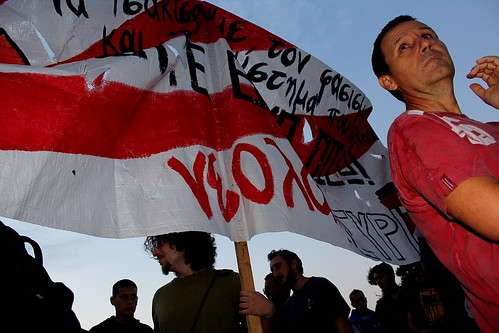
Partly, the anemic campaign is for reasons of self - defence. Ruling politicians are so detested by many of their voters that any kind of large public gathering is next to impossible unless the image politicians want to project is one of anger and discontent. Brave is the government minister who'd appear in public unless in front of a crowd of heavily vetted party loyalists. Whilst opposition parties such as SYRIZA and KKE (Greek Communist Party) will be holding outdoor rallies neither the prime minister nor deputy PM dare risk such a move, fearful that they'd be faced with a sea of hostile faces live on TV.
Case in point has been the election campaign of PASOK leader and deputy prime minister, Evangelos Venizelos. Appearances so far have so been held behind closed doors in meetings held for hard core party cadres rather than rank and file supporters.
In each case demonstrations by sacked public sector employees and other disgruntled groups means that such events are marked by high levels of security, further heightening the image of a political elite cut off from the rest of the nation.
For the prime minister's New Democracy's conservative party the picture, whilst not pretty, is nowhere near as dire as that of PASOK bu
t they too are saddled with massive debt load which has severely curtailed their spending. Though much of the mainstream media continues to support them, a serious decline in TV ratings for the most partisan pro-austerity channels and
the collapse in newspaper readership has lessened their ability to set the political agenda.
While the polls show wildly divergent predictions for the results, two things can be widely agreed upon; firstly, that even the support of the country's oligarchs may not be enough to avert
SYRIZA becoming the largest party in EU elections (local election results are less easy to use as an indicator for national party support as candidates are forbidden by the constitution to run under national party tickets,). And secondly PASOK will be wiped out, lucky if it elects even one euro MP. A long, inglorious fall from the time it dominated post Junta politics in the 1980's and 90's.
If the results prove particularly disappointing for government coalition partners then there is most likely to be quick and fundamental changes in the party leaderships as different groups vie for power and seek to avoid loss in support.
Venizelos has already warned that anything less than 10% share of the vote for PASOK Now renamed Olive Tree) will threaten government stability. A strange statement given that the party has not polled as high as 10 percent in years. Nearly all polls show that likely their share will be
be between 3 and 7 percent and that even their recent name change will do little to avert the inevitable
The prime minister is faced with a similar dilemma as a severe defeat at the polls will weaken his position and give ammunition to internal opponents already unhappy with his promotion of far right elements to top party and government posts. Many are suspicious that
once again Samaras will lead New Democracy to electoral defeat as he did in the mid 90's when he left the party to set up Political Spring, an act many Karamanlis loyalists still see as an act of betrayal.
The fact that the
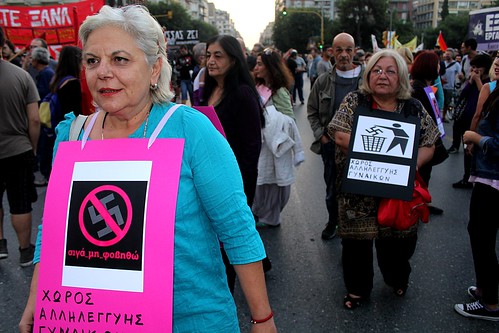
Greek supreme court has ruled that Golden Dawn can run for elections despite the fact that many of its MPs are facing criminal charges. Must give New Democracy even more reason to fear defeat as both parties have been actively cultivating far right polices in the hope of winning ultra-conservative voters. Problem is that unlike Golden Dawn, the prime minister's long series of u-turns and policy flip flops have disillusioned many on the Right.
Golden Dawn may have been vilified by both local and foreign press for its racist activities, but there are still many Greeks
who will use the party as a vehicle for their anger at the existing political set-up, which is widely perceived as both corrupt and out of touch. Even the media campaign that followed the f
atal stabbing of activist rapper Pavloss Fyssas by Golden Dawn members has ended up backfiring as the pro-government stations fall victim to their desire to please political goals of their owners at the expense of credibility.
The arrival of the
Potami - River party formed by former journalist Stavros Theodorakis promises to make firm predictions over the exact result even more difficult. Theodorakis recently set up the party as non-political alternative to the traditional ones of Left and Right.
Initially polls showed support as high as 15% but since then these numbers have dropped significantly especially as questions of how the party has been financed remain unclear and the fact that he was till
recently a senior reporter in the pro-government MEGA channel.
However, whatever happens the political landscape forged in the aftermath of the
Regime of the Colonels in the 70's is now almost at an end; PASOK, the child of left wing firebrand Andreas Papandreou is all but spent as a major political force, a victim of its adherence to hated austerity policies.
Their eternal rival, New Democracy, also created in the ashes of the Junta is riddled with dissent and after six years of grinding economic decline caused by austerity. Even among the party's core demographics the cuts in pensions, endless list of taxes on property and spending cuts have taken their toll with
levels of support now at less than half those of pre-crisis elections.
Finally, next Sunday's vote also marks the death knell for
the family dynasties that dominated so much of public life in modern Greece, the latest generation of Karamanlises Mitsotakises and Papandreous both took the reins of power riding to victory on name recognition and achievements of their father's and grandfathers, only to be found wanting as the crisis upturned so many of Greece's political shibboleths.
Konstantinos Karamanlis (nephew of New Democracy founder Kostas Mitsotakis and nephew of previous prime minister Konstantinos Karamanlis) won two terms in office but l
eft behind a heavily indebted economy and a party image battered by string of corruption and influence peddling scandals.
Similarly, Giorgos Papandreou's (son and grandson of previous Greek prime ministers) time at the helm was no less disastrous than his equally privileged predecessor, faced with an unprecedented economic downturn his vacillation turned a major setback into a full-blown meltdown, eventually leading to him
being deposed in a "palace" coup by Evangelos Venizelos
when Papandreou threatened the EU and IMF with a referendum over austerity.
Though neither will be missed by most voters, like so many failed leaders of the past they hang on like Banquo's ghost ever ready for a call from the Greece's voters to come back and save the nation. It's a call they are unlikely to receive.




.jpg)


The news, which was quickly labelled political blackmail by his political opponents sent the cost of Greek government borrowing on the world's financial markets through the roof with CDS's topping 900 points. A reaction that reinforced Papandreou's claim that if voters did not support PASOK candidates the alternative would be financial disaster and political chaos.
Whether the high stakes bluff really prevented an all out electoral rout for PASOK is debatable with polls showing that 2/3 of Greeks rejecting the PM's dilemma. However, the use of such dramatic tactics so early on in the current administration's term is indicative of the massive drop in support for the government and growing dissatifaction with the austerity measures which have hit middle and working classes especially hard. Evidence of the effects of the economic crisis can be seen everywhere from a thousands of closed businesses to the growing number of homeless begging in the streets.
Many families are struggling even to pay utility bills as witnessed by recent statistics published in the Greek press which show that 1 in 4 electricity bills have gone unpaid. In addition the country's largest telecom provider OTE reported that half a million bills are overdue.
The announcement of yesterday's results was greeted by all parties as a victory with Giorgos Papandreou announcing that it showed that the country was behind his government's attempts to save Greece from bankruptcy and so ruling out new elections. Antonis Samaras, the leader of the largest opposition party New Democracy hailed the vote as an endorsement of his party's anti – Memorandum stance. Aleka Papariga, leader of the Greek Communist Party noted that her party was the only won to increase its share of the vote .
Although the Left benefitted somewhat from the anti – PASOK protest vote it failed to make enough headway to upset the political status quo, similarly, the far Right LAOS party who at one point seemed poised to supplant the more mainstream New Democracy in opposition paid the price for its support of the government's measures.
However, the fact that so many Greeks choose not to vote has worried many political commentators. That voter turn out was at a historical low reflected the disgust and antipathy many feels for the political choices on offer. Amongst ordinary people there is a growing sense of dissafection with the two major political parties and families who have dominated Greek politics since the restoration of democracy in 1974.
In the capital, Athens turn out was especially low with nearly 60% choosing not to vote, a figure that is nearer 70% if spoilt and unmarked ballots are included. After a succession of governments on the right and the left promising and failing to reform Greece's underperforming state, fight corruption and bring development only party die hards remain convinced that those in power can bring about the much needed changes required if the country is to survive in 21st century.
Feeling betrayed and angry with the “politics as usual” attaitude of the larger parties some voters, especially in Athens have turned to more extreme alternatives. The neo – nazi Golden dawn party received over 5% of the vote in the capital as a whole though in some districts the figure was over 20% guaranteeing them a seat on the Athens municipal council