Showing posts with label austerity. Show all posts

Thursday, July 02, 2015

But Yes or No to what? Greece decides on Sunday.

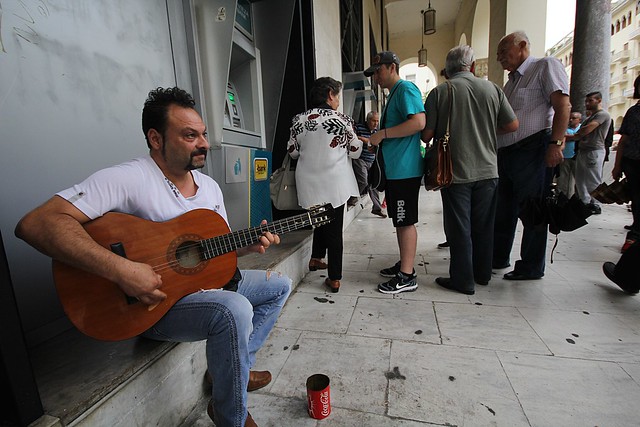
Greeks lining up at ATM - Thessaloniki

On Sundays Greeks go to the polls to vote. They will be asked to vote Yes or No. But Yes or No to what? The question seems to produce an endless array of answers, which have left Greeks arguing passionately for the past week, both on social media and in real life.For the economically minded supporters of the Yes side, it is a vote to stay in the Eurozone, to retain a stable currency and avoid the risks of introducing a new, untried currency which may or may not be worthless. It's a Yes to open banks, pensions being paid on time and a step away from the financial abyss. For conservatives it's a Yes to membership of the European Union and a step away from what they see as rabid, socialist madness.

In the No camp, a No is a refusal to accept an creditor imposed austerity plan which has crushed the Greek economy and even on its own terms is a failure. For the more nationalistically minded its is a vote for independence, a chance to show foreigners that Greeks will not and cannot take any more crap from either Washington, Brussels or Berlin.

In the maelstrom of debate, the usual lines that divide the Greek Left and Right have been blurred, muddled and sometimes utterly forgotten. Nor, as it is sometimes portrayed as a fight between haves and have nots. Whilst those in the Yes camp are amply represented in the country's oligarch controlled media, the poll number are not restricted to just those who've weathered six years of austerity with their wealth intact. Pensioners fearful of their future, owners of businesses both large and small as well as those fearful of the consequences of a Grexit have swelled the Yes vote.

On the other hand the No vote included those with little to lose from maintaining the status quo, such as the unemployed and young voters who see that more of the same in a nation with record high unemployment is not an option. Also there are those who  are sick of Greece's continual humiliation at the hands of the EU, ECB and IMF and wish to show these institutions that enough is enough, no matter what the cost. The fact that political Ancien Regime, discredited by corruption and ineptitude has thrown its weight behind the Yes vote is just further proof that a No vote is justified.

What will happen on Sunday, I do not know. If you'd asked me a week ago I would have said that the Yes vote will win comfortably, but given the fact that EU leadership smugly seems to betting on this combined with a week long fear campaign on TV makes me think that perhaps that things will turn out differently. The same political forces that tried so hard to crush Syriza in the January elections are once again openly playing their hand, and there's a chance they'll fail now as they failed then.

Once again the crude political intervention of the ECB which stopped lending to Greek banks via ELA so starving them of liquidity along with the arrogance of various German politicians simply fuel the No vote  just as the intervention of English politicians in the Scottish independence referendum aided the rise of the Scottish Nationalist Party.

Whilst people are angry they cannot take out money from their saving accounts and fearful for their future, there is a growing sense that they will not bow down and take anymore. Whether their vote is based on carefully calibrated deliberation or knee jerk nationalism, the result will be the same in the polling booths on Sunday.


Sunday, February 01, 2015

2015 - The Year We Fight Back


We're barely into February and already Syriza, a  radical left government has been elected in Greece in the face of fierce media resistance, their victory challenging the prevailing pro-austerity narrative that has wrought such destruction in southern Europe. Soon it seems the same feat is going to be repeated elsewhere as Podemos gains popularity and takes on Spain's corrupt political elite.

Orwellian economics - The insane dilemma at the heart of the Greek debate.


For those unfamiliar with Europe's unique take on macro-economic theory, here is a primer that attempts to explain Greek government's dilemma in dealing with its creditors; But let us put the problem in its context through the use of an extract from the end of George Orwell's 1984; O'Brien, Winston Smith's torturer and now mentor lectures him on the relationship between numbers and political reality;


“Do you remember,” he went on, “writing in your diary, ‘Freedom is the freedom to say that two plus two make four’?”

“Yes,” said Winston.

O’Brien held up his left hand, its back toward Winston, with the thumb hidden and the four fingers extended. “How many fingers am I holding up, Winston?”

“Four.”

“And if the Party says that it is not four but five—then how many?

“Four.”

The word ended in a gasp of pain. The needle of the dial had shot up to fifty-five. The sweat had sprung out an over Winston’s body. The air tore into his lungs and issued again in deep groans which even by clenching his teeth he could not stop. O’Brien watched him, the four fingers still extended. He drew back the lever. This time the pain was only slightly eased.

“How many fingers, Winston?”

“Four.”

The needle went up to sixty. “How many fingers, Winston?”...

“Five! Five! Fivel”

“No, Winston, that is no use. You are lying. You still think there are four. How many fingers, please?”

“Four! Five! Four! Anything you like. Only stop it, stop the pain!”

In essence these are the two choices that Greece's newly elected Syriza administration is being offered by the Troika (as it is known locally) made up of the European Union, European Central Bank and the International Monetary Fund.

Either Athens tells its creditors that with the current terms and conditions the debt load is unsustainable and that any chance of paying back in full the 317 billion euros borrowed since the first bailout deal in 2010 is, in practical terms, impossible. In which case Greeks face the possibility of being unable to access further credit and so goes bankrupt with who knows what consequences for the national economy.

Alternatively Syriza accepts the current status quo, caves into creditors demands knowing that the terms and conditions imposed are impossible to meet in the long term and in the meantime is forced to impose yet more crippling austerity measures which have gutted the economic base.

More and more serious analysts, economists and observers consider the nation's debt cannot ever be repaid yet the Troika and many of the top EU players continue to insist there can be no serious renegotiation of the debt and certainly no debt relief.  Thus Europe, like O'Brien in 1984 has created an insane dilemma in which the protagonist has not only to submit no matter what logic and common sense dictate but also truly believe that this madness trumps reality.

If Greek finance minister, Yanis Varoufaki fails to pull off a Kobayashi Maru style game changer and resets the parameters of the debate as now set down then whatever Syriza chooses, their fate will be the fate of Winston Smith in 1984 and the people of Greece, like Smith will be made to suffer for believing that financial reality is more important than ideology,

Let us leave Orwell with the last word(s).

“You are a slow learner, Winston,” said O’Brien gently.

“How can I help it?” he blubbered. “How can I help seeing what is in front of my eyes? Two and two are four.”

“Sometimes, Winston. Sometimes they are five. Sometimes they are three. Sometimes they are all of them at once. You must try harder. It is not easy to become sane.”


Monday, December 29, 2014

What If The World Ended And No One Noticed? The Greek Government Falls


The world ended today at 12.40 PM, at least that's what the Greek and much of the international media had led us to believe would happen if the parliament in Athens failed to elect a new president after its third and final attempt today.

I happened to be walking through the centre of Thessaloniki, Greece's second largest city when the news broke that  prime minister Antonis Samaras had failed to secure the 180 votes needed to avoid new round of national elections. Alas, no one had told the shoppers getting ready for New Year the terrible revelation that the entire Eurozone economy had fallen off the cliff. I didn't have the heart to break the news to people window shopping on the central Tsimiski boulevard.

For such an apocalyptic event you'd think there would be some reaction, some sign of hysterical disbelief, but nope, nothing, nada, tipota as they say in Greece. But the world only ended in that magic realm called the mainstream media, home to unicorns, endless talk of crisis and hyperbole, not in the really, real world of shoppers struggling against the unseasonable cold snap that has gripped the city recently.

Unlike the ladies and gentlemen of the press peddling the end of the world angle this news was just another scaremongering story to be shrugged off by a people who have been subjected to six years of such nonsense. There are only so many time you can see on the nightly news bulletins that the End Is Neigh before you switch off.

For the last few weeks the government choice of candidate for president has attracted the kind of attention usually lavished on US presidential races, the parliament in Athens was besieged by foreign reporters eager to get the latest news during the first rounds of the vote.This is strange for a number of reasons, not least being the fact that the Greek president plays the same kind of role in the country's political system that the White House cat has in Washington. Also the results of the first two rounds of voting were a foregone conclusion to everyone inside Greece and a source of high drama to those reporters who'd parachuted in to cover the story.

The inevitable defeat of Stavros Dimas, the coalition's choice in these votes produced endless speculation amongst many foreign correspondents seemingly unaware that the real drama would be today when parliament voted once more. But why let something as mundane as reality spoil a white hot story? Where's the fun in that?

For a post that has little but symbolic value, the choice of Greek president was something that EU leadership seemed to take very seriously, like guys debating BBQ techniques, everyone had an opinion and everyone knew that not electing a president would be a VERY, VERY BAD THING!

In the Greek press the pages of the national newspapers and the nightly news bulletins were full of the dire consequences of not electing a president. There would be bank runs warned the head of the Bank of Greece, the sacrifices of the Greek would be wasted said the prime minister, the vote would be a "credit event" said the coalition spokeswoman in a TV interview. Everyone agreed that not electing a president would be a VERY, VERY BAD THING!

Then to add even more drama, the second vote was accompanied by accusations that some were attempting to bribe MPs to switch sides and support the coalition candidate. Pavlos Haikalis, an Independent Greeks MP recorded what he claimed was one such attempt on video and gave it to the authorities who promptly dismissed the accusation. The government and their allies in the media also claimed that such accusations were part of a plot by the opposition and the SYRIZA party in particular to derail the vote by intimidating MPs who might have wanted to change their stance.

As if to hammer home just how important the vote was the Greek prime minister addressed the nation on Saturday in a televised interview carried out by members off the state run NERIT network. In what can only politely be called a "staged" event the two nervous journalists who looked as if they expected to be fired or executed at any moment tentatively asked a series of questions which the PM  answered with the aid of an autocue or say many commentators. With the kind of care you use when feeding your holidaying neighbour's pit bull they went through the motions of an interview, probably thankful they got through to the end of it still with all ten fingers attached.

No follow questions were permitted and not one of the many dubious claims made by Antonis Samaras during the 30 minute audience were challenged instead of a hard hitting journalistic challenge, the whole event seemed more like a monarch granting an audience to courtiers. Ιndeed outside dictatorships of the Central Asian republics and North Korean kind, it's rare to see such an easy ride given to any political leader.

Despite all this drama which included members of the neo-Nazi Golden Dawn party being bussed in from prison the vote turned out to be a lot less close than many (including myself) had predicted. The government failed to persuade any more MPs than the 168 that had supported them in the second round, falling far short of the 180 needed. Within less than two hours the date of national elections,   25th January was announced suggesting that the result came as no surprise to the political leadership.

Judging by the tactics, tone and rancour of this vote the national elections promise to be one of the dirtiest in living memory. With the radical left SYRIZA ahead in the polls and committed to challenging Greece's creditors the stakes couldn't be higher not just for a political establishment that has held sway since the 70's but also the country's shadowy, but ever present economic elite who have thrown their weight along with their media outlets behind the government.

The Guardian and SKY are already talking of crisis and economic turmoil, which is strange way to describe  a democratic vote in times of peace. But as happened in the 2012 elections showed there are many outside Greece eager to sway voters and make sure their opinions are heard.Once more a small economy on the edge of Europe is taking centre stage, once more punching far above its weight in the international scheme of things.

Tuesday, October 21, 2014

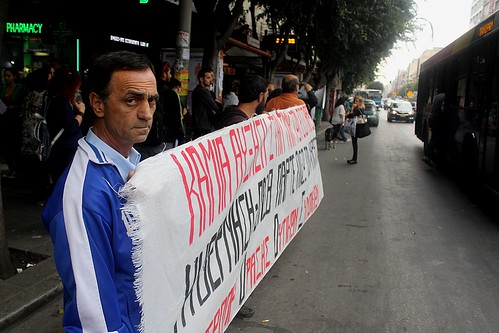
Greeks protest latest public transport price hike

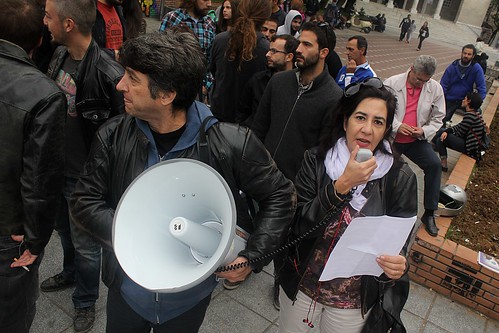
Greek protesters demonstrate against latest bus fare hike

Opposition parties and local activists protested the 25-33% increase in bus tickets in Greece's second largest city, Thessaloniki. Despite being one of the economically depressed regions in the entire EU, jobless Thessaloniki residents still have to pay full price for public transport.

Greek protesters demonstrate against latest bus fare hike

Greek protesters demonstrate against latest bus fare hike

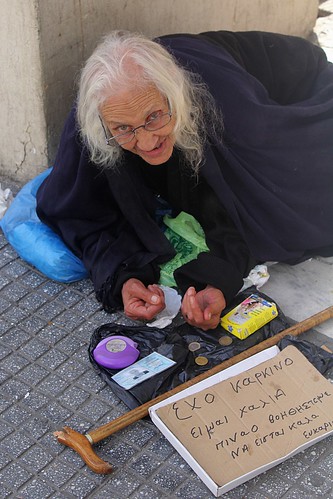
"I have cancer, I'm in terrible shape, please help" - Thessaloniki, Greece

"I have cancer, I'm in terrible shape, please help" - Thessaloniki, Greece

Thursday, May 29, 2014

Greek 2014 election results - a post mortem


First of all, let's get the apologies out of the way. In the run up to the Greek EU and local elections I predicted that the results might bring about major changes in the Greek political scene, even perhaps national elections. Nothing of the sort happened, the coalition remains in power as do the leaders of both New Democracy and PASOK. So how did I get it so wrong?

I had assumed that the weakest link in this particular chain would be the PASOK vote and that a dire poll result for them would signal the end of deputy PM and party leader Evangelos Venizelos. Venizelos, himself had publicly announced in the weeks leading up to the elections that anything less than a 10% share of the vote for his party would destabilise the coalition, hinting that the party might withdraw form power. The fact that PASOK hasn't polled as high as 10% for years seemed to reinforce the impression that changes were on their way.

Throughout the months prior to last Sunday's vote Greek opinion polls consistently underestimated the PASOK vote, most putting it between 5-7% (they received 8% in the EU vote) and since pollsters have historically always been more lenient towards parties in power I, and many others assumed that the final tally could even be lower. It was a sentiment further strengthened by PASOK's dire showing in the first round of the Athens and Thessaloniki municipal and city elections.

Also the fact that PASOK made almost no effort to advertise or campaign during the elections and even went as far as changing their name to Olive Tree (Elia) just added to the impression of a political organisation on the verge of collapse. Unlike 2009, there were none of the mass public rallies that used to, until recently, be the hallmark of Greek campaigning.

With New Democracy the issue was never one of collapse but rather how wide the gap would be between them and SYRIZA, by May even the most pro-govt pollsters could no longer hide the fact SYRIZA was pulling ahead, the question was by how much. Poll figures which were notoriously inaccurate  in 2012 had to be taken with a pinch of salt. The dream result for SYRIZA would have been one in which their share equalled or exceeded the combined vote of the coalition parties. Then, opposition leader Alexis Tsipras could claim that the government no longer had a popular mandate and therefore demand national elections. In the end neither happened.


New democracy lost by less than 4% and so prime minister Antonis Samaras could sell the defeat as the inevitable price of imposing difficult, but necessary reforms mid-term. Venizelos could argue that the results showed that the fall in popularity PASOK has suffered since the start of the crisis has been halted, and even reversed. In both cases the party base could be mollified with the idea that while not great the outcome could have been far worse.

So business as usual? No, I said that these elections marked the end of an era and that still remains true as the political landscape today is radically different form the one in place during the last European parliamentary elections in 2009. Then both PASOK and New Democracy were unassailable electorally, able to attract tens of thousands to their public rallies. Giorgos Papandreou and then prime minister Kostas Karamanlis could speak in public and mingle with party supporters would give them the kind of reception usually reserved for teen idols such as Justin Bieber. Between them the two parties garnered 70% of the vote and sent 16 out Greece's 22 MEPs to Strasburg. In 2014 most public rallies were marked by small turnouts and extremely tight security measures, the coalition's share of the vote had dropped to 31% and just 8 MEPs.

PASOK has lost much of its clout in the cities, where previously it had been entrenched, replaced by SYRIZA mayors and councilors. On the other hand the Golden Dawn vote  remained high and has weakened New Democracy, despite almost entirely negative press and a legal crackdown on its leadership. Even with no positive TV exposure, the antipathy many conservative voters feel towards the present government outweighed misgivings over Golden Dawn's true identity. Nor was this move right limited to those neighbourhoods hit hardest by job cuts, even in the upscale central district of Kolonaki, Athens, home to many foreign embassies Golden Dawn polled 13.7%.

With popular support at an all time low and a yet more austerity measures set to be imposed the Greek government's slim majority is coming under ever greater pressure, especially as despite all claims to the contrary the real economy is not improving, unemployment refuses to drop from record highs , trade deficit is climbing and the debt continues to balloon in size. While the national leadership may be congratulating themselves on retaining power, the wild last-minute assurances of vast numbers of new jobs and more foreign investments will come to haunt them in future clashes with the opposition who will seize upon such broken promises that the current political elite cannot be trusted.

Nor can such anger be put down as simply a local protest, the elections results across the EU have shown that problems austerity is creating has created a groundswell of resentment against not only national elites but also those operating in Brussels.


Monday, May 19, 2014

Greek Elections: Round One


With the first round of Greece's city and municipal elections over the government coalition parties and the opposition have being trying to persuade the public that they were the winners in yesterday's vote. However, unlike parliamentary or EU elections the conclusions that can be drawn are not so clear cut for a number of reasons.

First and foremost, local election results in Greece, as in the rest of the world are just as likely to be influenced by local issues such as rubbish collection, state of the roads etc. as they are by the party affiliations of the candidate. This mean clear comparisons between these results and national ones cannot be made so easily, for example in Greece's two largest cities, Athens and Thessaloniki independent candidates came first, but in Crete PASOK retained its lead in the municipal elections and conservatives aligned with New Democracy did very well in Macedonia.

Also the fact that many candidates stood as independents or as members of parties that have no clear affiliation with the national ones also makes more general conclusions difficult to make. While in the big urban areas the candidates favoured by the parties are easy to pick out, in other regions the connection, if any between local political groups and candidates and the national parties is less clear to many voters.

Finally, only one fifth of the contested positions have been decided, the rest will have to wait for the second round next Sunday.

The Guardian talked about an anti-austerity backlash and In Athens and Thessaloniki mayoral elections the candidates supported by New Democracy and PASOK fared badly, though how much of that was due to anti-government sentiment and how much was due to less than stellar contenders is hard to say.

However, all these caveats aside a picture does seem to be emerging that confirms recent opinion polls that SYRIZA is gaining strength and that candidates identified with parties that make up the coalition government. are losing support. The fact that the party has made gains in the urban areas is more proof that its is no longer just a raggedy band of protesters and stands poised to replace PASOK as the main opposition party on a permanent basis. Once PASOK loses its stronghold in local government then its ability to keep intact a party machine that depends more on patron client relations than it does on ideology is severely compromised.

New Democracy's position also seems to be under threat, not only from SYRIZA on the Left but Golden Dawn on the right. Despite the fact that much of leadership is behind bars facing criminal investigation, the neo -Nazi party's level of support was back to 2012 levels. Even in chic upmarket neighbourhoods such as Kolonaki in central Athens, they won 13.7% of the vote, in other poorer districts it topped 20%.

The prime minister's campaign strategy of pulling to the Right and co-opting the rhetoric and policies of Golden Dawn seems not to be paying off. Nor has the anti-Golden Dawn media coverage in the pro-government press seemed to have driven away voters.

The May 25th EU parliamentary vote will give a clearer picture of where Greece's parties stand in the eyes of the electorate when the contenders will be standing on party tickets for the 22 MEP seats. In 2009 PASOK and New Democracy won 15 of those, but this time around they'll be lucky to get half that number and there is a good chance that PASOK will get just one seat.

Already SYRIZA is promoting the idea that the EU vote is a referendum on austerity itself and that a poor showing by the government will mark the end of its popular mandate and so be the reason to hold new national parliamentary elections. On the other hand both prime minister Antonis Samaras and deputy prime minister, Evangelos Venizelos are calling upon supporters to vote for the coalition in the name of stability and so as to save a fledgling economic recovery.

My prediction for next week's EU vote is;

1 SYRIZA 20-25%
2 New Democracy 18-23%
3 Golden Dawn 8-10%
4 Potami (River)  6-8%
5 KKE (Greek Communist Party) 4-5% and Olive Tree (PASOK) 4-6%

Thursday, February 13, 2014

No More lies - Greece

With the crisis dragging on in Greece, voters are growing ever more angry at the lies and spin the government coalition parties employ to distract from their corruption, incompetence and lack of vision for the future.

In May the country will vote in both local authority and European parliamentary elections and if current opinion polls prove correct, then this mark that end of the monopoly on power the nominally socialist PASOK and far right New Democracy parties have held since the late 70's.

PASOK in particular, is likely to hardest hit with possibility that its share of the vote will be as low as 4%, a startling decline from the 44% it won in the 2009 general elections. New Democracy's base is also shrinking as people,sick of austerity and endless finance scandals turn their back on them, many changing allegiance to the neo-Nazi Golden Dawn party .

The position of the two main parties is not helped by the fact that between them they have 270 million euros in non-performing loans, which have been serviced since January 2013, making them technically bankrupt.

With the prime minister announcing new taxes on food, property and cigarettes, the chances that his New democracy party will fall from second place to third place behind SYRIZA and Golden Dawn should not be ruled out.

Whatever the final tally is poor results in May's elections will further increase pressure by party supporters and backbench MPs on PM Antonis Samaras and deputy PM Evangelos Venizelos to step down, so opening the way to more instability and the possibility of new national elections in the summer.