Showing posts sorted by date for query five things. Sort by relevance Show all posts

Sunday, July 19, 2015

The story so far - Feeding refugees in Thessaloniki, Greece

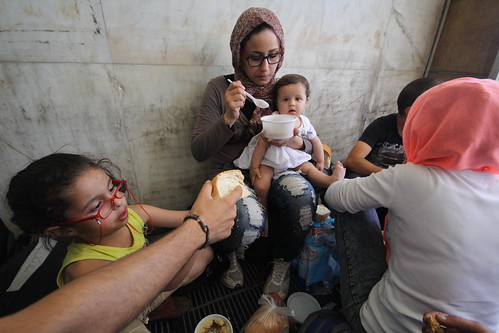
Syrian refugees stranded at Thessaloniki, northern Greece

Today, I'm taking a day off, this will the second day off I've had in the last five weeks. What was once a small, part-time effort to feed refugees here in Thessaloniki has mushroomed into a seven days a week effort (see our Facebook page) that hands out cooked meals and other much needed items to anywhere between 30 and 100 refugees a day passing through the city on their way north. Even now I'm amazed by how quickly and how successfully this has taken off.

Five weeks ago it became clear that the number of refugees in need of help was far beyond the means of me and my friends and so I sent out a call for help via Twitter. the idea was that like-minded people would get together and see if we could organise ourselves and expand the help we could provide. That has succeeded beyond my wildest dreams and instead of just a couple of people handing of cooked beans in a park I'm proud to be part of a group that is able to help and information to hundreds every week.

After the first meet up, a number of volunteers are came forwards and quickly we formed ourselves into a much more effective group. I'm not sure if it was luck or good timing but along with the first wave of people to join us were those who possessed an immense range of vital skills as well as a genuine appetite for hard work. Amir, has proven to be a huge asset as he himself is from Afghanistan and not only helps with translation and cultural advice, but also other insights into what it means to be a refugee. That combined with the fact that he is an able manager meant that he kept us going off the rails, especially, in the beginning when we had the tendency to run around like headless chickens.

The same goes for Maria, a German exchange student who as well as bringing much needed structure to our group, has also been its calm centre when things threatened to grow too chaotic. That combined with her gift for languages, social media skills and ability to forge links with other, similar groups has been invaluable.

Giannis is a 70 year old Greek pensioner who catches two buses just to get to the centre of the city to help us. His passion and knowledge of the local political landscape proved vital in establishing links with and getting help from Thessaloniki city council. Thanks to his and other people's intervention the city has provided toilet facilities to refugees and 50 portions of cooked food a day along with a van and driver to assist us.

Another source of assistance has been our collaboration with the Oikopolis social centre who on hearing of our work opened their kitchen facilities to us. This along with the network of connections that have at their disposal has transformed our efforts. In addition to material help they have been able to put us in contact with other groups doing similar work in the city.

After the initial wave of people joining us with have also been lucky enough to attract other volunteers who make all this possible and often are lugging things in 35C summer heat. Literally, without them none of this would be possible. They are an international bunch and on any given day there may be anywhere between four and eight different nationalities taking part.

The ever tireless Gorka, a Spanish exchange student, Marina , from the Ukraine, also on an Erasmus program, Nikoleta, a first year psychology student who is a also a dab hand at DIY and organising people, Safar, our second Farsi speaker who is always willing to do whatever is needed, also willing to make sure the job gets done., Jason and Marcus, our Irish friends who have really been great in providing help, the wonderful people from Anatolia College who have regularly brought much needed sanitary items and clothing,... This list goes on and I know I have left out people who should be mentioned, but don't worry, over the next few days I'll be filling in the missing names.

To say the last few weeks have been transformative is an understatement, the fact that we not only got this feeding program up and running but in the midst of a crisis here in Greece is a testament to the strength of people's willingness to help.

Friday, July 15, 2011

Embedded with Greece's Los Indignados


Occasionally, things happen that takes time to process or require distance to filter them through memory till they start to take on the contours of anything that can be explained in a meaningful way.

It has been over two weeks since I went to Athens to take part in the anti-government rally on the 29th June. Tagging along with a group of 400 "indignant" as the Greek protesters call themselves I found myself waiting at midnight outside the White Tower in the centre of Greece's second largest city, Thessaloniki with a bunch of people who resembled less a group of serious demonstrators than over aged participants in a school trip. The joking and jostling for position, who sits next to whom, brought back memories of similiar journeys as a kid.

Arriving in Athens the next morning we wasted no time and no sooner had we clambered off the coaches than a banner was unfurled and people took to the road to march and shout out chants, announcing to all who cared to listen that the northern contingent was in town and looking to join their big city counterparts in Syntagma Square. The Square which faces the houses of parliament has, for much of modern Greek history been the focal point of clashes between disgruntled citizens and their rulers.

As soon as we entered the square than many of us were overwhelmed with tears, though this was less to do with any emotion than the residue of tear gas that had been used the previous day and which still coated much of the area. Luckily for us, one of the leaders knew exactly where we could equip ourselves with gas masks and goggles that later would prove so vital for anyone who wanted to stay in Syntagma.

In the crowd that was massed in front of the parliament the atmosphere was a strange mix of carnival and demo, on the one hand people were in a upbeat mood with some present dancing to music played by drummers yet the underlying feeling of tension and anger was apparent to anyone familiar with Greeks and Greek culture.

Another interesting point was the "ideological" composition of the rally, which seemed to embrace a wide, if not contradictory range of political opinions. In the centre where trouble would later start were the "patriots" as I termed them, who were convinced that the entire Greek debt crisis was the result of American born prime minister, Giorgos Papandreou's collusion with the Jewish banking nexus, with a measure of masonic conspiracy theory thrown in for good measure.

On the other hand every shade of left wing opinion including the anarchists also had their own blocks. In the middle, a mass of others who identified with none of the available political choices but were convinced that the austerity law being debated was a disaster for the country and wanted send a message to those inside parliament.

The real panic began at 1.30pm when news that the austerity vote had passed became known, leading to a group of about 100-200 next to the barriers outside parliament to rush the police. The charge was quickly stopped when riot police units started firing tear gas and the demonstrators quickly retreated. Taking this as a cue a group of about 50-100 youths started pelting police lines from nearby the Grand Bretagne hotel and and the police intervened effectively the violence would have probably been over within a few minutes.

However, riot police units then took the attack as an excuse to lauch a concerted assault on the rally from five different directions, using thousands of tear gas cannisters, flash grenades and other weapons. The result was a generalised onslaught on anyone still remaining in Syntagma who were all perceived by the police as rioters, even though the vast majority were protesting peacefully and had nowhere to flee to.

Assualts by the police continued inside Syntagma and throughout much of the centre of Athens for the rest of the day, with hundreds being hospitalised with breathing problems or the result of beatings by the police who in many situations acted more like football hooligans than the agents of law and order.

How to describe the horror of seeing a pack of 10 officers kick and beat a man in front of my eyes, or the anger generated when a protesters who talked back to a policeman was repeatedly punched in the face by a another cop. It was scenes like these that infuriated many present and created a much wider circle of people, many older men and women willing to throw stones and other objects at the police.

I repeatedly saw demonstators plead with riot squad units to stop attacks and who intervened to calm down fellow protesters but often their attempts to play peacemaker were thwarted by the police themselves who lashed out at anyone who approached them or grabbed people, seemingly at random.Each time this happend yet another wave of anger rippled through those nearby.

This pattern of violence and over reaction repeated itself through the day and lead me to the conclusion that the violence of the police was not simply a lack of self control but part of a plan by the authorities to empty the square and put down the Indignant movement at all costs. I doubt if anyone in government uttered those words but I'm pretty sure that the police leadership was left with no illusion about what their political masters wanted done about the situation.

Another infuriating aspect of the day's events was the foreign coverage of the rally which seemed to misunderstand the gravity of the situation, For most of the foreign press crews the story as yet another clash between Greek "anarchists" and the police so ignoring the wider implications of a massive police surpression of a mainly peaceful protest movement.

I'm not sure if this was simply journalistic laziness or the result an agenda that much of the mainstream media often bring to news stories.I remember arguing with some smug US TV anchorman next to me who was waffling on about how futile the protests were as if it was a tired theatrical show that has outstayed its welcome rather than the desperate fight by ordinary Greeks for a viable future. This unwillingness or inability to look beyond the dramatic images to get to a deeper truth has marked much ofthe reporting from Syntagma and the Greek crisis in general.

Later as the day wore on my nerves and stamina dwindled the constant threat of attack by the police or injury by flying objects from both sides plus the experience of being tear gassed took its toll and even the adenaline jolt of being in a highly charged conflict wasn't enough to keep me going . So I went to a cafe to send off pictures and comment to Demotix. yet even there the atmosphere was heavy with tear gas and I ended up sitting at a table in a mall wearing a mask while tapping out my story.

Towards midnight I carefully made my way back  to Syntagma Square which now resembled a war zone with fires burning and the much of the surrounding area looking as if it had been used for target practice to get to the subway station to meet up with the other protesters from Thessaloniki who were going back by coach from Monestiraki.Even inside the station the regular thud of flash grenades going off near the entrance gave the impression that we were in an air raid.

Even though I have seen lots of upheaval in Greeece, including the violent uprising in December 2008 the level of violence I witnessed in Syntagma was of a new order of magnitude and it seemed that it was ushering in a violently different relationship between the Greek government and the people they are supposed to represent.

Tuesday, May 25, 2010

Looking into the abyss - Greek market shock therapy threatens to kill patient

Passerby

Sometimes it's the little thing that show you how grim things are getting here in Thessaloniki, the long lines of taxis waiting at ranks for customers to turn up even in the middle of the day when up till recently getting a cab was next to impossible. Or perhaps its the accents of wandering street vendors who are now more likely to be people from the city than some recently arrived immigrant from West Africa or a member of Greece's Rom community. The city centre has become a near ghost town on week nights, a mere shadow of its former, vibrant self with cafes uncharacteristically quiet and empty streets, this in a place that prided itself on 4am traffic jams.

Despite the ruling PASOK government's claims that the country is on the way to re-inventing itslef and "entering a new era" the IMF - EU imposed Stability Pact brings to mind the old medical joke, "the operation was a success, but the patient died". The price being paid to trim public spending and raise revenues to pay off Greece's massive $420 billion debt load has been steep indeed and the greatest burden is being carried by those on middle and lower incomes. i.e those least likely to have benefitted from previous state profligacy.

They have been hit by the double whammy of falling wages and rising prices. Even in the relatively priviledged public sector incomes have taken a 20% dive whereas in the private sectors wages which had been been stagnant for the last five years have taken a nose dive as threat of unemployment forces people to accept whatever they are given (regardless of labour legislation laws or union agreements) or face losing their jobs.

On the other hand inflation still rages at nearly 5% with the steepest rises being observed in food, clothing and transport, i.e goods and services used by all. As a result the the greatest pressure on budgets is being felt by the poorest. The rises in VAT and a second round of tax hikes on petrol have just added to the problem and as a result the economy is going into free fall as people consume less so adding to financial woes. The numbers speak for themselves; 48% of Greeks reported in a recent newspaper poll that they have cut down on food expenditure recenty whilst 90% have cut down on money spent on clothing.

With petrol averaging 1.50 euros a litre, (the most expensive in Europe) those in the tourist industry are bracing themselves for a rough summer season as fewer and fewer Greeks are able to reach holiday destinations, let alone afford to stay there. The crisis has already become obvious in the last few months with a 21% drop in car use in the greater Athens area. Similarly the recent bank holiday saw a signifigant drop in Athenians leaving capital for nearby villages and beaches, with many of those who did leave opting for a day trip rather than taking advantage of the gorgeous weather to spend three days away from the city.

However, perhaps the most corrosive effect of the economic crisis is not one that shows up in accountants' ledgers or bankers' balance sheets, its the fear and sense of desperation that is eating away at many, even those who have a job and money in their pockets are terrified that all could just disappear in the near future.

The problem is even greater for the young who have seen what little hope they had for the future evaporate with nothing it seems to take it place except the prospect long term unemployment or a lifetime of insecure badly paid labour with nothing to show for it at the end. Many people I talk to speak obsessively about living the country, trying their luck elsewhere. They are angry and disappointed that after years of study and hard work their qualifications mean virtually nothing in Greece.

They may be right as it is very hard to see how Greece is going to pull out of the present financial nose dive brought about imposition of "internal devaluation" which is also being applied in Latvia with similarly devastating results with a drop in 25 % GNP in just one year. The total loss is estimated to reach 30% next year, a figure greater than the USA during the Great Depression during 1929-1933 according to the Centre for Economic and Policy Research.

Friday, October 24, 2008

Blog wars

It seems that the conference on Monday here in Thessaloniki on participatory journalism and blogs has sparked off a mini-war between bloggers and the more the traditional media’s supporters.

I think that inadvertently the conference organisers have given us a text book example of how the new channels for collecting and desseminating news can run rings around older forms not just in terms of speed of response but in quality of reporting.

The two day event which started in Thessaloniki on Monday and moved to Athens on Tuesday was billed as a discussion on the influence of new media on old media and vice versa. Present were member of the Greek media establishment and academics from the Journalism and Mass Media department of the Aristotelion university of Thessaloniki as well as bloggers from the city.

So far, so good. The event was also to be webcast live and those following at home were invited to comment and send in questions to the panel.

However, the reality of the situation proved to be a mite different. Technical delays meant that the first panel started an hour and a half late and that the much vaunted wi-fi coverage proved as elusive as it was erratic. That alone would have been unfortunate but the problems with basics such as microphones, projection screens, lighting etc. meant that quite soon the whole situation descended into farce.

To add insult to injury the lack of technical preparation which matched by the lack of knowledge shown by many of the academics and older journalists invited. Yet it was their voices that dominated the debate at many points. Apparently, bloggers are insecure, psychologically unbalanced, vindictive souls only too willing to be used as puppets of the CIA and other like minded organisations. We don’t check our sources, we say nasty things, we don’t write properly and we are deeply disrespectful of our “betters” in the media. Well, at least that is something I agree with.

The first and last panel discussions were often little more than diatribes aimed at nasty bloggers (who by the way weren’t invited). Those who did turn up to this luddite slug fest spent the day wondering whether to laugh or cry at the level of discussion. Later we did decided to both and blog about it.

To say the response from those bloggers who followed the debate either on the internet or on the spot was scathing would be an understatement. They quickly and mercilessly dissected the thoughts, ideas and vanities of those taking part.

On the other hand the other side in this particular turf war took their time about responding to these comments. They ate in their fancy restaurants and patted themselves on the back for being so bold as I guess they had not bothered to follow the debate on the net. As a result the speed and vehermence of the criticisms must have come as a shock.

I think that fact that most of those present were a captive audience of journalism students, not about to upset their future grade point average with untoward criticisms lulled the academics into a false sense of security.

Slow they may have been, but they did get the message. This post on the official conference blog in Greek entitled 48 hours After (lovely title, just about sums up what they don’t get about instant access and response) in which they or one of their minions most probably, decried the awful way in which the bloggers wrote about the event and patted themselves on the back for being so very up to date.

Pleaseeeeeee the 90’s are over. They even had the nerve to say that the event was the culmination of five months preparation. Five months!!!!!! Please, not so loud people may hear you.

I looked at the 20 odd comments on the post and just one was critical. Most seemed little more that congratulations from the students to those organising the event. I actually posted a comment but mysteriously my thoughts on the conference didn’t make it pass the censors.

Actually, I think that attitude was indicative of the whole event. There was little attempt to reach out and engage in any meaningful dialogue. I don’t think that people had the chance to ask more than a dozen questions during whole event. Indeed the only meaningful exchange of ideas happened at the very end when guest speaker, Dan Gillmor chatted with the few students who didn’t scurry off to get their attendance certificates and us bloggers.

Instead this was a grandstanding event designed by those at the university to show how hip and web 2.0 they were. Unfortunately. the whole thing blew up in their faces when they realised that they didn’t control the direction of the debate outside the conference and that their ignorance of the subject would be exposed to a wider audience.

Thursday, June 21, 2007

Well, I never!


Happy!, originally uploaded by aNNa Munandar.

I was reading the latest edition of Time which was dedicated to the issue of food, a subject never far from my mind, dear reader. Anyway, some things I found out that I'd like to share;

1 Due to a dramatic drop in the more traditional seafood stocks such as cod, tuna and the like, we are now eating varieties that 40 years ago were considered "trash fish".

2 The Ukitas family in Japan spend $317.25 per week on food!!!!!! And there is only four of them!

3 The Aboubakars in Chad spend $1.23. And there are five of them.

4 800-or-so components go in Nescafe. This may explain why it tastes like the runoff from a toxic landfill.

5 Finns happen to be among the biggest consumers of ice cream per capita.

6 The poor still eat mainly carbohydrates and fats, the rich protein.

Tuesday, March 13, 2007

Using Lyrics


Lesson Plan

1 Think of a piece of advice that would you give somebody who is going to finish school.

2 Students swap advice and comment on how useful it would be.

3 Explain that the students the song contains pieces of advice to people finishing school/college.

4 Play the song and ask students to write down as many pieces of advice as they can.

5 Students get together and compare answers.

6 Hand out the lyrics. Play the song again.

7 Student compare their advice list with the lyrics.

8 Students choose their top five most useful tips and then compare their choice with one another.

Everybody's Free - Lee Perry & Quindon Tarver

Ladies and Gentlemen of the class of '97,

"Wear sunscreen

If I could offer you only one tip for the future, sunscreen would be it
The long-term benefits of sunscreen have been proved by scientists,
whereas the rest of my advice has no basis more reliable than my own
meandering experience.

I will dispense this advice now.

Enjoy the power and beauty of your youth, oh never mind, you will
never understand the power and the beauty of your youth until they've
faded. But trust me, in twenty years, you will look back at photos
of yourself and recall in a way you can't grasp now, how much
possibility lay before you and how fabulous you really looked.

You are not as fat as you imagine.

Don't worry about the future or worry that know that worrying is
as affective as trying to solve an algebra equation by chewing bubble
gum. The real troubles in your life are apt to be things that never
crossed your worried mind. The kind that blindsides you at 4 PM on
some idle Tuesday.

Do one thing every day that scares you.

Sing.

Don't be reckless with other peoples' hearts; don't put up with people
who are reckless with yours.

Floss.

Don't waste your time on jealousy, sometimes you're ahead, sometimes
you're behind.

The race is long and in the end, it's only with yourself.
Remember compliments you receive, forget the insults.
If you succeed in doing this, tell me how.
Keep your old love letters; throw away your old bank statements.

Stretch.

Don't feel guilty if you don't know what to do with your life.
The most interesting people I know didn't know at 22 what they wanted
to do with their lives, some of the most interesting 40-year-olds I
know still don't.

Get plenty of calcium. Be kind to knees, you'll miss them when they're
gone.

Maybe you'll marry, maybe you won't.
Maybe you'll have children, maybe you won't.
Maybe you'll divorce at 40, maybe you'll dance the 'Funky Chicken'
on your 75th wedding anniversary.
Whatever you do, don't congratulate yourself too much or berate
yourself either.
Your choices are half chance, so are everybody else's.

Enjoy your body.
Use it every way you can, don't be afraid of it or what other people
think of it. It's the greatest instrument you'll ever own.

Dance, even if you have nowhere to do it but your own living room.

Read the directions even if you don't follow them.
Do not read beauty magazines, they will only make you feel ugly.

Get to know your parents.
You never know when they'll be gone for good.
Be nice to your siblings.
They are your best link to your past and the people most likely to
stick with you in the future.

Understand that friends come and go.
But a precious few, who should hold on.
Work hard to bridge the gaps in geography and lifestyle, for as the
older you get, the more you need the people you knew when you were
young.

Live in New York City once, but leave before it makes you hard.
Live in Northern California once, but leave before it makes you soft.

Travel.

Accept certain inalienable truths: prices will rise, politicians will
philander, you too will get old and when you do, you'll fanaticise
that when you were young, prices were reasonable, politicians were
noble and children respected their elders.

Respect your elders.

Don't expect anyone else to support you.
Maybe you have a trust fund, maybe you'll have a wealthy spouse but
you'll never know when either one will run out.

Don't mess too much with your hair or by the time you're forty, it
will look eighty-five.

Be careful whose advice you buy, but be patient with those who supply
it. Advice is a form of nostalgia. Dispensing it is a way of fishing
the past from the disposal, wiping it off, painting over the ugly
parts and recycling for more than it's worth.

But trust me on the sunscreen."

Tuesday, February 06, 2007

Seven days, seven pictures - A project

In the university

I once did private lessons with a student who apartment had a stunning view of the sea here in Thessaloniki. Every time I went there I was amazed by the vista that his living room room offered. Yet when I commented on this he struggled to understand why I was so excited. I think that the same is true for the way many of us see our lives. We think that they are just the same as everyone else's and therefore seem a little mundane when in fact quite the opposite is true.

Here is a teaching activity which should reawaken our student's interest in their environment and give them a sense of how different their lives really are. The inspiration for this came from www.adayinthelife.org (alas, under construction at the moment) whose basic premise is that a different person from around the world takes a picture that illustrates his or her everyday life each day for a week.

"Publisher Jon Setzen from Brooklyn, N.Y., laments, "I'm upset that we haven't had anyone from Africa." He does have riveting shots of a "security wall" in the West Bank, "communist lunacy" in Romania and a woman cleaning a Wal-Mart gun display in Alabama. "I tell people not to send me arty shots," he says. "I think it's much more interesting to see the mundane aspects of everyday life around the world." And it is."

The Best Photo Blogs - Forbes.com


Lesson Plan

1 Ask students to write down five everyday events that happened during the previous week. e.g. I went out to dinner with my parents, I saw a DVD with my friends etc, I had an exam etc.

2 In pairs, students ask each other questions about the events mentioned.

3 Now ask them to think about if and how people in other countries do these everyday things.

4 Now go through the project guidelines;

a Take a pictures everyday for a week that illustrates your life.

b The pictures can be taken with a digital camera or mobile phone.

c All pictures should be put on the internet with a title and a description that explains what is happening so that somebody who doesn't live in Greece will understand the context.

d You can use a Flickr set, blog, Bubbleshare, Slide.com, Slideshare etc to present your photos.

e Students vote for the best project.

f Optional: Create a blog/wiki and post all the projects in one place.

I'm going to be doing this myself over the next week. So why don't you check out this post next Tuesday ?

Saturday, January 27, 2007

Tagged

I've been tagged for a meme by CurryBet. So here goes, five things that you don't know about me.

1 I've signed the Official Secrets Act. No, I'm not a member of MI5/6 but I did work for British Telecom and they required everyone to sign.

2 My favourite food is grilled octopus, something that I never would have dreamed possible before coming to Greece.

3 I can't drive a car. Even though I come from a family of professional drivers (they're all truckers).

4 My dream is to go to New York on holiday, preferably for an extended period of time in which I actually got got see something more than just the sights.

5 I once drove from Florence to Venice on a 200cc Vespa.

Friday, January 05, 2007

Five things about me meme

I was tagged for this by Peregrinations.

1 I'm the first person in my family to be formally educated beyond 15 years of age. It came as much a surprise to me as anyone else that you could study beyond 18. Still, one Ba and an Ma later, I reckon I've just got started.

2 I taught myself to read and write Greek. Once I'd been here a few months I thought I'd better hit the books. By the way, I was an awful language learner at school and drove my French teacher crazy, poor soul.

3 I once drove a Vespa from Athens to Rome. Two people, one hell of a lot of luggage and 24 hours later we arrived in the Eternal City. Roman Holiday all over again, sigh.

4 I once had to sing "Grease is the Word" to A couple of hundred kids in Poland. An experience neither they nor I wish to relive.

5 I used to spend my summer holidays in Tipperary, Ireland when I was a kid as my grandmother had a small farm there.

I tag Theodora p, TooManyTribbles, FCE BLog, Lightning Rod Girl, Lingual Bee

Thursday, October 19, 2006

Memes and EFL/ESL


I tried out the meme exercise with some of my classes and as I had hoped I've been getting some really interesting replies, including a student who'd delivered a baby in an ambulance, another who'd gone by car from Greece to Finland (check out some here). Inspired by my student's example I thought I'd add a new one of my own.

Ten things I've done that you probably haven't.

1 I'm the first member of my family to be educated beyond fifteen years old.

2 Went by car from Thesssaloniki (Greece) to London and back.

3 Once shared a lift with a murderer and his future victim (unbeknown to me I must add)on the day of the crime.

4 Once travelled to a greek island having it chosen at random from a list of 100.

5 Got off another ferry where the only other passengers to disembark were a shepherd and 20 goats.

6 My father's side of my family have lived in the same neighbourhood for at least 180 years.

7 Spent my summers on a farm in southern Ireland when I was a kid.

8 Dyed my hair black, then red and afterwards blond over the space of eight months (black was definitely a mistake, thankfully no photos exist).

9 Signed the Official Secrets Act (UK).

10 Went to wedding where the happy couple and all their guests went to the beach and spent the whole day swimming. We then went off to get ready for the ceremony, which took place in the local village square, at five o'clock in the afternoon,

Saturday, October 14, 2006

Angry soul searching


Τhe strangest things bring people to this site. A search for a BBQ video is just as likely to motivate somebody to click on my blog in Google as a teacher looking for role play exercises for EFL learners. Yesterday somebody chanced upon me looking for, "teaching efl optimism pessimism". I guess that lately there has been enough of both here.

I try to keep the tone of my blog positive, if a little sarcastic on occasion.
However, there are times when you just went to vent, to lash out against the sometimes criminally idiotic things that you see being carried out in the name of education. The scams, cons and lies that are being told students and parents by those charged with teaching them. Sometimes it gets so bad that you feel you have to scream out and let somebody know what is going on, to expose the whole rotten edifice of what passes for education in the private foreign language education system here in Greece.

You probably have no idea what I mean so I would like to illustrate this by way of an example. Today I talked to a friend of mine today, also a frontisterio (private language teacher) who has just left her previous job at a school we shall call the K school of languages. During the past year and a half the school which has no more than 300 students has got through, three secretaries, six teachers (out of a total of eight) and five drivers (i.e. the guys who drive the mini van that picks up the younger students). I worked there many years ago and learnt that I had lost my job at the school just two days after my daughter was born, so I guess I'm biased.

The owner, who is considered to be a pillar of the local EFL teaching community, regularly berates and demeans her teachers in front of the students.She is absolutely convinced that there is only one way to teach and that is her way. Any attempt at discussion or debate is meet with instant dismissal..
It is not uncommon for staff to be reduced to a state of tears by her tirades.

How does such a person stay in business is beyond me. Yet the supply of people looking for work so far outstrips demand that she can call upon an endless stream of employees to insult and fire.
Most teachers keep their doubts and reservations to themselves knowing that to voice such criticism would cost them their job in a time of high unemployment,

"
Thus rent doth make cowards of us all." to paraphrase Shakespeare.

I really do not want to be part of this system, yet until I can find an alternative that pays the bills I'm stuck.


Wednesday, September 20, 2006

EFL/ESL icebreakers


I'm starting lessons this Friday and so I'm digging out some exercises that I can use as first lesson ice breakers. As well as helping me get to know the students it helps them get to know each other. This is essential is developing a sense of community in the classroom and also has the added effect of making students feel more comfortable talking in English in front of each other. Here are a few activities you can use, if you wish.


Questionnaire


1 What makes you feel happy?

2 What's your most treasured possession?

3 What's you favourite song and why?

4 Who would you most like to meet?

5 Pick five words to describe you.

6 What do you want to do in the future?

7 What's your best quality?

8 What's your worst fault?

9 Describe your proudest moment.

10 What's the best advice you've been given?

The idea is that students first write down answer their own answers and then ask another student, preferably somebody they don't know.


MEME


1 Explain to students that they're going to write a meme. This is a list of answers to a question that people often post on their blogs.

2 Show the students the example below and ask them to write down three questions based on the list. i.e three things they would like to learn more about. E.g.

Where was the fire?
Why did you take only one suitcase?

Ten things I've done that you probably haven't:

1: Taught myself to read and write modern Greek
2: Once helped fight a forest fire.
3: Drove from Athens to Rome on a Vespa.
4: Hitch-hiked 8000 km in five weeks.
5: Lived out of a one suitcase for a year.
6: Saw inside my own heart, live.
7: Was interviewed on Italian TV.
8: Was once held by Czech soldiers in Vaclav Havel's back garden.
9: Spent my first term away from home as a university student on crutches (as I had had a motorbike accident one week before term started).
10: Took my driving test in a foreign language.

3 Students write down their own list. Remind them that it doesn't have to include extreme or unique events such as,"I survived a shark attack" but rather more everyday things, for instance, "I can play the piano" or, "I have four sisters."

4 You could reduce the list to five things or give it as a homework exercise then discuss it next time in pairs.

5 An interesting alternative is to include an extra "untrue" item and students try to find out which one it is.

CLASS PHOTO

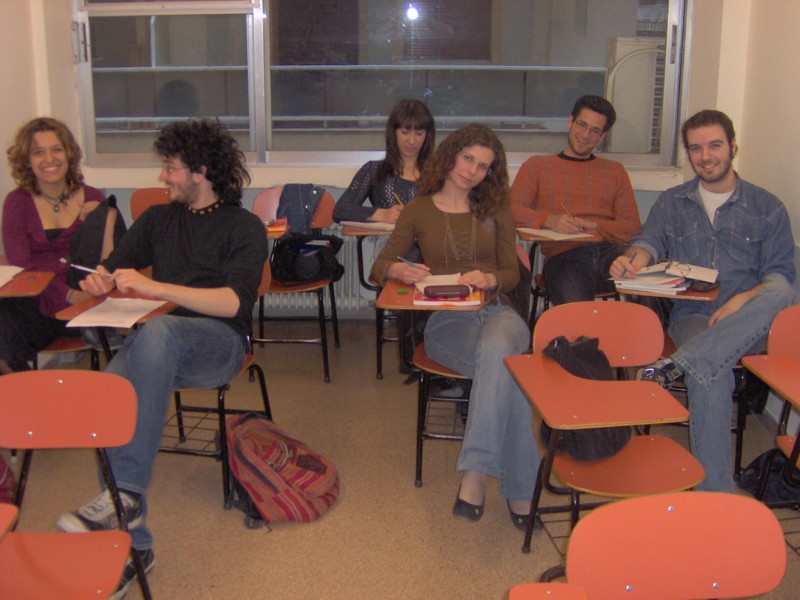
Prof 1c 2005-2006

Don't forget to take your digital camera with you so you can take a picture of everyone there. This will be useful when you set up your class's blog. Encourage the students to take their own photos using their mobile phones.

Thursday, September 14, 2006

EFL warm up exercises

I'll be starting my classes in the next couple of weeks and of course that means getting to know new students. It is something that always leaves me feeling a little nervous, even after seventeen years of teaching. Still, a few opening night nerves never did anyone any harm and helps me remember that every class is different. One exercise that I use to help students get to know me and each other is a time - line. I originally saw it in Teaching Adult Second Language Learners by Heather McKay. It also is a good way of starting off private lessons as well.

Basically what you do is draw a line on the board (or a piece of paper) and at five or six points which represent an important event in your life but in note form. For example;

born 1978
high school in 1994,
driving test in 1998
Lydia 1999.

The students have to use the notes to guess what happened at those various points in your life and think of questions to ask you about them.

For example, You graduated high school in 1994. Where did you go to school? What was it like? etc. Then students create their own time - lines and with their partner (preferably somebody thay don't now) and do the exercise in pairs.

I think it's extemely important to create a sense of community in the classroom as quickly as possible. If students get to know each other then they will more comfortable pushing their English to its limits. In a positive, accepting atmosphere students take more "risks", i.e. attempt things that they may get wrong. Without such experimentation progress becomes much more difficult.

Wednesday, August 30, 2006

Get in touch with your inner weirdness


I saw this meme over at Devious Diva's blog decided to add my own answers.

Ten things I've done that you probably haven't:

1: Taught myself to read and write modern Greek

2: Once helped fight a forest fire.

3: Drove from Athens to Rome on a Vespa.

4: Hitch-hiked 8000 km in five weeks.

5: Lived out of a one suitcase for a year.

6: Saw inside my own heart, live.

7: Was interviewed on Italian TV.

8: Was once held by Czech soldiers in Vaclav Havel's back garden.

9: Spent my first term away from home as a university student on crutches (as I had had a motorbike accident one week before term started).

10: Took my driving test in a foreign language.

Feel free to pick this up … It's amazing to read what wierd and wonderful things people have done in their lives.

Thursday, June 29, 2006

And there was much wailing and gnashing of teeth in the land


One of the great things about summer is that I have more time (and perhaps more importantly, appetite) for reading. I've finished the World is Flat by Thomas Friedman and Freakonomics which were both full of interesting, left-field ideas about everyday life. Of the two, Freakonomics is the easier read (not to mention shorter LOL). It investigates such intriguing ideas as what Sumo wrestlers and cheating techers have in common and the economics of naming your child!

Unfortunately, the world is not flat all over as I discovered yesterday while booking my return flight to Greece on the internet. The actual booking part went smoothly and was completed in less than five minutes (hurrah Thomson!!!). However, when I got my confirmtion email it didn't mention anything about tickets, Indeed it said that I had to have my flight documents with me when I check-in. As this is the first time I've booked a flight via all through the internet I wanted to confirm that I had indeed got a place on the flight and ask about the procedure as far as collecting the tickets was concerned.

The most logical answer would be that I would pick them up at the airport. However, living in Greece for many years has taught me always to check such details in order to avoid any unwanted complications.

Golden rule - The size of an organisation is inversely related to the common sense it uses when dealing with people.

And then suddenly bumpy terrain. First, I made a phone call to their "help" line which produced first, an engaged line(20 mins) and then a recorded message that they were all doing training. Next, a vist to the local Thomson travel agency got me zero results. They said that they had nothing to do with the internet side of the business and that I should phone the help line.

When I told them I'd already tried that they reminded me that they had no connection with the internet side of the business (if this is all starting to sound familiar I went through this loop two or three times before I realised that I was in fact dealing with some advanced, prototype cyborg, rather than human being. Eventually she did offer to phone on my behalf. However, only if I gave her the phone number,

"You mean that you don't know your own company's phone number?
"But they are loads.
"And you don't have a list somewhere?
"Why don't you phone the helpline?"
"BUT I HAVE ALREADY...... never mind."

After appproximately ten more phone calls, including one to Kafka's long-lost English descendent, and another one to somebody who first refused to give my the number of the Thomson customer service department, and then denied that that Thomson even had a customer service department at all, did I manage to get the information I needed.

Does "No frills" have to mean "no brains"?

Friday, June 16, 2006

The wiki so far

The wiki (EFL and Web 2.0) is now finished. Click here.

An Introduction


The aim of this site is to provide EFL or ESL students with enough technical knowledge to use the internet independently to study. It covers a range of skills from basic file management to producing podcasts. It is aimed at those with limited or minimal computer skills and so often deals with very basic issues which may put off more advanced users. However, in classes with mixed levels of competence in computing the more knowledgeable can quite happily used by the teacher as a learning resource.

In terms of linguistic competence, I would argue that the course is pitched at upper intermediate students and above. (Common European Framework B2 to C2 levels). However, with enough linguistic support, it could be used with students at lower levels.

The course could also be used to introduce L2 teachers to the use of technology in their lessons.The lessons are designed to be as "hands-on" as possible. In every lesson the learner has to produce something tangible at the end of the time, be it a blog entry, short podcast, a Wiki etc. In addition group and pair work is absolutely vital if the skills taught are to be mastered.

At every turn I have made every effort to make the exercises collaborative, taking as much responsibility for learning out of the hands of the teacher and putting it into those of the learners.


REQUIREMENTS

1 Access to a PC with DVD or CD Writer using Windows XP OS

2 Broadband internet access (though a dial up connection is ok for most lessons).

3 One of the following;

A mp3 player with voice recorder
A digital camera
A mobile phone with mp3 capability and a camera (ideally, with the ability to connect to a PC)

Table of Contents

1 File management - learning to move stuff around your computer.
2 Internet 101 - A quick look at what the internet can do
3 An introduction to blogging
4 Using and creating Wikis
5 Using digital cameras in the classroom (1) - using still photography
6 Using digital cameras in the classroom (2) - using video
7 Using and creating podcasts
8 Ideas for using Skype.

1 File management

One of the most important things that any computer user has to know is how to move data on and off a computer and to know where it is on the hard disk. If students cannot perform these basic tasks then much of what follows in this course will be incomprehensible.The teacher should therefore cover the following areas;

1 Explain what a hard disk is, what it does and how you find it using MyComputer. Then show students how to;

2 Create and name their own folder.

3 Move information from an exterior source and into their folder. This could be done by giving each student a CD or DVD with mp3s and asking them to choose the songs and or albums they like and then put them in their own folder.

4 Find their folder gain when starting up Windows.

5 Move the data to external medium such as an mp3 player or mobile phone.

6 Students then swap computers and find music on another person's computer that they like and using an mp3 player or mobile phone transfer it back to their computer.

7 Show students how to move the data from the hard disk to an external medium by ask them to burn a CD with their favourite songs.

Homework:

Students put the mp3s on their own PC. If you are doing this lesson with language students then ask them to review an album or write down their personal reaction to the music.

It is very important to remind students that mp3s are just the same as any other kind of data, be it Word documents, photos, music etc. That they can all be moved around in the same way.

If time permits show students how to how to use DVD Shrink (there is a very good page which explains it here).1 hand out a DVD movie and blank DVD to each student. Then using the site mentioned, go through the procedure for copying a movie. Also show students/teachers how to remove subtitles.

Homework:

Students create their own DVD copy with only English subtitles.

2 AN INTRODUCTION TO THE INTERNET

Or internet skills for scaredy cats

In this lesson the main idea is to show people how to;

1 find a page by putting in its web address
2 find something on the internet using a search engine such as Google or Yahoo.
3 refresh a page
4 stop a page loading
5 go back and forwards between pages and bookmark a page
6 open up new tabs
7 get their own email address using MSN Hotmail
8 send an email
9 open an email
10 reply to an email
11 send an email with an attachment
12 get their IM (MSN Messenger) address
13 how to chat
14 how to download files from the internet and put them in their own folders.
15 the basics of internet safety.

Before doing this lesson the teacher should have taken the class's photo and have loaded it onto each of the student's PCs.In the beginning make sure that all the students are aware of how you can connect their PC to the internet i.e. which icon to click on and what to do next if they are using a dial – up.

For steps 1 to 6: This could be done as a whole class but I think it would be more efficiently carried out by students themselves in small groups each one headed by a more computer literate student. The teacher should only intervene if the students feel that they can't understand something.

Just gently remind those who know about this stuff that they should be sensitive to the fact that not everyone shares their love or knowledge of computers.

For step 7: The teacher should be ready to guide the class as a whole step by step through the MSN Hotmail sign - up, as this can be very confusing to a newcomer, however, keep the groups created beforehand to act as a backup in case some students don't understand.

Be warned this stage will take time as finding an acceptable email address which hasn't been already claimed may be more than one attempt. Also there will inevitably be lost pages, mis-starts etc.

It is also a good idea for the teacher to keep a record of the students' email addresses, user names and passwords, as there is a good chance that students will forget or lose these details. If students do not feel comfortable knowing that someone else has such information then explains to them this email address is only for the course and that they can set up their own personal email address whose details will be known only to them at the end of the lesson.

For steps 8 to 10: First get students to swap their email addresses with someone else in the class. Show them where to put the email address they are writing to, subject, the main body of the message, and how to send it. The students are then shown how to open an email and rely to it.Students then repeat this procedure two more times with two new addresses.

For step 11: It would be a good idea if you have previously taken the class's photo and loaded it onto the student's PCs. Then show students how to attach, send and read such an email. Get them to send a reply with an attachment taken from their own PC.Just make it clear that they realise that files should be quite small in size.

If necessary show them how to find out the size of a file.

For steps 12 to 13: Go through the procedure using MSN Messenger as a class and ask students to chat with two other people, preferably on the other side of the classroom to give a sense of added realism.

For step 14: Go to CNN podcasts page and show them how to download the latest podcast using the right click and “save to” procedure. Just make sure they know how to choose My Folder. Students then download another file on their own.

For step 15: students should be made aware of the dangers of ;

opening attachments from people they don't know.
downloading .exe files.
not using up to date anti-virus programmes.
giving out personal information such as phone numbers, addresses, credit card numbers etc on the net.

Homework. Send and reply to an email from someone in the class. Use IM to chat with another member of the class.NB I would recommend using Mozilla Firefox rather than Internet Explorer for safety reasons.

3 An introduction to blogging

Ideally, the introduction to the idea of blogging should happen in the lesson before students are asked to create their own. The first step is to explain what a blog is. The usual way is to say that blog is the combination of the words “web” and “log”, which, however, will mean little or nothing to most. Better way is to call a blog your own free-of-charge internet site. The “free-of-charge” part should get their attention.

Also remind students that to set up and run a blog requires no more technical knowledge than sending an email.

In the lesson before introduce the http://www.technorati.com/ site. Explain to students that this is a place where they can find what people are saying in their blogs about various subjects. Ask them to choose something they are interested in e.g. teaching English, the World Cup, their favourite singer etc, put it in the search engine and find some blog entries. Encourage students to flip from one site to another.

Also ask them to find and make a note of a blog they like.(It would also be a good idea for the teacher to set up a class blog in advance. It can be used to post assignments and lesson plans for each part of the course. It could also be a forum in which students discuss any problems they have with the homework).

Alternatively, you could surf Technorati in the first ten minutes of your lesson.

Lesson plan

1 Students show the blog they've found and explain why they enjoyed it.

2 Take a photo of the class using a digital camera. Explain to students that one of the things they can put on a blog is a photo.

3 Students then take photos of each other. Explain that they will be needed later.This would a good time to put students into small groups with a more computer literate person in each one.

4 Take the students through how to set up a blog. I use Blogger (more because I'm used to it, rather than any innate superiority). This will be a time consuming procedure and be sure to not rush people through this. As with anything technical, allow the more computers - minded to help make sure everyone understands.

It is also a good idea to keep a note of students' blogs user name, password and blog title. It has been my experience that many students lose these pieces of information or fail to note them done in the first place.

5 Fill in the Profile Section on Blogger. Make sure the everyone, especially younger students, understand that this is a public forum and no personal information, such a surnames, phone numbers and details that could identify where you live, work or study should not be included. If working with children or teens, double check that students have not included anything too revealing.

6 Show students how to;

Post entries,
Add photos from the hard disk (using the photo that was taken earlier).
Add photos from the net.
Put in hyperlinks.

7 Student write a short biography where they have to add a link to the class blog, add a photo and a picture of the city in which they live.

8 For homework students should repeat their biography in the class blog and post another entry in their own blog on any subject they like. Just make sure that the post has a photo and a link. Also ask students to comment on at least one other person's blog entry.

In the weeks that follows students should try to post at least one entry with photos and links. The teacher could recommend a subject for the students to blog about or students could just choose stuff on their own.

9 Show students how to use RSS programmes.

10 If time permits, show students how to link their blog to other peoples' blogs and other sites. Make sure that everyone links to everyone else's blog in the class. Also show students how to add a visitor counter such as Clustrmaps or Geovisitors. I feel that if students get outside interest in their blogs the incentive to work on them increases enormously.

This is just the first step in a process which should last at least as long as the course and hopefully, much longer. The basic idea with blogging as with all the areas covered in the course is that you give people tools they can use to learn for themselves. It's the process, not the end result that counts.

USING WIKIS IN THE CLASSROOM (1)

Wiki or Wikipedia to use the full name is an encyclopaedia written by anyone who has an interest in a subject and access to the internet. Literally, anyone can write or amend entries. As well as being a great starting point for students doing research it can also be a valuable way for students to reach out to a wider audience.

Recently, there has been a lot of debate over whether the site is a valid source of information, the idea being that since anyone can add to it, who is going to control the quality of the content ? What is stopping people from deliberately adding untrue facts ? Indeed there have been cases where this has taken place but generally speaking, the quality of the entries compare favourably with the Encyclopaedia Britanica.

On a more fundamental note, the use of Wiki and the possibility that they may be wrong is an extremely powerful way to introduce the idea that no source of information should be accepted unthinkingly, as automatically correct. A very powerful idea and potentially troubling one for students who are brought up in educational systems where the teacher and the course book are seen as the source of all knowledge and are to be accepted without question.

LESSON PLAN

1 Choose a subject that students are likely to be well acquainted with. A good source of such ideas are local or national celebrations. Ask students to find out what they can about the chosen topic on Wiki

This might be a good opportunity for you to revise basic internet search techniques.

2 Ask students to comment on the quality of the information provided and make any suggestions on what could be done to improve the entry. This could be anything from amending a spelling to adding new paragraphs or photos.

3 Show students how to;

register with Wiki,
the rules of use,
how to modify an entry.

HOMEWORK

1 Choose an article which needs updating and edit it.

2 Post an entry on your blog and the class blog which links to the Wiki page and explain what you changed and why.

3 Read somebody else's blog and comment on their changes.

4 RSS the page and see if your changes have been edited.

USING WIKIS IN THE CLASSROOM (2)

In this part of the course the students are going to add their own Wiki entry to the encyclopaedia. this would best be done in large groups or as a whole class as it is a challenging exercise.

LESSON PLAN

1 Students decide upon the theme of their Wiki entry. I would suggest they focus on something local and connected with their immediate surroundings, for example their neighbourhood, school or class.

2 In groups either find or create their own content for the entry. In the case of a local entry most of this will have to be generated by the students themselves. (no bad thing, of course).

Ideally, the students should then go out and get photos to illustrate their article.

3 Each group then adds their entry to Wiki. This is best done in class time in order for the teacher to give as much technical assistance as possible.

HOMEWORK

1 Post a link to your group's wiki page on your blog and the class blog and explain in brief what it's about.

2 RSS the group's article and see what changes have been made.

3 Choose one other group's article and make one change that will improve it.


6 Using digital cameras in the classroom (1)

With the fall in prices in the price of digital cameras has become more and more affordable. The cheapest ones now cost less than 100 euros. In addition memory cards, which allow more photos or video to be stored has dropped equally dramatically. This coupled with the ever growing popularity of camera equipped mobile phones means that there are few reasons not to use them in class.

When you remind students to bring their camera or phone to the following lesson, also ask them to bring any connecting cables they may have. It wouldn't be a bad idea to have a USB cable on hand as well as a card reader.

Lesson Plan

1 Everyone takes a class photo and some photo of the others in the class.

2 remind students how to get the photo off the camera/mobile phone and into their folder on the computer.

3 Teach students how to;

Rename their images.
Resize images (so that they know how to shrink image file sizes so they can be used more easily on the net).
How to upload them onto their blog
How to send them as an attachment in an email.

4 Explain to students what Flickr is and then ask them to look at the site. Give them five minutes to find an image they like and get them to post it on their blog, download to their folder on the computer and email it to another student.

5 Explain to them ho they can set up their own flickr account. It is also a good idea to keep a note of students' Flickr user name and password. It has been my experience that many students lose these pieces of information or fail to note them done in the first place.

6 Get students to upload the pictures they have taken in the class, get them to add a label, tag and description. Also make sure the students to set up groups so the can easily see each other's pictures.

Homework:

Post some photos on Flickr along with tags and descriptions.

Post a Flickr photo on your blog.

7 If you are working with teachers here is the time to brainstorm possible ways in which digital photography could be used in the classroom,especially ways in which it could be used in conjunction with the course book.

Below is an example idea for beginning and intermediate students.A book that I have used over the years with beginners and post beginners is the Longman Photo Dictionary by Marilyn Rosenthal and Daniel Freeman (out of print). Basically each page is devoted to different aspects of everyday life with photographs to illustrate things such furniture, fruits etc (see photo below). However, this book was published in 1987 and so is somewhat out of date.

The idea is that students use their phones/camera to create their own, updated version. This could be a great way for students to practice basic vocabulary. This could also perhaps form the basis of a Wiki page or be used to create a drum for use by all the students in class.

LESSON PLAN

1 Divide the students into pairs. Give each pair a photocopy of one of the pages from the book. Deal with any vocabulary items they may notunderstand.

2 The students do the exercise on the page.

3 Now explain to the students that they have to produce their own page, using pictures they have taken themselves to illustrate the various vocabulary items.For example, one page is entitles Actions at Home and shows people;

shaving
cooking
combing their hair etc.

4 The students then use the picture(s) to create a page that does the same job as the original photocopy.

5 Students then use the internet to find photos of more exotic pages such as Winter Sports.

6 The various pages are all collected into one file which could be part of a Wiki page or left of the hard disk of a class computer.

Alternatively, each student could take a copy home with them on their mobile phone memory card, mp3 player or CDR. Homework: Post a lesson plan on your blog.

7 Using digital cameras in the classroom (2)

In addition to still images most digital cameras also have the ability to record video. The length of such video depend up the quality of the image and the size of the memory card that the phone or camera has installed. My digital camera has a 256 mob SD memory card which can store about 25 minutes of video. It most also be remembered that the quality of the video is not particularly good, however, despite these limitations there are plenty of extremely interesting uses for these video in the classroom.

Remind students that when they bring their digital cameras and/or mobile phones they should also bring any connecting cables that came with the device. Also it wouldn't be a bad idea to have a USB cable and a card reader.

Lesson plan

1 Get your students to take a couple of short videos of their classmates and remind them how to move the file off thecamera and into their file on their PC.

2 Show students how to move this file into Windows Movie Maker, then teach them how to;

Add titles
Cut from scene to scene
Add music
Add commentary
Edit down scenes.

3 Students then use the short video they recorded earlier to produce a short one - two minute film with titles and music.

Then why not try one of the lesson plans below with the class. If teaching beginner, intermediate students then does the Video your Course Book exercise.

4 If you are doing this with teachers then brainstorm other ways in which video could be used to help students learn.

Homework.

Students do the Record a Journey exercise at home and bring in the video using your camera or phone as flash memory.

Teachers could try out one of the ideas they brainstormed with their classes and write a blog entry on what they did and how well it worked.

Video your course book

All the software used either comes as standard with Windows or can be downloaded free of charge from the internet.This is another idea I have shamelessly stolen from Video by Richard Cooper, Mike Lavery and Mario Rinvolucri. Basically, it involves using a video camera to practice various grammar points in your course books. In this case the present continuous rule.

Lesson Plan

1 Present the rule in whatever way you usually do it.
2 Ask one student to work the digital camera or use his mobile phone. The others line up in a row, standing, and the person at the one end mimes an action, e.g. brushing their teeth.

The next person asks them:

"What are you doing?"

The second student replies, "Lying";

"I'm eating an apple"

The second student immediately starts miming eating an apple.

The third student asks:

"What are you doing?"

The fourth student answers;

"I'm chopping onions."And so on and so forth.

3 The whole class views the computer screen.

4 Darken or turn round the screen so they the students can only hear. The students take dictation of each new present continuous tense.

5 Now use the course book to present the tense.

Recording a journey

What you do is that you ask students to record a bus journey (it could also be done by passengers in a car or pillion passengers on the back of a bike - or Vespa, in my case). The students could record a travelogue as they went, explaining where in the city they are, what they think about the places passed etc. Or more realistically, add it later using Windows Movie Maker.

The aim is to give a 10-20 minutes guide to the city which could be posted on a blog or burnt onto CD and shared with the other students.If the idea of holding a video/digital camera for such a long time doesn't appeal then students could take still photos and again use Windows Movie Maker to create a slide show and then add commentary, titles and even music.

A standard digital camera with a cheap 256mb SD card can record 20-25 minutes of video.

8 An introduction to podcasting

Once again there is not much point going into technical details when introducing podcasts to beginners, you'll just confuse them or put them off with a bunch of meaningless gobbledygook. So the best way is to say that a podcast is a radio programme you can save onto your computer and which you can listen to at your leisure. Also that they can put it on their mp3 players or mobile phones and so listen to it anywhere they like.

Remind your students that the content of a podcast can literally be about anything and just as the subject matter varies enormously so does the quality of the content. Basically, the only differences between a regular radio programmes and a podcast are that podcast are transmitted via the internet and that anyone with a pc, internet connection and a microphone can create one.

Lesson plan

1 The best way to introduce students to the idea is to give them a list of podcast directories e.g. Podcast Alley, itunes etc. to look at.

2 Show them how to download a podcast onto their pc.

3 Students then chose a podcast that they like and download it on to their pc. Remind them to make a note of its internet address.

4 Then show them how to transfer it to their mp3 player/mobile phone.

Homework:

1 Listen to the podcast and write a short two paragraph review e.g. one paragraph on what they liked about it and one about what they didn't like.

2 Post this review along with a suitable image and the podcast link on their blog.

3 (Optional) Choose another podcast mentioned on somebody else's blog and download that.

In the next lesson students do one of the exercises mentioned below and collect the raw material for their own short podcast. I don't think it is realistic to ask students to do 30 or 40 minute podcasts on their first attempt instead this should be done collaboratively with each student or pair of students contributing two to three minute segments

Using podcasts in the classroom (1)

I came across the Guardian podcast travel page (see here) and downloaded their podcast on Athens. I thought that it would be a good for my private students to listen to it. They could compare their experience of Athens (the older ones usually go there at least once during their high school years) with that of the presenter.

Actually, I as loaded it from my ibook onto her mobile phone, which can play mp3s it suddenly occurred to me that this same phone could be used to create a similar podcast (with photos) about Thessaloniki.I know that I’ve mentioned this idea before in previous posts but I could now see how such a project could be done with equipment that many of my students carry with them, a mobile phone and then be transferred effortlessly to a PC where it could be turned into a podcast using readily available programmes which can either be download free from the internet or come with Windows as standard.

LESSON PLAN

1 Ask students about their impressions of Athens. What did they like or not like and what they would recommend people see and do.This is probably best done by asking students to spend a couple of minutes jotting down ideas and then putting them in groups or pairs and comparing them.

2 If you do this in a private lesson then give the Guardian podcast for homework and ask the student to write down how it compares with their experience of Athens.If you’re doing this as a class, play a short three to five minute extract from the start and ask them to compare it with their own experiences.

Students then discuss answers and hear it a second time.

3 Ask students what places would they recommend a foreign visitor to go to here in Thessaloniki.

What is the place?
Why is it interesting?

Here you may encounter some difficulties as students may have never visited the tourist traps or have seen them so often that they are hard pressed to describe something they consider self-evident. You may need to work with them on how to “distance “themselves from their home town in order to see it afresh.

4 For homework ask students to visit one of the places described and write down a few notes in English and Greek (if necessary) on the questions mentioned previously. Also ask them to make a note of any difficult vocabulary items that might be useful when describing these places.

5 In the next lesson students discuss their ideas and ask for help with vocabulary etc.

6 Explain to students that they are going to use their mobile phones to record a short, five-minute podcast. Remind them that they can do this on their own or in pairs as a kind of interview.

7 Students then write down a brief outline (and make sure it is brief as we want a sense of spontaneity, rather than the droning lecture).

8 Check the outline and make suggestions, if necessary.

9 Students record their podcast for homework and if possible, take photos (again, using their phone).

10 In the next lesson transfer (hopefully, the phones should all have USB cable connections - check to see if you need any other kind of cable).

11 One idea is to use Audacity and Lame to join and edit the different podcasts. Alternatively, Window Movie Maker (which comes with Windows XP) could be used to add photos and titles to the podcast.

12 The final product could be put on a webpage or blog, burnt onto a cd or stored on the students PC for use in their European Language Portfolio.

Using podcasts in the classroom (2)

LESSON PLAN

I Ask students ask about their favourite bar or cafe.

What makes it special?
Would it appeal to a foreign visitor?

2 Ask students what they know about Krakow, Poland. If you think that they'll not be able to answer then set this for homework.

3 Play one short extract from the first few minutes of the podcasts.

4 Students write down everything they can from it. They then share their information with each other.

5 Play the extract again. Students then discuss the differences between their favourite cafe and the one mentioned in the extract.

6 Divide students into two groups and explain to them that they are going to do something similar. One group thinks up questions and the other think about how to describe their bar/cafe.

7 Put the students in pairs and let one interview the other. If possible record the interview. It could become a great podcast idea.

USING SKYPE

Skype is a programme which can be downloaded free of charge from the net and it transforms your pc with broadband connection into a phone capable of making calls either free of charge or at a very cheap rate (as I speak, it is 1,7 cents per minute).

As with all of these lesson it does wonders to emphasise the fact that it's free and that it can save them a fortune if they make long distant phone calls. That, at least, should get their attention.

As with an ordinary phone the possibilities for communication are endless so whatever I talk about here will be the tip of the iceberg.

The most interesting ideas I have come across include;

Skypecasting


This is basically, the ability to join in a phone call with one or more speakers from any Skype enabled pc on the planet. As well as being able to take part in other people's discussions you can set up your own. Once again there are no limits on subject matter, duration or number of people allowed to join.

However, be warned as the larger the group the harder it is to communicate coherently. In addition the technology is still quite new and the quality of the connections varies considerably.

The beauty of Skype is that the majority of people using English on Skype use it as a foreign language which means that your students are on a level playing field in which no one is automatically "right" or "wrong". This is a powerful incentive to students to practice who feel intimidated by the speed and complexity of native speaker's language.

Tandem learning

Etwinning

Phone a stranger
Tuesday, June 06, 2006

Alex

Sources: NET - NET 105.8 - ANA

"The public opinion is numbed over the developments in the case of Alex Meschisvili, 11, who has been missing since 3 February from his home in Veria, Greece. As per the police, little Alex was murdered and a group of five children, aged between 11 and 13, hold the key to solving the case. A search is underway to locate the body of the unfortunate boy in the ruins of an abandoned house that was demolished a couple of months ago, as the juveniles indicated that Alex was buried in the house’s basement. Moreover, the foundations have been laid for a new building, just metres from the location. The Police are searching the premises assisted by an EMAK (Hellenic Rescue Team) unit with specially-trained dogs, while a Prosecutor and a Coroner have also arrived on site. In addition, by order of the Police Chief, the operation is being videotaped. A pair of shoes was found in the rubble earlier, but it was later clarified that they did not belong to Alex."


see here for the rest of the story


I thought long and hard about writing this post. I usually don't us this blog to talk about anything political as it is not the appropriate forum. However, sometimes things happen which make you stop and think about what the hell is happening around you. The murder of an 11 year old boy by his fellow students is one of those things.

For those of you who do not live in Greece the whole country has been watching with a kind of shocked horror the story that is coming out of the town of Veroia. Thankfully, such events are rare in Greece, however, the thing that makes my blood boil is the fact is that this is so obviously a hate crime and yet the media is spinning it as anything but. The fact that the five kids accused of murdering Alex were not all Greek seems to have blinded people to the obvious.

Yet, I would argue that racism, and lets do some straight talking here, is at the heart of the whole affair. It was racism, and not just Greek vs non-Greek prejudice that I believe help the "gang" decide upon their victim and it was racism that kept peoples' mouths shut afterward. If he had had a Greek surname there is no way a murder carried out in the centre of this small town, next to the town hall, in plain sight of hundreds of apartments would have gone unsolved for four months.

Believe me, anyone who has spent time in close-knit towns like Veroia knows that there is no such thing as a secret, that absolutely everyone knows everyone else's business.

I don't which is worse, a community that fills young peoples' mind with ideas of hate and prejudice or the adults who undoubtedly helped the children hide poor Alex's body and so prolonged a mother's agony for so long ?

I'm a parent too, and I wonder what the future holds or my daughter with her non-Greek looks and foreign surname. What kind of treatment awaits her in a society that finds it so hard to accept anyone different?

Also See Devious Diva's blog for her take on this.

Αθειρωμενο σε οσους κρυβονται πισω απο το δαχτυλο τους.