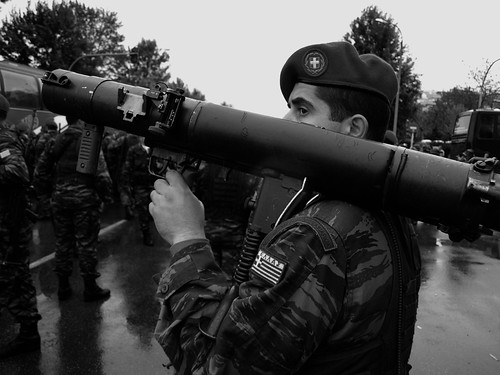
Scarface meets the Greek army.
Friday, October 29, 2010


Thursday, October 28, 2010
Wednesday, October 27, 2010
Greek Orthodox bishop tells candidate "you'll never become mayor as long as I live"
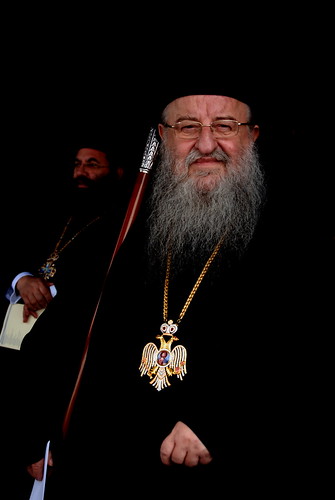
In what is turning out to be a clash between the Greek Orthodox church and the ruling PASOK party leading cleric Bishop Anthimos has been quoted as saying that he and the church will do everything in their power to prevent left of centre candidate Yiannis Boutaris from becoming mayor of Greece's second largest city, Thessaloniki. According to The Makedonia newspaper the bishop said that Boutaris, "will never become mayor as long as I live".
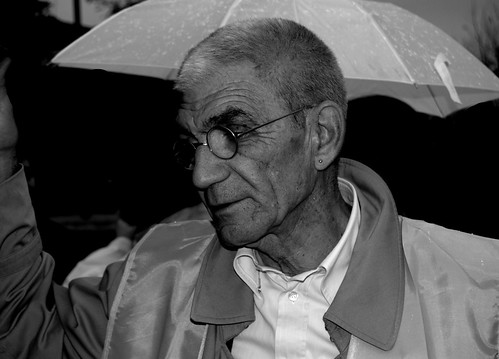
Boutaris, who is PASOK's candidate of choice in the upcoming local elections in November had compared the bishop with the Mujahadeen the previous day.
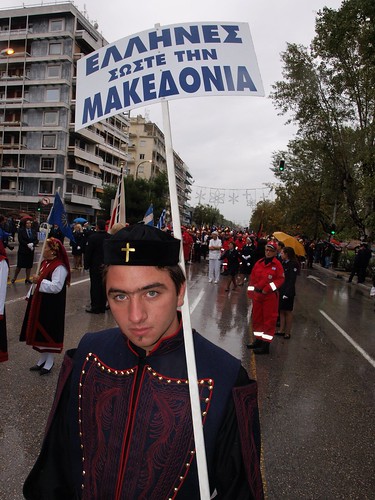
Demonstration against austerity measures - Thessaloniki, Greece

Demonstration against austerity measures - Thessaloniki, Greece, originally uploaded by Teacher Dude's BBQ.
This took place just after the end of the annual student parade commemorating Ochi day in Thessaloniki. More protests are expected tomorrow during the main military parade.
Greek PM's press conference fails to convince voters
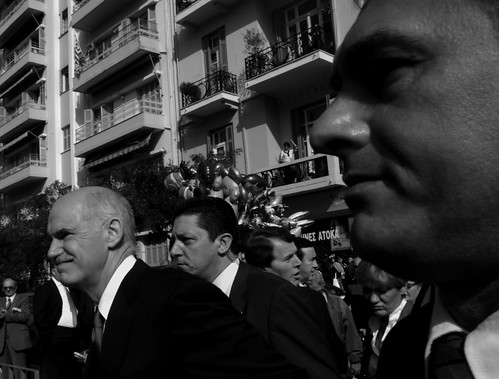
Greek prime minister, Giorgos Papandeou (left) leaving the St Demetrios cathedral - Thessaloniki, originally uploaded by Teacher Dude's BBQ.
Last night Greek prime minister took part in a Q & A session with journalists from the country's largest TV stations. The decision to organise such an event in the run up to the local elections in November was criticised by opposition parties who consider that the Papandreou is campaigning on behalf of his beleaguered PASOK party who have been trailing in the polls, affected by the harsh austerity measures that have seen living standards plummet as job losses, higher taxes and galloping inflation have combined to make for a perfect storm for those on lower incomes such as the unemployed and pensioners.
The harsh new economic reality facing Greeks can be seen in a slew of reports that show that many household are now struggling to pay basics such as power and phone bills. The state run electricity board says that 1 in 4 bills are overdue whilst the OTE telecommunications corporation has 500,000 unpaid accounts to deal with. Even in Greater Athens area, which one of richer parts of the nation 1 in 11 are receiving food handouts via breadlines according to research carried out by the Athens University of Economics recently. In Greece's second city, Thessaloniki, home to over a million nearly half the population is living on either savings or loans whilst another 40% say that they can barely make ends meet.
Even consumption of basics such as bread has dropped by 30% whilst other areas of the economy such as real estate and car sales have ground to a virtual halt. The Greek chamber of commerce says that 4,000 small businesses are closing every month with thousands more being added to unemployment figures.
With such a bleak outlook Giorgos Papandreou decided to hold a press conference to set out his party's policies and to explain to the nation what he believes has to be done to save Greece from bankruptcy.
The interview which was carried out by seven journalists lasted two hours and was followed by millions of viewers nationwide. In the first round journalists were allowed to ask one question and one follow up. A recipe which allowed the PM plenty of wiggle room and produced a predictably sonorific result as Papandreou was free to simply set out party positions that have long been made clear in previous briefings. While the questions were hard hitting, the lack of follow up meant they were easily sidestepped with waffle and set speeches.
The second half of the interview proved more interesting with reporters able to pursue points made and get the prime minister to do more than simple PR.
However,the basic tenet of Papandreou's message remained the same that the current crisis was the results of years of fiscal mismanagement that the previous New Democracy administration had failed to take seriously and that if Greece did not have any other choice but to implement the painful measures set down by the EU and IMF. He also made it clear that his government sees the forthcoming elections as a referendum on the measures intimating that if PASOK suffered a serious defeat then this would be seen as a loss of the popular mandate necessitating national elections in the near future.
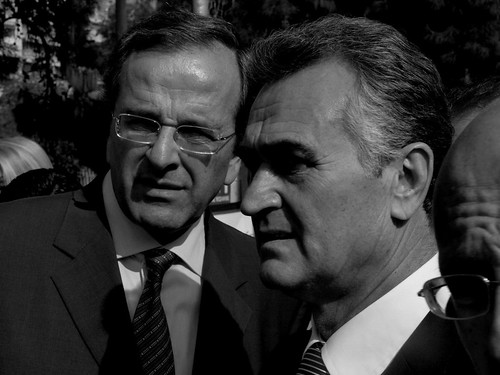
For Papandreou the choice is clear; either accept the cuts in public services and wages set out or vote for the opposition New Democracy party led by Antonis Samaras whose brand of populist rhetoric is full of heat and passion but light on concrete proposals on exactly how different his right of centre party would deal with a 400 billion debt load without severe cuts in public spending or higher taxation.
Yet despite growing dissatisfaction with both major parties it seems business as usual with both sides making lavish promises to voter in order to persuade people to support them. The ruling PASOK party has vowed to help local income families and farmer with extra funds before the end of the year, though where exactly the money is coming from is unclear especially with so many employees of the state run organisations and pensioners who have been waiting months to be paid. Next week heating oil distributors have threatened to suspend deliveries from 1st November in protest over delays over the return of tax payments promised earlier. Likewise hospital report running low on basic supplies after pharmacutical companies stopped taking new order until the government pays outstanding debts, some going back years.
However, the 600lb gorilla in the room is the possibility of still harsher cuts when Eurostat revises Greek debt figures for 2009. The organisation delayed publishing figures citing the need for more time to untangle Greece's often tangled web of public spending statistics until 15th November just after the second round of local elections. This has been seen in many quarters are an attempt not to upset PASOK's election chances still further with more bad news. On the one hand Papandreou has stated on a number of occasions that there will be no further measures for wage earners and pensioners whilst European Commissioner Olli Rehn has made it clear that higher than expected debt load will mean more sacrifices on the part of Greece in 2011.
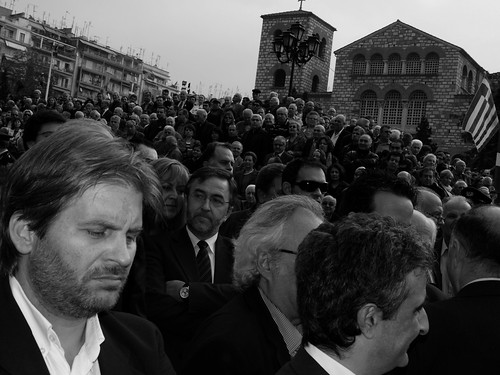
Attending celebrations in Thessaloniki today Giorgos Papandreou was met with boos and jeers by some worshippers outside the Saint Demetrios cathedral and was quickly whisked inside the building with church bells ringing in order cover the sounds of protests from TV crews covering the event. Hundreds of riot police were also on duty in the surrounding area ready to keep disgruntled state employees at a safe distance while people shouting anti-government slogans were swiftly confronted by uniformed and plain clothes officers in the crowd.
The harsh new economic reality facing Greeks can be seen in a slew of reports that show that many household are now struggling to pay basics such as power and phone bills. The state run electricity board says that 1 in 4 bills are overdue whilst the OTE telecommunications corporation has 500,000 unpaid accounts to deal with. Even in Greater Athens area, which one of richer parts of the nation 1 in 11 are receiving food handouts via breadlines according to research carried out by the Athens University of Economics recently. In Greece's second city, Thessaloniki, home to over a million nearly half the population is living on either savings or loans whilst another 40% say that they can barely make ends meet.
Even consumption of basics such as bread has dropped by 30% whilst other areas of the economy such as real estate and car sales have ground to a virtual halt. The Greek chamber of commerce says that 4,000 small businesses are closing every month with thousands more being added to unemployment figures.
With such a bleak outlook Giorgos Papandreou decided to hold a press conference to set out his party's policies and to explain to the nation what he believes has to be done to save Greece from bankruptcy.
The interview which was carried out by seven journalists lasted two hours and was followed by millions of viewers nationwide. In the first round journalists were allowed to ask one question and one follow up. A recipe which allowed the PM plenty of wiggle room and produced a predictably sonorific result as Papandreou was free to simply set out party positions that have long been made clear in previous briefings. While the questions were hard hitting, the lack of follow up meant they were easily sidestepped with waffle and set speeches.
The second half of the interview proved more interesting with reporters able to pursue points made and get the prime minister to do more than simple PR.
However,the basic tenet of Papandreou's message remained the same that the current crisis was the results of years of fiscal mismanagement that the previous New Democracy administration had failed to take seriously and that if Greece did not have any other choice but to implement the painful measures set down by the EU and IMF. He also made it clear that his government sees the forthcoming elections as a referendum on the measures intimating that if PASOK suffered a serious defeat then this would be seen as a loss of the popular mandate necessitating national elections in the near future.
For Papandreou the choice is clear; either accept the cuts in public services and wages set out or vote for the opposition New Democracy party led by Antonis Samaras whose brand of populist rhetoric is full of heat and passion but light on concrete proposals on exactly how different his right of centre party would deal with a 400 billion debt load without severe cuts in public spending or higher taxation.
Yet despite growing dissatisfaction with both major parties it seems business as usual with both sides making lavish promises to voter in order to persuade people to support them. The ruling PASOK party has vowed to help local income families and farmer with extra funds before the end of the year, though where exactly the money is coming from is unclear especially with so many employees of the state run organisations and pensioners who have been waiting months to be paid. Next week heating oil distributors have threatened to suspend deliveries from 1st November in protest over delays over the return of tax payments promised earlier. Likewise hospital report running low on basic supplies after pharmacutical companies stopped taking new order until the government pays outstanding debts, some going back years.
However, the 600lb gorilla in the room is the possibility of still harsher cuts when Eurostat revises Greek debt figures for 2009. The organisation delayed publishing figures citing the need for more time to untangle Greece's often tangled web of public spending statistics until 15th November just after the second round of local elections. This has been seen in many quarters are an attempt not to upset PASOK's election chances still further with more bad news. On the one hand Papandreou has stated on a number of occasions that there will be no further measures for wage earners and pensioners whilst European Commissioner Olli Rehn has made it clear that higher than expected debt load will mean more sacrifices on the part of Greece in 2011.
Attending celebrations in Thessaloniki today Giorgos Papandreou was met with boos and jeers by some worshippers outside the Saint Demetrios cathedral and was quickly whisked inside the building with church bells ringing in order cover the sounds of protests from TV crews covering the event. Hundreds of riot police were also on duty in the surrounding area ready to keep disgruntled state employees at a safe distance while people shouting anti-government slogans were swiftly confronted by uniformed and plain clothes officers in the crowd.
Monday, October 25, 2010
The secret Iraqi war files - Al Jazeera
A great report by Al Jazeera on the Iraqi War Diaries which were released by Wikileaks. Be warned some of the images are very disturbing. The photographs of children covered in their parent's blood after their car was fired upon by US soldiers manning a check point are not likely to be forgotten any time soon by anyone who sees them.
Even the figure of 15,000 additional Iraqi dead is likely to be an underestimate according to professor Jacob Shapiro to the Guardian.
Saturday, October 23, 2010
Wikileaks's Julian Assange - "Iraq was a blood bath on every corner"
Videos from Press TV
I have just finished following the Wikileaks conference live on the internet in which Julian Assange and British lawyers representing Iraqi victims of British military violence presented the latest leaked documents on the occupation of Iraq by US and UK forces. The material makes for painful reading and its a litany of brutality, lies and killings carried out in the name of American and British democracy. Not least of the shocking revelations is the addition of over 15,000 more Iraqi dead to the official death toll. In addition the documents also bring to light the extensive use of torture by UK forces and the legacy of colonial savagery and racism developed in imperial outposts such as Cyprus, Palestine and Northern Ireland that the British brought to Iraq.
As one contributor said it was hard to ignore the savage racism that allowed interrogators to operate with the the only limitation being that of their own imagination. thousands of people hauled off the streets and traeted in a manner that got Nazi officials long sentences in the Nuremberg war trials
Also what can you say about the murder of a young girl by a British soldier riding a tank as she played in street. What was here crime? What did she do to deserve such a fate? isndie there is a feeling of anger and disgust welling up to think that such crimes against humanity and decency were carried out by in my name. It makes me feel unclean and ashamed.
Links
The Wikileaks Warlogs can be seen here
http://wikileaks.org/iraq/diarydig
The CBS news account of the conference here
http://www.cbsnews.com/stories/2010/10/23/world/main6984273.shtml
Twitter feed here
http://twitter.com/#!/search/warlogs
The Guardian's mash up mapping all the deaths mentioned in the Iraqi War Diaries
http://www.guardian.co.uk/world/datablog/interactive/2010/oct/23/wikileaks-iraq-deaths-map
Wednesday, October 20, 2010
Greece falls 38 places in Press Freedom Index
According to Reporters Without Borders Greece has dropped 38 places in their press freeom index and now in 70th place, joint last place with Bulgaria in the European Union.In its latest report the organisation said that the placing was due to, "to political unrest and physical attacks on several journalists". The Greek national daily, Eleutherotypia also cited attacks by the police on reporters as a major cause for the fall in ranking for Greece in terms of press freedom.
Given the unprovoked attack on reporters last week during a protest when camera operaters and photographers were clubbed and tear gassed outside the Acropolis Athens position in the list is likely to remain low.
Given the unprovoked attack on reporters last week during a protest when camera operaters and photographers were clubbed and tear gassed outside the Acropolis Athens position in the list is likely to remain low.
Monday, October 18, 2010
Athens faces prospect of yet more austerity measures
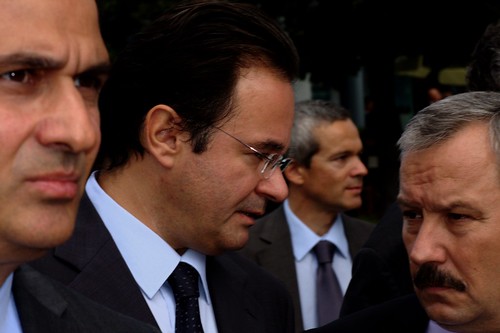
On Thursday the European Statistical agency Eurostat will announce revised government debt figures for Greece in 2009. Despite being in power for over year the left of centre PASOK government headed by Giorgos Papandreou has still not been able to produce a clear idea of how much Athens actually owes.
Years of creative accountancy coupled with official incompetence means that no one is quite sure what the state has spent over the last decade. Today's Naftemporiki newspaper article lists measuresthat have been used to hide the true extent of debt load including the credit swaps organised by Goldman Sachs as well as other tricks such as delaying health service debts for years and the creation of "special funds" totalling billions of euros which were not included in budget figures.
On the other hand the heads of Greece's two largest parties are engaged in name calling in the run up to the November local elections with both prime minister Giogos Papandreou and head of the opposition New Democracy party, Antonis Samaras exchanging jibes over who is to blame for the current economic crisis.
On the one hand claims by Papandreou that he had no idea of the depth of the country's economic woes is proving hard to sell especially in light of claims by both former German finance minister, Peer Steinbrueck and Eurogroup leader, Jean Claude Juncker that he was perfectly aware of the scale of government debt before he took -power in 2009.
On the other hand Samaras who served as a cabinet minister in the New Democracy government is claiming that his party left the country in good economic shape and that it is PASOK mishandling of the economy which produced the current crisis. A claim also challenged by Juncker's claims that fellow European leaders warned Greece about the consequences of its debt load in 2008 but which then prime minister, Kostas Karamanlis chose to ignore.
What we have unfortunately is a political clash in which both sides are seemingly unwilling to accept blame for the dire state of the economy and who indulge in populist mudslinging.Despite the severity of the situation the election campaign seems to see the parties operating on a business as usual basis.The consistent pattern of lying and evasion is undermining what little credibility the Greek political system has in the eyes of many voters who give little credence to political party claims and counter claims.
The only thing most people are sure about is that their living standards are rapidly dropping with 92% of people in the greater Athens area saying they have reduced spending even on food. As the political elites argue over who is not to blame one in three young Greeks are unemployed and the country is looking at even harsher measures which will make this winter one of the most difficult in living memory.
Years of creative accountancy coupled with official incompetence means that no one is quite sure what the state has spent over the last decade. Today's Naftemporiki newspaper article lists measuresthat have been used to hide the true extent of debt load including the credit swaps organised by Goldman Sachs as well as other tricks such as delaying health service debts for years and the creation of "special funds" totalling billions of euros which were not included in budget figures.
On the other hand the heads of Greece's two largest parties are engaged in name calling in the run up to the November local elections with both prime minister Giogos Papandreou and head of the opposition New Democracy party, Antonis Samaras exchanging jibes over who is to blame for the current economic crisis.
On the one hand claims by Papandreou that he had no idea of the depth of the country's economic woes is proving hard to sell especially in light of claims by both former German finance minister, Peer Steinbrueck and Eurogroup leader, Jean Claude Juncker that he was perfectly aware of the scale of government debt before he took -power in 2009.
On the other hand Samaras who served as a cabinet minister in the New Democracy government is claiming that his party left the country in good economic shape and that it is PASOK mishandling of the economy which produced the current crisis. A claim also challenged by Juncker's claims that fellow European leaders warned Greece about the consequences of its debt load in 2008 but which then prime minister, Kostas Karamanlis chose to ignore.
What we have unfortunately is a political clash in which both sides are seemingly unwilling to accept blame for the dire state of the economy and who indulge in populist mudslinging.Despite the severity of the situation the election campaign seems to see the parties operating on a business as usual basis.The consistent pattern of lying and evasion is undermining what little credibility the Greek political system has in the eyes of many voters who give little credence to political party claims and counter claims.
The only thing most people are sure about is that their living standards are rapidly dropping with 92% of people in the greater Athens area saying they have reduced spending even on food. As the political elites argue over who is not to blame one in three young Greeks are unemployed and the country is looking at even harsher measures which will make this winter one of the most difficult in living memory.
Thursday, October 14, 2010


How to turn a problem into a crisis - Greek riot police storm the Acropolis
Today Greek riot police entered the grounds of the Acropolis this morning in order to expel protesting employees who were demonstrating over delays in payment of wages stretching back two years. In response the government sent in riot police units who used batons, shields and tear gas indiscriminately, attacking reporters covering the story as well as protesters (video from Skai News here - incident is 16 minutes in).
Junior minister for culture, Telemaxos Hiteris, speaking on Skai News defended the actions of the police saying that "the law was the law and 30 employees could not be allowed to close down the Acropolis."The permanent members of staff have gone on strike in support of colleagues on short term contracts.
What has happened is a minor industrial dispute involving a few dozen employees has through the violent intervention of the police been turned into a story which has gone global with yet more images of police officers clashing with demonstrators inside Greece's most familiar landmark. Once again the authorities have mixed indifference, incompetence and violent over reaction into a volatile cocktail which confirms many Greek's worst opinion of the government (One Greek Twitter user said the "we really do have a junta).
Instead of negotiation and discussion batons and tear gas were used so inflaming a tense situation and sending the message to the outside world that Greece is racked by violent confrontation. Of course, this is not the case but by providing such images the authorities are doing everything in their power to promote this idea.
Tuesday, October 12, 2010
Fiddling while Athens burns - Greek media's love affair with the political establishment shows no sign of ending
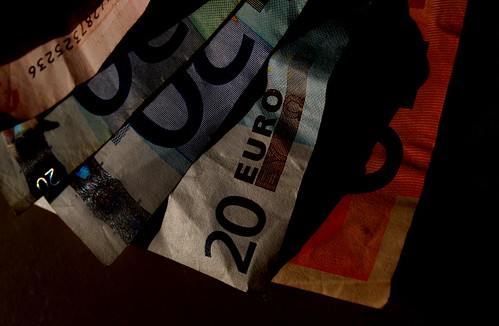
It's a measure of how far the Greek political system and its supporters in the local media are out of touch with the rest of the country that the recent uproar over the remarks by Jean Claude Juncker, head of Euro Group that been the subject of some much air time and print columns during the last few days. According to an off the record remark made by Juncker in Washington a Greek prime minister told him that Greece was a country of corruption, a revelation on par with learning that the French eat rather a lot of cheese or that it can get awfully cold in Russia.
The fact that Greece has one of the highest corruption indices in the European Union or that the present PM, Giorgos Papandreou made much the same comment after taking power in 2009 seems to have been ignored by the Greek political establishment and the country's media who went into a feeding frenzy in their attempts to identify which Greek PM had made such an outrageous statement. Kostas Simitis, head of the 2000-2004 PASOK run administration, Kostas Karamanlis, PM from 2004 till 2009 and finance minister Giorgos Papankonstantionou on behalf of current PM Giorgos Papandreou all rushed to say that they had said no such thing. (Juncker later made a statement saying that it was Giorgos Papandreou)
And so it has gone on, with endless speculation in the press as to exactly let the cat out of the bag. The fact that the Greek state is corrupt, of course comes as absolutely no surprise to anyone living in the country. Indeed Transparency International calculated that Greeks spent an average of 1355 euros in bribes in 2009.
Actually, the problem is not that the Greek political establishment turns a blind eye to corruption (see the Vatopedi land swap scandal) but rather everyone now knows. Worst of all, foreigners know just how venial Greek politicians are. How embarassing when one is putting one's best foot foward in Brussels, Strasburg or Washington that the rest of the world sees you as little more than a robber baron. For people as image conscience and ego driven as Greek politicans in power this comes as a terrible blow.
Perception, rather than reality is everything which is one of the reasons why the country is in such as mess. Why bother attempting to make difficult political decisions when all you need is a handful of IOUs and promises which you may or may not honour. Even now the opposition New Democract leader, Antonis Samaras is touring northern Greece in the run up to November's local elections giving his word to open factories, fund development and the like knowing full well that he would have no more financial freedom than the current PASOK administration to act. (The fact he was a cabinet minister in the previous government which ran up such huge debts seems to have slipped his mind at present).
Such a cavalier attitude to the truth also explains the chronic distrust of the average Greek concerning any promise politicians make. Indicative of this is the refusal of truck drivers to end recent industrial action despite promises by the government to discuss their demands. It wasn't until the proposals were put in writing that truckers agreed to stop strike action. Of course truck drivers know that even written reassurances mean little to politicians but it does give them a little less wiggle room.
But while the country's TV talking heads and their partners in crime and print have talked endlessly about what Juncker's statement means the country slides ever deeper into depression (both financial and psychological) with schools unable to pay fuel bills, hospitals running out of medical supplies and and an angry electorate bracing itself for a winter with 30% hikes in heating costs. For many patience is running out with the endless self - referential charade of the current political setup.
Just one more thing to consder, though when considering the role of corruption in the current financial debacle is that Iceland, whose per capita debt is even greater than Greece's, was ranked the world's 7th least corrupt government (Athens came in at 71) in 2008.
Saturday, October 09, 2010
One may smile and smile and be a villain
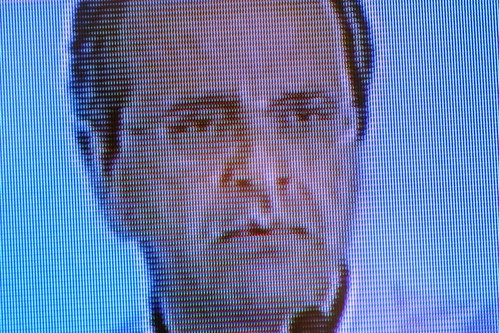
Αντώνης Σαμαράς - Antonis Samaras, originally uploaded by Teacher Dude's BBQ.
As leader of the main Greek opposition party, New Democracy, Samaras in campaigning hard in the run up to the local elections in November. The vote is likely to be a crash test for the country's two largest parties who between them have dominated parliamentary politics for the last three decades and are seen by many people as the cause of many of the financial woes Greece faces.
Despite the fact that until 2009 the conservative New Democracy party, of which Samaras was a senior member of, the party is insisting that they had nothing to do with the massive deficicit that triggered the EU/ECB/IMF bailout and the concurrent austerity measures which have brought the economy to its knees.

According to Samaras the fact that his party lied consistently about Greece's debt load (stating repeatedly in early 2009 that it would not exceed 4%) is nothing compared to the revelations that then opposition leader, Giorgos Papandreou knew perfectly well that the figure was nearer 15%. A fact that didn't stop Papandreou making a plethora of election campaign promises that he knew his PASOK party woud not be able to fulfill when it took power.
Faced with the choice between two failed political entities whose leaders have repeatedly mislead the electorate and continue to indulge in a frenzy of barefaced lies and deception it's not hard to predict that the turn out for the elections will reach an all-time low. On the one hand New Democracy is selling the idea that it has a secret plan to get the country out of recession, a lie so bold that one is reminded of Richard Nixon's secret plan to end the war in Vietnam during the run up to the 1972 elections.
On the other hand New Democracy party hacks are flooding the airwaves with claims that the country's debt load is a largely a figment of PASOK party's imagination, deliberately inflated to make their conservative predecessors look bad in the polls. This must come as quite a revelation to the EU statistical agency, Eurostat which has repeatedly found yet more hidden state debt since it arrived and is beefing up its Athens team in order to figure out how much Athens really owes.
On the other hand prime minsiter Papandreou has repeatedly stated that PASOK will not introduce new austerity measures even while stating to the EU/ECB/IMF trioka that his government will take any and every step to meet the conditions of the bailout plan.
What neither party seems to have understood is that in our wired society the idea of internal and external audiences is rapidly disappearing as people use the internet to quickly gather and publish news whatever it takes place and in whatever language it is published. Yet old habits die hard and the temptation to promise anything to whoever you have in front of you without taking into consideration future consequences remains a key ingredient of Greek political rhetoric.
Airbourne

I have been looking back through some of the things I photographed when I was in England a few years ago. This was taken during the Bristol Harbour Festival.
Friday, October 08, 2010
PASOK: or how I learned how to stop worrying and love the IMF

"We will make it as long as we believe in our strength and have self - confidence" - Giorgos Papandreou, Greek prime minister talking about the country's financial crisis.
 |
"We're on the right road" Greek finance minister", Giorgos Papakonstantiou

"I can see the economic measures are already working", Teacher Dude
Thursday, October 07, 2010
How did it come to this? The roots of the current Greek economic crisis

Looking into the abyss - Giorgos Papandreou, prime minister of Greece, originally uploaded by Teacher Dude's BBQ.
This article was originally written last February but I thought that I would post it again since most of the points remain valid and especially in light of the fact that Eurostat has warned that Greek debt numbers are to be revised upwards for the years 2006-2009.
Much of the current media coverage over Greece's debt crisis is focused on how the country is going to raise the funds necessary to cover the $400 plus billion it owes creditors. Scenarios concerning the role of Germany and/or France in bailing out Athens are discussed constantly on national TV and in the newspapers and what will need to be done in order to convince Greece's European partners to cover cost of lending the billions needed just to keep the country afloat.
However, whatever happens in the coming months the question of what Greece does next in a world in which its financial choices are closely scrutinised by whatever monetary institution steps into the breach to save the country from bankcruptcy has not been addressed.
The prospect that an elected socialist government will be obliged to implement a conservative fiscal policy controlled by unelected officials raises all kinds of political dilemmas which Giorgos Papandreou's PASOK administration will have to deal with in the immediate future.
Papandreaou will be forced to challenge directly exactly those public sector trade unions which have put him and PASOK in power. In addition he will be forced to cut areas of spending which have been used by successive government to ensure political support.
The prospect of a place in the Greek civil service has long been the source of political power for parties on the right and left of the political spectrum. This combined by the promise of public sector contracts to economic elites in the private sector form the basis of the country's feudal political structure and in no small measure contributed to its present woeful economic situation.
Instead of land and power being swopped for military service the present Greek version of feudalism sees votes and political support flowing up the system in return for public funds and the influence it garners flowing downwards. It is a structure of patron-client relations which links the heads of the major parties to the humblest villager and is the lifeblood of modern Greek politics.
The ebb and flow of such influence and the complicated web of personal, familial and political relations that it engenders helps explain much of the apparent confusion and chaos of modern life in Athens and other major cities. Much of the country's infrastructure is divided into a patchwork of competing fiefdoms that have formed as a result of the present political setup. Each participant owes their position and continued economic well being to maintaining the right connections with those above and below them in the hierarchy. In such a system qualifications, skill, effectiveness and ability play second fiddle to being able to stay in with those who are in a position to advance your career.
Another by - product is chronic inefficiency and confusion as its duty of every fiefdom to ensure that it gets the maximum amount of resources in order to guarantee its survival. Co-operation and cost cutting mean giving up exactly those resources one needs to make sure that money and influence continues to flow to those whose support you need.
The effects of this system also affect the private sectors as the companies competing for contracts with the public sector, a huge player in the Greek economy, do so on the basis of political, personal and family connections. In some cases this takes the form of outright bribery but many others there is the mutual understanding that favours given must at some point be returned. It is no coincidence that many of the country's richest men have media wings attached to their business conglomerations which can be used to promote or attack parties and politicians .
The upshoot of this unholy alliance is that crony capitalism and "licence Raj's" dominate the economy stifling innovation and competition. There is little incentive to cut the cost of your product or improve the quality of your service in such a system. As a result Greek companies will dominant nationally rarely have the expertise to break into developed markets where transparency means that methods used at home cannot be employed.
Whilst foreign observers often point the finger of blame at Greece's powerful public sector unions for lack of competiveness and low productivity the reality is that pay in the private sector has remained stagnant for years and that much critised worker protection laws are rarely applied to non - public sector businesses. Despite a pool of cheap, educated labour which can be hired and fired at will the private sector has done little to prepare the demands of a modern globalised economy and instead reaped the benefits of European Union's lowest wage while raising prices far beyond the rate of inflation safe in the knowledge that an invisible web of cartels and unofficial "gentlemen's agreements" mean that they will not be faced with any real competition.
It is difficult to see how an economic and political system run on such principles can reform itself in the kind of time scale being proposed by Europe and controlled by exactly those people who helped run the country into the ground in the first place. The obvious answer is that Greece will not be able to implement the kinds of reforms being demanded and that in trying to square the circle the country will tear itself apart as different social and economic groups turn on each other to preserve a semblance of their priviledges and power.
Already there has been a growing wave of political violence with terrorist attacks now forming a staple of the daily news. That combined with a burgeoning crime rate form the background to a society that appears to be gradually coming apart at the seams.
Much of the current media coverage over Greece's debt crisis is focused on how the country is going to raise the funds necessary to cover the $400 plus billion it owes creditors. Scenarios concerning the role of Germany and/or France in bailing out Athens are discussed constantly on national TV and in the newspapers and what will need to be done in order to convince Greece's European partners to cover cost of lending the billions needed just to keep the country afloat.
However, whatever happens in the coming months the question of what Greece does next in a world in which its financial choices are closely scrutinised by whatever monetary institution steps into the breach to save the country from bankcruptcy has not been addressed.
The prospect that an elected socialist government will be obliged to implement a conservative fiscal policy controlled by unelected officials raises all kinds of political dilemmas which Giorgos Papandreou's PASOK administration will have to deal with in the immediate future.
Papandreaou will be forced to challenge directly exactly those public sector trade unions which have put him and PASOK in power. In addition he will be forced to cut areas of spending which have been used by successive government to ensure political support.
The prospect of a place in the Greek civil service has long been the source of political power for parties on the right and left of the political spectrum. This combined by the promise of public sector contracts to economic elites in the private sector form the basis of the country's feudal political structure and in no small measure contributed to its present woeful economic situation.
Instead of land and power being swopped for military service the present Greek version of feudalism sees votes and political support flowing up the system in return for public funds and the influence it garners flowing downwards. It is a structure of patron-client relations which links the heads of the major parties to the humblest villager and is the lifeblood of modern Greek politics.
The ebb and flow of such influence and the complicated web of personal, familial and political relations that it engenders helps explain much of the apparent confusion and chaos of modern life in Athens and other major cities. Much of the country's infrastructure is divided into a patchwork of competing fiefdoms that have formed as a result of the present political setup. Each participant owes their position and continued economic well being to maintaining the right connections with those above and below them in the hierarchy. In such a system qualifications, skill, effectiveness and ability play second fiddle to being able to stay in with those who are in a position to advance your career.
Another by - product is chronic inefficiency and confusion as its duty of every fiefdom to ensure that it gets the maximum amount of resources in order to guarantee its survival. Co-operation and cost cutting mean giving up exactly those resources one needs to make sure that money and influence continues to flow to those whose support you need.
The effects of this system also affect the private sectors as the companies competing for contracts with the public sector, a huge player in the Greek economy, do so on the basis of political, personal and family connections. In some cases this takes the form of outright bribery but many others there is the mutual understanding that favours given must at some point be returned. It is no coincidence that many of the country's richest men have media wings attached to their business conglomerations which can be used to promote or attack parties and politicians .
The upshoot of this unholy alliance is that crony capitalism and "licence Raj's" dominate the economy stifling innovation and competition. There is little incentive to cut the cost of your product or improve the quality of your service in such a system. As a result Greek companies will dominant nationally rarely have the expertise to break into developed markets where transparency means that methods used at home cannot be employed.
Whilst foreign observers often point the finger of blame at Greece's powerful public sector unions for lack of competiveness and low productivity the reality is that pay in the private sector has remained stagnant for years and that much critised worker protection laws are rarely applied to non - public sector businesses. Despite a pool of cheap, educated labour which can be hired and fired at will the private sector has done little to prepare the demands of a modern globalised economy and instead reaped the benefits of European Union's lowest wage while raising prices far beyond the rate of inflation safe in the knowledge that an invisible web of cartels and unofficial "gentlemen's agreements" mean that they will not be faced with any real competition.
It is difficult to see how an economic and political system run on such principles can reform itself in the kind of time scale being proposed by Europe and controlled by exactly those people who helped run the country into the ground in the first place. The obvious answer is that Greece will not be able to implement the kinds of reforms being demanded and that in trying to square the circle the country will tear itself apart as different social and economic groups turn on each other to preserve a semblance of their priviledges and power.
Already there has been a growing wave of political violence with terrorist attacks now forming a staple of the daily news. That combined with a burgeoning crime rate form the background to a society that appears to be gradually coming apart at the seams.
Tuesday, October 05, 2010
Despite crisis business as usual for Greece's politicians
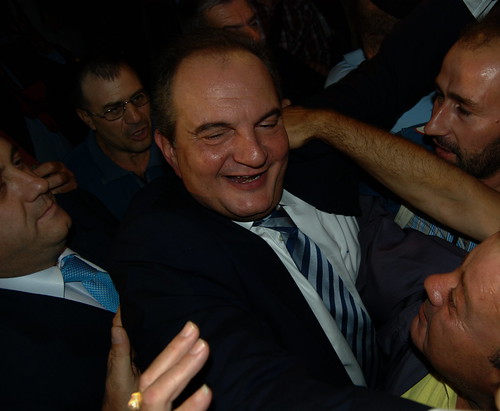
Κώστας Καραμανλής - Costas Karamanlis. Prime minister of Greece, originally uploaded by Teacher Dude's BBQ.
Towards the end of the ex - Greek prime minister, Konstantinos Karamanlis's second term yet another corruption scandal erupted which would ultmately be the death knell for the ruling conservative New Democracy party in the 2009 general elections. After less than two years in power the party founded by his uncle, also called Konstantinos Karamanlis in 1974 lost power to the left of centre PASOK party lead by Giorgos Papandreou, son and grandson of previous Greek PMs Andreas and Giorgos Papandreou.
The revelations that senior New Democracy officials had collaborated in a highly dubious land swap in which a remote lake in the north of Greece was exchanged for a large piece of prime Athens real estate outraged public opinion and ultimately ended in Karamnlis calling for early elections.
The details of the deal which featured the Greek Orthodox monastery of Vatopedi are as convoluted as they are legally dubious. However, an insightful article in Vanity Fair by Michael Lewis paints a lucid, if dark picture of corruption and lawlessness at the heart of the Greek political establishment. According to Lewis it was exactly the ability of polticians to operate without oversight or restraint that helped create the present financial crisis and massive debt load.
Yet even as the country set to enter its third year of recession with the prospect of still more cuts and the economy set to shrink even further the the political establisment in Athens are still playing the same constitutional games, seemingly untouched by the financial maelstrom embracing Greece. Evasions, denials and endless parliamentary manouevering still rule the day and even after the appearance plethora of evidence indicating wrong doing the former prime minister of Greece can say that neither he, nor his administration have any repsonsibility for either the Vatopedi scandal of the dire state of Athens's coffers.
It would be nice to think that by ousting a corrupt government Democracy has once more won out. The reality of the situation is that one corrupt poltical oligarchy has been replaced by another. The current rulers of Greece, PASOK have a rich history of scandal and corruption which has been not resulted in a single conviction, The Sieman's bribery case and a list of pay offs by other German firms to PASOK officials in the run up to the 2004 Olympic Games has also been put on the parliamentary back burner, to be quietly dropped at a future date.
Given that the current political scene is full of exactly those officials who presided over the creation of Greece's present woes its is very hard to have faith in their ability to not repeat the mistakes of the past. In all probability the future holds more of the same just on a smaller scale reflecting the country's dire fiancial state.
It's a bitter irony that Kostas Karamanlis was elected on a reform ticket by an electorate fed up with the corruption of the previous PASOK government lead by Kostas Simitis. His promise to clean up politics and reform the dysfunctional Greek state stroke a chord with voters who hoped that the right of centre New Democracy party would change the status quo. As history has shown the differences in ideology between Greece's two largest parties are nothing compared with their inability to resist the financial temptations offered by power.
Faced with the failure of both PASOK and New Democracy to control the greed of their own officials the local elections in November may prove to be the beginning of the end of the current Greek party political scene.
The revelations that senior New Democracy officials had collaborated in a highly dubious land swap in which a remote lake in the north of Greece was exchanged for a large piece of prime Athens real estate outraged public opinion and ultimately ended in Karamnlis calling for early elections.
The details of the deal which featured the Greek Orthodox monastery of Vatopedi are as convoluted as they are legally dubious. However, an insightful article in Vanity Fair by Michael Lewis paints a lucid, if dark picture of corruption and lawlessness at the heart of the Greek political establishment. According to Lewis it was exactly the ability of polticians to operate without oversight or restraint that helped create the present financial crisis and massive debt load.
Yet even as the country set to enter its third year of recession with the prospect of still more cuts and the economy set to shrink even further the the political establisment in Athens are still playing the same constitutional games, seemingly untouched by the financial maelstrom embracing Greece. Evasions, denials and endless parliamentary manouevering still rule the day and even after the appearance plethora of evidence indicating wrong doing the former prime minister of Greece can say that neither he, nor his administration have any repsonsibility for either the Vatopedi scandal of the dire state of Athens's coffers.
It would be nice to think that by ousting a corrupt government Democracy has once more won out. The reality of the situation is that one corrupt poltical oligarchy has been replaced by another. The current rulers of Greece, PASOK have a rich history of scandal and corruption which has been not resulted in a single conviction, The Sieman's bribery case and a list of pay offs by other German firms to PASOK officials in the run up to the 2004 Olympic Games has also been put on the parliamentary back burner, to be quietly dropped at a future date.
Given that the current political scene is full of exactly those officials who presided over the creation of Greece's present woes its is very hard to have faith in their ability to not repeat the mistakes of the past. In all probability the future holds more of the same just on a smaller scale reflecting the country's dire fiancial state.
It's a bitter irony that Kostas Karamanlis was elected on a reform ticket by an electorate fed up with the corruption of the previous PASOK government lead by Kostas Simitis. His promise to clean up politics and reform the dysfunctional Greek state stroke a chord with voters who hoped that the right of centre New Democracy party would change the status quo. As history has shown the differences in ideology between Greece's two largest parties are nothing compared with their inability to resist the financial temptations offered by power.
Faced with the failure of both PASOK and New Democracy to control the greed of their own officials the local elections in November may prove to be the beginning of the end of the current Greek party political scene.
Monday, October 04, 2010
Wild goose chase
It has been a particularly difficult summer here in Greece for everyone, rising prices, galloping unemployment and deep salary cuts have made people worried about how they are going to make it through the winter, which contrary to popular myth actually exists in Greece. Hard to believe when you 're on the beach and it is in the high 30s that the temperatures here in the north often are colder than those in the UK.
To make my particular situation even more difficult was the fact that I was burgled in May, which damn near wiped me out financially at the worst possible time of the year for a teacher. So when I got the chance to apply for a job as an IELTS examiner you can imagine how welcome that news was. Despite lack of funds I managed to scrape together the money necessay to travel to Athens for the interview. I travelled through the night by coach in order to save the cost of a hotel room and kept my spending to an absolute minimum.
After a long and stressful interview I returned the same day so spending endless hours stuck in a coach during the course of the day. As you can imagine a 14 hour, 1100km round trip is nobody's idea of a fun day out.
The only problem was that the British Council wanted me to do a five day series of training sessions in Athens, which was just impossible for me financially. As you can imagine spending five days away from home staying in a hotel, eating out and commutting is a major layout even in the best of times, let alone during one of the worse periods of economic crisis in modern Greek history. So I said that it was impossible for me and could I do the training closer to home. Thankfully, the BC assured me that someting could be worked out come September. September came and no word, when I sent off emails I was first told that the person responsible was unavailable, then I was told that the training material were appropriate for groups only and finally, today I received an email saying that is no job anyway.
I am angry that this whole procedure has been a waste of time, energy and money in which I foolishly participated, thinking that I might get a job out of it. I feel that that I have been misled and that an organisation has chosen to treat people with indifference and/or contempt. It's something that I have seen a lot of here in Greece as the economic situation has deteriorated and more and more people chase fewer and fewer positions. Teachers are being seen as just another commodity which can be exploited and discarded at will. An endless stream of other applicants can take their place if they are unhappy with expoitative wages, lack of social insurance or outrageous demands.
Saturday, October 02, 2010
Athens to audit kids in bid to raise tax revenue
The Greek government is introducing "tax cards" in the new year in order that children as young as seven years old have their financial transactions recorded electronically. As ludicrous as this sounds the Finance Ministry is all set on issuing 1.5 million cards to the country's primary, secondary and tertiary level students. The idea is that when young people buy anything there will be a record available for tax purposes.
It is a typical of the fact that faced with an IRS/Inland Revenue service riddled through with corruption and inefficiency the Greek state once more requires that every citizen police themselves. A less charitable comparision can be made with Pol Pot's Khmer Rouge who used children to gather information and evidence against their parents. Had the Khmer embraced technology instead of destroying it I'm sure they would have loved this idea.
On a more practical level every single retail business in the country will be obliged to buy card readers and keep records whilst 1.5 million kids/teens/young adults will be required to keep the card on them if they want to buy anything. As you can see this is a recipe for confusion, chaos and massive cost over runs - exactly the factors that helped the country get in the mess it already finds itself in.
All this from a government that doesn't even know how many students are studying at state universties and polytechnics after nine months of asking nor how many people it employs as a whole.
Subscribe to:
Comments (Atom)