The Thessaloniki international trade fair, or Helexpo as it is known locally has traditionally been the chance for the country to present its best face to the outside world.
However, this year's event was overshadowed by violent anti- government protests organised by groups as disparate as taxi drives and doctors, football fans and soccer moms, all angry with austerity measures which have crippled the economy and brought about a financial downturn unprecedented in modern Greek history.
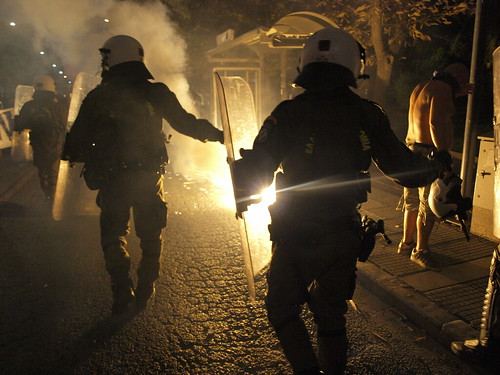
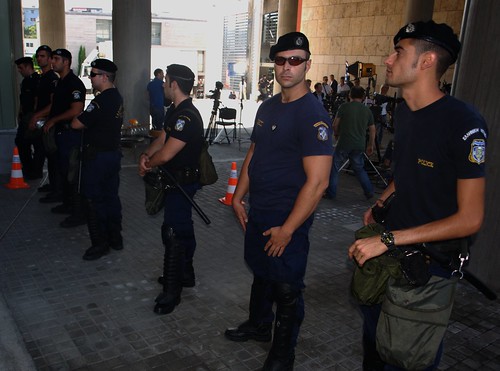
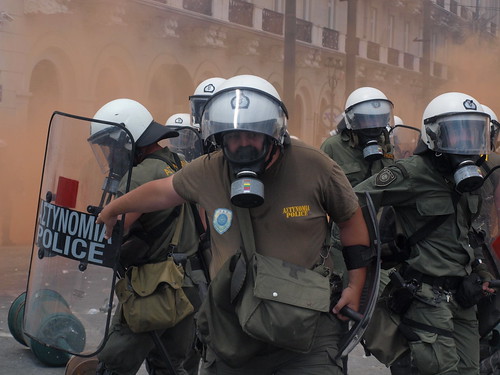
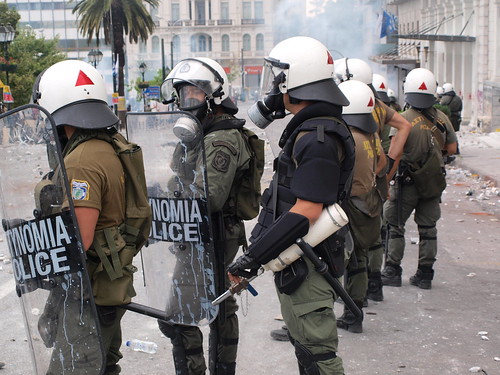
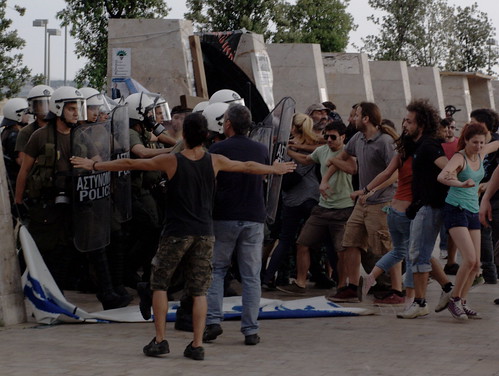
Prime minister. Girogos Papandreou gave is annual speech at the fair, the nearest thing Greece as to a state of the union address from behind a security cordon manned by 10-12,000 riot police armed with shields, tear gas and pistols.
The centre of Greece's second largest city of 1,2 million inhabitants was sealed off for one kilometre around the Vellidiou conference centre where the prime minister was scheduled to speak.
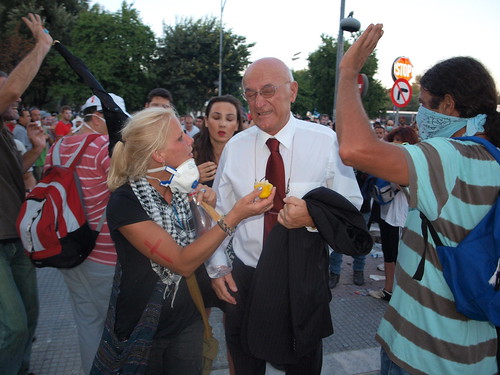
In the end the most violent protests came not from the city's large student population or anarchists but rather taxi drivers outraged by government reform measures. For over an hour thousands of driver fought with riot police units outside the trade fair.
Round of tear gas fired by the police were met with a hail of broken paving stones and several times forced them to retreat to the relative safety of the fair.
To add to the authorities woes thousands of football fans also clashed with police units in the centre as the local Iraklis FC supporters smashed shop windows and set fire to rubbish bins along the main Tsimiski Boulevard.
Clashes between students and police around the Aristotelian University of Thessaloniki which borders the trade fair also lasted into the small hours of the morning.
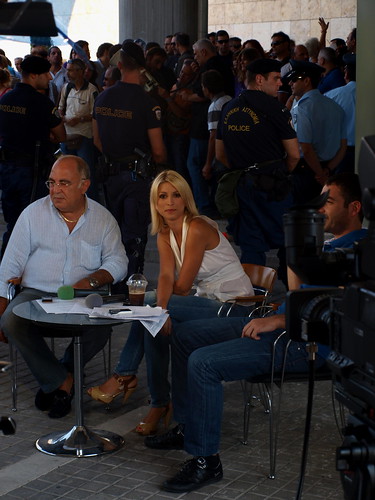
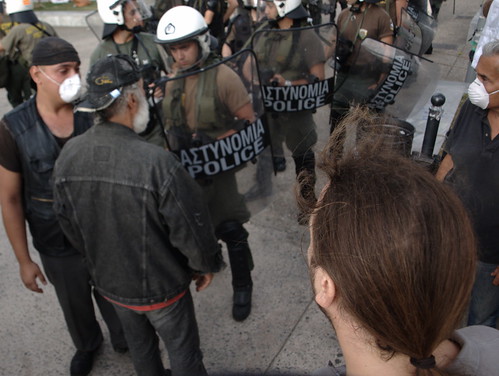
In the foreground a local TV news program with riot police forming a line to prevent protesters moving forward to demonstrate against Greek prime minister's visit to Thessaloniki town hall.
The media here, especially that funded by the state (as is the case with the station pictured above) is little more than publically funded propaganda designed to present those in power in the best possible light. Dull, biased and impossibly amateur these channels pump out a daily diet of press announcement and valedictory speeches which the vast majority of viwers simply ignore.
Since selection and promotion within such organisations depends on connections (bothe personal and political) and above loyalty to ones superiors quality and talent are often after thoughts which explains why so much money buys such bad TV.
Greek prime minister, Giorgos Papandreou is visiting the country's second largest in the run up to his annual address to the nation which traditionally marks the opening not only of the international expo but the new political season.
With coffers empty and yet more austerity measures soon to be imposed Papandreou's popularity is at an all time low as groups as diverse as dentists and taxi drivers, cleaners and surgeons are taking part in anti-government protests.
The city centre resembles less a trade fair than a city under seige with thousands of quasi-military riot police on stand by around strategic public buildings and the Makedonia Palace hotel where the prime minister and much of the cabinet will be staying for the weekend.
The real show of strength will be tomorrow when thousands of demonstrators have vowed to shut down the centre and do everything in theirpower to prevent the beleagured leader from giving his key note speech to the nation.
As of last Friday I no longer contribute to the Demotix website. For those who do not know them, Demotix bills itself as an;
"award-winning newswire where YOU tell the stories. We put photos and video from ordinary people and freelance photographers into the international news media."
When I started to upload photographs and news stories I was hoping that the site would be a serious replacement for other citizen journalism news hubs I had previously worked with. I was hoping that unlike these others Demotix would not degenerate into a centre for crack pot ideas and conspiracy theorists desperately trying to convince us that Hitler's brain was living on Mars.
In that respect Demotix has suceeded by retaining editorial control over content and judicious choice of what stories it promotes. So why am I leaving? The first and most obvious reason is the seemingly endless list of technical difficulties that mean uploading photographs (forget video,where problems grew exponentially) and stories can take hours and many repeated attempts.
If you're sitting in the comfort of your own home, an hour of two wasted now and then may not mean much but when uploading more often or you're outside in difficult conditions, such delays are infuriating.I remember cursing the site with every swear word I possess in both English and Greek when trying to upload a story from the Athens riots which was written on a rapidly dying laptop in an arcade filling up with tear gas.
Despite recent attempts to improve. every upgrade simply changes the nature of the bugs rather than their frequency, it seems. The last straw was on Friday when an entire story just disappeared from before my very eyes never to be seen again. With my main job about to start again I do not have the time to spend two, three hours nursing a story through defective software.
The other problem I have with Demotix is over payment or rather the lack of transparency over what is being sold, where and for how much. By chance I happened to come across some of my images that had been licenced to the Wall Street Journal and some Danish news sites yet no mention was made of this either via my account on Demotix or email. Later a member of the Demotix staff assured me that all the details of these transaction would be made available to me within the following days. That was over a month ago and still no update of my sales has appeared in my account data in Demotix.
As you can imagine this lack of feedback is both disappointing and frustrating and has confirmed my decision that Demotix is not the place for me.
Despite the fact that the Greek academic year has yet to begin, students in universities and polytehnics across the country are already gearing up to resist contoversial reform programme being introduced by minister for education, Anna Diamantopoulou.
According to student leaders over 300 department in institutions of higher education nationwide are now being occupied by students unhappy with changes designed to overhaul Greece's ailing universities and technical schools. For protesting students and academics the reforms are little more than than a cost cutting exercise being foisted upon Athens by its international creditors anxious to bring public spending down.
Amongst the most contested elements in the reform package is the abolition of the country's campus asylum laws whch mean that the police are only allowed to enter university/polytechnc proprty at the inviation of the dean. Such laws ahve long been a thorn in the side of the authorities as it means that institutions of higher education are essentially off limits to the police.
Today students took part in demonstrations nationwide, in the northern port city of Thessaloniki between two and three thousand students marched peacefully through the centre of the city.
The latest wave of protests in yet another headache for the ruling PASOK party whose austerity measures have been opposed by an ever widening section of Greek society and has seen groups as diverse as taxi drivers and doctors clashing with the authorities. With popular support at record low levels prime minister Giorgos Papandreou attempts to implement deeply unpopular economic measures demanded by the IMF and EU are in danger of failing completely.
It's that time of year again. The 76th Annual Thessaloniki Trade Fair approaches once again and the local political hacks, in order to look good for their political masters in Athen look to spruce up the city.
Usually, this takes the form of expensive vanity projects within walking distance of the trade fair and the hotel in which the prime minister and the rest of the cabinet stay. A tradition that the current PM is unlikely to break given the problems with public order that are caused every time high raking government official appear in public.
This year in order to do something the local town council has decided to lop down a number of fine old trees in the part near the hotel and build a "sculpture park".
In a time of direst austerity, in a city where one in four is without work and many do not have the money even to pay their power bills such vandalism and extravagance is a public slap in the face and yet another reminder of how far the country's political leadership is out of touch with the average voter.
Traditionally, August has always proved to the most dangerous month in Greece for forest fires. High temperatures, strong winds and difficult terrein have always proved a lethal combination for the nation's wooded areas.
This time it is the turn of the northern port of Thessaloniki to be the latest victim of forest fires which broke out this afternoon in the Seix Sou district, close to the city's zoo. The fire which is still raging burnt woods around several residential areas but so far there have been no reports of either burnt homes or casualties.
According to latest official reports the fire which is being fought on three different fronts is under partial control with several fire fighting aircraft taking part in the operation.
The Seix Sou areas was devastated in 1997 when a similar fire destroyed much of the pine woods surrouding Greece's second city.
For The political background to Greece's forest fire crisis
"Interagency coordination obstacles and a weakened forestry service continue to threaten Greece's ability to adequately protect its forests, wild lands, and meet climate change targets. Greece recently agreed to associate with the Copenhagen Accord through the EU (ref A), but by not addressing its growing wildfire problem, it leaves a significant gap in its climate change priorities.
Post has engaged many forest policy officials, pressing for a forest protection policy based on prevention rather than focusing on reactive measures. Greek officials have been thankful for U.S. support, primarily U.S. Forest Service (USFS) training through a $2.1 million USAID package that is set to run out in 2010. In recent meetings, Greek officials have been somewhat responsive to Post's engagement, stating their hope to establish legal forest boundaries and ramp up public prevention campaigns.
As the wildfire season approaches, Post continues to encourage responsible policy from the Government of Greece (GoG) to protect the country's natural environment, as part of the global effort to combat climate change."
It's 40 years since Easter Germany or to give the defunct state its full title, The German Democratic Republic (GDR) set about erecting a wall around the western sector of Berlin and so cutting off contact between the citizens of the capitalist West and socialist East. In it's way the wall or "Anti Fascist Protection Rampart" was an admission of failure on the part of the East Germans, a sign that they could not convince their own people to resist the siren call of the West with its democratic right, shiny consumer goods, fresh fruit and veg.
Likewise 40 years on another barrier was erected recently here in Greece, hastily thrown up, almost overnight it does not rival its German counterpart in either in size or durability but does, it its own way signal the end of a dream and is, like the Berlin Wall, also an admission of failure on behalf of a government that cannot trust its own people.
On the seafront of Thessaloniki, Greece's second largest city, a 1km chain link fence has been erected around the luxurious 5 star Makedonia Palace hotel and though no official announcement has been made the purpose of the barrier is clear to anyone familiar with local politics. The hotel will, as it does every year play host to Greek prime minister, Giorgos Papandreou and most of the cabinet who decamp from the capital to attend the opening ceremony of the Thessaloniki International Trade Fair.
The event, which marks the official start of the winter political season, involves the prime minister talking to the country in the nearest thing Greece has to a State of the Union address. It also marks an opportunity for trade unions and activists to flex their muscle in run up to the coming parliamentary session. Even in normal times the trade fair is a tense affair with both sides indulging in a show of strength and often with clashes between the more "warm blooded" participants and the police.
However, these are not normal times in Greece; the ecomony continues to shrink at an alarming rate and unemployment is soaring, especially here in the north. On the other hand the ruling PASOK party, which is barely able to muster 16% in opinion polls has nothing to placate disgruntled civil servents, trade unionist and voters general. The EU/ECB/IMF austerity measures have crushed consumption and put the Greek economy on life support. Worst of all, any hope that such cuts in public spending will help improve people's prospects in the short term have proven illusionary and as a result there is a ground swell of popular dissent which will probably find a new focus coming the prime minister's visit and hence the fence.
Like the Berlin Wall the fence also marks the end of a dream as it is concrete evidence of the growing divide between ruler and ruled in Greece and the end of an era for the ruling socialist party. When I first arrived in Greece at the end of the 1980's I was astounded by the popularity of the nation's political leaders, both on the left and right. In particular Andreas Papandreou, founder of PASOK and father of the present PM Giorgos Papandreou was still able to draw massive crowds numbering hundreds of thousands during election campaigns. Ironically, He often chose the Macedonia Palace hotel to give his speeches when in Thessaloniki as attendence was so massive that no other venue could acommodate everyone. For miles in either direction the seafront would be full of eager PASOK supporters following the speech via a long line of loudspeakers that stretched from the port to the old fun fair, a distance of no less than four miles.
But that era has long since disappeared, a victim of the rise in TV campaigning and a growing disillusionment with not just PASOK but the entire political scene in Greece. Instead of a sea of adoring fans Papandreou Junior is forced to erect fences which undoubtedly will be manned with thousands of riot police to defend himself against the very same people who once so ferevently supported his party.
Of course, you can only take a comparison so far, and the fence around the hotel, unlike the Berlin Wall will not be manned by soldiers with shot to kill orders and most of those fleeing Greece are going to escape poverty and not political oppression but there are enough similarities between the two to warrant a reappraisal of what exactly is the relationship between Greece's political elite and those it purports to represent.
A couple of weeks ago I went with my daughter and her friends to a free open air concert in the centre of Thessaloniki. The perfect antidote to the doom and gloom of recent months.
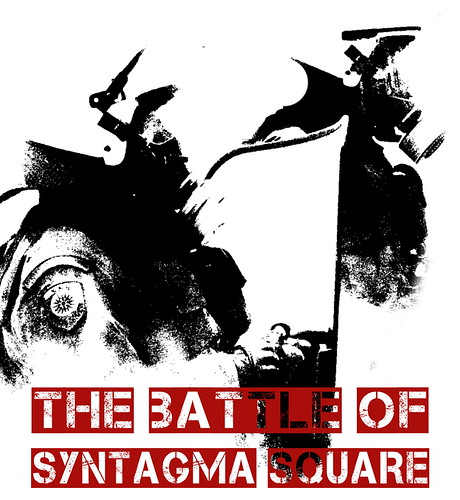
This was just one of the hundreds of acts of police violence commited by Greek riot squads during the 29th June, the vast majority of attacks were directed at peaceful protesters who'd gathered in Syntagma Square, central Athens to show their disagreement with the latest round of Government austerity measures which has brought the country to its knees economically.
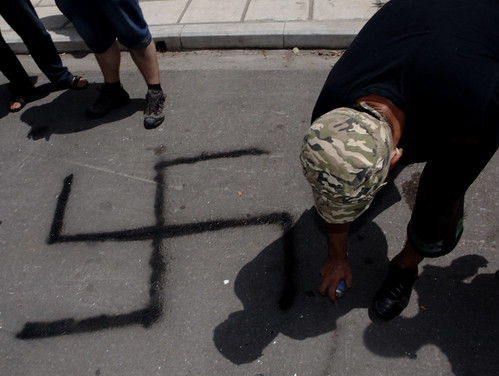
Despite the onset of Summer Greek protests show no sign of dying down despite the witheringly high temperatures of a Mediterranean heatwave. In Greece's second largest city, Thessaloniki members of the local anti-government "Indignant" movement this afternoon picketed the city's German consulate, shouting anti-German and anti EU slogans and spraying swasitikas on the pavement outside the main entrance.
Demands including the repayment of unpaid war reparation from Germany for the destruction caused by the Nazi occupation of Greece from 1941-1945. In addition German insistence of tough austerity measures has seen a massive upswing in anti-German feeling from across the political spectrum, a sentiment flamed by the repeated acusations that German corporations such as Siemens and HDW systematically bribed leading Greek politicians in order to win lucrative arms and security contracts
Occasionally, things happen that takes time to process or require distance to filter them through memory till they start to take on the contours of anything that can be explained in a meaningful way.
It has been over two weeks since I went to Athens to take part in the anti-government rally on the 29th June. Tagging along with a group of 400 "indignant" as the Greek protesters call themselves I found myself waiting at midnight outside the White Tower in the centre of Greece's second largest city, Thessaloniki with a bunch of people who resembled less a group of serious demonstrators than over aged participants in a school trip. The joking and jostling for position, who sits next to whom, brought back memories of similiar journeys as a kid.
Arriving in Athens the next morning we wasted no time and no sooner had we clambered off the coaches than a banner was unfurled and people took to the road to march and shout out chants, announcing to all who cared to listen that the northern contingent was in town and looking to join their big city counterparts in Syntagma Square. The Square which faces the houses of parliament has, for much of modern Greek history been the focal point of clashes between disgruntled citizens and their rulers.
As soon as we entered the square than many of us were overwhelmed with tears, though this was less to do with any emotion than the residue of tear gas that had been used the previous day and which still coated much of the area. Luckily for us, one of the leaders knew exactly where we could equip ourselves with gas masks and goggles that later would prove so vital for anyone who wanted to stay in Syntagma.
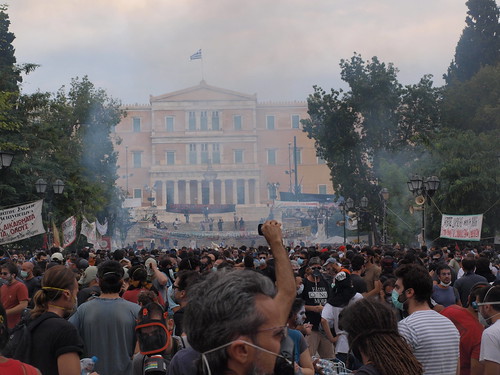
In the crowd that was massed in front of the parliament the atmosphere was a strange mix of carnival and demo, on the one hand people were in a upbeat mood with some present dancing to music played by drummers yet the underlying feeling of tension and anger was apparent to anyone familiar with Greeks and Greek culture.
Another interesting point was the "ideological" composition of the rally, which seemed to embrace a wide, if not contradictory range of political opinions. In the centre where trouble would later start were the "patriots" as I termed them, who were convinced that the entire Greek debt crisis was the result of American born prime minister, Giorgos Papandreou's collusion with the Jewish banking nexus, with a measure of masonic conspiracy theory thrown in for good measure.
On the other hand every shade of left wing opinion including the anarchists also had their own blocks. In the middle, a mass of others who identified with none of the available political choices but were convinced that the austerity law being debated was a disaster for the country and wanted send a message to those inside parliament.
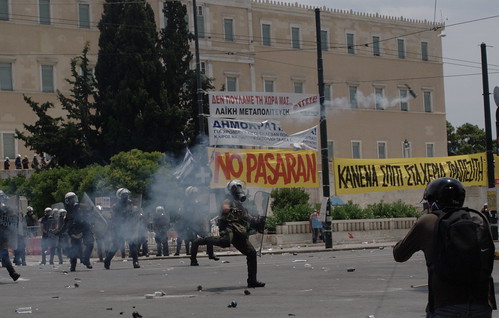
The real panic began at 1.30pm when news that the austerity vote had passed became known, leading to a group of about 100-200 next to the barriers outside parliament to rush the police. The charge was quickly stopped when riot police units started firing tear gas and the demonstrators quickly retreated. Taking this as a cue a group of about 50-100 youths started pelting police lines from nearby the Grand Bretagne hotel and and the police intervened effectively the violence would have probably been over within a few minutes.
However, riot police units then took the attack as an excuse to lauch a concerted assault on the rally from five different directions, using thousands of tear gas cannisters, flash grenades and other weapons. The result was a generalised onslaught on anyone still remaining in Syntagma who were all perceived by the police as rioters, even though the vast majority were protesting peacefully and had nowhere to flee to.
Assualts by the police continued inside Syntagma and throughout much of the centre of Athens for the rest of the day, with hundreds being hospitalised with breathing problems or the result of beatings by the police who in many situations acted more like football hooligans than the agents of law and order.
How to describe the horror of seeing a pack of 10 officers kick and beat a man in front of my eyes, or the anger generated when a protesters who talked back to a policeman was repeatedly punched in the face by a another cop. It was scenes like these that infuriated many present and created a much wider circle of people, many older men and women willing to throw stones and other objects at the police.
I repeatedly saw demonstators plead with riot squad units to stop attacks and who intervened to calm down fellow protesters but often their attempts to play peacemaker were thwarted by the police themselves who lashed out at anyone who approached them or grabbed people, seemingly at random.Each time this happend yet another wave of anger rippled through those nearby.
This pattern of violence and over reaction repeated itself through the day and lead me to the conclusion that the violence of the police was not simply a lack of self control but part of a plan by the authorities to empty the square and put down the Indignant movement at all costs. I doubt if anyone in government uttered those words but I'm pretty sure that the police leadership was left with no illusion about what their political masters wanted done about the situation.
Another infuriating aspect of the day's events was the foreign coverage of the rally which seemed to misunderstand the gravity of the situation, For most of the foreign press crews the story as yet another clash between Greek "anarchists" and the police so ignoring the wider implications of a massive police surpression of a mainly peaceful protest movement.
I'm not sure if this was simply journalistic laziness or the result an agenda that much of the mainstream media often bring to news stories.I remember arguing with some smug US TV anchorman next to me who was waffling on about how futile the protests were as if it was a tired theatrical show that has outstayed its welcome rather than the desperate fight by ordinary Greeks for a viable future. This unwillingness or inability to look beyond the dramatic images to get to a deeper truth has marked much ofthe reporting from Syntagma and the Greek crisis in general.
Later as the day wore on my nerves and stamina dwindled the constant threat of attack by the police or injury by flying objects from both sides plus the experience of being tear gassed took its toll and even the adenaline jolt of being in a highly charged conflict wasn't enough to keep me going . So I went to a cafe to send off pictures and comment to Demotix. yet even there the atmosphere was heavy with tear gas and I ended up sitting at a table in a mall wearing a mask while tapping out my story.
Towards midnight I carefully made my way back to Syntagma Square which now resembled a war zone with fires burning and the much of the surrounding area looking as if it had been used for target practice to get to the subway station to meet up with the other protesters from Thessaloniki who were going back by coach from Monestiraki.Even inside the station the regular thud of flash grenades going off near the entrance gave the impression that we were in an air raid.
Even though I have seen lots of upheaval in Greeece, including the violent uprising in December 2008 the level of violence I witnessed in Syntagma was of a new order of magnitude and it seemed that it was ushering in a violently different relationship between the Greek government and the people they are supposed to represent.
In many respects the situation in Britain closely replicates the situation here in Greece as far as the media is concerned. In both countries media conglomerates are owned by the very rich who do not hesitate to use their position to set the political agenda in order to ensure their interests are either protected or extended. In this they are assisted by both journalists and politicians eager to curry favour with owners in return for the kind of publicity that will advance their careers.
As for the rest of us, we are just treated as rather silly children who must be seen but not heard, occasionally a few of us are asked our opinion on the issues of the day but this is little more than window dressing, and is no way is allowed to interfere with the media's real job which is promoting the views of the wealthy and powerful.
I suppose those living in Greece should be thankful that the local media corporations are less practiced in the dark arts of spin than their UK counterparts and so their efforts often fail to convince, either that or Greeks, long accustomed to the constant media drone of state and non state propaganda are less credulous than UK consumers and so more cyncial about whatever claim or counter claim the media chooses to make.
Following the flame out at News International it is time once again to look at the simmering conlict between old and new media or perhaps more accurately between corporate embedded media and those operating outside the hermetically sealed world of political reporting. For too long those of using the new, powerful tools offered by the internet have taken traditional journalism's claims about superior accuracy and professionalism for granted.
What is emerging now in the wake of News of the World/ Times debacle is cold, hard truth is that much of commercial journalism is deeply corrupt and has no real claim to being better than the work done by bloggers and the like. When the slick presentaion is removed what really distinguishes media players from their independent counterparts? It certainly isn't integrity if the stories coming out of Wapping are to be believed.
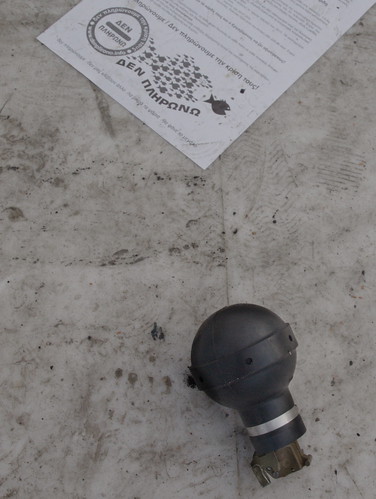
A leaflet for the "I won't pay" campaign lies on the pavement outside parlaiment in Athens, next to a used tear gas grenade, a particularly vile weapon that once lit fliesoff in all directions leaving a trail of disabling gas.
I saw several of these used by riot police last Wednesday by riot police and was always relieved when this hunk of metal which travels in the air at 50-60 kph managed not to hit anyone.
I thought the juxtaposition of the leaflet and the grenade encapsulates so much of what happened later that day. In essence a peaceful protest movement was drowned in a wave of violence and tear gas by a government terrified that it would develop even further and threaten their pwer.
Using a violent actions of a few demonstrators the police launched a sustained and savage attack on all sections of the rally leaving in its wake over 500 injured and the centre of Athens looking like a war zone, an especially damaging image for a country as dependent on tourism as Greece is. In contrast to most riot situations when the police use about 100 tear gas cannisters police sources admitted that 2860 cannisters were used on Wednesday alone.
The sense of outraged felt by those witnessing the casual brutality of the Greek police was paliable and goaded many , normally law abiding citizens to pick up whatever came to hand and fight back.
With the Indignant movement shattered, or at least geatly weakened, a false feeling of calm has decended upon Greece as people no longer take part in mass demonstrations. This is partly due to the time of year (Summer is traditionally a slow period politically) and partly a sence of futility as people have been unable to stop the austerity measures. But do not count on such emotions lasting indefinitely, with the coming Autumn the Greek government is likely to be faced by a large number of political challenges both from within and without parliament.
Already rage against the ruling PASOK party and politicians in general has lead to a series of over 90 attacks on MPs, a number which is set to rise as they return to disgruntled constituencies for the summer recess.
When I got back from Athens the first thing I did was take a shower to wash away the stench of tear gas, Maalox and fear that had hung around me since the morning. Although I have seen my fair share of violent clashes here in Greece, including the uprising in December 2008, nothing had prepared me for the sheer level of savagery shown by the Athens riot police. More than once I saw them act like wild animals, pouncing upon anyone foolish enough to stop to plead or remonstrate with them
Time and time again the police sent vollies of tear gas into packed crowds and it's only by a miracle that no one got crushed under foot as thousands of people ran panic striken from the gas and flash grenades. Nor did this stop throughout the day, from the moment the trouble started at 1pm till after midnight Syntagma Square smelt and sounded like a war zone with an almost continous series of loud explosions and renewed tear gas attacks on the Los Indignados encampment.
Even as far away away as Monesteriki (a neighbourhood about 1km from parliament) rampaging motocycle officers created havoc as they attacked peaceful protesters in cafes and tavernas and gunned their bikes along narrow streets packed with tourists drinking coffee outside.
At no point did the level of police response correspond with the threat they were facing, instead of calmly dealing with a small group of stone throwing trouble makers they launched an all out attack on five fronts against demonstrators which succeeded in provoking a furious reaction from a much larger section of the rally who had outraged by the scenes of uncontrolled police violence they were witnessing.
If such violence had been restricted to an handful of officer or units then perhaps you could talk about rogue officers acting unlawfully, but the scale and the duration of the operation left no doubt that police were under direct ordrs to do everything in their power to break up the demonstration and make sure those taking part would not regroup. In that way the country's political leadership and ultimately, prime minister Giorgos Papandreou took the decision to surpress the anti-government protests in manner more befitting the brutal regimes of Egypt and Tunisia than any EU member.
This is a decision that may buy the ruling PASOK administration some time as people reel in shock from the violence but in the long term has severely damaged, perhaps irreparably the credibility of Greek parliamentary democracy and probably will be the final nail in the coffin of PASOK as a viable political force in future elections.
In a country where folk memories of previous state violence run deep, sometimes going back generations the events of the 28th and 29th June are not likely to remain fade any time soon..
I was in Syntagma Square yesterday and it was like being in hell. I have never witnessed so much violence from the police in all the demos and protests I've covered in Greece. I saw riot police officers beat a man who'd fallen to the ground, acting for all the world like a wolf pack falling upon its prey. Pure, unadulterated savagery.
What I saw yesterday in Athens was a corrupt regime drown legitimate dissent in a sea of tear gas and violence.
The only bright spot was the extreme bravery of ordinary Greeks who defied the brutality of the police to protest and were capable of the most amazing acts of kindness to strangers even in the worst situations.
Just arrived in Athens and now along with 400 other protesters from Thessaloniki we're in Syntagma Square which looks a lot like a warzone, with used ordinance on the ground and broken windows throughout the area. There is a very strong police presence with who knows how many riot police platoons in the vacinity. Also the place absolutely stinks of tear gas, enough to bring tears to almost all those who marched into the square, hate to think what those who got te full dose of chemical warfare yesterday went through. One reliable soiurce on Twitter spoke of 270 people badly affectd by gas. The first thing I'm going to do when the stores open is buy a gas mask, no way Maalox on its own can deal with so much tear gas.
I'll also try to keep updates coming either here or via Twitter.
I've taken the plunge and signed up to join a group of Aganaktismenoi (Indiganant) who are off to take part in the anti-government rallies outside parliament in Syntagma Square, Athens.
I thought long and hard about the decision for a number of reasons, not least being could I afford to go. Also another thought weighing heavily on my mind was the possibility that the protests turning violent if the latest auterity law passes and becomes law.
Despite all those reservations I decided that I had to go for a number of reasons. First of all, I want to stand shoulder to shoulder with those who oppose these outrageous measures which threaten my and family's future for the forseeable future.
Another, equally compelling reason is the chance to see history being written, to take part and record events that I believe will be considered pivotal in the future. Since if thse kind of measues can be foisted on the Greeks you can be sure that the next targets will be Portugal, Ireland and later other EU states rolling back decades of hard won social progress.
The coach leaves at 10pm tomorrow from the White Tower and if I don't see you there hope we get the chance to meet up and chat in Athens.
Following a series of clashes between riot police protecting a far right rally and anti-racist groups, several platoons of riot police also attacked the encampment of Greece's Los indignados movement in the northern port city of Thessaloniki. Using pepper spray and flash grenades to disperse those present the police were eventually forced to retreat after camp organisers formed a human shield between themselves and angry demonstrators.
Last night I was invited to take part in the BBC News discussion on the Greek financial crisis.When I have time I'll write in more depth about the experience.
“But surely the Greeks have no choice but to accept the new austerity measures?” That was the question posed to me recently by a young BBC reporter and in its way sums up the chasm between the way the international (and much of the local) media sees the present financial crisis and how it's perceived by ordinary Greeks.
On the one hand the decision is simple, either implement the reforms demanded by your creditors or go bankrupt. The problem is many Greeks are already bankrupt, they're in the middle of the worse economic downturn in modern Greek history and after 18 months of austerity have run out hope, patience and most importantly, money.
In effect a large swathe of the population is already insolvent, especially those who were struggling to make ends meet even before the current crisis hit. For them whether the Eurozone folds or Greece defaults is a matter of complete indifference, facing as they do the prospect of losing their job, having their power cut off and seeing their children's future disappear. What the hell do they care about the state of international money markets?
For others the pressure of constant worrying about their financial situation has already proved too much. A tragic case that come to mind is an acquaintance of mine whom I bumped into a week ago, seeing her frantic and distraught I initially thought that she'd had too much sun, caught out by the sudden appearance of good weather. Later as she lay down in the shade, drinking water given by passers by I realised that she was in fact suffering from something else. Muttering constantly about how she was a suitable employee, she suddenly sat up and whipped a wad of papers which turned out to be her CVs which she then thrust into the hands of anyone near enough to take them, talking all the while about how she was a good employee and she deserved the job.
It became obvious that she was in the grip of a manic episode and that her psychological state was delicate but thankfully one of her neighbours turned up and escorted her home while she keep up an endless stream of talk about the skills she had, the qualifications she possessed.
I'm not sure what her psychological background is and whether this was a new occurence but deep in my heart I'm convinced that the current crisis has literally sent her mad. I hate to use such crude terminology but the reality of the situation is so awful coy euphemisms are just plain insulting to everyone concerned. The incident which unsettled me deeply brought home the fact that we could all be in such a position if Fortune, which seems all knees and sharp elbows at the moment pushed just a little too hard in the wrong direction.
Given the fact that nothing in the current austerity package offers anything like a way out of the current economic slump, except in some semi-mythical long term scenario, don't blame the Greeks for not putting another millstone around their neck willingly. The have lived the effects of austerity for 18 months and all it has brought it decline, depression and despair.
The vote in parliament over the new austerity legislation next week is almost an irrelevance as even if does pass the real battle won't be in the debating chamber but on the streets outside as outraged Greeks show their anger and disgust with a morally bankrupt political leadership that capitulated without a real fight.
This is the question that many foreign analysts and especially those in the north of Europe keep asking. Surely, in times of economic difficults the number of state employees should be reduced in order to help the country balance its books? The slowness with which Athens has implemented such cuts has been put down to the variously to sloth, fecklessness of the ruling socialist PASOK party and the supposed love affair Greeks have with civil service jobs.
As with most complicated economic systems the reality doesn't easily fit either into national stereotypes nor grand economic theories. To understand the reliance of the Greek state sector one has to look more closely at its role in the social, political and economic life of the country. For years the only real jobs in Greece were those in the civil service, by "real", I mean in the way most people in the developing world understand employment in the modern sense with regular pay and benefits, standardised entrance procedures and the chance of a career.
For the rest of the population the choices were either submit to whims of Greece's noriously exploitative private sector job market or be self employed. Weak private sector trade unions, the lack of legal protection, constant threat of being fired plus chronically low wages meant that for most Greeks the only way out of poverty and up the social ladder was a place in the civil service or a business of your own.
The Greek state, almost from its inception has used the promise of stable employment and reasonably high salaries to ensure loyalty for those in power and co-opt those individuals and groups who threatened the status quo. As with many authoritarian regimes public sector employment also brought with it a wide range of other benefits such as preferential treatment by orgnaisations such as banks and higher social standing in general.
When the Regime of the Colonels fell in 1974 and parliamentary democracy was restored to Greece the Left which had long been hounded and surpressed by the State was for the first time able to appeal to voters for their support openly and no longer would voters on the left be penalised or blacklisted in applications for state positions. With the rise to power of the socialist PASOK party in 1981 headed by Andreas Papandreou, (father of present PM Giorgos Papandreou) the parameters of the Greek state were expanded so as to widen access to education, health care and other benefits so making PASOK wildly popular for a generation as it opened opportunities previously undreamt of for many lower income Greeks. In doing so Papandreou also took advantage of a burgeoning state sector to continue the time honoured practice of all Greek rulers of rewarding supporters with postions on the public pay roll..
However, while new rulers could add new positions and sinecures to the state pay roll getting rid of older employees was always a problem as the public sector developed powerful trade unions aligned with exisiting political parties whose job it was to protect their members interests when administrations changed. Cut back too deeply on existing jobs and pay would trigger an angry response in the form of strikes and loss of possible backing for the union's party of choice.
However, in contrast to trade union movements in other countries the Greek unions realised that any show or weakness or compromise would invite disaster for their members when dealing with a new government all too eager to get rid of opposition within the state apparatus and reward followers with positions left vacant.
As a result you have a public sector which is built fom the ground up over decades to resist cuts in both jobs and pay and its perhaps a telling indication of the power of Papandreou, who owes his position as PASOK party leader in large part to his links with trade unions that strike action has been muted, at least compared with the 80's and 90's. Yet, the promise by Athens to privatise large swathes of the public sector combined with deep pay cuts has put that deal in jeopardy as rank and file members grow impatient with the lack of concrete action on the part of their leadership.
Few, if any Greeks have any illusions about how badly run their public sector is, they daily have to deal with its infuriating lack of responsiveness to public needs and pay huge amounts to deal with its deficiencies. So, their opposition over cuts in public spending is not based on a rosy view of the past but the hard earned, often bitter experience that if they public sector is cut back they will be thrown upon the none too gentle mercies of the private sector which will happily replace public monopolies with their own more expensive private ones in which only those with enough money will be able to afford the kind of health care, pesnions and education that most people took for granted.
Against my better judgement I found myself staying up late to follow the Greek government vote of confidence last night. Not so much to find out the result, that was a foregone conclusion after prime minister,Giorgos Papandreou's cabinet reshuffle/meltdown last week. But rather to follow the reaction of Greeks on Twitter and those gathered outside parliament in Syntagma Square, Athens.
Despite the presence of a huge crowd outside parliament the local media and especially state run TV news did their best to ignore the fact, meaning that any Greek wanting to gauge the reaction of his/her fellow citizens would have been better off going to foreign news sites than his own national media. This is a sad indictment of how mainstream news in Greece, like its political institutions considers only those within its own tight orbit worthy of attention. The rest of the population is looked upon as creatures as distant and exotic and galloping gazelles in Kenya.
I don't think many Greek Twitter users believed that the ruling PASOK government was in any real danger of falling despite the breathless commentary offered by TV stations worldwide, but their anger over the politicians in parliament flew back and forth with ever increasing intensity, tinged with a particularly Greek mixture of frustration,anger and satire.
At 2AM the final vote came in, 155 in favour of the government, 143 against and 2 absent, including rather mysteriously Dora Bakoyianni , ex - cabinet minister and the leader of the newly minted Democratic Alliance party .
Of course the markets and Grece's creditors will take the vote to mean that parliament is on track to pass the new austerity measures being demanded by ECB and German politicians and so the smart money will make a quick killing selling off position acquired during this week's market funk, knowing full well that the vote is essentially meaningless, as was last week's cabinet reshuffle in terms of winning over the Greek electorate.
The reality is that the austerity package is deeply unpopular and seen as a slow death for the Greek economy, any political group alligning itself with it faces political suicide in the next elections.Even if the legislation is passed the level of resistance towards Papandreou and the troika of lenders dictating terms is likely to grow making attempts to put it into action difficult and in the long term probably futile.
The most likely result is more street protests, large scale industrial action and the resurgence of civil disobedience campaigns such as the "I won't Pay" movement which successfully encourages drivers to not pay highway tolls and public transport passengers to ride without buying tickets.
The insistence of foreign and especially German polticians and bankers that Grece knuckle under is also feeding a groundswell of nationalist feeling, always a powerful and unpredictable element in Greek political life, though still not clearly formulated the continued pressure from Berlin and Frankfurt is drawing comparisons with Greece's painful occupation by Nazi Germany during the Second World war, a volitile analogy that does not bode well for future European co-operation.
The real showdown will come next week when the austerity package comes to a parliamentary vote, then we'll see if Papandreou will be able to hold together his fragile party alliances in the face of massive public protests and the prospect of MPs returning to their constituencies and outraged voters during the summer recess..
"Kleftes, kleftes". "Thieves, thieves" is the chant that is heard most nights outside the Greek parliament building in Syntagma Square, The slogan of a people outraged by the continued whole scale corruption and abuse of power by its political rulers.
After years of endless financial scandals ordinary Greeks have had enough and any political figure foolish enough to appear in public without a hefty police presence very soon feels that anger.
Some photoshop fun hiding a deeper truth that the entire political leadership of Greece can no longer appear in public without fear of drawing irate crowds who are outraged with the current party political set up, both on the Left and the Right.
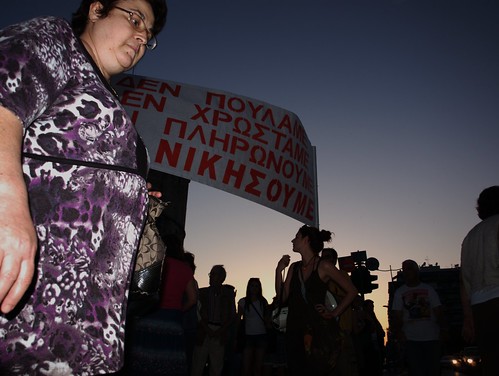
The three weeks of rallies and demonstrations in Greece have been aimed as much at a corrupt and ineffectual political elite as they are at the latest austerity measures.
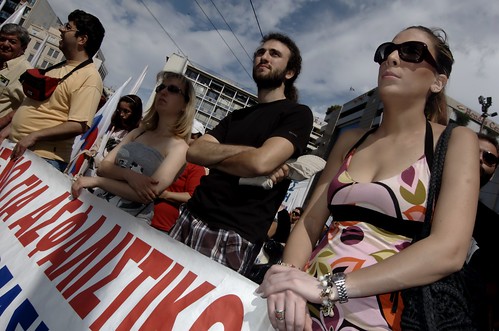
In Athens, Thessaloniki, patra and many other cities against Greece angry protsters gathered to show their opposition to the latest round of austerity measures and a political system widely reviled for being corrupt and ineffectual.
With demonstrations now entering their third week prime ministerGiorgos Papanderou is fighting a losing battle to push through legislation being demanded by Greece's creditors in return for further loan guarantees. However, resistance to the package of wage cuts, public spending reduction and privatisation has stirred up a popular movement unprecedented in modern greek political history.
Disavowing links with all established political parties Greece's Los Indignados movement has sprung up overnight using Facebook, internet and blogs and been able to bring hundreds of thousands of previously disenchanted Greeks into the political arena, setting off a political crisis the current administration is at a loss to handle.