Wednesday, March 30, 2011


Tuesday, March 29, 2011
Greek riot police clash with protesters during Independence Day parade
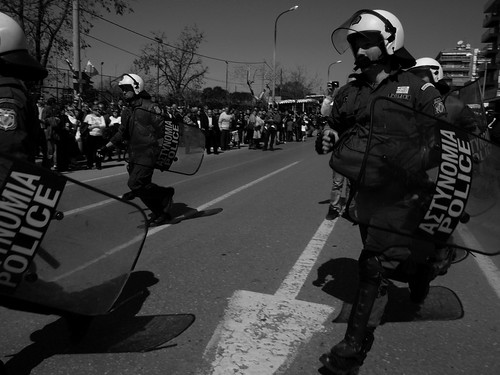
Greek riot police clash with protesters during Independence Day parade, originally uploaded by Teacher Dude's BBQ.
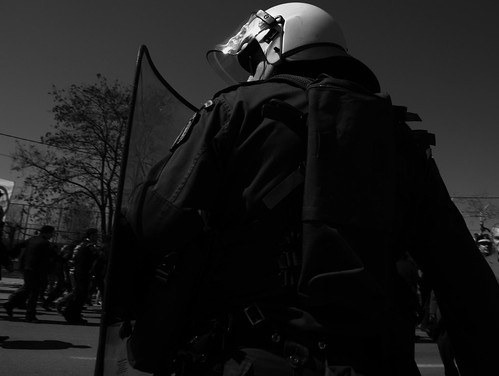
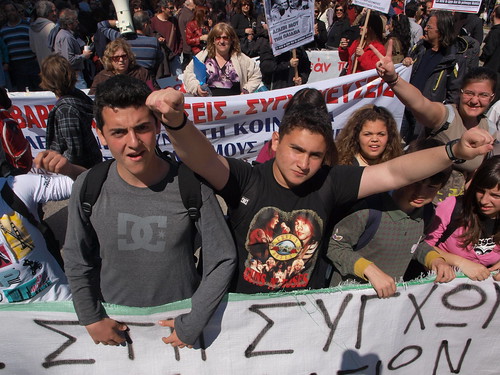
Protesters unhappy with with austerity measures and Greece's involvement in Nato's Libyan campaign demonstrated during the annual independence day parades leading to the intervention of riot police .
www.demotix.com/news/635506/greek-independence-celebratio...
Monday, March 28, 2011
The use and abuse of Wikileaks in Greece

While Wikileaks has upturned much of the way in which states interact with the media, the effects of this upheaval have only impacted Greece only tangentially with very few of the US State department cables from Athens to Washington reaching the light of day (as I write this just four are available from the Cablegate mirror site).
After an initial flurry of newspaper and TV activity the issue disappeared from public view. However with the deal between the Norwegian daily Aftenposten and the Kathimerini newspaper and its sister TV channel Skai Wikileaks has once more become part of the local media landscape. Skai investigative TV show, Oi Fakeloi (The Files) has started running a series of programs which are using the material from the cables to shed light of areas of Greek political policy such as the relationships between Athens and its neighbours.
In that respect Wikileaks has fulfilled its mandate of allowing ordinary citizens to judge for themselves decision, often taken in secret by their own governments yet the Greek media, including the corporation that owns both Kathimerini and Skai is not just a neutral means of informing people about local and world events. As the US embassy cable from Athens pointed out;
"Closer inspection reveals a Greek media industry controlled by business tycoons whose other successful businesses enable them to subsidize their loss-making media operations. These media operations in turn enable them to exercise political and economic influence."
In this respect Skai and Kathimerini are no different to other media group operating in Greece and the fact that the both have their own political and economic agenda is obvious on most days. However, while most media outlets worldwide have their own ideological "leanings" there is a world of difference between adhering to a political or economic line and using your platform to exercise political pressure to push through policies favourable to the owner.
While the journalist working on The Fakeloi are serious in their intent of getting to the truth in Greek political life they are simply a small part of the media wing which is being used to gain leverage over a democratically elected government. In the case of Skai News reporting is being used as a battering ram to get Athens to adhere to a policy of public spending cuts and greater austerity measures which is deeply unpopular amongst the population in general.
Almost nightly the ruling PASOK administration is under fire for not fulfilling some aspect of the austerity package agreed by the troika (IMF, European Central Bank and the EU Commission). On the other hand legislation or policies which follow the line set down by Greece's creditors are often lavished with praise or presented without critical analysis.
Protests, however, by Greeks over cuts in living standards or loss of livliehoods are often go unreported or are termed acts of extremism. Case in point being the recent series of demonstrations against members of the government during public appearances. Such incidents have been condemned as an attack on democratic institutions and in some reports described as acts of fascist terrorism.While one might not agree with booing politicians and pelting them with yoghurt such cases cannot be compared with say, Kristallnacht which was the line put forward by Kathimerini columnist Angelos Stangou in an article publish last week.
In such an atmosphere the decision by Aftenposten and by default Wikileaks has given a media corporation with its own very particular agenda and enormously powerful tool to blackmail those in power. If they deviate from a favourable line then the threat of damaging revelations from Cablegate can be used to prompt a change of heart. This is not what Wikileaks was meant to be about, it was not envisaged as means of extorting preferential treatment for the rich and powerful but rather giving ordinary people the means to oversee their own rulers.
Unless the remainder of the State Department cables concerning Greece are released for scrutinisation then the ideals of Julian Assange and the other founders of Wikileaks are in danger of being compromised.
Tuesday, March 15, 2011
The Tillman Story and Wiebo's War at the 13th Thessaloniki Documentary Film Festival
The 13th Thessaloniki Documentary Film Festival is in full swing and yesterday I had the chance to see two great documentaries that managed to combine compelling stories, beautiful images and a strong message. The Tillman Story is a moving account of US football star Pat Tillman who gave up a multi -million dollar contract to join the Army, only to be killed by his own side during a botched operation in Afghanistan.
Director Amir Bar-Lev and screenwriter Mark Monroe take a unjaded look at how the US military and political leadership lied about the incident in order to spin a more acceptable patriotic version of the truth. In doing so we have an insight into how the media across the board also fell in line with the official line to produce what amounted to a propaganda campaign in support of the Bush administration's foreign war policy.
However, don't let the politics put you off as Bar-Lev has produced a movie that is full of intrigue, suspense and human emotion in the raw. For those of you who missed the previous showing there is another showing at 8pm, Thursday at the Olympion cinema, Aristotelous Square (the film is in English with Greek subtitles).
The second movie I managed to catch is Wiebo's War which examines the life of a Christian community in Alberta, Canada and their struggle with oil companies who started drilling in the area. The resulting environmental destruction set in motion a series of events that would pit Wiebo Ludwig's group against both energy corporations and their neighbours. Once again we have a film with a powerful plot and beautiful images to tell a story that is both moving and has a strong sense of narrative. As a result film maker David York avoids giving the viewer the sense that s/he are being preached at. A trap into which many documentaries with worthy topics sadly fall into.
The film can be seen again at 24.00 (yikes) on Thursday at the Olympion cinema. If you are around at that time I recommend the film unreservedly.
Last but not least, Enraged December - Οργισμένος Δεκέμβρης can be seen at 3.30pm today at the Stavros Tornes theatre (in the port).
Monday, March 14, 2011
Friday, March 11, 2011
Enraged December - Οργισμένος Δεκέμβρης - Screening this Sunday

Enraged December - Οργισμένος Δεκέμβρης - Screening this Sunday, originally uploaded by Teacher Dude's BBQ.
You can see Enraged December - Οργισμένος Δεκέμβρης this Sunday 8pm at the Tonia Maretaki screen which is in Warehouse D, the port, Thessaloniki.
"What was the uprising of December 2008? Who participated? What were the causes and how will it affect the future of socio-political demands in Greece? All these questions are trying to find answers in the documentary Enraged December which was filmed by a group of people who met in Thessaloniki during the first days following the murder of Alexandros Grigoropoulos (6th December 2008) in Athens. The film attempts to describe the chronicle of revolt through the eyes of those who participated in the mobilizations during the first three highly charged weeks."
I was one of the people who participated in the making of this documentary.
"What was the uprising of December 2008? Who participated? What were the causes and how will it affect the future of socio-political demands in Greece? All these questions are trying to find answers in the documentary Enraged December which was filmed by a group of people who met in Thessaloniki during the first days following the murder of Alexandros Grigoropoulos (6th December 2008) in Athens. The film attempts to describe the chronicle of revolt through the eyes of those who participated in the mobilizations during the first three highly charged weeks."
I was one of the people who participated in the making of this documentary.
Tuesday, March 08, 2011
Thursday, March 03, 2011
Job seeker. Thessaloniki, Greece
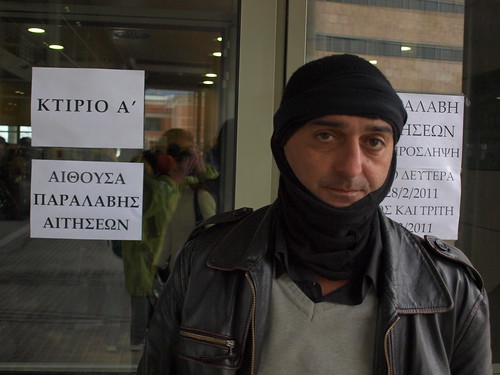
Thousands of people have thronged Thessaloniki (Greece's second largest city) city hall in order to apply for one of 900 jobs as road cleaners. Applicants include people with professional qualificatiosn such as architects and civil engineers according to local TV channels who interviewed those queing this morning.
While Athens says that unemployment nationwide is 14.9% trade unions and opposition parties claim that the figure is much higher, especially in the north which has seen much of its industrial base close down or move to neighbouring Balkan countries.
According to the latest Eurostate figures the Greek economy shrank at an annual rate of 6.6% in the last quarter of 2010, up from the 5.7% recorded in the third quarter.
While Athens says that unemployment nationwide is 14.9% trade unions and opposition parties claim that the figure is much higher, especially in the north which has seen much of its industrial base close down or move to neighbouring Balkan countries.
According to the latest Eurostate figures the Greek economy shrank at an annual rate of 6.6% in the last quarter of 2010, up from the 5.7% recorded in the third quarter.
Wednesday, March 02, 2011
Greek protesters chain themselves to government building in solidarity with 300 immigrants hunger strikers - Thessaloniki, Greece,
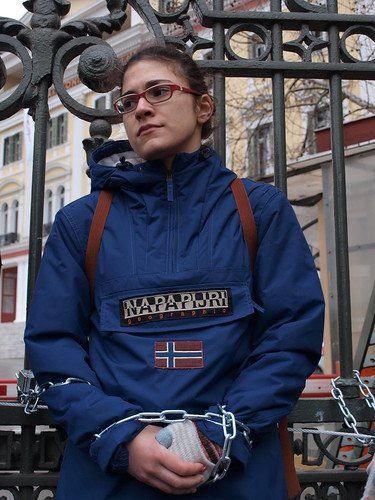
Greek protesters chain themselves to government building in solidarity with 300 immigrants hunger strikers - Thessaloniki, Greece,, originally uploaded by Teacher Dude's BBQ.
As the hunger strike by 300 immigrants in Athens and Thessaloniki, Greece enters a critical phases dozens of supporters chained themselves to government buildings in the country's second largest city, Thessaloniki in a show of solidarity.
With the protest in its second month more than 78 of the participants have already been hospitalised and doctors treating the remainder warn that unless the strike ends immediately those taking part run the risk of permanent damage to vital organs. As of Sunday hunger strikers also decided to stop taking the salt and sugar solutions. Protesters also hung banners saying "The Papandreou government kills" from the balcony of the ex-Ministry of Northern Greece.
In Athens where 250 of the 300 immigrants are based Greek riot police broke up a press conference organised by human rights groups supporting the demands of the immigrants for legal residence papers.which was due to be held outside parliament.
With the protest in its second month more than 78 of the participants have already been hospitalised and doctors treating the remainder warn that unless the strike ends immediately those taking part run the risk of permanent damage to vital organs. As of Sunday hunger strikers also decided to stop taking the salt and sugar solutions. Protesters also hung banners saying "The Papandreou government kills" from the balcony of the ex-Ministry of Northern Greece.
In Athens where 250 of the 300 immigrants are based Greek riot police broke up a press conference organised by human rights groups supporting the demands of the immigrants for legal residence papers.which was due to be held outside parliament.
Tuesday, March 01, 2011
Occupying army - Thessaloniki, Greece
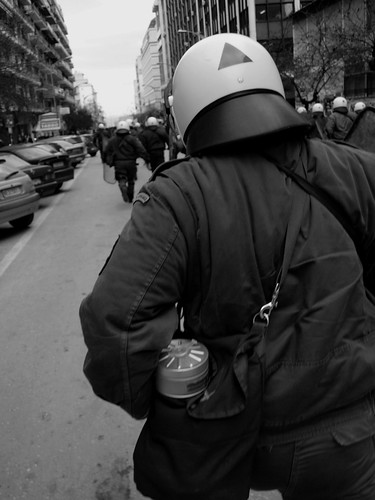
Taken during Greek riot police assault on marchers taking part in anti-government protest on February 23rd 2011.
There are moments when you cover a tense situation when the lines and boundaries and for a few brief moments you can move freely as a photographer from one side to the other. On the other the fluidity of these moments is also dangerous as you have to be aware of the possibility of attack from any angle.
Monday, February 28, 2011
Spokesman for the 300 immigrant hunger strikers in Greece addresses rally.
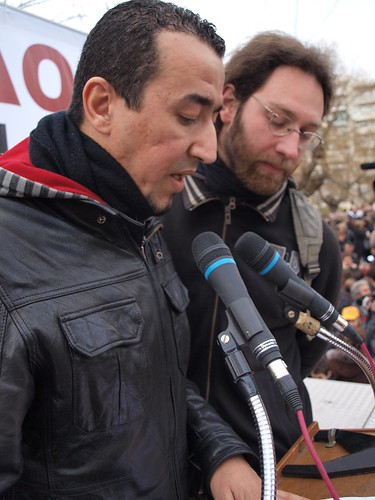
Spokesman for the immigrant hunger strike enters 35th day, originally uploaded by Teacher Dude's BBQ.
Spokesman for the hunger strikers at a rally last wednesday.
300 immigrants in Athens and Thessaloniki have entered their 35th day of a hunger strike aimed at securing residence papers.
From today onwards they will be refusing the sugar solution whicg they have been taking till now. With several hunger strikers hospitalised doctors have warned that they now risk the threat of permanent organ damage.
Greece currently grants asylum to less than 0.1% of applicants and has been repeatedly condemned by the UNHCR, Amnesty International and the governments of Sweden, Germany, Holland and Norway for its treatment of immigrants.
For more on the background to the situation check out these blogs (written in a variety of languages, including English).
hungerstrike300.espivblogs.net/
allilmap.wordpress.com/
300 immigrants in Athens and Thessaloniki have entered their 35th day of a hunger strike aimed at securing residence papers.
From today onwards they will be refusing the sugar solution whicg they have been taking till now. With several hunger strikers hospitalised doctors have warned that they now risk the threat of permanent organ damage.
Greece currently grants asylum to less than 0.1% of applicants and has been repeatedly condemned by the UNHCR, Amnesty International and the governments of Sweden, Germany, Holland and Norway for its treatment of immigrants.
For more on the background to the situation check out these blogs (written in a variety of languages, including English).
hungerstrike300.espivblogs.net/
allilmap.wordpress.com/
Saturday, February 26, 2011
Photographs and video from Greek anti-government march on 23rd February 2011 - Thessaloniki.
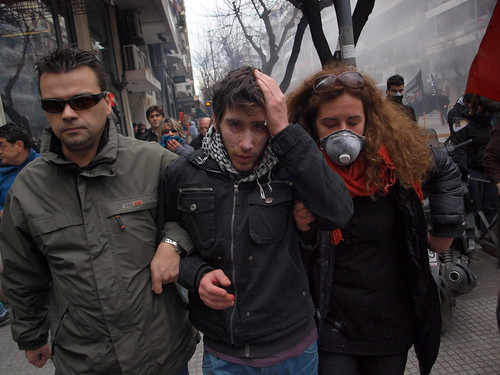
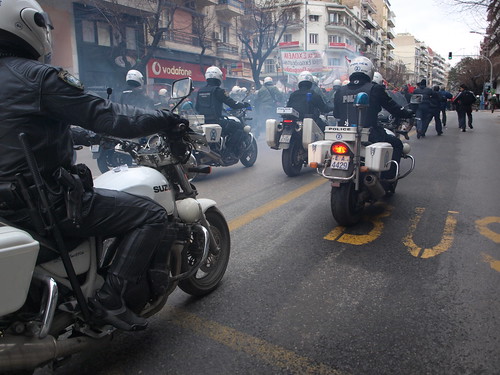
More pictures and video from the marches that accompanied the general strike last week. The person taking the video was also attacked by police officers who often employed batons and tear gas indiscriminately to break up the march. In addition to this the riot police also made extensive use of military grade ordinance which is intended for special forces anti-terrorist operations in the form of the N591 stun grenade. This is the third occasion (I've witnessed this in the last year alone. See here and here for the previous two instances).
At 8 mins 20 sec you can see footage of the police attacking the camera operator as they tried to film the arrest of a demonstrator. I also saw uniformed officers clubbing marchers on Tsimiski Street who had not been involved in any acts of violence and clearly posed them no threat.
The video was originally posted on the We Are Change Greece website which has a description of the events shown in Greek and English.
Another video from the Antipliroforisi (Anti-misinformation) site from the same demo showing police using tear gas, flash greandes and motorcycles to stampede demonstrators along the main street in Thessaloniki.
Thursday, February 24, 2011
Greek police use tear gas to break up anti-government march - Thessaloniki, Greece
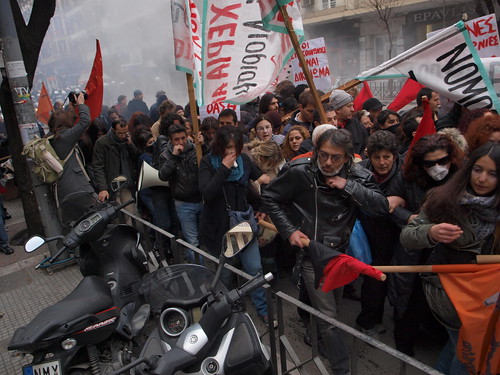
Greek police use tear gas to break up anti-government march - Thessaloniki, Greece, originally uploaded by Teacher Dude's BBQ.
Yesterday's general strike in Greece shut down much of the country's infrastructure and was accompanied by protests marches nationwide. In Athens organiser said that turnout was over 100,000 and in the northern port city of Thessaloniki between 15,000 and 20,000 too part in anti-austerity demonstrations.
The police in Thessaloniki used tear gas, clubs, flash grenades to break up the march after anarchist groups started smashing windows and tearing down bank security cameras. However, the riot units concentrated their attention on leftist groups not involved in acts of vandalism, attacking trade unionists and members of left wing groups along the length of the central Tsimiski Boulevard..
The police also used motorcyle units to chase and intimidate marchers in scenes remininscent of the unrest that followed the re-election of Iranian President Mahmoud Ahmadinejad.
Clashes continued later when groups attacked the Ano Poli police station when rocks and Molotov bombs.
The police in Thessaloniki used tear gas, clubs, flash grenades to break up the march after anarchist groups started smashing windows and tearing down bank security cameras. However, the riot units concentrated their attention on leftist groups not involved in acts of vandalism, attacking trade unionists and members of left wing groups along the length of the central Tsimiski Boulevard..
The police also used motorcyle units to chase and intimidate marchers in scenes remininscent of the unrest that followed the re-election of Iranian President Mahmoud Ahmadinejad.
Clashes continued later when groups attacked the Ano Poli police station when rocks and Molotov bombs.
Monday, February 21, 2011
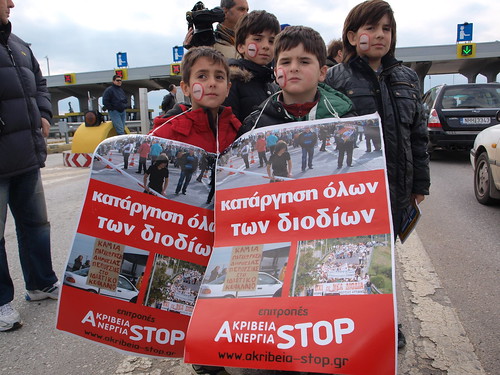
Papandreou's credibility gap widens at home.
Today the Greek government started its plan to boost the local car market by encouraging motorists to take their old cars off the road in return for subsidies of up 6000 euros on the purchase of new vehicles. The plan is according to government designed to revive the country's ailing car market which has been hard hit by the current economic crisis.
Yet the idea of paying millions at a time of major financial readjustment seems odd, especially considering the Greece has virtually no automobile industry and the vast majority of the money will go abroad. Also the fact that subsidies are designed so that the larger the car the greater the money returned (in effect, a tax break for the better off) is particularly galling when poorer Greeks are being faced with public transport price rises of between 40% and 180%
Although prime minister Giorgos Papandreou likes to give the appearance of being more ecologically minded than his predecessors the policy of promoting more car sales whilst making bus and tram use much more expensive is hardly the greenest way forward. However, such contradictions are emblematic of the ruling PASOK party's often schizophrenic policies.
Last week junior minister for education Fofi Genimata announced that introduction of a new 2.2 billion euro package designed to promote life long learning yet at the same time lecturers in Greek polytechnics (TEI) were occupying campuses nationwide in protest over the fact that they have not been paid since November. Likewise angry parents demonstrated the decision by school bus drivers in Greece's second largest city, Thessaloniki to suspend work until they have been paid money owed .
Time and time again the government announces new programmes or introduces legislation without checking whether the funds are available in the vain hope that such policies will, at least in the short term divert voters attention from the fact that the economy is in free fall and no one, least of all politicians have the slightest idea how to fix the problem .
Whilst everyone agrees the answer to Greek woes is "development" the policies being promoted to encourage it are not working. Cuts in the public sector have reduced government spending but at the same time disrupted the national economy and lead to spiralling unemployment and the closure of hundreds of thousands of small businesses. Likewise falling wages are crippling Greek families who are also facing huge rises in costs of utility bills, transport and food. Even consumption of bread has been hit with bakers reporting drop in turn over of 30%.
Much has been made of the fact the Greek wages have outstripped rises in productivity over the last two decades but what foreign economist fail to realise is that the cost of living has steadily risen as well, especially after the introduction of the Euro which saw the price of goods and services double or triple. As a result higher salaries have not been translated into higher standard of living but rather greater profits for the cartels and monopolies that control much of the Greek economy. (In the case of bread the cost of loaf has risen from 50 drachmas (15 cents) to 80 cents, an increase far in excess of even the most generous pay rises)
The most blatant contradiction between Papandreou's stated aims and the government's day to day running concerns political corruption. Although the country has been rocked by revelation after revelation over the bribes paid to government ministers and other high level officials belonging to both PASOK and its main rival New Democracy not one MP has been charged nor spent a day in jail. On the other hand when faced with a campaign of civil disobedience over increases in bus fares and road tolls legislation was quickly passed that make such actions criminal offences.
It's hardly surprising given this background that the government faces an ever growing credibility gap with fewer and fewer people believing that those in charge have either the will or the ability to drag Greece out of its present slump.
Yet the idea of paying millions at a time of major financial readjustment seems odd, especially considering the Greece has virtually no automobile industry and the vast majority of the money will go abroad. Also the fact that subsidies are designed so that the larger the car the greater the money returned (in effect, a tax break for the better off) is particularly galling when poorer Greeks are being faced with public transport price rises of between 40% and 180%
Although prime minister Giorgos Papandreou likes to give the appearance of being more ecologically minded than his predecessors the policy of promoting more car sales whilst making bus and tram use much more expensive is hardly the greenest way forward. However, such contradictions are emblematic of the ruling PASOK party's often schizophrenic policies.
Last week junior minister for education Fofi Genimata announced that introduction of a new 2.2 billion euro package designed to promote life long learning yet at the same time lecturers in Greek polytechnics (TEI) were occupying campuses nationwide in protest over the fact that they have not been paid since November. Likewise angry parents demonstrated the decision by school bus drivers in Greece's second largest city, Thessaloniki to suspend work until they have been paid money owed .
Time and time again the government announces new programmes or introduces legislation without checking whether the funds are available in the vain hope that such policies will, at least in the short term divert voters attention from the fact that the economy is in free fall and no one, least of all politicians have the slightest idea how to fix the problem .
Whilst everyone agrees the answer to Greek woes is "development" the policies being promoted to encourage it are not working. Cuts in the public sector have reduced government spending but at the same time disrupted the national economy and lead to spiralling unemployment and the closure of hundreds of thousands of small businesses. Likewise falling wages are crippling Greek families who are also facing huge rises in costs of utility bills, transport and food. Even consumption of bread has been hit with bakers reporting drop in turn over of 30%.
Much has been made of the fact the Greek wages have outstripped rises in productivity over the last two decades but what foreign economist fail to realise is that the cost of living has steadily risen as well, especially after the introduction of the Euro which saw the price of goods and services double or triple. As a result higher salaries have not been translated into higher standard of living but rather greater profits for the cartels and monopolies that control much of the Greek economy. (In the case of bread the cost of loaf has risen from 50 drachmas (15 cents) to 80 cents, an increase far in excess of even the most generous pay rises)
The most blatant contradiction between Papandreou's stated aims and the government's day to day running concerns political corruption. Although the country has been rocked by revelation after revelation over the bribes paid to government ministers and other high level officials belonging to both PASOK and its main rival New Democracy not one MP has been charged nor spent a day in jail. On the other hand when faced with a campaign of civil disobedience over increases in bus fares and road tolls legislation was quickly passed that make such actions criminal offences.
It's hardly surprising given this background that the government faces an ever growing credibility gap with fewer and fewer people believing that those in charge have either the will or the ability to drag Greece out of its present slump.
Wednesday, February 16, 2011
Back to the future for Greece.
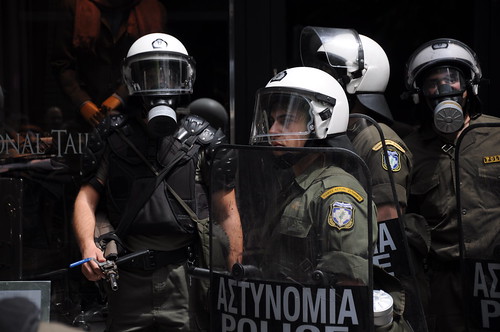
I suppose it is natural when faced with new and unsettling situations to turn to tried and tested solutions. This certainly seems to be the case with the Greek government who are in a historically retrospective frame of mind.
Recently, the ruling PASOK party decided that the private sector would be better suited to the job of collecting tax, an idea almost as old as civilisation itself. In Ottoman times it was named Iltizam with the state auctioning off taxation rights to the highest bidder (any connection between and the current greek system of road tolls is purely coincidental). A similiar set up known as the Ferme Générale was also used to great effect by Louis XVI, well, at least until outraged tax payers helped liberate the Sun King's head from the rest of his body during the French Revolution.
Also dating from this period the Greek government headed by the son of a political refugee and immigrant is in the process of restoring the18th century prison hulk for immigrants entering the country via Turkey. Αccording to the Vima newspaper 300,000 euros per year will be spent on renting a Dutch owned prison ship which will be anchored off the coast near the northern city of Alexandroupoli. The fact that such a vessel can be towed out to sea means that it is far away from such interfering busy bodies as the UNHCR and Amnesty International who have regularly condemned the conditions under which immigrants in detention are held.
As with the idea of privatised tax collection the prison ship has a long and glorious history which does it credit. Just ask the Nazis and Chile's Pinochet regime who made use of this wonderful innovation. Add a touch of malnutritian and a case or two of scurvy and the glory days of the 1800's are once again yours.
Those of a more modern turn of mind might be able to see similarities between Athens handling of public protests over the building of a landfill site in the Keratea region near Athens and those that followed the Japanese government's attempts to extend the Narita airport from the late 60's till the 70's. In both cases the government believed that the best way to promote devlopment was through the liberal apllication of riot police, tear gas and violence. In this case Giorgos Papandreou is no slouch and has employed the quasi - military MAT special police units with an elan that would make his fellow members (well, till last month) of the Socialist International Hosni Mubarak and Ben Ali green with envy.
Like the Narita example, villagers and local inhabitants of towns in the area have been fighting long and bitter battles with the authorities for other 70 days. While the government insists that the rubbish dump is necessary for the future of waste deposal in the capital the type of facilities it is promoting is due to be phased out in the EU within two years according a blog written by residents.
The reality of the situation is the current administration is clutching at straws, left staggering from a series of politically damaging gaffes and losing supporter at an ever increasing rate the PASOK leadership is desperately attempting to claw its way out of the hole which it has dug for itself by promoting even the most improbable of policies in the hope that voters will be convinced that it is doing something positive for the country.
Monday, February 14, 2011
Greek PM feigns shock over EU-IMF reform plans
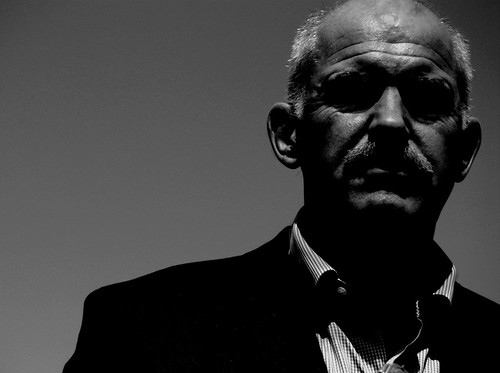
On Friday the IMF, EU and ECB (known locally as the Troika) announced their joint proposals concerning the future of the Greek economy and actions needed to reduce the country's massive debt load which is set to exceed 150% of GDP this year. The most controversial element of the plan is the privatisation of 50 billion euros of public assets over the next three years and was protrayed in much of the media as a sell off of the family silver at bargain basement prices. Only the rabidly pro-PASOK Ethnos newspaper dared to present the news that troika representatives had issued an apology as a victory for the government.
In the face of such stiff opposition Greek Prime minister Giorgos Papandreou claimed to have blind sided by the EU-IMF saying that the press conference had given the impression that the Greek government was simply following the orders given it by the country's creditors.The reality of the situation is that the so-called argument is a rather crude PR trick designed to spin the fact that the ruling PASOK party have already agreed to carry out the measures demanded and is attempting to sell the public the idea that they are still in charge and not just acting as locally recruited management representatives.
The ploy has failed to convince even ardent government media supporters in the privately run SKAI channel who condemned it as a cheap theatrics. Indeed it is hard to believe that after months of negotiations the head of the Greek government was unaware of all the details of the EU-IMF strategy and was taken by surprise.
Actually, if you read Papandreou's actual complaint he was apparently not criticising the content of the Troika's press conference but the manner in which it was presented. Government minister for education Anna Diamantopoulou even went as far as to suggest that Troika representatives be banned from making public statements during a radio interview this morning.
Many Greek journalists and commentators have derided the plan to raise the 50 billion as impractical given the depressed state of the economy and the Greek state's abysmal record in selling off public assets. For example more than seven years after hosting the Olympic games in 2004 much of the expensive facilities built are falling apart, forgotten and neglected despite the billion dollar price tag.
Another fear is that given the deeply corrupt nature of Greek politics much of the assets will be sold off in sweet heart deals to friends and supporters of the government and so the sacrifices made by the Greek people will be wasted as little of the money will actually make it into public offers. These concerns are no just limited to a few crackpots but are daily reinforced as scandal after scandal involving officials from both of the largest political parties are swept under the carpet. Only last week charges against those involved in the massive Vatopedi monastery land swap scandal were dropped despite the fact that the case resulted in the Greek state losing hundreds of millions in lost revenue.Likewise revelations in Der Spiegel last year that members of the ruling PASOK party including an ex - minister of defence took bribes in return for buying German submarines have resulted in no official reaction of behalf of the country's justice system.
Given the inability of the political system to police itself the idea of politicians handling billions of dollars in real estate and public property is an invitation to corruption on a scale not seen since the debacle that followed the fall of the Soviet Union when massive fortunes were made by ruthless “businessmen” who used bribes and threats to amass fortunes by taking control of state owned industries.
Saturday, February 12, 2011
Civil disobedience in Greece's second largest city
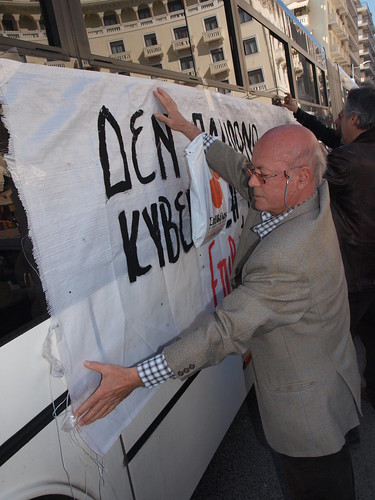
Members of the "We Won't Pay" campaign take over buses in Thessaloniki, Greece in protests over the latest round of bus fare increases which have pushed up ticket prices by up to 180%.
The PASOK minister for transport, Demtrios Reppas responded by calling those taking part "freeloaders" while the government hastily passed legislation making failure to pay bus tickets a criminal offence.It is ironic that Reppas who has, as a member of Greek parliament since 1981 been entitled to free travel for three decades is now accusing those who refuse to pay fare and toll price hikes of ranging from 40% to 300% of being unreasonable.
For more on the aims and actions of the organisation (in Greek but tyou can use Google Translate).
http://epibates-thess.blogspot.com/
The PASOK minister for transport, Demtrios Reppas responded by calling those taking part "freeloaders" while the government hastily passed legislation making failure to pay bus tickets a criminal offence.It is ironic that Reppas who has, as a member of Greek parliament since 1981 been entitled to free travel for three decades is now accusing those who refuse to pay fare and toll price hikes of ranging from 40% to 300% of being unreasonable.
For more on the aims and actions of the organisation (in Greek but tyou can use Google Translate).
http://epibates-thess.blogspot.com/
Employees of the Agelioforos and Makedonia newspapers protest wage cuts in Thessaloniki, Greece
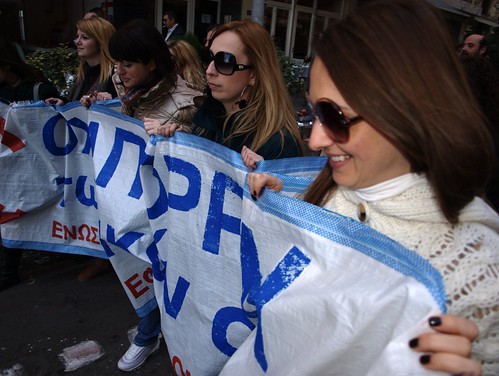
Employees of the Agelioforos and Makedonia newspapers protest wage cuts in Thessaloniki, Greece, originally uploaded by Teacher Dude's BBQ.
Management of the newspapers are attempting to reduce pay by between 25 and 40%. In protests employees marched through the centre of Thessaloniki, Greece's second largest city yesterday morning.
The newspaper industry in Greece is, like so many other places in crisis with falling sales and an uncertain future. However, unlike other countries the main problem is not so much competition from the internet as with falling advertising revenues caused by a shrinking economy.
On the other the quality of journalism in many papers is poor and people are less and less willing to pay for reporting that is often little more than rehashed party political PR and overly reverential interviews with those in power. The media in general is viewed by many as being unreliable and beholden to powerful political and business interests (see here for survey carried out by GPO) . Less the fourth estate than the propaganda wing of the PASOK and New Democracy parties along with those businessmen who support them.
The newspaper industry in Greece is, like so many other places in crisis with falling sales and an uncertain future. However, unlike other countries the main problem is not so much competition from the internet as with falling advertising revenues caused by a shrinking economy.
On the other the quality of journalism in many papers is poor and people are less and less willing to pay for reporting that is often little more than rehashed party political PR and overly reverential interviews with those in power. The media in general is viewed by many as being unreliable and beholden to powerful political and business interests (see here for survey carried out by GPO) . Less the fourth estate than the propaganda wing of the PASOK and New Democracy parties along with those businessmen who support them.
Subscribe to:
Posts (Atom)
In the northern port city of Thessaloniki 1,500 people took part in a march to protest the changes which are part of a wider shake up in the country's educational system. However, many teachers voiced their doubts over whether such changes can bring about an improvement in Greece's economic performance which has been in freefall since the imposition of austerity measures by the nation's creditors in 2010.
With unemployment set to reach record post war levels this year, government coffers empty and GDP down 6.6% many teachers and other civil service employees believe that that the current reforms have less to do with with upgrading the school system than balancing the books.
www.demotix.com/news/644469/school-closures-spark-protest...