Following the example of net user's response to the tragedy in Mumbai, the Greek riots have also generated a wiki page. I kick myself for not having looked in Wikipedia earlier.
"The 2008 Greek riots started on 6 December 2008, when 15-year-old Alexandros Grigoropoulos (Greek: Αλέξανδρος Γρηγορόπουλος) dropped dead almost immediately after being hit by a bullet fired by Greek Police special guard, Epaminondas Korkoneas (Greek: Επαμεινώνδας Κορκονέας), following a small altercation between police and a group of youths in the Exarcheia district of Athens[1].
According to eye-witnesses, the special guard shot the 15-year-old directly on the left side of his chest. The guard asserts, however, that the boy was killed by a ricochet. The forensic autopsy was inconclusive, and the results of the ballistics are still expected.[2] according to police, Grigoropolous was shot as he attempted to throw a fuel-filled bomb at police.[3] The confrontation resulted in widespread rioting and demonstrations across the city, with hundreds of youths engaging riot police with Molotov cocktails and damaging property.
Demonstrations and rioting later spread to several other cities, including Thessaloniki, Greece's second-largest city. Outside Greece, demonstrations, riots, and clashes, also took place in Cyprus, in the capital Nicosia and the western city of Paphos on December 8.[4] Newspaper Kathimerini called the rioting "the worst Greece has seen since the restoration of democracy in 1974".[5]
Yesterday I gave a talk, along with Asteris Masouras on social media and activism for students of the school of journalism at the Aristotelion university of Thessaloniki. The presentation was part of the course, Blogs and the New Media: legal matters and ethics organised by professor Elsa Delagianni. It was a nerve wrecking experience speaking in front of an audience in Greek and I'm sure that I garbled my grammar on more than one occasion. Still, both my and Asteris's presentations on the uses of blogs, Twitter, Delicious and the like were well received.
As promised here is the slide show presentation I used along with a brief summary of my talk in English and a list of the sites mentioned. I will also post the video of the event as soon as it becomes available.
Greek riots 2008 - Using social media to tell a different story
The presentation is divided into three sections: Finding out what was happening
The internet provided me with invaluable tools to find out about events during the riots and protests that followed the death of 15 year old Alexandros Grigoropoulos on 6th December 2008. The killing of the teenager by a police officer sparked off a wave of violent responses that last nearly a month.
By using Twitter, blogs, Indymedia Athens, Technorati and Google's Blog Search I was able to find information on what was happening both here in Thessaloniki and across the country. In the beginning these were virtually the only sources of reliable information available as the mainstream media were at a loss to explain what was happening and limited their coverage to long distance shots of burning streets and interviews with self - proclaimed experts who had no direct connection with the events happening in Athens and other cities.
Getting your story out
For most December I went out onto the streets to cover the marches, demonstrations and riots that were taking place daily in Thessaloniki and then going home to publish the pictures I had taken and write article to explain the story behind the images. I used participatory journalism sites sites such as CNN's Ireport, Nowpublic and Guardian weekly to submit stories and also wrote on my blog, put photos on Flickr and added video to Youtube.
As a result within days I was giving interviews to CNN, BBC, Sky news as well as French and Egyptian news outlets. The paradox was that foreign media services half a world away were better informed about what was happening here than their Greek counterparts who literally were just a kilometre or two away from what was happening.
The difference being that reporters in Paris, London and New York had taken advantage of the opportunities that social media sites such as Twitter and blogs offer in getting out a story and decided to interview those directly involved. By contrast Greek TV stations limited themselves to endless footage of burning cars and "analysis" by politicians who were at a loss to understand what was going on and just used that opportunity to peddle their own conspiracy theories. I don't think I saw an interview with anyone under 40 till nearly two weeks after the riots had kicked off. A personal impressions of what happened
At one point I wrote in my blog that I felt like I had lived six months worth of experiences in six days. The more I look back at my blog entries from that period the more I believe that. December proved to be one of the pivotal moments in my life, a period of intense excitement, mixed in with large does of fear and exhaustion. The routine of going out and photographing, the often violent protests, researching and writing articles as well as trying to fit in my day job as a teacher meant that by the day Christmas came I was on the verge of burning out.
On the other hand I felt I had embarked on a hyper intensive journalism course in which months of tuition were compressed into a matter of days. In addition the huge gulf between what I witnessed and what the mainstream media reported confirmed many of the suspicions I had felt before about the role of TV in creating a consensus about how stories are defined.
I felt that I was in a position to explain the background to what was happening to a non - Greek audience. That what we were seeing was not simply a bunch of hooligans out to cause mayhem just for the hell of it. I wanted to bring to light wider set of causes such as police brutality, political scandals, unemployment and lack of faith in the present system which were fuelling the protests.
For more on using social media in general and the influence it had on the Greek riots check out these links:
Despite entering their third day the scenes of chaos and rioting in Greece's major cities seems far from over. Although there was an overnight lull in the clashes between protesters and riot police in Athens and other cities the peace was once again broken this afternoon when high school student marchers protesting the death of 15 year old, Andreas Grigoropoulos turned violent. Once more the central police station Thessaloniki, The country's second largest city came under attack. Unconfirmed eye witness accounts say that the police arrested a 13 year old girl during the event.
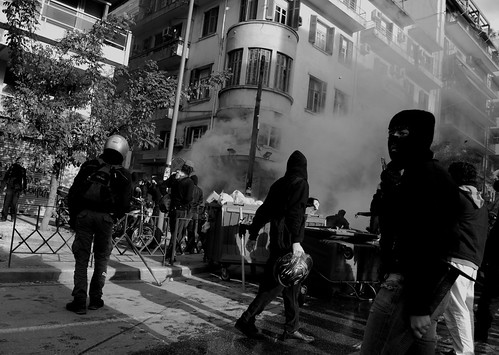
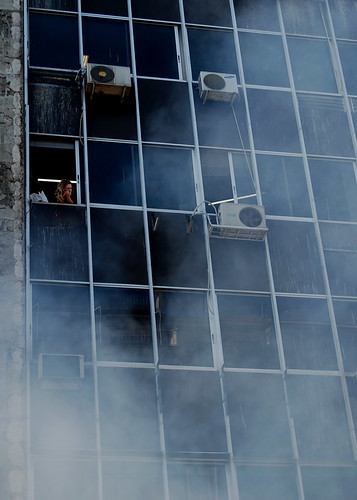
With the smell of burning plastic and tear gas hanging over much of the centre Thessaloniki resembles a war zone with heavily armoured riot police taking and re-taking strategic points along the central Egnatia Boulevard. In keeping with the tenets of guerrilla warfare their opponent simply retreat from the onslaught simply to reappear elsewhere within minutes.
Anarchist protesters have also taken over much of the university campus and other off campus departments such as the school of theatre where huge banners are hanging from the upper floor windows and loud rock music is blasting out.
In the face of such wide spread resistance the riot police appear unable to maintain order in the city. The situation seems to have slipped out the authorities ability to control. Traffic is still being allowed to enter riot zones around the university even though drivers are coming under attack with stones and paving blocks.
With two more protest rallies scheduled today at 6pm today in Athens and Thessaloniki there is little likelihood that tensions will lessen and protesters go home. Indeed more and more cities throughout the country are reporting unrest.
The latest revelation that the dead teenager was apparently shot in cold blood by a police officer in the Exarchia district on Saturday has simply added to the anger and frustration that many young Greeks feel over the situation in the country as a whole. Rising unemployment, low wages and limited prospects have helped fuel a toxic mix which is easily ignited. However, it should be noted that while violent street clashes are not unusual in Greece the length, duration and intensity of these latest episodes has taken many by surprise.
With Greek riots entering their fifth day there is no sign there they about to end soon. Overnight there were violent clashes between in Athens, Thessaloniki and Volos.In Greece's second city anarchists occupying caused extensive damage to the Law and Theology department in the university campus.
In Patra and Larissa angry citizens attacked protesters in the cities universities. In addition riot police allowed groups of youths to throw rocks back at anarchist protesters in the university of Thessaloniki (see video here).
Greek prime minister, Kosas Karamanlis last night went on TV to make a call for national unity after pleas by the government for claim over the death of 15 year old Alexandros Gigoropoulos went unheeded. yesterday the funeral of the teenager shot dead by the police on Saturday was marred by incident. Video showing Greek motor cycle patrolmen firing into the air toscare off high school students wa shown on national TV (see video here). In addition other photographs have emerged of police officers pointing service pistols at demonstrators.
Today, Greek trade unions have called for a nationwide strike in order to protest the present government's handling of the economy.
Tomorrow and on Thursday mass demonstrations have been planned by high school students in Thessaloniki and other Greek cities. This looks like it is set to run and run.
For more info on what is happening check out these links;
Last night saw the another round of protests and riots in Greece's major cities sparked off by the shooting by police of a 15 year - old in Athens on sSaturday. The scale and intensity of the the troubles has alarmed at shocked those in power and is being compared in the media to the disturbances that followed the Rodney King beating in LA and the 2005 riots in France
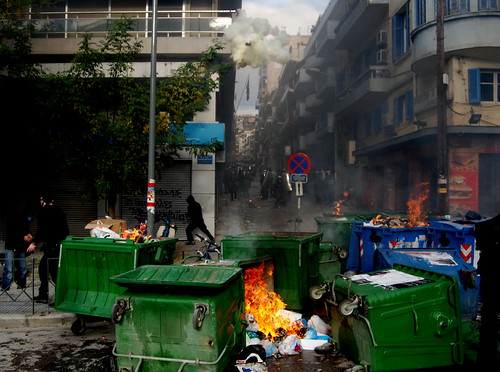
In Thessaloniki, Greece's second largest city between 5000 and 10, 000 people took part in a protest march last night which was repeatedly tear gassed by riot police. In addition the march was also accompanied by attacks by anarchist groups on stores belonging to multi-national chains, banks and post offices. Several buildings were set on fire including Starbucks and McDonald franchises during the clashes which lasted into the morning.
Although Athens and Thessaloniki are quiet at the moment more protest marches are planned to coincide with the burial today of 15 year old Alexandros Grigoropoulos. In the original police report the death was termed an act of self defense by the two police officers involved who claimed that they had come under attack from a mob of thirty youths.
However, eye witness accounts given to the Greek media talk of an execution style killing as the officer who fired first aimed at the youth after getting into an argument with the teenagers.
What many argue, though is the killing of Alexandros was merely the cue for the violent expression of a much deeper sense of dissatisfaction by young Greeks. Even before the current economic downturn those under 25 faced sky high levels of unemployment and limited prospects in low paying jobs. This combined with a deep sense of distrust of the government fostered by years of scandal has found its expression in violence and protests seen over the last four days.
In addition the incident has once again thrown light on the Greek police's tarnished record concerning unlawful killings and a systematic lack of accountability even when evidence of abuse is overwhelming. According to the national daily, Eleutherotypia one person a week dies in custody in Greek police stations and jails.
The unprededented wave of protests and discontent that has hit Greece since Saturday shows no sign of abating. Although the country enjoyed relative calm last night after days of rioting, high school and university students are planning to block roads in Athens today. In addition at least 100 high schools are under occupation, as well as the universities in many cities in protest against the shooting of 15 year old Alexandros Grigoropoulos by a police officer in central Athens.
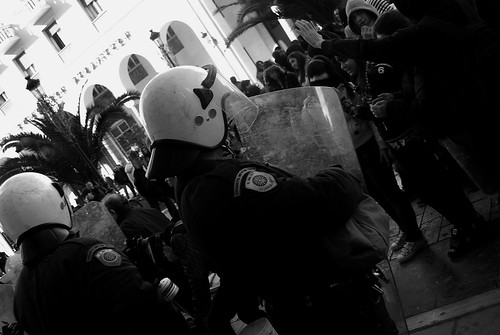
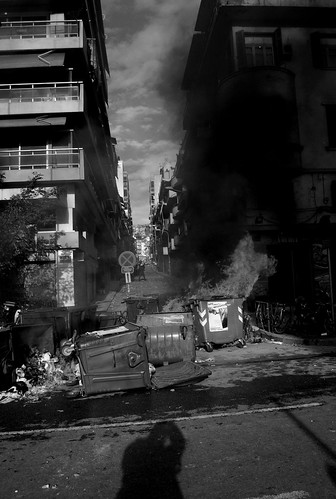
Yesterday students some as young as twelve clashed with riot police in the northern port city of Thessaloniki. The central police station in Aristotelous square came under repeated attack from stone throwing teenagers who also set fire to rubbish bins and smashed shop windows.
The Greek government has announced a series of measures to help the hundreds of businesses damaged during the riots. Estimates over the cost of disturbances rangge from a three hundred to one billion euros. However, the opposition PASOK party has expressed skepticism over the government's plans to help pointing out that similar promises were made to those who lost homes in last year's devastating forest fires yet not kept.
The two policemen accused of killing the teenager claim that the fatal shot was a ricochet and that the officer who fired had shot into the air in order to scare off a gang of thirty youths who previously attacked them with rocks and bottles.
The defendents also said in their testimony that the dead student had been expelled from several schools and involved in incidents of football hooliganism.
However, several eye witnesses interviewed on Greek TV argue that there were no more than ten youths at the time of the incident and just one bottle was thrown at the defendent's patrol car. They also claim that the officer aimed his pistol directly at the group and fired and after Grigoropoulos fell to the ground walked away.
Friends and family of the teenager also denied categorically the accusations concerning the child's supposedly troubled academic career and alleged involvement in football violence.
The Greek police federation condemned the the actions of the two officers, calling the death a "horrific criminal act".
On the other hand defence lawyer Alexis Kougias, who took on the case other two other lawyers withdrew, claimed that there had been a "misunderstanding" and that foresenic evidence bore out his client's claim that the death was the result of bullet ricocheting. The results of the ballistics analysis of the bullets fired have, however, not been released yet.
I was just going through pictures I have taken over the last two weeks. It seems like all this started two years ago so intense has the experience been.
One day 'll get round to putting all this down on paper.
The death of a 15 year - old in central Athens during clashes with police in the Exearchia district has sparked off a series of violent protests in the Greek capital and other major cities. Thessaloniki, Patras, and Crete all witnessed violent clashes between demonstrators and riot police.
According to official reports Andreas Grigoropoulos died after being shot at 9pm by police guarding the Exarcheia police station, which due to its proximity to the university of Athens is often a target for attacks by anarchist and other leftist groups. However, eyewitness accounts tell a different story. According to local residents the the police officer shot Grigoropoulos after an argument. Greek national TV is now calling the incident a "cold blooded Murder" rather than an act of self - defence.
News of the death quickly spread via the internet, SMS and word of mouth leading to protests across Greece. Today's marches quickly turned violent as enraged demonstrators took our their anger on banks, shops and police stations.
In Thessaloniki, Greece's second city the central Leukos Pyrgos police station was attacked by masked anarchists with rocks and Molotov cocktails. The police replied with tear gas and flash grenades causing panic and chaos amongst the thousands of marchers not involved in the violence.
TV images being shown live on Greek TV show central Athens swathed in smoke and tear gas and tens of small fires burn unattended as the fire fighters are unable to put them out.
Although violent scenes are not uncommon in Greece the extent, duration and intensity of the riots seems to have taken the authorities by surprise.In addition the fact that many of those who took in protest marches were neither young nor students is indicative of the fact that the death of the teenager has angered many Greeks. Case in point was the pensioner, who stood in front of a phalanx of riot police, apoplectic with rage shouting, "cops, killer, pigs" during the march in Thessaloniki
The events couldn't have come at a worst time for the conservative New Democracy government which has been losing support due to its handing of the recent economic crisis and the alleged involvement of many senior officials in the Vatopedi corruption scandal.
Here are two news stories I noticed which didn't get widely reported outside Greece. I wrote about them for Now Public but not many other English language news sources picked up on them.
Nine subway carriages worth 13.5 million euros went up in flames during the early hours of Tuesday morning following an arson attack on the Athens - Piraeus Electric Railways (ISAP). A group of approximately 15 - 20 people wearing party masks boarded the last train at 1 am and when it reached the final stop in the Athens suburb of Kifissias set fire carriages (click here to see video from Mega Channel).
According to unconfirmed police reports as soon as the train reached Kifissias, its last stop the attackers forced passengers to disembark and then doused the carriages with inflammable material and set fire to it. Afterwards molotov cocktails were thrown at other parked carriages nearby.
Although no group has claimed responsibility there is strong possibility that the incident is connected with the recent attack on a labour activist who was worked as a cleaner for ISAP. In December Konstandina Kouneva who was secretary for the All - Athens Union of Cleaners and Domestics Cleaning Employees was abducted and forced to drink acid resulting in massive internal injuries and the loss of one eye.
According to Kouneva the assault followed a series of telephone threats prompted by attempts by the union to expose alleged labour rights abuses by the OIKOMET employment agency.
The incident prompted several protest marches and attacks on targets connected with the OIKOMET, which employed Kouneva and has a contract with ISAP.
UPDATE
Two previously unknown groups calling themselves The Gangs of Conscience and Perama Extremists claimed responsibility saying, it was, in part, a protest against what happened to Konstandina Kouneva. In addition it also said that it intended futher attacks on the public transport system in its proclamation.
Hundreds of refugees from Afghanistan clashed with riot police for hours yesterday evening in the western Greek city of Patra. The disturbances were sparked off when an Afghan man was seriously injured while trying to board a truck entering the city's port. After the accident tens of fellow refugees attacked the vehicle throwing rocks and other objects.
Later the tensions escalated leading to protesters setting up barricades and closing streets near the port. In reply the police deployed riot units and used tear gas in an effort to disperse them.Running battles lasted into the early hours of Tuesday morning as police attempted to confine the protesters to a shanty town that serves as a home for over a 1000 refugees in the city.
Unconfirmed eyewitness accounts reported on Greek blogs and Indymedia Patra speak of the involvement of residents including members of far right groups in efforts to put down the demonstration. Eventually the police were able to push back the refugees to their encampment and disperse far right groups.
Patra, which is Greece's gateway to Italy has become a way station for immigrants seeking to reach the rest of Europe. However, the Greek state has been reluctant to give official asylum status to all but a handful of immigrants entering the country without proper documentation. Greece's daily newspaper Kathimerini has reported that out of 20,692 asylum applications submitted in 2007, Greek authorities approved eight.
As a result refugees are forced to attempt the crossing to Italy illegally, often in the backs of trucks bound for the Italian ports of Brindisi and Ancona.
The riots are the latest in a series of clashes between refugees and the authorities in Patra, including a series of accusations of police abuse of Afghan refugees. In September 2008 there were also riots as refugees clashed with police and Customs officers inside the port following the beating of three immigrants.
Greek police have been accused of heavy handedness and over - reaction after a raid on a bookshop in central Athens following a book reading by the author Dimitris Papachristos. Shortly after the reading approximately 50 masked riot police surrounded the Floral bookshop in the Exarchia district and arrested two teenagers inside prompting protests by members of the audience, including the author and journalists, Sotiris Damatapoulos, reporter with the Greek state broadcaster ERT and Stelios Elliniadis, radio presenter who demanded to know why the officers were masked and had covered their ID numbers. As a result all three were also arrested.
On hearing of the event head of the newly formed Ministry for the Protection of the Citizen, Michalis Chrysohoidis demanded that the release of those being held in the central Athens police station and according to the TVXS independent news service said that the officers were out of control.
Last night's raid followed clashes between police and local youths in the area in which stones and bottles were thrown. However, many left wing groups have accused the police of acting as an army of occupation with mass sweeps and arrests of local residents and visitors to the area.
Questions still remain over how much oversight the newly elected PASOK government can exercise upon the nation's police force which has repeatedly been condemned by the UNHCR, Amnesty International and many other European humans rights groups over its violent treatment of immigrants and supporters of opposition groups. Universities in Athens and Thessaloniki, Greece's second city were occupied this week by students protesting the death of Pakistani national, Mohammed, Kameran Atif following his detention by police in the Nikia district of Attiki.
Despite sparking off nationwide riots which cost the country billions of euros in damage and brought Athens and many other Greek cities to a halt for days on end the Greek police force seems to have learnt little from the violent December protests which followed the death of a 15 year old shot by an officer in the Exarchia.
UPDATE
Minister for the Protection of the Citizen, Michalis Chrysohoidis sought and received the resignation of the head of Greek police force EL. AS, Vasilis Tsiatouras this evening.
Just hours after the shooting of 15 year old Alexandros Grigoropoulos by a police officer in the Exarchia district of central Athens, hundreds started violent protests that would last for weeks and cost the country billions of euros in damages. Despite the ferocity of the response to the killing it seems that the Greek authorities have yet to appreciate the potential for backlash created by accusations of police violence. One of the major driving forces behind the December riots, the worst in modern Greek history was the conviction that the officer involved would not be punished.
In the latest case the recently formed Delta motorcycle unit stand accused of using excessive force in the arrest of a 27 year old man last week in Exarchia. According to report in today's national daily, Eleutherotypia the unnamed man was detained and beaten by several police officer who left him with broken ribs and a punctured lung. Afterwards he and four others who had also been detained were tied to a tree.
The official police report states that the detainee had been stopped during a routine check and arrested for carrying explosive materials, GBH and resisting arrest. Throughout most of last Thursday night police and youth clashed in a series of running skirmishes in the area.
As the article in Eleutherotypia points out it is a standard police tactic in such cases to charge victims of police violence with serious crime in order to justify their treatment. In a similar case in November 2007, Cypriot student, Augustinos Dimitrios whose brutal beating was captured on live TV was charged with resisting arrest.
Similarly, the police officers charged with the killing of Alexandros Grigoropoulos in December first stated that they had acted in self defence after allegedly being attacked by a group of stone throwing youths, including Alexandros. Despite the appearance of amateur video footage the following day which contradicted the official version of events the authorities insisted on sticking with the officer's discredited account for weeks.
The Greek police force has routinely been the object of critical attention by organisations such as UNHCR, the European Union, Amnesty International and other human rights groups. In both 2005 and 2008 the Council of Europe’s Committee for the Prevention of Torture (CPT) roundly condemned the Greek authorities for turning a blind eye to the violent treatment of prisoners and suspects by prison and police officers (click here to see report).
I thought I'd share a few tips with those covering the anniversary of the death of the Greek teenager, Alexandros Grigoropoulos this weekend. I hope they prove useful.
1 - The potential for violence has increased rapidly over the last few weeks so be prepared for clashes.
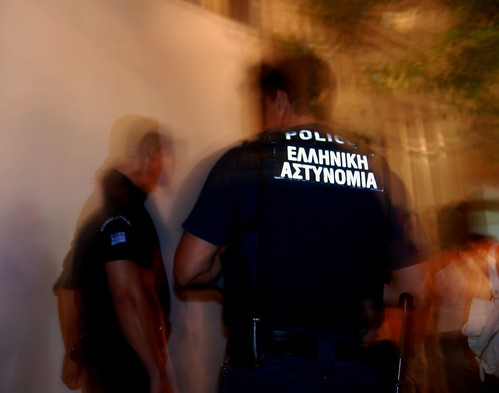
2 - Being a reporter is no guarantee of safety, especially with the police. The Greek cops have a long and inglorious history concerning photographers. They will not hesitate to use force if they feel you are photographing them.
3 - Many of the demonstrators, especially the anarchists view the media and hence reporters with the same contempt they hold for the police. Use discretion when taking pictures around them, if challenged put away your camera immediately unless you want it smashed. However, most other political/social groups are more tolerant of the media.
4 - The riot police have changed tactics recently so expect extensive use of tear gas and flash grenades. Maalox antacid tablets mixed with water can help somewhat. Though not with breathing.
5 - The grounds of the university of Athens are officially off limits to the police, so make sure you know where the nearest entrances are if the police advance. Being a foreigner or reporter will not protect you.
6 - If you do get detained make sure you have ID otherwise you risk days of belong held in a police cell.Try to get the number of some Greek friends in case you get arrested.
7 - Areas such as Exarchia are a rabbit warren of small streets, get familiar with the local geography so that if you have to make a quick retreat you know where you're heading.
Protesters will be formed into blocks. It is probable that anarchist protesters who have intention to clash will be in groups around protesters' blocks. If they start throwing rocks or other objects at the cops things may escalate in no time. I advise you that when you see the first signs of a clash, stay close to a political/student block.
In case of intense use of tear gas don't panic and don't try to run away from the main group of protesters in alleys etc. The best thing you can do (especially if you can't open your eyes) is get into a group, grab the person next to you and walk together.
A group of lawyers will be around in the protest to provide law advice in case someone gets arrested. These are their phone numbers:
6972-718536
6972-799025
6976-395658
6946-738686
6978-909319
6936-492025
6975-752346
6973-335960
If you get arrested, call them as quickly as you can. Do not sign anything in the police station and have in mind that cops may try to deceive you.
Taken during the December riots last year. So many things were happening at the time that I barely had time to take more than a cursory look at my pictures so I only just found these.
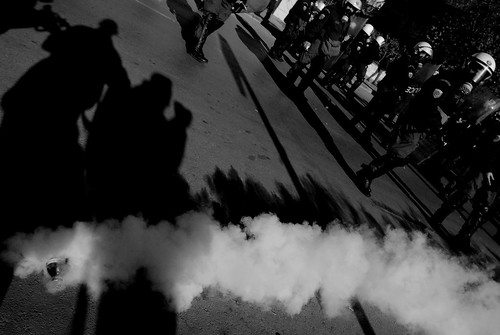
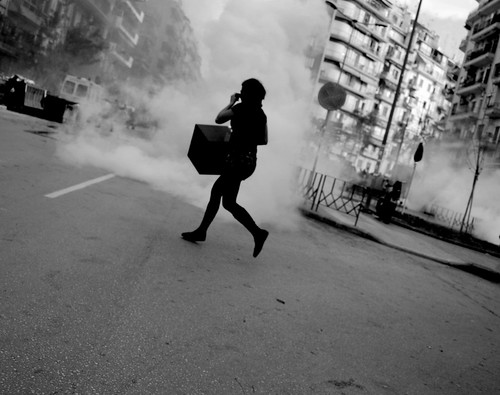
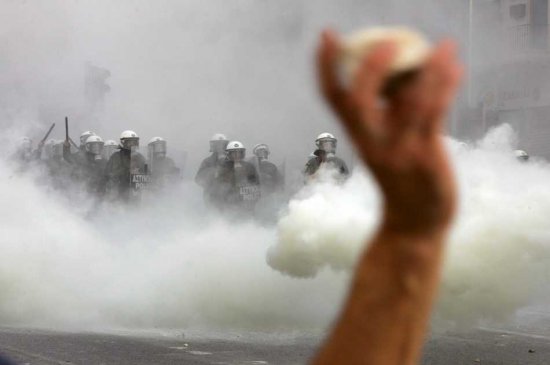
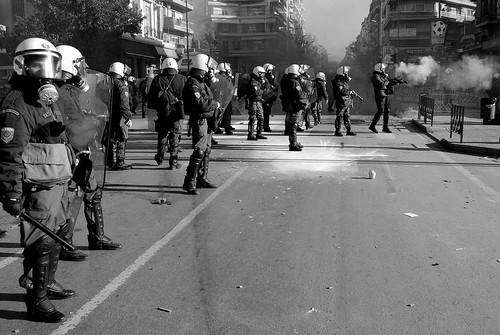
Riot police firing tear gas canisters at high school kids who were just a few metres away.
This was taken just moments after a riot cop fired tear gas at them from a range of less than 20m.
in about an hour I'm expecting a phone call from CNN. They want to interview me about the riots that have been going on in Greece over the last couple of days.
Even the state run TV channels, which usually follow the government line to the letter are now talking about the murder of 15 year old in Athens on Saturday night. It seems that eye witnesses are saying that the two officers got out of their patrol car after getting into an argument with a group of thirty teens in the Exarchia district. apparently, one of the officers throw a flash bomb at the group whilst the other fired at them three times resulting in the death of Andreas Grigoropoulos.
The police have a long and inglorious history of over reaction and violence. In part encouraged by the fact that even the most outrageous breeches of the law usually get over looked or punished lightly. Case in point was the savage beating on live TV of Cypriot student, Avgoustinos Dimitriou November 17, 2008. None of the eight oifficers involved spent time in jail. Indeed, the hapless student was charged with resisting arrest and tried recently in Thessaloniki.
In addition there have been a string of deaths of immigrants involving the police. Here in Thessaloniki last year Nigerian national,Tony Onouha, who died after falling from the balcony of a cafe in Kalamaria while "being chased by officers" according to the official report.
Last year the Council of Europe’s Committee for the Prevention of Torture (CPT) also noted in its report considerable number of allegations of abuse by police officials of foreign nationals in custody including the case of a detainee allegedly tortured with pliers while in custody in the northern Greek city of Alexandroupoli.
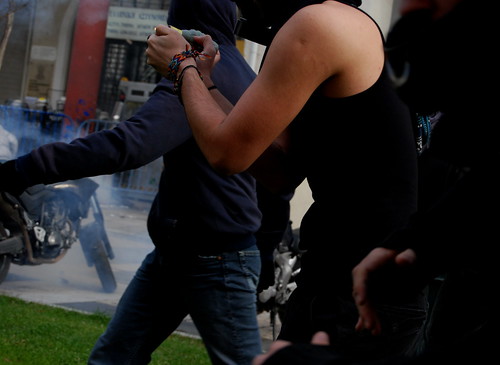
I, myself fell victim to these thugs last year when I was beaten by riot police during a peaceful demonstration on Tsimiski. My crime? Taking pictures of them.that cost me a broken nose, dislocated shoulder and extensive bruising.
Just minutes after the curtains went up, demonstrators seized the stage of the National Theatre, Athens and read out a prepared statement demanding the immediate release of all those arrested in the recent events following the killing of Greek teenager, Alexis Grigoropulos by police two weeks ago. The protesters also called upon the audience to join them in the streets shouting", Turn off your cell phones, turn on your conscience."
The performance of Roberto Succo by Bernard -Marie Koltes was cancelled in a gesture of solidarity by actors and theatre staff with the young protesters.
In addition a massive protest concert was held yesterday outside the Athens univesity campus where thousands watched 64 groups and singers perform until early hours of Saturday morning.
The rioting which started last night in Athens is still going on there and here in Thessaloniki. The national channels are now talking about cold blooded murder rather than self - defence. Mega channel has eye witness accounts of how the police officer who shot the 15 year old was not under attack at the time but rather got into an argument wit a group of teens and shot the kid.
To tell you the truth such a shocking accusation doesn't surprise me as the police has a terrible reputation for the use of violence and so extreme as the incident is it is hardly unprecedented.
I'm watching government representative Gerasimos Giakoumatos happily help lower New Democracy's poll ratings even further with a PR boomerang that is a joy to behold. The guy's arrogance and indifference is amazing.
Latest opinion poll results show that nearly half of Greek voters believe that neither of the country’s two major political parties is capable of governing. The ruling right - wing New Democracy was given an approval rating of just 16% whilst the opposition centre left PASOK party polled just 17%.
The results underline the massive lack of trust in the present political system which has been exacerbated by the recent economic downturn, a series of high profile corruption scandals and the wave of violent confontations which swept Greece In December and January.
This week doctors and other health care officials took industrial action for 48 hours in order to protest the chronic staff and equipment shortages that have plagued the public health care system for years.
A senior doctor at a hospital in Thessaloniki, Greece’s second city, speaking on condition of anonymity said that his department had just a third of the nurses required. In addition lack of staff means that Greek hospitals are regularly demanding doctors work more than the European Union mandated limit of 48 hours a week.
There have also been complaints over shortages of basic supplies such as bandages and medicine in many hospitals caused by cuts in funding by the Ministry of Health and massive delays in paying medical suppliers for previous orders.
The death of a 58 year old man this week in a ambulance taking him to hospital in Thessaloniki sparked off a political row when it came out that the man died as paramedics were unable to revive him following a heart attack as their resuscitator was missing parts. Although a coroner's report said that the death was unrelated to the heart attack, doctors who treated the man are adamant he could have been saved if the ambulance's equipment had been in working order.
The strike action is just one of a series of protests which has seen the government pitched against students, farmers, cleaners and even police officers.
Whilst the riots and street clashes that were sparked off by the killing of a teenager in December have faded from the world’s TV screens violent confrontations have continued albeit on a smaller scale.
Last week Thessaloniki saw riots in which 500 - 1000 demonstrators attacked the city’s central police station and take part in running street battles for hours. In addition there were 17 arson attacks on Friday by a revolutionary organisation calling itself the Conspiracy of the Cores of Fire.
Even more violent have been the armed attacks on police stations in Athens which left one police officer seriously injured after being shot while standing guard outside the Ministry of Culture signalling a rekindling of terrorism in the country.
Political and economic woes have added to calls for national elections by many unhappy with the government’s handling of a wide range of everyday issues such as employment, education and law enforcement.
Currently, Prime minister Kostas Karamanlis has just a slim one seat majority in parliament and is facing a series of clashes within his own cabinet as ministers manouever to position themselves for the possibility of national elections and a subsequent leadership battle.