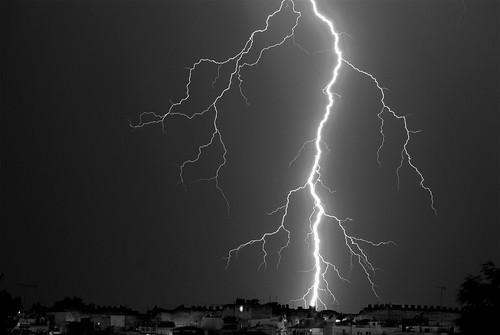
"Lightning is an atmospheric discharge of electricity usually accompanied by thunder, which typically occurs during thunderstorms, and sometimes during volcanic eruptions or dust storms. In the atmospheric electrical discharge, a leader of a bolt of lightning can travel at speeds of 60,000 m/s (220,000 km/h), and can reach temperatures approaching 30,000 °C (54,000 °F), hot enough to fuse silica sand into glass channels known as fulgurites which are normally hollow and can extend some distance into the ground. There are some 16 million lightning storms in the world every year."
Showing posts with label wiki. Show all posts
Showing posts with label wiki. Show all posts
Friday, June 19, 2009
"I have become death the destroyer of worlds"


Sunday, June 07, 2009
2009 European parliamentary elections in Greece
In a few minutes the polls will close for the European parliamentary elections in Greece. In Thessaloniki the weather has been excellent with temperatures in the low 30s with just a few wisps of clouds to disturb the azure blue sky, a tour operator's dream package and a nightmare for Greek politicians. Unlike say, Britain where good weather ensures a higher turnout at the polls, a perfect summer's day has sent voters in Greece's second city rushing to the seaside to enjoy the country's famed beaches.
Unlike 2007, my local polling station has been as quiet with just a trickle of people coming in and out to cast their votes. In the last national elections the school was abuzz with commotion and movement as people desperately looked for places to park their car or chat with friends and neighbours. As is the case in Greece, civic duty then had the air of a carnival with people enjoying the festive atmosphere. Today the picture is completely different as local residents have taken advantage of the three day holiday and left the city leaving the roads empty for those wishing to vote in the EU elections.

Despite the fact the turnout is likely to be much higher than in many other EU countries many political leaders are anxiously awaiting mot just the results for their particular party but also the percentage of absentee votes.
After a year and a half of almost non - stop accusations of corruption and mismanagement the ruling New Democracy party is expecting a drop in their figures. However, considering how many times the party's name has been implicated in graft and influence peddling scandals things could be worst.
New Democracy's standing in the polls has been helped considerably by the fact that rival left - wing PASOK party has also been facing corruption charges concerning its last stint in power when it allegedly accepted bribes from German electronics giant Siemens over contracts for the 2004 Olympics in Athens.

Smaller parties such as the Greek Communist Party (KKE) and SYRIZA have been trying hard to capitalise on the larger parties failings but with limited success, unable to match the vast media budgets that New Democracy and PASOK have at their disposal. In addition the incestuous relationship between Greek media corporations and political life means that those not allied with the two main parties struggle, often in vain to get their message across.
However, voters are expected to show with their absence that it is not business, a fact likely to influence the timing of the next general elections.
For more information check out the Wiki page on the 2009 European elections in Greece.
Sunday, February 15, 2009
The Battle of Algiers (1966)
Click on the picture above to see the whole movie with English Subtitles.
The Battle of Algiers (Italian: La battaglia di Algeri) is a 1966 black-and-white film by Gillo Pontecorvo based on events during the 1954-1962 Algerian War against French rule.
The film depicts an episode in the war of independence in then-French Algeria, in the capital city of Algiers. It reconstructs the events of November 1954 to December 1960 in Algiers during the Algerian War of Independence, beginning with the organization of revolutionary cells in the Casbah. From there, it depicts the conflict between native Algerians and European settlers (pied-noirs) in which the two sides exchange acts of increasing violence, leading to the introduction of French paratroopers, under the direction of General Massu and then Colonel Bigeard, to root out the National Liberation Front (FLN). The paratroopers are depicted as "winning" the battle by neutralizing the whole FLN leadership through assassination or capture. However, the film ends with a coda, depicting demonstrations and rioting by native Algerians for independence, in which it is suggested that though the French have won the Battle of Algiers, they have lost the war.
Battle of Algiers - Ennio Morricone
Tuesday, December 09, 2008
Greek riots on Wikipedia
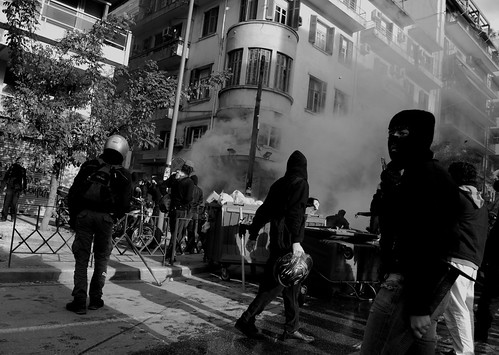
Following the example of net user's response to the tragedy in Mumbai, the Greek riots have also generated a wiki page. I kick myself for not having looked in Wikipedia earlier.
"The 2008 Greek riots started on 6 December 2008, when 15-year-old Alexandros Grigoropoulos (Greek: Αλέξανδρος Γρηγορόπουλος) dropped dead almost immediately after being hit by a bullet fired by Greek Police special guard, Epaminondas Korkoneas (Greek: Επαμεινώνδας Κορκονέας), following a small altercation between police and a group of youths in the Exarcheia district of Athens [1].
According to eye-witnesses, the special guard shot the 15-year-old directly on the left side of his chest. The guard asserts, however, that the boy was killed by a ricochet. The forensic autopsy was inconclusive, and the results of the ballistics are still expected.[2] according to police, Grigoropolous was shot as he attempted to throw a fuel-filled bomb at police.[3] The confrontation resulted in widespread rioting and demonstrations across the city, with hundreds of youths engaging riot police with Molotov cocktails and damaging property.
Demonstrations and rioting later spread to several other cities, including Thessaloniki, Greece's second-largest city. Outside Greece, demonstrations, riots, and clashes, also took place in Cyprus, in the capital Nicosia and the western city of Paphos on December 8.[4] Newspaper Kathimerini called the rioting "the worst Greece has seen since the restoration of democracy in 1974".[5]
Wednesday, December 03, 2008
Fridge: RIP

My old fridge finally gave up the ghost last night. With a small bang and a terrible whiff of CFCs the thing shuddered to a halt for the last time. I can't say that I'm surprised by its demise as it has been making a colourful, if noisy collection of sounds for years.
I suppose I should be thankful to Thomas Midgley Jr (they don't make names like that anymore) for developing CFCs as before the 1930s fridges had a nasty habit of killing people when they broke down. The cooling gases inside were so volatile that it was like living next to a chemical time bomb. As the wiki entry charmingly puts it;
"As the refrigerating medium, these refrigerators used either sulfur dioxide, which is corrosive to the eyes and may cause loss of vision, painful skin burns and lesions, or methyl formate, which is highly flammable, harmful to the eyes, and toxic if inhaled or ingested."
You could almost forgive Midgley for inventing one of the destructive greenhouse gases if it wasn't for the fact that he also came up with the wonderful idea of putting lead in petrol/gas.
Given his track record we perhaps should be thankful he passed away in 1944 before he had the chance to market, say uranium flavoured toothpaste "for a smile that really shines in the dark."
Subscribe to:
Posts (Atom)