Showing posts with label media. Show all posts

Tuesday, February 16, 2016

Refugee crisis brings racist rhetoric back into the European mainstream

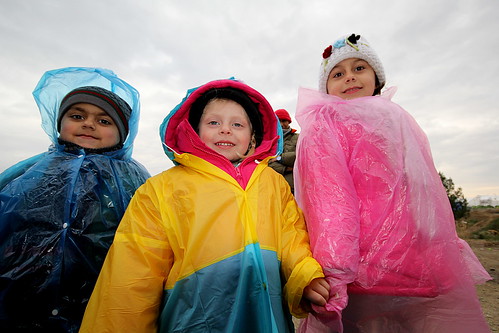
Refugee children - Idomeni transit camp, northern Greece


''The waves of immigrants threaten to turn Europe into an endless hell of Islamic terrorism"

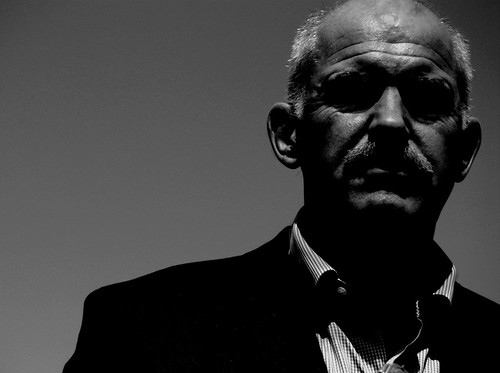
Greek Orthodox bishop Anthimos - Thessaloniki 14th February 2016

The current refugee crisis  has awakened the very worst in Europe's collective psyche, with racist rhetoric that would have been considered unacceptable in "respectable" discourse a few years ago becoming part of mainstream political discussions. Ideas and attitudes that were once the preserve of far right extremists are gradually worming their way into media and political debate as the arrival of refugees prompts responses that often verges on the hysterical.

Bishop Anthimos, who has long been a fixed feature of the Greek Orthodox ultra-nationalist far right addressed a conference on Sunday in the northern Greek city of Thessaloniki in order to draw attention to the supposed threat of the "Islamisation" of Europe. In this he is hardly along as similar ideas are quickly gaining ground in other nations (just see Hungary's PM, Viktor Orban and the rise of the Pegida movement in Germany and elsewhere. With austerity policies making the traditional parties of power ever increasingly unpopular, many politicians have been happy to scapegoat refugees directly or ride the wave of fear whipped up by mainstream media outlets looking to boost flagging ratings and declining political influence.

With many European states willing to use heavily armed NATO warships to stem the flow of refugees in the Aegean and fund Macedonia to fence in EU member, Greece the fear of the Other so shamelessly cultivated by much the continent's mainstream media is bearing poisonous fruit, Once more Europe has shown that Fear sells, both at the polling both and the news stand.

Thursday, August 14, 2014

Create your own media message - a community guide


"If we play by their rules we lose, if we create our own rules we have a chance"

Once again the power of of social media can not only be seen in its ability to spread information but also in its power to challenge the way in which the mainstream media sets the agenda on a particular issue, even in places as far apart as The Gaza Strip and Ferguson, Missouri. Despite the vast differences in both geography and cause both cases show that even the most well-oiled media machine can be challenged by ordinary people on the ground using tools such as Twitter, Youtube and Instagram. 

Here are some tips for anyone who wants to use the power of the internet to get their message across and give themselves leverage in their dealings with more traditional forms of media.

1 A community or group should never rely solely on mainstream media to get their message out. It's naive to believe they're are neutral parties in many news events. Remember TV channels and newspapers are often large organisations whose first loyalty is to those who own and/or control them and not to you. In the worst case scenario you are simply another lunch item on their menu, to be consumed today and forgotten tomorrow.

2 Even if the reporter on the scene is sympathetic to your cause, they are often not in charge of how the final story is seen. They may be on your side but as we have seen from coverage in Gaza there is often a massive disconnect between the story reported by those on the ground via Twitter and the one that reaches viewers and readers back home once the editorial line comes into play.

3 Yes, cultivate media who seem sympathetic, but remember media organisations frequently come to a story with their own agenda. Check them out on the internet see if their views and your views coincide. Do not take it on faith that what a journalist tells you is what they are telling their audience.

4 Don't just give the news channels "raw material" in the form of video, footage or interviews without knowing who they are and how they operate. Too many of those in the media see "civilians" as just another expendable resource to be used and then discarded in order to get their story out. Remember once you hand over your material you have no control over how it will be edited and presented. 

5 Use your existing online and offline social networks to communicate your message, share material, produce your own media. The more people who can help you, especially in the beginning, the more others are likely to pick up on it later on and promote your cause. Remember on the internet you have the possibility of contacting sympathetic voices across the globe.

6 Share materials and talent with those around you. If you can, form a group that will allow you to pool talents, materials and resources. Whether it is video footage from a different angle, access to PCs or a gift with writing or photography, your community or group is likely to be a treasure trove as far as material and skills are concerned, it's your job to make the most of these gifts.

7 If a community  or group produces its own coverage (video/pictures/written accounts) it stands a better chance of getting its story out intact.  The more you can do for yourself, the less your have to rely on media outsiders taking your story out of your hands and turning into something you do not recognise. If nothing else you can point people to your version when calling out distorted accounts produced by others.

Video can edited with free tools  with  programs such as Windows Movie Maker which comes pre-installed on many Windows PCs (see here for training video). It allows you to make your videos shorter and more effective and also means you can add media (video, photographs or audio) from many different sources.

8 None of this needs a lot of cash or fancy equipment but it does take time and you will need some technical skills which are well worth learning. A good place to begin is the Witness.org site which is full of practical tips on using video for activism. It is designed to teach those not in media how to cover different events in a professional manner and how to keep yourself and those whose stories you are covering safe. Check out their YouTube channel here

If you are going to use photographs rather than video then always remember that a short text describing what is happening in the picture adds to your audience's understanding of the context of the event and also makes your image more credible. 

9 Don't forget to licence your images (be they video, articles or photos) under a Creative Commons licence when posting them online. This means that media outlets cannot just claim that once you posted them you allowed free use of use them to anyone. Of course many will steal your work anyway but at least a CC licence gives you some kind of legal leverage and shows your audience that you are the victim of copyright theft and not just negligent or naive. See more on CC in this video.


Saturday, August 03, 2013

Greek TV going down the tubes

As seen on TV


Perhaps the easiest way to understand just exactly where the Greek economy is heading is to switch on the TV whilst here. Don't worry no knowledge of the language is required (many of the most popular series are in Turkish anyway), just the ability to cast a discerning eye over what is being shown and sold.  The first impression is that Greeks fashion tastes ossified sometime in the late 90's. Do they really think that is still cool? No, seriously? This misunderstanding stems from the fact that there are no new TV productions being made in Greece and so the stations are filling airtime with popular hits from the last couple of decades. This is also true for foreign imports such as Friends which is repeated so often you might be forgiven for believing Ross, Monica et al have created their own cult of personality.

The same goes for the adverts, gone are many of the slick Hollywood - style productions used by multi-nationals to push their wares, instead we have street barkers hawking carpets, dodgy diet products and perhaps the ugliest shoes on the planet, and all of this on prime time TV, even on the largest private stations.

In short, Greek TV like so much of the economy is in crisis and has sought to combat declining revenues by cutting back on spending and firing staff. And, as with the rest of the economy the results have been a miserable failure. Falling quality has driven away much of the TV's audience especially among the younger and well-educated who have migrated to the internet in search of something a little less trashy. Those left are happy enough with their daily diet of Turkish drama, gossip and b/w Greek movies from the 60's but they are a sign that TV in Greece is fading away as it's core audience gradually shuffles off this mortal coil, both just a shadow of their former selves.

To understand the reasons behind this decline is to understand the reasons why the Greek economy in general has suffered so badly over the last six years since in many respects they are are closely connected in ways it is often difficult  for outsiders to understand . The first thing to realise is that Greek TV was never really about making money, at least not in the way broadcasters usually do so. In most parts of the world a successful TV station makes it cash through bringing in as many viewers as possible and then using that to sell advertising. More viewers means more ad money which allows you to buy/create better programming which brings in more eyeballs etc, etc, etc.

However, in Greek economic universe there is often a kink. Whilst having as many viewers as possible is a given and ad revenue important too, neither has been the primary goal of the larger commercial stations. Instead these broadcasters are embedded in wider business empires and acted as the PR wings of the handful of very rich families that dominate much of the Greek economy. 

With these tools the owners of financial corporations, shipping lines, construction conglomerates etc. use the power of the media and especially that of the television to influence political policy. Parties and political careers can be nurtured, opponents embarrassed or vilified by suitably briefed reporters on the nightly newscast and in return all the owners required is a friendly ear in government. No wonder every self-respecting oligarch in Greece has, since private TV stations were permitted in 1989, sought to buy a TV channel, to go along with their newspapers and the inevitable football team.

However, as they ownership of the media has always been divided between a number of players the impression given to the outside world is that of plurality in which a variety of views and political opinions are expressed when in reality what is on offer are different interest groups vying for power and influence. The rewards for such influence are great; government contracts for major structural works, benign tax regimes, laws that effectively crush competitors are regularly doled out to those willing to support in power. In other words crony capitalism masquerading as a free economy in which those with the best connections to the State rather than the most efficient or innovative thrive.

However, the media sector was hit by a triple whammy after 2008 and the start of the current round of austerity measures. The crisis of confidence over that state of Greek banks mean that loss making media outlets could no longer rely on friendly banks to give no-strings attached loans, advertising revenue went into steep decline as multi-nationals cut back on their TV presence and the steady stream of State "support" dried up. Finally with public finances suddenly under close scrutiny many of the traditional means used to reward media supporters such as public works contracts, used by both PASOK and New Democracy parties became unavailable .

With Greece wavering on the edge of default and/or exit from the Eurozone, the stance of the owners of the country's media changed dramatically, instead of squabbling among themselves the TV stations and their sister newspapers suddenly came down hard of the side of any party or politicians most willing to implement the austerity measures being demanded by the Troika. The few outlets such as Alter TV or Eleutherotypia that refused to tow the line quickly found themselves in financial difficulties when banks refused to extend further lines of credit and so closed down.

On the other hand if it seemed that the government was dragging its feet then politicians would face the wrath of a vengeful journalists and commentators warning darkly that the nation risked wasting the hard won sacrifices made by ordinary Greek people for short term political gain.A warning that the oligarchs would not countenance any threat to their privileged place in the country's economy or open confrontation with the country's creditors and its attendant risk of default.

Such influence reached its peak (or nadir) in the 2012 elections when the Greek media along with much of foreign coverage painted SYRIZA as a threat to Greece's recovery and kept up an unrelenting campaign of of vilification against anyone advocating an end to austerity. Day after day, week after week, month after month the airwaves and front pages were filled with the doomsday scenarios that would accompany any attempt by Greek political forces to question the logic of austerity.

Likewise the supposedly independent public broadcaster ERT gradually lost more and more editorial control post 2008 as government sought to impose their own line and clamped down on even the faintest signs of resistance to the pro-austerity narrative playing upon the nation's screens nightly. The final act in that drama came in June when just two days after a strike that kept the prime minister off the air the government sent riot police to shut down transmission and fired all its employees leading to a three month war of nerves which continues to this day.
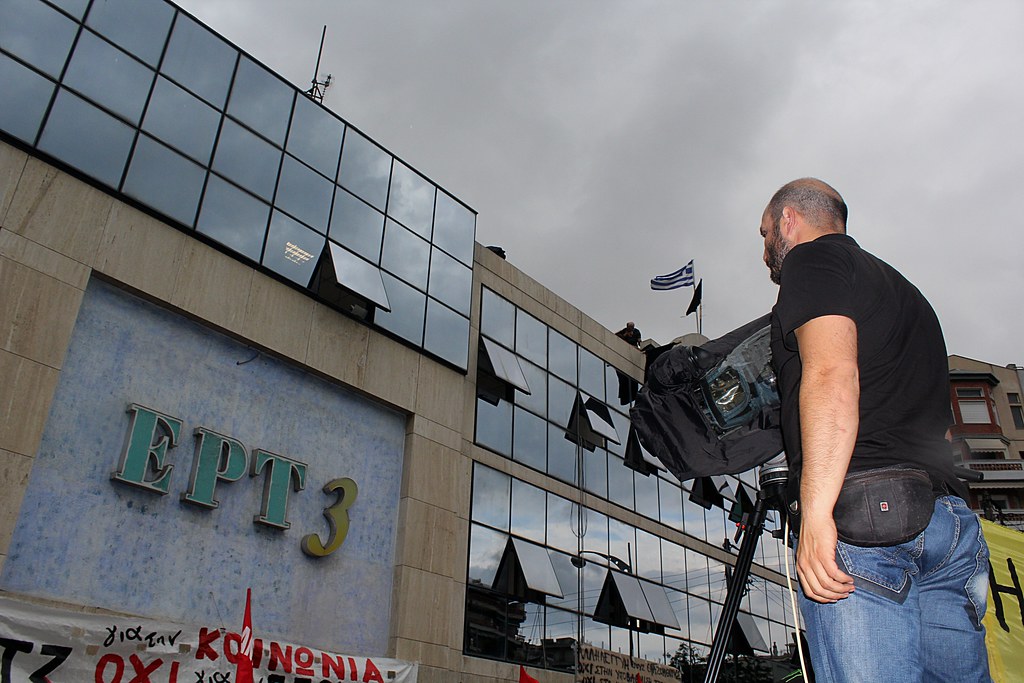
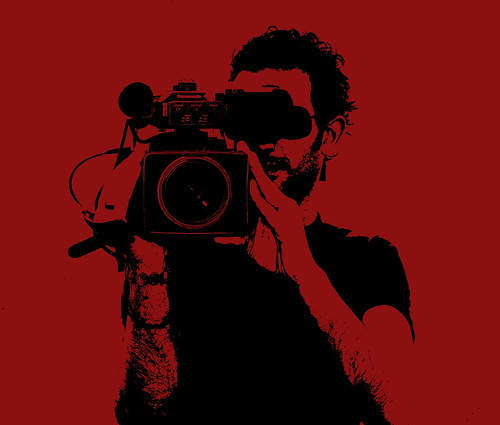
Cameraman outside ET3 studio - Thessaloniki, Greece


While the political situation may have stabilised Greek TV is still in crisis, the private TV stations so long, the playthings of rich oligarchs wishing to play political games are deeply in debt and stuck in a downward economic spiral in which every cut ensures fewer viewers and less revenue. And those who've gone are not coming back, once given a taster of the choice and variety the internet offers it is going to be next to impossible to lure people back to the TV screen with pitifully poor fare on offer at present. 

Deprived of access to government funds and cheap loans that have kept stations afloat till now they have become a mill stone around their owners' necks. Their primary purpose; their ability to set the political agenda  is now in severe decline, a victim of the public's distrust in news reporting whittled away away by endless stream of propaganda posing as news.

Even the parties the media relied upon to exercise power are waning, the government coalition partners, PASOK and New Democracy are seen by many voters as corrupt and beholden to the same wealthy individuals and family dynasties that own so much of the media. On the other hand Golden Dawn which has been largely excluded from the media has continued to grow in popularity at the expense of the two main parties in the coalition government, proof that TV's ability to make and break parties is fading.

So what happens next? The closure of ERT and the re-division of ad money to other stations will give the industry a slight boost for a while but in the middle to long term the situation look bleak. The lords of the small screen have been used to having enormous power for so long they disdained the internet as just a childish fad and did little to prepare for the new media landscape coming into being. They're have been half-hearted attempts to put their stations on mobile platforms such as Android but the reality is that the content is so poor that those most likely to use the service, namely the young are those least likely to be interested in what they have to offer. 

Most likely, media owners will do with their TV station what they did with their newspapers and run them into the ground, hoping that before they fail completely some second tier magnate will be persuaded by the fading glamour to take it off their hands.


Sunday, April 29, 2012

Far From The Madding Crowd - Election campaigning Greek style

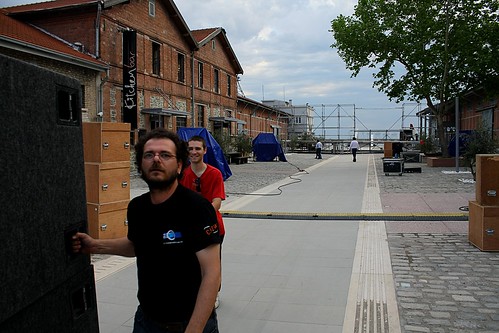
Setting up sound  stage for PASOK election rally by Teacher Dude's BBQ

Today at 6pm  Evangelos Venizelos, the head of PASOK and till recently the leader of the largest party in the Greek parliament will be addressing voters in the northern port city of Thessaloniki. The picture, taken yesterday shows technicians busily setting up stage inside the port in order to be ready for today's' rally. 

However, what the photograph really shows is that the current crisis in mainstream politics caused by five years of recession and three years of austerity has overturned nearly every aspect of election campaigning. In days gone by any political leader worth their salt would have organised a massive public meeting in Aristotelous Square, an event to which the party faithful from all over Northern Greece would come and for hours would be whipped up into a frenzy in anticipation of the arrival of their leader. (see photos from 2009 elections here).

PASOK party rally in Greece for the 2009 European elections

Even when the leaders were as lacklustre as Giorgos Papandreou and Kostas Karamanlis, the party supporters could be relied upon to put on a good show for the TV camera in the hope of swaying voters at home.But no longer. The two largest parties, PASOK and New Democracy cannot rely upon, or even completely trust their own voters. Over the last two years the numbers of attacks on politicians appearing on public have risen exponentially and although most involve little more than jeering and the throwing of yogurt others have turned much more violent. However, even worse than the possibility of violence is the damaging PR effect of TV images showing a candidates in front of hostile audience.


With the parties limited to using TV and internet to get their pre-election message across, preserving the fiction that they still enjoy mass support becomes even more important. Hence the choice of venue shown in the picture. It allows police and party media handlers to carefully control access and it's position far from the Thessaloniki's main streets means that protesters can be kept of sight and earshot.


Also the narrow space (it's the jetty pointing out to sea in Google Maps shot above) means that even a few  hundred people can be, with the right angles and lenses be made to look like an adoring crowd. Also since it is outdoors Venizelos can claim (at least on TV) that he is still popular enough to appear in public. What viewers will not see will the thousands of police on duty making sure that Venizelos can appear unmolested outdoors. Claiming to represent the will of the people whilst hiding behind rows of baton wielding riot police is not the carefully honed media message PASOK wants to send to voters on the eve of such an important vote.

Saturday, February 12, 2011

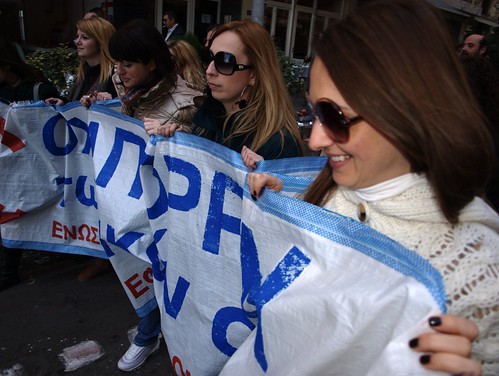
Employees of the Agelioforos and Makedonia newspapers protest wage cuts in Thessaloniki, Greece


Management of the newspapers are attempting to reduce pay by between 25 and 40%. In protests employees marched through the centre of Thessaloniki, Greece's second largest city yesterday morning.

The newspaper industry in Greece is, like so many other places in crisis with falling sales and an uncertain future. However, unlike other countries the main problem is not so much competition from the internet as with falling advertising revenues caused by a shrinking economy.

On the other the quality of journalism in many papers is poor and people are less and less willing to pay for reporting that is often little more than rehashed party political PR and overly reverential interviews with those in power. The media in general is viewed by many as being unreliable and beholden to powerful political and business interests (see here for survey carried out by GPO) . Less the fourth estate than the propaganda wing of the PASOK and New Democracy parties along with those businessmen who support them.

Monday, November 22, 2010

Financial crisis and the media: The failure of the Fourth Estate in Greece


As seen on TV., originally uploaded by Teacher Dude's BBQ.

It hardly comes as a surprise that the Greek media is less than impartial and that each part has its own line when it comes to political and financial issues. In the UK the fact that the Telegraph is a strong supporter of the Conservatives or the The Guardian has a left wing bent comes as a surprise to no one. Indeed this is one of the reasons readers choose one rather than the other. Here in Greece the same holds for TV stations as well as newspapers, though sometimes in less obvious ways as the nightly news bulletins aspire to respectability through trying to appear objective in their presentation of the day's events.

However, this veneer of objectivity has started to wear even thinner as the effects of Greece's economic crisis grow ever more apparent and the authorities desperately try to balance the demands of the country's creditors for cuts and reforms with a population deeply unhappy with the current state of affairs. This is most easily seen in the state run channels such as NET, ET1 and ET3 which nightly have a running commentary which is virtually indistinguishable from the official party line and like South Korea's “sunshine policy” attempts to avoid confrontation with government officials and present their policies in the best possible light. In other words spinning the administration's spin still further till the resulting story resembles something drafted by a Soviet era Pravda editorial team.

Case in point has been the visit to Athens by the IMF, EU, ECB trioka in order to negotiate the terms of Greece's next installment of the country's bailout package. The fact that the payment had been delayed was initially attributed by both the ERT news agency and the government to technical difficulties, which clashed with stories running in both Associated Press and Deutsche Welle that reported that the delay had been caused by the Austrian finance minister, Josef Proell threat to withhold his country's contribution to the bailout fund if Greece did not fulfill its obligation to raise more tax revenues. Other Greek media outlets did mention the news once it came out in the international press but even today there is no mention of Austria's role in the current negotiations in the state run ERT online news service .

In addition the recent government split between prime minister Giorgos Papandreou and employment minister Louka Katseli over whether Greece should accept the Trioka's demands for more flexible employment legislation and the abolition of industry wide contracts has been either underplayed or ignored. The disagreement between the minister and creditor's has threatened to derail talks over the terms and conditions of the multi – billion loan, yet today ERT top domestic news story is that foreign minister, Dimitris Droutsas has warned Turkey that failure to remove troops from Northern Cyprus will affect it EU application bid.

Unable to hide the fact that negotiations with the EU and IMF are not going as planned the government and it supporters in the media are attempting to divert attention elsewhere, preferably towards an external “enemy” in order to look tough on national issues. The reality is that such smoke and mirrors cannot hide the fact the Papandreou will almost certainly be forced to backtrack on pre -election promises not to implement further austerity measures further undermining his standing within the ruling PASOK party and the electorate in general.

It's also measure of how much the troika – Katseli affair has spooked the government and their media allies that the pro – government Skai TV channel news commentators were frantically demanding the minister return to the back benches and not disrupt talks that threaten to shipwreck the country. Such partisan statements in news bulletins means that even the pretense of neutrality is being dumped in a last ditch attempt to persuade viewers that Athens is in charge of the situation and not attempting to play a terrible hand of poker with all its cards on show.

Far away from the glare of the TV studio lights the majority of Greeks have written off both the media and the government convinced that neither can be trusted and that vital decisions concerning the future are no longer in the hands of their elected officials. With businesses closing at an ever faster rate and yet more VAT and tax hikes the reality of the situation is that Greece's future is grim and this can no longer be hidden. Despite almost Orwellian attempts by the seven state run outlets to call wage cuts, “readjustments” and the crisis an “opportunity” people are no longer listening to this daily diet of spin, evasion and PR hot air.

There is, however, still much to be learned from ERT (Greece's answer to the BBC) presentation of the news if one looks deep enough. Like sovietologists of old poring over the latest copy of Pravda there is a lot to be gleaned in the choice and order of news items. The first few items often give an insight into what PR line is being promoted which in turn allows the careful observer to understand what the authorities are most worried about. Hence last weeks triumphant headlines that Greece had secured the third tranche of cash from the EU was an indicator that there were doubts that over if the money would indeed be paid.

Similarly today's revanchist statements by the foreign minister is a fairly strong indicator that Papandreou's government is in deep trouble and is looking to create a diversion. Not that we will find out this from NET, ET1 etc but most likely from a TV station or newspaper supported by the opposition or more plausibly foreign media such as the BBC or Reuters. 

To understand why the local media is so bad and getting to the truth you have to understand the close, almost incestuous relationship between journalists and politicians. For the media news IS party politics, sometimes to the exclusion of virtually everything else and that access to sources is worth all kinds of compromises. This is not just a Greek phenomenon but the fact the mainstream political parties are able to reward the "right kind" of coverage with lucrative positions as "consultants" or even candidates in local and national elections means that many reporters do not bite the hand that feeds them.

Nor is the situation in the private sector much better as TV stations and other news outlets are owned by very rich men who use them as a way of gaining leverage with the state by supporting or criticising politicians and parties in order to win lucrative state contracts or to derail legislation not in their interest. In such an environment the Fourth Estate is simply a tool to be used to sway public opinion and so apply pressure when needed. 

On rare occasions where journalists do show integrity the cost is their livelihood as documentary film maker Stelios Koulaglou found out to his cost when he aired a documentary on the state run NET channel on unemployment critical of the then ruling New Democracy government. The result was  his instant dismissal and the end of a well respected TV series Reportage Horis Synora (Reporting Without Borders), which had been running since 1996 and had four times been awarded Best news Programme of the Year.

Wednesday, September 22, 2010

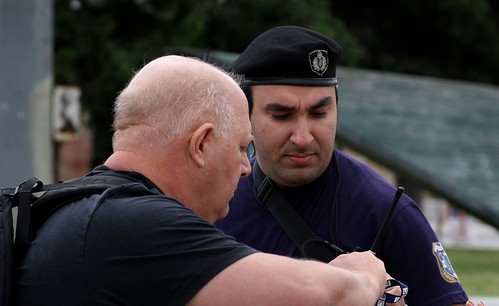
BBC's Malcolm Brabant being questioned by Greek police after show throwing incident - Thessaloniki, Greece

BBC's Malcolm Brabant being questioned by Greek police after show throwing incident - Thessaloniki, Greece

"The BBC has been accused of failing to support one of its foreign correspondents after his report about a shoe being thrown at the Greek prime minister was temporarily removed from the BBC News website.

Malcolm Brabant, an award-winning BBC correspondent, filmed the shoe-throwing incident involving the Greek prime minister, George Papandreou, earlier this month."


Monday, July 19, 2010

The Guardian interview with Giorgos Papandreou - life style puff piece?

"He cuts through the water with agility and speed." gushes Helena Smith, the Guardian's Athens corresponent, who then goes on to describe Greece's embatted prime minister as "statuesque" and later swoons over his "Olympian stamina". Guys, get a room.

This kind of journalism was be hilarious if the story behind it was not so tragic and didn't involved the suffering of so many people. Yet, the Guardian's interview with Papndreou is yet another example of how shallow the foreign media's analysis of what is happening in Greece really is.

We find out from the hard hitting piece that, "you have to make tough decisions in politics" and that "as long as I feel I am doing what I think is right and just for my country, for the Greek people, that is enough for me." While Smith does mention the enormous problems that Greece faces, many the result of the policies adopted by Papandreou's own PASOK party when it was in power she allows many claims by the prime minister to go unchallenged.

For example Papandreou insists that he was unaware of the true extent of Greece's financial woes before taking power in September 2009, a claim that the governor of the Bank of Greece refuted in an interview with the investigative journalism TV show "Neoi Fakeloi" (New Folders) which aired on the Skai TV channel May 2010. According to Giorgos Pavopoulos both the former and present prime minister were told during the national election campaign that the country's national debt was rising fast and likely to reach 12% before the end of 2009.

On the other hand Papandreou is allowed to repeat without challenge the oft heard claims that his government will help mobilise youth to change the country through the setting up of new businesses, especially those connected with renewable sources of energy and "green" initatives. While the sentiments are admirable no details are given about such programs and how they are to be funded when money for services as basic as hospital supplies are drying up. Nor does it seem to be having effect on the growing problem of unemployment which is hitting young Greeks hardest of all with over 30% without work, a figure set to rise still further as the economy continues to shrink.

At no time is the fact that many economists belive that the current IMF/EU/ECB bailout plan is doomed to failure according to many of the world's leading economists who think that the austerity package is most likely to lead to a long term depression reminiscent of 1929. Instead the government's tired old line that the there are no alternatives to the measures is repeated and that the economy will be "reinvigorated". No wonder the interview was warmly and repeatedly quoted on the state run ERT TV news.

What we see is yet another example of how "access journalism" reduces reporters to little more than stenographers and cheer leaders for those in power and that by making so many compromises to gain access to their subject the whole point of a newspaper interview is subverted and allowed to become little more than a life style puff piece. The fact it makes its appearance in a newspaper as serious as the Guardian makes it all the more depressing.


Friday, November 13, 2009

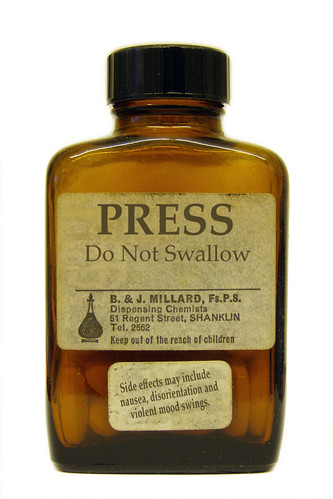
PRESS - Do Not Swallow May '- 68 Revisited

Saturday, January 10, 2009

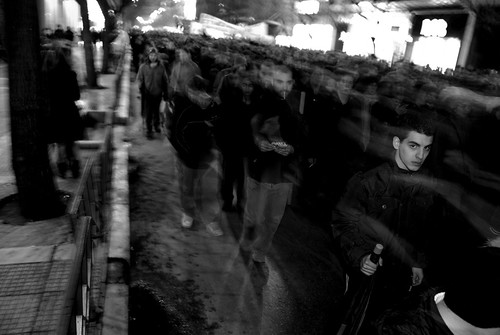
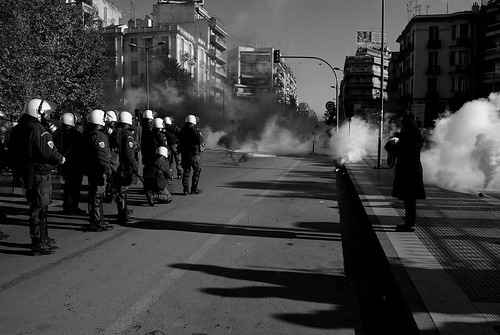
Anti - government protests - Thessaloniki, Greece

Thousands of students and other groups took to the streets of Athens and Thessaloniki yesterday to protest the present Greek government and its policies.

The government has announced that it has decided on a policy of zero tolerence in dealing with Greece's recent wave of unrest and the change in the ruling New Democracy party's change in tactics was seen in a more aggresive stance on the part of the MAT (Greek riot police) on Friday.

However, the change has proved to be less effective than hoped for as most of the arrests carried out the Athens authorities turned out to be lawyers acting as volunteer legal advisors to those taking part in yesterday's march. The 18 lawyers have filed a suit against deputy minister for law and order, after the head of the riot squad that detained them said that he was carrying out a "political decision", according a report on the Greek TV station Skai's, web site.

In addition the Athenian union of newspaper correspondents (ESIEA) have officially complained to the ministry of law and order over the beating of journalists and other members of the media by the police during yesterday's march.

http://my.nowpublic.com/world/greek-protests-resume-after-holiday-lull


Also the independent Greek news agency tvxs.gr posted video of riot police intimidating innocent citizens after the march. If you fast forward to 9 mins you'll see them harrassing a senior citizen who dared to question their authority.

Wednesday, December 10, 2008

What a day - Greek riot updates

No end to violence in Greek cities

What a day. I went back to the centre to see what was happening around the university campus I Thessaloniki as just when I thought everything was quiet and all the violence has ended I turned a corner right into a couple of platoons of riot police getting ready to retreat from stone throwing anarchist who'd left the university grounds.

I was fumbling about to figure out how to turn on the video camera my student had just lent me when my mobile rang and somebody at Sky news told me I'd be talking live. Yikees!!!! Then all hell seemed to break loose as the MAT (Greek riot police regrouped) and charged back by me. In the middle of giving an eyewitness account my truculent mobile died on me making for a dramatic effect, I guess.

Strangely, around the riot police were groups of masked men throwing stones into the university, something that did not seem to bother the cops next to them at all. I keep on hearing rumours members of the far right Xryse Aygh movement are getting involved but I can't confirm this.

I do however have video of the incidents around the university which I'm putting up on Youtube in a while.

Update


I managed to upload the video which shows the situation last night just outside the university next to the Genematas hospital. Notice the civilians wearing gas masks and throwing stones at the anarchists in the university just meters from where the riot police are standing.

In Patras, the port city near Athens thousands attacked rioters in the university grounds.

I just came across this video uploaded to ireport by my friend, Jay. It shows high school students demonstrating in he Analipsi district of East Thessaloniki yesterday. They are chanting, "Batsi gourouni, dolofoni", "cops, pigs, killers"

Tuesday, December 09, 2008

Media, media, media

Riot police ready to go into action in Thessaloniki, Greece

I'm going to have to get myself a press agent. The phone has been going all day as Sky News, The Guardian, BBC and Les Observateurs have called asking for interviews and my opinions on what has been happening in Greece and why. Actually, I'm happy to do this as people need to have a different view to the official spin story taking shape.

And to think I've also put in full day at work .

Tuesday, December 02, 2008

Fame! I want to live forever.