"If we play by their rules we lose, if we create our own rules we have a chance"
Once again the power of of social media can not only be seen in its ability to spread information but also in its power to challenge the way in which the mainstream media sets the agenda on a particular issue, even in places as far apart as The Gaza Strip and Ferguson, Missouri. Despite the vast differences in both geography and cause both cases show that even the most well-oiled media machine can be challenged by ordinary people on the ground using tools such as Twitter, Youtube and Instagram.
Here are some tips for anyone who wants to use the power of the internet to get their message across and give themselves leverage in their dealings with more traditional forms of media.
1 A community or group should never rely solely on mainstream media to get their message out. It's naive to believe they're are neutral parties in many news events. Remember TV channels and newspapers are often large organisations whose first loyalty is to those who own and/or control them and not to you. In the worst case scenario you are simply another lunch item on their menu, to be consumed today and forgotten tomorrow.
2 Even if the reporter on the scene is sympathetic to your cause, they are often not in charge of how the final story is seen. They may be on your side but as we have seen from coverage in Gaza there is often a massive disconnect between the story reported by those on the ground via Twitter and the one that reaches viewers and readers back home once the editorial line comes into play.
3 Yes, cultivate media who seem sympathetic, but remember media organisations frequently come to a story with their own agenda. Check them out on the internet see if their views and your views coincide. Do not take it on faith that what a journalist tells you is what they are telling their audience.
4 Don't just give the news channels "raw material" in the form of video, footage or interviews without knowing who they are and how they operate. Too many of those in the media see "civilians" as just another expendable resource to be used and then discarded in order to get their story out. Remember once you hand over your material you have no control over how it will be edited and presented.
5 Use your existing online and offline social networks to communicate your message, share material, produce your own media. The more people who can help you, especially in the beginning, the more others are likely to pick up on it later on and promote your cause. Remember on the internet you have the possibility of contacting sympathetic voices across the globe.
5 Use your existing online and offline social networks to communicate your message, share material, produce your own media. The more people who can help you, especially in the beginning, the more others are likely to pick up on it later on and promote your cause. Remember on the internet you have the possibility of contacting sympathetic voices across the globe.
6 Share materials and talent with those around you. If you can, form a group that will allow you to pool talents, materials and resources. Whether it is video footage from a different angle, access to PCs or a gift with writing or photography, your community or group is likely to be a treasure trove as far as material and skills are concerned, it's your job to make the most of these gifts.
7 If a community or group produces its own coverage (video/pictures/written accounts) it stands a better chance of getting its story out intact. The more you can do for yourself, the less your have to rely on media outsiders taking your story out of your hands and turning into something you do not recognise. If nothing else you can point people to your version when calling out distorted accounts produced by others.
Video can edited with free tools with programs such as Windows Movie Maker which comes pre-installed on many Windows PCs (see here for training video). It allows you to make your videos shorter and more effective and also means you can add media (video, photographs or audio) from many different sources.
8 None of this needs a lot of cash or fancy equipment but it does take time and you will need some technical skills which are well worth learning. A good place to begin is the Witness.org site which is full of practical tips on using video for activism. It is designed to teach those not in media how to cover different events in a professional manner and how to keep yourself and those whose stories you are covering safe. Check out their YouTube channel here.
If you are going to use photographs rather than video then always remember that a short text describing what is happening in the picture adds to your audience's understanding of the context of the event and also makes your image more credible.
9 Don't forget to licence your images (be they video, articles or photos) under a Creative Commons licence when posting them online. This means that media outlets cannot just claim that once you posted them you allowed free use of use them to anyone. Of course many will steal your work anyway but at least a CC licence gives you some kind of legal leverage and shows your audience that you are the victim of copyright theft and not just negligent or naive. See more on CC in this video.


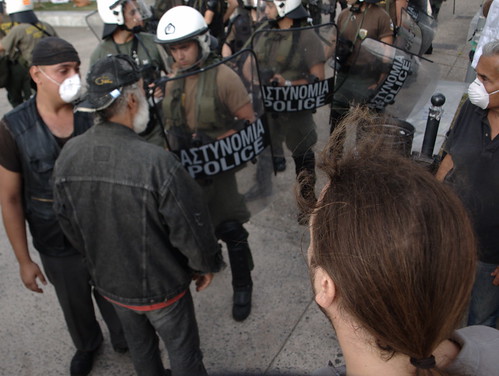
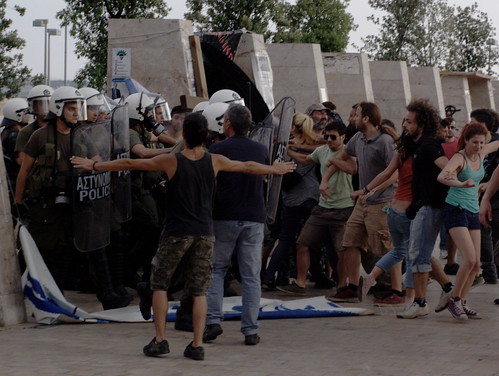
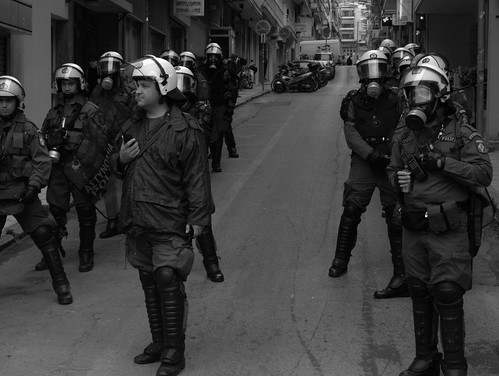
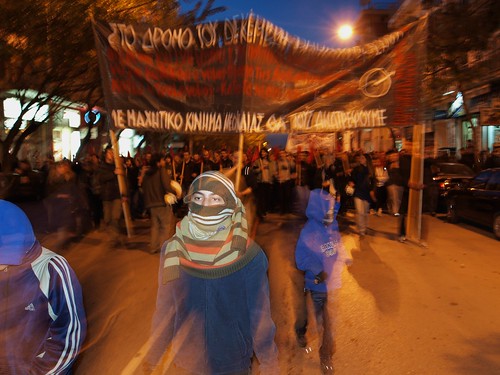


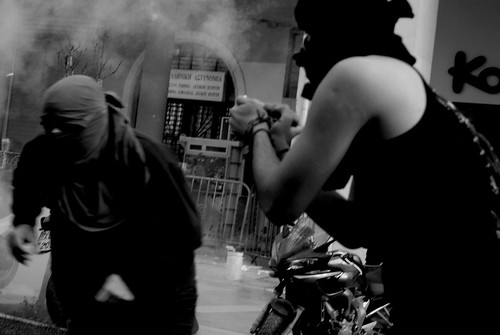
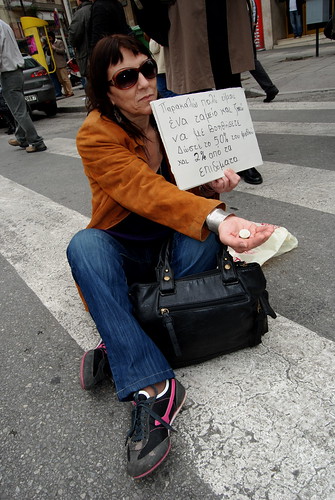

For me, however that experience came to me in my forties, hardly an age given over to violent uncontrollable emotion, Yet something in me was woken by the news that police officers had gunned down a 15 year old for no apparent reason in central Athens. I cannot say what I expected when I joined a demonstration on the following morning, an uncharacteristically warm Sunday morning. perhaps a small march with a few hundred (if that) politically active students which would last about an hour before everyone went back home or grabbed a bit to eat.
Instead thousands of people of all ages appeared and then more and still more till the marcher numbered anywhere near 10,000. But as well as the larger than expected turn out I noticed other, more worrisome signs such as the guys rapidly stuffing the necks of beer bottles with cloth.
From the beginning there was a feeling of anger and rage from many in the march, an undefinable sense that some unwritten covenent had been broken and that it wasn't business as usual. That was confirmed when the march verred off its usual route and made its way to the central police station in Aristotelous Square. Moving a little ahead of the front of the crowd I witnessed the first wave of clashes between protesters and riot police, a scene that would be repeated endless times over the following month in Thessaloniki and every other Greek city.
The police responded with endless rounds of tear gas and baton charges yet, almost miraculously people scattered then reformed, determined not to be intimidated by them. The rage and anger towards the police then mutated as the protests went on day after day into a general sense of violent discontent with the authorities in general.
Witnessing these events reminded me of all the account I had read of the student revolts of the late Sixties including Paris in 1968. Yet these protesters were not just teens or college students but rather came from virtually every age group including pensioners who red with anger would hurl the most furious insults at police officers.
The other aspect of the events of December and January was the sense of unreality that came from listening to the mainstream Greek media's account of the events which ranged from clueless to perneciously misleading. At a loss to explain a revolt which owed nothing to traditional party politics they attempted to describe it either in terms of mindless hooliganism or shadowy conspiracy theories.
It was then that I realised the true power of internet tools such as Twitter, Facebook, Youtube and blogs as they quickly proved a far more reliable source of information than TV stations which lumbered through the crisis like a half-blind brontosauras.
Two years on the conditions which fuelled the massive protests of 2008 have worsened still further and the anger feel by many then has grown and intensified as people feel betrayed by their leaders. The ruling political caste seems even more cut off from its popular grassroots support than ever before and seem oblivious that they are standing in the middle of a pool of petrol flicking cigarette butts into the void.