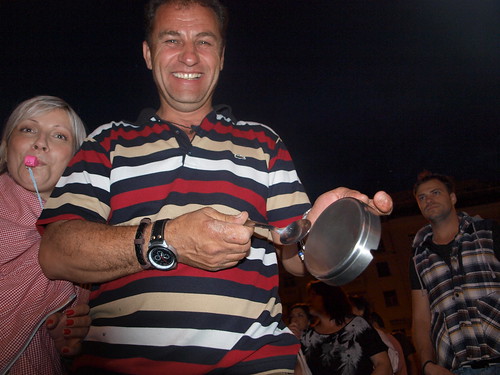
The sudden decision of Greece's government to shut down the state run broadcaster, ERT has provoked a nationwide wave of protest, with employees and their supporters taking over studios, despite repeated attempts to close down transmission.
Monday's decision to close down the entire public broadcasting network in Greece at midnight took the entire country by surprise. Even political insiders were unprepared for the swiftness of the closure nor the reaction of the staff of ERT who quickly occupied their own studios and transmission facilities through Greece.
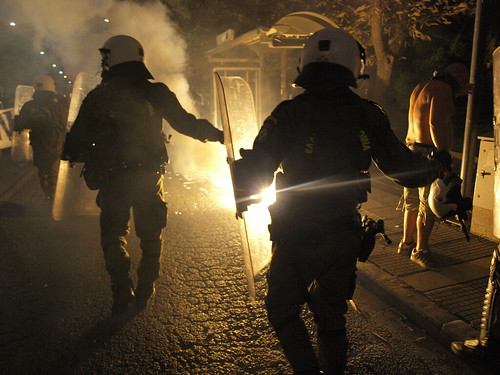
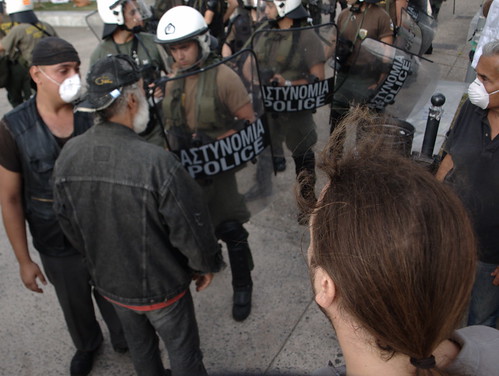
However, the Greek government was in mood for compromise and even before the midnight deadline, riot police units gradually shut down transmitters across the nation. attempts by other stations to re-broadcast ERT signals were also thwarted by the private agency that controls digital broadcasting.
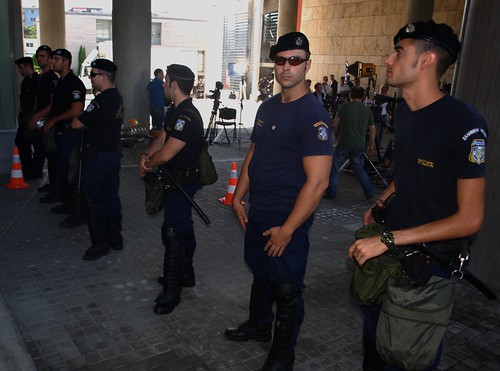
While transmission from both Athens continuing via the internet the ET3 studio based in the northern city of Thessaloniki is facing severe difficulties after authorities cut off telephone and internet connections to the studio. In addition hundreds of riot police units have taken up position in the area and man fear that they will be used to seize the ET3 building.
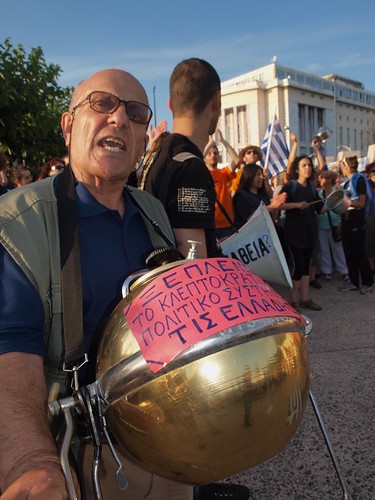
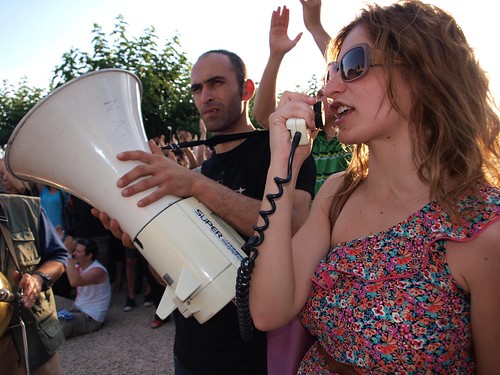
Since the announcement of the closure of ERT thousands of supporters have gathered in Athens and Thessaloniki to thwart a possible attempt by police to raid the facilities.
Despite the fact that Greece's economy has been shrinking for nearly six years, unemployment is at record levels and disposable income is dropping, the local and international corporations that control much of the nation's motorway network have repeatedly raise the cost of using these roads.
In an attempt to reverse this groups of Greek activists, part of the Den Plirono movement have resumed their protests at road tolls across the country, encouraging motorists to pass through without paying. This is a risky venture as many have been arrested and several are now facing civil and criminal court cases.
I was hoping that my trip down to Athens would allow me two visits in a row when I wasn't tear gassed and up till late in the afternoon of Tuesday it seemed that was exactly what was going to happen. Despite the massive crowds that turned up in Syntagma Square to mark the visit of German chancellor, Angela Merkel the mood of the people was peaceful if not calm.
Despite draconian security measures which included a ban on any form of gathering or assembly along the planned route from Athens airport to the centre between 60,000 and 80,000 turned up to voice their anger and frustration not only with EU - IMF imposed austerity but also their own corrupt government coalition.
As the day wore on groups of stone throwing youths started their ritualised attacks on the riot police units that had lined the square. It's hard to express the surrealistic nature if such clashes as they seem to serve little purpose with both sides acting out a pre-arranged script which they've failed to share with the rest of us. To add to the sense of the unreal the small army of photographers and camera operators present gave the scene the feel of some alternative sports match.
Of course, the tear gas and the chunks of marble which often filled the air were real enough and at one point I was forced to retreat as I had not brought any protection. Fearing the possibility that I'd be stopped by the police I'd left my gas mask at home rather than face a day in police custody while they checked out my ID.
At any point the police could have used their overwhelming force to clear the place in just a few minutes, but instead they chose to play a bizarre game of cat and mouse with masked protesters. Even when they managed to catch someone the crowds immediately swarmed around them hurling every kind of vile insult in the Greek language to show just what they thought of them.
Later on, like children bored of playing the same old game for hours on end the police entered Syntagma Square in force using batons, pepper spray and tear gas to clear the area, once gain using their doctrine of casual brutality in the name of restoring public order.
The same absurdist script was also playing out for the cameras in the streets behind parliament as Greek prime minister, Antonis Samaras and Angela Merkel strolled through the tree lined streets on the way to a joint press conference. I assume the images were intended to show that contrary to foreign press reports the PM could walk freely in public without fear of attack.
What the TV pictures did not show were the seven water canons parked just up the road and 1000's of heavily armed riot police that separated the leaders from the seething demonstrator in Syntagma. With security measures as tight as these even Barack Obama could happily spend a carefree morning window shopping in down town Kabul or Baghdad.
It hard to fathom what was the point of the whole expensive exercise since Merkel said little of substance and merely repeated her position that Greece needed to stick to the terms of the bailout deal and press ahead with yet more tax hikes, public spending cuts and lay offs. Instead of strengthening Samaras's position within Greece's shaky coalition government, Merkel underlined just how little real power Greece's political leadership has in its negotiations with the EU/IMF/ECB troika.
On the other hand the hardware stores in Monestiraki which do a roaring trade in improvised gas masks and marble wholesalers who regular replace the smashed stone work in Syntagma had a great day.
The Thessaloniki international trade fair, or Helexpo as it is known locally has traditionally been the chance for the country to present its best face to the outside world.
However, this year's event was overshadowed by violent anti- government protests organised by groups as disparate as taxi drives and doctors, football fans and soccer moms, all angry with austerity measures which have crippled the economy and brought about a financial downturn unprecedented in modern Greek history.
Prime minister. Girogos Papandreou gave is annual speech at the fair, the nearest thing Greece as to a state of the union address from behind a security cordon manned by 10-12,000 riot police armed with shields, tear gas and pistols.
The centre of Greece's second largest city of 1,2 million inhabitants was sealed off for one kilometre around the Vellidiou conference centre where the prime minister was scheduled to speak.
In the end the most violent protests came not from the city's large student population or anarchists but rather taxi drivers outraged by government reform measures. For over an hour thousands of driver fought with riot police units outside the trade fair.
Round of tear gas fired by the police were met with a hail of broken paving stones and several times forced them to retreat to the relative safety of the fair.
To add to the authorities woes thousands of football fans also clashed with police units in the centre as the local Iraklis FC supporters smashed shop windows and set fire to rubbish bins along the main Tsimiski Boulevard.
Clashes between students and police around the Aristotelian University of Thessaloniki which borders the trade fair also lasted into the small hours of the morning.
Greek prime minister, Giorgos Papandreou is visiting the country's second largest in the run up to his annual address to the nation which traditionally marks the opening not only of the international expo but the new political season.
With coffers empty and yet more austerity measures soon to be imposed Papandreou's popularity is at an all time low as groups as diverse as dentists and taxi drivers, cleaners and surgeons are taking part in anti-government protests.
The city centre resembles less a trade fair than a city under seige with thousands of quasi-military riot police on stand by around strategic public buildings and the Makedonia Palace hotel where the prime minister and much of the cabinet will be staying for the weekend.
The real show of strength will be tomorrow when thousands of demonstrators have vowed to shut down the centre and do everything in theirpower to prevent the beleagured leader from giving his key note speech to the nation.
As of last Friday I no longer contribute to the Demotix website. For those who do not know them, Demotix bills itself as an;
"award-winning newswire where YOU tell the stories. We put photos and video from ordinary people and freelance photographers into the international news media."
When I started to upload photographs and news stories I was hoping that the site would be a serious replacement for other citizen journalism news hubs I had previously worked with. I was hoping that unlike these others Demotix would not degenerate into a centre for crack pot ideas and conspiracy theorists desperately trying to convince us that Hitler's brain was living on Mars.
In that respect Demotix has suceeded by retaining editorial control over content and judicious choice of what stories it promotes. So why am I leaving? The first and most obvious reason is the seemingly endless list of technical difficulties that mean uploading photographs (forget video,where problems grew exponentially) and stories can take hours and many repeated attempts.
If you're sitting in the comfort of your own home, an hour of two wasted now and then may not mean much but when uploading more often or you're outside in difficult conditions, such delays are infuriating.I remember cursing the site with every swear word I possess in both English and Greek when trying to upload a story from the Athens riots which was written on a rapidly dying laptop in an arcade filling up with tear gas.
Despite recent attempts to improve. every upgrade simply changes the nature of the bugs rather than their frequency, it seems. The last straw was on Friday when an entire story just disappeared from before my very eyes never to be seen again. With my main job about to start again I do not have the time to spend two, three hours nursing a story through defective software.
The other problem I have with Demotix is over payment or rather the lack of transparency over what is being sold, where and for how much. By chance I happened to come across some of my images that had been licenced to the Wall Street Journal and some Danish news sites yet no mention was made of this either via my account on Demotix or email. Later a member of the Demotix staff assured me that all the details of these transaction would be made available to me within the following days. That was over a month ago and still no update of my sales has appeared in my account data in Demotix.
As you can imagine this lack of feedback is both disappointing and frustrating and has confirmed my decision that Demotix is not the place for me.
This was just one of the hundreds of acts of police violence commited by Greek riot squads during the 29th June, the vast majority of attacks were directed at peaceful protesters who'd gathered in Syntagma Square, central Athens to show their disagreement with the latest round of Government austerity measures which has brought the country to its knees economically.
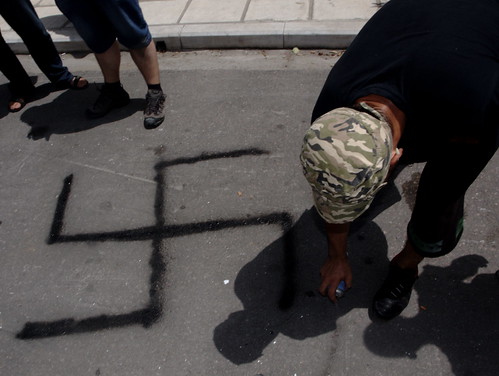
Despite the onset of Summer Greek protests show no sign of dying down despite the witheringly high temperatures of a Mediterranean heatwave. In Greece's second largest city, Thessaloniki members of the local anti-government "Indignant" movement this afternoon picketed the city's German consulate, shouting anti-German and anti EU slogans and spraying swasitikas on the pavement outside the main entrance.
Demands including the repayment of unpaid war reparation from Germany for the destruction caused by the Nazi occupation of Greece from 1941-1945. In addition German insistence of tough austerity measures has seen a massive upswing in anti-German feeling from across the political spectrum, a sentiment flamed by the repeated acusations that German corporations such as Siemens and HDW systematically bribed leading Greek politicians in order to win lucrative arms and security contracts
Occasionally, things happen that takes time to process or require distance to filter them through memory till they start to take on the contours of anything that can be explained in a meaningful way.
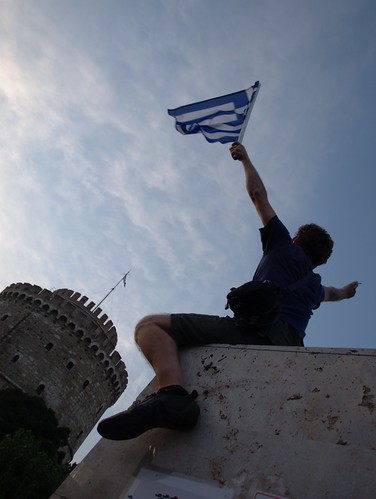
It has been over two weeks since I went to Athens to take part in the anti-government rally on the 29th June. Tagging along with a group of 400 "indignant" as the Greek protesters call themselves I found myself waiting at midnight outside the White Tower in the centre of Greece's second largest city, Thessaloniki with a bunch of people who resembled less a group of serious demonstrators than over aged participants in a school trip. The joking and jostling for position, who sits next to whom, brought back memories of similiar journeys as a kid.
Arriving in Athens the next morning we wasted no time and no sooner had we clambered off the coaches than a banner was unfurled and people took to the road to march and shout out chants, announcing to all who cared to listen that the northern contingent was in town and looking to join their big city counterparts in Syntagma Square. The Square which faces the houses of parliament has, for much of modern Greek history been the focal point of clashes between disgruntled citizens and their rulers.
As soon as we entered the square than many of us were overwhelmed with tears, though this was less to do with any emotion than the residue of tear gas that had been used the previous day and which still coated much of the area. Luckily for us, one of the leaders knew exactly where we could equip ourselves with gas masks and goggles that later would prove so vital for anyone who wanted to stay in Syntagma.
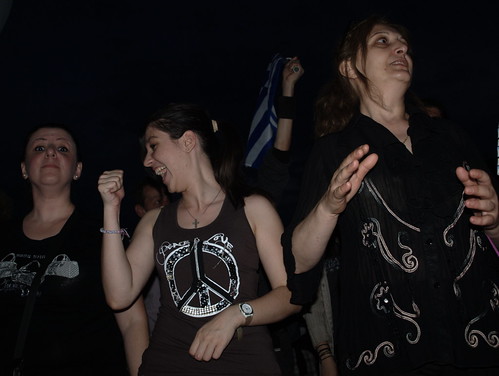
In the crowd that was massed in front of the parliament the atmosphere was a strange mix of carnival and demo, on the one hand people were in a upbeat mood with some present dancing to music played by drummers yet the underlying feeling of tension and anger was apparent to anyone familiar with Greeks and Greek culture.
Another interesting point was the "ideological" composition of the rally, which seemed to embrace a wide, if not contradictory range of political opinions. In the centre where trouble would later start were the "patriots" as I termed them, who were convinced that the entire Greek debt crisis was the result of American born prime minister, Giorgos Papandreou's collusion with the Jewish banking nexus, with a measure of masonic conspiracy theory thrown in for good measure.
On the other hand every shade of left wing opinion including the anarchists also had their own blocks. In the middle, a mass of others who identified with none of the available political choices but were convinced that the austerity law being debated was a disaster for the country and wanted send a message to those inside parliament.
The real panic began at 1.30pm when news that the austerity vote had passed became known, leading to a group of about 100-200 next to the barriers outside parliament to rush the police. The charge was quickly stopped when riot police units started firing tear gas and the demonstrators quickly retreated. Taking this as a cue a group of about 50-100 youths started pelting police lines from nearby the Grand Bretagne hotel and and the police intervened effectively the violence would have probably been over within a few minutes.
However, riot police units then took the attack as an excuse to lauch a concerted assault on the rally from five different directions, using thousands of tear gas cannisters, flash grenades and other weapons. The result was a generalised onslaught on anyone still remaining in Syntagma who were all perceived by the police as rioters, even though the vast majority were protesting peacefully and had nowhere to flee to.
Assualts by the police continued inside Syntagma and throughout much of the centre of Athens for the rest of the day, with hundreds being hospitalised with breathing problems or the result of beatings by the police who in many situations acted more like football hooligans than the agents of law and order.
How to describe the horror of seeing a pack of 10 officers kick and beat a man in front of my eyes, or the anger generated when a protesters who talked back to a policeman was repeatedly punched in the face by a another cop. It was scenes like these that infuriated many present and created a much wider circle of people, many older men and women willing to throw stones and other objects at the police.
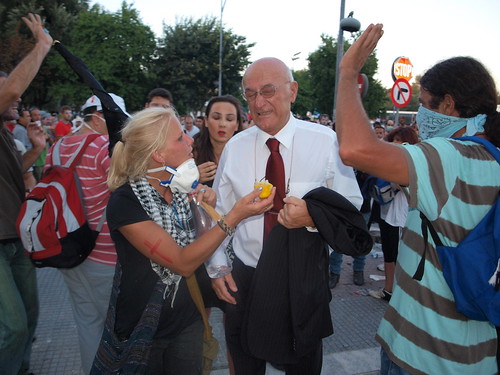
I repeatedly saw demonstators plead with riot squad units to stop attacks and who intervened to calm down fellow protesters but often their attempts to play peacemaker were thwarted by the police themselves who lashed out at anyone who approached them or grabbed people, seemingly at random.Each time this happend yet another wave of anger rippled through those nearby.
This pattern of violence and over reaction repeated itself through the day and lead me to the conclusion that the violence of the police was not simply a lack of self control but part of a plan by the authorities to empty the square and put down the Indignant movement at all costs. I doubt if anyone in government uttered those words but I'm pretty sure that the police leadership was left with no illusion about what their political masters wanted done about the situation.
Another infuriating aspect of the day's events was the foreign coverage of the rally which seemed to misunderstand the gravity of the situation, For most of the foreign press crews the story as yet another clash between Greek "anarchists" and the police so ignoring the wider implications of a massive police surpression of a mainly peaceful protest movement.
I'm not sure if this was simply journalistic laziness or the result an agenda that much of the mainstream media often bring to news stories.I remember arguing with some smug US TV anchorman next to me who was waffling on about how futile the protests were as if it was a tired theatrical show that has outstayed its welcome rather than the desperate fight by ordinary Greeks for a viable future. This unwillingness or inability to look beyond the dramatic images to get to a deeper truth has marked much ofthe reporting from Syntagma and the Greek crisis in general.
Later as the day wore on my nerves and stamina dwindled the constant threat of attack by the police or injury by flying objects from both sides plus the experience of being tear gassed took its toll and even the adenaline jolt of being in a highly charged conflict wasn't enough to keep me going . So I went to a cafe to send off pictures and comment to Demotix. yet even there the atmosphere was heavy with tear gas and I ended up sitting at a table in a mall wearing a mask while tapping out my story.
Towards midnight I carefully made my way back to Syntagma Square which now resembled a war zone with fires burning and the much of the surrounding area looking as if it had been used for target practice to get to the subway station to meet up with the other protesters from Thessaloniki who were going back by coach from Monestiraki.Even inside the station the regular thud of flash grenades going off near the entrance gave the impression that we were in an air raid.
Even though I have seen lots of upheaval in Greeece, including the violent uprising in December 2008 the level of violence I witnessed in Syntagma was of a new order of magnitude and it seemed that it was ushering in a violently different relationship between the Greek government and the people they are supposed to represent.
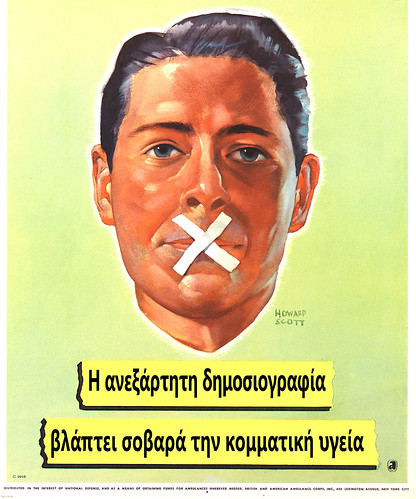
In many respects the situation in Britain closely replicates the situation here in Greece as far as the media is concerned. In both countries media conglomerates are owned by the very rich who do not hesitate to use their position to set the political agenda in order to ensure their interests are either protected or extended. In this they are assisted by both journalists and politicians eager to curry favour with owners in return for the kind of publicity that will advance their careers.
As for the rest of us, we are just treated as rather silly children who must be seen but not heard, occasionally a few of us are asked our opinion on the issues of the day but this is little more than window dressing, and is no way is allowed to interfere with the media's real job which is promoting the views of the wealthy and powerful.
I suppose those living in Greece should be thankful that the local media corporations are less practiced in the dark arts of spin than their UK counterparts and so their efforts often fail to convince, either that or Greeks, long accustomed to the constant media drone of state and non state propaganda are less credulous than UK consumers and so more cyncial about whatever claim or counter claim the media chooses to make.
Following the flame out at News International it is time once again to look at the simmering conlict between old and new media or perhaps more accurately between corporate embedded media and those operating outside the hermetically sealed world of political reporting. For too long those of using the new, powerful tools offered by the internet have taken traditional journalism's claims about superior accuracy and professionalism for granted.
What is emerging now in the wake of News of the World/ Times debacle is cold, hard truth is that much of commercial journalism is deeply corrupt and has no real claim to being better than the work done by bloggers and the like. When the slick presentaion is removed what really distinguishes media players from their independent counterparts? It certainly isn't integrity if the stories coming out of Wapping are to be believed.
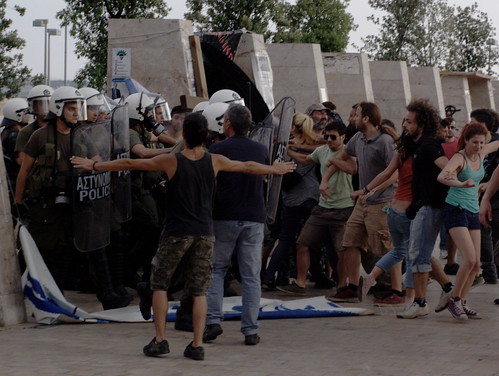
Following a series of clashes between riot police protecting a far right rally and anti-racist groups, several platoons of riot police also attacked the encampment of Greece's Los indignados movement in the northern port city of Thessaloniki. Using pepper spray and flash grenades to disperse those present the police were eventually forced to retreat after camp organisers formed a human shield between themselves and angry demonstrators.
Defying torrential rain and the siren call of the country's beaches thousands of indignant Greeks massed once more for the third Sunday in a row to show their anger over the latest austerity mesures which the ruling PASOK government aims to get through parliament this week.
With the imposition of poll tax on those earning 8,000 euros and more combined with yet further increases in VAT (sales tax) and extra indirect taxation via power bills prime minister Giorgos Papandreou is attempting to staunch Greece's hemorraghing public finances and satisfy demands for action by the troika of creditors made up of the IMF, EU and European Central Bank.
On the other side of the equation stands a sizeable chunk of Greek public opinion, with according to some polls 90% of the electorate opposed to further measures. In the latest poll carried out by the Greek public opinion research company Public Issue found that over two million Greeks have taken part in some form of anti-government protest. Even within the ruling PASOK party 16 MPs have broken ranks and called upon their leader to allow more debate on the latest legislation which threatens to unleash further social unrest.
For the 19th day running protesters gathered in streets and square nationwide with calls for the government to leave power and the country to stop all payments on debt owed. In the northern port city of Thessaloniki around 5,000 marched through the city despite repeated downpours.
More mass demonstrations have been called for Wednesday to coincided with the national strike called by public and private sector trade unions with plans to encircle parliament and other government buildings across the country.
With hand outstretched and palm facing skwards, thousands of Greeks direct the "montza", a gesture of deepest loathing and disrespect in the direction of the nation's parliament, the most visible outward sign of the anger and sense of betrayal many people feel towards the ruling PASOK party and the current political system in general.
They call themslves ,"The indignant" and for twelve days crowds have gathered in the centre of cities and towns across Greece to show their dissatisfaction with the current economic crisis caused by the imposition of austerity measures designed to rein in Athens massive public spending deficit. The package designed by the IMF, European Commission and the European Central Bank was intended to put the country's financial house in order and allow it to repay the massive debt load acquired over decades of unchecked public spending. However, the economic recipe of wage reductions, public spending cuts and privatisations has seen a sudden leap in unemployment, business closures on an unprecedented scale and consumer spending drop precipiticiously.
Despite lowering pay and pensions Greek prime minister, Giorgos Papandreou has been unable to stop the Greek eonomy from going into free fall and is now faced with the unenviable task of persuading his own party, parliamentary opposition and the population in general that even more drastic measures need to be taken if the country is not to default on its obligations to creditors.
On the one hand fellow European political and financial leaders have repeatedly emphasised the fact that Greece cannot expect further bailout packages without structural reforms whilst at home Papandreou faces growing pressure from within his own socialist PASOK party to reject such changes. Outside parliament the growing wave of anger with a political caste who, following decades of corruption scandals, have retained little credibility amongst the electorate, means that few can appear in public without creating tense scenes that require the intervention of the police. Over the past weeks MPs and members of the cabinet have been repeatedly booed, jeered and become the target of angry crowds when seen in public,
Most unsettling for the administration is the spontaneous appearance of a natiowide protest movement modelled on previous demonstrations in the Arab world and Spain. Using Facebook and other social media sites the "Aganaktismeni"or Indignant have repeatedly been able to use the internet to muster crowds of hundreds of thousands in Athens, Thessaloniki and other Greek cities, However, in contrast to previous mass demonstrations the peaceful nature of the rallies has flummoxed the authorities more used to using riot police and tear gas to deal with popular dissent.
With protests growing in size day the options available for Giorgos Papandeou seem to shrinking day by day.