Showing posts with label eu. Show all posts

Thursday, January 12, 2017

The winter crisis in Greece - refugees left in limbo as those in charge pass the buck

Cold Kills Refugees

After days of anticipation, the Ariadni cold wave finally hit Greece a few days ago bring polar temperatures and heavy snowfall across across the country. Not only was this spate of bad weather predicted days in advance, it was the butt of many jokes and sarcastic comments on Facebook and Twitter as the full force of the front hit nearly two days later than had been originally forecast. So why the Greek authorities and the large international NGOs who help run many of the camps were taken so completely by surprise by the event is something of a surprise in itself. While many ordinary Greeks were left without water and electricity by the extreme cold, those worst hit were many of the 60,000 refugees still living in tents and abandoned industrial buildings in makeshift camps.

On the Greek islands of Lesbos, Chios and Samos some refugees were left to spend days in unheated tents enduring temperatures as low as -5C , Nor was it only the islands that saw such squalid neglect of people in dire need.  Despite repeated assurances by Greece' Migration minister, Yannis Mouzalas that, with a few minor exceptions that those on the mainland were already in properly "winterised" accommodations (see his interview in the Turkish daily Hurriyet) photographs and video soon appeared on both Facebook and Twitter from volunteers and aid workers on the ground showing freezing families in snow covered tents and freezing warehouses struggling to survive polar temperatures.

Once the story was picked up by the international media the Greek government's response was to first ban photography and filming in the worst effected camps (refugee camps are under the control of either the Greek army or police force and access to them is strictly regulated) and then slowly place a minority  (500 out of nearly 6,000) of the most vulnerable in more suitable housing, at least until the worst of the winter weather abated.

While the severity of the cold spell is unusual for Greece, it is not unprecedented, Greek winters especially in the north are shorter than those in northern Europe but are often quite severe due to the mountainous topography of the region, so much so that the nation has over 25 ski resorts that people flock to every year. Even on the islands winter temperatures are often no more clement than those in some parts of northern Europe such as southern UK and Ireland, even in a mild winter. Forcing people to live in tents and abandoned buildings for months in such conditions is nothing short of criminal.

As is so often the case, finding the villain of the piece is a complicated, frustrating process with all the major players, Greek central government, local authorities, EU and UNHCR Greece busily blaming each other for this easily avoided fiasco. In the meantime many refugee still find themselves in cold, squalid camps waiting for a plan to improve the situation that no one in a position of authority seems willing to provide.

Sunday, February 07, 2016

Video:Tensions rise in the Eidomeni transit camp - northern Greece (footage taken on 3 February)


The major ferry strike which cut off the Greek islands from the mainland meant that when it ended  on the 31st January there was a sudden surge in the number of refugees heading from Athens to the Eidomeni transit camp on Greece's northern border with FYR Macedonia. The situation was further exacerbated by with the unwillingness of the FYR Macedonian government to open the border crossing at Eidomeni to more than a fraction of refugees. The result was an an explosive situation in the camp as thousands of tired, hungry people waited in limbo unsure of what they had to to face next.

On Wednesday 3 February riot police were deployed in an attempt to keep control of a steadily deteriorating situation as thousands sought to get their papers stamped by the Greek police, without which they would not be allowed to cross into FYR Macedonia.

With camps full to overflowing, many refugee families were forced to sleep out in the open in freezing temperatures for three nights and with little information about if or when they would be allowed to continue their journey.

Behind the decision on whether to open or close the border lie a multitude of political calculations in which smaller Balkan nations juggle the intense political pressure they are under from northern EU nations to stop the flow of refugees with the fear that they will become a dumping ground for people nations such as France, Germany and Denmark do not want to accept.

As the EU continues to prevaricate and avoids taking concrete decisions concerning the refugee crisis in Greece and the rest of the Balkans, it is the youngest and most vulnerable who continue to pay for their ineptitude and vacillation.

Monday, January 25, 2016

Can you Help? Demand the Greek government treats refugees more humanely


 Over 1,000,000 million refugees entered Europe in 2015, more than 800,000 chose the Western Balkan route which took them to an obscure railway crossing near the tiny village of Eidomeni on  Greece's northern border with FYR Macedonia.

After a journey from the port of Pireaus that can last up to 20 hours refugees are rushed by the Greek police to the border. Volunteer groups and NGOs at the camp are often given as little as 10 minutes to hand out food, clothing, medical aid and information before crossing over.

There is the constant fear that the government of FYR Macedonia will permanently close down the border with Greece and so leave people stranded. When the border is open or closed seems to be completely at the whim of the FYR Macedonia government  and there is little or no co-operation between the authorities on both sides of the frontier and so little idea when and for how long the crossing remain shut.

For their part the Greek police who control acccess to Eidomeni also refuse to share information with NGOs and volunteer groups over when and how many refugees will be arriving at the camp on any given day, despite the fact that they control the flow from start to finish on the Greek mainland. Indeed since December the attitude of the police has perceptibly hardened, ranging from sullen indifference to active hostility, sometimes kicking out organisations such Médecins Sans Frontières all together, with little or no notice.

To make an already difficult situation worst, the police forbid access to the hot food, doctors, heated tents and other faciities that have been built recently at Eidomeni. Instead refugees are forced to wait endless hours at a road side petrol station/cafe 20km from the site whilst temperatures at night often drop to -15c. Here refugees are obliged to buy food and water whilst just a ten minute ride away volunteers wait to hand out such items at no cost.

Last week over 3,000 people, including many families with very young children were forced to endure extreme cold overnight while the camp remained half empty.

We are calling upon media outlets to highlight this scandalous abuse of refugees by the Greek authorities. The more international pressure is brought upon the SYRIZA government and prime minister, Alexis Tsipras the more likely refugees will receive more humane treatment on the Greek leg of their trek to safety.

Refugee Solidarity Movement Thessaloniki-Eidomeni

Saturday, January 23, 2016

Video: Winter at Eidomeni - Refugees wait to cross the Greece - FYR Macedonia border


Over one million refugees entered Europe in 2015, the vast majority chose the Western Balkan route which leads from the Turkish coast via the Greek islands to Eidomeni, a tiny village on the Greek - FYR Macedonian border. Over 800,000 people have passed through this unofficial crossing point which is little more than a collection of tents armed guards and barbed wire before going on North to their final destination in nations such as Germany, Austria and Sweden.

Since May the Refugee Solidarity Movement Thessaloniki has been offering help to those making the trek north first in the city of Thessaloniki and then from September we have been going to Eidomeni where we serve hot tea and help out the other groups providing food, clothing and information to refugees arriving there.


Thursday, July 02, 2015

But Yes or No to what? Greece decides on Sunday.

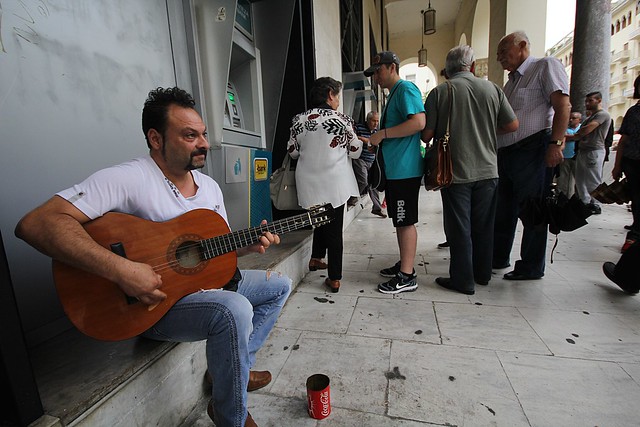
Greeks lining up at ATM - Thessaloniki

On Sundays Greeks go to the polls to vote. They will be asked to vote Yes or No. But Yes or No to what? The question seems to produce an endless array of answers, which have left Greeks arguing passionately for the past week, both on social media and in real life.For the economically minded supporters of the Yes side, it is a vote to stay in the Eurozone, to retain a stable currency and avoid the risks of introducing a new, untried currency which may or may not be worthless. It's a Yes to open banks, pensions being paid on time and a step away from the financial abyss. For conservatives it's a Yes to membership of the European Union and a step away from what they see as rabid, socialist madness.

In the No camp, a No is a refusal to accept an creditor imposed austerity plan which has crushed the Greek economy and even on its own terms is a failure. For the more nationalistically minded its is a vote for independence, a chance to show foreigners that Greeks will not and cannot take any more crap from either Washington, Brussels or Berlin.

In the maelstrom of debate, the usual lines that divide the Greek Left and Right have been blurred, muddled and sometimes utterly forgotten. Nor, as it is sometimes portrayed as a fight between haves and have nots. Whilst those in the Yes camp are amply represented in the country's oligarch controlled media, the poll number are not restricted to just those who've weathered six years of austerity with their wealth intact. Pensioners fearful of their future, owners of businesses both large and small as well as those fearful of the consequences of a Grexit have swelled the Yes vote.

On the other hand the No vote included those with little to lose from maintaining the status quo, such as the unemployed and young voters who see that more of the same in a nation with record high unemployment is not an option. Also there are those who  are sick of Greece's continual humiliation at the hands of the EU, ECB and IMF and wish to show these institutions that enough is enough, no matter what the cost. The fact that political Ancien Regime, discredited by corruption and ineptitude has thrown its weight behind the Yes vote is just further proof that a No vote is justified.

What will happen on Sunday, I do not know. If you'd asked me a week ago I would have said that the Yes vote will win comfortably, but given the fact that EU leadership smugly seems to betting on this combined with a week long fear campaign on TV makes me think that perhaps that things will turn out differently. The same political forces that tried so hard to crush Syriza in the January elections are once again openly playing their hand, and there's a chance they'll fail now as they failed then.

Once again the crude political intervention of the ECB which stopped lending to Greek banks via ELA so starving them of liquidity along with the arrogance of various German politicians simply fuel the No vote  just as the intervention of English politicians in the Scottish independence referendum aided the rise of the Scottish Nationalist Party.

Whilst people are angry they cannot take out money from their saving accounts and fearful for their future, there is a growing sense that they will not bow down and take anymore. Whether their vote is based on carefully calibrated deliberation or knee jerk nationalism, the result will be the same in the polling booths on Sunday.


Wednesday, June 03, 2015

A Short Story About The Greek Credit Crisis: A European Morality Tale

Greek government radical new approach to economic growth pays off

Let's imagine a situation. Let's imagine that times have been good for you and you decided to buy a house, a house that you always dreamed of, a place that you can call home. The only problem is that this place is a bit pricey, certainly a stretch financially but what the hell, times are good, your credit rating is just fine and the guys at the bank just love you.

Alas, the economy takes a downturn, your job isn't as secure as it used to be and the boss is muttering darkly about downsizing and wage cuts. Now those mortgage payment instead of being steep become vertical so you go to the bank and decide to ask them if some kind of deal can be made. They look at you aghast, they had no idea that you are unable to meet your financial commitments, otherwise why would they have sent you all those credit card applications or phoned so insistently wondering if you want a loan for a new car/holiday/kid's dental work/shopping/home extension. They are shocked, shocked to hear that you have been so profligate with their hard earned cash, how on earth could you have deceived them in such an underhand manner?

But rather than lose a long standing customer (and a house they'd never sale for money you paid for it) they decide to offer you a loan to cover your debts. The problem is that this loan comes with some pretty severe conditions, no more outings, eating in restaurants is a thing of the past, also the kids really should leave home, they're a drain on your resources and frankly, granny's presence puts the family budget over the edge.

Grudgingly, you accept the terms, what else can you do? The problem is that the job market is still not getting better, the boss is demanding ever greater "flexibility" when it comes to salaries and that loan you just took out to cover the mortgage is still just beyond your pay grade. No matter how low the interest payments are, they are piling up and up.. So you go back to the bank and explain the situation, maybe rather than foreclose they could be persuaded to cut the total loan and allow you to pay, at least some of it whilst keeping a roof over your head. The mere suggestion is enough to make them choke on their mid-morning lattes and you get the impression that all is lost.

Yet, these are finance professionals and they know that a foreclosure would not only look bad for the bank, it would also not do their careers any good at all so they come up with a compromise solution. this time they'll issue you a credit card to draw upon when you need to pay the next installment of the loan you took out to cover your initial mortgage. Your kid's college fund will have to go, and that pension plan you took out is way too extravagant for a family of YOUR means. While you look dumb struck, they add a final condition,"you have to sell the family car". But how will you get to work or find a better job without a car? "No", they say, "a car is simply a luxury you can no longer afford, the price of petrol alone means it's not a viable option. Have you considered cycling to work?"

Without a car you cannot earn enough to pay off the credit card installment which you needed to pay off the loan you took out from the bank to pay back the mortgage you had with them. You refuse, saying the conditions are unacceptable. 

Welcome to Greece.

Monday, June 01, 2015

EU believes puts its faith in guns not aid


According to a secret document released on 25 May 2015 by Wikileaks the EU is in the process of implementing a plan for the use of military force in order to deal with the growing refugee influx from Libya to Europe via the Mediterranean. The plan devised by the EU Politico-Military Group aims to "disrupt human smuggling networks" and  "to contribute to systematic efforts to identify, capture and destroy vessels before they are used by traffickers".

Given the turbulent nature of Libya in the aftermath of the NATO - sponsored overthrow of the Gaddafi regime, how yet more European military intervention is going to affect the situation on the ground is unclear. This, in turn leads to the problems of identifying "traffickers" (as the document calls those taking migrants to Europe) in a fluid, often violent civil conflict in which different factions are vying for advantage. It is all too easy in these cases to be misled by groups hoping to use European military force to even the odds by way of air strikes. As the West's debacle in Iraq and Afghanistan, shows ignorance of local history, customs and political realities is often fatal for civilians. 

Yet even if EU manages to avoid the mistakes of the past it is hard to imagine how such actions will do anything more than temporarily limit numbers from Libya. The operations are being marketed as a way of saving refugees from the dangers of a taking a route which has cost the lives of thousands, but refugees are perfectly aware of the risks they take when crossing the Mediterranean. With the expansion in ownership of smart phones worldwide, modern refugees can often contact home via services such as Viber and Facebook, so ensuring valuable, potentially life saving information can be shared. Faced with the choice of drowning on a leaky vessel and going back to the war torn homes they fled, they are opting for the former, given the fact the EU immigration rules have given very little chance of choosing a safer alternative.

Even if, by some miracle European war planes/ships do manage to target just smuggler ships what exactly happens to those intercepted in international waters? Will they be forced back to Libya, fired upon if the crew refuses to heed warnings, foisted off on some third nation's territory following Australia's example?

Should this measure work then the next step would be the switch to smaller, less easily detected vessels even less suitable for making a long sea crossing and hence we have the possibility that a successful interdiction policy will lead to even more drownings of men, women and children in the Mediterranean, now the most dangerous stretch of water for refugees in the world. Alternatively, the flow of those willing to risk all for a better life will be channelled elsewhere to places such as Spain and Greece whose close proximity by sea to other non-EU nations make them impossible to seal off unless the most draconian of war time precautions are employed.

Already, Greece has become a transit spot and many unable to fly or use other forms of transport are walking across the Balkans in order to reach places such as Germany and Holland. In cities in the north the parks are now temporary home to groups, often composed of families with young children taking a short break before continuing their arduous trek north (see previous post). In an era when air travel has become more affordable than ever before we are faced with the sight of groups of people attempting to cross a continent on foot.

On a deeper, more moral level the idea of using military action in a humanitarian crisis is a symptom of a malaise in Europe, instead of providing aid and relief to those fleeing war, poverty and other disasters in places such as Syria and Yemen The EU, which won the Nobel Peace Prize in 2012, is authorising the use of force against some of the poorest and most desperate people on the planet. 

The deliberate conflation of the terms "smuggling" and "trafficking" by European politicians and mainstream media outlets is part of the current media strategy aimed at legitimising military action to deal with, what in essence is a refugee crisis. The idea is that people who smuggle others (angels by no means|) over a border are the same as those who are little more than modern day slavers.This, itself the product of the hardening of attitudes to newly arrived migrants, minorities and other groups of the poor who have suffered the brunt of austerity measures implemented since the 2008 financial crisis. Often the poorest are pitted against each other in a bitter fight for basic resources such as employment, health care and housing


Attitudes to immigration, once the preserve of far right fringe groups such as the ultra-right British National Party are now to be considered respectable enough to be part of mainstream political discourse and even worse are becoming the basis for initiatives that remind us of the darker days of Europe's recent past. 


Thursday, May 21, 2015

Walking North - Europe's crisis of conscience.

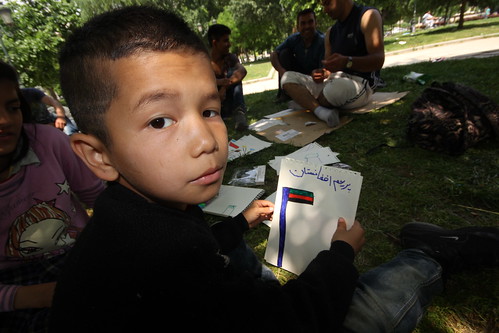
Refugees in the park, taking a break before continuing their journey north.

Today it was lentil and tomato soup, some bread and cheap chocolate croissants for the kids. As welcome as the home cooked food was, what most of the refugees that have chosen a park in the northern port city of Thessaloniki were interested in was Wi-Fi passwords and a place to charge their smart phones. We live in a schizophrenic age when people are forced to walk halfway across the European continent as if in a 1940's newsreel yet are guided by the latest Google apps and can tell family and friends back home that they are safe via Facebook and Viber.

At a time when flying from Greece to Berlin, Oslo or Rome can cost less than the price of mediocre restaurant meal the EU's draconian immigration regulations and the ever coarsening attitudes of northern European nations to refugees means that thousands are trekking across the Balkans, hiding in forests, sleeping rough in parks in the hope of escaping the wars Europe has been so eagerly fostering directly or indirectly in North Africa, the Middle East and Asia.

Along with groups of young men now the parks in the northern Greek port city of Thessaloniki,  and other cities across the Balkans are playing host to entire families, some with young kids also making the same arduous journey north. Hence the food my friend and I have been distributing, along with the advice on getting internet access. Not much compared with what they have face in the coming days and weeks but something, a remainder that Europe is not just home to frightened xenophobes, happy to forget their own horror stories of war and dislocation every time political carpet baggers and publicity hungry media bigots want to grab votes and headlines.

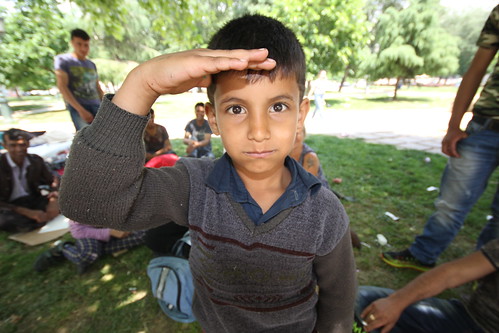
Refugee kid goofing off in the park

Sunday, February 01, 2015

2015 - The Year We Fight Back


We're barely into February and already Syriza, a  radical left government has been elected in Greece in the face of fierce media resistance, their victory challenging the prevailing pro-austerity narrative that has wrought such destruction in southern Europe. Soon it seems the same feat is going to be repeated elsewhere as Podemos gains popularity and takes on Spain's corrupt political elite.

Orwellian economics - The insane dilemma at the heart of the Greek debate.


For those unfamiliar with Europe's unique take on macro-economic theory, here is a primer that attempts to explain Greek government's dilemma in dealing with its creditors; But let us put the problem in its context through the use of an extract from the end of George Orwell's 1984; O'Brien, Winston Smith's torturer and now mentor lectures him on the relationship between numbers and political reality;


“Do you remember,” he went on, “writing in your diary, ‘Freedom is the freedom to say that two plus two make four’?”

“Yes,” said Winston.

O’Brien held up his left hand, its back toward Winston, with the thumb hidden and the four fingers extended. “How many fingers am I holding up, Winston?”

“Four.”

“And if the Party says that it is not four but five—then how many?

“Four.”

The word ended in a gasp of pain. The needle of the dial had shot up to fifty-five. The sweat had sprung out an over Winston’s body. The air tore into his lungs and issued again in deep groans which even by clenching his teeth he could not stop. O’Brien watched him, the four fingers still extended. He drew back the lever. This time the pain was only slightly eased.

“How many fingers, Winston?”

“Four.”

The needle went up to sixty. “How many fingers, Winston?”...

“Five! Five! Fivel”

“No, Winston, that is no use. You are lying. You still think there are four. How many fingers, please?”

“Four! Five! Four! Anything you like. Only stop it, stop the pain!”

In essence these are the two choices that Greece's newly elected Syriza administration is being offered by the Troika (as it is known locally) made up of the European Union, European Central Bank and the International Monetary Fund.

Either Athens tells its creditors that with the current terms and conditions the debt load is unsustainable and that any chance of paying back in full the 317 billion euros borrowed since the first bailout deal in 2010 is, in practical terms, impossible. In which case Greeks face the possibility of being unable to access further credit and so goes bankrupt with who knows what consequences for the national economy.

Alternatively Syriza accepts the current status quo, caves into creditors demands knowing that the terms and conditions imposed are impossible to meet in the long term and in the meantime is forced to impose yet more crippling austerity measures which have gutted the economic base.

More and more serious analysts, economists and observers consider the nation's debt cannot ever be repaid yet the Troika and many of the top EU players continue to insist there can be no serious renegotiation of the debt and certainly no debt relief.  Thus Europe, like O'Brien in 1984 has created an insane dilemma in which the protagonist has not only to submit no matter what logic and common sense dictate but also truly believe that this madness trumps reality.

If Greek finance minister, Yanis Varoufaki fails to pull off a Kobayashi Maru style game changer and resets the parameters of the debate as now set down then whatever Syriza chooses, their fate will be the fate of Winston Smith in 1984 and the people of Greece, like Smith will be made to suffer for believing that financial reality is more important than ideology,

Let us leave Orwell with the last word(s).

“You are a slow learner, Winston,” said O’Brien gently.

“How can I help it?” he blubbered. “How can I help seeing what is in front of my eyes? Two and two are four.”

“Sometimes, Winston. Sometimes they are five. Sometimes they are three. Sometimes they are all of them at once. You must try harder. It is not easy to become sane.”


Monday, December 29, 2014

What If The World Ended And No One Noticed? The Greek Government Falls


The world ended today at 12.40 PM, at least that's what the Greek and much of the international media had led us to believe would happen if the parliament in Athens failed to elect a new president after its third and final attempt today.

I happened to be walking through the centre of Thessaloniki, Greece's second largest city when the news broke that  prime minister Antonis Samaras had failed to secure the 180 votes needed to avoid new round of national elections. Alas, no one had told the shoppers getting ready for New Year the terrible revelation that the entire Eurozone economy had fallen off the cliff. I didn't have the heart to break the news to people window shopping on the central Tsimiski boulevard.

For such an apocalyptic event you'd think there would be some reaction, some sign of hysterical disbelief, but nope, nothing, nada, tipota as they say in Greece. But the world only ended in that magic realm called the mainstream media, home to unicorns, endless talk of crisis and hyperbole, not in the really, real world of shoppers struggling against the unseasonable cold snap that has gripped the city recently.

Unlike the ladies and gentlemen of the press peddling the end of the world angle this news was just another scaremongering story to be shrugged off by a people who have been subjected to six years of such nonsense. There are only so many time you can see on the nightly news bulletins that the End Is Neigh before you switch off.

For the last few weeks the government choice of candidate for president has attracted the kind of attention usually lavished on US presidential races, the parliament in Athens was besieged by foreign reporters eager to get the latest news during the first rounds of the vote.This is strange for a number of reasons, not least being the fact that the Greek president plays the same kind of role in the country's political system that the White House cat has in Washington. Also the results of the first two rounds of voting were a foregone conclusion to everyone inside Greece and a source of high drama to those reporters who'd parachuted in to cover the story.

The inevitable defeat of Stavros Dimas, the coalition's choice in these votes produced endless speculation amongst many foreign correspondents seemingly unaware that the real drama would be today when parliament voted once more. But why let something as mundane as reality spoil a white hot story? Where's the fun in that?

For a post that has little but symbolic value, the choice of Greek president was something that EU leadership seemed to take very seriously, like guys debating BBQ techniques, everyone had an opinion and everyone knew that not electing a president would be a VERY, VERY BAD THING!

In the Greek press the pages of the national newspapers and the nightly news bulletins were full of the dire consequences of not electing a president. There would be bank runs warned the head of the Bank of Greece, the sacrifices of the Greek would be wasted said the prime minister, the vote would be a "credit event" said the coalition spokeswoman in a TV interview. Everyone agreed that not electing a president would be a VERY, VERY BAD THING!

Then to add even more drama, the second vote was accompanied by accusations that some were attempting to bribe MPs to switch sides and support the coalition candidate. Pavlos Haikalis, an Independent Greeks MP recorded what he claimed was one such attempt on video and gave it to the authorities who promptly dismissed the accusation. The government and their allies in the media also claimed that such accusations were part of a plot by the opposition and the SYRIZA party in particular to derail the vote by intimidating MPs who might have wanted to change their stance.

As if to hammer home just how important the vote was the Greek prime minister addressed the nation on Saturday in a televised interview carried out by members off the state run NERIT network. In what can only politely be called a "staged" event the two nervous journalists who looked as if they expected to be fired or executed at any moment tentatively asked a series of questions which the PM  answered with the aid of an autocue or say many commentators. With the kind of care you use when feeding your holidaying neighbour's pit bull they went through the motions of an interview, probably thankful they got through to the end of it still with all ten fingers attached.

No follow questions were permitted and not one of the many dubious claims made by Antonis Samaras during the 30 minute audience were challenged instead of a hard hitting journalistic challenge, the whole event seemed more like a monarch granting an audience to courtiers. Ιndeed outside dictatorships of the Central Asian republics and North Korean kind, it's rare to see such an easy ride given to any political leader.

Despite all this drama which included members of the neo-Nazi Golden Dawn party being bussed in from prison the vote turned out to be a lot less close than many (including myself) had predicted. The government failed to persuade any more MPs than the 168 that had supported them in the second round, falling far short of the 180 needed. Within less than two hours the date of national elections,   25th January was announced suggesting that the result came as no surprise to the political leadership.

Judging by the tactics, tone and rancour of this vote the national elections promise to be one of the dirtiest in living memory. With the radical left SYRIZA ahead in the polls and committed to challenging Greece's creditors the stakes couldn't be higher not just for a political establishment that has held sway since the 70's but also the country's shadowy, but ever present economic elite who have thrown their weight along with their media outlets behind the government.

The Guardian and SKY are already talking of crisis and economic turmoil, which is strange way to describe  a democratic vote in times of peace. But as happened in the 2012 elections showed there are many outside Greece eager to sway voters and make sure their opinions are heard.Once more a small economy on the edge of Europe is taking centre stage, once more punching far above its weight in the international scheme of things.

Sunday, October 05, 2014

For UK politicians Greece still has lessons worth learning

Party faithful listen to speech by Conservative leader, Antonis Samaras at election rally - Thessaloniki, Greece
New Democracy campaign rally

At first glance Greece and Britain would seem to have little in common, stuck as they are at the opposite ends of the European Union not only geographically but also economically. Whilst the UK economy has slowed down in the wake of the 2009 downturn, it has not seen anything like the destruction in terms of income and output suffered by the small Balkan nation.

However, despite the differences in history and modern political culture the British political scene is showing remarkable similarities to its Hellenic counterpart. Old certainties are crumbling, the traditional parties of power are facing challenges and new formations have emerged that undermine the status quo.Like UK politics, modern Greek politics have been dominated by two main parties, the centre Left PASOK and the centre right New Democracy have held power in one form or another since the 80's and even as late as 2009 could easily assure (in all but a few cases) that they would rule without the need of a coalition partner. All that has gone and along with it an entire political system that grew up in its wake.

The most dramatic fall has been that of PASOK who in 2009 could still drum up 44% of the popular vote yet today languishes at 6-7% in the polls. While the conservative New Democracy party has suffered less it has seen it's level of support drop by a third and can no longer rule alone, both the victim of unpopular austerity measures that have failed to lift the economy out of the crisis and have seen the country's foreign debt balloon.
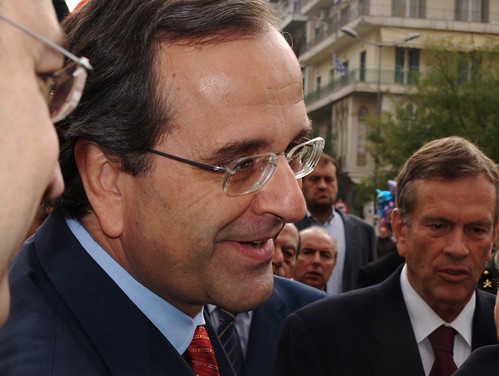
New Democracy leader, Antonis Samaras electioneering in Thessaloniki, Greece
Antonis Samaras - Greek prime minister

So what can UK political leaders learn from these experiences? Judging from recent development probably very little as they seen intent on using the same formulas that have been tried and found wanting not only in Athens but across the EU. This means that in all likelihood the same outcomes will be seen in Britain meaning what exactly?

1 - Under pressure from the rise of UKIP (United Kingdom Independent Party) UK Tories have been moving to the Right in order to win back ground on issues such as immigration and law and order. The Greek prime minister, Antonis Samaras reacted in this manner in order to thwart the rise of Golden Dawn who have been siphoning off votes from New Democracy's right flank. This resulted in mass police sweeps of recent arrivals in Athens and the creation of internment camps where those without documentation sometimes wait for months or years to be released.

Such draconian measures did little to win back voters, as this strategy suffers from two weaknesses; firstly, the move to the right legitimises the other, smaller right wing parties and so allows them to fight campaigns on their "own turf" politically. Instead of being on the sidelines shouting to be heard, parties such as Golden Dawn, True Finns and France's National Front get a front row seat in political and media debates and so policies once considered as extreme  or part of the lunatic fringe are suddenly seen as part of mainstream discourse.

Secondly, the growing distrust of mainstream political parties means that while conservative voters may agree with a "tougher" stance on issues such as immigration they may not believe that the Tories will keep their word, or that any measures taken will be purely cosmetic.So in the end the use of "dog whistle" politics damages the Conservatives who alienate the centre while not convincing those further to the right that they can be trusted to keep campaign promises.

2 - UK Labour party has promised that should it win power it will produce a balanced budget which means that unless it seriously changes taxation legislation (almost unthinkable for Labour strategists) this will involve a series of cuts in public spending so repeating previous Tory policies. Since 2009 Labour's equivalent, PASOK has applied such cuts in order to comply with foreign creditors' demands and the result, politically has been a decimation of its party base and the rise of the once, tiny SYRIZA radical left party which is poised to become the next government of Greece.
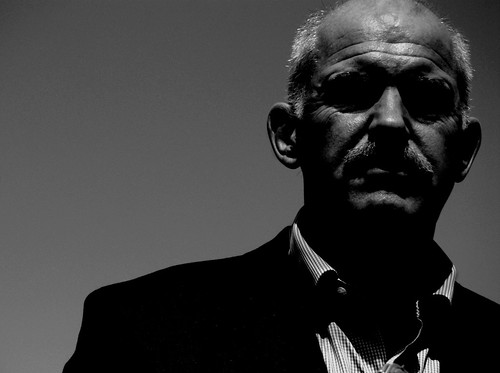
Giorgos Papandreou -  Γιώργος Ανδρέα Παπανδρέου
Giorgos Papandreou - former Greek prime minister

As there is no SYRIZA waiting to step from the wings in British politics many traditional party Labour voters will probably either vote UKIP (or SNP in Scotland) or simply not bother voting given they have been offered no real choice in terms of policies on offer.This decline is simply heightened by the lacklustre leadership of Ed Miliband, whose wooden speaking style and inability to connect with ordinary voters echoes that of ex - Greek PM and PASOK leader, Giorgos Papandreou who suffered from the same weaknesses.

3 - It seems that fate of smaller coalition partners across the EU to be diminished by their time in power and this is no different in Greece or Britain. So far three parties have at one point or another formed a coalition with the dominant New Democracy party and all three have seen their support dwindle from the alliance. Both the far right LAOS party, the centre left Democratic Left parties have virtually disappeared from the polls and a rump PASOK is languishing with support in the single digits.

Likewise, the UK's Liberal Democrats have also paid the price of a place at the table and the endless compromises they have made in order to accommodate the Conservatives' agenda will become crystal clear in the 2015 elections when few of those who switched their votes in the previous general elections will make the same mistake again.

4 - In Greece the demands that government pass yet more cuts and impose more taxes has forced previously implacable political enemies to kiss and make up in order to pass legislation in parliament that is deeply unpopular. The sight of a series of government with both PASOK and New Democracy has weakened both and led many voters to dismiss both as simply two sides of the same corrupt political coin, further fuelling the rise of other parties both on the Left and the Right.
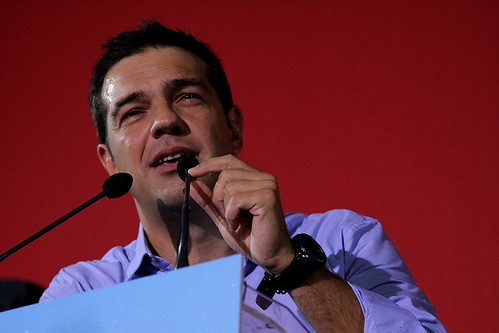

Alexis Tsipras, leader of SYRIZA speaking in the city of Thessaloniki
Alexis Tsipras - leader of the SYRIZA party

In the UK the sight of David Cameron, Ed Miliband and Nick Clegg all campaigning side by side in the Scottish referendum has produced a similar image, the idea that despite all the faux fighting over issues, all three parties are essentially the same when push comes to shove. This unedifying sight will also help UKIP, promoting their idea that they are the plucky political outsiders, untainted by the politics of compromise, willing to take on vested interests.

This approach has certainly worked for Greece's neo-Nazi Golden party which has managed to retain third place in the polls by presenting itself as a right wing anti-systemic force, untouched by the corruption associated with politics of power. It's a message so powerful that Greek conservative voters are willing to oversee the parties bloody recent history and blatant extremism, not to mention universally negative press.

While the UK mainstream may rain down scorn and indignation on UKIP, in the end it probably won't deter many from voting for them, since as the Scottish vote showed even the weight of the entire press corp against you doesn't always guarantee that people will buy into an agenda that the media has set out.

The reality is that in both politics and media  the old world is disappearing and yet those at the top of both these greasy poles seem intent on ignoring these changes, terrified of the new, intent on clinging to worn out ideas whose sell by date has long gone, the only question is how long the political leaders and their media teams across the EU will insist on using tactics and polices that are obviously not working.

Monday, May 19, 2014

Greek Elections: Round One


With the first round of Greece's city and municipal elections over the government coalition parties and the opposition have being trying to persuade the public that they were the winners in yesterday's vote. However, unlike parliamentary or EU elections the conclusions that can be drawn are not so clear cut for a number of reasons.

First and foremost, local election results in Greece, as in the rest of the world are just as likely to be influenced by local issues such as rubbish collection, state of the roads etc. as they are by the party affiliations of the candidate. This mean clear comparisons between these results and national ones cannot be made so easily, for example in Greece's two largest cities, Athens and Thessaloniki independent candidates came first, but in Crete PASOK retained its lead in the municipal elections and conservatives aligned with New Democracy did very well in Macedonia.

Also the fact that many candidates stood as independents or as members of parties that have no clear affiliation with the national ones also makes more general conclusions difficult to make. While in the big urban areas the candidates favoured by the parties are easy to pick out, in other regions the connection, if any between local political groups and candidates and the national parties is less clear to many voters.

Finally, only one fifth of the contested positions have been decided, the rest will have to wait for the second round next Sunday.

The Guardian talked about an anti-austerity backlash and In Athens and Thessaloniki mayoral elections the candidates supported by New Democracy and PASOK fared badly, though how much of that was due to anti-government sentiment and how much was due to less than stellar contenders is hard to say.

However, all these caveats aside a picture does seem to be emerging that confirms recent opinion polls that SYRIZA is gaining strength and that candidates identified with parties that make up the coalition government. are losing support. The fact that the party has made gains in the urban areas is more proof that its is no longer just a raggedy band of protesters and stands poised to replace PASOK as the main opposition party on a permanent basis. Once PASOK loses its stronghold in local government then its ability to keep intact a party machine that depends more on patron client relations than it does on ideology is severely compromised.

New Democracy's position also seems to be under threat, not only from SYRIZA on the Left but Golden Dawn on the right. Despite the fact that much of leadership is behind bars facing criminal investigation, the neo -Nazi party's level of support was back to 2012 levels. Even in chic upmarket neighbourhoods such as Kolonaki in central Athens, they won 13.7% of the vote, in other poorer districts it topped 20%.

The prime minister's campaign strategy of pulling to the Right and co-opting the rhetoric and policies of Golden Dawn seems not to be paying off. Nor has the anti-Golden Dawn media coverage in the pro-government press seemed to have driven away voters.

The May 25th EU parliamentary vote will give a clearer picture of where Greece's parties stand in the eyes of the electorate when the contenders will be standing on party tickets for the 22 MEP seats. In 2009 PASOK and New Democracy won 15 of those, but this time around they'll be lucky to get half that number and there is a good chance that PASOK will get just one seat.

Already SYRIZA is promoting the idea that the EU vote is a referendum on austerity itself and that a poor showing by the government will mark the end of its popular mandate and so be the reason to hold new national parliamentary elections. On the other hand both prime minister Antonis Samaras and deputy prime minister, Evangelos Venizelos are calling upon supporters to vote for the coalition in the name of stability and so as to save a fledgling economic recovery.

My prediction for next week's EU vote is;

1 SYRIZA 20-25%
2 New Democracy 18-23%
3 Golden Dawn 8-10%
4 Potami (River)  6-8%
5 KKE (Greek Communist Party) 4-5% and Olive Tree (PASOK) 4-6%

Sunday, April 13, 2014

Angie Through The Looking Glass - Merkel visits Athens

Greek recovery is back. The news story that refuses to die no matter how many times the predictions are debunked.


Photo I took during Merkel's 2012 visit to Athens.

Once again the world's press and a large chunk of the nation's police force descended upon Athens in anticipation of the visit by German chancellor, Angela Merkel to beleaguered Greek prime minister, Antonis Samaras.

Bathing in glow of German praise for his government's austerity policies and the a successful five - year bond auction the fragile coalition government and its supporters in the the media were certain that this marked the end of a six-year economic downturn that has not been seen in a developed European country at peace since the Great Depression. Nor was such optimism limited to local reporters and analysts, foreign outlets such as the BBC also waxed lyrically that Greece had finally turned a corner.


Alas, as with so many similar predictions made in 2009, 2010, 2011, 2012 and 2013, the facts, on closer examination do not bear out the basic assumption that a successful bond sale signals growing confidence in Greek economic performance and hence represents the end of the downturn in the real economy. Unemployment still remains high at 26.7% and 20% of those in employment remain unpaid for at least three months, often for much longer. Exports have dropped and GDP is still more than 25% less than it was in 2008. The government is mired in scandal over its connection with Golden Dawn and during the last austerity vote saw it's parliamentary majority drop to just one MP in the 300 seat house.

As if to underline the growing sense of unease, a massive car bomb went off outside the Bank of Greece building in central Athens a day ahead of Merkel's visit. Although police were quick to claim it was probably the work of anarchists, the sophistication and scale of the attack is completely unlike the kinds of attack such groups usually carry out. As yet no individual or group has claimed responsibility.

Yet none of this could puncture the joint Hellenic-German display of  mutual appreciation on display, and to make sure that that would remain so 5000 police officers were on duty to enforce a ban on any form of demonstration in the centre of the Greek capital. Strange that a leader who compared the NSA with the East German secret service (Stasi) for tapping her phone had nothing to say with a display of state strength that Erich Honenker would have gladly approved of.

In keeping with the authoritarian spirit of the day, the Greek state run press Agency APA doctored the chancellor's speech, deleting all reference to austerity in their translation which was released to the local press. Unnecessary given that both state and private broadcasters (which are owned by country's oligarchs with close ties with the ruling parties) went to extraordinary lengths to make sure the prime minister's version of events got as wide and uncritical a hearing as possible.

On  the other hand reactions to Merkel's appearance in Athens on Twitter were almost universally negative, with many comparing it to the visit of a monarch to a newly acquired colony and seething at the revoking of basic civil rights for the duration. Abroad, financial analysts were less giddy with excitement over possibilities of a Greek recovery given that fact that none of the economic fundamentals which are crushing development have changed.

So what was the point? Economically almost none, but politically the return of Greece to the money markets is being sold as a indication that the austerity policies which have brought many European economies to their knees is finally paying off. This is a message we are going to be hearing repeatedly over the next few weeks as EU countries go the poll to vote in European parliamentary elections in May and while this media narrative may play well in Germany throughout the rest of Europe the response could be more muted.

Usually, EU elections are marked by indifference both among the public and the media, but given the growing unpopularity of parties implementing austerity and the rise of the far Right this year's vote is the nearest thing the continent will have to a referendum on the dominant austerity narrative. In the UK, the Conservative/Liberal coalition government is nervously facing the prospect of a spike in UKIP support at their expense. Hollande's position in France would also be seriously weakened if he has a repeat of the debacle his party suffered in the recent local elections.

As well as EU vote Greece will also have local elections in May and the reality is that it will mark the end of a political era with PASOK being ousted from power in many districts, a fall from political grace that has seen its share of the vote drop from 43% in 2009 to around 4%, if recent polls are to be believed. That will probably signal the downfall of deputy PM and PASOK  leader Evangelos Venizelos's time as party leader, even his blustering, bullishness will not be able to keep in check anger at how the party has been destroyed by its leadership's commitment to austerity policies.

Similarly, the prime minister's New Democracy party is also growing restless, unhappy with the coterie of far right advisors and politicians that surround the leader, also worried that they too, may eventually suffer the same fate as PASOK as their power is challenged by SYRIZA on the left and Golden Dawn of the right. A poor showing in May elections may also trigger a challenged to Samaras's leadership.

This is why the visit of Angela Merkel and the bond auction was so vital to a political leadership, desperate to convince the public that despite all the evidence to the contrary the Greek economy is on the right track. Whether this will be transformed in votes in the polls is another matter.Putting aside the growing anti-German sentiment in Greece, the statistics and indicators being used by politicians and media to make the case for recovery are, at best tangential to the everyday struggle for survival many Greeks face. Spreads, yields, and bonds will not make finding a job any easier, reduce skyrocketing tax bills or stop the flood of young people leaving the country.

Wednesday, March 20, 2013

How Cyprus can call the EU's bluff.

As you are probably aware Cyprus is now in the middle of negotiations with EU leaders over a 17 billion euro bailout needed to save the country from bankruptcy. The original plan which involved the taxing of bank deposits at up to 10% has proved unworkable and has been voted down by the Cypriot parliament. However, there is another plan that would allow Nicosia to secure a loan and not have to implement painful spending cuts (and risk becoming the new Greece/Spain/Portugal) nor impose a bank levy that would annoy foreign depositors, especially the Russians.

When Cyprus achieved independence from Great Britain in 1960 large swathes of the island were handed over to the British armed forces to be used as bases in the strategically important eastern Mediterranean. The Sovereign Bases Area are still important given their proximity to Middle Eastern hot spots and the fact they lie so close to vital shipping routes through which so much of the world's oil comes via the Suez Canal.

So here is the deal. The Cypriot parliament turns down present Eurogroup proposals and instead announces that a) they are considering re-negotiating The Sovereign  Base Area deal with a view to inviting other nations to tender bids for a long term lease or b) they say that they will allow other nations to build naval facilities on the country's territory, thus giving them a similar deal . The cost in either case to be approximately the same as the money being used by EU to blackmail (the Cypriot PM's words, not mine) Nicosia into agreement.

Now this is where things get really interesting. Given the poor shape the Assad regime is in, Russia must be wondering if its naval base in Syria will survive a regime change and therefore an alternative offer would be welcome. That it comes from a country with such close ties with USA and UK makes the idea an even more delicious irony, given NATO's encroachment on countries close to the Russian border has been so unrelenting. The fact that huge volumes of natural gas may be flowing through this part of the world soon also adds to the attraction.

Even the suggestion of such an offer to the Russians will set alarm bells ringing in London, Washington and possibly Paris and combined these countries will be able to bring a huge amount of pressure to bear in Brussels and Berlin. Does the EU really want to change the balance of power in such a sensitive region for a paltry 7 billion euros? Given the geo-political ramifications and the fact that the European nations have already pumped 1.7 trillion euros into propping up the continent's ailing banking system, a few billion more may be considered a price worth paying.

In either case, Cyprus comes out on top, it doesn't have to tax depositors, large or small, it's banking sector comes out of hiding this week intact (more or less) and it gets the money it needs to avoid bankruptcy.