Showing posts with label IMF. Show all posts

Thursday, July 02, 2015

But Yes or No to what? Greece decides on Sunday.

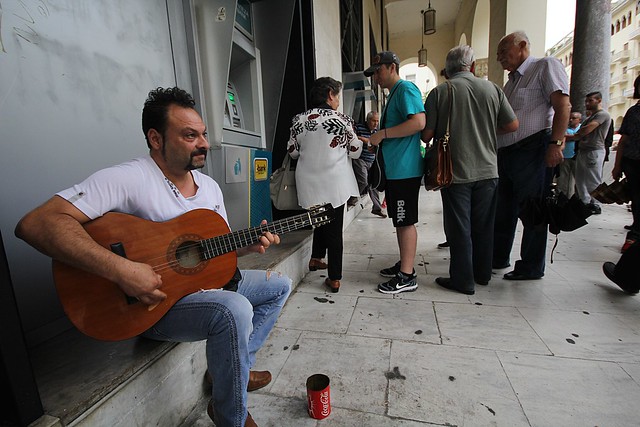
Greeks lining up at ATM - Thessaloniki

On Sundays Greeks go to the polls to vote. They will be asked to vote Yes or No. But Yes or No to what? The question seems to produce an endless array of answers, which have left Greeks arguing passionately for the past week, both on social media and in real life.For the economically minded supporters of the Yes side, it is a vote to stay in the Eurozone, to retain a stable currency and avoid the risks of introducing a new, untried currency which may or may not be worthless. It's a Yes to open banks, pensions being paid on time and a step away from the financial abyss. For conservatives it's a Yes to membership of the European Union and a step away from what they see as rabid, socialist madness.

In the No camp, a No is a refusal to accept an creditor imposed austerity plan which has crushed the Greek economy and even on its own terms is a failure. For the more nationalistically minded its is a vote for independence, a chance to show foreigners that Greeks will not and cannot take any more crap from either Washington, Brussels or Berlin.

In the maelstrom of debate, the usual lines that divide the Greek Left and Right have been blurred, muddled and sometimes utterly forgotten. Nor, as it is sometimes portrayed as a fight between haves and have nots. Whilst those in the Yes camp are amply represented in the country's oligarch controlled media, the poll number are not restricted to just those who've weathered six years of austerity with their wealth intact. Pensioners fearful of their future, owners of businesses both large and small as well as those fearful of the consequences of a Grexit have swelled the Yes vote.

On the other hand the No vote included those with little to lose from maintaining the status quo, such as the unemployed and young voters who see that more of the same in a nation with record high unemployment is not an option. Also there are those who  are sick of Greece's continual humiliation at the hands of the EU, ECB and IMF and wish to show these institutions that enough is enough, no matter what the cost. The fact that political Ancien Regime, discredited by corruption and ineptitude has thrown its weight behind the Yes vote is just further proof that a No vote is justified.

What will happen on Sunday, I do not know. If you'd asked me a week ago I would have said that the Yes vote will win comfortably, but given the fact that EU leadership smugly seems to betting on this combined with a week long fear campaign on TV makes me think that perhaps that things will turn out differently. The same political forces that tried so hard to crush Syriza in the January elections are once again openly playing their hand, and there's a chance they'll fail now as they failed then.

Once again the crude political intervention of the ECB which stopped lending to Greek banks via ELA so starving them of liquidity along with the arrogance of various German politicians simply fuel the No vote  just as the intervention of English politicians in the Scottish independence referendum aided the rise of the Scottish Nationalist Party.

Whilst people are angry they cannot take out money from their saving accounts and fearful for their future, there is a growing sense that they will not bow down and take anymore. Whether their vote is based on carefully calibrated deliberation or knee jerk nationalism, the result will be the same in the polling booths on Sunday.


Sunday, February 01, 2015

Orwellian economics - The insane dilemma at the heart of the Greek debate.


For those unfamiliar with Europe's unique take on macro-economic theory, here is a primer that attempts to explain Greek government's dilemma in dealing with its creditors; But let us put the problem in its context through the use of an extract from the end of George Orwell's 1984; O'Brien, Winston Smith's torturer and now mentor lectures him on the relationship between numbers and political reality;


“Do you remember,” he went on, “writing in your diary, ‘Freedom is the freedom to say that two plus two make four’?”

“Yes,” said Winston.

O’Brien held up his left hand, its back toward Winston, with the thumb hidden and the four fingers extended. “How many fingers am I holding up, Winston?”

“Four.”

“And if the Party says that it is not four but five—then how many?

“Four.”

The word ended in a gasp of pain. The needle of the dial had shot up to fifty-five. The sweat had sprung out an over Winston’s body. The air tore into his lungs and issued again in deep groans which even by clenching his teeth he could not stop. O’Brien watched him, the four fingers still extended. He drew back the lever. This time the pain was only slightly eased.

“How many fingers, Winston?”

“Four.”

The needle went up to sixty. “How many fingers, Winston?”...

“Five! Five! Fivel”

“No, Winston, that is no use. You are lying. You still think there are four. How many fingers, please?”

“Four! Five! Four! Anything you like. Only stop it, stop the pain!”

In essence these are the two choices that Greece's newly elected Syriza administration is being offered by the Troika (as it is known locally) made up of the European Union, European Central Bank and the International Monetary Fund.

Either Athens tells its creditors that with the current terms and conditions the debt load is unsustainable and that any chance of paying back in full the 317 billion euros borrowed since the first bailout deal in 2010 is, in practical terms, impossible. In which case Greeks face the possibility of being unable to access further credit and so goes bankrupt with who knows what consequences for the national economy.

Alternatively Syriza accepts the current status quo, caves into creditors demands knowing that the terms and conditions imposed are impossible to meet in the long term and in the meantime is forced to impose yet more crippling austerity measures which have gutted the economic base.

More and more serious analysts, economists and observers consider the nation's debt cannot ever be repaid yet the Troika and many of the top EU players continue to insist there can be no serious renegotiation of the debt and certainly no debt relief.  Thus Europe, like O'Brien in 1984 has created an insane dilemma in which the protagonist has not only to submit no matter what logic and common sense dictate but also truly believe that this madness trumps reality.

If Greek finance minister, Yanis Varoufaki fails to pull off a Kobayashi Maru style game changer and resets the parameters of the debate as now set down then whatever Syriza chooses, their fate will be the fate of Winston Smith in 1984 and the people of Greece, like Smith will be made to suffer for believing that financial reality is more important than ideology,

Let us leave Orwell with the last word(s).

“You are a slow learner, Winston,” said O’Brien gently.

“How can I help it?” he blubbered. “How can I help seeing what is in front of my eyes? Two and two are four.”

“Sometimes, Winston. Sometimes they are five. Sometimes they are three. Sometimes they are all of them at once. You must try harder. It is not easy to become sane.”


Tuesday, November 27, 2012

How much salvation can one country take?

Greece - Where they make a desert, they call it salvation

For a moment I thought that I'd that the last three years had all been a nasty dream. The presenter on the news was speaking in glowing terms about how Greece had been saved by its EU partners and that now that the bailout deal had been agreed the country could look forward to avoiding bankruptcy.

The problem is that we have all heard this before. In 2009 the local and foreign news organisations were both peddling the same media narrative when the first tranche of bailout cash was approved in return for implementation of tough austerity measures. I still remember the first question I was asked then during an interview with the BBC World Service; "But why are Greeks so upset about being saved?"

The inability of the foreign media to comprehend the angry reaction of Greek popular opinion to the cuts in salaries and services is once again being repeated despite three years in which the country's economy has declined so drastically that the drop in economic indicators is now on par with the United States during the early 30's at the height of the Great Depression. Unemployment now affects 1 in 4 (though that figure may be as high as 30% according to research carried out by Greece's trade union congress) and shows no sign of improving any time soon. Economic output has declined year on year since 2009 and will continue to so for the forseeable future unless present austerity policies are not abandoned.

Greece's mainstream media, owned and controlled by the country's corrupt oligarchs today is celebrating the decision by the Eurogroup to authorize the release of the next installment of bailout cash, not least because of the bulk of the money will be used to recapitalise the banks they own.On the state run news journalist speak  of the skill with which the government has avoided disaster, knowing full well that criticism or real or implied invites instant dismissal.

A much smaller proportion of the cash will go to pay wages and salaries for the immediate future. On the other hand the terms of the deal mean that thousands of public sector workers will be laid off, a decision which has seen local government grind to a halt as workers strike and occupy town halls across the country.

Here in Thessaloniki, Greece's second largest city and home to over a million residents the decision by KTEL (Greece's answer to Greyhound Buses) to suspend operation means that for many the city is effectively cut off from surrounding towns. The dispute over money owed by Athens is set to spread to Thessaloniki's urban transport network as the local bus company has also threatened to stop running from the first of December unless it is paid money owed by central government.

With winter setting in, money getting ever scarcer and the cost of heating sky rocketing ordinary Greeks might be forgiven once again for hoping that EU and the IMF would not insist on saving them again


Friday, August 31, 2012

Austerity storm clouds darken Greek government's future

Greece's Indignados continue protests for sixth day - Sign says "We have a voice. Real democracy now!"


After months of official government announcements and newspaper headlines, Greece's latest austerity programme has been made public with anger and disbelief coming from all corners, including the country's usually supine media. The news that salaries,pensions, disability benefits and aid to the unemployed will be included in the the 11.9 billion euro package of cuts is likely to spark off a yet more protests as will the likely 40,000 state sector lay offs .

Police officers were the first to react with demonstrations in Athens after the government said that their wages and bonuses would not be exempt from the budget measures being demanded by creditors in return for another cash injection. The Greek language blogosphere was alive with angry responses from police related blogs angry that pre-election promises had not been kept and promising a series of protests over the decision.

The first hurdle facing Greece's fragile three party coalition government is how to persuade their restive backbenchers to voter for measures their supporters violently disagree with. On the one hand many rank and file MPs from New Democracy, PASOK and Democratic Left have said they are opposed but how much of this is principled protest and how much is just a PR ploy designed to keep voters back home sweet is hard to say. During the last two round of cuts much was made of potential backbench revolt which eventually failed to materialise.


The $64,000 question is how such cuts, if they are passed will be enforced without the support of the police. With resentment against yet more austerity rising after a summer lull, police officers are being used ever more frequently to end protests and labour disputes. If they decide that this is not their public function, as one police leader intimated last night during an interview on MEGA TV then what other means of persuasion does the government have? Even the feared quasi - military MAT riot units cannot be everywhere.

The first test of Greek prime minister Samaras's ability to impose his will on a recalcitrant nation will come in September with the opening of the Thessaloniki International Trade Fair which traditionally marks the start of the new political year. The presence of the prime minister and much of the government is also a signal every year for massive protests and last year's event proved no exception with football fans, taxi drivers and anarchists fighting pitched battles with 8000 police officers outside the fair,

Samaras has already announced that this year's attendance at the fair will be a brief one and will not include the traditional state of the nation address which coincides with the most intense of protests. However, even if the Trade Fair passes off without major incident Greece's political calender will provide plenty more opportunities for police and protesters to make their respective stances known

Monday, June 18, 2012

Greece election post mortem

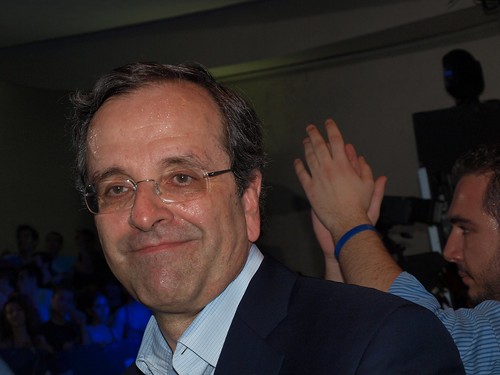
Antonis Samaras, head of Greece's main opposition party, New Democracy

First things first. An apology to anyone who  bet (and lost their shirt) on my prediction that SYRIZA would be the largest party in parliament today, if I see you, let me buy you a drink, it's the least I can do. As it turned out my analysis was off the mark. I overestimated SYRIZA's final vote and more crucially underestimated the final New Democracy tally. Also I didn't see the collapse in Greek Communist party support which halved, unlike PASOK and Golden Dawn who only saw a small drop in votes received. All in all, my days as a poll pundit are numbered. (Vote statistics can be found here).

Why was I so wrong? First of all, I failed to grasp just how successful the fear campaign over possible Greek exit would be. I had assumed that the constant barrage of warnings over the consequences of Greece having to leave the Eurozone had done its work and wouldn't push Samaras's vote over 25%. On the other hand the record low turnout (down 8% from 2009) seemed to have had an effect, I suspect on younger voters who would have supported anti-bailout parties. Finally, the scenes of violence perpetrated by Golden Dawn spokesman on live TV did nothing to diminish their popularity, which is both surprising and deeply worrying.

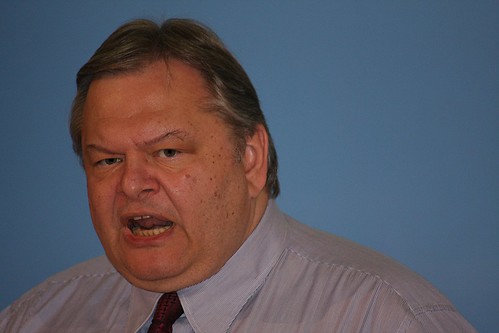
PASOK leader, Evangelos Venizelos

Mea culpa aside, today the New Democracy leader, Antonis Samaras will be asked by the president of the Greek republic to form a government. At first glance this seems just a formality as New Democracy with 129 seats and the other pro-bailout party, PASOK with 33 seats will comfortably exceed the 151 MPs needed to form a majority. Indeed both leaders in the last week of campaigning repeatedly stated the need for the country to immediately have a working administration in order to deal with its current economic meltdown.

However, beyond the campaign promises, Samaras and PASOK leader, Evangelos Venizelos have to take into account other factors concerning their own and their parties' political future. If they do assume power, then they will be seen as the parties that are responsible for the country's economic woes, leaving SYRIZA and others to claim that have are the only real anti-austerity choice in any future elections. Given the drubbing PASOK got and the marginal victory achieved by new Democracy that more or less guarantees their defeat in the next elections (barring an economic miracle and the Germans have outlawed miracles).

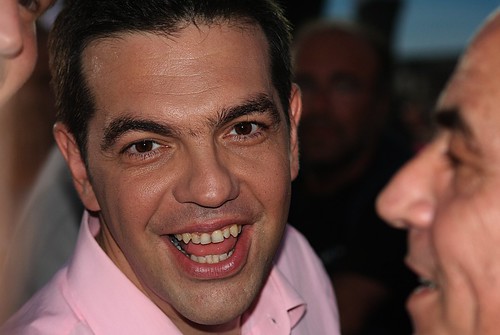
Alexis Tsipras, head of the The Radical Left Coalition, SYRIZA

The answer to this dilemma is to try and persuade SYRIZA leader, Alexis Tsipras to join the government with promises, appeals to patriotism and threats of possible dire economic consequences if he does not.This card was played after the May elections and judging by official SYRIZA statements coming out in the Greek media such overtures are almost certainly likely to be rejected. On the other hand the Democratic Left have made it quite clear that they will be willing to take part in such a government. But this does not solve Samaras and Venizelos's long term problem about how deal with Tsipras in coming elections.

The other factor which plays a crucial role in any negotiations is ego. Even with Greece mired in the worst economic downturn, the monsterously overblown egotism of both Samaras and Venizelos may prove an obstacle in forming a stable government. Both have spent decades slowly working their way up the greasy pole of political power and just as they seemed to be destined to become prime minister, the game changed. To have to share power after so many years playing second fiddle is almost more than either can bear.

Whatever form the next Greek government takes, its fate will not be decided in Athens but in Berlin and Brussels. If the troika (EU/ECB/IMF) are serious about supporting Samaras then serious concessions in the terms of the current austerity measures will have to be made, otherwise with unemployment rising 1% every two months and the economy contracting the fragile New Democracy - PASOK (and possibly Democratic Left) coalition will fracture under the weight of more job cuts and tax hikes. At which point Greece holds yet more elections and most likely brings to power SYRIZA.

There seem to be mixed signals coming out of Europe over whether there will indeed be a change in approach which will allow New Democracy to stay in office, on the one hand deputy German finance minister, Steffan Kampeter said that Greece shouldn't be overstrained during a talk on German TV, on the other the Eurogroup of EU finance minsters sent a polite but clearly worded statement last night warning Athens that it could not deviate from the term of the bailout agreement.

With cost of lending in Spain continuing to rise and with Italy on the verge of asking for its own bailout deal none of this may matter as the systemic problems of the Eurozone continue to rage unchecked, leading to possibly disastrous results for European debtors and creditors alike


Monday, May 07, 2012

End of an era in Greek politics

Sea of Greek flags being waved by New Democracy youth wing

With the dust settling on yesterday's election results only one thing is certain in Greece; the previous political era is now officially over. Both the conservative New Democracy and left wing PASOK parties who've dominated the stage for more than a generation received a drubbing at the polls. Even though New Democracy emerged as the largest party, it garnered just 18.89% (at time of writing), just over half its 2009 election share. PASOK, lead by Evengelos Venizelos suffered an even more crushing reversal, and is left with just 41 seats, down 129 from 2009.

Other losers included the far right LAOS party and conservative Democratic Alliance who both failed to reach the 3% threshold for parliamentary representation. Also the plethora of splinter groups/parties set up by expelled PASOK and New Democracy MPs failed to make any headway, with the sole exception of the hard right Independent Greeks lead by Panos Kammenos which won 33 seats.

On the other the Radical Left Coalition (SYRIZA) came second in the polls, just a few percentage points behind New Democracy and gained 51 seats,and would be just 7 behind the conservative if it were not for the electoral rule that awards an extra 50 seats to the party with the most votes. The newly minted Democratic Left also entered parliament for the first time with 19 seats, having attracted much of its support from dissatisfied PASOK voters.

However, the official communist party KKE proved to have a disappointing night, increasing its share of the vote by less than 1%, a reflection that its old style campaign failed to reach out and convince few new voters.

The more worrying development was the rise of the neo-Nazi Golden Dawn party who are set to have 21 seats in parliament. The extremist group which has been linked numerous acts of violence against immigrants and political opponents are not simply a far right formation but rather a party that believes fervently in many of the core tenants of national socialism and Hitlerite ideology. Their ascent to power allows them a place in the political mainstream and assures them airtime on TV and radio from which they can promote a platform of racial hatred and political intolerance.

With the old political order in tatters and a parliament fractured so deeply along deeply held ideological lines forming a  new government will be difficult. In the immediate aftermath of the vote many party leaders rushed to deny that they'd form alliances with others. For example KKE leader Aleka Papariga came out against an alliance with SYRIZA while Kammenos ruled out possible partnership with New Democracy. On the other hand ND leader Samaras and PASOK leader Venizelos are reaching out to other political forces in the hope of creating a viable block.

What is clear is that neither the left nor the right are in a position to form a majority government of their own, and that means either new elections immediately or a fractious coalition unlikely to survive the backlash generated by the latest round of job cuts and tax hikes which are likely to the poorest hardest. In that case new elections during the summer seems unavoidable.

The irony is that the unbending demands of the troika (IMF, EU and ECB) has created exactly the situation they were most anxious to avoid, one in which Greece is unable or unwilling to implement the austerity measures that are part of the next "bailout: plan.


Friday, March 30, 2012

Debt crisis puts European project in jeopardy

Is this the future of Europe? When rioting broke out in Athens in previous years it was seen as a purely local phenomenon, taken as yet more evidence by foreign press that the Greeks were an unruly and undisciplined bunch who refused to see sense.

The idea propagated in much of the international press was that the the austerity measures imposed by the country's creditors were the only sensible solution for the nation and that refusal to knuckle down was was a refusal to accept reality. I remember being interviewed by the BBC and the first question was why the Greeks were so upset about being "saved". The reporter seemingly unaware of the harsh conditions of the bailout deal.

Two years on the Greek economy is in free fall beset with a disintegrating private and public sector which is shedding jobs at an unprecedented rate. If that wasn't enough, the government's attempt to balance the books by rising taxes on everything from bread to boats has just sped up the decline. At every single juncture an increase in taxation has been matched with a fall in consumption leading to even less money flowing into the coffers.

Despite two years of patent failure IMF and EU officials continue to claim that their policy recommendations have been ignored and that the Greek government has brought this disaster upon itself. Yet, in nations which have adopted troika policies more comprehensively the results are the same. In Spain and Portugal (always seen by foreign financial press as the model student) the same cycle of decline and debt is also playing out and with it a growing level of violent dissent.

Yesterday's images from Madrid and Barcelona echo those seen recently in Athens and other Greek cities as young people facing a future without hope or work work out their resentments in the streets.With youth unemployment in both country's reaching 50% a potential generation gap is opening up as young Europeans start to associate the EU with poverty and joblessness.

Even if the European ideal survives the current Eurozone crisis the damage done to its image in the eyes of the continent's youth may mean that it's future will be in doubt as young Europeans enter political life and see the union, not as a guarantor of unity and prosperity but an force for disruption and inequality.

Tuesday, September 20, 2011

Greece: Light blue touch paper and stand well back

Evangelos Venizelos by Teacher Dude's BBQ
Evangelos Venizelos, a photo by Teacher Dude's BBQ on Flickr.
Over the last two days it seems that the Greek government has been in tense negotiations with the IMF and EU partners over the conditions attached to the country's sixth bailout installment. The local media has been cutting into normal programming to report even the the slightest update over the state of play.

In an address to the nation on Sunday, deputy prime minister quoted Churchill to show quite how serious the situation Greece was facing. In Venizelos's opinion anything but a united front by Greek political parties, academics and the media would lead to disaster and  in a fierce attack on critics he stopped just short of accusing those opposed to the austerity measures of treason.

Angry taxi drivers protesting outside Thessaloniki trade fair

So considering the atmosphere of supposedly feverish negotiations it came as more than a surprise when the IMF's official spokeman said that Athens's creditors had in fact demanded no new cuts or taxes but rather that the ruling PASOK government applied measures that had already been agreed upon in summer.

And there you have so many of Greece's problems in a nutshell. The country's political elite, even as the situation deteriorates even further still continues playing the same old games.Like generals fighting the last war, the leadership of PASOK still thinks it can fob off foreigners with promises it cannot keep while fobbing off domestic critics with talk of victories won.

However, this particular web of half-truths, fudges and outright lies is about to crumble as it becomes more and more apparent that Athens hasn't the political power to stop massive cuts in public services and pay. On the other hand local trade unions, public sector workers and huge swathes of the population facing yet more tax hikes are at breaking point. After three years of recession pockets are empty, people are desperate and anger at the mendacity and ineptitude of the country's political class is at an all time high.

Thousands of riot police on duty to protect Greek PM during visit to Thessaloniki

Even before the present debt crisis public confience in the political system was low following the seemingly endless series of corruption scandals that dogged the conservative New Democracy's five years in power. Even by the abysmally low standards of Greek politics the Karamanlis administration had reached new depths of veniality, helped in part by laws drafted by present deputy PM Venizelos protecting ministers from prosecution.

Both major parties are polling historically low and are struggling to get more than 20% of the vote. Nor have the smaller parties both of the left and right been able to capitalise on this trend. Instead there has been a widespread sense of disgust which is signalling a seachange in Greek political life.The current politicial set up is in crisis and despite frantic claims to the contrary no one is clear about how to get Greece out of the hole it finds itself.

Outside the hermetically sealed world of party politics however, protests movements are being created that promise to challenge prime minister Giorgos Papandeou's plans. Even the traditionally pro-PASOK public sector trade unions are promsing a long drawn out fight over cuts in pay, conditions and numbers. A battle that will intensify once details of lay-offs involving 100,000 civil servents are announced this week.

Greek protesters in face off with riot police during anti-government march- Thessaloniki, Greece

Less predictably, and perhaps more explosively, the country's Indignant movement is likely to see a resurgence following it's violent surpression in June. In addition the "I Won't Pay" civil disobedience movement created to fight road toll hikes is likely to pick up support amongst the 5 million housholds facing an emergency property tax in October as part of their electricity bill. Failure to pay in full will, according to the government result in people having their power cut off

This measure is deeply dispised as it is seen as little more than a legislative smash and grab that will includes the unemployed and disabled but not the nation's second largest property owner, the Greek Orthodox Church.

Just today there are at least three major demonstrations being planned in central Athens, a number that is likely to rise as the full extent of Athens's new austerity measures beome clear.

Venizelos may have compared himself with Winston Churchill on Sunday however, Marshal Petain, leader of the puppet Vichy French regime during World War Two seems a much closer historical fit, given how much national sovereignty has been surrendered propping up an economy on the brink of collapse.

Friday, June 24, 2011

"But you have no choice?" - Why Greeks refuse to lay down and play dead

“But surely the Greeks have no choice but to accept the new austerity measures?” That was the question posed to me recently by a young BBC reporter and in its way sums up the chasm between the way the international (and much of the local) media sees the present financial crisis and how it's perceived by ordinary Greeks.

On the one hand the decision is simple, either implement the reforms demanded by your creditors or go bankrupt. The problem is many Greeks are already bankrupt, they're in the middle of the worse economic downturn in modern Greek history and after 18 months of austerity have run out hope, patience and most importantly, money.

In effect a large swathe of the population is already insolvent, especially those who were struggling to make ends meet even before the current crisis hit. For them whether the Eurozone folds or Greece defaults is a matter of complete indifference, facing as they do the prospect of losing their job, having their power cut off and seeing their children's future disappear. What the hell do they care about the state of international money markets?

For others the pressure of constant worrying about their financial situation has already proved too much. A tragic case that come to mind is an acquaintance of mine whom I bumped into a week ago, seeing her frantic and distraught I initially thought that she'd had too much sun, caught out by the sudden appearance of good weather. Later as she lay down in the shade, drinking water given by passers by I realised that she was in fact suffering from something else. Muttering constantly about how she was a suitable employee, she suddenly sat up and whipped a wad of papers which turned out to be her CVs which she then thrust into the hands of anyone near enough to take them, talking all the while about how she was a good employee and she deserved the job.

It became obvious that she was in the grip of a manic episode and that her psychological state was delicate but thankfully one of her neighbours turned up and escorted her home while she keep up an endless stream of talk about the skills she had, the qualifications she possessed.

I'm not sure what her psychological background is and whether this was a new occurence but deep in my heart I'm convinced that the current crisis has literally sent her mad. I hate to use such crude terminology but the reality of the situation is so awful coy euphemisms are just plain insulting to everyone concerned. The incident which unsettled me deeply brought home the fact that we could all be in such a position if Fortune, which seems all knees and sharp elbows at the moment pushed just a little too hard in the wrong direction.

Given the fact that nothing in the current austerity package offers anything like a way out of the current economic slump, except in some semi-mythical long term scenario, don't blame the Greeks for not putting another millstone around their neck willingly. The have lived the effects of austerity for 18 months and all it has brought it decline, depression and despair.

The vote in parliament over the new austerity legislation next week is almost an irrelevance as even if does pass the real battle won't be in the debating chamber but on the streets outside as outraged Greeks show their anger and disgust with a morally bankrupt political leadership that capitulated without a real fight.

Monday, February 14, 2011

Greek PM feigns shock over EU-IMF reform plans

Giorgos Papandreou -  Γιώργος Ανδρέα Παπανδρέου


On Friday the IMF, EU and ECB (known locally as the Troika) announced their joint proposals concerning the future of the Greek economy and actions needed  to reduce the country's massive debt load which is set to exceed 150% of GDP this year. The most controversial element of the plan is the privatisation of 50 billion euros of public assets over the next three years and was protrayed in much of the media as a sell off of the family silver at bargain basement prices. Only the rabidly pro-PASOK Ethnos newspaper dared to present the news that troika representatives had issued an apology as a victory for the government.

In the face of such stiff opposition Greek Prime minister Giorgos Papandreou claimed to have blind sided by the EU-IMF saying that the press conference had given the impression that the Greek government was simply following the orders given it by the country's creditors.The reality of the situation is that the so-called argument is a rather crude PR trick designed to spin the fact that the ruling PASOK party have already agreed to carry out the measures demanded and is attempting to sell the public the idea that they are still in charge and not just acting as locally recruited management representatives.

The ploy has failed to convince even ardent government media supporters in the privately run SKAI channel who condemned it as a cheap theatrics. Indeed it is hard to believe that after months of negotiations the head of the Greek government was unaware of all the details of the EU-IMF strategy and was taken by surprise.


Many Greek journalists and commentators have derided the plan to raise the 50 billion as impractical given the depressed state of the economy and the Greek state's abysmal record in selling off public assets. For example more than seven years after hosting the Olympic games in 2004 much of the expensive facilities built are falling apart, forgotten and neglected despite the billion dollar price tag.

Another fear is that given the deeply corrupt nature of Greek politics much of the assets will be sold off in sweet heart deals to friends and supporters of the government and so the sacrifices made by the Greek people will be wasted as little of the money will actually make it into public offers. These concerns are no just limited to a few crackpots but are daily reinforced as scandal after scandal involving officials from both of the largest political parties are swept under the carpet. Only last week charges against those involved in the massive Vatopedi monastery land swap scandal were dropped despite the fact that the case resulted in the Greek state losing hundreds of millions in lost revenue.Likewise revelations in Der Spiegel last year that members of the ruling PASOK party including an ex - minister of defence took bribes in return for buying German submarines have resulted in no official reaction of behalf of the country's justice system.

Given the inability of the political system to police itself the idea of politicians handling billions of dollars in real estate and public property is an invitation to corruption on a scale not seen since the debacle that followed the fall of the Soviet Union when massive fortunes were made by ruthless “businessmen” who used bribes and threats to amass fortunes by taking control of state owned industries.

Wednesday, December 15, 2010

Greece goes on strike

Teachers' union members on strike in Greece

Yesterday the Greek parliament wAS in the process of debating a raft of new labour laws that would radically change the pay and conditions of  most employees and is likely to trigger a fall in wages that will further depress living standards of most Greeks, perhaps pushing them back to levels not seen since the 80's. I do not know the outcome of the vote nor do I particularly care as the result is a forgone conclusion and in the final analysis the decision is not in the hands of elected officials in Athens but rather those of  technocrats in the IMF, European Commission and the European Central Bank. What the ruling PASOK government cares to call the outcome of the vote is merely window dressing and should not be confused with anything resembling democratic process.

However, away from the parliamentary puppet theatre the country today is set to come to a standstill as trade unions in the public and private sector have declared a general strike for today. Trains, buses, planes are  not running and much of Greece's infrastructure has shut down for the durqtion. Across the country people are gathering to take part in protest marches and demonstrations as I write this, angry and disappointed by their rulers.

I will be on the streets trying to take photographs and video of today's events and will be providing updates whenever I have internet access and time. To follow the events on Twitter use the #imfgr hastag. Most of it will be in Greek, of course but Google Translate does a good job of rendering Greek into English and other languages. Alternatively, you could use the following Greek words in your search engines and then translate.

ΑΠΕΡΓΙΑ (STRIKE)

ΕΛΛΑΔΑ (GREECE)

ΑΘΗΝΑ (ATHENS)

ΠΟΡΕΙΑ (MARCH)

Monday, December 06, 2010

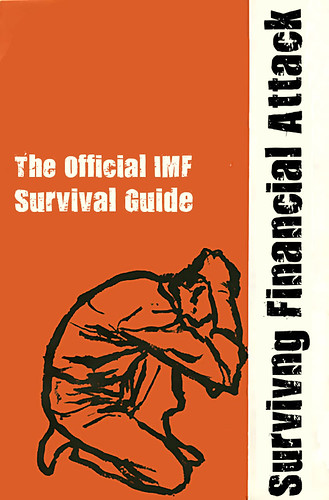
Surviving Financial Attack - The Official IMF User's Guide


Thursday, December 02, 2010

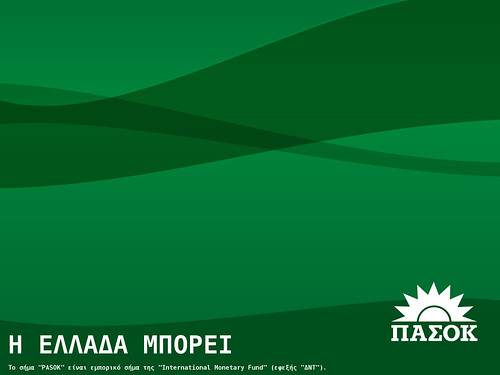
ΠΑΣΟΚ - ΔΝΤ: I love you.


ΠΑΣΟΚ ΔΝΤ, originally uploaded by Teacher Dude's BBQ.

Το σήμα "PASOK" είναι εμπορικό σήμα της "International Monetary Fund" (εφεξής "ΔΝΤ").Μην χρησιμοποιείτε κανένα εμπορικό σήμα του PASOK κατά κανέναν τρόπο που εκφράζει ή υπονοεί σχέση με την εταιρεία Panhellenic Socialist Movement Greece, χορηγία, υποστήριξη, πιστοποίηση ή έγκριση. Μην χρησιμοποιείτε κανένα Panhellenic Socialist Movement Greece εμπορικό σήμα του κατά τρόπον που υποδηλώνει ότι η εταιρεία συνδέεται νομικά με την εταιρεία σας. Πρέπει να προβάλλετε της εταιρική σας επωνυμία πιο έντονα από οποιοδήποτε εμπορικό σήμα του PASOK σε όλα τα υλικά.

Wednesday, December 01, 2010

Greece and the Neo - Orwellians

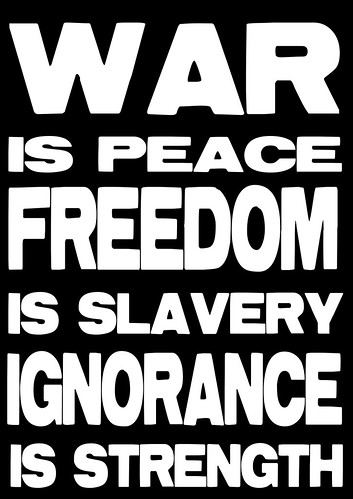
 War is peace - new strategic approach to Afghan conflict

"And if all others accepted the lie which the Party imposed—if all records told the same tale—then the lie passed into history and became truth."

Unlike the pontiffs of old Greek prime minister Giorgos Papandreou seems able to be an unlikely follower of the dogma of papal infallibility in which a move from one theological/ideological position to its exact opposite can be achieved without having erred in either case. On 23rd May Papandreou stated categorically to El Pais that Athens would not ask for its mountain of debt to be restructured, a position he repeated in a BBC interview in September and on 16th November to El Figaro, going so far as to say such a move would be a "disaster for Greeks".

Yet just last week the IMF/EU/ECB decided to extend the payment schedule for Greece's bailout out package from five to 11 years and this is now being hailed by the government and much of the media as a kiss of life for the country. It's interesting to see how the state run channels and pro-government TV stations such as MEGA, Skai and Antenna have promoted this latest change of heart without the slightest reference to previous government statements which held that such policies were not in the nation's interest.

In a repelling way it is fascinating to see how the ideas George Orwell espoused in 1984 are still revelent is a seemingly democratic regime with a free press. The truth, however, is the press in Greece is neither free nor independent but rather beholden to powerful political and economic interests which limit the parameters of what is acceptable in terms of political discussion. One only has to compare the rough ride given Ireland's ruling politicians following their bailout with the servile treatment of their Greek counterparts by local media. In many repects its hard to tell the difference between the official government line and that taken by the reporters who are covering domestic political matters.

The reality of the matter is that the press have sided with those in power in the hope of persuading ordinary Greeks that the massive social and economic dislocation they are suffering is inevitable and that any possible protests against PASOK's austerity measures are futile and anti-productive. This may, indeed by the case, but the stiffling of free and open debate about the options Greece has in the face of the current economic crisis is both dangerous and short sighted as it is steadily undermining respect for the government and democratic institutions in general.

Thursday, November 25, 2010

The Machine is dead. Long live the Machine. Is it the end of business as usual in Greek politics?


For the best part of four decades the two major parties in Greece have relied upon their ability to provide jobs in the public sector as a means of winning public support and elections. For many “a place in the sun” as a civil service job is called in Greece has been a powerful motivator since such positions offer far more security, better pay and conditions than in the private sector where low wages and flagrant abuse of labour legislation are now the norm.

In the past when the economy was growing at rates that made Athens the toast of the European Union Greek governments were happy to ignore such abuses as employees could easily find work elsewhere and the State could easily fund the ever growing number of people on the public payroll. However, with access to cheap credit seemingly at an end and the IMF and EU breathing down its neck for cuts the country is about to undergo radical changes that will not only alter the nature of its economy but also the relationship between rulers and ruled.

Greece's creditors are insisting on a massive reduction in the size of the state and in particular has demanded that for every new hiring, five public sector workers leave. Given the size of the civil service in relation to the rest of the economy this involves a severe jolt to the labour market and is likely to lead to even higher unemployment as the private sector is also shrinking at an unprecedented rate and will not be able to absorb the tens of thousands of new job seekers. This, in turn will push down wages and purchasing power for those employed so further worsening the government's economic position as more businesses close and tax revenues plummet.

In the long term the inability of the ruling party to offer incentives to its supporters in the form of jobs will lead to a breakdown in the network of patron – client relations which is the lifeblood of the modern Greek political system. Whether nominally socialist or conservative the two largest parties, PASOK and New Democracy which have dominated parliament since 1974 have regularly used power to reward followers with state jobs.

While the leader of the right wing New Democracy, Kostas Karamanlis may have promised to reform the state and cut public spending his party followed the internal logic of the system and added employees to the public payroll on an unprecedented scale.

Similarly, while the socialist PASOK vowed to improve public services the reality was that while those working in the education and health rose steadily the quality of services offered dropped to the point that whilst the country had one of the worst school systems in Europe it employs four times the number of educators working in Finland, home to the world's highest ranking schools .

At first glance such moves may seem contradictory but they fit in perfectly with the logic of a political caste that despite marching under different ideological flags differ little in terms of day to day policy. The job of the ruler is to stay in power and once you understand that and leave aside political lablels everything else starts to make sense. If you cannot reward followers then the well oiled party machinery that can deliver votes quickly starts to break down.

The problem is that there are no longer jobs or contracts to hand out. The insistence of the IMF/EU/ECB troika has seen to that by standing tough despite Papandreou's claims that the new austerity measures will not lead to more civil service job losses. However, this hasn't stopped PASOK, state run TV channels and the government's supporters in the media in general from pushing the line that some will still be hired.

In the recent vote the PASOK candidate for the position of Mayor in Thessaloniki, Greece's second largest city committed himself to creating 50,000 new jobs. This at a time when Papandreou has been forced to cut 40,000 places. Even then the government NET news spoke of 8,000 new openings but failed to mention  that any “new” positions created will, in fact be filled by people transferring from other sectors of the civil service.

As the reality of the situation filters down you are likely to see a fragmentation of the party political scene as party members and functionaries jump ship either to join other parties or quit politics all together. The record low turn out in the latest local elections is just a symptom of this sea change in public life and is likely to intensify as the crisis worsens as Athens sits by on the sidelines unable to influence an economic policy decided upon in Brussels, Frankfurt and Washington.

Already Dora Bakoyianni, who was until last year a contender for the leadership of New Democracy has created a new party with the aim of challenging her former colleagues for the centre right vote. Such moves are likely to be replicated in PASOK if MPs and cabinet ministers fall out with the leadership or see that the party is doomed at the polls.

Does this means that the political scene is about to change for good? Probably not in the short term if the tactics and strategies displayed during November's local elections are anything to go by. Too many of the major parties' nomenclature are wedded to the present sysytem which has brought them power and personal wealth for decades to give it up without a fight. Instead they will keep on down the same road but with fewer and fewer resources to back up their promises. In the place of a corrupt, mismanaged political system which costs hundreds of billions you will have a corrupt, mismanged one that runs on far less money.

Wednesday, November 24, 2010

"Our job is to report the news, not fabricate it. That's the government's job."

Keep calm, all is well

In my last post I talked about the role of the media and especially TV in presenting the consequences of the current economic crisis in Greece. I was particularly scathing of the role of the state run channels and the pro - government private stations in their efforts to distort the effects of the IMF/EU mandated austerity measures and present whatever PASOK party does in the best possible light.

Yesterday representatives of the IMF, EU commission and the European Central Bank held a press conference setting out the terms of the next installment of bailout money and outlining what the Greek government had and had not achieved in terms of reducing public spending and raising tax revenue. Considering the recommendations presented are set to change the whole of the Greek economy and involves massive upheavals, wage cuts and job losses  you would think that coverage of the event by the Greek press would be intense. Instead not one station broadcast the conference live and limited their reporting to short snippets which included luke warm praise by the troika of Greeec'e efforts so far. This was the line that was presented by most of the TV news bulletins along with prononouncements by experts that Greece had no choice but to accept such changes.

Instead there was extensive live reporting of a routine visit by a the head of the Cypriot republic which was attended by the prime minister, Giorgos Papandreou. Rather than reporting live a story which is set to effect the vast majority of the Greek population the media chose to focus attention on a mundane diplomatic story. As I said before the government and its supporters in the private sector are desperately trying to hide the fact that despite all the rhetoric about protecting jobs and living standards the ruling PASOK party have been forced time and time again to back down and accept everything the country's creditors have put forward.At the same time they have been required to engage in Orwellian feats of linguistic gymnastics in which cuts are called readjustmenst and savage criticsm termed positive feedback. In fact anything that covers the truth that the country is bankrupt and no longer responsible for virtually any aspect of economic policy.

 Indeed the IMF, EU and ECB by timing their report on Greece till after the country's recent elections (out of 27 EU countries, only Greece's report was delayed) you could argue that they have directly involved themselves in national politics. If the current measures which were inspired by the Eurostat's report on the economy had been announced on 27th October as happened with every other EU member) there is a good chance that Giorgos Papandeou's party would have suffered massive defeat and the country would be in the run up to national elections as has happened in Ireland.

Monday, November 22, 2010

Financial crisis and the media: The failure of the Fourth Estate in Greece


As seen on TV., originally uploaded by Teacher Dude's BBQ.

It hardly comes as a surprise that the Greek media is less than impartial and that each part has its own line when it comes to political and financial issues. In the UK the fact that the Telegraph is a strong supporter of the Conservatives or the The Guardian has a left wing bent comes as a surprise to no one. Indeed this is one of the reasons readers choose one rather than the other. Here in Greece the same holds for TV stations as well as newspapers, though sometimes in less obvious ways as the nightly news bulletins aspire to respectability through trying to appear objective in their presentation of the day's events.

However, this veneer of objectivity has started to wear even thinner as the effects of Greece's economic crisis grow ever more apparent and the authorities desperately try to balance the demands of the country's creditors for cuts and reforms with a population deeply unhappy with the current state of affairs. This is most easily seen in the state run channels such as NET, ET1 and ET3 which nightly have a running commentary which is virtually indistinguishable from the official party line and like South Korea's “sunshine policy” attempts to avoid confrontation with government officials and present their policies in the best possible light. In other words spinning the administration's spin still further till the resulting story resembles something drafted by a Soviet era Pravda editorial team.

Case in point has been the visit to Athens by the IMF, EU, ECB trioka in order to negotiate the terms of Greece's next installment of the country's bailout package. The fact that the payment had been delayed was initially attributed by both the ERT news agency and the government to technical difficulties, which clashed with stories running in both Associated Press and Deutsche Welle that reported that the delay had been caused by the Austrian finance minister, Josef Proell threat to withhold his country's contribution to the bailout fund if Greece did not fulfill its obligation to raise more tax revenues. Other Greek media outlets did mention the news once it came out in the international press but even today there is no mention of Austria's role in the current negotiations in the state run ERT online news service .

In addition the recent government split between prime minister Giorgos Papandreou and employment minister Louka Katseli over whether Greece should accept the Trioka's demands for more flexible employment legislation and the abolition of industry wide contracts has been either underplayed or ignored. The disagreement between the minister and creditor's has threatened to derail talks over the terms and conditions of the multi – billion loan, yet today ERT top domestic news story is that foreign minister, Dimitris Droutsas has warned Turkey that failure to remove troops from Northern Cyprus will affect it EU application bid.

Unable to hide the fact that negotiations with the EU and IMF are not going as planned the government and it supporters in the media are attempting to divert attention elsewhere, preferably towards an external “enemy” in order to look tough on national issues. The reality is that such smoke and mirrors cannot hide the fact the Papandreou will almost certainly be forced to backtrack on pre -election promises not to implement further austerity measures further undermining his standing within the ruling PASOK party and the electorate in general.

It's also measure of how much the troika – Katseli affair has spooked the government and their media allies that the pro – government Skai TV channel news commentators were frantically demanding the minister return to the back benches and not disrupt talks that threaten to shipwreck the country. Such partisan statements in news bulletins means that even the pretense of neutrality is being dumped in a last ditch attempt to persuade viewers that Athens is in charge of the situation and not attempting to play a terrible hand of poker with all its cards on show.

Far away from the glare of the TV studio lights the majority of Greeks have written off both the media and the government convinced that neither can be trusted and that vital decisions concerning the future are no longer in the hands of their elected officials. With businesses closing at an ever faster rate and yet more VAT and tax hikes the reality of the situation is that Greece's future is grim and this can no longer be hidden. Despite almost Orwellian attempts by the seven state run outlets to call wage cuts, “readjustments” and the crisis an “opportunity” people are no longer listening to this daily diet of spin, evasion and PR hot air.

There is, however, still much to be learned from ERT (Greece's answer to the BBC) presentation of the news if one looks deep enough. Like sovietologists of old poring over the latest copy of Pravda there is a lot to be gleaned in the choice and order of news items. The first few items often give an insight into what PR line is being promoted which in turn allows the careful observer to understand what the authorities are most worried about. Hence last weeks triumphant headlines that Greece had secured the third tranche of cash from the EU was an indicator that there were doubts that over if the money would indeed be paid.

Similarly today's revanchist statements by the foreign minister is a fairly strong indicator that Papandreou's government is in deep trouble and is looking to create a diversion. Not that we will find out this from NET, ET1 etc but most likely from a TV station or newspaper supported by the opposition or more plausibly foreign media such as the BBC or Reuters. 

To understand why the local media is so bad and getting to the truth you have to understand the close, almost incestuous relationship between journalists and politicians. For the media news IS party politics, sometimes to the exclusion of virtually everything else and that access to sources is worth all kinds of compromises. This is not just a Greek phenomenon but the fact the mainstream political parties are able to reward the "right kind" of coverage with lucrative positions as "consultants" or even candidates in local and national elections means that many reporters do not bite the hand that feeds them.

Nor is the situation in the private sector much better as TV stations and other news outlets are owned by very rich men who use them as a way of gaining leverage with the state by supporting or criticising politicians and parties in order to win lucrative state contracts or to derail legislation not in their interest. In such an environment the Fourth Estate is simply a tool to be used to sway public opinion and so apply pressure when needed. 

On rare occasions where journalists do show integrity the cost is their livelihood as documentary film maker Stelios Koulaglou found out to his cost when he aired a documentary on the state run NET channel on unemployment critical of the then ruling New Democracy government. The result was  his instant dismissal and the end of a well respected TV series Reportage Horis Synora (Reporting Without Borders), which had been running since 1996 and had four times been awarded Best news Programme of the Year.

Tuesday, November 16, 2010

Greek authorities take no chances on the eve of Polytechniou Day


It seems that the Greek nation has finally accepted the inevitable and got on board with the austerity package demanded by the country's creditors. It must be true since the prime minister, Giorgos Papandreou said so during his speech after the results of Sundays local elections. So did IMF head Dominique Strauss Kahn in an interview on French radio when he said that the victory of the ruling PASOk party showed that Greek had understood the need for change.

What both leaders choose to ignore was the enormous drop in turnout by Greek voters, in some cases 50% less than in previous elections in 2006 and the growing dislocation between the country's ruled and rulers. While both major parties made some gains the overall trend is one of ever intensifying disenchantment with the current political system. Less an endorsment of the country's politicians than an understanding that the country no longer controls its destiny, no matter which party is nominally in charge.

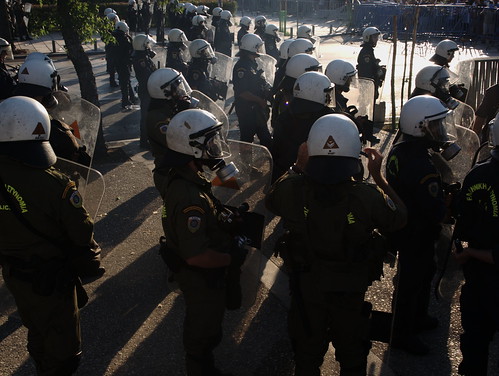
Tomorrow marks the 37th anniversary of the Polytechnic uprising which set in motion a chain of events that led to the overthrow of the military dictatorship that had siezed power in 1967. Every year students and others march in Greece's major cities in commemoration of those who died to restore freedom and democracy. The day is often used as a platform by political groups to demonstrate against unpopular government policies. This year's anniversary is likely to repeat this tradition and the presence of 7000 additional police officers in the centre of the capital is testiment to how worried the government is about the marches turning into something more violent.

Already there have been clashes in Athens between youths and the police around the university of Athens campus the scene of many of the violent confrontations during the 2008 uprising which caused billions of euros worth of damage.

Polytechniou day as it is known in Greece will prove to be an acid test over whether young Greeks in particular have accepted the massive cuts in public spending and job losses proposed by the European Union, European Central Bank and IMF.

Given the anger and frustration felt by much of the population over the continued economic crisis there is a very real possibility that a miscalculation by the authorities could have drastic consequences.