Evangelos Venizelos, leader of the Greek PASOK party about to address supporters ahead of next weeks elections. The audience was dominated by the party's ageing party base, with those under 40 being a distinct minority.
Showing posts with label Evangelos Venizelos. Show all posts
Showing posts with label Evangelos Venizelos. Show all posts
Tuesday, January 20, 2015
PASOK leader on the campaign trail
Evangelos Venizelos, leader of the Greek PASOK party about to address supporters ahead of next weeks elections. The audience was dominated by the party's ageing party base, with those under 40 being a distinct minority.


Monday, May 12, 2014
Where Have All The Flags Gone? The End of Days For Greece's Post - Junta Political Order.
At least till recently Greek election campaigns have been vibrant. rambunctious affairs, marked by mass public rallies, a barrage of ads on TV and the kind of political theatre long since extinguished in Northern Europe. Yet this year shows that whilst Greece may be steeped in tradition, it has also a long history of radical change and re-adjustment, a legacy of its traumatic modern history which has seen the small Balkan nation undergo invasion, civil war, famine and spectacular economic growth and decline.
In contrast to 2009's hard fought EU election campaign, the current run up to the dual local and EU parliamentary votes on 18th and 25th May have been so low key as to be practically invisible. Gone are the constant TV ads and posters on every major thoroughfare. gone are the large scale public rallies that used to be the trade mark of both New Democracy and PASOK parties.
So why the reticence on the part of a political caste whose one guiding principle is to stay both in power and the public eye? Partly, it is financial, New Democracy and PASOK are bankrupt in all but name, owing between them 250 millions euros to the banks and as their State funding is linked to electoral prowess their steep decline in support means they have little chance of returning to solvency. State allocation for campaign spending (of which PASOK and New Democracy got the lion's share) which reached 65 million Euros in 2010 has now been reduced to 7 million and with so little cash the lavish outlays that allowed Greece's two largest parties to outspend on a massive scale their political rivals has disappeared.
Partly, the anemic campaign is for reasons of self - defence. Ruling politicians are so detested by many of their voters that any kind of large public gathering is next to impossible unless the image politicians want to project is one of anger and discontent. Brave is the government minister who'd appear in public unless in front of a crowd of heavily vetted party loyalists. Whilst opposition parties such as SYRIZA and KKE (Greek Communist Party) will be holding outdoor rallies neither the prime minister nor deputy PM dare risk such a move, fearful that they'd be faced with a sea of hostile faces live on TV.
Case in point has been the election campaign of PASOK leader and deputy prime minister, Evangelos Venizelos. Appearances so far have so been held behind closed doors in meetings held for hard core party cadres rather than rank and file supporters. In each case demonstrations by sacked public sector employees and other disgruntled groups means that such events are marked by high levels of security, further heightening the image of a political elite cut off from the rest of the nation.
For the prime minister's New Democracy's conservative party the picture, whilst not pretty, is nowhere near as dire as that of PASOK but they too are saddled with massive debt load which has severely curtailed their spending. Though much of the mainstream media continues to support them, a serious decline in TV ratings for the most partisan pro-austerity channels and the collapse in newspaper readership has lessened their ability to set the political agenda.
While the polls show wildly divergent predictions for the results, two things can be widely agreed upon; firstly, that even the support of the country's oligarchs may not be enough to avert SYRIZA becoming the largest party in EU elections (local election results are less easy to use as an indicator for national party support as candidates are forbidden by the constitution to run under national party tickets,). And secondly PASOK will be wiped out, lucky if it elects even one euro MP. A long, inglorious fall from the time it dominated post Junta politics in the 1980's and 90's.
If the results prove particularly disappointing for government coalition partners then there is most likely to be quick and fundamental changes in the party leaderships as different groups vie for power and seek to avoid loss in support.
Venizelos has already warned that anything less than 10% share of the vote for PASOK Now renamed Olive Tree) will threaten government stability. A strange statement given that the party has not polled as high as 10 percent in years. Nearly all polls show that likely their share will be be between 3 and 7 percent and that even their recent name change will do little to avert the inevitable
The prime minister is faced with a similar dilemma as a severe defeat at the polls will weaken his position and give ammunition to internal opponents already unhappy with his promotion of far right elements to top party and government posts. Many are suspicious that once again Samaras will lead New Democracy to electoral defeat as he did in the mid 90's when he left the party to set up Political Spring, an act many Karamanlis loyalists still see as an act of betrayal.
The fact that the Greek supreme court has ruled that Golden Dawn can run for elections despite the fact that many of its MPs are facing criminal charges. Must give New Democracy even more reason to fear defeat as both parties have been actively cultivating far right polices in the hope of winning ultra-conservative voters. Problem is that unlike Golden Dawn, the prime minister's long series of u-turns and policy flip flops have disillusioned many on the Right.
Golden Dawn may have been vilified by both local and foreign press for its racist activities, but there are still many Greeks who will use the party as a vehicle for their anger at the existing political set-up, which is widely perceived as both corrupt and out of touch. Even the media campaign that followed the fatal stabbing of activist rapper Pavloss Fyssas by Golden Dawn members has ended up backfiring as the pro-government stations fall victim to their desire to please political goals of their owners at the expense of credibility.
The arrival of the Potami - River party formed by former journalist Stavros Theodorakis promises to make firm predictions over the exact result even more difficult. Theodorakis recently set up the party as non-political alternative to the traditional ones of Left and Right. Initially polls showed support as high as 15% but since then these numbers have dropped significantly especially as questions of how the party has been financed remain unclear and the fact that he was till recently a senior reporter in the pro-government MEGA channel.
However, whatever happens the political landscape forged in the aftermath of the Regime of the Colonels in the 70's is now almost at an end; PASOK, the child of left wing firebrand Andreas Papandreou is all but spent as a major political force, a victim of its adherence to hated austerity policies.
Their eternal rival, New Democracy, also created in the ashes of the Junta is riddled with dissent and after six years of grinding economic decline caused by austerity. Even among the party's core demographics the cuts in pensions, endless list of taxes on property and spending cuts have taken their toll with levels of support now at less than half those of pre-crisis elections.
Finally, next Sunday's vote also marks the death knell for the family dynasties that dominated so much of public life in modern Greece, the latest generation of Karamanlises Mitsotakises and Papandreous both took the reins of power riding to victory on name recognition and achievements of their father's and grandfathers, only to be found wanting as the crisis upturned so many of Greece's political shibboleths.
Konstantinos Karamanlis (nephew of New Democracy founder Kostas Mitsotakis and nephew of previous prime minister Konstantinos Karamanlis) won two terms in office but left behind a heavily indebted economy and a party image battered by string of corruption and influence peddling scandals.
Similarly, Giorgos Papandreou's (son and grandson of previous Greek prime ministers) time at the helm was no less disastrous than his equally privileged predecessor, faced with an unprecedented economic downturn his vacillation turned a major setback into a full-blown meltdown, eventually leading to him being deposed in a "palace" coup by Evangelos Venizelos when Papandreou threatened the EU and IMF with a referendum over austerity.
Though neither will be missed by most voters, like so many failed leaders of the past they hang on like Banquo's ghost ever ready for a call from the Greece's voters to come back and save the nation. It's a call they are unlikely to receive.
Monday, June 18, 2012
Greece election post mortem
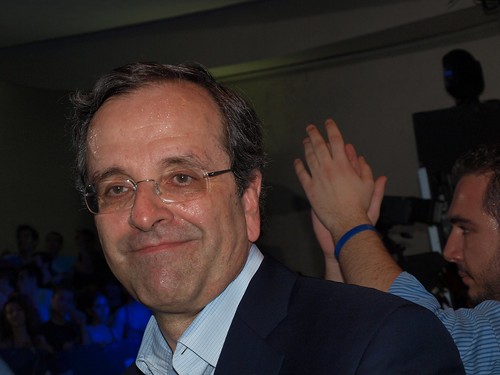
First things first. An apology to anyone who bet (and lost their shirt) on my prediction that SYRIZA would be the largest party in parliament today, if I see you, let me buy you a drink, it's the least I can do. As it turned out my analysis was off the mark. I overestimated SYRIZA's final vote and more crucially underestimated the final New Democracy tally. Also I didn't see the collapse in Greek Communist party support which halved, unlike PASOK and Golden Dawn who only saw a small drop in votes received. All in all, my days as a poll pundit are numbered. (Vote statistics can be found here).
Why was I so wrong? First of all, I failed to grasp just how successful the fear campaign over possible Greek exit would be. I had assumed that the constant barrage of warnings over the consequences of Greece having to leave the Eurozone had done its work and wouldn't push Samaras's vote over 25%. On the other hand the record low turnout (down 8% from 2009) seemed to have had an effect, I suspect on younger voters who would have supported anti-bailout parties. Finally, the scenes of violence perpetrated by Golden Dawn spokesman on live TV did nothing to diminish their popularity, which is both surprising and deeply worrying.
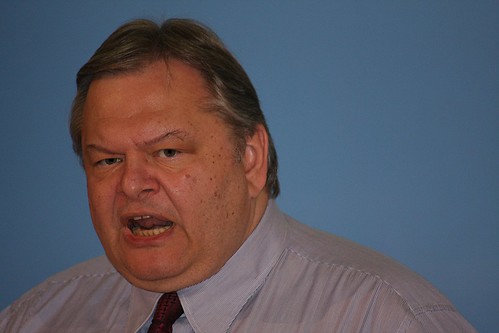
Mea culpa aside, today the New Democracy leader, Antonis Samaras will be asked by the president of the Greek republic to form a government. At first glance this seems just a formality as New Democracy with 129 seats and the other pro-bailout party, PASOK with 33 seats will comfortably exceed the 151 MPs needed to form a majority. Indeed both leaders in the last week of campaigning repeatedly stated the need for the country to immediately have a working administration in order to deal with its current economic meltdown.
However, beyond the campaign promises, Samaras and PASOK leader, Evangelos Venizelos have to take into account other factors concerning their own and their parties' political future. If they do assume power, then they will be seen as the parties that are responsible for the country's economic woes, leaving SYRIZA and others to claim that have are the only real anti-austerity choice in any future elections. Given the drubbing PASOK got and the marginal victory achieved by new Democracy that more or less guarantees their defeat in the next elections (barring an economic miracle and the Germans have outlawed miracles).
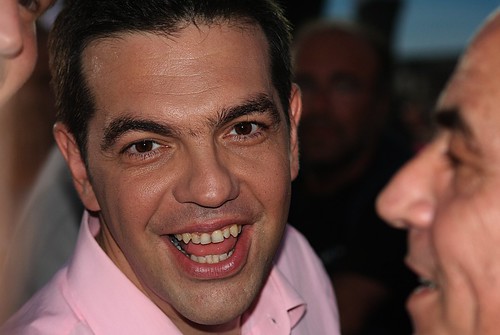
The answer to this dilemma is to try and persuade SYRIZA leader, Alexis Tsipras to join the government with promises, appeals to patriotism and threats of possible dire economic consequences if he does not.This card was played after the May elections and judging by official SYRIZA statements coming out in the Greek media such overtures are almost certainly likely to be rejected. On the other hand the Democratic Left have made it quite clear that they will be willing to take part in such a government. But this does not solve Samaras and Venizelos's long term problem about how deal with Tsipras in coming elections.
The other factor which plays a crucial role in any negotiations is ego. Even with Greece mired in the worst economic downturn, the monsterously overblown egotism of both Samaras and Venizelos may prove an obstacle in forming a stable government. Both have spent decades slowly working their way up the greasy pole of political power and just as they seemed to be destined to become prime minister, the game changed. To have to share power after so many years playing second fiddle is almost more than either can bear.
Whatever form the next Greek government takes, its fate will not be decided in Athens but in Berlin and Brussels. If the troika (EU/ECB/IMF) are serious about supporting Samaras then serious concessions in the terms of the current austerity measures will have to be made, otherwise with unemployment rising 1% every two months and the economy contracting the fragile New Democracy - PASOK (and possibly Democratic Left) coalition will fracture under the weight of more job cuts and tax hikes. At which point Greece holds yet more elections and most likely brings to power SYRIZA.
There seem to be mixed signals coming out of Europe over whether there will indeed be a change in approach which will allow New Democracy to stay in office, on the one hand deputy German finance minister, Steffan Kampeter said that Greece shouldn't be overstrained during a talk on German TV, on the other the Eurogroup of EU finance minsters sent a polite but clearly worded statement last night warning Athens that it could not deviate from the term of the bailout agreement.
With cost of lending in Spain continuing to rise and with Italy on the verge of asking for its own bailout deal none of this may matter as the systemic problems of the Eurozone continue to rage unchecked, leading to possibly disastrous results for European debtors and creditors alike
Thursday, May 10, 2012
EU and Greece's high stakes poker game.
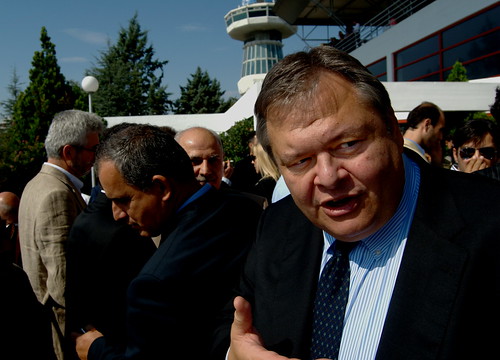
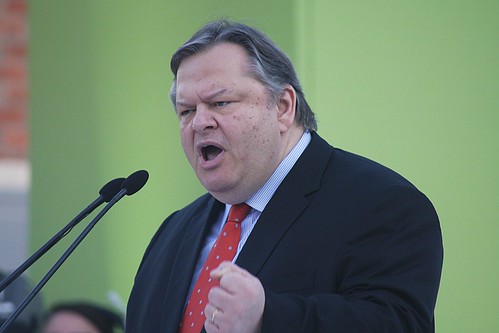
Evangelos Venizelos, a photo by Teacher Dude's BBQ on Flickr.
This time my prediction proved right and Alexis Tsipras this morning told the Greek president that his SYRIZA (Radical Left Coalition) party is unable to form a new government. This means that the task now falls to the head of the centre left PASOK party, Evangelos Venizelos, however, the chances of Venizelos, whose party lost 70% of its parliamentary seats in Sunday's elections, faring any better than Tsipras or the conservative leader, Antonis Samaras are slim.
It is becoming quite obvious that under the present economic conditions any party working with PASOK or New Democracy in order to form a pro-austerity government is signing their own political death warrant and with elections likely in June that mitigates against any agreement.
So what happens next?
Tsipras used his time in the political spotlight to further underline his party's opposition to the terms of the Greek bailout deal and made it quite clear that if the Radical Left took power they would play a very different game from their immediate predecessors. Also in a parliamentary address broadcast live on TV last night at 9pm he reached out to other groups on the left, both trade unions and political parties in what could be called the creation of a united front in any new national elections. If SYRIZA can attract some of the smaller left wing parties and get the Ecologists to sign up there is a good chance that they may overtake the conservatives in the polls. In addition the language Tsipras used was also aimed at the supporters of the Greek Communist party (KKE) who may be persuaded to switch allegiances. There are rumblings of discontent amongst KKE rank and file members who are unhappy with Aleka Papariga's unwillingness to form wider political alliances.
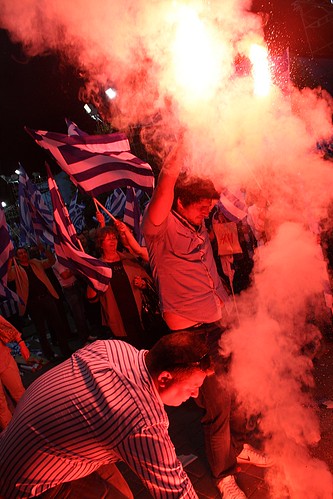
The prospect of a radical left wing, anti-austerity government in Athens has, predictably enough provoked a strong reaction by both local and European elites. Already the local media are running scare stories blaming political instability for falling tourism bookings and saying that ΣΥΡΙΖΑ would use power to grab people's savings. In a similar vein, both Samaras and Venizelos claimed that such a government would get the country kicked out of the Eurozone and the EU and would lead to economic collapse.
On the European level last night the EU said that it was delaying payment of part of the latest bailout tranche, of the 5.2 billion euros promised, only 4.2 billion will be released today, the remaining 1 billion destined to fill holes in the Greek government's day to day running costs will be paid at the some unspecified time in June. Such crude blackmail attempts underline the sense of unease being felt in Brussels and Berlin at the prospect of Greece defying creditors and possibly derailing the entire EU austerity program.
There is an other possibility as the BBC's Paul Mason pointed out that in light of the elected parties being unable to form a government and unelected technocratic caretaker government would be charged with passing the latest cuts and tax hikes scheduled for June and July. Such a move would plunge the country into even more political turmoil as people would see it as a clear defiance of the anti-austerity message the national elections sent. In such a climate the legitimacy of the parties participating in such a government would be shredded, opening up opportunities to other less mainstream parties, including the neo-Nazi Golden Dawn who already have 21 MPs in parliament.

Once again the Greece and the EU are playing a game of high stakes poker, upping the ante and hoping that the other will fold first. However, unlike previous round the mood in Greece has changed dramatically with the worsening economic crisis and threats of dire social consequences of failure to comply no longer hold such sway. With youth unemployment at 50% and the thousands of businesses closing every week, for many the worst has already arrived.
Tuesday, May 08, 2012
Squaring the circle - Radical Left's Alexis Tsipras takes turn at forming new Greek government
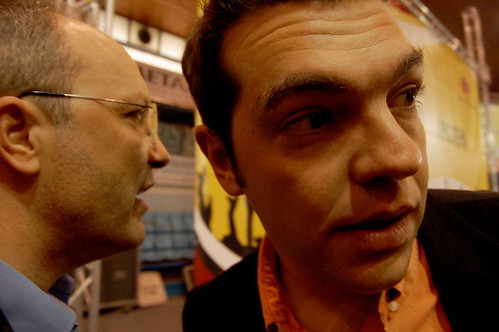
Αλεξης Τσιπρας/ Alexis Tsipras, a photo by Teacher Dude's BBQ on Flickr.
Well, one of my predictions bit the dust. The possibility that New Democracy would work with Independent Greeks was nixed yesterday when Panos Kammenos refused even to meet with New Democracy leader, Antonis Samaras. Now it's the turn of the leader of the Radical Left coalition party (SYRIZA), Alexis Tsipras to try and form a government. After today's meeting with the president of Greece at 2pm he will have 72 hours to forge a coalition.
At first glance this seems an uphill task given the fact that the Greek Communist party (KKE) has ruled out any possible deal and without their 26 seats getting a 151 seat majority just from the left went from being difficult to being impossible.Even if KKE's leader Aleka Papariga had agreed, the presence of members of PASOK once again in government would have caused enormous problems both within parliament and with the electorate at large who sent a very clear message that they do not want more of the same.

So what's left? One rumour doing the rounds of the Greek language twittersphere is that a quick and dirty coalition of PASOK, Independent Greeks, SYRIZA and Democratic Alliance would form a short term government to repeal the election law that gives leading party an extra 50 seats in parliament and then announce new national elections with a more level playing field.
However, this is just a rumour and I believe the most likely outcome will be Tspiras announcing that a new government cannot be formed in which case the task falls to PASOK leader Evengelos Venizlos who is likely to have even less luck.
So its seems that new elections will be held once more with the 10th or 17th June being mentioned as the most likely dates. It will be interesting to see if they produce radically different results to the previous ones. Equally interesting will be how this affects the next round of measures required by Greece's creditors in return for the latest bailout installment. If Athens is not in a position to implement the tax hikes and job cuts being demanded will the money be withheld? With government revenues falling all the time what happens to the real economy and the stability of the Eurozone as markets get ready for a possible knock on effect in Spain, Italy and Portugal.
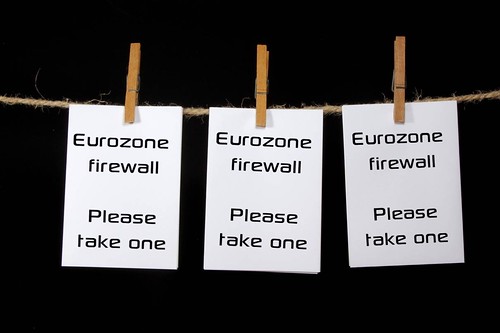
In such a case will the EZ's firewall be enough?
Tuesday, May 01, 2012
Evangelos Venizelos addressing Greek election rally. Thessaloniki, Greece
Evangelos Venizelos addressing rally. Thessaloniki, Greece, a photo by Teacher Dude's BBQ on Flickr.
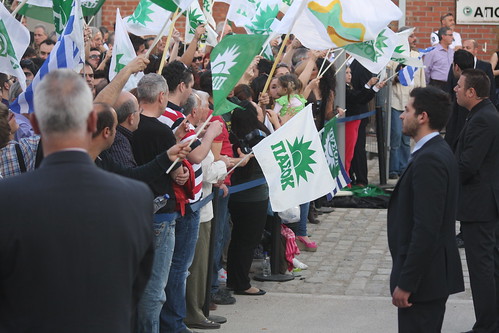
Everything I wrote about in the previous post happened more or less as about 1000 hardcore PASOK party supporters turned up to hear Evangelos Venizelos speak, but judging by the TV footage you'd think it was ten times that many. Despite my predictions, however, security was a little more lax and there were no protests by irate voters anywhere near the event
On the other hand, apart from a 100 or so members of PASOK youth wing, carefully positioned in front of the stage the rest of the audience consisted of old time party supporters whose average age was about 50.
The party is a spent force.
Sunday, April 29, 2012
Far From The Madding Crowd - Election campaigning Greek style
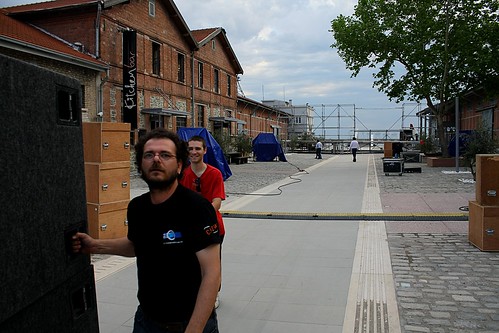
Setting up sound stage for PASOK election rally, a photo by Teacher Dude's BBQ on Flickr.
Today at 6pm Evangelos Venizelos, the head of PASOK and till recently the leader of the largest party in the Greek parliament will be addressing voters in the northern port city of Thessaloniki. The picture, taken yesterday shows technicians busily setting up stage inside the port in order to be ready for today's' rally.
However, what the photograph really shows is that the current crisis in mainstream politics caused by five years of recession and three years of austerity has overturned nearly every aspect of election campaigning. In days gone by any political leader worth their salt would have organised a massive public meeting in Aristotelous Square, an event to which the party faithful from all over Northern Greece would come and for hours would be whipped up into a frenzy in anticipation of the arrival of their leader. (see photos from 2009 elections here).
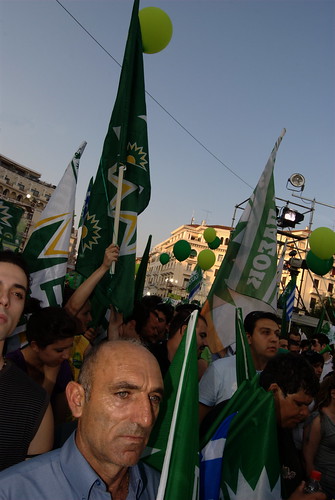
Even when the leaders were as lacklustre as Giorgos Papandreou and Kostas Karamanlis, the party supporters could be relied upon to put on a good show for the TV camera in the hope of swaying voters at home.But no longer. The two largest parties, PASOK and New Democracy cannot rely upon, or even completely trust their own voters. Over the last two years the numbers of attacks on politicians appearing on public have risen exponentially and although most involve little more than jeering and the throwing of yogurt others have turned much more violent. However, even worse than the possibility of violence is the damaging PR effect of TV images showing a candidates in front of hostile audience.
With the parties limited to using TV and internet to get their pre-election message across, preserving the fiction that they still enjoy mass support becomes even more important. Hence the choice of venue shown in the picture. It allows police and party media handlers to carefully control access and it's position far from the Thessaloniki's main streets means that protesters can be kept of sight and earshot.

Also the narrow space (it's the jetty pointing out to sea in Google Maps shot above) means that even a few hundred people can be, with the right angles and lenses be made to look like an adoring crowd. Also since it is outdoors Venizelos can claim (at least on TV) that he is still popular enough to appear in public. What viewers will not see will the thousands of police on duty making sure that Venizelos can appear unmolested outdoors. Claiming to represent the will of the people whilst hiding behind rows of baton wielding riot police is not the carefully honed media message PASOK wants to send to voters on the eve of such an important vote.
Subscribe to:
Posts (Atom)