Showing posts with label analysis. Show all posts

Thursday, January 08, 2015

Greek elections - state of play so far


The Greek national election campaign is now well under way and all parties involved have started their campaigns, both on the road an in the media. The Greek prime prime minister, Antonis Samaras kicked off New Democracy's efforts with a televised rally in a hotel in city of Larissa, almost immediately followed by SYRIZA leader's rally in a stadium in Athens. The contrast could not have been greater, while the prime minister gave a lacklustre performance which meet with lukewarm response, even among party faithful, Alexis Tsipras on the other hand showed just how far he's come as a public speaker, both energising the party base with his speech and showing that he was clearly setting himself out as a national leader.

In the meantime, coalition party leader Evangelos Venizelos addressed PASOK party members in a cafe, reminding viewers that the glory days of the party when they could attract crowds numbering hundreds of thousands were well and truly over.

To add to the uncertainty surrounding the most unpredictable Greek election in years, ex-prime minister and once leader of PASOK Giorgos Papandreou announced his formation of a new party, The Movement of Democratic Socialists in the same period, a move that was quickly condemned by the current PASOK leader as "irrational and unethical". Some media outlets were even predicting, rather generously as it would later turn out, that the new party would garner anything up to 6% of the poll, so allowing it representation in parliament.

New Democracy's campaign which as being spraying the internet with banner ads and pop up non-stop since the day of the vote for president has been focused on playing on fears of ordinary Greeks that a SYRIZA victory would be tantamount to an exit for the Eurozone, even the the European union itself. 

The talk of Grexit cultivated by the Samaras and echoed by pro-government TV stations and newspapers has spooked markets and led to a number of European officials to back track and say that such a contingency is out of the question. However, such denials did not stop prime minister repeating such threats in his speech on Tuesday in the northern city of Komotini, though latest news reports seem to indicate that the party's campaign will change direction and now focus on the government's track record in power.

As part of this change in tack it seems Samaras is willing to use the even more incendiary topic of immigration, even the tragic deaths of the 12 people killed in the Charlie Hebdo shooting in Paris on Wednesday were used by him in order to attack SYRIZA's immigration policies. In his speech in Halkidi he said, 

"There was a massacre today in Paris yet some people want to invite more illegal immigrants and hand out citizenship"

This campaign promises to be the dirtiest in years, and as if to underline the point the prime minister and other senior New Democracy figures were eagerly using the deaths of the victims in Paris to drum up votes for their party which has consistently been behind the polls over the last few weeks. Whilst some surveys have put SYRIZA anything up to 7.5% ahead, most seem to agree on a 3-4% lead for Alexis Tsipras's Radical Left party, despite the fact that they are facing an almost uniformly hostile mainstream media inside Greece and to a large degree abroad.

If such figures prove accurate this mean that SYRIZA will be unlikely to elect the 151 MPs required to have a majority government in Greece's 300 seat parliament and so will probably need to form a coalition with one or more of the smaller parties vying for power. This is where the waters muddy and accurate predictions of what will happen on election day and afterwards become less certain. All the other parties who could be in parliament are polling between 6 and 2% which given the margin of error present in such cases means any meaningful estimation of how seats will be distributed is difficult.

However, some guesses can be made. It would seem sure that KKE (Greek Communist Party) will once again get 4-6% and so about 12 seats as it did in 2012. Whilst KKE has not been able to exploit the economic crisis in order to widen its base, it's party organisation and strong campaigning abilities mean that the party faithful will turn out and support them. Likewise Golden Dawn's support in the polls has remain steady at 5-6% despite the jailing of most of it leadership on criminal charges pending trial. Despite almost singularly negative press coverage there remains a hardcore of voters who are willing to vote for them, no mater what.

On the other the once might PASOK party was in the throes of a major meltdown, even before the announcement of Papandreou's new party which is likely to drain what is left of its popular support among older voters. Latest polls show PASOK at between 3 and 5% and the Movement of Democratic Socialists at 2-3%, though there is a possibility that neither will break the 3% barrier needed to gain a seat in parliament. The situation is not helped by high level defections from PASOK to other parties. Today, PASOK cabinet minister Angela Gerekou announced she would be standing on a New Democracy ticket in the next elections.

The other major unknown is the amount of success the Potami (River) party will enjoy,set up last year by a former TV presenter with the oligarch owned MEGA TV station, Potami has been built up as a centre - left alternative to SYRIZA for those unhappy with PASOK's record in power. Currently, it is polling 5-7% and seems on track to be the third largest party.

Other parties such as the far light LAOS and the centre left Democratic Left party who once were government coalition partners have paid the price for pushing through deeply unpopular austerity measures and seem unlikely to win even one seat in parliament. Even the Independent Greeks party once seen as a viable centre right alternative to New Democracy is struggling to reach 3%

(It should be noted though that Greece's pollsters have proven notorious political in the results over the last few elections and so any results should be taken with a pinch of salt, and the political affiliations of the news outlets that commission them should be taken into account).

Whatever the final outcome, it seems SYRIZA may need allies, but this is where things get complicated. A first glance the most obvious coalition partner would seem to be KKE but this is extremely unlikely given the deep ideological gulf that divides them. The insistence of KKE's party leadership on maintaining ideological purity in the face of siren calls of power is unlikely to disappear soon.

A partnership with either a rump PASOK or Potami also is not without risks and threatens to split SYRIZA which till very recently was a loose coalition of leftist parties, many of who are far to the left of the Tsipras leadership and would view such allies with the deep suspicion, seeing them as the agents of the establishment seeking to worm their way back into positions of power and responsibility. 

Finally, there is a possibility that no government may be formed and so Greece may have to go to the polls again. Such a move would definitely make the nation's creditors deeply uneasy as it would raise the spectre of default over debt repayments due in 2015. 

Monday, May 12, 2014

Where Have All The Flags Gone? The End of Days For Greece's Post - Junta Political Order.


At least till recently Greek election campaigns have been vibrant. rambunctious affairs, marked by mass public rallies, a barrage of ads on TV and the kind of political theatre long since extinguished in Northern Europe. Yet this year shows that whilst Greece may be steeped in tradition, it has also a long history of radical change and re-adjustment, a legacy of its traumatic modern history which has seen the small Balkan nation undergo invasion, civil war, famine and spectacular economic growth and decline.

In contrast to 2009's hard fought EU election campaign, the current run up to the dual local and EU parliamentary votes on 18th and 25th May have been so low key as to be practically invisible. Gone are the constant TV ads and posters on every major thoroughfare. gone are the large scale public rallies that used to be the trade mark of both New Democracy and PASOK parties.

So why the reticence on the part of a political caste whose one guiding principle is to stay both in power and the public eye? Partly, it is financial, New Democracy and PASOK are bankrupt in all but name, owing between them 250 millions euros to the banks and as their State funding is linked to electoral prowess their steep decline in support means they have little chance of returning to solvency. State allocation for campaign spending (of which PASOK and New Democracy got the lion's share) which reached 65 million Euros in 2010 has now been reduced to 7 million and with so little cash the lavish outlays that allowed Greece's two largest parties to outspend on a massive scale their political rivals has disappeared.

Partly, the anemic campaign is for reasons of self - defence. Ruling politicians are so detested by many of their voters that any kind of large public gathering is next to impossible unless  the image politicians want to project  is one of anger and discontent. Brave is the government minister who'd appear in public unless in front of a crowd of heavily vetted party loyalists. Whilst opposition parties such as SYRIZA and KKE (Greek Communist Party) will be holding outdoor rallies neither the prime minister nor deputy PM dare risk such a move, fearful that they'd be faced with a sea of hostile faces live on TV.


Case in point has been the election campaign of PASOK leader and deputy prime minister, Evangelos Venizelos. Appearances so far have so been held behind closed doors in meetings held for hard core party cadres rather than rank and file supporters. In each case demonstrations by sacked public sector employees and other disgruntled groups means that such events are marked by high levels of security, further heightening the image of a political elite cut off from the rest of the nation.

For the prime minister's New Democracy's conservative party the picture, whilst not pretty, is nowhere near as dire as that of PASOK but they too are saddled with massive debt load which has severely curtailed their spending. Though much of the mainstream media continues to support them,  a serious decline in TV ratings for the most partisan pro-austerity channels and the collapse in newspaper readership has lessened their ability to set the political agenda.

While the polls show wildly divergent predictions for the results, two things can be widely agreed upon; firstly, that even the support of the country's oligarchs may not be enough to avert SYRIZA becoming the largest party in EU elections (local election results are less easy to use as an indicator for national party support as candidates are forbidden by the constitution to run under national party tickets,). And secondly PASOK will be wiped out, lucky if it elects even one euro MP. A long, inglorious fall from the time it dominated post Junta politics in the 1980's and 90's.

If the results prove particularly disappointing for government coalition partners then there is most likely to be quick and fundamental changes in the party leaderships as different groups vie for power and seek to avoid loss in support.


Venizelos has already warned that anything less than 10%  share of the vote for PASOK Now renamed Olive Tree) will threaten government stability. A strange statement given that the party has not polled as high as 10 percent in years. Nearly all polls show that likely their share will be  be between 3 and 7 percent and that even their recent name change will do little to avert the inevitable

The prime minister is faced with a similar dilemma as a severe defeat at the polls will weaken his position and give ammunition to internal opponents already unhappy with his promotion of far right elements to top party and government posts. Many are suspicious that once again Samaras will lead New Democracy to electoral defeat as he did in the mid 90's when he left the party to set up Political Spring, an act many Karamanlis loyalists still see as an act of betrayal.

The fact that the Greek supreme court has ruled that Golden Dawn can run for elections despite the fact that many of its MPs are facing criminal charges. Must give New Democracy even more reason to fear defeat as both parties have been actively cultivating far right polices in the hope of winning ultra-conservative voters. Problem is that unlike Golden Dawn, the prime minister's long series of u-turns and policy flip flops have disillusioned many on the Right.


Golden Dawn may have been vilified by both local and foreign press for its racist activities,  but there are still many Greeks who will use the party as a vehicle for their anger at the existing political set-up, which is widely perceived as both corrupt and out of touch. Even the media campaign that followed the fatal stabbing of activist rapper Pavloss Fyssas by Golden Dawn members has ended up backfiring as the pro-government stations fall victim to their desire to  please political goals of their owners at the expense of credibility.

The arrival of the Potami - River party formed by former journalist Stavros Theodorakis promises to make firm predictions over the exact result even more difficult. Theodorakis recently set up the party as  non-political alternative to the traditional ones of Left and Right. Initially polls showed support as high as 15% but since then these numbers have dropped significantly especially as questions of how the party has been financed remain unclear and the fact that he was till recently a senior reporter in the pro-government MEGA channel.

However, whatever happens the political landscape forged in the aftermath of the Regime of the Colonels in the 70's is now almost at an end; PASOK, the child of left wing firebrand Andreas Papandreou is all but spent as a major political force, a victim of its adherence to hated austerity policies.


Their eternal rival, New Democracy, also created in the ashes of the Junta is riddled with dissent and after six years of grinding economic decline caused by austerity. Even among the party's core demographics the cuts in pensions, endless list of taxes on property and spending cuts have taken their toll with levels of support now at less than half those of pre-crisis elections.

Finally, next Sunday's vote also marks the death knell for the family dynasties that dominated so much of public life in modern Greece, the latest generation of Karamanlises Mitsotakises and Papandreous both took the reins of power riding to victory on name recognition and achievements of their father's and grandfathers, only to be found wanting as the crisis upturned so many of Greece's political shibboleths.

Konstantinos Karamanlis (nephew of New Democracy founder Kostas Mitsotakis and nephew of previous prime minister Konstantinos Karamanlis) won two terms in office but left behind a heavily indebted economy and a party image battered by string of corruption and influence peddling  scandals.

Similarly, Giorgos Papandreou's (son and grandson of previous Greek prime ministers) time at the helm was no less disastrous than his equally privileged predecessor, faced with an unprecedented economic downturn his vacillation turned a major setback into a full-blown meltdown, eventually leading to him being deposed in a "palace" coup by Evangelos Venizelos when Papandreou threatened the EU and IMF with a referendum over austerity.

Though neither will be missed by most voters, like so many failed leaders of the past they hang on like Banquo's ghost ever ready for a call from the Greece's voters to come back and save the nation. It's a call they are unlikely to receive.


Friday, April 04, 2014

All The Prime Minister's Men - Top aide to Antonis Samaras reveals his close ties with Golden Dawn


Perhaps one of the worst kept secrets in Greek political life came to light when Golden Dawn MP Ilias Kasadiaris released a video (transcript in English here) which revealed just how close the party was to Takis Baltakos, cabinet secretary to both the prime minister, Antonis Samaras and Deputy PM, Evangelos Venizelos. The tone and content of the conversation underlined what many had suspected that instead of being stalwart foes, the ruling New Democracy party and the avowed political outsiders Golden Dawn party were in fact working closely together.


This is doubly embarrassing for the prime minister as it not only undermines New Democracy's policy of presenting itself as a moderate bulwark against extremism on both the Left and the Right (the so-called Theory of the Two Extremes) but also shows just how little independence the Greek judiciary has in the country's political system. According to Samaras's right hand man, the prosecutions of senior Golden Dawn figures and the imprisonment of its MPs was based on the threat they posed to New Democracy's poll share and not because of their string of violent attacks on immigrants and political opponents.

Despite the fact that the neo-Nazi party had racked up an impressive record of violent racist assaults for years prior to 2013's clamp down the real trigger was, according to the secretly recorded video, their rise to 14% in the polls. Taking advantage of the murder of rapper, Pavlos Fyssas by Golden Dawn members in the port city of Piraeus, Greek police arrested top members of the party and charged them with being part of a criminal conspiracy.According to the transcript, this decision was not based on evidence linking local party supporters involved with the national leadership but rather political pressure brought to bear on judges involved..


Before that, however the Greek prime minister was quite happy to play a double game, on the one hand condemning Golden Dawn as a threat to democracy (especially when abroad) but on the other using their language and ideas to win back conservative voters with anti-immigrant policies taken straight from the pages of the Golden Dawn playbook. Also, when necessary using the threat of an alliance with the party to rein in Democratic Left, the junior party in Greece's (then) three-party coalition government when it threatened to vote against the government over the closure of the state broadcaster, ERT,.

Given Samaras's past as a ultra-nationalist in the in 1990's and the fact that he has surrounded himself with a coterie of far right politicians that this group has close ties with Golden Dawn should come as no real surprise. The ideological overlap between the clique that forms the heart of New Democracy's leadership and the Europe's most far right parliamentary party is much greater than either would like to admit (as least in public).

So, it seems the love that dare not speak its name has become a matter of public record as Greece's creaking coalition govt hangs on by a thread with a majority of one following the expulsion from PASOK of a senior MP who voted again the latest round of austerity laws imposed by Athens's creditors.

In May Greece goes to the polls to vote in European parliamentary, local and if one cabinet minister is to be believed national elections that promise to recast a political landscape that was formed in the 70's. The once powerful PASOK party is likely to be trounced, lucky to elect even one Euro MP whilst its last remaining stronghold in local government will be severely weakened by a drop of 90% in popularity since 2009.


For New Democracy the other traditional party of power the fall has been less crushing but still severe enough to possibly warrant a challenge to the leadership by a party base unwilling to follow PASOK's example and march themselves off into political oblivion.

Now the prime minister's problem is how to manage the decline and turn defeat at the hands of the main opposition party, SYRIZA into a minor victory. If the gap between the two in polls is a matter of a few points Samaras may be able to convince the party base that it was the necessary price to push through unpopular, but much needed policies. If, however, the gap is larger and conservative voters pick Golden Dawn in sufficiently large numbers then Samaras's position will be untenable, leading to a fierce scramble for the leadership within the party and the almost certain end of the unholy alliance between PASOK and New Democracy so putting an end to the coalition government that has governed Greece since 2012. That in turns means new round of national elections in which none of the old political paradigms will apply anymore.

Whilst this is bound to create uncertainty, not least within financial markets, it will signal the end of a era of graft, clientalism and pork barrel politics in which both PASOK and New Democracy officials from the top to the very bottom treated the State as their own private fiefdom and turned a blind eye to the actions of  handful of extremely rich men who used their political connections to wield enormous, and often unseen influence over the economy and lives of millions of Greek citizens.


Thursday, June 10, 2010

Greece's poorest in fight for survival

Trade unionists march in protest against austerity measures - Thessaloniki, Greece

With the summer finally here it would be nice just to enjoy the sun and forget our worries with some time at the beach. However, no matter good the weather is the fact still remains that the Greek economy is in serious trouble with signs of economic decline appearing everywhere from the sight of pensioners dumpster diving to the fact that consumers are cutting back even on staples such as milk and other diary products.

Even with the help that people have been so generous in giving me after the break - in I am still wondering how I'm going to get through the next three months, traditionally a period when people are not interested in doing English lessons. On the other hand I see people especially those who live in the poorer neighbourhoods on the west side of the city for whom the coming summer is going to be a fight for survival. Contrary to what you may have read in the foreign press about profligate Greeks living high on the hog there are millions of ordinary people who are worried over how they are going to pay household bills and feed their families.

These are Greeks on lower incomes (some of the lowest in the EU) who do not have a steady income, jobs in the public sector and who saw little or nothing of the massive state expenditure racked up by previous governments. These are the Greeks who are obliged to send their kids to dire state schools, live in areas with lousy roads, high crime and virtually non-existent public services. They are the Greeks who take their risks in a public health service which is running out of basic medical supplies and in many cases do not have the staff to offer proper emergency care.

To add to their burdens Greece is currently in the grip of an inflationary cycle with prices rising by 5.4% , three times the Eurozone average. Much of this increase is fuelled by rises in VAT and indirect taxes on petrol and much due to ever present price cartels which make sure that competition is in name only.

With shrinking incomes comes rising unemployment, especially for the young and women who were already disadvantaged in the job market wages have fallen still further leading to a slow death dive in which less and less money is available which in turn results in demand shrinking and so yet more job losses. It's very hard to see how the economy is going to avoid this. Despite talk of PM Giorgos Papandreou's talk of stimulating development the reality is that the government has little to offer other than words.

What seems likely is that whatever promises the present socialist PASOK government has given to the IMF/ECB in return for further bailout money are going to be harder to keep. Not simply because the austerity measures they demand are causing massive social upheaval but also because with the Greek economy tanking sources of tax revenue are drying up faster than a puddle in Death Valley. Those who made their billions through their political and personal connections with the two major parties have long since made sure that their wealth is beyond the reach of the taxman, leaving Athens to grab what it can from those citizens who do not have access to Swiss bank accounts or off-shore companies.

As the Greek parliament once again goes through the annual charade of investigating itself for corruption and once again manages to avoid bringing even one of their ranks to justice the rest of Greece looks on disgusted with this particular puppet theatre, convinced that whatever political capital PASOK and New Democracy had has long since vanished.

Sunday, May 02, 2010

Judgement day for Greece

May Day in Greece

Today Greek prime minister will announce the full details of the deal that it has negotiated with the EU-IMF-ECB over the conditions of the bailout package. So far the media here have been coy about saying what exactly the agreement contains but the general consensus is that it will include painful cuts across the board in terms of pay and conditions in both the private and public sector. In addition there are likely to be large job cuts as many civil service positions are axed.The most likely tactic will be a change from permanent contract to fixed term ones which when they run out will not be renewed.

As well as cuts in income Greeks are also going to be hit by yet another round of rises in VAT and other indirect taxes (the second in six months). Already the local public tranport authority here in Thessaloniki has announced 20-100% increase in bus ticket prices.

As you can imagine there is a lot of popular anger from people affected by these measures and this is likely to fuel a wave of protests and strikes in the coming months. Already the Greek communist party (KKE), which is the third largest has delared that it will fight the austerity package and is calling on workers to raise up. Other groups are also oganising different ways to try and fight against the government's plans with direct action and protests which have been scheduled for the coming week.

While everyone in Greece agrrees that the present situation is dire and things cannot continue as before they are bitter and angry that the very same politicians who failed to avert the present economic crisis either due to incompetence, corruption or indifference are now calling upon ordinary Greeks to make sacrifices. This would be a steep order for any country even in the best of circumstances but giving the extreme corruption of Greece's ruling political and economic nomenclenture none of country's leaders retains the moral stature necessary to convince people to take the difficult steps that lay ahead.

THe ruling PASOK party headed by Giorgos Papandreou has done little to clean up ts own house when it comes to graft and influence peddling and despite court cases in Germany and the UK, the scandals its senior members were involved in during their last term in power have yet to result in any criminal charges being brought against those involved here. On the other hand the newly elected leader of the defeated New Democracy, Antonis Samaras heads a party whose members presided other one of the worst periods of corruption in Greek history yet few have even been fired let alone been the subject of a court trial.

What people are enraged about is that such incompetence and corruption is likely to be repeated since no one is in a position to put a stop to the pevious abuses of power. The judiciary is little more than an extension of whoever is in power and can be ignored at will while the media is suppine in the face of the temptation of rewards from those in power in the form of state jobs, contracts and advertising revenue. Sometimes it seems that the news here is a choice between a Hellenic version of Fox News or Pravda, with very little objective reporting.

The clashes witnessed in Athens during May Day are likely to be repeated in the following days as the general strike this week is going to a catatlyst for people's rage and frustration.

Wednesday, April 21, 2010

The effects of Greece's economic crisis hit home


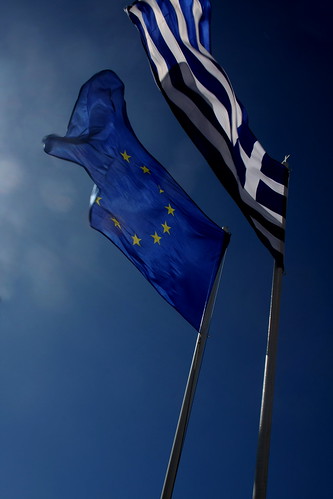
Greek flag - EU flag, originally uploaded by Teacher Dude's BBQ.

You can see the current economic crisis in Greece start to nibble away at even the upscale neighbourhoods here in Thessaloniki. The symptoms are not as brutal or as obvious as the endless rows of For Sale/For Rent signs that have sprouted up in the poorer areas on the west side of the city. Yet like fissures in a supporting wall they are set to widen and become more visible as the stresses on it increase.

In the shopping malls on the east end of town such as Mediterranean Cosmos the paving stones are cracked, seemingly uncared for and the food court floor is strewn with rubbish. On the other hand security guards thread their way endlessly around the tables in their mock police outfits, like revellers on their way to a fancy dress party.

In the other malls even local fast food outlets such as Goodys have stopped displaying prices, perhaps in an attempt to delay sticker shock until after the unsuspecting customer has made their choice. The whole complex has an eerie Dawn of the Dead, Zombies in the Mall feel to it as the handful of shoppers listlessly wheel their trollies up and down the empty aisles.

What the wealthier sections of Thessaloniki, and Greek society in general are realising is that the financial downturn which has been hitting poorer Greeks for last two to three years is exonerably reaching out to their corner of the world as well.

Friday, December 19, 2008

Events in Greece -Time for reflection

Crisis? What crisis?

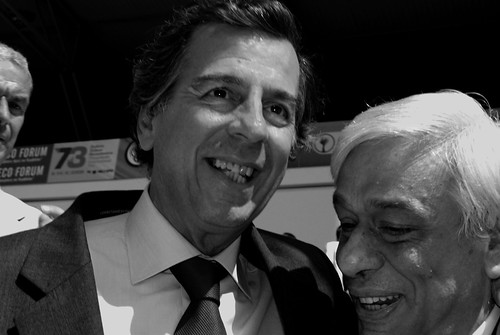
On the left the Greek minister for culture, Mixalis Liapis and on the right Prokopis Pavopoulos, the law and order minister.

Many people across the world will have been shocked by the scale of violence witnessed over the last 13 days in Greece. Scenes of intense confrontations with the police and a level of destruction that you normally wouldn't associate with a country famed for its natural beauty and long history.

However, away from the beaches and the museums there are has been a growing sense of despair amongst people, especially those under 25 that the country they live in has no place for them. A feeling that those in charge politically and economically lead lives cocooned by wealth and family connections which leave them indifferent to the problems faced by the rest of the population.

Cronyism, corruption and lack of accountability have eaten away at people's respect for institutions at the heart of Greek life. A fact that was vividly illustrated this week by two decisions which added to the impression that those in authority are above the law.

The first concerned the parliamentary report on the Vatopedi corruption scandal. The case which involved the dubious acquisition of state owned property by the Vatopedi Orthodox monastery involved several senior government officials and cost hundreds of millions of tax payer's money. However, despite a deluge of evidence indicating the misuse of office by high ranking government members the report concluded that there were no grounds for criminal charges.

This is simply the latest in a series of 45 scandals that have come to light since the New Democracy party came to power in 2004 on a platform of clean government.

The other case which has helped undermine faith in the Greek justice system and especially ELAS (the national police force) was the verdict in the Augustinos Dimtrios case which came out last week. Dimitrios, a university student from Cyprus was savagely beaten by eight police officers in an incident which was captured on live TV. Although the officers involved were found guilty none was sentenced to a jail term, instead they received a suspended sentence.

This has added to the sense, amply supported by numerous cases of police violence that law enforcement officials in Greece operate above the law, accountable to no one. One of the reasons why the clashes between protesters and riot police over the last week have been so fierce is the anger provoked by the possibility that the officer charged with killing 15 year old Alexis Grigoropoulos will walk free.

A toxic mix, of unemployment, disillusionment and frustration has driven young people onto the streets time and time again, it has led them to occupy 600 schools nationwide and hundreds of university departments. As of yet there has been no concerted demands for a program of political change, however, this simply reflects the fact that there are so many disparate participants involved in the protests. The speed and scale of the reaction has been such that there is no one group of people or organisation that can truthfully say that represent the demonstrator's will at the present time.