Showing posts with label democratic left. Show all posts

Saturday, June 22, 2013

ERT - Greek prime minister's plan for a surgical strike turns into war of attrition

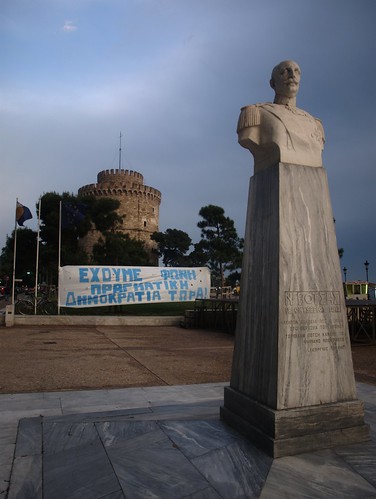
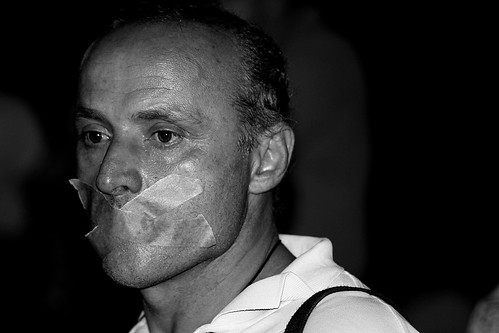
Protests against government's closure of public broadcaster, ERT continue in Thessaloniki, Greece. by Teacher Dude's BBQ

Like so many plans that go badly array, it must have seemed a great idea, at least in the beginning. With a bold move, the Greek prime minister, Antonis Samaras would at once show the country's lenders that his flagging reform program was back on tracks and appeal to his conservative base by getting rid of a symbol of public sector extravagance. What could go wrong?

Unfortunately for the Greek government just about everything. The decision 11 days ago by the ministry of finance to announce the immediate closure of Greece's public broadcaster, ERT set in motion a series of events that is now threatening to bring down the uneasy coalition that has been in power since last summer's elections. The departure of the Democratic Left from the three party coalition yesterday in protest over the handling of the ERT affair has seriously weakened the PM's hand  and revealed  that just how unstable the partnership with PASOK has become.

This is just one in a series of political miscalculations that has turned a political gamble into a political nightmare for Samaras, both at home and abroad, garnering yet more criticism and negative publicity for the country at exactly the time the leadership has been boasting to any media outlet who would listen of its success in turning the economy around.
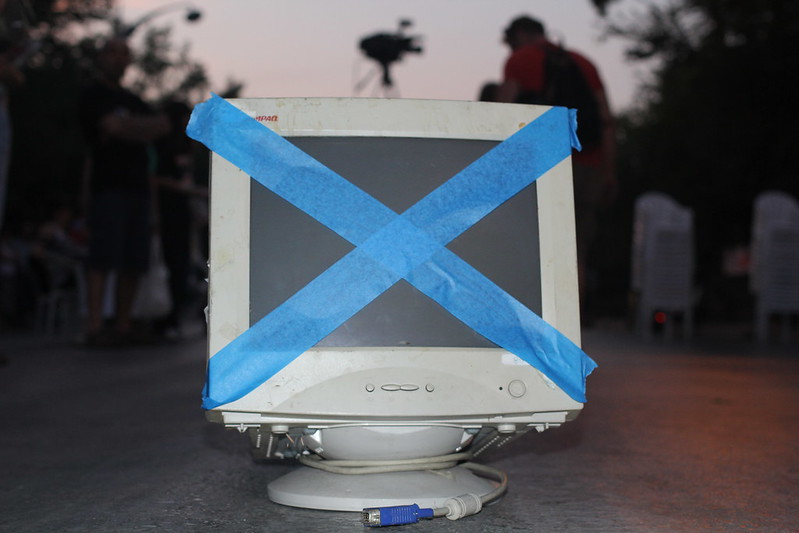
Protests against government's closure of public broadcaster, ERT continue in Thessaloniki, Greece.

The live TV images of ERT reporters warning of impending police action only to be replaced by a black screen shocked many Greeks, especially among the older generation who had witnessed similar media black outs during the Regime of the Colonels (1967-1974). For foreign observers such as The European Broadcast Union and the Head of the BBC the sudden cutting off of a public broadcaster whilst on air was unprecedented in post war Europe and a direct attack on democratic values and freedom of the press.

Instead of a few days of protests by the employees of ERT which could easily be ignored by pro-government private media the government was faced with a media insurrection as journalists and technicians defied threats by the authorities to continue broadcasting, using internet live streaming, unused analogue signals, satellite etc. This, along with the social media storm created meant that thousands turned up outside state run studios in Athens, Thessaloniki and other cities to protect   those inside from the riot police units that quickly deployed around such facilities.

Instead of stifling the voice of those working in ERT these actions encouraged people to find their signal in any way they could and demand via the live streaming channel provided by the EBU grew so rapidly it overwhelmed the site's capacity.
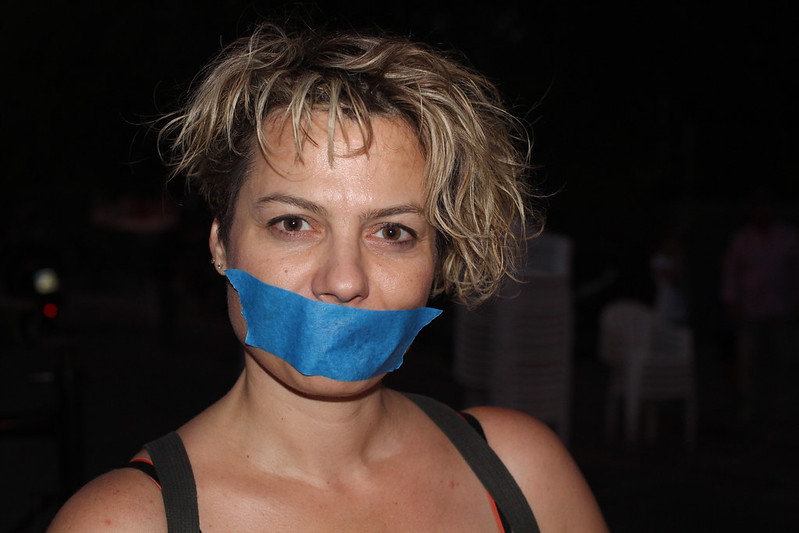
Protests against government's closure of public broadcaster, ERT continue in Thessaloniki, Greece.

The quick surgical strike that New Democracy advisers had promised was now turning into a long drawn out and very public shouting match in which the government was being viewed as bullying autocrats rather than bold reformers taking on an arrogant publically funded elite. The decision by the Council of State that ERT be allowed to go back on air via its normal broadcast facilities was ignored so adding to the sense that Samaras was acting as if he and his ministers were above the law, a point the opposition SYRIZA party seized upon in order to appeal to disillusioned PASOK supporters, increasingly frustrated with their own party leadership.

Now the authorities are on the horns of a dilemma, if they back down over the ERT closure, then this will likely re-ignite anti-austerity opposition and provide a template for future battles over the sale off of publically owned power and water utilities. On the other hand a swift, police raid to empty the occupied broadcasting facilities would be a PR disaster, both at home and abroad as well as possibly shattering the fragile alliance with  the PASOK party.

So, probably the government will be forced to play the long game, hoping that as time goes by ERT employees can be bribed or coerced into agreeing to a watered down version of the original closure plan

Sunday, June 16, 2013

ERT - Greek government embroiled in very public showdown with state run broadcaster.

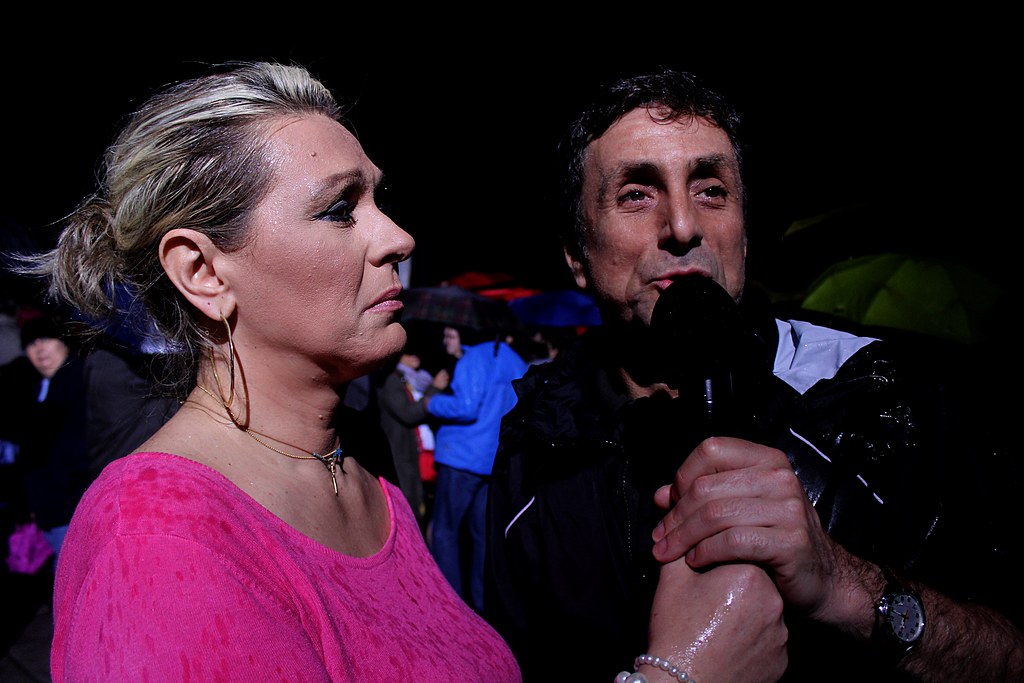
ERT reporter talking to people gathered outside studio in Thessaloniki, Greece

Sitting in the foyer of the ET3 studios, now being occupied by its own journalists and technicians the strangest thought crossed my mind; those who were part of the groups protecting the building included some of the station's most bitter opponents. The same people that have been so critical of the willingness of public broadcasters to toe the government line and allow politicians such a free hand in domestic affair were now willing to stay there day and night and risk injury in the event of a riot police raid. The irony of the situation was not lost on them.

The sudden decision by the Samaras government to shut down ERT on Tuesday took even insiders by surprise, no one I talked to, be they journalists or political activists had expected that such a move would happen so quickly. That the government was looking to subject ERT to the same kinds of cuts as suffered by other areas of the public sector was obvious but the swiftness of the closure left everyone wondering what was really behind the action.

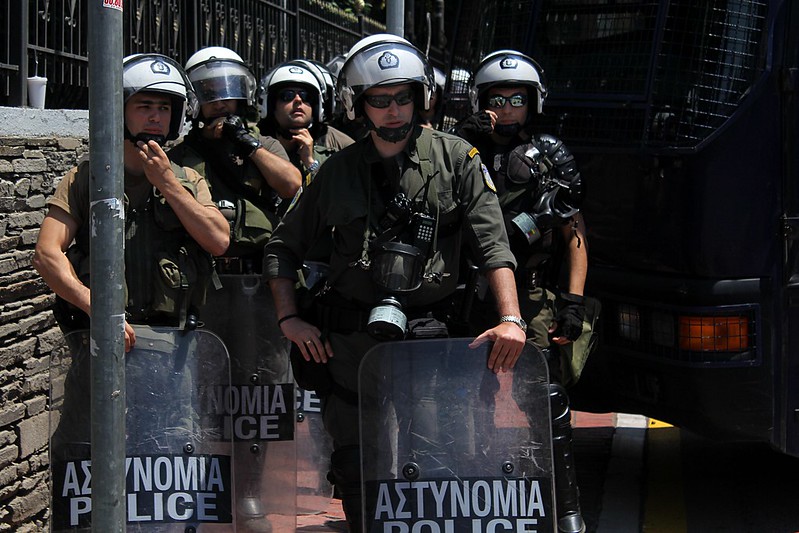
Heavy riot police presence around  ERT studio in Thessaloniki, Greece

However, no one in the government, I suspect realised the the scale and determination of the reaction both from within Greece and abroad. Within hours technicians and journalists had stopped normal programming and were providing news and updates of the situation within the studios and suddenly, most miraculously of all, reporting on what was happening and not what they been told  by the government party leadership to cover.

It was this change in reporting which most probably prompted the Greek prime minister, Antonis Samaras's decision to send in the riot police to shut down transmission facilities across the country and the privately run DIGEA service to threaten other TV channels when they attempted to re-broadcast ERT's signal. The idea of journalists who has been privy to so many of the back room deals, dirty political tricks and acts of censorship going public with their knowledge must have terrified politicians used to always getting their way whenever they appeared on the state run channels.

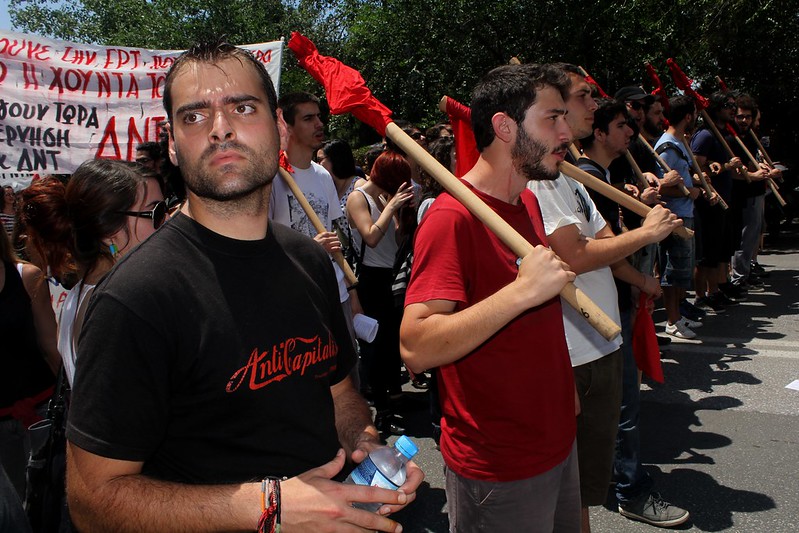
Protesters come out on the streets in support of public broadcaster ERT - Thessaloniki, Greece

For many older Greeks the announcement by NET TV presenter that the riot police were on the move followed by a black screen brought back memories of the Regime of the Colonels that ruled the country with iron fist from 1967 to 1974. Like Spain, and Portugal the experience of living under a dictatorship is still a vivid part of Greek popular memory and not simply a footnote is a school history book.

Unlike the 1970's the shutting down of the ERT signal has proved more problematic and technician have defied the crackdown using internet broadcasting, satellite signals (provided by the European Broadcasting Union) and resurrected analogue frequencies to ensure that NET in Athens and ET3 in Thessaloniki are still on the air. In its turn the authorities have tried to thwart these moves, shutting off telephone and internet connections to ERT facilities and in many parts of Athens and Thessaloniki, platoons of riot police have been stationed just a few hundred metres from ERT facilities.

As many Greek Twitter users repeatedly wrote; support of ERT was about defending democracy and not the status quo, so even groups opposed to the idea of a state run broadcaster were willing to stand shoulder to shoulder with sacked journalists in the demonstrations, marches and concerts that have been taken place in Athens, Thessaloniki and other Greek cities over the last five days.

IMG_4kk739

The reason and timing behind the ERT closure has been a source of speculation for many political analysts in the media and beyond. For some the closure was a diversionary tactic designed to draw attention from the failure of the Greek - Russia GAZPROM deal that the prime minister had hailed as a "success story".. For others the move is the opening shot in a new round of elections that will allow New Democracy to dump both PASOK and Democratic Left coalition partners who are both doing badly in the polls in order to form a new government that will allow them top act more freely.

For what It's worth I believe that the closure of ERT is a political gamble by Samaras, who sees it as a way to kill several bird with one stone. In firing 2,600 public employees in such a swift and dramatic manner he thinks that he'll win point abroad with the Troika (ECB, EU and IMF) who have repeatedly criticised Greece for dragging its feet over public sector reforms.

Domestically, Samaras feels he can still sell the idea that he is a bold reformer taking on a corrupt, wasteful public organisation that is a burden to the tax payer. And finally, the the loss of so many media outlets will play well with the local oligarchs, upon whose support he relies upon more and more. Their own media wings are hemorrhaging cash as the economy continues to shrink and ad money dries up.

However, the gamble may not have paid off, international reactions from have been far greater and far more critical than Athens had probably expected and even local popular support for ERT is much higher than Samaras had anticipated, with 65% of those questioned in recent VPRC poll saying they disagreed with the decision to shut down the broadcaster.

So what happens next? Hard to say, on the one hand the PM has acknowledged that the loss of the so many stations was hasty and has offered to re-instate a limited number of ERT employees to run a skeleton service yet in this mornings speech he vowed to shut down the public broadcaster.

As with so many aspectsof current Greek political policy decisions change from day to day, with political opportunism being more of a guide than any grand plan or ideology.

More on this story via Asteris Masouras at Global Voices.

Friday, August 31, 2012

Austerity storm clouds darken Greek government's future

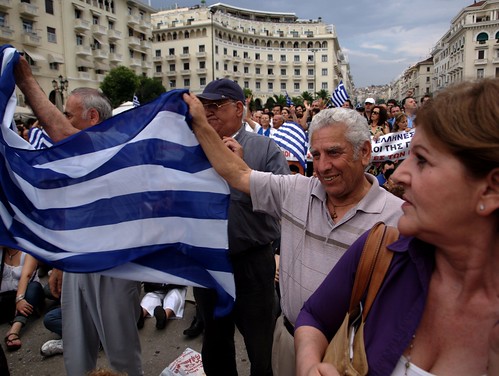
Greece's Indignados continue protests for sixth day - Sign says "We have a voice. Real democracy now!"


After months of official government announcements and newspaper headlines, Greece's latest austerity programme has been made public with anger and disbelief coming from all corners, including the country's usually supine media. The news that salaries,pensions, disability benefits and aid to the unemployed will be included in the the 11.9 billion euro package of cuts is likely to spark off a yet more protests as will the likely 40,000 state sector lay offs .

Police officers were the first to react with demonstrations in Athens after the government said that their wages and bonuses would not be exempt from the budget measures being demanded by creditors in return for another cash injection. The Greek language blogosphere was alive with angry responses from police related blogs angry that pre-election promises had not been kept and promising a series of protests over the decision.

The first hurdle facing Greece's fragile three party coalition government is how to persuade their restive backbenchers to voter for measures their supporters violently disagree with. On the one hand many rank and file MPs from New Democracy, PASOK and Democratic Left have said they are opposed but how much of this is principled protest and how much is just a PR ploy designed to keep voters back home sweet is hard to say. During the last two round of cuts much was made of potential backbench revolt which eventually failed to materialise.


The $64,000 question is how such cuts, if they are passed will be enforced without the support of the police. With resentment against yet more austerity rising after a summer lull, police officers are being used ever more frequently to end protests and labour disputes. If they decide that this is not their public function, as one police leader intimated last night during an interview on MEGA TV then what other means of persuasion does the government have? Even the feared quasi - military MAT riot units cannot be everywhere.

The first test of Greek prime minister Samaras's ability to impose his will on a recalcitrant nation will come in September with the opening of the Thessaloniki International Trade Fair which traditionally marks the start of the new political year. The presence of the prime minister and much of the government is also a signal every year for massive protests and last year's event proved no exception with football fans, taxi drivers and anarchists fighting pitched battles with 8000 police officers outside the fair,

Samaras has already announced that this year's attendance at the fair will be a brief one and will not include the traditional state of the nation address which coincides with the most intense of protests. However, even if the Trade Fair passes off without major incident Greece's political calender will provide plenty more opportunities for police and protesters to make their respective stances known

Monday, May 14, 2012

Greece's political elite gears up for new elections

"Apocalypse, bane, coup de grace, death knell, end of the world, The End of days "

Judging by the reports circulating in both the Greek and foreign media The End of Days is indeed almost upon us if Athens cannot form a government within the next 24 hours. You would think that such an awful prospect would focus minds of those in power and yet it is just business as usual for Greece's political elite who, even now are more interested in playing political musical chairs than in dealing with deep rooted problems.


According to much of the local media Greece is facing catastrophe as the Radical Left Coalition party (SYRIZA) is refusing to take part in a government of national salvation along with PASOK, New Democracy and the Democratic Left. As a result journalists and senior officials say that new elections will have to be held which could irreparably damage the country and lead to Athens exit for the Eurozone and possibly EU.


However, the maths do not add up. PASOK, New Democracy and Democratic Left have between them 168 seats in the country's 300 seat parliament, more than enough to form a majority government. Indeed, if the Independent Greek party could be persuaded to come on board then the coalition would boast an impressive 201 majority. However the fly in the ointment is the Democratic Left's insistence that they will only help form a government if SYRIZA is also part of it. On the right Panos Kammenos's conservative Independent Greeks have repeatedly refused to co-operate with New Democracy.

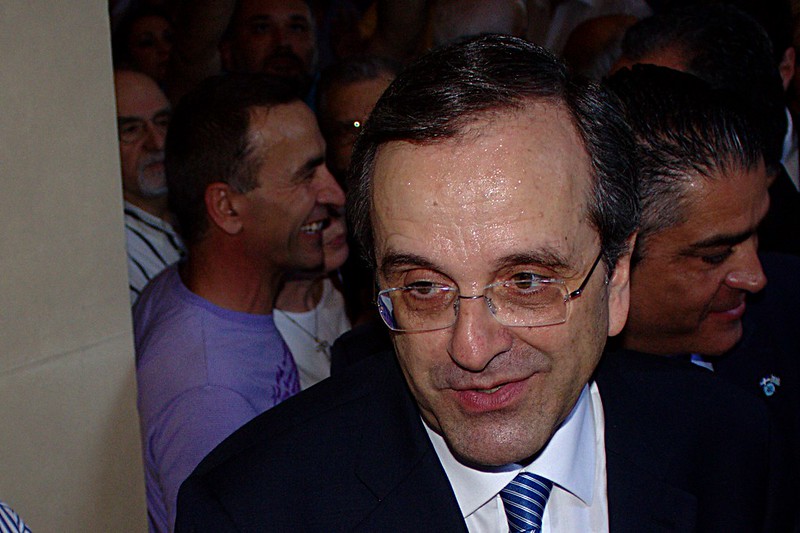
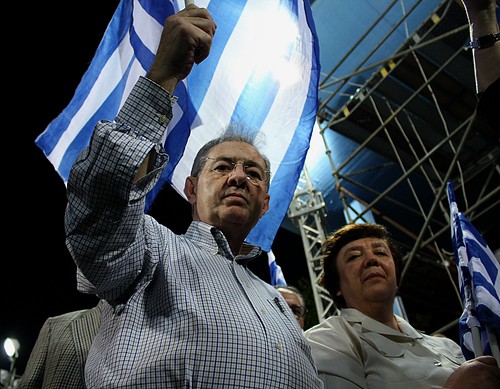
Party faithful listen to speech by Conservative leader, Antonis Samaras at election rally - Thessaloniki, Greece


However, that is not the media narrative being promoted. Instead Antonis Samaras, leader of New Democracy, Evangelos Venizelos, leader of PASOK and Fotis Kouvellis, leader of Democratic Left have all put the blame firmly on SYRIZA's Alexis Tsipras. But if the situation is so dire then some kind of compromise can be reached, surely?


And the answer is no as this is all part of the tawdry political game that has been played since Greece sought  help with its debts in 2009. Once again the heads of the two major parties are hoping to shore up their dwindling electoral base by scaring the living daylights out of voters with talk of unpaid pensions and imminent economic collapse. PASOK, led first by Giorgos Papandreou and then by Venizelos used the same language to push through austerity legislation despite the presence of hundreds of thousands of disgruntled Greeks protesters outside parliament.


Instead of cobbling together a government both Samaras and Venizelos are already campaigning for the next round of elections, most probably set for 17th June by attacking SYRIZA who are according to latest polls on track to be the largest party. The message is clear, if you vote SYRIZA Greece will go bankrupt, be kicked out of the Eurozone and all your savings will be lost. The EU has helpfully made such scenarios more realistic by refusing to release money promised for the payment of Greece's day to day running costs (money destined for debt repayments was paid on time).


It is a message that is likely to weigh on people's minds as they vote and may be enough to put off those considering voting left. On the other hand, unemployment, especially among the young is climbing rapidly, prices of basic goods are spiralling upwards and many have lost any hope of a decent future. Will they be swayed by talk of the End of Days? For them they are already here. Will talk of lost savings affect those under 30 who have none to speak of?


There are two contradictory forces at work as far as the next elections are concerned. On the one hand the fear of possible national bankruptcy may well drive those who still have something to lose back into the arms of New Democracy and PASOK and so give them a boost, perhaps enough to form a government of their own.


On the other hand disgust with the ineptitude and corruption of the current political set up has not disappeared and the inability of the main leaders to recognise that is costing them dearly. People know full well, that despite promises to renegotiate terms of the bailout agreement if Germany refuses (and there seems every indication that they will) then Greek politicians will have little choice but to accept the decision. Another round of public spending cuts and tax hikes would follow just adding to the economic woes that Greece has been facing for the last five years.


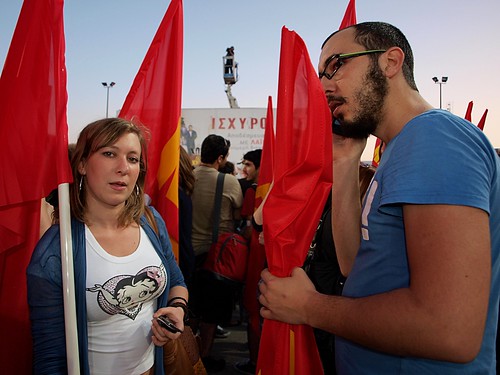
Greek communist party election rally - Thessaloniki, Greece


SYRIZA benefited from the disgust that ordinary Greeks feel about their government in May and that is likely to be repeated in June. However, there are several factors that may up their share of the vote still further. Both PASOK and New Democracy have shown that even after the drubbing they received they have not changed attitudes in the slightest and still continue to act as if the elections never happened. This will provide SYRIZA with extra votes, especially from younger voters who are not benefiting from the status quo.


Also the endless back room political games played by newly formed Democratic Left in the last few weeks have alienated even its own MPs and will cost them in June, the most likely recipient of their votes will be SYRIZA. The fact that the Greek Communist party has decided not to work with any other left parties has irked many of its electoral base, especially the young who do not want to sit of the political sidelines. Though the number of voters will be quite small as the party's supporters are among the most loyal in Greek politics


Lastly, as SYRIZA has emerged as a viable political force more and more voters will no longer see a vote cast for them as wasted, so attracting people who see them as something more than a party of protest. Voters, like everyone else love winners.