Wednesday, September 20, 2006

EFL/ESL icebreakers


I'm starting lessons this Friday and so I'm digging out some exercises that I can use as first lesson ice breakers. As well as helping me get to know the students it helps them get to know each other. This is essential is developing a sense of community in the classroom and also has the added effect of making students feel more comfortable talking in English in front of each other. Here are a few activities you can use, if you wish.


Questionnaire


1 What makes you feel happy?

2 What's your most treasured possession?

3 What's you favourite song and why?

4 Who would you most like to meet?

5 Pick five words to describe you.

6 What do you want to do in the future?

7 What's your best quality?

8 What's your worst fault?

9 Describe your proudest moment.

10 What's the best advice you've been given?

The idea is that students first write down answer their own answers and then ask another student, preferably somebody they don't know.


MEME


1 Explain to students that they're going to write a meme. This is a list of answers to a question that people often post on their blogs.

2 Show the students the example below and ask them to write down three questions based on the list. i.e three things they would like to learn more about. E.g.

Where was the fire?
Why did you take only one suitcase?

Ten things I've done that you probably haven't:

1: Taught myself to read and write modern Greek
2: Once helped fight a forest fire.
3: Drove from Athens to Rome on a Vespa.
4: Hitch-hiked 8000 km in five weeks.
5: Lived out of a one suitcase for a year.
6: Saw inside my own heart, live.
7: Was interviewed on Italian TV.
8: Was once held by Czech soldiers in Vaclav Havel's back garden.
9: Spent my first term away from home as a university student on crutches (as I had had a motorbike accident one week before term started).
10: Took my driving test in a foreign language.

3 Students write down their own list. Remind them that it doesn't have to include extreme or unique events such as,"I survived a shark attack" but rather more everyday things, for instance, "I can play the piano" or, "I have four sisters."

4 You could reduce the list to five things or give it as a homework exercise then discuss it next time in pairs.

5 An interesting alternative is to include an extra "untrue" item and students try to find out which one it is.

CLASS PHOTO

Prof 1c 2005-2006
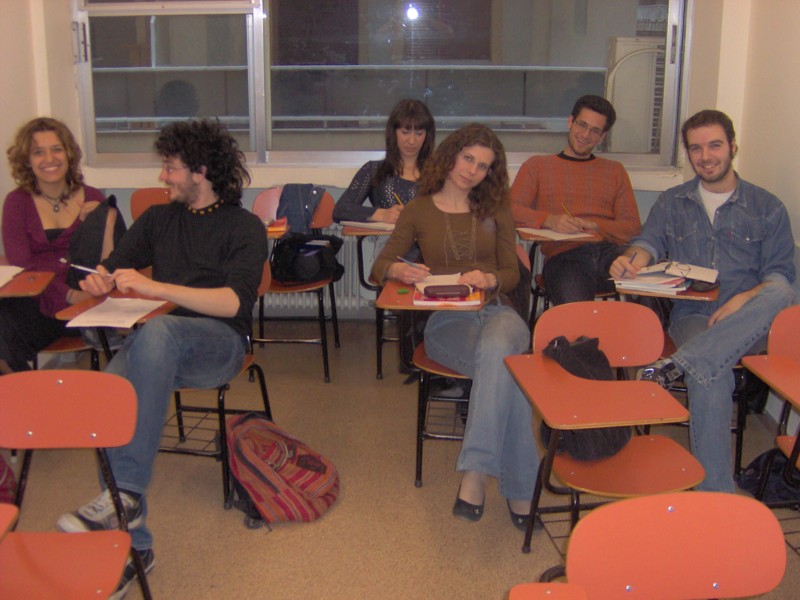
Don't forget to take your digital camera with you so you can take a picture of everyone there. This will be useful when you set up your class's blog. Encourage the students to take their own photos using their mobile phones.

Tuesday, September 19, 2006

Video, photos and EFL/ESL

I mentioned in my previous post that I had been using my digital camera to help teach my daughter English. I thought I'd just put down the ideas in a more formal manner.

This exercise can be done with any level, even with complete beginners.


Lesson Plan


1 After doing your normal lesson tell the students that you will be videoing the dialogue in the course book. To do this you will need props and somebody to be the camera operator.

2 Students assign themselves roles and rehearse their lines. When they feel comfortable with their performance they ask the camera operator to video them. This could be done with a digital camera or a suitably equipped mobile phone.

It is very important that students understand that this exercise is indeed a performance and to do it well doesn't just mean getting the grammar or pronounciation of individual sound right. It should sound as natural as possible.

3 Transfer the videos to a PC, ask students to look at them and think of ways they could improve them. This need not be just focused on language points, it could also cover points such as speaking more loudly, lighting or staying in focus.

4 If necessary, students record their performance once again.

5 These videos can be posted on a class or personal blog via YouTube. Alternatively, students can save them on a memory stick/mp3 player/mobile phone and transfer them to their own PC as part of their electronic portfolio.

Instead of using dialogue from a course book you could also use comic strips or film dialogue as a starting point .

Dimosthenes Liakopoulos - The Voice of Salonika


Well, I feel a tad let down by Mr Liakopulos, to tell you the truth. I went downtown this morning to check out the hordes ravenous for truth and enlightenment, ready to find out about the secret organisations and cabals that control our lives, to finally discover the real story behind UFOs. After listening to his TV performance last night I was ready to fight my way into the book store here in the centre, I had even brought my own shopping trolley, ready to stock up on his precious works. Alas I must have missed the crowds as when I passed by the place was empty, however, there were still plenty of great works on display. Phew, I thought I'd missed my chance to finally see into the heart of things.


My particular favourite is the series of books that “proves” every single civilisation on Earth was in fact Greek, that indeed the whole planet is Greek. Something that must come as quite a shock to scholars of , say the Aztec, Inca and Zoltec cultures. Indeed nearly every single scientific discovery or technological advance is Greek as well. I'm eagerly waiting for them to prove that the Ipod was the work of Plato, still give them enough time and they'll get there.

Snide comments aside though, The smaller TV channels here are full of like - minded, chauvanist crap, each one spewing hour after hour of revanchist hate talk aimed at establishing the superiority of Greeks and Greek culture while denigrating other nations and ethnic groups. Anti-semitism walks hand – in - hand with lectures of the alleged superiority of the greek language, while talk of secret Vatican plots easily blends in with anti-immigrant rants. It would be easy just to write off these idiots as a crazy, lunatic fringe, yet history teaches us that such people can have disasterous effects on the body politic. The Nazis, for instance had their mystics and ideologues, who mixed racial theories with Nordic mythology.

The other problem is that such groups have access to TV broadcast technology which means such racist outpouring is not just limited to beer kellers or church halls but has a potential audience of millions.


If you've seen V For Vendetta's Voice of London then you will have a pretty good idea of what is going on here. Hell, Prothero and the presenters here even look alike.

Monday, September 18, 2006

Lessons with Lydia


This weekend I started doing English lessons with my daughter, Lydia. I have been a bit wary of doing this up till now as she only started her Greek school last year. I thought that if she started lessons in both languages at the same time she'd get confused. However, a year later and it seems that she has no problem reading and writing in Greek, also she has picked up a lot of stuff on her own as far as reading in English is concerned. So, it seems its time to help her with her written English.

We started with the Chatterbox books, which, while not aimed at bilinguals is fun and full of songs and other interesting activities. Also, as Lydia is not a balanced bilingual (her Greek far outstrips her English) I thought the book would help correct some problems with grammar and enrich her vocabulary.

The first lesson went fine and we both really enjoyed ourselves, I think she loves being the centre of attention and is keen to show me how much she knows. During the second lesson I had a brainstorm and decided that it would be a good idea to create our own version of the comic strip in the book using our digital camera and then adding speech balloons using Open Office (of course, you could also use Word for Windows). Actually, Ewan MacIntosh planted the seeds of the idea when he posted a comment on a recent post. Much fun was had finding props to use and posing for the photos and then we had to muddle through the process of adding captions etc. Still, as learning exercises go, it was great.

The best part was when Lydia said,

"Why don't we use video?"

Out of the mouths of babes. So we videoed the comic strip I (I got great reviews as Pluto, the dog) and played it back on the computer.

The moronic inferno


When I was young my father would takes us all to the local Sunday market were the barkers and stall holders would outdo each other in both the volume they produced and the outrageousness of their claims;

"GET YOUR GENUIIIIINNE ROLEEEEEX WATCHES HERE, TWO FOR A TENNER!!!"

And so on and so forth, thus making a quick buck out of credulity and greed of the truly stupid. It's strange, however, to see such high powered sales tactics applied to the rarified world of publishing. Yet, according to a programme I came across on TV Thessaloniki called Loud and Greek (Δυνατα και Ελληνικα) I can, for a mere ten euros find out the secrets of the ancients and uncover secret Catholic/ American/Jewish/ Turkish plots to enslave us all.

In the space of five minutes I was shocked to discover that

"All of the twelve apostles were Greek, except, that is Judas."

The ancient Greek explorer,
Pytheas reached the North Pole first."

"The Vatican has a secret plan to take over Greece."


Well, I guess it's not that secret as they're flogging a book with all the details. But let's not let logic get in the way of tried and tested prejudice, now shall we. However, according to the presenter these books are flying off the shelves, that people are coming equipped with shopping trolleys, so great is their thirst for knowledge. He even went so far as to say that his books shops were facing a tsunami wave of eager readers. You too can see this for yourself, if you pop down to Agias Theodoras 1, Thessaloniki or Panepistimiou 57, Athens. Make sure you get there early though to avoid the crush.

While the devious plots and plans of the gnomes of Zurich and the Elders of Zion may be an open book to these jerks, the internet seems to be beyond them as all their links and sites are dead.

Sunday, September 17, 2006

Story telling in EFL/ESL


One of the things students find difficult is writing stories at advanced levels. I think this is, in part due to the fact that they very little practice of doing this in their own language and so they are doubly stumped when it comes to doing it in English. However, once they get over their initial difficulties Greek students often turn out to abe accomplished story tellers. Interestingly, according to exam statistics from UCLES Greeks score much higher on these kinds of written exercises than, say essay writing and the like.

The basic aim of this exercise is to “ease” advanced students into creative writing by providing them with a frame work they can pin their ideas to. It also has the added bonus of forcing students to be more disciplined in their story telling.


LESSON PLAN


1 – Ask students to find out about the last book their partner read.

2 – Give out a photocopy of the cover of the book (Burn Marks by Sara Paretsky) that you are going to use in the activity. Students have a few minutes to find out as much as they can about the book's story, style etc.

3 – Give the handout (this should be about three or four paragraphs taken from one or two consecutive pages). Now deal with any grammar or vocabulary queries that students have.


4 Explain to the students that they have to fill in the missing gaps using exactly six sentences. It is probably best if you put students into pairs or small groups for this.

5 Students the exchange their stories and see if the other group's effort makes sense. Does it fit in with the pre-existing story? Are there are continuity errors?

6 For homework ask students to continue the story.

Spot the difference


If you've ever done a spot the difference exercise then you should be familiar with the basic idea. You can also use for teaching EFL. Divide the class into two groups Give one group a copy of the top picture (which they cannot show their partner) and the other group the bottom picture. The idea is that in pairs the students find out the differences just by describing their own photos). It is also a good way of preparing students for the FCE interview (part 2) which students, amongst other things) have to compare and contrast two photos.

Steve McQueen - an early EFL pioneer


This is an idea that I got years ago while watching Bullitt. In the film Steve McQueen plays a detective who is tracking down a suspect. At some point they come into possession of his suitcase and try to find out as much as they can about the mystery man from the contents. Well, you can do the same thing using, say the stuff you have hanging around your home from your last holiday for example leaflets, photos, receipts etc. This is a great way of getting students to practice modal verbs (past and present) and the language of suggestion.

Lesson plan


1 – Explain to students that they are going to be detectives and that they found some important evidence about a suspect.

Here might be good time to revise or teach modals and/or the language of suggestion.

2 – Divide the class into groups of three or four students and give them each a “mystery pack” i.e. The photos, ticket stubs, flyers etc. you've chosen(see below). The students now have to find out as much as they can about the person using the clues given. For instance;

For instance;


Are we talking about a man or woman?

How old are they?

What can we say about their movements, interests, acquaintances etc?

3 - Students write down what they have found out and make sure they separate what they not for sure from what might be true about the suspect.

E.g The person has a connection with the university of Liverpool, s/he may have studied there.

4 - This would be a great warm up exercise for writing a report which is often part of the Cambridge FCE, CAE and CPE written papers.

From the Kathimerini newspaper


Questions mount regarding possible price fixing in the dairy

The findings of an investigation by the Competition Commission into possible price fixing in the dairy industry will be prepared more than a month ahead of schedule as speculation grows regarding the background behind this week’s corruption allegations

Sources said that the commission’s examination of the industry will be ready in 10 days rather than the early November deadline originally set.The government will be keen to shed light on the sector that has given birth to one of the country’s largest state corruption cases.

Dairy company Mevgal informed the Competition Commission earlier this week that it was being asked for a 2.5-million-euro bribe from one of its officials to avoid slapping it with a 25-million-euro fine.

The commission’s director, Panayiotis Adamopoulos, along with two accomplices, were arrested and charged with blackmail on Tuesday in response to the allegations.The news has given way to questions as to whether the alleged blackmailers had approached others in the dairy industry.

“My guess is that they did not just approach us (for a bribe),” Mevgal’s legal adviser, Kriton Metaxopoulos, told Skai Radio.

No other dairy firm has come forth with claims that it has been approached for a kickback.Police said that they are investigating all cases handled by Adamopoulos since he took up his position in November 2005.

The dairy industry was the subject of an investigation by the competition watchdog in 1997. Claims that Greece has the highest priced dairy products in the European Union have fueled rumors that companies in the sector are not allowing the market to operate efficiently.

Meanwhile, the government is measuring the fallout from news of the corruption scandal which is considered to be mixed.Political analysts expect the bribery revelations to provide the government with political points in the long term, as it has made the fight against corruption one of its key policies.

“Whenever such incidents appear, they will be met efficiently. This was not done for many years in the past. Whoever is involved will suffer the consequences as dictated by the law,” said alternate government spokesman Evangelos Antonaros.


Saturday, September 16, 2006

Money talks

The chickens are coming home to roost it appears. The Mevgalgate bribery scandal which broke here in Greece last week continues to grow in scale and extent. The strangest part of this whole sorry story is the role played by the head of the municipality of Thessaloniki, Panagiotis Psomiadis who has close political links with those accused of taking bribes from the Mevgal diary company. Psomiadis, it seems has decided that he, like Jesus Christ, is the victim of betrayal by those around him. It's hard though to see in his carefully coiffered, expensively besuited presence any resemblance.


If such comparisions are not outrageous enough, he has started to play the “northern” card, telling the assembled journalists that they are bunch of snotty - nosed Athenians punks. This has been the classic tactic used by local authority officials for decades, whenever somebody criticises Town hall, they always cry that Athens is to blame, that those down South care little for their northern compatriots.

Images courtesy of Country Boy + Girl


Video games in the classroom


I came across this article from Alternet while reading the news on my PDA (moi, a geek?) and it reaffirms my view that video games have a place to play in education in general and language learning in particular. I'm not saying that we should be telling our students to put down Plato's Republic and get some real learning on Call of Duty 3 but rather that games do have something to offer apart from thrills and spills. Coincidentally, the school mentioned is only a few miles from where I grew up.


Reading, Writing and Video Gaming


By Marco Visscher, Ode. Posted September 14, 2006.


Teachers are learning that video games can actually improve our schools. As education adapts to please the gamer generation, will textbooks become obsolete?

The door closes with a squeak and a creak. Oh, no! Is it locked? Let's check ... No, thank God, you can open it ... So now, another go at getting to the ladder. Maybe through this narrow hallway? ... No, it's a dead end.

See here for the rest of the story

Friday, September 15, 2006

EFL/ESL role play


As many of the people I teach are university students I thought that this might be a fun exercise to do in class. The main aim is to practice speaking skills through role plan. Be warned - the reading and speaking skills needed for this are pretty advanced.


Lesson Plan


1 Ask students to find somebody who has ever shared an appartment. They then ask the person what it was like.

2 Ask students (on their own) to draft a list of characteristics of the perfect flatmate. They then form groups of four and discuss their answers.

3 Tell students to imagine that they are now looking for two/three other people to share an appartment with them. However, everyone is going to pretend to be someone else.

4 Give each person one of the profiles from the article above. The students read their “roles”. Tell them that have to keep in character i.e. pretend to be the kind of person mentioned in the profile and find flatemates that they are most compatible with.

Here students will need a lot of help not just with unfamiliar vocabulary but also cultural differences between Greek and English student life. However, it not necessary that they understand everything, just the gist of the part they have to play.

5 Students then stand up and imagine that they are at a party. Give them 10 to 15 minutes to find their ideal flatmates.

6 The groups then report back to the teacher explaining why they chose each other.

Comics and EFL teaching

I just thought I'd digitise and post some of the ideas I've used in my lessons over the last few years. It's a shame to think that they lay half-forgotten in some dusty folder when someone might find them useful. Here are some suggestions for using comic strips in order to help students with their writing and speaking skills. Although this partcular strip would work best with B2 levels and above the same ideas could be used with different comics and lower levels.


Lesson Plan

1 Give out the photocopy and ask students to discuss in pairs how the world depicted is different to our own. Elicit answers.

2 Ask students to speculate on what the story is about and who the main characters are.

3 Students then fill in the missing dialogue and discuss their answers in groups.

At this point you could use the exercise as the basis for any number of writing, speaking or even listening activities.

Ask students to perform the dialogue (including sound effects) and record it using a mobile phone/mp3 player/ cassette recorder etc. The class votes on the best performance.

Ask students to write a story which incorporates the dialogue.

Ask students to speculate on what happens next and create their own dialogue.

Ask students to say which actors would be most suitable to play these roles in a movie and why.

Use the Judge Dredd story cassettes/CDs/mp3s and ask them to fill in the missing blanks with the original words.

Please take part in this poll

I have a theory which I would like to test out on this blog. I'll let you know more details later on after people have taken part in the poll below. This question is aimed at people who have learnt English as a foreign langauge.

Thursday, September 14, 2006

"One may smile and smile and be a villain" - Hamlet


I few days ago I wrote about (see here) the politicians who turned up at my daughter's school in order to welcome students on the first day of the school year. I could barely hide my loathing of these self-serving blowhards. Now it seems that my instincts were right as one of those present, Panangitis Psomiadis (the guy in the photo on the far right - where else - with the red tie) is concerned.It seems that the head of the municipality of Thessaloniki has been implicated in a massive bribery scandal now rocking Greece (see here for the story in English).

Reality vs rhetoric


Greek Results in the fce & cpe Exams

Explanations and Solutions

Copyright © 1999-2002 Costas Gabrielatos


This article is based on my response to a survey carried out by ELT News, which invited teacher educators in Greece to offer their views on the reasons behind the extremely low rate of success of Greek candidates taking the FCE and CPE examinations of the University of Cambridge Local Examinations Syndicate (UCLES). The response was originally published in ELT News 127, September 1999. In the original version I responded separately to the four questions asked by the editor; in this version I have re-organised and expanded my discussion. This version: April 2002.


background


The FCE and CPE exams of the University of Cambridge Local Examinations Syndicate (UCLES) are extremely popular in Greece. Nevertheless, the success rate in Greece is by far one of the lowest in the world: just under 50% for FCE and around 30% for CPE. In this article I identify three main reasons for this unfortunate situation: popular myths about the exams, misguided approaches to exam preparation, and syndromes ailing ELT in Greece. I also propose short- and long-term solutions to the problem.


explanations

Three popular myths

A large number of teachers, learners and parents in Greece seem to be influenced by three very popular ELT myths. The uncritical acceptance of these myths and their use to explain away the extremely low pass rate in both FCE and CPE are among the main reasons why little has changed in the way language examinations are approached in Greece.

See here for the rest of the article


I have decided to post this as many of the problems Costas Gabrielatos discusses directly impinge on my teaching practice. If you want an idea of the obstacles that ordinary teachers face teaching in the majority of language schools here in Greece then this article is a good place to begin. Low wages, chronic job insecurity and the fact that most school owners are ignorant of most the developments that have taken place in EFL/ESL in the last 30 years mean that the cycle of waste (in terms of student's time and their parent's money) and failure repeats itself again and again.

I've lost count of the number of times that people have come up with new innovative ideas for their lessons only to have them vetoed by the school owner as they are "not in the course book" or "we don't have time for such nonsense".

EFL warm up exercises

I'll be starting my classes in the next couple of weeks and of course that means getting to know new students. It is something that always leaves me feeling a little nervous, even after seventeen years of teaching. Still, a few opening night nerves never did anyone any harm and helps me remember that every class is different. One exercise that I use to help students get to know me and each other is a time - line. I originally saw it in Teaching Adult Second Language Learners by Heather McKay. It also is a good way of starting off private lessons as well.

Basically what you do is draw a line on the board (or a piece of paper) and at five or six points which represent an important event in your life but in note form. For example;

born 1978
high school in 1994,
driving test in 1998
Lydia 1999.

The students have to use the notes to guess what happened at those various points in your life and think of questions to ask you about them.

For example, You graduated high school in 1994. Where did you go to school? What was it like? etc. Then students create their own time - lines and with their partner (preferably somebody thay don't now) and do the exercise in pairs.

I think it's extemely important to create a sense of community in the classroom as quickly as possible. If students get to know each other then they will more comfortable pushing their English to its limits. In a positive, accepting atmosphere students take more "risks", i.e. attempt things that they may get wrong. Without such experimentation progress becomes much more difficult.

Wednesday, September 13, 2006

Cool Cat Teacher Blog: Laptop Campus: Bane or Boone?

Cool Cat Teacher Blog: Laptop Campus: Bane or Boone?

I came across this post on Vicky Davis's blog. It seems that there is a growing backlash against the idea of laptop schools in the US. I have to agree with Vicky in her conclusion that the problem is not the technology but aimlessness in applying it. Laptops, like any other kind of device used in the class room is no substitute for a well-organised syllabus or a dedicated teacher.

Computers by themselves are no more likely to educate than a library card is. However, when used in conjunction with a decent education sytem both are powerful tools to help students learn.

In the early 90's lots of language schools here in Greece spent huge amounts of money buying PCs to use for teaching English, spurred on by the idea that these beige boxes would somehow (the details were always fuzzy) miraculously get students to study more. The reality of the situation was that without any clear idea of how they could be used in the classroom the computer was quickly relegated to the status of a failed novelty.

Of course the problem lay not with the limitations of the machine but rather with an inability of those in charge to train staff to exploit them. PCs ended up being used as little more than dull electronic textbooks which students soon got bored of.

Tuesday, September 12, 2006

Salonica Greece Riot 10-9-05

The rioters cannot be touched if they are on university grounds so it becomes a case of "catch me if you can". Still, as you can see these guys play for keeps.

I was about 50m away when all of this was happening, scary

Monday, September 11, 2006

Remembering 9/11


Where were you when you heard about 9/11?

.
I suppose this will be one of those questions that will mark out a whole generation. Just as people talked about where they were when Kennedy was assassinated. For my own part, I remember I was idly zapping through the TV channels when the first footage of the attack was aired, about ten in the morning, Greek time. This was even before the second plane had hit the other Twin Tower. Like most other people my immediate reaction was that there had been a terrible accident. However, after the second plane crashed I realised that this was not just some hideous coincidence but rather a deliberate act . As the day wore on the sheer enormity of what had taken place started to hit home and the feeling of shock was replaced by anger, pity and grief.

The images of people jumping to their deaths live on TV is something will haunt me for the rest of my life. Some things once seen cannot be unseen

First day of school


It was the first day of the school year and so I went with Liddy to find out about her timetable. Instead of that, I got a lesson in the practical applications of Chaos Theory in managing large organisations. Two hours later nobody was any the wiser than when they arrived. We all had to listen to a bunch of announcements that made little or no sense or just plain contradicted themselves while everyone baked in the sun. All of this is via a tannoy system which I think is some high - end encryption device capable of taking any message and turn it instantly into gibberish. At the end of this farce hundreds of parents and kids stood around scratching their heads, trying to figure what exactly had just happened.


The problem is that the new school which should have been finished months
ago will take at least another two weeks of work to complete. Even in the existing school necessary maintainance work was left to the last minute meaning that the painters were still finishing classrooms even as the first kids turned up.

The worst of all was having to listen to speech after speech by local politicians pontificating on how they have improved the local community through their hard work and diligence. This in a district so badly run that even numbering the homes has been messed up.

(Rumour has it they're flming a Greek version of The Sporanos)

After the fifth joker started stumbling through his ode to himself I snuck off
to sluice the crap out of my ears. After years of listening to the same stilted, wholly self-serving rhetoric that pours out their mouths I simply just walk off. Listening just encourages them.


Transcript of the speech

I would hmhhhhhhnhhh and add that hmmhhhhhhhhh so hmhmnmmhhhhm thank you for hhhmhmmjhh mhnmmnhhhhhhhhhhhhhhhhhhhhhhhhh vote hmhmhhhhmhmhmhhhmhhm
wonderful hnhmhhhhmhhhmhhmh our great movement mhmhmhmhmhmhmmhmhmh
mhhmmhhmmh hmhmhhhmhmmhmhmhhmhmmhmhmhmh me mhhmmhhmmhmhhm mehmhmhhmhmmh me mhhmhmhhhmhmmh my workhmhmmhmhmhmh I have strived mhmhhmhmhmhmhmhmhmhmhmh my efforts hhmmhmhmhmhmh we need to work together hmmhhmhmhmhmhm.

Saturday, September 09, 2006

Rioting in Thessaloniki


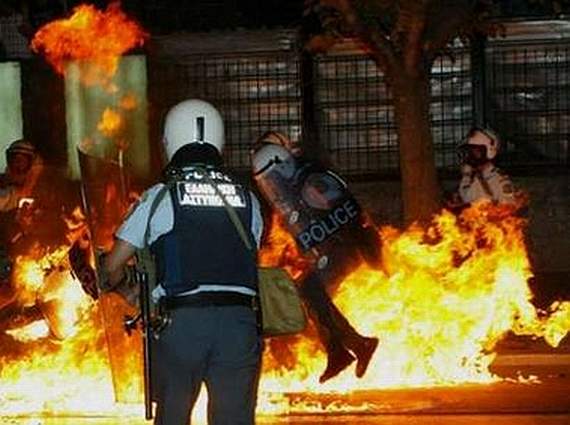
This was a very strange kind of disturbance as just behind the lines of tooled up riot police (the MAT as they're known here) the outdoor cafes on Melinikou St were full of guys watching a football match on wide screen TVs while sipping on their frappe, oblivious to the fact that just a couple of hundred meters away trouble was brewing.

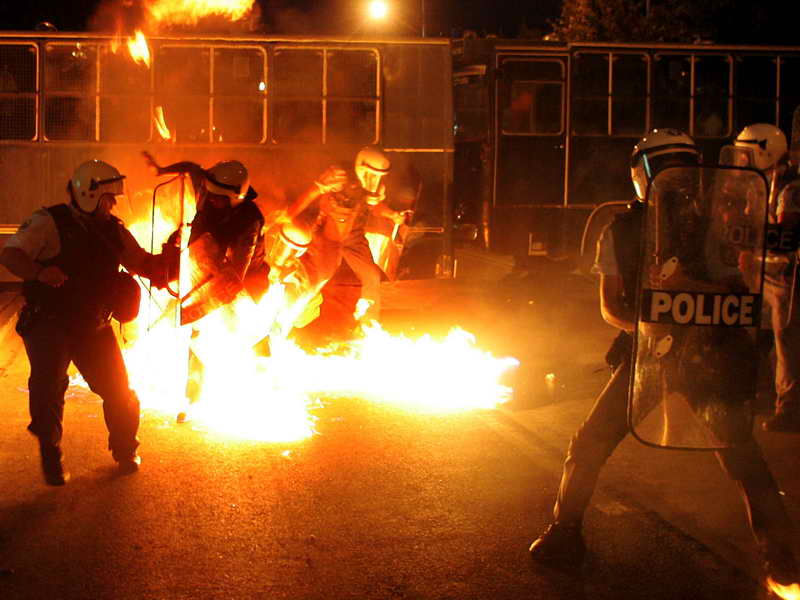
On the southern perimeter of the Aristoteleion university campus a vicious game of cat and mouse was being played out between molotov wielding anarchists and the MAT who in turn lobbed cannister after cannister of tear gas into the campus grounds, which by law they are not allowed to enter.


It is a very ritualised form of conflict which takes place two, three times a year here in Thessaloniki. Both sides have their roles and stick strictly to the script which was established years ago. Despite the sense of deja vu, the rocks and petrol bombs are still frighteningly real as I saw for myself when I foolishly decided to follow the local film crews and photographers in order to take a closer look. There is nothing like having a petrol bomb thrown at you to reawaken those long dormant survival instincts. Not to mention the awful burning sensation of tear gas in your eyes, nose and throat.


On the other hand the vast majority of protestors who marched by the trade fair were peaceful, even if the long lines of flag waving marchers (each group carefully colour coded) reminded of Kurosawa's Ran. The martial feel of the event was heightened by the drums playing out miltary style tattoos and the presence of quasi - miltary, shield-bearing riot police dressed in helmets and gas masks massing and dispersing according to some mysterious plan or else suddenly marching off single file.

Friday, September 08, 2006

71st Thessaloniki Trade Fair


Some more photos from the International Trade Fair,Thessaloniki, both inside and outside


Actually, not long after I left rioting broke out with Paok football fan clashing with the police in this very spot. See here for the story (Greek) and here (English).


«Πεδίο μάχης» το Βελλίδειο. Οι διαδηλωτές κρατούσαν πανό που έγραφε: «κι εμείς ψηφίζουμε».
Θεσσαλονίκη
Τελευταία ενημέρωση 08/09/06 22:00
Στείλε το άρθρο με emailΤύπωσε το άρθρο
Επεισόδια σημειώθηκαν έξω από το Βελλίδειο Συνεδριακό Κέντρο, την ώρα που ο πρωθυπουργός εγκαινίαζε την 71η ΔΕΘ, με πρωταγωνιστές εκατοντάδες οπαδούς του ΠΑΟΚ.

Φωτοβολίδες, καπνογόνα έπεσαν στην οροφή του Συνεδριακού Κέντρου και τα υπουργικά αυτοκίνητα. Πέτρες και ξύλα εκτοξεύτηκαν εναντίον των ΜΑΤ. Από την επίθεση των διαδηλωτών, μάλιστα, υπέστη ζημιές η είσοδος της Έκθεσης.

Thessaloniki under seige


Today sees the start of the International Trade Fair here in Thessaloniki and and the prime minister of Greece, Kostas Karamanlis is scheduled to give a speech. He will announce that public works such as the city's long awaited subway and the airport expansion will start soon. I like to see politicians pay their respects to such time-honoured traditions, as he is the fifth prime minister I've seen announce exactly the same public works. Hell, one year they even went as far as dig a hole in Egnatia St to show how serious they were about their promises. Only to fill it in three years later when the funding and political interest in Athens disappeared.

On the other hand, the city looks as if it is under seige. The streets are full of riot police hanging around their armoured buses, awaiting the arrival of the numerous demonstrators who will come later this evening. I tried taking a few photographs but the police made it clear that I'd better not. They looked jittery and so I thought that engaging in a discourse about my right as a citizen to take snap shots would be asking for trouble. Just as well I got my hair cut as they were stopping everyone with long hair ("they're all anarchists, as everyone knows") in Navarina Square.

Phalanxes of cops are marching up and down the streets in full riot gear and there seems enough manpower here to have another crack at Stalingrad. As they say in Greek, "the air smells of gunpowder". Strangely though, the actual trade fair is quiet and very laid back (a thousand law enforcement officers not withstanding) and I'm writing this in the air-conditioned comfort of the Education Ministry's pavilion.

More updates on the hour, every hour.

Thursday, September 07, 2006

My CV/Resume

If anyone knows of any jobs in Thessaloniki or wants to collaborate via the internet in the following areas;

Teaching EFL/ESL
EFL/ESL materials development
Translation (Greek to English)

Please get in contact with me at this email

CURRICULUM VITAE


FIRST NAME Craig

SURNAME Wherlock

DATE OF BIRTH 31/03/1967

NATIONALITY British

EMAIL


EDUCATION


1999 Το Κρατικο Πτυχιο Γλωσσομαθειας, επιπεδο Δ. Βαθμος - Καλως
(The Greek language examination Level C2. Grade C)

1995-1997 Aston university, UK Msc(TEFL)

1992 (summer) The εntrance examination for foreigners wishing to study at a Greek university (university of Thessaloniki). Grade 9/10

1985-1988 Liverpool university , Ba(Hons) Sociology. Grade 2:1

1978-1985 Bedminster Down school, Bristol, UK

A-level English (A)
A-Level Maths (C)
A-Level Chemistry (C)
10 O-Levels


EMPLOYMENT


2002 -2006 The Vafopoulou school of Languages, Proxenou Koromila 36 Thessaloniki


Levels taught: B2 to C2

2001-2002 The Svarna school of languages. Metamorfoseos 33, Kalamaria

Levels taught: Mixed levels ranging from intermediate to C2

1996-2001 The Anagnostou-Mylona school of languages, A. Fleming 21, Sykies

Levels taught: From B junior to C2

1996-1999 The A. Karaoglanni school of languages, Oraiokastro

Levels taught: From B2 to C2

1997-1999 Το Μικρο Λαικο Πανεπιστιμιο (KLEINE VOLKSHOCHSCHULE) . The German school, Thermi

Levels taught: Adult beginners

1992-1996 The Daniilidou-Christidou school of languages, V.Olgas 211, Thessaloniki

Levels taught:From C1 to C2

1989 -1992 The Strategakis school of languages, Proxenou Koromila 24, Thessaloniki

Levels taught:All from A junior to C2

Summer1995 UNESCO-BUNIAC summer school, Bydgoszcz, Poland

Level taught: Intermediate

Summer 1993-4 Nord Anglia language centre, Cambridge, UK

Levels taught: Beginner to intermediate

1990-1998 Oral examiner FCE and CPE

1993-2003 Oral examiner ECPE

1995- 2002 Oral examiner PALSO/EDEXCEL

I have tutored students for German state school examinations, United Nations entrance examinations, KET, PET, IELTS, FCE, CAE, CPE, ECCE, ALCE, ECPE, Kratiko B2 and C, TOIEC, TOEFL, GMAT and the Edexcel suite of exams.


OTHER PROFESSIONAL QUALIFICATIONS


I have also regularly attended and presented seminars on various aspects of EFL practice and theory. I am particularly interested in the ways modern technology such as blogging, podcasting and other web 2.0 tools can be used to motivate our students and supplement more traditional teaching methods. In addition I am computer literate and can use Word, Excel, Power Point and have created pages on the internet, both for myself and my students (see below for links).

EFL and Web 2.0

Retziki girl strikes back

Sagem

Skywalker Greece

Proficiency 1c

Lc3 FCE Class

Proficiency 2b

I have been a member of TESOL Macedonia-Thrace since 1994 and served on the board from 1997-1999.

Wednesday, September 06, 2006

Music and EFL

Nerina Pallot


Lesson plan

1 Ask students to bring a song on their mobile phone, mp3 player, cd, cassette etc to the next lesson which has a message, i.e. a song that is trying to tell us something. That message can be personal, political religious etc. Also ask the students to find the lyrics as well. The easiest way is to put thetitle of the song in quotation marks with the word, "lyrics" in Google.

2 Students give each other the lyics and the song to listen to (using headphones, of course) and ask their partner to say what they think the message is.

3 Give out the lyrics to the song first (I think this exercise works best with songs that the students are unlikely to know).

4 Students discuss;

a - possible meaning of the lyrics
b - type of music that accompanies them
c - when and by what kind of musician/group the song was performed
d - possible commercial sucess of the song

5 Students work together in groups to swop opinions.

6 Play the song and ask students to see if their guesses in (4) were correct.

7 Students write about the message of the song they brought with them and why it is so important to them on their blog .


Everybody's Gone to War Lyrics
Artist(Band):Nerina Pallot


Everybody's Gone to War Lyrics
But we don't know what we're fighting for,
Don't tell me it's a worthy cause,
No cause could be so worthy.

If love is a drug, I guess we're all sober,
If hope is a song, I guess it's all over,
How to have faith, when faith is a crime?
I don't want to die...
If God's on our side, then God is a joker,
Asleep on the job, his children fall over,
Running out through the door, and straight to the sky,
I don't want to die...
I-I-I-I
I-I-I-I
don't want to die,
I-I don't want to die...

so...
Everybody's going to war,
But we don't know what we're fighting for,
Don't tell me it's a worthy cause,
No cause could be so worthy.

If love is a drug, I guess we're all sober,
If hope is a song, I guess it's all over,
How to have faith, when faith is a crime?
I don't want to die...
If God's on our side, then God is a joker,
Asleep on the job, his children fall over,
Running out through the door, and straight to the sky,
I don't want to die...
I-I-I-I
I-I-I-I
don't want to die,
I-I don't want to die...

I've got a friend, he's a pure-bred killing machine,
I think he might be dead by Christmas...

Tuesday, September 05, 2006

Forget the scisssors,bring me my hedge trimmer.

BEFORE


AFTER


For the first time in nearly a decade I once again have short(ish) hair. It's a strange sensation not having enough of the stuff to tie up in a pony tail. Still, I'm getting used to it, slowly that is.

"Now, what I want is, Facts."


I'm in the centre again, sweating it out on an a bench near Karolou Dil St. My original plan was to pop downtown and find myself some free wifi hotspot in order to make some phone calls to England using Skype. Unfortunately, the wifi landscape is always in a state of flux, many have simply disappeared whereas others are now occupied by building sites or people have wised up and turned on their firewall. One place has even been turned into a public urinal, judging by the smell.

However, my persistance has paid off and I eventually found a bench in the shade in which to do my stuff. Still, it's 30c and very humid which means being here is not much fun.

I had a great fun this morning as I had the chance to use film, music, blogs and comics all in one lesson. I have a student, Kostas, who being a typical 14 year old boy at the end of his summer holidays has little enthusiasm for doing lessons. He is, on the other hand, crazy about science fiction and so that is the angle I'm pushing in order to get him to read and write in English. It seems to be working, at least for the time being. It has to be better than what most of his friends have to go through when doing their lessons at frontisterio (small language schools) which consist of mindlessly learning lists of grammar rules and vocabulary.

It's so heartening to see that the spirit of Dicken's Thomas Gradgrind is alive and well in the twenty first century. You can't beat traditonal values!

Writing successful blurb - efl lesson


While flitting across the blogosphere I came across the The Penguin Blog and saw an interesting post about what a successful blurb needs to have;


"According to Colin, the copywriter working on Lachlan's War, all blurbs need to have the following:

1) A hook - something to draw the reader into the story (I think all books need a hook, as well).

2) A powerful or atmospheric opening statement, as people browsing in bookshops often hold a title in their hands for a mere handful of seconds and if you fail to grab their attention in those seconds, you've lost them.

3) Emotion. To engage with any kind of writing - i.e. get a connection between author and reader – there must be an emotive response - whether it be suspense, tension, sadness, love, lust, joy, laughter, hate, fear etc.

4) A pay off or intrigue - a promise. This basically means leaving our prospective book buyer wanting to know more. It's a contract, if you like, between blurb and reader (though I don't think anyone ever successfully sued a blurb writer or author for defaulting)."

As well as applying this to books couldn't we also use the same principle in describing films, TV programmes, albums etc? It would certainly make for an interesting lesson, an alternative to writing reviews or summaries. I think I'll try this out in one of my private lessons this week.

Lesson plan

1 - Hand out photocopies of either book covers (if you have small classes or a library close at hand then why not use the books themselves) or DVDs.

2 - Explain to students what a blurb is. Use the books/DVDs as examples, if necessary.

3 - Students then read the blurb (discretely be on hand to help with an difficult vocabulary) and choose which book or movie would be the most interesting.

4 - Students discuss their choice with each other. Ask them how much the blurb influenced their decision.

5 - Give out a photocopy with the blurb advice given above. Explain any ideas or words that they don't understand and ask them to see if the blurb they read previously follows this advice. Make sure they give concrete examples.

6 - Students then think of a film or book which they think their partner might like.

7 - Using the advice given in the handout students write their own blurb for a film or book that would be suitable for their partner.

8 - Students read each others blurb and say if they would see the film/ read the book mentioned and why/why not. If they have already seen or read it then ask them how accurate the blurb is.

9 They post their blurb on their blog along with a picture and a link.

Sunday, September 03, 2006

Exam registration information for Greece - winter 2006


All this talk about exams and the like has reminded me that I, too have students who want to take some this winter. So I thought I'd put all the necessary information about registration and the fees here so I don't forget. My annual nightmare is that the deadline for one exam or another will expire before I've been able to inform my students. It's not happened yet but I've come pretty close on occasion.

Registration for

ECPE is between 18th and 29th September (cost 85 Euros). The actual exam will be 25th November.

ECCE is until 22nd October (cost to be announced). The actual exam will be 9th December.

ALCE. No registration deadline mentioned (click link to see if that changes later on). The actual exam will be 13th January 2007. Cost to be announced.

FCE/CAE/CPE
is between 25th September and 6th October (cost 150 to 175 Euros). The actual exams will be 2nd and 3rd December.

Kratiko B2/Γ1
is between 4th September and 22nd September. (cost 50 - 60 Euros). The actual exams will be 18th and 19th November.

If you think that some students take up to three of these exams at a go then there are indeed a cash cow.

Another day, another book fair

Yep, more of the same as far as the book fair is concerned. An endless stream of books that promise instant success for your students in the now long list of EFL/ESL exams that have taken the place of education. I browsed through some of them only to be disheartened by the awful content. They amount to little more than rehashes of the exam they are supposedly preparing students for. In no case is there any principled development of basic skills. As tools for learning a foreign language they are on par with the Yellow Pages in terms of usefulness.

There are also seminars as well but they amount to little more than 45 minutes ads for the book or series being promoted. They all have catchy titles such as;

"How to successfully prepare your students for the Michigan Examinations."

or

"Targeting exams"

or

Are Michigan exams) really Easier than Cambridge ones ? (sic)

Forget teaching, get me a certificate. In short, the publishers are little better than snake oil salesmen, promising miracle cures for their gullible audience.

On the bright side I did get the chance to talk to Theodora, Roger and many others who are fighting the good fight against all odds.

Saturday, September 02, 2006

Lost in Translation


A film that people either love or hate. There seems to be no middle ground, at least if you judge by what people say on IMDB.

I guess if you've ever travelled to a different country under your own steam then you've probably had a Lost in Translation moment. I remember getting off the train in Belgrade and picking up a map of the city from tourist information kiosk and then realising that while all the street names on the leaflet were in Latin script, all the place names in the city were written in Cyrillic. I spent most of my time there trying to figure where the hell I was.
Hedwig And The Angry Inch - Origin Of Love (Japanese)

Imagine a musical in which the Dead Kennedys and ABBA collaborate on a remake of the Rocky Horror Picture Show

Customer feedback


When you ask three euros (four dollars). for a cup of coffee at least have the good manners to make a proper cup, not just semi - caffeinated dish water. The Skopeuterio (Σκοπευτηριο) cafe on the sea front (Leoforos Nikis) has just made it to the top of my s##t list for today. Still, there is a wireless hotspot in the area which means I can give them some instant feed back, blogging style.

After complaining about the filter coffee they had brought me I asked them to give me a fresh cup, at which point they simply came back with stuff that had been hanging around in the pot for hours and had just been microwaved!!! And people complain about Starbucks LOL.

Contrary to popular belief, revenge is a dish best served piping hot so that why I'm putting this on the net. Visitors beware! The Skopeyterio, Thessaloniki is best avoided until they realise that the job of a cafe is to serve coffee, not slops. It's not rocket science, guys.

Actually, the baker's (the name escapes me) at the top of Aristetlous Square, just below Egnatia St opposite the post office has the best filter coffee and it costs just one euro. The only problem is that it is take out only.

Film therapy

When life gets too crappy then there are two film I watch that help me drag ( no pun intended) me out of my gloom;


And if I see them the world becomes a better, more comprehensible place.

Friday, September 01, 2006

Wake up and smell the coffee


I just finished my private lessons and I thought I just have to write something about what happened to me today or I'll just explode. I went into the school today to talk about my programme over the coming winter. When we discussed this briefly at the start of summer it was made very clear to me that I'd have to commit more hours to the school in the future.

Usually, I do private lessons as that is the only way you can make a living as a teacher here in Greece if you are not in the public sector. The problem is that the more hours I work in the language school the poorer I become. However, imagine my shock when the programme offered was far fewer hours than I had been led to believe and spread all over the week, dramatically limiting my opportunities for private lessons.

If you think that I can get more money being unemployed than I can working a 10-hour teaching programme for advanced students then you understand why I'm less than enthusiastic about taking the school up on their "generous" offer.