Showing posts with label idomeni. Show all posts

Sunday, April 23, 2017

Passing through - memories from the Western Balkan Route

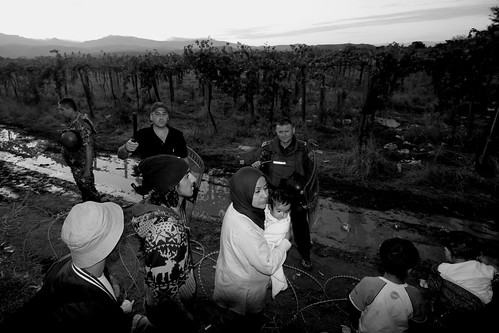
Batons Vs babies - Idomeni, On the Greek-Macedonian border in August 2015

I took this photograph in August, 2015 in the neutral zone that separates Greece from it's northern neighbour, Macedonia. Then, the village of Idomeni was unknown, even to the vast majority of Greeks. A tiny railway crossing that for some reason was fast becoming the focal point for refugees taking the Western Balkan Route from  Turkey to the countries of northern Europe.

However, this day was different, instead of tens or hundreds making their surreptitiously across the border to catch the north bound train in the town of Gevgeliji, thousands had been left stranded by the decision by the Macedonian government to close down the unofficial crossing point and deploy both riot police and border troops to enforce this decision.

With summer temperatures reaching 35C+  these people were left to fend for themselves in the fields around the tiny railways station on the Greek side of the border, Drinking water was virtually non-existent and refugees were reduced to drinking water from the irrigation systems in nearby fields, and sanitary facilities were just a handful of portoloos that quickly became unusable due to the demands of so many people.

The fact that the border had been closed came as no surprise as this had been a fairly regular occurrence all through the summer of 2015 as EU and Balkan governments vacillated over what to do with the ever increasing number of refugees and migrants fleeing the fighting in Syria and Afghanistan and poverty in other regions of the world.

This confusion manifested itself as an endlessly changing policy on the part of the Greek authorities and in particular, the police who would turn a blind eye to refugees making their way from the Greek islands to Idomeni and then suddenly introduce bans of movement in the north. Not, that such moves made much of difference to the numbers of refugees moving north, if the trains were denied them, refugees took the local buses or taxis. In the worst cases when all other options were denied them , they simply walked, guided the 70 km from the nearest large city, Thessaloniki by Google maps.

However, not only the Greek authorities but also their Macedonia counterparts had started to clamp down on refugee movement and not only were the borders more tightly guarded, the train that connected Gevgeliji with Belgrade had been suspended, the daily service completely overwhelmed by the scale of the passenger flow.

Yet, the border was still relatively porous and the nothing to mark it out but a dusty series of paths and raggedy hedges that separated Macedonian and Greek fields. With nothing in the way of natural or man made barriers to deter them , many made the dash to the nearby town , chased down by Macedonia police or border units in the wheat fields.

On the other hand while this was an option for healthy young people with a sense of adventure, it was really possible for the bulk of refugees who were travelling in family groups, often with older relatives or young children, Instead, they sweltered in the summer heat, waiting for the travel rules to change once again as they has so many times before.

The local solidarity groups that had been helping those making the journey north since 2014 were overwhelmed by the sudden increase in the scale of the numbers of refugees suddenly amassed in Idomeni and so appeals groups across northern Greece to come and help out. I managed to wing a place on a convoy of cars and vans that had set out from Thessaloniki, carrying drinking water, cooked food, clothing and sanitary items. I had been doing this with my group since May and I thought my experience would help in this situation and in that I was completely and utterly wrong.

Not only was the scale of the crisis much greater than I had previously experienced, the state of those in need was far more precarious. Instead of providing food and clothing to those who were tired and weary from their journey from Athens to Thessaloniki, these people were in need of far more and as a result more desperate. It was a combination that required all those providing help and required a degree of discipline and organisation that we had till then not obtained.It quickly became clear that if we were not to create more problems then we were solving then we would have to up our game.

The experience and failures I witnessed that day would prove invaluable when our group started going up to Idomeni on a regular basis later on in September and till the route was finally shut down for good in March 2017.

Monday, April 11, 2016

In Idomeni

Idomeni at night - northern Greece

"You had to be there. It's a cliche worn smooth by time but it is true that often images and other people's accounts of a situation are often a poor substitute for being on the spot. The same holds true for the Idomeni refugee camp that lies on southern side of the Greek - Macedonian border. At night you have the sense that you are on the set of a movie, a mixture of the bridge scene from Apocalypse Now and any number of zombie movies/series in which survivors huddle together for protection. The acrid smell of burning plastic, constant flow of hooded people, and the powerful spotlights just add to the surreal, post-apocalyptic atmosphere of the place.

Despite the fact that the border has been closed for over a month the mainly Syrian and Iraqi refugees refuse to leave, and hang on to the hope that Macedonia (along with Serbia, Croatia, Slovenia, Austria and ultimately Germany will reverse their latest decision to close down the Western Balkan Route that allowed refugees to reach northern Europe. They feel they are the victim of some kind of cruel joke that they are stranded in a field in northern Greece whilst so many others, including many of their own family members were allowed to pass just weeks earlier.

Another factor keeping refugees in Idomeni is uncertainty over destinations being offered by the Greek authorities, many of which have been hastily erected and offer little material advantage over Idomeni, Why move to another unknown camp when all it offers is a tent in a muddy food and awful food? Refugees already have that.

In addition many of these camp are literally in the middle of nowhere, isolated from towns and cities for fear of provoking local residents. As a result there are often a collection of tents in a muddy field with nowhere to go and nothing to do. Plus there is the ever present fear that at any point they may be turned into "closed centres", i.e prison camps where people are held prior to being deported as happened on the Greek islands such as Chios to all those who arrived after 20th March which marked the implementation of the EU's deal with Turkey.

In the video posted here refugees were occupying the railway line which connects Greece and Macedonia in protest over the closed border, however,  in the last few days these protests have escalated and yesterday Macedonia border police and troops used tear gas and rubber bullets to prevent refugees crossing the border, According to Doctors Without Borders who are operating at Idomeni over 300 people were treated for the effects of these weapons, including many children who were hit by plastic/rubber bullets or overcome by tear gas which also reached the main camp, far from the border clashes.


Wednesday, March 16, 2016

Colors - Open Kitchen / Colors - Ανοιχτή Κουζίνα serve up to 8,000 meals a day at Idomeni, Greece


The Greek aid organisation, Colors - Open Kitchen cooks and serves up to 8,000 meals a day at the Idomeni transit camp on the Greek - FYR Macedonian border.

The camp, originally designed to house 2,000 refugees for a day is now home to 15,000 who have been stranded there for over three weeks.

The group struggles to find money, supplies, vehicles and volunteers on a daily basis yet despite all these difficulties and the miserable conditions at Idomeni they come through every day.

To find out more about who Colors - Open Kitchen are and how you can help check out their Facebook page.


Friday, March 04, 2016

Refugee Voices - interview with a Syrian refugee stranded at Idomeni, Greece


This interview took place on the 2nd March 2016 at the Eidomeni transit camp on the Greek Macedonian border. This man has been stranded in a field, sharing a flimsy tent with the other members of his family for 11 days. Just a few hundred people are allowed to cross the Macedonian border every day whilst approximately 1,000 refugees arrive per day. As a result 11,000 are stuck in  a transit camp designed to hold 1,500 for a day, not the two weeks some have been there.

The Refugee Solidarity Movement of Thessaloniki and Eidomeni goes up to Eidomeni twice a week to serve hot, sweet Syrian style tea. Wherever possible our volunteers help out with other groups.

For more on who we are and what we do check out our Facebook page.


Monday, February 15, 2016

Video: Refugee Stories - Eidomeni in northern Greece


This Afghan father agreed to talk to us and his son translated. The interview took place on 10th February 2016 as the two were waiting to cross into FYR Macedonia, the next stage of their journey to Germany.

Sunday, February 14, 2016

Latest video from the Eidomeni transit camp on the Greek - FYR Macedonian border


With Greek farmers blocking highways across the country coaches carrying refugees from Athens to the northern border crossing are being forced to take provincial roads. As a result the journey can take more than 12 hours.

To add to an already chaotic situation the Greek police are unwilling or unable to provide information to NGOs and volunteer groups at Eidomeni concerning when and how many coaches are arriving on any given day.

Partly, this is due to the police's long standing hostility to humanitarian groups operating at the camp, partly, it is incompetence. Although the police have been given the responsibility of monitoring refugee coaches on the move they do not seem to be able to implement this policy in practice.

As a result making decision about how much, food, water and other forms of aid will be needed becomes a matter of guesswork.

The Refugee Solidarity Movement of Thessaloniki - Eidomeni was on hand to give out cups of hot sweet tea last Wednesday and Saturday but with few arrivals we had far fewer "customers" than on other occasions. Still, plenty waiting in the camp to cross the border were happy for the offer of a cup of tea.

Other volunteers helped out at the clothing distribution tent where their Arabic/Greek/English speaking skills were much appreciated.

Fortunately, the border was open for much of the day, though how long it will so is unsure as FYR Macedonia and Greece come under ever more pressure from northern EU nations to stem the flow of refugees taking the Western Balkan Route from the Aegean to northern Europe.

Refugee Solidarity Movement of Thessaloniki and Eidomeni


Sunday, February 07, 2016

Video:Tensions rise in the Eidomeni transit camp - northern Greece (footage taken on 3 February)


The major ferry strike which cut off the Greek islands from the mainland meant that when it ended  on the 31st January there was a sudden surge in the number of refugees heading from Athens to the Eidomeni transit camp on Greece's northern border with FYR Macedonia. The situation was further exacerbated by with the unwillingness of the FYR Macedonian government to open the border crossing at Eidomeni to more than a fraction of refugees. The result was an an explosive situation in the camp as thousands of tired, hungry people waited in limbo unsure of what they had to to face next.

On Wednesday 3 February riot police were deployed in an attempt to keep control of a steadily deteriorating situation as thousands sought to get their papers stamped by the Greek police, without which they would not be allowed to cross into FYR Macedonia.

With camps full to overflowing, many refugee families were forced to sleep out in the open in freezing temperatures for three nights and with little information about if or when they would be allowed to continue their journey.

Behind the decision on whether to open or close the border lie a multitude of political calculations in which smaller Balkan nations juggle the intense political pressure they are under from northern EU nations to stop the flow of refugees with the fear that they will become a dumping ground for people nations such as France, Germany and Denmark do not want to accept.

As the EU continues to prevaricate and avoids taking concrete decisions concerning the refugee crisis in Greece and the rest of the Balkans, it is the youngest and most vulnerable who continue to pay for their ineptitude and vacillation.

Refugee Solidarity Movement Thessaloniki and Eidomeni - What we do.


A surge in arrivals at the Eidomeni transit camp on Greece's northern border with Macedonia obliged the Greek police to open the main camps in order to deal with the increase in refugee numbers. However, the Macedonian border was often closed in late January for long stretches at a time and without warning leading to long delays. Even when it was open only a trickle of refugees were allowed to cross in order to continue their journey north.

Once again the Refugee Solidarity Movement of Thessaloniki and Eidomeni were there to hand out hot, sweet tea and help out wherever there is a need. Thankfully, we have built up good working relations with NGOs who operate there 24/7 and volunteers from our group often lend a hand when things are rushed and help is needed.

Monday, January 25, 2016

Can you Help? Demand the Greek government treats refugees more humanely


 Over 1,000,000 million refugees entered Europe in 2015, more than 800,000 chose the Western Balkan route which took them to an obscure railway crossing near the tiny village of Eidomeni on  Greece's northern border with FYR Macedonia.

After a journey from the port of Pireaus that can last up to 20 hours refugees are rushed by the Greek police to the border. Volunteer groups and NGOs at the camp are often given as little as 10 minutes to hand out food, clothing, medical aid and information before crossing over.

There is the constant fear that the government of FYR Macedonia will permanently close down the border with Greece and so leave people stranded. When the border is open or closed seems to be completely at the whim of the FYR Macedonia government  and there is little or no co-operation between the authorities on both sides of the frontier and so little idea when and for how long the crossing remain shut.

For their part the Greek police who control acccess to Eidomeni also refuse to share information with NGOs and volunteer groups over when and how many refugees will be arriving at the camp on any given day, despite the fact that they control the flow from start to finish on the Greek mainland. Indeed since December the attitude of the police has perceptibly hardened, ranging from sullen indifference to active hostility, sometimes kicking out organisations such Médecins Sans Frontières all together, with little or no notice.

To make an already difficult situation worst, the police forbid access to the hot food, doctors, heated tents and other faciities that have been built recently at Eidomeni. Instead refugees are forced to wait endless hours at a road side petrol station/cafe 20km from the site whilst temperatures at night often drop to -15c. Here refugees are obliged to buy food and water whilst just a ten minute ride away volunteers wait to hand out such items at no cost.

Last week over 3,000 people, including many families with very young children were forced to endure extreme cold overnight while the camp remained half empty.

We are calling upon media outlets to highlight this scandalous abuse of refugees by the Greek authorities. The more international pressure is brought upon the SYRIZA government and prime minister, Alexis Tsipras the more likely refugees will receive more humane treatment on the Greek leg of their trek to safety.

Refugee Solidarity Movement Thessaloniki-Eidomeni

Saturday, January 23, 2016

Video: Winter at Eidomeni - Refugees wait to cross the Greece - FYR Macedonia border


Over one million refugees entered Europe in 2015, the vast majority chose the Western Balkan route which leads from the Turkish coast via the Greek islands to Eidomeni, a tiny village on the Greek - FYR Macedonian border. Over 800,000 people have passed through this unofficial crossing point which is little more than a collection of tents armed guards and barbed wire before going on North to their final destination in nations such as Germany, Austria and Sweden.

Since May the Refugee Solidarity Movement Thessaloniki has been offering help to those making the trek north first in the city of Thessaloniki and then from September we have been going to Eidomeni where we serve hot tea and help out the other groups providing food, clothing and information to refugees arriving there.


Video: Refugees crossing the frontier: Eidomeni on the Greek - FYR Macedonian border


Eidomeni, located in northern Greece is a major transit point for refugees trying to reach northern Europe after arriving on the Greek island from Turkey.

Despite temperatures that can fall as low as -16c the Greek police has been refusing to allow those arriving to use the facilities at the camp, which were erected at great expense by international NGOs. Instead of being able to stay in heated tents with time to get hot food, clothing and medical attention people are often kept by the Greek police  for anything up to 20 hours in coaches that have brought them from Athens at a local roadside petrol station - restaurant. This has proved a major source of income for the service station which, otherwise would be quiet at this time of year.

NGOs such as Médecins Sans Frontières (MSF) and local volunteer groups have repeatedly implored the Greek authorities to change their policy yet to no avail. Instead refugees are rushed through the Eidomeni border crossing in a matter of minutes giving aid groups little time to provide them with food and other forms of aid.

For more on the situation in Eidomeni check out the Refugee Solidarity Movement of Thessaloniki and Eidomeni Facebook.