Thursday, September 27, 2012

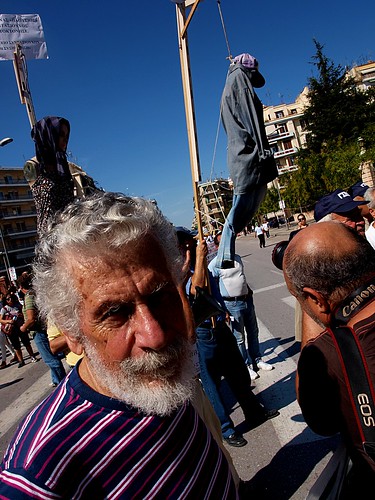
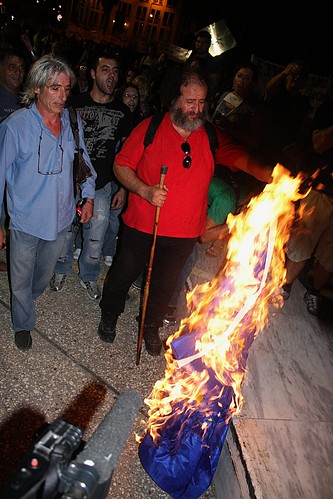
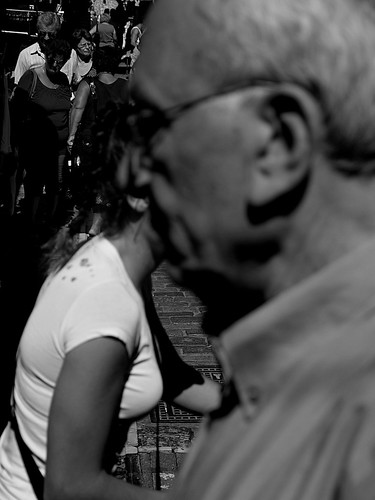
Angry pensioners take part in Greek general strike march

Between 20,000 and 25,000 protesters took part in anti-austerity demonstrations in Greece's second largest city, Thessaloniki. In contrast to the events in Athens the protest passed off peacefully.

Tuesday, September 25, 2012

Blackmail is such an ugly word

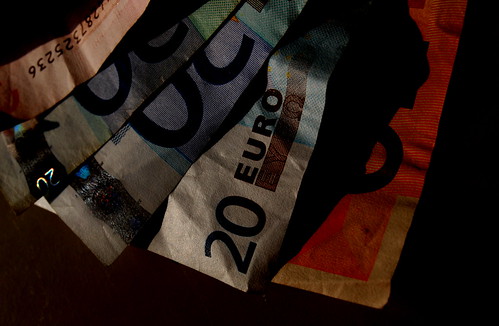
The Greek media has recently been full of stories concerning a mysterious list of 30 politicians who are suspected of having income far in excess of that declared. Newspapers and TV channels have devoted endless hours and column inches to the subject even suggesting the names of those possibly on the list and what there presence means for Greece's embattled party political system.

 However, behind the furore created its seems that other battles are being fought. Athens has been in tough negotiations with its creditors over the terms of the next installment of "bailout" cash and part of the agreement includes unpopular cuts in public spending and yet more tax hikes. While the Greek government has made it known that it is holding out for better terms the reality is that they have little room for manoeuver and no leverage. At some point they will have to acknlowlege this and send the appropriate measures to be approved in parliamwent. And then the real battle will begin.

The current three party coalition consisting of the nominally conservative New Democracy party and the nominally socialist PASOK and Democratic Left parties have little in common other than a desire for Greece to stay within the eurozone. Their stint in power has proved disasterous in terms of popular support if opionon polls are to be believed and they are faced with with backbench rebellion. Even the right wing New Democracy has problem not only with its fiscal policies but also the fact that its leader, Antonis Samaras badly fractured the party during his successful leadership bid.

Faced with the prospect of shaky support in parliament for any more austerity legislation the party whips are perhaps searching for new ways of ensuring backbench discipline. In the past this was achieved by by threats of de-selection but with PASOK in terminal decline and the other parties support fading away such moves have less appeal. Many MPs already know that they face little chance of re-election if the political climate remains the same and that yet more taxes and cuts will condemn to oblivion at the polls.

The other threat used extensively after the last austerity legislation vote in 2011 was expulsion from the party, with both PASOK and New Democracy using this blunt instrument to deal with recalcitrant MPs. However, such a move proved to be politically expensive as many MPs either formed new parties or defected to other existing ones. A move that cost the PASOK - New Democracy coalition votes in the 2012 elections.

So what to do next? With more traditional methods of maintaining the party whip exhausted the threat of investigation by the tax authorities for undeclared income might prove more effective. The fact that the names have not been revealed just adds to the uncertainty and could be used to nip any revolt in the bud with just the hint that names will be leaked to the press.

After decades of financial scandals involving both New Democracy and PASOK members, even in the highest circles of government the number of those in parliament with economic skeletons in their cupboards will surely include more than the 30 indivividuals being investigated by the authorities. The beauty of endemic political corruption is that not only does it reward loyal supporters, it can also be used to rein in challenges to the status quo. All it takes is a word to friendly journalists and a high profile trial to thwart rivals.

Sunday, September 23, 2012

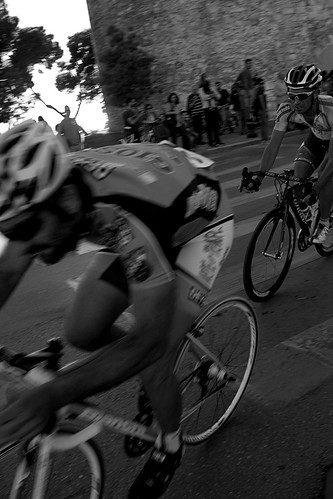
Thessaloniki urban cycle race

As part of the International Day Without Cars a large part of the centre of Thessaloniki was closed to traffic and people wandered along usually car clogged roads enjoying the change in pace.

Walking along the seafront, you had the impression that the city had become a holiday resort for the day, with people enjoying the sunshine and gently making their way past the cafes and bars.

The one exception to this was the cycle race in which hundreds of professional racers flew around the city and gave Thessaloniki a small taste of the Tour de France for an hour or so.

After that finished it was once more back to gentler rhythms as people signed up for the Popular Ride which was altogether a more laid back affair.

The beauty of the event was that so many were enjoying a break from the seemingly endless stream of bad news that has afflicted Thessaloniki over the last few years. For a day people strolled, laughed and left behind whatever was bothering them

Sunday, September 16, 2012

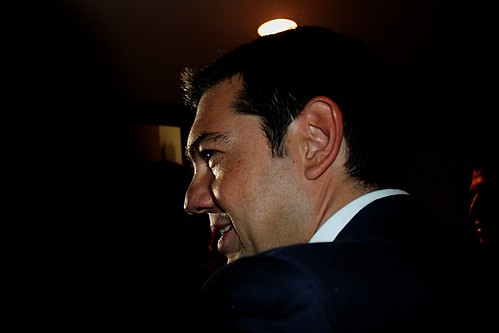
Alexis Tsipras - Fighting an uphill battle to get his message out

For fans of signs and omens the sudden end of summer and onset of rainy weather that accompanied the arrival in Greece's second largest city of the leader of the Radical left Coalition, Alexis Tsipras probably made perfect sense. The sudden chill in Thessaloniki seems to be a fitting metaphor for his relationship with the press as SYRIZA has an uphill battle on their hands trying to get the party's message out in the face of intense mainstream media hostility. With most of the traditional media joined at the hip to more mainstream parties such as New Democracy and PASOK  Tsipras has no natural allies in the media, whose members often play a dual role of journalist and party supporter, an incestuous set - up that has hobbled objective reporting for decades.

Although, by law his party's success in the previous elections guarantees them a certain amount of airtime on state run channels, the rest of the media has done its best to play down their importance.Hardly surprising given the fact that so much of Greece's media is owned by extremely rich oligarchs who are fighting tooth and nail to ensure the country implements austerity conditions demanded by the EU and IMF and so remains in the Eurozone.

The last thing they or the embattled coalition government need is another strong challenge from the Left that threatens to derail the current round of negotiations over spending cuts. As a result SYRIZA has found it hard to gain traction in public opinion and do more than present itself simply as a party of protest. Often it is forced to react to news agendas promoted by the current administration and their supporters in the Greece's news rooms. With the news cycle out of their hands they are forced to play defence and find it difficult to persuade anxious voters that they have are of constructive ideas and not just criticism.

Then again, it would have naive of Tsipras to have expected any other response from a media set up that is so wedded to the corruption and amorality of Greek government politics.  Instead of begging for a place at the table with the big boys, SYRIZA needs to get its message across to the people who no longer read papers or believe what they see on the TV news bulletins.

Some activists are unhappy that that the scale of their victory in June's election has made the party complacent, more interested in playing traditional party political games instead of using their new found leverage to reach out at the grassroots to more people affected by the collapse of the economy in a more direct manner.


Wednesday, September 12, 2012

After the Fair


This year's protest marches to mark the start of the new political year passed off without incident in Thessaloniki. About 30,000 people participated in the three main demonstrations, and in contrast to last year no fighting was reported. It seems that the continued grind of austerity is taking its toll on Greece's opposition and this can be seen in the turn out of such protests which lack the numbers and vigour of previous ones.

This was, in part the result of the prime minister Antonis Samaras's decision not to make the traditional state of the union address at the fair, a spectacle that acts as a lightening rod for violent clashes between marchers and riot police. In part perhaps people are suffering from demonstration fatigue or perhaps they have lost the hope that taking to the streets can change anything. The decline in such protests does not mean that the current round of cuts and job cuts have been accepted but rather Greeks seem to have decided that they are inevitable and are now looking to their own personal survival.

Friday, August 31, 2012

Austerity storm clouds darken Greek government's future

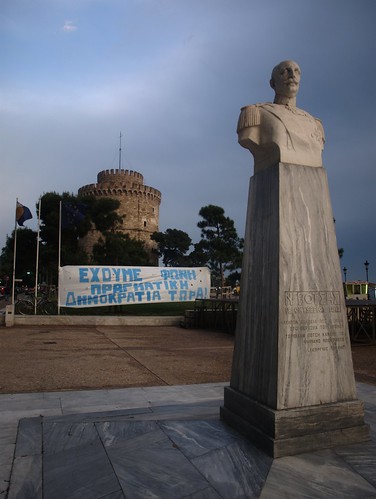
Greece's Indignados continue protests for sixth day - Sign says "We have a voice. Real democracy now!"


After months of official government announcements and newspaper headlines, Greece's latest austerity programme has been made public with anger and disbelief coming from all corners, including the country's usually supine media. The news that salaries,pensions, disability benefits and aid to the unemployed will be included in the the 11.9 billion euro package of cuts is likely to spark off a yet more protests as will the likely 40,000 state sector lay offs .

Police officers were the first to react with demonstrations in Athens after the government said that their wages and bonuses would not be exempt from the budget measures being demanded by creditors in return for another cash injection. The Greek language blogosphere was alive with angry responses from police related blogs angry that pre-election promises had not been kept and promising a series of protests over the decision.

The first hurdle facing Greece's fragile three party coalition government is how to persuade their restive backbenchers to voter for measures their supporters violently disagree with. On the one hand many rank and file MPs from New Democracy, PASOK and Democratic Left have said they are opposed but how much of this is principled protest and how much is just a PR ploy designed to keep voters back home sweet is hard to say. During the last two round of cuts much was made of potential backbench revolt which eventually failed to materialise.


The $64,000 question is how such cuts, if they are passed will be enforced without the support of the police. With resentment against yet more austerity rising after a summer lull, police officers are being used ever more frequently to end protests and labour disputes. If they decide that this is not their public function, as one police leader intimated last night during an interview on MEGA TV then what other means of persuasion does the government have? Even the feared quasi - military MAT riot units cannot be everywhere.

The first test of Greek prime minister Samaras's ability to impose his will on a recalcitrant nation will come in September with the opening of the Thessaloniki International Trade Fair which traditionally marks the start of the new political year. The presence of the prime minister and much of the government is also a signal every year for massive protests and last year's event proved no exception with football fans, taxi drivers and anarchists fighting pitched battles with 8000 police officers outside the fair,

Samaras has already announced that this year's attendance at the fair will be a brief one and will not include the traditional state of the nation address which coincides with the most intense of protests. However, even if the Trade Fair passes off without major incident Greece's political calender will provide plenty more opportunities for police and protesters to make their respective stances known

Friday, August 24, 2012

Despite crisis good times still roll for Greek MPs

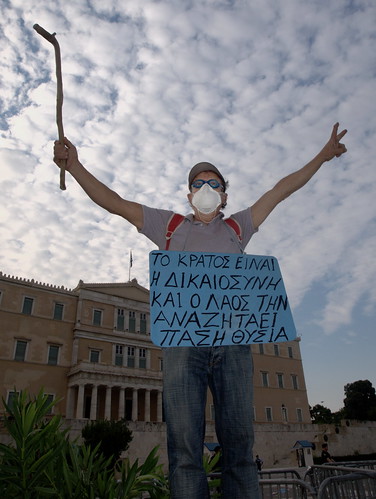
"The state means justice and the people seek it at all costs'- Protesters outside Greek parliament.

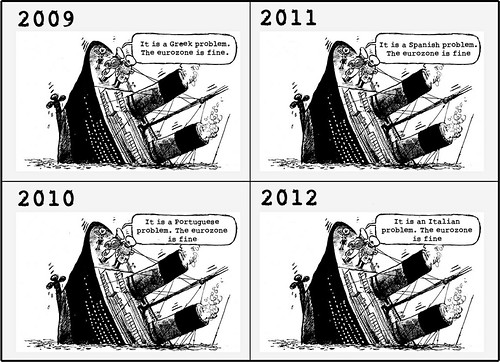
Antonis Samaras is currently doing the rounds in Europe, attempting to persuade fellow EU leaders that Greece needs two more years to fulfil the obligations required to receive the country's next installment of cash to avoid bankruptcy. Samaras has even personally guaranteed that Germany will be repaid in full, though how intends to do this is another matter, unless there is a secret coda in Steve Job's will that no one has been aware of till now.

On the other hand The PM's attempt to prove the Greece has changed and become a more fiscally responsible country have been undermined by even high ranking members of his own government, who upon being elected to parliament seemingly appointed to state jobs just about every member of their extended family not in jail or the grave. Case in point being New Democracy heavy weight, Vyron Polydoras, who secured a government job for his daughter after Greece's first national elections in May. Polydoras was also involved in a scandal during the Karamanlis administration after he used his position as minister for public order to have them transferred to his own offices.

However, this misuse of parliamentary privilege is not limited to New Democracy as such moves have been made PASOK, Independent Greeks and Golden Dawn MPs, with a total of 150 extra employees being added to the public payroll at a cost of nearly 3,000,000 euros annually.

At first sight such nepotism and pork barrel politics would seem to give fodder to Greece's foes in Europe who argue that Athens refuses top take reforms of its bloated state sector seriously. However, such accusations ignore the fact that these abuses are the preserve of the those at the top of Greece's deeply corrupt political system. For ordinary Greeks, the cuts in spending are very real indeed. A telling example is that while 187,000 people registered as jobless receive unemployment benefit (usually less than 400 euros a month), 734,000 do not. Hardly evidence of profligate welfare spending and for those who remain unemployed for more than 12 months there is little in the way of financial assistance form the State.


The irony of the situation is that during Greece's deeply divisive dual elections in summer much of the European political leadership and the financial establishment across the world exerted as much influence as it could muster to shore up support for New Democracy and Antonis Samaras, and in doing so helped maintain the corrupt political empires that helped Greece get so deeply into debt in the first place. 

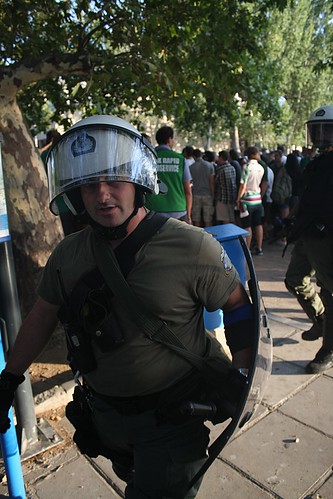
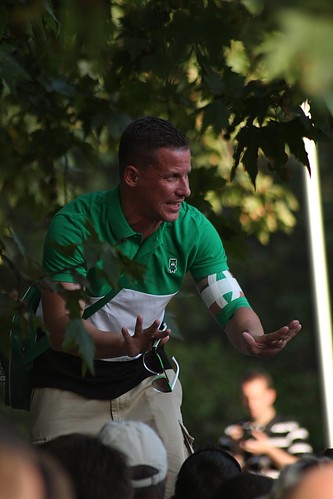
SK Rapid Wien supporter calms down fans during face off with Greek riot police

Monday, August 20, 2012

As crisis deepens Greece's rulers take racism into the mainstream

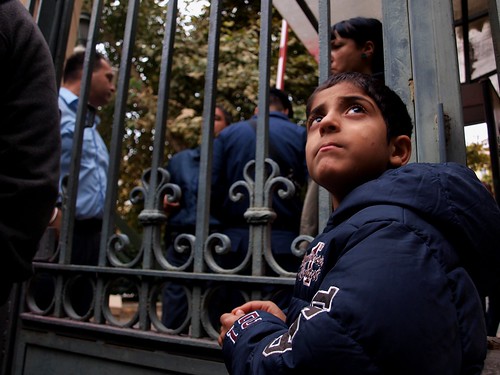
Seeing refugee families approach Greek riot police close gates to ministry building

With August coming to an end and the temperatures dropping from the low 40s C to low 30s C The northern port city of Thessaloniki shakes off of its summer lethargy as people come back from their annual holidays and the town readies itself for the return of its large student population. However, amidst the renewed hustle and bustle some things haven't changed. Many of the businesses in the centre remain shuttered, their store fronts decorated with graffiti and For Rent signs, the cafes while now busier are far fewer in number and the restaurants mostly remain empty except on the weekend. The only new business is a chain of fast food outlets that does a roaring trade in in 70 cent hot dogs and cheap iced coffees.

On the other hand whether it be in the supermarket lines or in the streets the talk is about how everyone will pay the latest round of bills. The guy pumping petrol complains about the cost of road tax whilst the woman behind me in line frets about how she'll make it through the winter if the government decides to raise the cost of heating oil by 40% as promised. 

And these are the lucky ones. The ones who still have a job and some source of income. For those who were already at the bottom of the pile before the crisis took hold the situation is now dire. No  large supermarket is complete without a gaggle of beggars waiting outside its entrance. The sight of old people and young kids rummaging through waste bins for food or stuff to recycle no longer turns heads, or even draws a comment.

For Greece's most vulnerable the country is rapidly becoming an endless nightmare, not only because of lack of jobs or money but because they are being scapegoated by politicians in power along with their allies in the national media. For immigrants the situation is worst of all. While the foreign media have focused on the open racist rhetoric of the Neo-Nazi Golden Dawn party (which won 7% of the vote in the last national elections) the campaign against non-Greeks is not limited to the party's shaven headed black t-shirted thugs.

With the start of the Xenios Zeus police operation Athens has been using mass round ups of anyone with a dark skin in central Athens to prove that it is tough on undocumented migrants despite condemnation by Amnesty International. With the Samaras government unable to halt economic contraction and faced with a humiliating fait accompli from Berlin, Greece's failing political system is looking for a way out. In this they have found willing allies in the country's ailing mainstream media, owned to large extent by oligarchs determined to make sure that the country remains in the Eurozone, whatever the social cost.

A typical example of the manner in which immigrants are portrayed in Greek news can be seen in the recent case of a 15 year old girl who was beaten and left unconscious after an attack on the Greek island of Paros. With the police under pressure to produce results they arrested a Pakistani hotel employee, who according to official reports confessed to the crime. The fact that he was not allowed access to a lawyer during his time in custody on Paros seems to be considered a minor detail. Later police said that his DNA had been linked to the crime scene. At this point both TV and newspapers decided that trials and verdicts were irrelevant in such a case and talked of "a beast in human form" and "monsters among us".

Such language and tactics draw unfavourable comparisons with the propaganda attempts of the Nazi's in the mid 1930s and are being increasingly used by "respectable" mainstream reporters and politicians who routinely attribute rising crime rates and economic decline to the presence of immigrants.

In a climate where the nightly news bulletins are full of stories blaming the country's growing lawlessness on ruthless foreigners, it is hardly surprising that attacks on immigrants are on the rise, increasing not just in number but also ferocity. 

To make the situation even more intolerable, immigrants have every reason to believe that the police is not a neutral player in this increasingly violent game. During the recent elections some studies suggested the in Athens alone nearly 50% of police offers cast a vote for Golden Dawn, while Indymedia Athens and alternative news sources are full of police either turning a blind eye to racist violence or even abusing foreigners themselves.

The reality is the racism in Greece has, along with poverty become part of the respectable mainstream, simply another tool to be used by an deeply unpopular political elite eager to win back support from an electorate worn down by four years of economic collapse and terrified that everything that worked so hard to achieve over the previous decades will be taken away from them.


Tuesday, July 31, 2012

Greece on the move as crisis bites deeper.


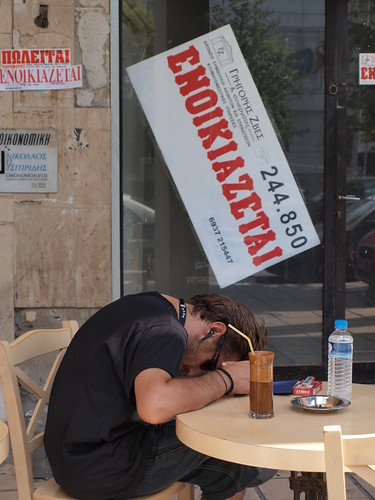
For Rent says the sign behind the man. Thessaloniki, Greece

While for many outside the country, the main symptoms of the current economic crisis are the soup kitchens in central Athens, or perhaps the violent confrontations that light up TV screens from time to time,but there is another quieter, yet just as significant trend sweeping Greece. Thousands upon thousands of Greeks are on the move, leaving the larger cities for the countryside or smaller provincial towns or abandoning the country to try their luck abroad. As with so many other economic and social upheavals the current one has forced people to up sticks and try their luck elsewhere. However, this time there are no endless trails of refugees marching along dusty roads, or convoys of dispossessed Okies with their belonging strapped to the top of a car. Instead it's the steady rhythm of friends, neighbours and colleagues gradually slipping away.

There are no firm figures for the numbers involved and those official statistics that do surface in the media often contradict themselves, nevertheless the truth is that something is changing and I see it with my own eyes every day. In every apartment block in every street no entrance hall is complete without a handful of For Rent or For Sale signs, apartments I pass by on my way to work lay empty for months on end, even though the removal vans seem to be doing a roaring trade.

On a more personal level, many of my friends and acquaintances have left the city. Thomas, who's now in Germany, trying to start a new life, Anne and Makis who have decided to go back to Makis's home town of Alexandroupolis, Panos who is off to Crete to try his hand at farming after losing his job in the latest round of job cuts, and so the list goes on.

And most importantly for me, my own 12 year old daughter, who is now living in central Greece, after her mother's business finally succumb to the crisis., so obliging her to move back to be closer to the her own family and the support they can offer. So instead of being a weekend dad, I've become a fortnightly one, as every two weeks I catch a train to Larissa, and then a coach and then a lift to see her in her new home.

I do not harbour any bitterness to my ex for her decision, she tried everything to find work in Thessaloniki and when that didn't work out she was left with no real choice. Given such unpalatable options, you do what you can to survive.

This weekend though, my daughter is staying with me, or to be more accurate she's staying over at a series of friends, catching up on lost gossip and news from the classmates she left behind. Even then, the story is the same. One has left for England, another is going with her family to Australia, another's family is contemplating moving back to Albania if things do not improve in the near future.

Ironically, my financial situation has stabilised and unlike the last few summers, paying the rent and bills is not something that wakes me up at 4am in a cold sweat. I've even been in the enviable situation of turning down jobs (don't worry, I passed them on to friends in need) in order to take a couple of weeks off but this is something I usually keep to myself as complaining about work when so many around you are desperate for any kind of job seems the height of bad taste.

Those left behind hang on, hoping that things will change soon or praying that their job won't be the next in line. All the while the new government at the behest of Greece's creditors carve yet more slices off the public sector and chase after an ever dwindling tax base. This week it's the turn of higher education as Athens desperately seeks to find another 11.5 billion euros worth of spending cuts and so has announced the closure of at least 30% of the university and polytechnic department, effective immediately.

On the other hand it feels at times like being on a raft in the middle of a storm and all you can do is cling on as tightly as possible and focus on the few inches in front of your face, you do not have the energy to imagine what will happen next so all you do is focus on the immediately around you and forget the rest.