Showing posts with label eu economic crisis. Show all posts

Tuesday, May 28, 2013

What has been lost

Unpaid local authority workers protest in Greek city of Thessaloniki

I have been very quiet recently, at least as far as this blog is concerned. While I still tweet quite a lot about what is happening in Greece, over the last month or so I have lost the desire to go out on the streets and cover what has been happening in the city. Perhaps the fact that the end of the academic year is approaching and everyone is feeling worn out is to blame, or maybe the endless stream of bad news I hear from those around me is getting to me.

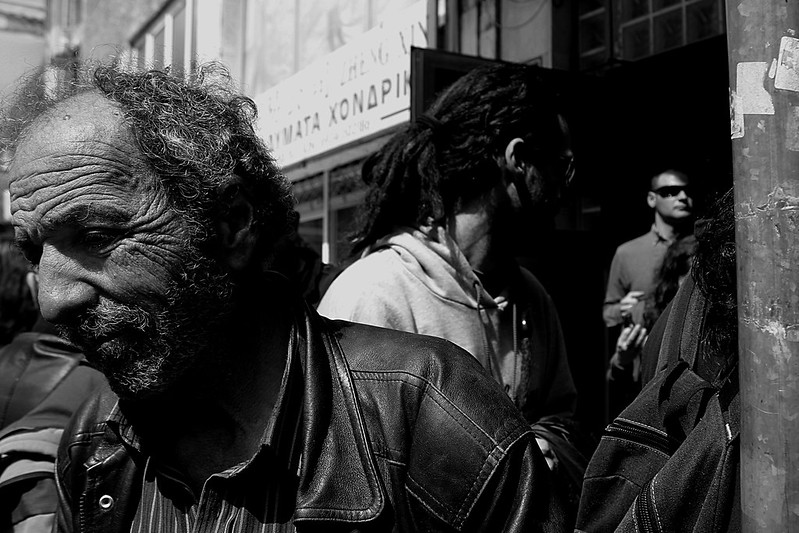
More friends are leaving the country to escape the crisis, others are struggling on but the cost is enormous both financially and in terms of dignity. It's hard to be sanguine when so many people you know are fighting to just retain their self respect in the face of grinding poverty which seems to have no end.

On the other hand the international press, or at least The Economist, FT, CNN and even the Guardian have decided that no matter what your eyes tell you every time you go out the worst of the crisis in Greece is over. Business confidence is up, the government's privatisation plan is finally going ahead, and the banking sector is stabilising. All of which is fine as long as your main interests are in finance and not out there in the "Real Economy"with the rest of us schmucks.

Despite the euphoria in the mainstream media the economy is still collapsing,unemployment hasn't stopped rising, let alone dropped, the suicide rate is the highest in 50 years, 200% increase in new AIDS cases reported and just to add yet more joy to everyday life a new drug, Sisa or Shisha is doing a roaring trade in Athens.

There are some bright spots, since Greece is not a war zone and despite the deepest wishes of many a  journalist on the Death and Debt tour of Southern Europe, there are not dead bodies piling up in the streets. It's not that kind of disaster. Some of those I know have moved abroad to much better paid positions where their skills will be properly utilised, and hopefully some day in the near future they will be able to come back to Greece and share what they have learnt.

Yet even in these cases there is a price to pay, relationships are forced to bear the weight of a such a move and even the most privileged of emigrants have to deal with stress and dislocation caused by moving to a new country. While many may dream of living the American Dream, few believe that their ideal future is set in some provincial town or village in Northern Europe.

For those left behind, phrases like "light at the end of the tunnel" or "The worst is over" seems like a bad joke. In the this part of Greece, the official unemployment figures for young people are 72%, which in practical terms means that virtually no one is in full - time employment.

For older people who lose their jobs the prospects are little better. The few jobs that are on offer are nearly all low skill ones in the service industry where 15-20 euros for 10 hour day is considered acceptable. Of course, these jobs come without  any form of social security contributions, health plan, or hope of a pension Nor do the wages offered cover the cost of living as the latest OECD survey on Greek cost of living shows prices for basic consumer goods have dropped only slightly below those found in Germany where a full-time  salary of 300-400E a month is unheard of.

However, summer is here, the weather is improving and people are out in the streets and cafes, celebrating the end of a difficult winter and for the casual observer, everything seems fine. To find out what has been lost you have to talk to people, crack their outward reserve and get them to trust you enough to reveal stories they may feel deeply ashamed of. That takes time and as we've seen from much of  the foreign media's coverage of the crisis in Greece, often considered  not worth the effort. Much easier to talk to political heads, regurgitate official figures and hang out at the bar of your hotel.

For those who spent a life struggling to improve themselves and provide for their family's future, debt, unemployment and loss of purpose in their lives is deeply felt. The stigma of poverty that haunted Greek society, especially in the difficult post war years is still part of many people psychological make up and so a return to levels of poverty not seen in decades is a bitter blow.




Monday, August 20, 2012

As crisis deepens Greece's rulers take racism into the mainstream

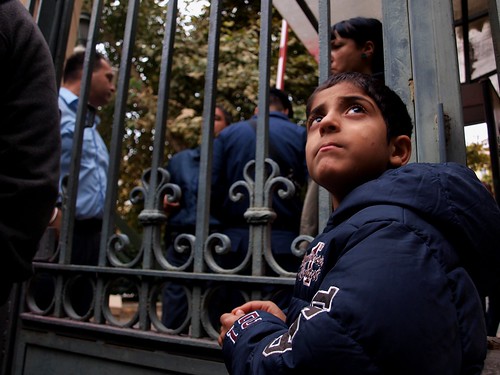
Seeing refugee families approach Greek riot police close gates to ministry building

With August coming to an end and the temperatures dropping from the low 40s C to low 30s C The northern port city of Thessaloniki shakes off of its summer lethargy as people come back from their annual holidays and the town readies itself for the return of its large student population. However, amidst the renewed hustle and bustle some things haven't changed. Many of the businesses in the centre remain shuttered, their store fronts decorated with graffiti and For Rent signs, the cafes while now busier are far fewer in number and the restaurants mostly remain empty except on the weekend. The only new business is a chain of fast food outlets that does a roaring trade in in 70 cent hot dogs and cheap iced coffees.

On the other hand whether it be in the supermarket lines or in the streets the talk is about how everyone will pay the latest round of bills. The guy pumping petrol complains about the cost of road tax whilst the woman behind me in line frets about how she'll make it through the winter if the government decides to raise the cost of heating oil by 40% as promised. 

And these are the lucky ones. The ones who still have a job and some source of income. For those who were already at the bottom of the pile before the crisis took hold the situation is now dire. No  large supermarket is complete without a gaggle of beggars waiting outside its entrance. The sight of old people and young kids rummaging through waste bins for food or stuff to recycle no longer turns heads, or even draws a comment.

For Greece's most vulnerable the country is rapidly becoming an endless nightmare, not only because of lack of jobs or money but because they are being scapegoated by politicians in power along with their allies in the national media. For immigrants the situation is worst of all. While the foreign media have focused on the open racist rhetoric of the Neo-Nazi Golden Dawn party (which won 7% of the vote in the last national elections) the campaign against non-Greeks is not limited to the party's shaven headed black t-shirted thugs.

With the start of the Xenios Zeus police operation Athens has been using mass round ups of anyone with a dark skin in central Athens to prove that it is tough on undocumented migrants despite condemnation by Amnesty International. With the Samaras government unable to halt economic contraction and faced with a humiliating fait accompli from Berlin, Greece's failing political system is looking for a way out. In this they have found willing allies in the country's ailing mainstream media, owned to large extent by oligarchs determined to make sure that the country remains in the Eurozone, whatever the social cost.

A typical example of the manner in which immigrants are portrayed in Greek news can be seen in the recent case of a 15 year old girl who was beaten and left unconscious after an attack on the Greek island of Paros. With the police under pressure to produce results they arrested a Pakistani hotel employee, who according to official reports confessed to the crime. The fact that he was not allowed access to a lawyer during his time in custody on Paros seems to be considered a minor detail. Later police said that his DNA had been linked to the crime scene. At this point both TV and newspapers decided that trials and verdicts were irrelevant in such a case and talked of "a beast in human form" and "monsters among us".

Such language and tactics draw unfavourable comparisons with the propaganda attempts of the Nazi's in the mid 1930s and are being increasingly used by "respectable" mainstream reporters and politicians who routinely attribute rising crime rates and economic decline to the presence of immigrants.

In a climate where the nightly news bulletins are full of stories blaming the country's growing lawlessness on ruthless foreigners, it is hardly surprising that attacks on immigrants are on the rise, increasing not just in number but also ferocity. 

To make the situation even more intolerable, immigrants have every reason to believe that the police is not a neutral player in this increasingly violent game. During the recent elections some studies suggested the in Athens alone nearly 50% of police offers cast a vote for Golden Dawn, while Indymedia Athens and alternative news sources are full of police either turning a blind eye to racist violence or even abusing foreigners themselves.

The reality is the racism in Greece has, along with poverty become part of the respectable mainstream, simply another tool to be used by an deeply unpopular political elite eager to win back support from an electorate worn down by four years of economic collapse and terrified that everything that worked so hard to achieve over the previous decades will be taken away from them.