Showing posts with label unemployment. Show all posts

Tuesday, October 01, 2013

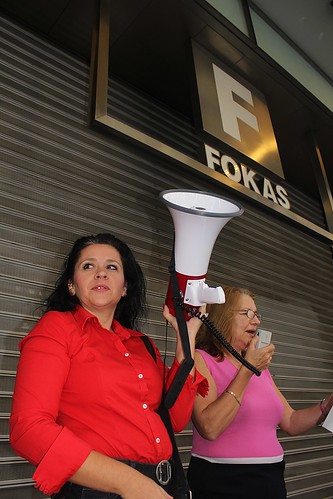
Employees protest after the Fokas department store faces eviction.

The Fokas department store, one of the landmarks in Greece's second largest city, Thessaloniki is now facing eviction over unpaid rent payable to the premise's owner, the Greek Orthodox Church.

The closure of the business will see hundreds of employees lose their jobs in a city where unemployment rate is nearly 30%.
Tuesday, May 28, 2013

What has been lost

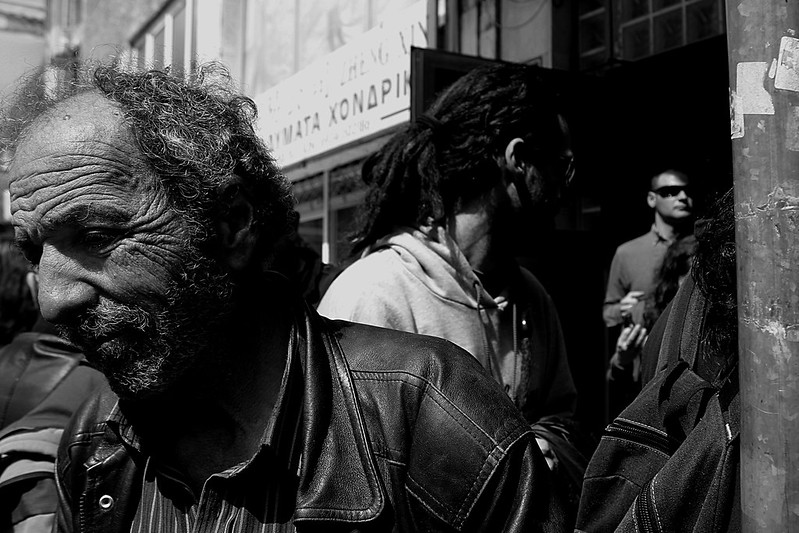
Unpaid local authority workers protest in Greek city of Thessaloniki

I have been very quiet recently, at least as far as this blog is concerned. While I still tweet quite a lot about what is happening in Greece, over the last month or so I have lost the desire to go out on the streets and cover what has been happening in the city. Perhaps the fact that the end of the academic year is approaching and everyone is feeling worn out is to blame, or maybe the endless stream of bad news I hear from those around me is getting to me.

More friends are leaving the country to escape the crisis, others are struggling on but the cost is enormous both financially and in terms of dignity. It's hard to be sanguine when so many people you know are fighting to just retain their self respect in the face of grinding poverty which seems to have no end.

On the other hand the international press, or at least The Economist, FT, CNN and even the Guardian have decided that no matter what your eyes tell you every time you go out the worst of the crisis in Greece is over. Business confidence is up, the government's privatisation plan is finally going ahead, and the banking sector is stabilising. All of which is fine as long as your main interests are in finance and not out there in the "Real Economy"with the rest of us schmucks.

Despite the euphoria in the mainstream media the economy is still collapsing,unemployment hasn't stopped rising, let alone dropped, the suicide rate is the highest in 50 years, 200% increase in new AIDS cases reported and just to add yet more joy to everyday life a new drug, Sisa or Shisha is doing a roaring trade in Athens.

There are some bright spots, since Greece is not a war zone and despite the deepest wishes of many a  journalist on the Death and Debt tour of Southern Europe, there are not dead bodies piling up in the streets. It's not that kind of disaster. Some of those I know have moved abroad to much better paid positions where their skills will be properly utilised, and hopefully some day in the near future they will be able to come back to Greece and share what they have learnt.

Yet even in these cases there is a price to pay, relationships are forced to bear the weight of a such a move and even the most privileged of emigrants have to deal with stress and dislocation caused by moving to a new country. While many may dream of living the American Dream, few believe that their ideal future is set in some provincial town or village in Northern Europe.

For those left behind, phrases like "light at the end of the tunnel" or "The worst is over" seems like a bad joke. In the this part of Greece, the official unemployment figures for young people are 72%, which in practical terms means that virtually no one is in full - time employment.

For older people who lose their jobs the prospects are little better. The few jobs that are on offer are nearly all low skill ones in the service industry where 15-20 euros for 10 hour day is considered acceptable. Of course, these jobs come without  any form of social security contributions, health plan, or hope of a pension Nor do the wages offered cover the cost of living as the latest OECD survey on Greek cost of living shows prices for basic consumer goods have dropped only slightly below those found in Germany where a full-time  salary of 300-400E a month is unheard of.

However, summer is here, the weather is improving and people are out in the streets and cafes, celebrating the end of a difficult winter and for the casual observer, everything seems fine. To find out what has been lost you have to talk to people, crack their outward reserve and get them to trust you enough to reveal stories they may feel deeply ashamed of. That takes time and as we've seen from much of  the foreign media's coverage of the crisis in Greece, often considered  not worth the effort. Much easier to talk to political heads, regurgitate official figures and hang out at the bar of your hotel.

For those who spent a life struggling to improve themselves and provide for their family's future, debt, unemployment and loss of purpose in their lives is deeply felt. The stigma of poverty that haunted Greek society, especially in the difficult post war years is still part of many people psychological make up and so a return to levels of poverty not seen in decades is a bitter blow.


Tuesday, November 13, 2012

M - A Modern Greek Tale

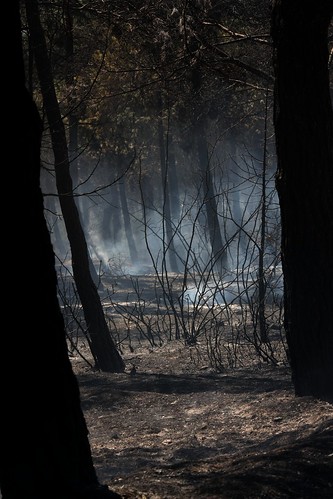
The aftermath of a forest fire near Thessaloniki, Greece

I have a friend who I shall M. Out of respect for the fact she has enough on her plate as it is without my revealing her real name and adding to the battle she has to wage to retain what is left of her dignity. M phoned my last night barely able to contain her anger, seeking a sympathetic ear for her angry venting. Yet again another job interview had ended in failure and yet again her hopes of finding work, any kind of work were dashed. This time she had been told that her qualifications, which are impressive made her potential employers uneasy.

While Greece's young and educated have long given up the dream of a well paid job that matches their education and skills, the realisation is growing that any kind of job, no matter how badly paid or unskilled is no longer open to them, even when they lower their expectations to levels undreamed of just a couple of years ago. Even a part - time job paying 200 euros a month for a 20 hour week is the subject of intense competition and now the degrees and certificates that so many worked so hard to pass are seen as best an irrelevance and at worse a disincentive.

The bitter irony is that a whole generation of Greeks have been raised to find a future in an economy that no longer exists. The sacrifices made by both parents and children to assure their kids future have proven to be an educational Ponzi scheme with people now holding useless pieces of paper that had once promised a prosperous future.

So my friend M once more trawls the internet and local paper for any kind of job, recent experience and her inner work ethic means that she will happily do any time of honest work that assures her a wage.In summer that meant 12 hour days on the street outside a seaside pizzeria, using her flawless English to persuade tourists to step inside.Now that the holiday season is over she is back in Thessaloniki struggling to find the money to finish her studies that would enable to become a therapist. However, the dream of such a job is fading away quietly being forgotten with every unanswered email, every fruitless interview, every day without the hope of some kind of way out of her dead end.

Friday, August 24, 2012

Despite crisis good times still roll for Greek MPs

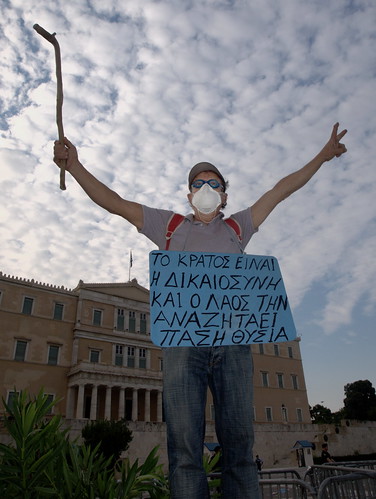
"The state means justice and the people seek it at all costs'- Protesters outside Greek parliament.

Antonis Samaras is currently doing the rounds in Europe, attempting to persuade fellow EU leaders that Greece needs two more years to fulfil the obligations required to receive the country's next installment of cash to avoid bankruptcy. Samaras has even personally guaranteed that Germany will be repaid in full, though how intends to do this is another matter, unless there is a secret coda in Steve Job's will that no one has been aware of till now.

On the other hand The PM's attempt to prove the Greece has changed and become a more fiscally responsible country have been undermined by even high ranking members of his own government, who upon being elected to parliament seemingly appointed to state jobs just about every member of their extended family not in jail or the grave. Case in point being New Democracy heavy weight, Vyron Polydoras, who secured a government job for his daughter after Greece's first national elections in May. Polydoras was also involved in a scandal during the Karamanlis administration after he used his position as minister for public order to have them transferred to his own offices.

However, this misuse of parliamentary privilege is not limited to New Democracy as such moves have been made PASOK, Independent Greeks and Golden Dawn MPs, with a total of 150 extra employees being added to the public payroll at a cost of nearly 3,000,000 euros annually.

At first sight such nepotism and pork barrel politics would seem to give fodder to Greece's foes in Europe who argue that Athens refuses top take reforms of its bloated state sector seriously. However, such accusations ignore the fact that these abuses are the preserve of the those at the top of Greece's deeply corrupt political system. For ordinary Greeks, the cuts in spending are very real indeed. A telling example is that while 187,000 people registered as jobless receive unemployment benefit (usually less than 400 euros a month), 734,000 do not. Hardly evidence of profligate welfare spending and for those who remain unemployed for more than 12 months there is little in the way of financial assistance form the State.


The irony of the situation is that during Greece's deeply divisive dual elections in summer much of the European political leadership and the financial establishment across the world exerted as much influence as it could muster to shore up support for New Democracy and Antonis Samaras, and in doing so helped maintain the corrupt political empires that helped Greece get so deeply into debt in the first place. 

Wednesday, April 20, 2011

Unemployment crisis in Thessaloniki


According to a study recently carried out by the Workers Centre in Thessaloniki (Greece's second largest city and home to over a million inhabitants) one in four is unemployed, however in some trades such as construction that figure is nearly 70%.

In terms of everyday life this means that the city is being torn apart by the sudden loss in income suffered by many families with some estimates putting the drop as high as 40%. This means that even those who have a job and an income are loathed to spend money on anything other than the basics in the fear that they too may lose their job in the near future. As you can imagine the sudden shrinkage in economic activity has proved to be disasterous with For Sale and To Let signs sprouting up even in the city's most exclusive shopping areas. In less favoured districts the number of emply or closing businesses is enormous, in some cases outnumbering those who struggle on.

Not that much of this story makes it onto the nation's news bulletins, instead the state run channels and the pro - government sections of the press are more interested in presenting the official line that such changes are an inevitable in order to bring growth and development to Greece. This is in stark contrast to the message in the media abroad which is more and more convinced that the current austerity measures are doomed to failure as government income projections time and time again turn out to be unrealistic.

The current policy seems less like a rescue package than scorched earth economics which leave in their wake nothing but ruin and poverty.

Friday, April 15, 2011

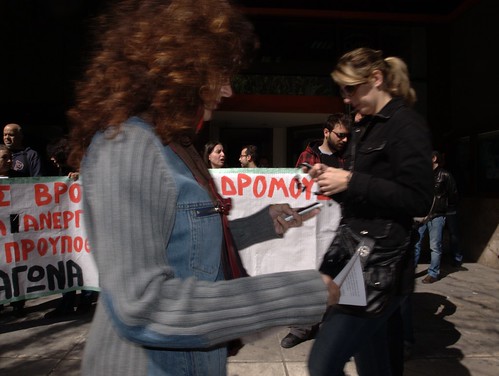
Protesters demonstrate against rising unemployment in Greece


Figures recently announced by the Greek government show that unemployment nationwide at the record high of 15.1% and set to go even higher as nearly 1000 jobs are lost per day in the worst economic crisis the country has seeen since the end of the Second World War..

As the effects of the austerity package implemented at the behest of its creditors bite even deeper the Greek economy has contracted by over 6% in the last year alone. With cuts in the public sector and wages in general the average household has seen a drop in spending power of 40% which has led in turn to job losses in the private sector.

However, according to recent studies carried out by the GSEE (Greece's equivalent of the British TUC) the unemployment rate is likely to top 20 - 22% in 2012, meaning that 1,2000,000 will be looking for work in a nation of 11 million inhabitants..

In protesters outside a local unemployment office in the Northern Greek city of Thessaloniki today demanded the extention of benefit payments to all jobless for the entire period of their time out of work. At present jobless Greek can only claim dole if they have had collected 250 national insurance stamps in the previous two years, so ruling out hundreds of thousands who were previously employed in the country's extensive black economy. In addition once benefit payments run out after 12 months those without work can only claim again after two years of full unemployment leaving a question mark over the future of millions of families who may be faced with a future without any tangible source of income

www.demotix.com/news/658923/greek-jobless-figures-reach-r...

Friday, August 20, 2010

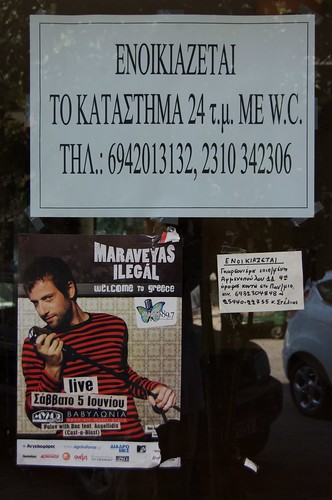
ENOIKIAZETAI - FOR RENT

As the economic crisis in Greece bites ever deeper more and more of these signs are appearing in shop windows across Thessaloniki, Greece's second largest city. In some neighbourhoods closed down shops now outnumber those still in business.

Rapidly rising unemployment (up 50% in just one year), shrinking incomes and worry about what the future holds means that Greek families are now cutting back on spending in every category including basics such as groceries, a fact that many of my Greek friend swore blind would never happen no matter how bad things got.

With consumer confidence rock bottom and Greece's GDP set to drop 3.5% this year no wonder 86% of businesses are reporting cash flow problems. The Greek Chamber of Commerce is predicting the closure of 100,000 small enterprises before the year is out with the loss of yet more jobs.

Some parents, especially those on lower incomes are even cutting back on the amount they spend on their children's education, a situation that was almost inconceivable a few years back. The conventional wisdom was that Greek parents would make any sacrifice in order to help their son or daughter get the qualifications needed to get on in life.

The problem is that not only do families have far less disposable income than ever before but also there has been the realisation that the degrees and certificates that have been gained with so much sweat, toil and financial outlay are virtually worthless in terms of getting a decent job. The country s full of university graduates who cannot get work of any kind, let alone jobs that utilise their expensively acquired education.

It is exactly this generation that rose up in December 2008 and were at the forefront of the most violent and extensive civil disorder Greece has seen in a generation. However, the economic conditions then seem positively idyllic compared with the prospects now with one in three of 15-24 year olds jobless. No society, especially one as volatile as Greece can stand such levels of anger and hopelessness amongst its young for long.

Last time it was the killing of a 15 year old teens which caused a month long series of riots and confrontations in virtually every urban area nationwide and led to billions of euros worth of damage. One has to wonder how long it will be before another incident sets off the Greece's disaffected youth.

Thursday, August 19, 2010

Greece's richest yet to feel the heat of the economic crisis.

Sometimes there is such a wide divide between the way news about Greece is presented abroad that you might be forgiven for thinking that perhaps the country is like Slovenia, constantly being confused with Slovakia.

Today the BBC had a lead story that the Greece has fulfilled the conditions for the next installment of the massive 110 billion euro bailout package. To judge from the tone of the article all is well in Athens and now it is business as usual.

The fact that the imposition of the IMF/European Union/European Central Bank measures has crippled the economy seems little more than a perplexing footnote. The reality is that virtually every economic indicator is in the red. Unemployment has risen nearly 50% in just a year, 30 billion euros has been taken out of the country's banking system in the last 12 months and tourism revenue has dropped 25% since 2008.

The Greek Chamber of Commerce is also predicting that over 86% of business are facing liquidity problems and that 100,000 are set to close by the end of the year so further hampering government efforts to raise tax revenue in order to reduce the massive deficit.

However, unable or unwilling to take on Greece's wealthiest prime minister Giorgos Papandreou has followed the safe path and hiked up VAT twice in th last few months and pushed up fuel prices over 70% since taking power last September. Such tactics are a stark admission of how ineffectual the Greek state is in taxing the country rich directly. As a result the burden of the sacrifices being demanded is falling disproportionately on the shoulders of theworking and middle class.

At first glance such measures could hardly be considered an easy option for any democratically elected government but the fact that PASOK would rather go head to head with millions of bitterly disappointed voters than challenge the wealth and power of the country's richest inhabitants speaks volumes about how much influence they wield in modern Greece.

Sensing the growing outrage over falling wages, rising unemployment and the huge tax increases PASOK is mounting a propoganda campaign to convince the electorate that the better off are also being called up to pull their weight. Day after day the state run channels, along with pro government newpapers and TV stations are reporting raids on clubs and bars evading tax.

The problem is that most Greek have seen such campaigns so often that they are very cynical about their supposed results. Most believe that even if businesses are caught a quick word/bribe to the relevent official means that the case will quietly be dropped once the glare of publicity has moved on.

On the other hand Greece has pointedly ignored the opportunities for clawing back lost revenue squirrelled away in Swiss bank accounts by refusing to act on information that the French and Italian authorities were quick to utilise in their crack down on tax evasion.

Apparently not one of the 1000 plus Greek customers of the Swiss branch of HSBC was worth investigating. In contrast the Italian tax authorities found several cases of wrong doing among the 5728 Italian individuals and companies with accounts.

Whether SDOE (Greek IRS) was right in making such a call is less important than the message it has sent to the public that while they are being crushed by the current austerity program those with access to wealth are not feeling much pain at all. Protected by their off shore companies and close connections with those in power, Greece's elite are quite happy to ride out this crisis in the comfort of their villas and yachts.

The sad irony is that the measure to raise state revenues are not working the, more Athens raises VAT and other indirect forms of taxation the greater the gap is between the amount collected and that needed. Fears of unemployment, falling incomes and rising prices of basic goods such as bread and power means that people have far less disposable income and what money they do have left over is being hoarded in case of future emergencies. With the economy entering a graveyard cycle it is becoming harder and harder to believe that Greece will be able to halt the decline without a radical reapprisal of its current economic priorities.
Friday, August 06, 2010

The Greek economic crisis's 600lb gorilla in the room

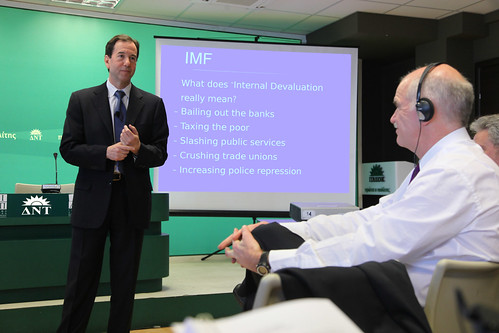
I'm sure than you have that old medical joke, "the operation was a success but the the patient died" a thousand times but I can't help but recall it when I see on the state - run ET1 and NET news bulletins reports of how quietly optimistic the IMF/EU/ECB are about the progress Athens has been making in implementing the economic reforms needed before they approve the latest installment of the bailout package.
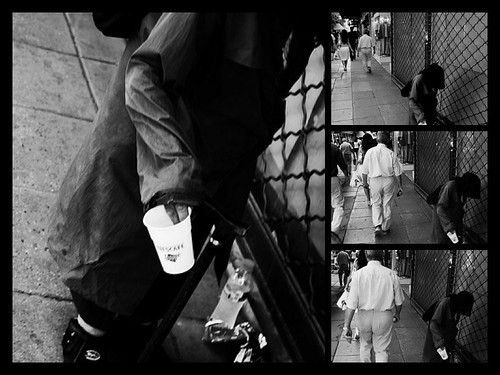

However, nowhere in the constant round of self - congratulation and back slapping are you going to hear anything about the issue that is most worrying to Greeks, namely unemployment. Currently, the official figure is 570,000 or 11.7% however, behind these numbers hide some truely horrifying facts. In some areas such as the Attiki region and Ionian islands the number of those looking for work has risen by up 50% in just one year. According to the latest OECD predictions unemployment is set to reach nearly 15% in 2014 whilst the Greek Trade Union Conference or GSEE (ΓΣΕΕ) is talking about a million jobless by next year out of a total labour force of 5 million.

Even this figure may be an underestimate since unemployment figures only include those signing on, which does not include many of those who have been unemployed more than one year who are considered to be "economically inactive" rather than unemployed or simply do not bother signing on as their benefits have run out. Nor are those working in the black economy (tourism and construction and even education are rife with employers who refuse to pay contributions) without national insurance who cannot claim unemployment benefit.


No provision has been made by the government for the tremendous social disruption likely to be caused by having one in five or even one in four of the work force unemployed, a number which is going to be higher if you happen to be a woman, disabled, under 25 or over 50. No mention was made of unemployment in the joint European Commission, European Central Bank and IMF upbeat press announcement concerning Greece's latest installment of the bailout package.
It's hard to consider any economic plan which produces joblessness on a scale not seen since the Great Depression as a success, yet that is exactly what the Greek government representatives and their supporters in much of the media are trying to do. There seems little awareness of the degree of social dislocation unemployment of such a scale is bound to produce. instead we are feed a steady diet of statistics and projections which are based on economic modela which do not take into account the conditions on the ground nor the fact that many official economic indicators are little more than educated guesses, the product of a state apparatus that does not even know how many people it employs.

On the other hand whilst hundreds of thousands of pensioners face cuts in their incomes to get permssion to borrow 9 billion euros the Greek government has found 25 billion to give to banks in order to improve their credit worthiness, which in addition to the 26 billion given in 2008 amounts to 15% of GDP or nearly four times the amount Greece spends on education per annum


NB the picture is NOT real but a piece of photoshopped fun. Just a reminder for those who had their sense of humour removed instead of tonsils when young.

Monday, March 22, 2010

Going under - Greece and revival of Thatcherism


As with any story the numbers only make so much sense by themselves and often reveal little about what is happening to ordinary people. As you probably already know Greece owes 320 billion Euros and is fighting desperately with its EU partners for the right to borrow yet more. Prime minister Giorgos Papandreou has thrown down the gauntlet to Germany, France et al to come up with a loan guarantee plan before 25th March (Greek independence day, by the way and a fact not lost on the public here) saying that otherwise Athens will go to the IMF for the money.

Whatever happens one thing is certain; the country is entering a preiod of economic depression unprecedented in its post war history with a society deeply divided and a welfare system that was struggling to cope even when Greece was being compared to Ireland in terms of its growth rates. Official figures for unemployment are about 10%, a number which is no more reliable than any other wonky statistic the government cares to publish. In reality nobody knows though local newspaper state that 20% is closer to the truth.

What we have is a return to the 80's and a re-run of Margaret Thatcher's first term as UK prime minister. Massive cuts in public services, clashes with trade unions and a promise to slash public debt are all part of the PASOK government's emergency program. In its wake we are already seeing a sharp rise in unemployment, and swathes of the country decimated as the ailing economy goes under.

Like Thatcher, Papandreou will be aclaimed abroad for being "decisive" and "brave", for taking "difficult, but necessary decisions". All the while letting others suffer for something he and his party should have stopped whilst in opposition. Where were PASOK and the shadow cabinet when the previous New Democracy government was selling the country down river?

The last time I saw the sharp end of Thatcherism was in Liverpool as a student and I still remember the damage wrought by such policies in terms of despair and hopelessness. Entire neighbourhoods wrenched apart by economists, politicians and civil servants who saw not people but graphs and pie charts. Grand theories which could be easily turned into into sound bites and question hour speeches.

I am now seeing the same financial tsunami rippling through the neighbourhoods where I live and work here in Thessaloniki. Walking through one yesterday I couldn't help but notice how many small businesses had closed down over the last few months, the number of older people riffling through rubbish bins and child beggers at the traffic lights, some barely able to see over the car bonnets.

On the other hand the political parties seem to think that it is business as usual and that they can continue putting on the same old puppet show to dazzle the public. However, no number of ads or sound bites can find you or your kids a job, nor replace the dreams you had for the future.

The levels of frustration especially among the young have reached new heights. As 24 year old Konstantinos told me, "If there's ever a war I'm out of here. I don't know anyone who'd fight, not for this government. They don't give a damn about us".