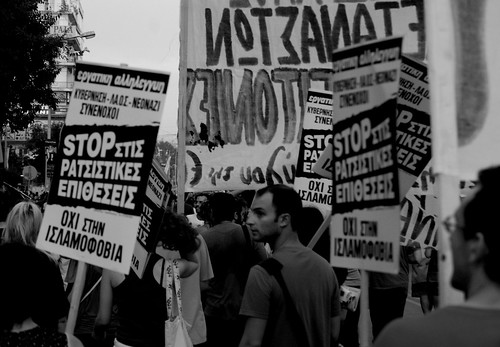
"In 2010, the Turkish border with Greece became the main entry point for people attempting by irregular methods to reach member states of the European Union, with some 128,000 arrivals. While some entered as migrants with the simple wish of finding a better life, a significant number fled violence or persecution in countries such as Afghanistan, Eritrea, Iraq and Somalia. The journey is perilous, with many reports of drowning when people board flimsy vessels and try to cross the Mediterranean Sea or the River Evros on the border between Greece and Turkey.
The many deficiencies in the Greek asylum system are exacerbated by the pressure of tens of thousands of people awaiting asylum hearings. Reception facilities for new arrivals, including asylum-seekers, are woefully inadequate. Last year, UNHCR visited a number of overcrowded facilities where children, men and women were detained in cramped rooms with insufficient facilities. UNHCR is working with the Greek government to improve its asylum system and has called upon other European states to offer support."
"GENEVA (Reuters) - More than 850 people including 200 unaccompanied children are being held in shocking conditions at a detention centre for illegal immigrants on the Greek island of Lesvos, the U.N. refugee agency UNHCR said on Friday.
"The report on the centre at Pagani adds to concern already expressed by UNHCR about Greece's treatment of migrants.
UNHCR spokesman Andrej Mahecic said commission staff had visited the centre, which has a capacity of 250 to 300, earlier this week. Most detainees were from Afghanistan, he said.
"The UNHCR staff described the condition of the centre as unacceptable," he told a briefing.
"One room houses over 150 women and 50 babies, many suffering from illness related to the cramped and unsanitary conditions of the centre," he said."
In a move, reminiscent of pirate movies from the past, demonstrators from Greece, Germany, Italy and France in a flotilla of small boats blockaded a port on the Greek island of Lesvos (Mytilini). Around 40 rubber dinghies were used to prevent ferries from entering the port in protest against conditions in the Pagani immigration detention centre on the island. According to human rights activists refugees, some as young as two years hold have been held in an overcrowded ex - warehouse in appalling conditions.
Greek blogger Afroditi Al Salech describes the appalling conditions in the centre, originally designed to hold 250, but now home to 900 inmates, 300 of them children who are often locked up for days on end as there is not enough room in the yard for people to exercise for more than a few minutes every day.
Inside refugees, 150 women and 50 babies are often forced to sleep on the floor due to lack of space for beds and hundreds have to share the facilities' handful of leaking bathrooms throughout summer when temperatures often top 40c.
The majority of those held are refugees fleeing poverty and war in Afghanistan and Somalia who were smuggled onto the island from the nearby Turkish coast. According to official figures 100 people arrive per week on the island often dumped at sea by people smugglers anxious to avoid detection by the Greek navy and coast guard.
After being processed by the authorities those arriving on Greek territory are kept for months on end in such detention centres and then either illegally deported to Turkey or sent on their way to Athens where if they are lucky they can move to another European Union country or work on the black market.
However, many find themselves stuck in a bureaucratic nightmare which keeps them in Greece. According to the Dublin II Accord refugees are obliged to apply for asylum in the first country they reach. However, Greece has been accused by the UNHCR, Amnesty International and other human rights organisations of systematically refusing to grant such requests. Last year just 0.04% of those seeking asylum were granted it.
Without papers immigrants in Greece cannot travel legally to other countries nor get work or health insurance. As a result ports such as Patra and Igoumnitsa on the west coast of Greece have attracted thousands desperate to smuggle themselves out of the country.
Despite repeated criticism by the UNHCR of conditions at the Pagani detention centre (see here for last week's critical report) Athens has so far done little to alleviate overcrowding or implement measures for the protection of underage refugees who often disappear into the system and are never heard from again.
Questions still remain about the fate of 12 under age refugees from Afghanistan and Iraq who disappeared from a shelter in Thessaloniki, Greece’s second city in early August. According to reports in the Greek press the 12 were part of a group of 13 minors taken by ferry from a detention centre on the island of Mytiline on Tuesday to stay in shelters run by NGOs in the northern port town.
However, staff at the Arsis shelter for young people stated that 12 of the 13 had signed papers giving themselves permission to leave. The case came to light when Greek member of parliament, Giannis Zogias visited the shelter only to be told that most of the refugees had gone.
As the country gears up for national elections in the near future, the ruling conservative New Democracy government has sought to take a tough line on immigration in order to win back ground from the far right LAOS party who made substantial gains in the recent European parliamentary elections. In doing so prime minister Kostas Karamanlis hopes to shore up support from the right wing of the party and claw back votes.
In reply to the UN's recent condemnation of the Greece's handling of racism, leading LAOS party official, Adonis Georgiadis, MP for 2nd district of Athens said that he would seek the aid of wealthy Greek tycoons to round up all the refugees in the country and dump them in Sweden and New York if he were prime minister
Questions still remain about the fate of 12 under age refugees from Afghanistan and Iraq who disappeared from a shelter in Thessaloniki, Greece’s second city. According to reports in the Greek press the 12 were part of a group of 13 minors taken by ferry from a detention centre on the island of Mytiline on Tuesday to stay in shelters run by NGOs in the northern port town.
However, staff at the Arsis shelter for young people stated that 12 of the 13 had signed papers giving themselves permission to leave. The case came to light when Greek member of parliament, Giannis Zogias visited the shelter only to be told that most of the refugees had gone.
According to employees of the Arsis foundation, which is funded in part by the Greek ministry of the interior the document in question is a declaration that the minors have no parents and so are their own legal guardian. Otherwise they have the right to stay in the shelters until they come of age
The fate of the group remains unknown, though probably they have made their way to Athens in order to make their way to Italy according to source quoted in Greek national daily, Rizospastis. The same source also said that over the last month more than 40 young refugees had signed similar documents and had left the Koinoniki Alleleleggi (Social Solidarity) Shelter which is run by the Thessaloniki city council.
The Greek government’s treatment of refugees has repeatedly come under fire by the United Nations Refugee Agency, UNHCR, Amnesty International and the European Union for failing to abide by international agreements on the treatment of immigrants and refugees. Currently, less than 1% of those who apply for asylum are granted it.In addition European human rights groups such as Pro - Asyl and the European Commission for the Prevention of Torture have documented numerous cases of mistreatment by members of Greece’s police force and Coast Guard.
In July Arivan Osman Abdulach, a 29 year Afghan refugee died of injuries sustained after allegedly being beaten by members of the Greek port police in the northern port of Igoumenitsa in April.
The issue of immigration as become a political hot potato for the ruling New Democracy party following its recent poor showing during this year’s European parliamentary elections. Stung by loss of votes to the far right LAOS party, Greek prime minister, Kostas Karamanlis has announced a new “get tough” policy on illegal immigrants. Actions have included clean sweep operations in the centre of Athens and swifter procedures for the deportation of immigrants without papers. In addition the government has ordered that deportees be not given the right to appeal.
However, critics of the government’s new policies have pointed out that the country is violating both European Union law and international accords on human rights.
The ruling New Democracy party has also announced that it will set up internment camps throughout the country to house those who do not have a legal right to stay in the country. It should be noted that at present Greece grants asylum to 0.1% of those who apply for it and has been repeatedly criticised by Amnesty International, other European governments and the UNHCR for its treatment of refugees and immigrants.
On the other hand the latest poll carried out by Public Issue found that 93% of those questioned thought that Greece could not take in any more immigrants and that 62% said that immigration is probably harming Greece.
Stung by his party's poor showing in the recent European elections prime minister Kostas Karamanlis has decided to get tough on the issue of immigration in order to avoid losing more support to the far right LAOS party. With the possibility of general elections in either September or March 2010 at the latest Karamanlis is hoping that a tough stance on crime and immigrants will help bring back voters who have deserted the party in droves after two years of corruption and influence peddling scandals involving several government ministers.
The Greek daily Nea newspaper reported that the government was in the process of setting up internment camps for illegal immigrants throughout the country. Eleven disused army bases have been chosen in order to house those found without legal residency documents.
Stung by their losses in the recent European elections the ruling conservative New Democracy party has taken a sharp turn to the right in order to win back dissatisfied voters who’s defected to the far right LAOS party in last week’s elections.
In addition the police have made hundreds of arrests of suspected illegal immigrants in the centre of Athens in an action which has been interpreted as a “get tough” message by the government of Kostas Karamanlis to the party’s base following months of falling opinion poll results brought on by a series of corruption scandals and unhappiness with Athens’s handling of Greece’s deepening recession.
However, many opposition groups are doubtful whether the proposed measures will be anything other than a publicity exercise. Despite recent crackdowns the government has failed to formulate a coherent policy concerning the integration of the country’s 1 million foreign born inhabitants.
Desperate to leave Greece, the state has made it virtually impossible for them to travel, resulting in hundreds of thousands stuck in a bureaucratic limbo in which they are constantly at risk of arrest and deportation by the police. Even those who do escape face the risk of being sent back to Greece under the terms of the EU’s Dublin II regulations which states that immigrants have to apply for asylum in the first European Union country they reach. However, countries such as Holland, Finland and Norway have suspended such agreements citing lapses and abuses of the asylum laws in Greece, especially concerning minors.
Growing concerns over immigration have been exploited by Greece’s far right parties and organisations in order to raise their public profile and gain political leverage in parliament. Giorgos Karatzaferis, leader of the nationalist LAOS party used the recent elections to promote his party’s anti - immigration policies. In addition ultra - nationalists groups such as the neo - Nazi Chrysi Aygi (New Dawn) have stepped up attacks on immigrants in Athens.
This is not the first time that internment camps have been used in the history of modern Greece. During the military junta which ruled from 1967 to 1974 the state set up camps on the Greek islands to imprison and torture political dissidents.