Showing posts with label The Economist. Show all posts

Saturday, July 17, 2010

Greece - looking beyond the statistics


As Greeece sinks more and more deeply into economic recession one of the most frustrating aspects of the crisis is the lack of quality coverage from the foreign press. Whilst most Greeks have little of no confidence in the veracity of local media reporting, they do not expect the same kind of low grade journalism from organisations such as the BBC or the Economist.

On Thursday Gavin Hewitt, the BBC's European editor wrote about the current situation in Greece in his blog and while reflecting the widely held belief amongst economists the the current "rescue package" is doomed to failure seemed happy to simply regurgitate Athens's line on how the situation is all under control and that things are going to plan. Hewitt even went as far as to say that;

"It was expected that austerity would persuade Greeks to keep their wallets shut. Private consumption is actually up by 1.5%."

No source is given for this surprising factoid and it flies in the face of virtually every piece of economic and anecdotal evidence I know of. Since the massive hikes in VAT and tax on petrol have lead nearly everyone I know to cut back on spending on everything from holidays to food. According to the national daily Imerisia sales of petrol have fallen 30% since the beginning of the year leading to the closure of over 1000 petrol stations nationwide. In addition foreign retail chains such as FNAC and Aldi have recently announced that they are pulling out of the Greek market and local supermarket chain Atlantik is set to close its doors as well with the loss of 4000 jobs.

These events hardly point to a bouyant retail sector nor do they seem to show that private consumption is on the rise. This is another example of foreign commentators with little in the way of real life experience of the countries they are covering relay on official statistics and second hand accounts. If Hewitt had asked anyone outside the hermetically closed worlds in which foreign journalist often operate he would have seen a different picture from that shown in the officially sanctioned Greek state media which drifts ever further from the shores of reality in its quest to prop up the government's line.

However, the BBC is not alone in swallowing the half truths and full-on misconceptions that often surround Greece's role in the present economic crisis. A hardy perennial in that category is the idea that the country has, in the words of the Economist, "a lavish social security system" and that uncontrolled public spending on the old and poor has bankrupted the country.

Yet what the Economist either do not care to know or did not bother to find out is that while lavsh payments are to be found in the sytem they are limited to the members of the country's state and party nomenclature and that for every 50 year old living high on the hog on their state pension there are hundreds of other OAPs eeking out a living on less than 400 euros a month in a country where the cost of living is only shade lower than in countries such as Germany and the UK.

With the highest rate of poverty in the EU and the largest number of working poor Greece is hardly the worker's paradise that publications such as the Economist would have us believe. Life for those without the right party and personal connections is a hard struggle for survival which is daily getting becoming more difficult as the IMF/EU/ECB measures eat away at the nation's economic foundations so bringing little more than poverty and despair in the name of an economic orthodoxy which failed so spectacularly in 1929.

Monday, June 01, 2009

ΠΑΣΟΚ - Με την ευγενική χορηγία της Ζίμενς

"Reinhard Siekaczec, a former executive at the German electronics giant, which supplies equipment to Greece’s state telecoms operator, gave damaging testimony at a trial in Munich earlier this year. He said that “commissions” worth 8% of the contract’s value were paid to Greek politicians and senior executives through a network of offshore companies. The total amount exceeded €1 billion, he claimed. Most of it apparently went to officials from Pasok, which held power from 1993 to 2004, but the New Democracy government elected that year approved a contract worth over €40m for security equipment for the Athens Olympics.

Nikos Zagorianos, a prosecutor investigating the Siemens affair, is shortly to go to Germany. One former Pasok official, Theodoros Tsoukatos, has admitted that he accepted €400,000 from the local Siemens boss as an election contribution in 1999, when he was a prime ministerial aide responsible for collecting political donations. Amid the furore, Kyriakos Mitsotakis, a New Democracy deputy who is the son of a former prime minister, recently paid an overlooked bill for a switchboard that was supplied to his private office by Siemens, after a copy of the invoice was printed in a Greek newspaper."

http://www.economist.com/world/europe/displaystory.cfm?story_id=12209248

Saturday, December 20, 2008

And they say bloggers are sloppy!!!!!

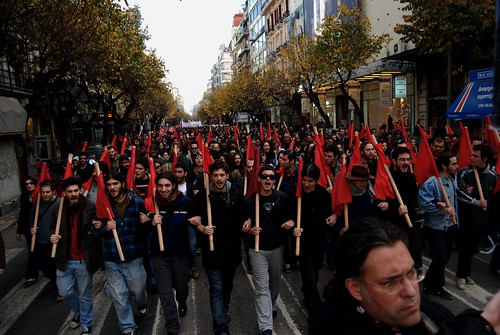
Day of Rage - Greek protests: Day 2

Foreign coverage of the events in Greece has been a mixed bag. There have been some very good articles on the causes of the protests, for example the Guardian wrote in depth about the situation (click here) and the BBC's Malcolm Brabant gives a very accurate account of the underlying causes (click here) .

On the other hand I have come across a lot of "remote - control" journalism. The kind where the person has done little more than Google the subject for an hour or so or chatted to some guy in a bar. You know the classic foreign correspondent tactic when abroad and disconnected from the culture. I think this article in the Economist definitely falls into the second category. Sweeping generalisations, lack of context and a blind acceptance of other media sources make for pretty sloppy work.

So, instead I recommend Twitter (#griots hash) which has been a very good source of information and links written by those actually involved or on the scene. Most of it is in Greek but you can translate the page into English by clicking on the button on the right hand side. Also Technorati and Google's blog search can often prove very valuable.

Sunday, October 26, 2008

Separated at birth?


I just came across this strange coincidence. In March I wrote this on the blog and for NowPublic.com.

The ghost of Mexico City comes back to haunt Beijing

Stop me if you've heard this one before. An authoritarian one party state uses blunt military force to squash a popular uprising. Hundreds are killed or injured and the government fears that attempts to burnish its image abroad by holding the Olympic games will be tarnished by images of dead protesters splashed across the world's media. (Click here to read the rest).

and today I came across this article in the Economist from April 24th.

The ghosts of Mexico 1968

A DEVELOPING country gets the Olympic games as an acknowledgment of its new, exalted status. An authoritarian government, awash with money, exploits the chance to project a peaceful, progressive image. Critics of the regime use the games as a chance to demand more democracy and human rights. There are demonstrations, forcefully broken up. (Click here for the rest of the article).

Actually, the rest of the article is radically different from mine but it follows the same logic. But before I say that have been plagiarised I have to say that I use other sources all the time. Indeed the idea for my post came from reading 1968: Marching in the Streets by Tariq Ali and Susan Watkins. That and my anger at the way the Greek authorities did their best to surpress any possible protests on the Olympic torch route (see here).

Still, it is gratifying to think that you have perhaps influenced the flow of news and ideas in the mainstream media.