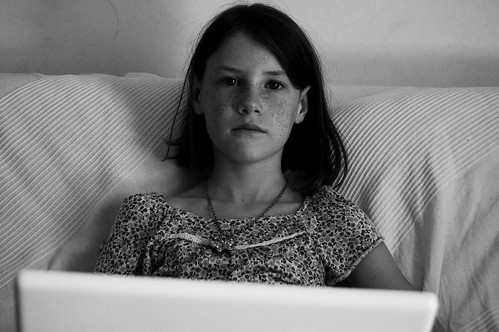
Just before the last elections the Greek government announced that it was going to pay for every student entering the first year of junior high school (gymnasio) to have a laptop. Many, including myself, dismissed the move as yet another empty election promise made by a ruling party rapidly losing popular support. It seems that I was wrong about that as the first computers make their way into the hands of students I teach.
Despite this good news I think that the move is still little more than a publicity stunt and that in order for the country to drag it's antiquated education system out of the 19th century a lot more has to be done than dump a load of cheap netbooks onto the market. While providing students with PCs is an admirable thing, the policy, like so many educational polices before it is based on garnering good publicity rather than improving fundamentals. Greece's educational system is beset by a series of deeply rooted problems which are according to international organisations such as OECD seriously affecting the country's economic performance.
While Greek academics make much of the fact that the current system is based on humanist principles rather than market forces the reality of the situation is that it is a deeply unequal process whereby the the children of the poor are systematically weeded out due to the ever increasing need for pupils to undergo expensive extra tuition. A process which can start as young as seven years old and continue up to postgraduate level. The outcome is that huge amounts of talent are being ignored and wasted.
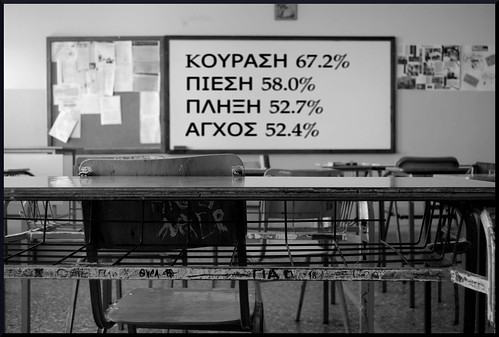
The resulting educational system is one in which only those with well off parents are able to bear the financial burden of combating the deficiencies of the state system with it's lack of funding and dispirited teachers. If this was not indictment enough the ridiculously swollen curriculum means that students in the final classes of high school have to put in 100 hour weeks for years on end, desperately trying to cram for exams which reward those who can most accurately reproduce the content of substandard text books, often decades out of date.
Even pupils as young as 11 are expected to plough through 25-30 text books in the course of their 30 week school year. Of course only a small proportion of this can be effectively assimilated in terms of real knowledge and hence students, parents and teacher collaborate in an expensive, time consuming charade in which good grades and cramming are substituted for learning and comprehension. It is a culture which promotes learning by heart, shortcuts (SOS as they are known in Greek) and crib notes (skonakia). All of which are rational reactions to the irrational demands of an overblown curriculum.
Of course in such a system creativity, self-expressions and comprehension are just luxuries which are quickly discarded by student and teacher alike in favour of getting better grades in yet more tests.
It would be nice to think that such huge outlays of times, money and effort were producing a generation of young Greeks who have a sound grasp of the basics, who were able to hold their own against anyone in the world in terms of educational prowess. Unfortunately, according to the PISA (Programme for International Student Assessment) organisation which measures the educational attainment of 15 year olds around the world this is not the case. In most indicators Greek students fare far worse than their European counterparts in terms of their linguistic, mathematical and scientific knowledge.
In such a sclerotic system I'm not sure how the presence of computers is going to help. Has any provision been made for the inclusion of material other than that in the coursebooks? Have teachers been trained in the use of PCs? What about internet connections? Has provision been made for wi-fi access? Are there even enough plugs to charge 20 to 30 netbooks?
The answer to all these questions is a deathly silence which just about sums what will happen in terms of actual classroom practice. For the main part teachers unfamiliar with computers will ignore them, the curriculum will continue to assess only that which is book based and the kids will stop lugging around their laptops knowing that their chances of using them are next to nil.
So am I dispirited by this? Strangely enough no. The fact that a whole generation of kids are going to be using this technology gives me hope as they will become familiar with it whatever the schools say or do. In addition for me as a language teacher it means that more and more of what I do in my English lessons can use the possibilities of the web.
In a sense this is hidden hope upon which OLPC (One Laptop Per Child) project is based on, not that the presence of laptops will be widely utilised by our current hyper conservative educational systems but rather that by showing young learners that there are other sources of knowledge, other ways of leaning apart from the traditional academic routes a demand will be created for another kind of education in which text, teacher and tests do not dominate. One in which the often medieval understanding of what a classroom is will be gradually eroded and learning techniques based on unlimited access to knowledge replace those based on dealing with scarcity.

