Showing posts with label eleutherotypia. Show all posts

Monday, November 23, 2009

Greek police accused of beating 35 year old mother in front of her two year old child

Greek police raze refugee camp to the ground.

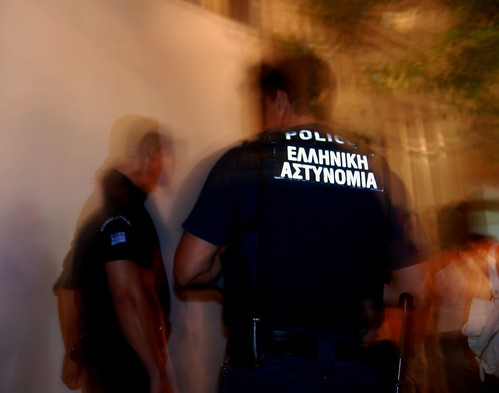
I just came across a story that once gain confirms my belief that the police here in Greece are out of control subject to little or no oversight. In an appalling case reported in the Eleutherotypia newspaper's site (see here in Greek) a 35 year old Armenian woman was beaten, handcuffed and detained in front of her two year old child home on the home from a supermarket in Athens last Thursday.

According to the interview she gave to the newspaper the incident was triggered when the woman, who is married to a well - known Greek musician, was accused by plain clothes police in an unmarked car of insulting them. They then asked if she was from Romania and when she said that she was, in fact from Armenia demanded to know why she was in Greece. They then produced police ID and demanded she come with them to the local police station.

When she went to get the pushchair carrying her child they grabbed her, pushed her to the ground, kicking and punching her in the belief she was resisting arrest. The hapless mother was handcuffed and taken with her child to the Aghios Pantelimenos police department where she was kept for four hours.

The Aghios Pantelimenos district of Athens has been in the news on several occasions over the last year following clashes with the far right group, Chrysi Aygi and immigrants living in the area. Many foreign born shop owners have also accused the police of turning a blind eye to racist intimidation in the area.

Wednesday, November 18, 2009

The truth is out there but not if you read the Greek press

The Greek blogosphere has been full of complaints over the way the mainstream media covered yesterday's Polytechniou Day. It seems there has been a concerted effort to either play down or ignore much of what happened. For example much of Thessaloniki, Greece's second largest city was covered in a blanket of tear gas for hours on end as riot police fired round after round of the stuff into the university grounds to supposedly disperse a few dozen protesters.

In addition the clashes between right and left wing student groups in the morning has been less than honest. For example today's Eletherotypia newspaper reported that;

"Επεισόδια σημειώθηκαν και νωρίς το πρωί, την ώρα που άρχιζε η κατάθεση στεφάνων στο μνημείο των πεσόντων, στο προαύλιο της Πολυτεχνικής Σχολής του ΑΠΘ. Ομάδα φοιτητών του Πανεπιστημίου Μακεδονίας που πρόσκεινται στη ΔΑΠ προσπάθησαν να πλησιάσουν για να καταθέσουν στεφάνι, αλλά μέλη νεολαιών της εξωκοινοβουλευτικής Αριστεράς τούς υποδέχτηκαν με πέτρες. Ακολούθησε συμπλοκή στο οδόστρωμα της Εγνατίας οδού που κράτησε περίπου 15-20 λεπτά."


They were incidents early this morning when members of DAP (the student wing of the conservative New Democracy party) attempting to lay a wreath during a ceremony for the victims of the 1973 Polytechnic uprising at the Aristotelion university of Thessaloniki were stoned by members of the student supporters of the extra parliamentary left. The clashes that followed lasted approximately 15 -20 minutes."


Well, I happened to be there at the times and as you can see from the picture above the hundred or so DAP members who gathered opposite the university were hardly dressed for a such a solemn ceremony. Nor do those who wish to pay their respects hurl paving stones, bottles and insults at people attending,

There were clashes but from what I saw many of those inside were preparing to defend the shrine set up inside the campus from attack by these hooligans.

So why the discrepancy in the accounts? I'm not sure if it is just indifference, ignorance or a worry that the newspaper's political line must be preserved irrespective of the truth.

Monday, September 07, 2009

Greek police fail to learn lessons of December

Greek police raze refugee camp to the ground.

Just hours after the shooting of 15 year old Alexandros Grigoropoulos by a police officer in the Exarchia district of central Athens, hundreds started violent protests that would last for weeks and cost the country billions of euros in damages. Despite the ferocity of the response to the killing it seems that the Greek authorities have yet to appreciate the potential for backlash created by accusations of police violence. One of the major driving forces behind the December riots, the worst in modern Greek history was the conviction that the officer involved would not be punished.

In the latest case the recently formed Delta motorcycle unit stand accused of using excessive force in the arrest of a 27 year old man last week in Exarchia. According to report in today's national daily, Eleutherotypia the unnamed man was detained and beaten by several police officer who left him with broken ribs and a punctured lung. Afterwards he and four others who had also been detained were tied to a tree.

The official police report states that the detainee had been stopped during a routine check and arrested for carrying explosive materials, GBH and resisting arrest. Throughout most of last Thursday night police and youth clashed in a series of running skirmishes in the area.

As the article in Eleutherotypia points out it is a standard police tactic in such cases to charge victims of police violence with serious crime in order to justify their treatment. In a similar case in November 2007, Cypriot student, Augustinos Dimitrios whose brutal beating was captured on live TV was charged with resisting arrest.

Similarly, the police officers charged with the killing of Alexandros Grigoropoulos in December first stated that they had acted in self defence after allegedly being attacked by a group of stone throwing youths, including Alexandros. Despite the appearance of amateur video footage the following day which contradicted the official version of events the authorities insisted on sticking with the officer's discredited account for weeks.

The Greek police force has routinely been the object of critical attention by organisations such as UNHCR, the European Union, Amnesty International and other human rights groups. In both 2005 and 2008 the Council of Europe’s Committee for the Prevention of Torture (CPT) roundly condemned the Greek authorities for turning a blind eye to the violent treatment of prisoners and suspects by prison and police officers (click here to see report).

Monday, July 27, 2009

Greek government's forced deportation provokes anger


Amidst protests by local human rights activists refugees on the Greek island of Chios were taken to detention centres on the Greek mainland in handcuffs. Around 60 recently arrived immigrants were taken by ferry from the island in the northern Aegeon to the the Greek - Turkish border region of Evros. Amongst those relocated were an 15 year old Somalian boy forced to leave behind his mother on the island.


According to Greek national daily, Eleutherotypia, attempts by a 17 year old Palestinian detainee to claim asylum during the transfer were ignored despite the presence of a lawyer whose repeated pleas that the teenager be given his rights under UN treaties signed by Greece were dismissed.


Unconfirmed reports on the Indy.gr news site claim that previous deportations on the 16th July ended up with the refugees being dumped near the Greek - Turkish border. It should be noted that the area is heavily mined and that every year tens of those attempting to cross into Greece from Turkey fall victims to the regions numerous minefields.


Greece has been repeatedly accused of violating international agreements concerning the handling of unaccompanied minors by organisations such as Amnesty International. In addition courts in Germany has refused to deport refugees back to Greece citing the country’s unwillingness to abide by EU and other international treaties concerning the treatment of undocumented immigrants under 16.

The recent upsurge in enforced deportations has followed in the wake of the ruling New Democracy’s poor showing in the the recent European parliamentary elections. In clamping down on illegal immigration in Athens and the Aegean islands prime minister, Kostas Karamanlis is seeking to stem the flow of votes to the far right LAOS party which sent two representatives to Brussels by adopting a get tough policy on protesters and undocumented immigrants.

However, the official policy of “cleaning up” immigrant neighbourhoods has also given rise to growing militant activity on the party of the country’s ultra - nationalist groups with several well - documented cases of the police turning a blind eye to racist groups attacking buildings and areas frequented by foreigners such as Agios Pantelimenos section in central Athens which has witnessed several incidents involving member of the neo nazi Chysi Aygi organisation.


Tags: | | | | | | | |

Monday, June 01, 2009

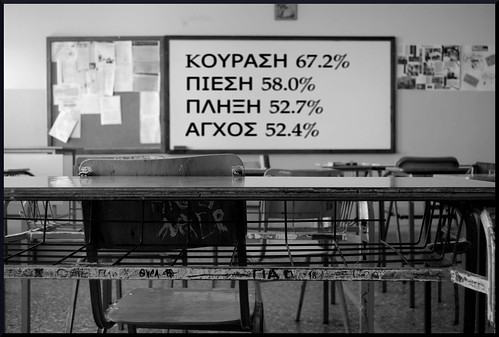
Μάθε καλά τα SOS για τις εξετάσεις. Here are your crib notes for the test.


Μάθε καλά τα SOS για τις εξετάσεις. Here are your crib notes for the test., originally uploaded by Teacher Dude's BBQ.

ΚΟΥΡΑΣΗ 67.2%
ΠΙΕΣΗ 58.0%
ΠΛΗΞΗ 52.7%
ΑΓΧΟΣ 52.4%

TIREDNESS 67.2%
PRESSURE 58.0%
BOREDOM 52.7%
ANXIETY 52.4%

As I was in the centre a headline in the Eleutherotypia newspaper caught my eye, Pupils Golgothas. Actually, every year newspapers use exactly the same words to describe the annual Panhellenic university entrance exams. However, the article also mentioned the results of a survey which had been conducted on student attitudes to school. The most popular response was tiredness, followed by pressure, boredom and anxiety.

To fully understand what students in Greece go through on regular basis you have to look at a typical day for many of them. This involves waking up at 7am in order to be in school for just after 8am. After doing a full day at school many of them are expected to do extra lessons at cramming schools, known as frontisteria in Greek.

Here they are supposed to learn the material which the regular school program was unwilling or unable to teach them. If this was not enough students are often assigned huge amounts of homework by both their school and frontisterio.

The basic logic being that "good" teachers swamp their pupils with material. As a result, after finishing extra lessons at 9 or 10pm they are often studying till midnight for the next day.

As if this wasn't enough the teenagers are also expected to study for a foreign language qualification which many consider essential in today's job market. So, add another 6 - 10 hours of lessons and study to your week.

You'd expect that with so much teaching going on the amount that students learn would be much higher than in other countries? Unfortunately, no. In international surveys on student ability Greek pupils regularly score far below their "lazy" European peers (see pg 53).

What you have is the educational equivalent of gruel. A low quality product dished out in large quantities. Dull, boring and mostly ineffective which people are forced to consume in vast amounts as they have no alternative.

The picture above was taken a little while back in a high school here in Thessaloniki. I spent a weekend in this classroom wondering how on Earth people stand seven odd hours a day in such a place without going crazy. The material and intellectual poverty of the place was enough to depress even the most ardent advocate of education. Bare walls, broken furniture, total absence of any kind of teaching equipment other than a board marker were stark reminders of how little interest the present government has in providing quality learning.

The school, which was less than a decade old was little more than a warehouse to keep kids off the streets, a con trick to fob off parents with the illusion that their children are being educated.