It's a measure of how far the Greek political system and its supporters in the local media are out of touch with the rest of the country that the recent uproar over the remarks by Jean Claude Juncker, head of Euro Group that been the subject of some much air time and print columns during the last few days. According to an off the record remark made by Juncker in Washington a Greek prime minister told him that Greece was a country of corruption, a revelation on par with learning that the French eat rather a lot of cheese or that it can get awfully cold in Russia.
The fact that Greece has one of the highest corruption indices in the European Union or that the present PM, Giorgos Papandreou made much the same comment after taking power in 2009 seems to have been ignored by the Greek political establishment and the country's media who went into a feeding frenzy in their attempts to identify which Greek PM had made such an outrageous statement. Kostas Simitis, head of the 2000-2004 PASOK run administration, Kostas Karamanlis, PM from 2004 till 2009 and finance minister Giorgos Papankonstantionou on behalf of current PM Giorgos Papandreou all rushed to say that they had said no such thing. (Juncker later made a statement saying that it was Giorgos Papandreou)
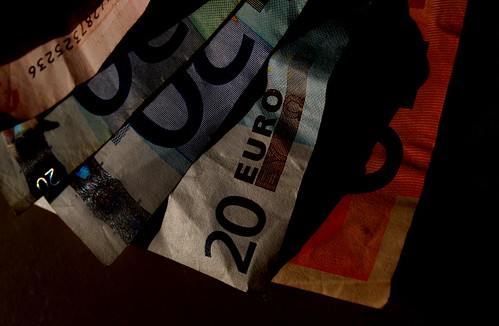
And so it has gone on, with endless speculation in the press as to exactly let the cat out of the bag. The fact that the Greek state is corrupt, of course comes as absolutely no surprise to anyone living in the country. Indeed Transparency International calculated that Greeks spent an average of 1355 euros in bribes in 2009.
Actually, the problem is not that the Greek political establishment turns a blind eye to corruption (see the Vatopedi land swap scandal) but rather everyone now knows. Worst of all, foreigners know just how venial Greek politicians are. How embarassing when one is putting one's best foot foward in Brussels, Strasburg or Washington that the rest of the world sees you as little more than a robber baron. For people as image conscience and ego driven as Greek politicans in power this comes as a terrible blow.
Perception, rather than reality is everything which is one of the reasons why the country is in such as mess. Why bother attempting to make difficult political decisions when all you need is a handful of IOUs and promises which you may or may not honour. Even now the opposition New Democract leader, Antonis Samaras is touring northern Greece in the run up to November's local elections giving his word to open factories, fund development and the like knowing full well that he would have no more financial freedom than the current PASOK administration to act. (The fact he was a cabinet minister in the previous government which ran up such huge debts seems to have slipped his mind at present).
Such a cavalier attitude to the truth also explains the chronic distrust of the average Greek concerning any promise politicians make. Indicative of this is the refusal of truck drivers to end recent industrial action despite promises by the government to discuss their demands. It wasn't until the proposals were put in writing that truckers agreed to stop strike action. Of course truck drivers know that even written reassurances mean little to politicians but it does give them a little less wiggle room.
But while the country's TV talking heads and their partners in crime and print have talked endlessly about what Juncker's statement means the country slides ever deeper into depression (both financial and psychological) with schools unable to pay fuel bills, hospitals running out of medical supplies and and an angry electorate bracing itself for a winter with 30% hikes in heating costs. For many patience is running out with the endless self - referential charade of the current political setup.
Just one more thing to consder, though when considering the role of corruption in the current financial debacle is that Iceland, whose per capita debt is even greater than Greece's, was ranked the world's 7th least corrupt government (Athens came in at 71) in 2008.


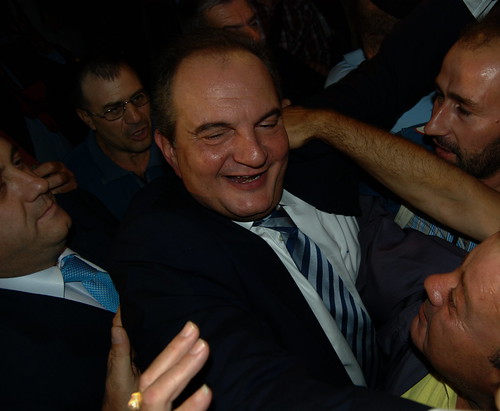
The revelations that senior New Democracy officials had collaborated in a highly dubious land swap in which a remote lake in the north of Greece was exchanged for a large piece of prime Athens real estate outraged public opinion and ultimately ended in Karamnlis calling for early elections.
The details of the deal which featured the Greek Orthodox monastery of Vatopedi are as convoluted as they are legally dubious. However, an insightful article in Vanity Fair by Michael Lewis paints a lucid, if dark picture of corruption and lawlessness at the heart of the Greek political establishment. According to Lewis it was exactly the ability of polticians to operate without oversight or restraint that helped create the present financial crisis and massive debt load.
Yet even as the country set to enter its third year of recession with the prospect of still more cuts and the economy set to shrink even further the the political establisment in Athens are still playing the same constitutional games, seemingly untouched by the financial maelstrom embracing Greece. Evasions, denials and endless parliamentary manouevering still rule the day and even after the appearance plethora of evidence indicating wrong doing the former prime minister of Greece can say that neither he, nor his administration have any repsonsibility for either the Vatopedi scandal of the dire state of Athens's coffers.
It would be nice to think that by ousting a corrupt government Democracy has once more won out. The reality of the situation is that one corrupt poltical oligarchy has been replaced by another. The current rulers of Greece, PASOK have a rich history of scandal and corruption which has been not resulted in a single conviction, The Sieman's bribery case and a list of pay offs by other German firms to PASOK officials in the run up to the 2004 Olympic Games has also been put on the parliamentary back burner, to be quietly dropped at a future date.
Given that the current political scene is full of exactly those officials who presided over the creation of Greece's present woes its is very hard to have faith in their ability to not repeat the mistakes of the past. In all probability the future holds more of the same just on a smaller scale reflecting the country's dire fiancial state.
It's a bitter irony that Kostas Karamanlis was elected on a reform ticket by an electorate fed up with the corruption of the previous PASOK government lead by Kostas Simitis. His promise to clean up politics and reform the dysfunctional Greek state stroke a chord with voters who hoped that the right of centre New Democracy party would change the status quo. As history has shown the differences in ideology between Greece's two largest parties are nothing compared with their inability to resist the financial temptations offered by power.
Faced with the failure of both PASOK and New Democracy to control the greed of their own officials the local elections in November may prove to be the beginning of the end of the current Greek party political scene.