Friday, June 30, 2006

Should I be worried?


If you put "banging teachers" in Google you get my blog at the
top of the list. How weird is that? Click here. More strange
and illuminating facts courtesy of Sitemeter.com.

Thursday, June 29, 2006

And there was much wailing and gnashing of teeth in the land


One of the great things about summer is that I have more time (and perhaps more importantly, appetite) for reading. I've finished the World is Flat by Thomas Friedman and Freakonomics which were both full of interesting, left-field ideas about everyday life. Of the two, Freakonomics is the easier read (not to mention shorter LOL). It investigates such intriguing ideas as what Sumo wrestlers and cheating techers have in common and the economics of naming your child!

Unfortunately, the world is not flat all over as I discovered yesterday while booking my return flight to Greece on the internet. The actual booking part went smoothly and was completed in less than five minutes (hurrah Thomson!!!). However, when I got my confirmtion email it didn't mention anything about tickets, Indeed it said that I had to have my flight documents with me when I check-in. As this is the first time I've booked a flight via all through the internet I wanted to confirm that I had indeed got a place on the flight and ask about the procedure as far as collecting the tickets was concerned.

The most logical answer would be that I would pick them up at the airport. However, living in Greece for many years has taught me always to check such details in order to avoid any unwanted complications.

Golden rule - The size of an organisation is inversely related to the common sense it uses when dealing with people.

And then suddenly bumpy terrain. First, I made a phone call to their "help" line which produced first, an engaged line(20 mins) and then a recorded message that they were all doing training. Next, a vist to the local Thomson travel agency got me zero results. They said that they had nothing to do with the internet side of the business and that I should phone the help line.

When I told them I'd already tried that they reminded me that they had no connection with the internet side of the business (if this is all starting to sound familiar I went through this loop two or three times before I realised that I was in fact dealing with some advanced, prototype cyborg, rather than human being. Eventually she did offer to phone on my behalf. However, only if I gave her the phone number,

"You mean that you don't know your own company's phone number?
"But they are loads.
"And you don't have a list somewhere?
"Why don't you phone the helpline?"
"BUT I HAVE ALREADY...... never mind."

After appproximately ten more phone calls, including one to Kafka's long-lost English descendent, and another one to somebody who first refused to give my the number of the Thomson customer service department, and then denied that that Thomson even had a customer service department at all, did I manage to get the information I needed.

Does "No frills" have to mean "no brains"?

Tuesday, June 27, 2006

Staring out the window


Strange facts that you may be interested to learn about yourselves, dear Teacher Dude's BBQ readers.

1 80% of you use English on your computer, but only 2% know Dutch.
2 Only 11% of you use Macs.
3 However, less than half of you use Internet Explorer !!!!
3 Most of you are European (56%).
4 But 1% of you are from Peru.
5 One of you came across my site whilst looking for "aqualand corfu". I hope you read the article and choose a better hotel.
6 Today's visitors came from Poland, UK, USA, Canada, Greece, Australia, Serbia, Denmark, the Czech republic, Japan, Chile and Cambodia.
7 You spend, on average about eight minutes on the site.
8 One of you viewed this site from the Falk Laboratory school, Pittsburgh.

And you seem like such normal folks. LOL

BTW if you want to find out similar information about your own visitors check out Sitemeter.com and Geovisitors.

Monday, June 26, 2006

Taking time out to appreciate the flatness


One of the good things about being on holiday is that I can spend more time reading and surfing on the net. So, along with the fact that I temporarily (sigh) have access to a much faster connection means that I can enoy the "flatness" that the internet has been promising for so long.

Over the last day or so I have been doing nothing productive at all, which is tremendously liberating and has allowed me to come across some very interesting nuggets of information. So, please forgive the self - promotion, I'm merely doing it in order to illustrate a point.

Weird and wonderful facts that have caught my attention. Well, firstly, I have been sited as a source in an essay written by some student at the university of Harvard (sorry, the link has mysteriously disappeared from Google. No, seriously LOL), which is pretty mindblowing to tell you the truth. Secondly, and even cooler if possible, I got name checked in a podcast by David Noble who was talking about a Skypecast he organised, and which I took part in. Actually, I was in a park in Thessaloniki, mooching off somebody's wifi connection, if I remember.

Finally, and perhaps completely un-web 2.0, I got the chance to speak Greek in Bristol. Ducking into a cafe to get out of the rain I sat myself down at a table in the corner and found myself overhearing a conversation in Greek by the people next to me. I think I freaked them out a little when I asked them where they were from in Greek. They kept on asking me if I was really from Bristol and looking at my quizzically. I'm not sure they knew what to make of me. The city is not exactly a hotbed of language learning to tell you the truth.

Sunday, June 25, 2006

The future's catching up with me

We Didn't Start the Fire

Last year I blogged about using this song as a basis for a video using a digital camera and/or images taken from the internet and edited using Window's Movie maker. Well, it seems my words have proven prophetic and a whole load of people have done exactly that. Cool!!

Check out the other videos here.

A history of the world in three parts


In the World is Flat Friedman talks about Globalisation 1.0, 2.0 and 3.0 in order to show how computers, the internet etc are a continuation of older patterns of trade and contact. I think that this three-way division could also be used as far as technology and education are concerned.

Teaching and technology 1.0

This is the stage I'm at, as far as my teaching situation in Greece in concerned. The battle is all about access. Access to PCs, access to the internet, access to broadband. In each case there is not enough of these things and so our teaching practices can only use of the web indirectly. For example, I use material such as hand outs downloaded from the net or podcasts in the classroom instead of traditional listening materials. I can set up a class blog but can't access it at school or during lesson time. As a result internet use is merely a "gimmicky" extra which can happily be ignored by those who don't like it.

Teaching and technology 2.0

In this stage the practical problems mentioned above have, for the main, been solved. Access to computers and fast internet connections are taken for granted. Technically, at least, the barriers have been removed. Yet web tools such as podcasting and blogging still have to be approved of by educational authorities and teachers who are sceptical. The internet can no longer be kept out of the classroom, however, teachers can simply use it the same way they'd use more traditional resources and so nullify any effect it may have. An even greater problem is that internet tools have to be integrated into a traditional curriculum which values only "pen and paper" knowledge.

This seems to be the stage at which most of the teachers using the net I admire seem to be. It seems that as much of their energy is expended defending the new practices as is used actually using them.

Teaching and technology 3.0

Friedman's book talks about the how the introduction of internet technology into business in the mid to late 90's didn't immediately spark off a productivity boom. His main idea is that this technology didn't create these gains until people had started to organise themselves in new and different ways which allowed them to exploit the new web - based opportunies more efficiently.

I would argue that this is also going to be true for education. The internet will be so important to the way we teach and learn that educators will either have to embrace it or choose another profession.

Up till now it has been used as a way to augment or reproduce from afar the traditional classroom experience. What will happen however, is that the tools such as vlogs, podcasts, voip, blogs etc will introduce a completely different way of getting yourself an education. I have no idea what form this will take, but I'm absolutely sure it will not be anything like the way we are teaching today.

Ninja podcasting

Ask A Ninja: What is podcasting ?

Now, this is what I need to put on my Wiki space in order to explain podcasting. As the man says it 's all about making apple pies for whales!!!

It's that simple.

Friday, June 23, 2006

Joining the dots

As some of you may already know I've been reading The World is Flat over the last week or so and it has had a great impact on how I see the world and what I think I should be doing as a teacher in my classroom. However, I keep on having a number of historical "flashbacks" as I see an older pattern repeat itself. Ok, here is a pop quiz.

What do these places have in common ?

Lindisfarne, England - 7th century
Edinburgh, Scotland - 18th century
Manchester, England - 19th century
Kitty hawk, North Carolina USA - 20th century
Bangalore, India - now

Well, in short they are all centres of world changing events that in their time were considered to be part of the periphery. In each case these places played host to thinkers and visionaries who changed the world. In each case those who were not considered part of the intellectual mainstream, created ideas and concepts that changed (or will change) the very fabric of our civilisation.

And I see the same thing happening all over again with the next intellectual revolution to hit us in education. The changes are not being led by those at the pinnacle of the educational establishment, but rather by practitioners who are experimenting with the new tools of learning and forging ahead, irregardless of current shibboleths. Once again, it is those who are far from the centre, on the periphery, geographically, economically and politically who are showing people the way forward.

It's a wonderful example for those of us who feel that we are far from the traditional centres of decision making and who have, up till now, felt we must simply do what others have deemed important.

If you want to see what the future of education looks like, check out:

http://edcompblog.blogspot.com//
http://coolcatteacher.blogspot.com//
http://edu.blogs.com/edublogs//
http://eflgeek.com//
http://thedailyenglishshow.blogspot.com//
http://teacherindevelopment.blogsome.com//

Now, this is just a tiny, tiny part of the wave on innovation that has been released by web 2.0. Just imagine what their students will be able to do!!!

Posters


I came across this interesting site which was mentioned on a class history blog. It's would be great if they could design it so that everyone could add their own slogans, something along the lines of FlagrantDisregard.

Thursday, June 22, 2006

My first international lesson - First impressions

Well, I finished my first phone lesson, albeit with a few hiccups and misfires. It worked pretty well, but it would not be my preferred way of teaching if I could avoid it, for a number of reasons.

1 Technical problems are still an issue with Skype. The sound quality is variable, which is ok if you want to talk to another fluent speaker of your language but makes thing much more difficult for learners.

2 Timing: as there are slight delays in transmission the delicate oral ballet that makes up a conversation is often disrupted. Once again fluent speakers can compensate but it can be difficult for less advanced students to know when to speak.

The "No gap - No overlap" rule that English uses doesn't hold true for other languages and so knowing when exactly (and since we're talking about 0.10 second time intervals, I mean exactly) to contribute is a skill that has to be practised.

3 My student was a little hesitant at the beginning of the lesson but so got into his stride and coped with the technology well. However, not everyone is as confident as he is and I think that this kind of communication would be too daunting for many.

4 Video would help these initial difficulties enprmously as being ale to see the other person furnishes us witha wealth of extra information and makes it easier to talk freely, at least with people we know.

Gazing Windows...


Gazing Windows...
Originally uploaded by Trapac.
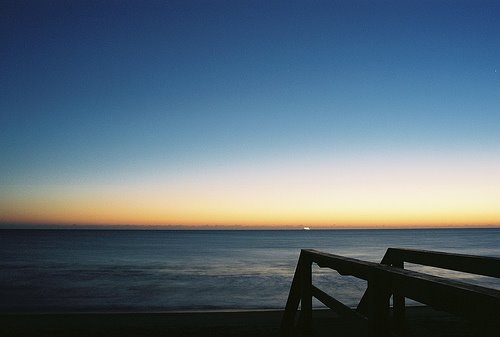
Better than sending you all postcards, don't you think?

My first international lesson

In a few minutes I'll be doing a lesson with one of my students back in Greece. He is taking the ALCE exam on the 24/25th June. We've been preparing for this since September, however as he had exams at his state school and I wanted to get back to England to see my folks, we stopped doing lessons for a couple of weeks. So, to help him get back into the rhythm of things as far as English is concerned, I'm going to do some interview practice via Skype. Unfortunately, because of practical issues (connection speed, etc) we'll have to do this on the phone.

Still, from small acorns .......

Wednesday, June 21, 2006

Thessaloniki


I was just browsing through Flickr when I came upon this page. If you want to see Thessaloniki at it's best look no further. These images are better, by far than those I've seen in guide books, magazines etc there.


Adding to your blog


Once your students have got the hang of the basics of blogging here are some really fun things to add to their own blog;

1 Video: If you sign up with YouTube you can post any of their clips directly onto your blog.

2 Photos: Although you can add photos easily enough in most blogs Flickr allows you to post directly from their site, if you sign up with them. FlagrantDisregard also has a lot of fun applications which allow you to play with photos and then post them either on Flickr or your blog.

3 Counters: There are a plethora of sites that will let you add a counter. My favourite is NeoCounter which counts the number of hits you get, lets you know when somebody is visiting and tells you which country they come from.

4 If you want to see exactly where your visitors come from try Geovisitors, which allows you to zoom in on their location using either their own maps or Google Earth.

5 Audio: If you want to add an mp3 file then go to Del.icio.us's Playtagger site. After you add their script to your blog's template you can link directly to any mp3 file on the net.

6 Skype: If you subscribe to Skype you can add a counter which allows people to call you directly from your blog. Click here.

All of these applications require to copy and paste some code into your blog's template. This may involves a bit of playing around to find out where they best go but you don't have to be a computer genius to get them to work.

If you know of any other good applications, please let me know.

Tuesday, June 20, 2006

I'm reading the World is Flat an I've been looking and listening to various podcasts and videos connected with technology and teaching. I get this tremendous sense that we are stumbling into brilliance, tripping over this new technology and landing not just on our feet, but into a some wonderland of infinite possibilities.

In a sense, I'm already annoyed about how the future will view this period, for them it will be yawn - worthy, hardly worth mentioning. Just as we take for granted clean water, electricity and mass communication.

The good news, however, is that we can use this grace period in a way that those before us couldn't. These developments don't depend on some power station far away or a transmitter beyond the horizon. It comes from the strokes on your keyboard. It will depend on what you decide to add to the net, not want some guy in your nation's capital or financial centre decided you thought you'd like.

Breaking out of the geek ghetto

While browsing Edublog's ....err blog I came across this link to the Guardian, which has an article on web 2.0 stuff and teaching in which some of the blogs he helped set up are mentioned. I tell you that boy's going places;

"Web's second phase puts users in control

The web's shift from a tool of reference to one of collaboration presents teachers with some rich opportunities for e-learning

Steve O'Hear
Tuesday June 20, 2006
The Guardian


Many believe the web has entered a second phase, where new services and software - collectively known as web 2.0 - are transforming the web from a predominantly "read only" medium to one where anyone can publish and share content and easily collaborate with others.

The "new" web is already having an impact in class, as teachers start exploring the potential of blogs, media-sharing services, and other social software, which, although not designed specifically for e-learning, can be used to empower students and create exciting new learning opportunities. These same tools allow teachers to share and discuss innovations more easily and, in turn, spread good practice."

(see here for the rest of the article)

Monday, June 19, 2006

EFL Course is go!!!


I've finished doing my EFL and Web 2.0 Wiki Space. I would appreciate any comments or improvements you have in mind and, most importantly feed back from anyone who has used the ideas in class.

Thanks in advance.

Videocard

Clifton Suspension Bridge

A small taste of home. I was here today, once again taking in the local sights.

BTW this isn't my work (wish it were), it belongs to Timelapseman on YouTube.

The English Daily Show

Show 71 Monday 12 June

THIS IS REALLY FUNNY. CHECK IT OUT. THE ENGLISH DAILY SHOW.
Show 77 Sunday 18 June

the Daily English Show